Showing posts with label Mickey Mouse and Friends. Show all posts

Sunday, December 2, 2012

Haven't We Seen These Tales Before?

Long-time readers of my reviews -- going back to the days when this blog was a bare-bones enterprise housed in the "Baratcave" -- may recall the warm praise that I gave to this wonderful, David Gerstein-edited collection of the Disney GOOD HOUSEKEEPING pages of the 30s and 40s.

I'm not sure how well the volume ended up selling, but Amazon says that it has only one copy left in stock, so I'll take that as a good sign.

If there were any justice, then MICKEY AND THE GANG would forever remain the definitive collection of the HOUSEKEEPING features.  An interloper appears to have arrived on the scene, however, judging by the most recent issue of PREVIEWS magazine. 


The publisher -- either Universe or Rizzoli (what, no Isles?), depending upon what source you're reading -- credits Walt Disney (!) as the "author" of this book, which will feature "50 of the funniest and most fascinating features" from the HOUSEKEEPING years.  Rizzoli is apparently connected in some manner with the Italian edition of the Gottfredson Library, so this probably isn't some fly-by-night project, but still... are these people aware that MICKEY AND THE GANG even exists?  And if so, then what's the point?

Sunday, December 26, 2010

Comics Review: MICKEY MOUSE AND FRIENDS #303 (December 2010, Boom! Kids)

Mickey's snazzy new wheels -- provided by the Mouseton Police Department, which, judging by the number of high-tech accouterments packed into the vehicle, must be doing double duty as an affiliate of Double Duck's "Agency" -- take The Mouse and his lady into something resembling an adventure in "Mickey Mouse and the Tools of the Trade." For what is basically a six- to eight-page plot from a Dell/Gold Key issue of MICKEY MOUSE stretched out, like the proverbial piece of discarded gum attached to one's shoe, to over 20 pages, this 2002 Italian story is surprisingly enjoyable. The antagonists (a pair of supermarket thieves who intend to use the proceeds of their petty theft to "escape to South America"? Uh huh...) are easily dismissed, allowing us to focus on the wonder-car's many attributes. Minnie kvetches in somewhat annoying fashion before getting caught up in the chase, and the two mice don't even get (or deserve) the lion's share of the credit for sacking the bad guys, but this story rises above the humdrum for two reasons: Saida Temafonte's good scripting (Temafonte has improved a great deal since those early installments of WIZARDS OF MICKEY, HERO SQUAD, and Double Duck) and Giorgio Di Vita's artwork, which preserves the liveliness of the best Italian artists without stepping "over the line" into rampant sloppiness. Not a deathless work by any means, but a nice time-passer while we gin ourselves up for 2011 and the return of "classic" Mouse material.

Saturday, December 4, 2010

Comics Review: MICKEY MOUSE AND FRIENDS #302 (November 2010, Boom! Studios)

Sergio Badino and Giorgio Cavazzano's "Legend of the Robo-Presidents" turns out to have been a more substantial epic than I'd thought. I was expecting another "half-and-half" deal here, with one story closing and another opening; instead, "Robo-Presidents" takes up all the space. In said space, we learn that The Phantom Blot has retrofitted the giant robot Presidents that inventor Borzon Gutglum had been commissioned to build to complement the newly-sculpted Mount Rushmore attraction (make sure to read that again, slowly) with the help of software designed by Gutglum's slightly wayward grandson. For all of The Blot's pleonastic, pompous pedantry (at least translator Saida Temafonte is consistent on this score; s/he used the same characterization for vastly different versions of The Blot in the ULTRAHEROES and WIZARDS OF MICKEY tales), the villain's plot is what he himself might call a "dreadfully banal" strike at the gold in Fort Knox. This comes, it should be noted, on the heels of The Blot's channeling of Hugo Drax in Casty's "Mickey Mouse and the Orbiting Nightmare." Honestly, if The Blot's new image as an intellectual is to be taken entirely seriously, then he really should be above ripping off schemes by James Bond villains, much less relying on the help of goons with names like "Billy Bob." The Blot, in the tradition of Pinky and the Brain, seems not to realize that the flying Robo-Presidents couldn't possibly get off the ground if they were truly "stuffed" with gold, but at least he has writer Badino to blame for that little oversight. Morty and Ferdie get a rare chance to fill the HD&L hero role, and, as you might guess, the "Nintenduck" obsession that they displayed in #301 winds up being a key to the good guys finally winning. An absurd story, to be sure, but oddly engaging, with Cavazzano's energetic art, as always, a point in its favor.

In the wake of The Blot's appearing without his black hood and cloak throughout the WIZARDS OF MICKEY sequence and in civvies in part two of "Mickey Mouse and the Orbiting Nightmare," his partially-unmasked status here is notable. Once he captures Mickey, Minnie, Morty, and Ferdie, he pulls off his hood and spends the rest of the story with his head showing above the cloak. I suppose that this is an "Italian thing," and, after mulling over the events of both this story and "Orbiting Nightmare," it's a "thing" that I actually do understand. The Blot can't pretend that absolutely no one knows what he looks like anymore (otherwise, why use a disguise to infiltrate Space Hotel Olympus in the first place?) and, while he can still rely on the "full effect" of his costume to produce some "fright value," there is no real reason why his face can't be regularly shown. This, of course, provides the writers with a challenge, to make The Blot's schemes really imaginative so as to compensate for the "loss of mystery." If The Blot's next caper involves "toppling" Mousetonian rockets or swallowing up Duckburgian space capsules, then he has every right to lodge a protest.

Sunday, October 31, 2010

Comics Review: MICKEY MOUSE AND FRIENDS #301 (October 2010, Boom! Kids*)

The conclusion of "300 Mickeys" -- the "Clone Saga" that should, by all rights, have been devoured in one gulp in MM&F #300 -- is served up "cold pizza" style in this issue. The "Mickey-Me's" created by Eega Beeva's "Pduplication Ray" do their expected slapstick "thang," including putting the real Mouse and Eega on trial for "[planning] to unmake us!". There's actually something of an edge to this silly business, in that Mickey and Eega realize that eliminating clones would be akin to murder (or, in Stefan Petrucha's slightly more decorous phrase, "taking lives"). Fortunately, Eega has access to all manner of convenient technological problem-solvers, and one of them saves the day, giving the multitude of Mickeys their own "space" while ridding Mouseton of a grave threat. Left unexplored is the question of how an entire planet of cocky, strong-willed Mice will manage to govern itself. Petrucha and Cesar Ferioli make the most of this one-joke idea, but I still shake my head at Boom!'s decision to serialize this tale.

The back side of the book is given over to the opening stanza of yet another serialized scenario, Sergio Badino and Giorgio Cavazzano's 2007 Italian story "Legend of the Robo-Presidents." We come to issue's end just as the vacationing Morty, Ferdie, Mickey, and Minnie have tumbled into the bowels of Mount Rushmore (think I'm kidding? One of Mickey's nephews wonders whether M&F have found "some President's small intestine") and discovered a clutch of mechanical gear. I sure as shootin' hope that we aren't headed for something as silly as that KIM POSSIBLE digest story set in Washington DC which climaxed with several national monuments coming to life and fighting. Given that M&F are depicted as video-game-obsessed, however, I fear that joystick manipulation of a "National Treasure" may be in our immediate future. BTW, you can tell that this story is a foreign import even if you aren't hep to the Italian drawing style; several panels are devoted to an explanation of who's depicted on the monument. Oddly enough, the "rock-star Presidents" are depicted in humanoid form. Considering that DuckTales showed duck-billed Presidents on Mount Rushmore in the episode "Ali Bubba's Cave," this comes as something of a surprise. Though Barks did depict a human "Senator Snoggin" monument in one of his 50s "ten-pagers," so perhaps the DuckTales "Mount Rushmore" ISN'T the Duck-and-Mouse-world equivalent of Mount Rushmore after all, but a duck-centric facsimile... uh, my head hurts.

* For some reason, the cover logo is that of Boom! Studios proper, as opposed to Boom! Kids. I don't know what to make of this; it may be an oversight, or something more.

Saturday, October 30, 2010

Boom! Primps its Paradigm


This week's issue of PREVIEWS magazine, soliciting comics orders for January 2011, may reflect at least a portion of Boom!'s promised "2.0" upgrade. The ballyhooed "great leap forward" may, in fact, end up being a pivot back to the past. The blurbs for WALT DISNEY'S COMICS AND STORIES #715 (why am I getting peckish for an Oh! Henry bar right about now?) and MICKEY MOUSE #304 (you read it right -- no ...AND FRIENDS) proclaim "Classics are back at BOOM!" The real news, of course, is that these classics are appearing in slick-paper format, rather than hardback collections. To celebrate the 70th anniversary of WDC&S' first appearance, WDC&S #715 will feature works by Carl Barks, Don Rosa, Gil Turner, and Daan Jippes, while MM #304 will feature "the first complete reprint" of Floyd Gottfredson and Bill Walsh's "The Pirate Ghost Ship" (aka "The Isle of Death") since 1944. Evidently, the reprints in WDC&S #78-80 (1947) and GLADSTONE COMIC ALBUM #17 (1989) didn't reproduce every jot and tittle of the original story. UNCLE $CROOGE #400, scheduled for release in February, will follow up on these issues with a double-sized special release.

Obviously, I'm pleased that Boom! is going in a more Gemstone-like direction, at least for the time being. but some things could be improved. The key to bringing back some of the "old sourdoughs" who may have abandoned the field in disgust will be to print material of the "classic" vein that Americans haven't seen before. Don't get me wrong, it'll be great to see "The Pirate Ghost Ship" again, but I'd rather see hitherto-unprinted William Van Horn stories and the like. I'm also bothered by the fact that Boom! can't seem to completely rid itself of the "multiple covers" obsession. WDC&S #715 will have two cover variations, one a parody of the cover to WDC&S #1 by Van Horn, the other a "character mash" by Jippes. That gambit went over like a "foil-embossed" balloon when MM&F #300 was released, and I'd really hate to limit myself to only one of these two fine pieces of art, but how else to send a message to Boom! that this collector-driven drivel must stop?

.

.

.

The October Boom! issues appear to be edging a bit closer to that Harvey Comics-style marketing approach that I suggested in an earlier post. We now have an "Upcoming from Boom! Kids" section on the letters page with small reproductions of the covers of the month's Disney and Pixar releases, plus a "spotlight" item (in this case, the collected DOUBLE DUCK Volume 3). Disney Comics did much the same thing in its heyday but accompanied its full-page spread of covers with a one- or two-column summary of what was actually in each issue. There are still a couple of pages of ad space to work with, so why not put them to even better use?

Monday, October 25, 2010

Is Boom! REALLY a Bust? No, But...


While I'm trying to find the time to catch up on my comics reading, I ran across this take on Boom!'s handling of the Disney comics line. I'm definitely in agreement with "The Hyperionites" on the issue of Boom!'s reliance on continuing story lines. Not that Boom! should abandon the notion entirely -- I'm fine with the serialization of Casty's stories in WDC&S and the treatment of the material in DARKWING DUCK in a manner more befitting a superhero -- but there's no point to running multi-part stories simply for the sake of running multi-part stories. For sure, MICKEY MOUSE AND FRIENDS #300 would have been a lot more special had Boom! run "300 Mickeys" in its entirety. Of course, the book would have been more expensive, but Boom! seems to have no problem raising the prices of individual issues for the flimsiest of reasons ("foil-embossing," anyone?). Asking readers to pay an additional $1 or $1.50 for a complete, "300-friendly" adventure wouldn't have cost too much in terms of circulation.

One reason for hope regarding the issue of "lack of sufficient content for the money" is that we are starting to see backup stories with a fair amount of regularity. The reduction of advertising pages is a welcome trend, as well. No longer do we see multiple pages bringing the latest MUPPETS-related releases to our attention. In fact, I think that Boom! would do well to imitate Harvey Comics (which "The Hyperionites" correctly finger as a very kid-friendly line) and put "coming issue" information for all of its Disney-Pixar releases on a special page, together with brief blurbs about what's in each issue. Even Star Comics did the readers that favor.

Boom! can certainly improve how it packages and markets its collections. The article's praise of Bongo Comics' trade paperbacks is interesting in that Bongo has done nothing but reprint SIMPSONS COMICS issue-by-issue -- just as Boom! was doing with its entire line at one point. And therein lies the difference: be judicious about what recently published material you collect. It's clear that Casty and DARKWING (plus, I imagine, RESCUE RANGERS when it becomes available) are Boom!'s strongest selling points at the moment, so, by all means, give those works a handsome paperback treatment -- but DON'T reprint every single story arc separately; try to package where appropriate. Also, Boom! should consider giving those willing to buy the paperbacks something extra -- perhaps a potted history of the Darkwing Duck TV series (which would also fit well as part of the collection of DARKWING stories from DISNEY ADVENTURES that Boom! will be letting loose in a couple of months) or a longer interview with Casty. As for the hardbacks, I'm already on record as favoring classic, Gemstone- and Gladstone-style material for those, should Boom! see fit to revive them.

Perhaps Boom! will address these and other issues during "Boom! Kids 2.0" next year. The mere fact that they're going through such an exercise suggests that they're ascending a "learning curve" of some sort. Only time will tell whether said "curve" leads to the plateau of Shangri-La or to a plummet off a cliff.

Monday, October 18, 2010

Comics Review: UNCLE $CROOGE #396 (Boom! Kids, October 2010)... plus just a tad extra

How strange... "Messes Become Successes," the follow-up to "Like a Hurricane" (Boom!'s catch-all title for the first four DuckTales-themed issues of UNCLE $CROOGE -- the better to package the unrelated stories in a trade paperback) was supposed to begin here, but you wouldn't know it from looking at the title page, which simply lists the titles of the two featured stories. It couldn't be that Boom! realized in the nick of time that not enough people would catch the reference to the rarely-heard second verse of the DT theme song! Could it? Or perhaps Launchpad obliterated the relevant copy when he crashed into the wall in James Silvani's amusing cover. (Was it really only nine years ago that TaleSpin was pulled off the air in the immediate aftermath of 9/11? And now we see this scene on a Disney comics cover, and no one probably batted an eye.)

Picking up where the ambitious, and generally successful, "The Eye of Flabberge" left off, #396 gives us a decent-to-good pair of Launchpad-focused stories, both of which were produced for Egmont in the early 1990s. Happily, given how late in the Egmont/DT production game they were created, "Lovelorn Launchpad" and "Double Indemnity" show plenty of enthusiasm, due in part to artist Millet's expressive artwork. It also doesn't hurt to have old reliables David Gerstein and Jonathan Gray back on dialogue duty -- though, if they were in fact responsible for "Lovelorn Launchpad" as well as "Double Indemnity," then they have a major temporal gaffe to answer for. Scrooge loaning the crash-prone Launchpad surplus warplanes for a "tax write-off" is a clever idea... but surplus Boer War planes (sic) that look like they were rejects from Rosie the Riveter's production line?! I could sooner believe that Snoopy's doghouse actually IS a Sopwith Camel.

"Lovelorn Launchpad" finds LP head over brown-booted webbed heels in love with comely pilot Bedelia Airheart... so much so that he tracks her to the forbidding Hamalaya Mountains, where she's disappeared while trying to set a speed record. It should be noted that LP's attitude towards women was anything but a settled issue in the TV series: he chortled "Usually it's the girls chasin' me!" in "The Lost Crown of Genghis Khan," fell hard for the exotic seer Sen-Sen in "The Duck Who Would Be King," and desperately welcomed possession of the Gizmosuit in "A Case of Mistaken Secret Identity" because "At last I'm gettin' the girls!"... and all of them, somehow, seemed in character. Here, too, the inept earnestness of LP's efforts to "save" the inconvenienced, but otherwise unimperiled, Bedelia (who ends up saving LP instead) flows naturally from the pilot's eternal willingness to laugh at danger and his equally persistent fallibility. I could have done without the walk-on by a particularly silly version of (I guess) the Abominable Snow...uh...woman -- suffice it to say that the Barksian version of the character seen in "Lost Crown" has little to worry about, even when it comes to impressing males -- but this is a cute story that succeeds in its modest goals.

"Double Indemnity," originally written by Bob "The Gold Odyssey" Langhans, is a little more ambitious than "Lovelorn Launchpad," if only because Magica De Spell is involved, but its logical holes make it hard to take too seriously. Magica's creation of a Launchpad clone who will waylay Scrooge during a trip to Faroffistan and steal the Old #1 Dime would have made for a great TV episode, but the mechanics of said cloning are Rube Goldberg-esque in their lack of plausibility. Why would placing a lock of LP's hair in the clone's pocket "activate" the simulated simpleton? Wouldn't the genetic info in the hair have to literally be part of the clone? Among other things, this gives Scrooge, HD&L, and Launchpad a convenient way of stopping the simulacrum without rendering it a pulpy mess, and the dubious deus ex machina is duly delivered by LP (who'd earlier been transformed by Magica into a simply hilarious "McQuack-friendly version" of a pigeon, complete with red topknot and brown booties). Gerstein and Gray do a wonderful job of characterizing the fake LP, making him gum up his catchphrases and such. Evidently, the "Nega-LP" (actually, given his inadvertent gaffes, he's more of a Launchpad McNothing, a la the Fred and Barney clones created by The Great Gazoo) should have slowed down when he speed-read the wall chart with Launchpad's characteristics on it. The story's ending is a jumble of chaotic action that simply cried out for a televisualization of same, but I'm not complaining; too many DT comic-book stories have simply gone through the motions without trying to capture the sheer energy that made the show so enjoyable. This issue is much more like what I had hoped UNCLE $CROOGE would be when it switched to DT mode. At least we're somewhere close to that point now.

.

.

.

Boom! Kids has released a "teaser" promising something called "Boom! Kids 2.0" for 2011. It's hard to know exactly what that means in terms of new material; RESCUE RANGERS debuts at the end of the year, but that isn't even a Boom! Kids comic, technically speaking (nor is DARKWING DUCK). Things are definitely looking up for the "old sourdoughs," however, at least in the short run. According to August Paul Yang, who attended a Boom! panel at the recent New York Comic Con and wrote up a report on the Disney Comics Mailing List, Boom! Kids will be feting the 70th anniversary of WALT DISNEY'S COMICS AND STORIES with some special issues featuring (to borrow a phrase from the post-"Implosion" version of Disney Comics) "The American Masters." This seems a lot more promising at first blush than the inappropriate, coitus interruptus-inflected manner in which MICKEY MOUSE AND FRIENDS #300 handled the "300 Mickeys" story. Now, only let Boom! bring back some version of the hardback "Classics" collections to mate with Fantagraphics' launching of the Floyd Gottfredson library, and I'll accept the "upgrade" most cheerfully.

Friday, September 24, 2010

Comics Review: MICKEY MOUSE AND FRIENDS #300 (September 2010, Boom! Kids)


OK, let's get the obligatory gag out of the way up front...

MICKEY, IN A SCREAMING FALSETTO: THIS... IS... MOUSETON!!
(Well, it officially has been since 1990, at least.)

But seriously... I'd like to toss the geniuses responsible for the $6.99 "Deluxe Edition" of this milestone issue into the nearest available "pit of doom." For your three extra bucks, you get (1) a Daan Jippes cover that I have a sneaking feeling I saw sometime back during the "Gladstone I" era and (2) a "foil-embossed" MICKEY MOUSE logo. Nothing so declasse, in other words, as, well, actually printing the lead story (Stefan Petrucha and Cesar Ferioli's "300 Mickeys") complete in an extra-sized issue. Just when it seemed as though Boom! were weaning itself off this multiple-cover routine, they squander a unique opportunity to do a "mega-issue" in favor of this cheesy gambit! The two "historical background" pages (including contributions from Casty, Jippes, and David Gerstein) don't really begin to make up for this, though they do add to the nostalgic feel associated with reading a "shoulda-coulda" Gemstone-issue-in-all-but-name.

"300 Mickeys" bears all the earmarks of a story that was originally slated to appear in Gemstone's MICKEY MOUSE ADVENTURES digest. Mickey uses Eega Beeva's "Pduplication Ray" to clone himself and keep simultaneous dates with Minnie (for dinner) and Goofy (at the arcade). Unfortunately, clones of "Mickey Nothing" unexpectedly continue to pop into existence even as Eega (who's suddenly got the "p"s back in his speech patterns -- this, plus the neat, MMA-style lettering, is a dead giveaway that this story was prepared a while back) returns to retrieve the gizmo. Adding to the inevitable chaos is the inconvenient fact that the clones, much like VHS tapes, "lose integrity" (in this case, become less intelligent) with every duplication. In the grand tradition of Pinky and the Brain's "Paper World," the increasingly mindless clones are soon fixing to set up shop for themselves on a newly-created island in the Tulebug River. Petrucha and Ferioli do their usual high-quality work, and the whiff of the Gemstone era is frankly quite refreshing after all those Italian WIZARDS OF MICKEY stories. Why Boom! didn't see fit to fit the entire story into issue #300 -- especially when the "300" conceit is part of the story's title -- is a complete mystery to me.

As he should, Floyd Gottfredson gets a nod at the back of the book with eight pages' worth of the quasi-continuity "Tanglefoot Pulls His Weight," essentially a string of gags in which Mickey tries to convert his knobbly-kneed horse into a "working animal," with decidedly mixed results. Now that MM&F has been re-established, I'd really like to see a "Gemstone-lite" issue like this now and again in between all the Italian imports. But, please, can we keep in mind that the drive to serialize may not always be appropriate?

Friday, September 3, 2010

Comics Review: WIZARDS OF MICKEY #8 (August 2010, Boom! Kids)

The plot didn't tie up all of the loose ends -- and the grand and glorious opportunity for all the members of Wizards of Mickey to show their mettle in a "climactic battle" against The Phantom Blot pretty much devolved into the "Mickey Mouse Magic Show" before all spells were said and cast -- but the last issue of WOM amounted to a fairly decent payoff. Nereus does, in fact, turn up to lend Mickey et al. a hand; in fact, we find that he had actually magically come back with The Blot from that distant dimension, which makes all those communications with Mickey a little more logical, if only slightly. Goofy gets to use his "Iron Dragon" to dispatch The Blot's fire-breathing ally, but Donald's contribution to the festivities is limited to casting a delayed-reaction spell on Mickey's staff that Mickey cleverly employs against The Blot at just the right time, and "Pluto the Were-dog" has no role at all. Pete and The Beagle Brothers, meanwhile, are apparently still caught up in the twister whipped up by the peeved Turbo at the end of issue #7, the misleading cover displayed above notwithstanding. (To slightly paraphrase Greg Weagle, the last thing this story needed was more windbags!) Mickey winds up the Supreme Sorcerer and possessor of the Great Crown, which, considering that many more WOM stories exist, seems almost too good to be true; when you're on top, isn't the only place you can go straight down -- and wouldn't Mickey have to lose the Crown at some point in order for future stories to have any meaning or tension? The phrase "So ends the first chapter in the saga [of WOM]" strongly suggests that we may find out at some future time. I'll certainly more than welcome additional WOM stories as part of the regular "budget" of tales in the newly revived MICKEY MOUSE AND FRIENDS. A revival of the WOM title itself, however, seems unlikely.

Friday, July 16, 2010

Comics Review: WALT DISNEY'S COMICS AND STORIES #708 (June 2010, Boom! Kids)... plus a little extra


Just when it looked as if Casty really was going to go the "been there, done that" route and serve us up a warmed-over goulash of equal parts Floyd Gottfredson's "Land of Long Ago" and the TaleSpin episode "Paradise Lost," part two of "Mickey Mouse on Quandomai Island" took a turn for the decidedly weird during its final panels, leaving the reader legitimately baffled as to what might happen next. It's clear as crystal, at least, that the preening Duke Hight of Conceet is a nogoodnik to the core, planning to turn the dinosaur-choked isle into "a game reserve for the ridiculously rich!" His alliance with Pete to that effect is one of the great "opposites attract" moments of recent Disney comics history. Duke Hight must have been fooling himself, though, to think that his speedy "heel-turn" wouldn't affect his play for Minnie, who slips quite naturally into hectoring Captain Planet mode when she learns what Hight is up to. The X-factor of the chapter is the stammering, white-haired scientist Baquater, who decided to stay behind with his beloved dinos when his colleagues decided to leave... or so he says. There's strong reason to believe that something much more sinister has happened to the researchers and that the timid, germophobic Baquater is in on the plot. Mickey has had surprisingly little to do in this adventure thus far, but that seems to be about to change. David Gerstein, Jonathan Gray, and Francisco Sperafico continue to do an excellent job of translation to complement the most exciting "hitherto unknown" talent that Boom! has uncovered to date.

Chapter two of "Minnie Runs Out of Time" offers little more than Minnie discovering the dramatic effects that her chronology-chilling coffee maker has had on the suddenly-still citizens of Mouseton. "I heard something like this happened in Duckburg once," she muses, which is true only if you count Don Rosa's "On Stolen Time" as canon but DON'T count DuckTales' "Time Teasers". Since "Time Teasers" got to the idea first, I'd prefer that the reasoning go in the opposite direction, if you don't mind too much. Minnie takes advantage of the situation to essay a few fairly limp "let's adjust things while time is stopped" sight gags, but then sees something that scares her silly. I'm guessing it isn't Keno Don or Anthony Adams (the author of "Time Teasers") demanding royalties (to say nothing of whoever wrote those Mr. Pem episodes of Voyage to the Bottom of the Sea). This fragile story is still miles better than "Peg-Leg Pete and the Alien Band"...

.

.

.

... and, just when you thought it was safe to put memories of that "nonstory" behind you, the just-released paperback edition of Casty's "Mickey Mouse and the World to Come" saw fit to reprint the whole thing as a backup to the main feature! Not only that, but we get a far-too-lengthy series of "previews" of other Boom! collections, as well. Personally, I'd have stuck with the five summary pages of "Graphic Novels Available Now" at the very end of the book and let it go at that. A "leaner and livelier" paperback collection of "World to Come," including only the Casty story and perhaps an extended version of Boom!'s interview with the creator, could probably have sold for a few dollars less and coaxed a few additional people who hadn't read the original story to open their wallets. Suddenly, I begin to understand why Boom! had so much trouble pushing these "collections of stuff we recently sold in another format" and finally had to cancel them.
.

.

.

On a more positive note -- surely, the most positive tocsin that Boom! has sounded for quite some time in a business-related sense -- DARKWING DUCK #1 sold more copies in comic-book stores than any other Boom! release since the line's first issues of WALT DISNEY'S COMICS AND STORIES and MICKEY MOUSE AND FRIENDS. (The first DuckTales-themed issue of UNCLE $CROOGE didn't do nearly as well, but, then, its iffy quality didn't merit higher sales than the ones it actually got.) Boom! appears to have itself a "keeper" in the DARKWING book, and I applaud its decision to keep the title going after the current mini-series is completed.

Wednesday, June 30, 2010

An Update on Boom! Sales

Here's an updated graph detailing Boom! sales to comic-book and specialty shops as of May 2010. (Thanks to Kneon for the updated information.)
Sales for MICKEY MOUSE AND FRIENDS/WIZARDS OF MICKEY aren't included because there was only one additional data point available. WOM #2 sold 3704 copies -- a 27% decline from the first issue -- and the remaining issues covered during this period, WOM #3 and WOM #4, didn't make Diamond's list of the Top 300 sellers. At least WOM fared better than HERO SQUAD, which fell out of the Top 300 after issue #1. The DONALD DUCK AND FRIENDS graph is missing a data point for month 6 (issue #352) for the same reason. What would worry me if I were Boom! is that DD&F #352 was the final issue of the first Double Duck story arc, the one which Red Primerose's identity was revealed. By contrast, the final chapter of Casty's "Mickey Mouse and the World to Come" (WDC&S #706) produced a modest, but welcome, uptick in sales. With the declines of UNCLE $CROOGE and DD&F having flattened out at the same time, perhaps we have reached the proverbial "bottom of the ski slope."

The most recent PREVIEWS solicited orders for books slated to be released in September... and HERO SQUAD and WIZARDS OF MICKEY are conspicuous by their absence. Instead, MICKEY MOUSE AND FRIENDS will return for a gala issue #300. There's lots of WIZARDS OF MICKEY material still out there; ULTRAHEROES, not so much. What will Boom! do when/if it decides to revisit these concepts? I wouldn't mind HERO SQUAD being a "filler" in some other book at some point, but there doesn't appear to be enough remaining material to justify restarting the title. Also, wouldn't a return to "classic" practice in MM&F be stepping on the over-sized Mouse shoes of the Casty material currently running in WDC&S?

With the apparent shelving of the "New Direction" titles for the nonce and the concurrent commitment to DuckTales material in UNCLE $CROOGE and an ongoing DARKWING DUCK title, Boom! might be said to have redefined its target audience. With HERO SQUAD and WIZARDS OF MICKEY, Boom! aimed for the "kid" audience brought up on a diet of superhero movies and HARRY POTTER novels. The current Disney Afternoon gambit seems to be attempting to reach those young adults (and, of course, a couple of us young-at-heart older ones) whose first sustained, consistent exposure to "Disney product" came through watching the "Golden Age" TV series. Judging by the early reports on the brisk sales of DARKWING DUCK #1, this may not have been a bad strategy. Aside from the "goosing effect" that nostalgia has had on sales, the older readers of the TV-based comics might encourage their own children to become interested in the old series. Were the various divisions of Disney not so rigidly segregated, I might even dare to hope that this might lead Disney DVD to rethink its decision to abort its releases of the "Golden Age" DVD collections.

Friday, May 28, 2010

Comics Reviews: DISNEY'S HERO SQUAD #5 and WIZARDS OF MICKEY #5 (Boom! Kids, May 2010)

There's no longer any serious doubt in my mind that HERO SQUAD has fallen WELL behind fellow "Disney departure" titles WIZARDS OF MICKEY and DONALD DUCK AND FRIENDS on the old "like-o-meter." This week's issue of HS falls dangerously close to "worthy-of-MSTing" territory, while WIZARDS, despite serious inconsistencies in artistic quality and the creakiness inherent in its "from-one-venue-to-another" structure, has stabilized into a reliably satisfactory reading experience.


For a "significant" issue that finally allows us to see the effects of the assembled Ultramachine and reveals the identity of the "genius" responsible for inventing such a dangerous device in the first place, HERO SQUAD #5 is distressingly poor, especially in the realm of simple logic. Exactly HOW, may I ask, did Mickey, who was very clearly left behind when the Ultraheroes returned to Duckburg from The Sinister 7's island, manage to join them by the time they arrived to face off against The 7 at Villa Rose? (At least Scrooge, The Money Bin, and The Beagle Boys get a proper "blastoff notice" from the isle as a sidebar to the main action.) Gladstone/Cloverleaf's traitorous actions in HS #4 still haven't been explained, but neither has his apparent decision to break off from BOTH groups and "wait for the right moment to show everybody I'm the best of them all!". Given that Iron Gus accidentally captures all of The 7 save the renegade Emil Eagle by sheer, dumb good fortune (and isn't good luck Cloverleaf's shtick, anyway?), Clove is already halfway there without even trying. The powers of Eega Beeva's "Green Ultra-Suit" consist of the rapid quasi-magical deployment of... prehistoric animals, including a "Pleistocene flea" (sic) that can "disable all technological devices" (not even sic-worthy). Of course Eega is capable of time travel, so one can see him dipping liberally into the distant past, but why use only beasts from that period, rather than mixing in some uber-tech so as to keep foes (especially futuristic ones) honest? Eega's approach might be dismissed as an odd quirk of a character liberally festooned with same, but then we learn that Eega himself was responsible for building the Ultramachine... and that, when activated (by a desperate Emil, in this case), the device zaps Eega into "giant zombie" mode. That's the kind of super-weapon I want to create -- a machine the activation of which renders me completely incapable of controlling myself. No other issue of this title has pointed up so clearly the disadvantages of the "forced-serial" format. No doubt future chapters will provide us with some sort of explanation for Cloverleaf's behavior and Eega's frankly senseless tech, but cutting the story off before we get there leaves the reader completely baffled. The novelty of seeing Disney characters as superheroes has worn off; now it's time to get semi-serious and start putting the pieces of this increasingly schizophrenic narrative together.

In contrast to HS #5, WIZARDS OF MICKEY #5 features a refreshing number of "shout-outs" to earlier stages of the ongoing episodic continuity. Pluto, unseen since MICKEY MOUSE AND FRIENDS #296, finally joins (or, in the case of master Mickey, rejoins) "Our Gandalfian Gang," newly "pawed" with the power of lycanthropy. I'm not entirely comfortable with the explanation as to how Pluto gained this "talent" (nor was I aware that werewolves magically grew spiked helmets upon transformation), but at least Mickey appears to have the ability to control it (even during a full moon!), so it will probably come in handy as we proceed. Pluto helps Wizards of Mickey uncover the "monster scam" being run by Pete and The Beagle Brothers before we head off to a nice breather -- a party amongst the contestants in the sorcery tournament. We see some familiar folks here, including "Team Diamond Moon," "Team Jinx", and even the trio of soup-brewing sorcerers who originally told Mickey about the tournament back in #296. Though the ever-changing artwork makes it harder than it should to recognize some of these old faces, it's nice to see writer Stefano Ambrosio maintaining a throughline of characters, as well as theme. Sadly for WOM, Pete and The Beagles, newly sprung from gaol, also return, under the direct orders of this issue's most noteworthy returnee: The Phantom Blot. I'd still like to know how The Blot avoided Nereus' fate, but at least he's back, above-board, and undisguised, so another showdown with WOM will no doubt soon be upon us. Add the priceless revelation that Goofy -- after having previously considered a number of different occupations in lieu of sorcerer-dom -- now thinks that his true calling may be as a statistician, and how could I not enjoy this issue? (Technically, Goofy's actually a probabilist, since he talks about the chances of Pete and The Beagles escaping from prison. Let him perform a few hypothesis tests and/or sample surveys, and then I'll be completely convinced.)

Wednesday, April 14, 2010

Boom! Sales: The First Six Months (more or less)

Since a statistical graph is always worth three thousand words... plus or minus a margin of error of 500 or so... I've created a line graph to illustrate Kneon Transitt's data log on the number of Boom! "Duck and Mouse" titles that Diamond has sold to comic-book shops. Here, "Boom! Issue Number" refers to the first, second, etc. issues of each title released under Boom!'s auspices. The abbreviations in the legend should be obvious. (Sorry I didn't include HERO SQUAD, but Kneon had only one data point for that title. For the record, HERO SQUAD #1 sold 4557 copies.)

The one spike in the MICKEY MOUSE AND FRIENDS graph indicates the switchover from MM&F to WIZARDS OF MICKEY. WOM #2 sold about 1300 copies less than WOM #1, which might be due to the "collector's item" reflex but is still bothersome, given that MM&F and WOM have been telling a continuing story.

Kneon includes links to some information on Gemstone sales as well. Boom! appears to be holding its own reasonably well relative to Gemstone's later sales figures, but the downward trend is nonetheless worrisome. I'm especially disappointed in the figures that Kneon reported for the hardback and softcover collections. The first volume of LIFE AND TIMES OF SCROOGE McDUCK barely cleared the 1000-copy mark, and it's the only collection to have done so to date. WALT DISNEY'S VALENTINE'S CLASSICS scored a paltry 383 copies, a real shame given the high quality of that collection. MICKEY MOUSE CLASSICS did better (785), but only slightly better than CHRISTMAS CLASSICS. Hopefully, bookstore sales will help pump up these figures a bit, especially on the collections that merely reprint material that has already appeared in the monthly titles.

Monday, February 8, 2010

Comics Reviews: DISNEY'S HERO SQUAD #1 and WIZARDS OF MICKEY #1 (Boom! Kids, January 2010)

Last week's Boom! releases marked a watershed in American Disney comics history. The company's decision to shift the ongoing Ultraheroes and Wizards of Mickey story lines into their own eponymous titles may not appear to dramatically tempt fate, but it definitely represents a gamble. "Themed" books with familiar Disney characters assuming unusual roles have long done well in Europe, but never have they replaced traditional titles in the manner that WIZARDS OF MICKEY has now supplanted MICKEY MOUSE AND FRIENDS in America. Should these new books outsell MM&F and WALT DISNEY'S COMICS AND STORIES, will Boom! shift en masse to a "themed" approach, revamping even the "classic" titles and limiting "classic" material to its pricey hardback collections? That would be a "sea change" surging beyond even Disney Comics' introduction of TV-based titles and ROGER RABBIT releases in the early 90s.

In its opening 14 pages, HERO SQUAD #1 bravely faces the "New World" -- and quails ever so slightly. Though described as a "super-slugfest," the latest chapter in the "Ultramachine" saga features hardly any violence at all, super or otherwise. Indeed, "Iron" Gus Goose foils the attempt of John D. Rockerduck (aka "Roller Dollar") to locate Ultrapod-6 by doing nothing more than falling asleep and discombobulating Rockerduck's "cyborg-miners" with his snoring! Fethry "The Red Bat" shows a little more initiative, scandalizing the Pod-5-seeking Phantom Blot by tromping on The Blot's obsidian instep after all manner of "Bat-repellers" have failed to foil the villain. (I thought The Blot's most recent appearance had established that his body is liquid in nature? Fethry's folly is nicely reminiscent of a Warner Bros. or Darkwing Duck gag, regardless.) Elsewhere, The Beagle Boys again screw up Scrooge's attempt to escape The Sinister 7's clutches, while Donald and Daisy, still clueless to one another's crushingly obvious secret identities, meet in Duckburg and bicker in approved Duck Avenger/Super Daisy style. Really, that's all there is to this "collector's issue" insofar as Ultraheroes material goes. Even the artwork, by Roberta Migheli, falls well below the series' genially disheveled, eminently surmountable standard. Boom! probably could have picked a better moment at which to launch HERO SQUAD than this.

The ish's big surprise comes after the Ultraheroes segment, when the "powers-that-edit" abruptly decide to provide some much-needed historical perspective and announce a new subfeature detailing "the secret beginnings of your favorite Ultraheroes!". Better late than never! Taking the first bow is Super Goof in Bob Ogle and Paul Murry's "The Thief of Zanzipar", from SUPER GOOF #1 (1965). Actually, SG had made a couple of appearances before this "origin tale," but this story firmly establishes the Super Goobers as the one true source of Goofy's powers and gives SG his first "official" adventure. The amusing script and first-class Murry artwork are pleasant reminders of Gold Key's golden years. Two problems "grody" up the Goobers, however. First, we only get the first nine of the story's 16 pages, meaning that we'll have to wait an extra issue before another Ultrahero gets his or her chance to shine. Second, Goofy's face is, I kid you not, a light purple in color!  I suppose that's better than Goofy the Genie's entire body being colored blue for the WDC&S #584 reprint of the 1960s story "A Lad 'n His Lamp," but it still looks really, really peculiar, especially since no other character in the story gets a mauve makeover. Colorist Eric Cobain needs to look into this before worried fans begin to write in offering to perform the Heimlich Maneuver on Goofy.


If HERO SQUAD stumbles a bit out of the gate, then WIZARDS OF MICKEY -- once you get past the well-designed logo -- tromps on the reader's face and laughs in the process. Well, at least for a brief moment. The narrative quickly wraps up the "Team Diamond Moon" subplot in fairly slick fashion, giving "Princess Minnie" a back story and permitting Mickey a moment of true nobility to boot, but then hoots with derision in the faces of those who've complained of Boom!'s awkward handling of splits in its chapter arcs: "Stay tuned for the next episode... See you here soon! Like now! No, seriously, turn the page!" Then follows the title page of the next chapter, "The Dragon's Nest." The only good thing about this remarkably inartful editorial decision is that it doesn't involve any misspellings. "The Dragon's Nest" itself is fine, with "Wizards of Mickey" outpointing a team of... erm, they kinda look like Muppets, I guess... for a "light diamagic" and forging ahead to isolated Crow Fortress to fight for the "sleep diamagic" (though Goofy's lullabies may work just as effectively, at least on animals). The "Lord of Deception," meanwhile, thinks that he may finally have a lead on the location of the Dragons' Kingdom, thanks to the imprisoned Nereus' unwitting assistance. I must admit to being surprised by the speed with which "Team Diamond Moon" was discarded -- I had expected them to become steady allies of "WOM," at the very least -- but perhaps Minnie, Daisy, and Clarabelle will reappear in later chapters. Frustratingly, the inside front cover of the book boasts what appears to be a map of the setting for these sorcery stories, but it's too small and faint to read. Why not create a fold-out version as a keepsake of this first issue? That would have been a great way to attract attention from the casual rack-browser. Leaving aside the painful editorial leg-pulling, WIZARDS OF MICKEY continues to rival the "Double Duck" arc in DONALD DUCK AND FRIENDS as the best of Boom!'s "New Direction" material.

Tuesday, January 12, 2010

Comics Review: MICKEY MOUSE AND FRIENDS #299 (Boom! Kids, December 2009)

The blurb-writer at Boom! needs assistance, stat! Here's the innocent-on-the-surface plot summary for this issue, per Comic Book Resources:

Student of the great wizard Grandalf, Mickey Mouse, along with friends Donald Duck and Goofy, must face off against the Phantom Blot and his nefarious Team Black Phantom!

The same aggressively genetic blurb was used for MM&F #298, but, since "Wizards of Mickey" is a continuing story with a single general theme, no big deal, right? Er, not so much...


(1) The Phantom Blot, aka "The Lord of Deception," does appear here for a two-page rant of little consequence, but Peg-Leg Pete and the Beagle Brothers are nowhere to be found; "Wizards of Mickey"'s only thaumaturgical tiff in this relatively uneventful issue is with "Team Tapestry" and its "knitted warrior" come to life.

(2) Another team on the side of the magical "angels" makes its debut here: "Team Diamond Moon," consisting of our old friends Minnie, Daisy, and Clarabelle. (No, they don't dress in schoolgirl pinafores, though Minnie, somewhat to my dismay, sports the unbecoming "lipstick look" that various comic-book artists gave Mickey's girlfriend in the 50s and 60s.) The distaff diviners claim a victory of their own in the ongoing sorcerers' tournament, do the character-interaction "thang" with the boys, and then conveniently vanish from the scene during the battle with "Team Tapestry." They'll no doubt appear again soon enough, given that Donald is enamored with Daisy (even to the point of enlisting Goofy's help in an attempt to serenade her) and Minnie, the self-described "Princess of Moonland" (hm, maybe she and Usagi Tsukino have more in common than I thought!), appears to be something of a "big cheese" in this still-rather-nebulously-defined "universe."

(3) Who is this "Grandalf" they blurb of? Mickey's master Nereus is still imprisoned by "The Lord of Deception" but finds time to perform another "information dump" on Mickey through the medium of a magical medallion. Apparently, The Blot's minions all wear medallions bearing the letter M. Unless M stands for "Magic" -- which seems rather silly in this world, given the pervasive use of sorcery -- this ranks as the most mystifying use of that initial since the English translation of Go Mifune's name was not accompanied by a similar updating of his clothes.


Hopefully, Boom!'s PR people will catch up with the actual story in time for the next issue. Lest you think that I'm dissing #299, it's actually not that bad, despite the relative lack of forward plot movement. I even got an extra laugh out of Clarabelle's magical shtick of divining fortunes; it reminded me in a weird way of her House of Mouse role as "cast gossip." Needless to say, the shtick does come with something of a catch...

Friday, January 1, 2010

Comics Review: STAR COMICS ALL-STAR COLLECTION, Volume 1 (Marvel Comics, 2009)

My "Silver Age of Comics Collecting" (not to be confused with the "Golden Age" of 1975-1982, during which I concentrated solely on RICHIE RICH) began in a peculiar way that sort of typifies my decidedly atypical comics-collecting experience. Here's how I described it in a piece I wrote for THE HARVEYVILLE FUN TIMES! (issue #41):

In the Spring of 1985, in a last, defiant gasp of my overweening interest in "classic" Harvey comics, I buy a small number of Marvel's late and decidedly unlamented Star Comics when they start appearing on the sparsely populated magazine racks of a small food store located down the street from the Brown [University] Graduate Center. In this year of CRISIS ON INFINITE EARTHS, I derive considerable pleasure from the likes of TOP DOG, PLANET TERRY, and EWOKS. Don't get me wrong -- even I can see that the Star offerings are, by and large, pale imitations of Harvey comics (especially the notorious ROYAL ROY, which pisses me off... uh, royally). What excites me the most is the presence of creator credits. At long last, I have incontestable proof that the artist who I always thought was Warren Kremer was, in reality, Warren Kremer! I'm so happy to be proved right that I compose a personal letter to Mr. Kremer on my manual typewriter (yep, this WAS a while ago...) and send it to the Marvel offices.

If it sounds like I'm setting up the duckpins for a revisionist bowl-a-rama, you're correct... up to a point. Marvel's recent out-of-nowhere release of the first of a planned series of volumes reprinting the (short-lived) exploits of Star Comics' original creations was a pleasant surprise, given the generally low esteem in which these comics are held. I couldn't help but snap the book up, and I'm delighted to say that these works hold up much better than I'd recalled -- with one big, gold-plated, starts-with-Rs exception. It's no Dark Horse LITTLE LULU line, for sure, but you could certainly do worse than purchase this collection with an eye towards getting a young child interested in comics. If you really want to go "above and beyond," you might also get a couple of the Dark Horse HARVEY COMICS CLASSICS volumes and do a direct "compare-and-contrast," so as to fully understand the tangled Star-Harvey relationship.


Star Comics came into existence because the notoriously deal-happy Harvey family couldn't make a deal. The original Harvey Comics line, unable to cope with the "brave new world" of the direct-market distribution system, ceased publication in 1982. Over the next several years, Marvel, seeing an opening in the kids' comics market -- an opening that would become a gaping maw once Western Publishing finally gave up the ghost in '84 -- dickered with Harvey over the rights to print Harvey comics. When the two parties couldn't come to terms, Marvel hired away some of Harvey's idled personnel and set up shop for itself, giving the line a new title in order to establish a cordon sanitaire between the newbies and the superhero-dominated Marvel Universe. Featuring a mixture of licensed properties and original creations, Star sputtered along for a couple of years before the new line was jettisoned and the few ongoing titles (ALF and BARBIE, most notably) were gathered under the Marvel banner. While no original title lasted longer than TOP DOG's 14 issues, it is these titles that have come to symbolize what minimal profile Star has retained among comics fans -- and it is these titles that are at the center of the controversy over whether Star really was just a bald-faced Harvey knockoff.
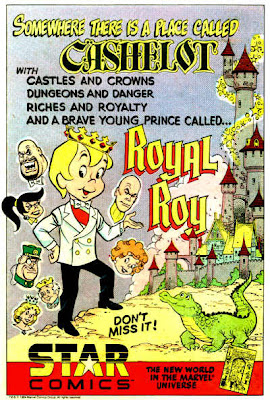

ROYAL ROY is the one title reprinted in this collection that truly deserves all the scorn heaped upon it. Roy was a Richie Rich ripoff -- nothing more, nothing less -- and the cast of supporting characters have direct parallels to Richie's cast in a manner not seen again in popular culture until The Lion King's "borrowings" from Kimba the White Lion. Reportedly, young prince Roy's facial features had to be changed at the last minute to make the resemblance to Richie less grindingly obvious. The change in setting from Richville to the kingdom of Cashalot didn't fool anyone -- in fact, the decision to make Cashalot a rich kingdom seemed calculated to twist a painful knuckle into RICHIE fans' spines -- and, I would argue, gave what was already an idea doomed to failure even less of a chance to succeed. For all of his immense wealth, Richie remained, at heart, a fairly typical American kid who could "connect" with readers in a manner that the regal Roy never could, not even when he took a "commoner" girl friend, Crystal Clear (read: Gloria Glad), in ROYAL ROY #2. The cynicism of the whole enterprise almost beggars (heh) belief. Marvel's decision to cancel the title after six issues (in, I might add, the face of the Harvey family's most justified lawsuit ever) didn't remove the bad taste from people's mouths. Indeed, the whole affair wound up curdling Star's overarching reputation for good. More's the pity, as the other, legitimately original Star creations ranged from good to excellent.


While less ambitious than PLANET TERRY (the first "children's comic" of my acquaintance to essay a continuing story line) and less artfully produced than WALLY THE WIZARD (to my mind, the real revelation of this collection), Top Dog was at the beginning, and probably always will be, my favorite Star character. The concept is simple enough -- "typical kid" Joey Jordan meets and adopts (in a manner of speaking) an opinionated talking dog who's something of a "Renaissance mutt" -- but the execution is charming. Kremer, inked by Harvey associate Jacqueline Roettcher in a manner that will be instantly familiar to anyone who's read Kremer's work on RICHIE RICH AND CASPER in the 1970s, makes TD, Joey, and the supporting players very appealing. Lennie Herman's scripts for TD #1-#3 are also excellent, though the Cold War-flavored "Spies" (TOP DOG #2) has aged a bit. (The prolific Herman actually died before the first Star comics appeared on the shelves; it'll be interesting to see how the stories' quality will hold up once other hands take the controls.) If I have any modern complaints with these engaging stories, they lie in (1) the use of a wealthy snob, Mervin Megabucks, as Joey and TD's main antagonist -- he's much too reminiscent of Richie's "mean" Cousin Reggie van Dough for my taste -- and (2) the fact that TD, wisecracker though he may be, isn't as big of a smart-aleck as he probably ought to have been. He's a Bugs Bunny type, but rendered in pale pastels. If Herman had combined the likability of Richie Rich with the sassiness of, say, a Hot Stuff or a Little Audrey, then we would really have had something.


PLANET TERRY looks a lot like a conventional Harvey comic -- same page layout, same division into "chapters" with different titles, etc. -- but just look at the characters once and the novelty is obvious. Terry, an (extremely) prematurely graying teenager, is on a galaxy-spanning quest to find his lost parents. Along the way, he acquires a comely female robot and a scaly green muscle-monster as allies. The temptation to link Terry to Timmy Time -- the young, white-haired time-traveler (created by one of Alfred Harvey's sons, BTW) who appeared in a single issue of Harvey's RICHIE RICH AND TIMMY TIME (1977) -- is as strong with me as "The Force" was with young Luke Skywalker, but I don't honestly think that Terry was a ripoff. Star had already tweaked the Harvey family's nose once with Royal Roy, so what could have been gained by antagonizing them again? Terry's adventures (which ceased prematurely when the comic was cancelled with issue #12) are good, solid "space opera" with definite Star Wars overtones. Even though the story arc was never resolved, I only read a couple of issues of the comic, so a lot of the future goings-on will be entirely new to me.


Speaking of new experiences, I had never read WALLY THE WIZARD before sampling issues #1-#2 in this collection. Perhaps I've been softened up by a combination of the HARRY POTTER novels and the ongoing Wizards of Mickey story line in MICKEY MOUSE AND FRIENDS, but I found these adventures of an apprentice wizard in a vaguely defined medieval setting to be utterly winning. For all of Wally's boss Marlin's muttering "To think that I had my pick of apprentices!", Wally's mastery (or lack thereof) of magic isn't really germane to his success; he relies more on a combination of quick-wittedness and thoughtfulness to get his ju-ju jobs done. In "A Plague of Locust" (WW #1), Wally's willingness to help a dragon's offspring turns the dragon into an ally in a battle against a metal locust (Duke Igthorn is probably feverishly taking notes even now) that is threatening the royal family. Wally then wins "The Magic-a-Thon" (WW #2) through what Marlin, somewhat patronizingly, describes as "sheer intelligence." Wally's creator, Bob Bolling of LITTLE ARCHIE fame, peppers "Locust" with sight gags and verbal jokes while also breaking the "Harvey boundaries" by using multiple splash panels and three-tiered pages. Howie Post (with inker Jon D'Agostino) takes up the drawing reins from Bolling in #2 and gives all of the characters that goofy Post "spin" so familiar to Harvey Comics readers, while Sid Jacobson's plot is every bit as good as Bolling's. WALLY, like PLANET TERRY, lasted 12 issues even though, unlike the other titles mentioned above, it did not lean on Harvey (in the time-honored manner of the drunk leaning on the lamp post: "for support, not illumination") as a clear aesthetic inspiration. Too bad: this is one comic that could (and probably should) have survived Star's later "engulfment" by Marvel.

Kudos to Marvel for finally making this material available again. These characters, for the most part, deserve a chance to gain the attention of a new comics-reading generation.