Showing posts with label Video Games. Show all posts

Monday, September 22, 2014

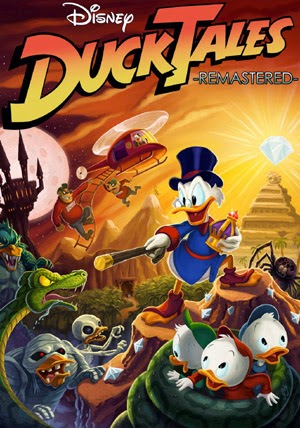
POST-"DUCKTALES RETROSPECTIVE" PERSPECTIVES: "DuckTales Remastered" and "Scrooge's Loot"

DuckTales Remastered: The Cutscenes Movie now -- comments later!  (By which I mean, it would be a good idea for you to watch the video game's cutscenes before tackling my observations, since the latter will make more sense then.)


Evidently, some of the gamer magazine reviewers were not too pleased with the inclusion of "so much" interstitial material in this release.  For them, the play's the thing.  Those of us whose loyalty is to the animated series, rather than the mechanical imperatives of joystick manipulation, know better.

The running backstory here lasts 76 minutes, two minutes longer than the running time of DuckTales: The Movie.  It's only natural, therefore, to consider Scrooge and company's search for five long-lost treasures, and their ongoing entanglements with the Beagle Boys, Flintheart Glomgold, Magica de Spell, and several additional (and, in some cases, surprisingly familiar) foes, as being a "second movie" of sorts.  What is more unexpected is that the material hangs together well enough to actually merit a comparison to a theatrical feature.  This is to the game designers' credit.

The sequential nature of the treasure quests makes for a rather rigid narrative structure, at least throughout the majority of the game.  After a thwarted Beagle Boy raid on Scrooge's Money Bin reveals the existence of a map detailing the locations of the treasures, we're locked into a series of individual forays, separated by returns to the Money Bin, consultations with Scrooge's supercomputer (which is located under Scrooge's desk in this version, as opposed to simply "being there," as it was in the original Capcom game), and decisions as to the next treasure to find.  During each individual treasure hunt, Scrooge must literally put together a number of subpieces -- scraps of paper, golden coins, sections of the Gizmosuit, etc. -- before discovering the headlined bauble.  Once all the treasures are in place, the "allied" Flinty and Magica (a first -- and, as one might expect, a "marriage" that will prove to be very short-lived) intervene, and the Ducks' struggles against them constitute the remainder of the gameplay.  In the end, Scrooge winds up empty-mitted, but he doesn't mind, since he and his friends and family have gotten to enjoy "the adventure of a lifetime."

Scrooge's Nephews are captives on no less than three occasions during the game.  No surprise there, given that Scrooge's rescues are part of the gameplay, but I find the scenario somewhat ironic.  After all, many of Carl Barks' earliest DONALD DUCK adventures featured HD&L saving their Uncle Donald from one peril or another.  I could have asked for a bit more variety in the conditions of the boys' incarceration, however.  Each time they're jugged, HD&L are put in cages similar to the one they inhabited in "The Land of Trala La."  The only difference is that, the third time around, the boys are all in the same cage.

While the Beagles are first seen running en Rota-like masse towards the Bin, the only individual Beagles to get any game time are those old standbys: Big Time, Burger, Bouncer, and Baggy.  They're not searching for riches, but rather, an old painting that holds a "secret code" giving directions to the various treasures.  First on the "finding line": the Sceptre of the Incan King, deep in the Amazon jungle.  (Yes, this does make geographical sense... barely.)

While it does include both of the show's major second-season additions, many of the attitudes evinced by the characters are very much in the tradition of the first season.  The string of insults that Scrooge addresses to Launchpad will surprise no one who has seen "Scrooge's Pet," among other episodes.  Unfortunately, LP doesn't get any chances, here or anywhere else, to truly prove his mettle, serving instead as a means of (frequently bumpy) transportation from place to place.  The local natives who cede the Sceptre to Scrooge (and giggle behind Scrooge's back that the "treasure" is actually King Manco Capquack's old back-scratcher) look like miniature versions of the somewhat more, er, "traditionally depicted" locals of "Jungle Duck."  Their chief is extremely well-spoken, which should come as absolutely no surprise to anyone living in 2014.

Duckworth has little to do here other than chauffeur Scrooge to the Money Bin, stand around, and make dryly ironic comments.  Mrs. Beakley's plate is a bit fuller... literally.  At various times during gameplay, Mrs. B. appears OUT OF NOWHERE to provide Scrooge with sustenance (and, I presume, extra game points).  To me, this is additional evidence that the devoted nanny and housekeeper possesses immense innate talents, of which DT fans had the poor fortune to see only a few.

Phase two finds Scrooge, HD&L, and Webby in Transylvania, at the haunted castle of Count Drake Von Vladstone, aka Count Dracula Duck.  (Cue grumbling from Britishers in the audience.)  The McGuffin in play here is the Coin of the Lost Realm.  Both Scrooge and HD&L are in familiar form during this trek, with hard-headed Scrooge pooh-poohing the existence of "vampires, banshees" and similar ephemera (evidently, he's forgotten all about the events of "Ducky Horror Picture Show") and HD&L dissing Webby as "a big chicken."  Karma comes to call when the boys subsequently fall into a trap, and it's up to Scrooge to save their tail feathers.  The Beagle Boys, disguised as ghosts, wander around the castle and cause mischief for a while, but Magica is the (entirely appropriate) main foe here.

All of the surviving voice actors from the TV series perform more than honorably in their return engagements.  Alan Young sounds a bit subdued, as one would expect of a 94-year-old, but his Scrooge is right on point.  Ditto the HD&L and Webby of the 70-year-old Russi Taylor.  Chuck McCann, Terry McGovern, and Frank Welker are themselves, nuff said.  As for June Foray... well, if her accent for Magica has slipped just a bit, then that is certainly understandable for someone who will turn 97 this fall.  The signature cackle and attitude remain pretty much intact.

Magica's appearance in the mirror is the occasion for what is, remarkably, Webby's first-ever comment about Magica, at least in an animated format:

Well, it IS in character.  Right, Joe?

The next two treasure treks add to our comforting sense of familiarity by directly retracing the steps of DuckTales -- and Barks -- adventures past.  First, Scrooge and HD&L visit Scrooge's African diamond diggings in search of the Giant Diamond of the Inner Earth, only to discover a panicked workers' stampede that seems -- and sounds -- mighty familiar:

Following Scrooge's mine-car descent to the depths, the Terri-Fermians make their reappearance.  They're pretty much identical to the multicolored clone-guys seen in "Earth Quack," though their King (once again, voiced by Welker) is a little more distinctively characterized this time around, and they refer to the diamonds that are interfering with their "Great Games" as "garbage rocks."  After defeating the King in a roll-and-crash-off, Scrooge has little trouble acquiring the Giant Diamond as part of a deal to take out the rest of the "garbage."

There's a bit of a continuity error in the setup to this sequence.  Before departing for Africa, Scrooge instructs the boys to "find Gyro," presumably to take him along for the ride.  The subsequent helicopter ride, however, includes Scrooge, Launchpad, and HD&L, but not Gyro.  Instead, Gyro is already in Africa when the Ducks arrive on the scene. 

The post-Africa Money Bin confab also features my favorite line in the "movie" (starting at time mark 35:05 in the video).  The line itself isn't exceptionally witty, but Russi Taylor's reading of it is.  She lays on the sarcasm with a trowel, as if she were channeling a line from the slightly more cynical Nephews of Barks' later period.  Or, perhaps Russi has spent so much time working on The Simpsons by now that she finds it easier to sound snarky, no matter what character she is voicing.  You be the judge.

Treasure number four turns out to be nothing less than The Lost Crown of Genghis Khan.  And the Ducks need to find it in Shadow Pass, no less.  The setup isn't quite the same as it was in the TV episode.  In a gambit reminiscent of Scrooge's reverse psychology in "The Golden Goose, Part 2," HD&L are left at home this time, while Webby is charged with "looking after them."  But Webby isn't to be put off so easily this time.  Instead, in the time-honored (if not wholly time-justified) tradition, she tags along.

Scrooge finds himself saddled with an additional passenger when he discovers Bubba Duck frozen in a block of ice inside a cave.  How Bubba got there (and why Scrooge was unaware of his disappearance and subsequent location) is more than I can tell, though unpleasant images of "one-way Himalayan rides" come to mind.  After being freed, Bubba subsequently has little more to do than run in cycles in the background, jumping up and down and pounding his club at random moments.  I don't know about you, but I find that to be extremely funny, especially considering Bubba's ultimate fate in the series.

Glomgold also makes his first appearance of the game during the trip to Shadow Pass, hurling insults and bombs at Scrooge and company.  His biggest moments are still to come, though.

In Shadow Pass, Scrooge discovers the (female) Yeti himself, though he needs some assistance from Webby in order to communicate effectively with it.  In a nice callback to the series, Webby claims to have gotten her ability to deal with monster-speak from the Junior Woodchuck Guidebook.  (And she doesn't even need to consult it in order to tell what the monster is growling -- most impressive.)  The "thorn" plaguing the Yeti turns out to be the Lost Crown itself.  A bit simpler than DT's original telling of the tale, but perfectly acceptable.  Launchpad manages to get in a variation of a much-beloved line from the TV episode when he claims, "Usually, it's me the girls go ga-ga for."

Incidentally, you know that Launchpad is having a rough day (or, a rough series of treasure hunts) when even Webby feels free to make with a wisecrack after Scrooge temporarily leaves her in Launchpad's care.

The fifth and final treasure takes us the farthest afield: the Green Cheese of Longevity (is that referring to Duck longevity, or to the age of the cheese?) is located on the Moon.  This time, Scrooge's traveling companions are Gyro and Fenton (with Gizmosuit in tow, in a natty new briefcase this time).  The new voice actor for Fenton makes the character sound a little "goonier" than seems proper to me.  Hamilton Camp's Fenton was enthusiastic and somewhat naive, but he wasn't "goony."  Scrooge's insults to Fenton seem a bit more justified here than they did in the series, which I don't think was the idea.   

At least this Fenton seems a bit more on the ball when it comes to protecting his secret identity.  He is well aware that Gyro might get suspicious when he disappears and Gizmoduck reappears.  Scrooge blows it off by making a derogatory reference to Gyro's deductive reasoning skills, but the fact remains that Fenton was aware of the issue.  (Of course, there is always the distinct possibility that Gyro learned the truth about Fenton when he rebuilt the Gizmosuit after the original suit was destroyed in "Attack of the Metal Mites."  Given how thoroughly the series had mucked up the issue of Fenton's secret ID by the end, perhaps we should simply pretend that this whole sequence doesn't exist.)

Scrooge bests Glomgold, the Beagle Boys, and a giant rat (yes, really) for the Green Cheese and returns to Earth... only to find that Flinty and the Beagles have HD&L and the other treasures in their possession.  Flinty has barely finished chortling over securing the treasures and thereby becoming the richest Duck in the world (exactly how he would do that is never made clear; perhaps he was planning on auctioning them off, or something?) when Magica blows in and assumes ownership.  Intending to use the treasures to revive Count Dracula Duck and "rule the world" (a parlay of similar opacity to Glomgold's), Magica takes HD&L as hostages, demanding the Old Number #1 Dime in exchange.  (It's always good to have a backup plan, especially when it should be the main plan.)  Flinty and Scrooge decide on a "Robot Robbers" redo and agree to cooperate in order to get HD&L and the treasures back.  If this isn't confusing enough already, just wait.

Scrooge and Flinty brave a couple of snares inside Mount Vesuvius -- with Scrooge doing all of the heavy lifting, big surprise -- before the showdown in Magica's lair.  (Sorry, Greg, but there's no pentagram in evidence this time.)  There, Glomgold proves that he's been playing a double game all along by swiping Old #1.  Magica uses the treasures to summon Dracula Duck, whom Scrooge must then dispatch.  Dracula's demise turns out to be surprisingly creepy, with the undead monster writhing in apparent agony before drying up to ashes and blowing away.

Magica's lair subsequently begins to fall apart (huh??), and HD&L's cage breaks, freeing the lads (ditto??).  To finish the job, Scrooge must recover Old #1 from Flinty and Magica, who are tussling over it.  Glomgold won't give the dime up until Magica hands over the treasures... and, here, I really must object.  Magica used the treasures to summon Dracula, so, presumably, they don't exist any more, just as Old #1 would no longer exist if Magica were to melt it down to become part of a magical amulet.  Glomgold must therefore be either exceptionally naive or exceptionally stupid, neither of which I can truly buy.  To me, this is the most questionable moment of the entire narrative.  The fact that it comes at the climax is most unfortunate.

Scrooge short-circuits the villains' somewhat contrived quarrel by barging in and recovering the dime.  Following a 'copter rescue from a fiery fate, we get a flyoff scene suspiciously reminiscent of the ending of "Send in the Clones."  Given that "Clones" was Magica's first major starring role *annoyed side glance at "Magica's Magic Mirror"*, there's a pleasing symmetry in this.

Back in Duckburg, the proverbial "whole gang" grins with glee as Glomgold and the Beagle Boys are carted off in the paddy wagon.  (Seeing as how Flinty was last seen hanging onto Vulture Magica's tail feathers, while Magica had transformed the Beagles into pigs before taking her leave of Scrooge's office, there are some obvious continuity issues here.)  We iris out on a reprise of a familiar gag from "Scroogerello."  Scrooge's short-bordered generosity is even narrower than it appears to be; he takes HD&L to the ice-cream shop while ignoring everyone else, including Webby.  Somehow, I don't think that the "wee lassie" would take that dissement lying down.  Perhaps she will defy Scrooge and tag along again?  (Let's not even talk about Bubba's reaction.)

The creators of DuckTales Remastered have a lot to be proud of.  With the perspective of a quarter-century and the help of advanced technology, they were able to revamp a much-loved video classic while using the cutscenes to pay a more elaborate, and highly knowledgeable, tribute to the series that inspired it.  That mythical 101st episode of DuckTales?  Close enough, I deem.

.

.

.

Oh, there's another DuckTales-related video game out there, you say?

Actually, this one is of comparatively little interest to DT fans.  Alan Young and Terry McGovern do appear as the voices of Scrooge and Launchpad, and Flintheart Glomgold, Magica de Spell, and Ma Beagle are the villains who have absconded with Scrooge's (ugh) loot, but the gameplay features a generic Duck-boy character.  (HD&L are off visiting Uncle Donald, in case you're wondering.)  It appears to be a pleasant diversion for gaming enthusiasts, nothing more, nothing less.

Some DUCKTALES comics reviews should be coming your way next.

Friday, September 19, 2014

"Remaster"ing the "DuckTales" Universe

My review of the "cutscenes" from DuckTales Remastered should be posted sometime during the next several days.  Expecting some sort of "sneak peek" at my verdict?

Tuesday, September 9, 2014

DUCKTALES RETROSPECTIVE: Final Thoughts and a Look Ahead

A housekeeping note before I begin: I have placed links to the opening chapters of my two sets of animation retrospectives (DuckTales and Kimba the White Lion) at the head of my list of favorite blogs and Web sites, on the far right of this page.  The DT "launch page" has direct links to my reviews of all 100 of the episodes, and I'm going to include a similar set of links for Kimba as soon as I get the chance.

I'd like to augment the thank-yous I wrote in my review of "The Golden Goose, Part 1" by paying special tributes to GeoX and Greg Weagle.  Responding to their different takes on the eps played a central role in helping me to clarify some of the new thoughts that came to my mind while revisiting the series.  So, what better way to organize my final thoughts on the project than by sticking with tradition and answering some other DT-related questions that turned up during their own wrapup comments and posts? 

(The N&V Community) What, you're not going to favor us with the inevitable "Best of" and "Worst of" lists first?  Isn't that sort of thing kind of expected at this point?

Well, GeoX and his correspondents discussed such lists, whereas Greg did not -- at least, not formally -- but I can certainly get behind adherence to that particular tradition.  Here are my lists, which may be a little more extensive than what you might be expecting:

Best Half-Hour Episodes

1.  "Hero for Hire"
2.  "Sir Gyro de Gearloose"
3.  "Raiders of the Lost Harp"
4.  "The Uncrashable Hindentanic"
5.  "Top Duck"
6.  "Duck in the Iron Mask"
7.  "Home Sweet Homer"
8.  "All Ducks on Deck"
9.  "Double-O-Duck"
10.  "The Land of Trala La"

An exceptionally difficult list to put together; there were quite a few eps that I felt bad about leaving out, especially those from the Fenton-Bubba era.

Worst Half-Hour Episodes

10.  "Down and Out in Duckburg"
9.  "The Right Duck"
8.  "The Money Vanishes"
7.  "Duckman of Aquatraz"
6.  "Luck O' the Ducks"
5.  "Once Upon a Dime"
4.  "Magica's Magic Mirror" / "Take Me Out of the Ballgame"
3.  "Bubba's Big Brainstorm"
2.  "New Gizmo-Kids on the Block"
1.  "Yuppy Ducks"

Most of these are obvious, but I did put some thought into how to order them.  I decided to give "Once Upon a Dime" a little bit of extra consideration for at least trying to incorporate bits and pieces of Duck-comics lore into Scrooge's story, including some elements that were fairly obscure.  It may not have been done well, but "Dime" at least showed more essential ambition than the misbegotten two-episode experiment.

Best Half-Hour Components of Multi-Part Stories

1.  "Don't Give Up the Ship" ("Treasure of the Golden Suns")
2.  "Too Much of a Gold Thing" ("Treasure of the Golden Suns")
3.  "A Whale of a Bad Time" ("Catch as Cash Can")
4.  "Wrongway in Ronguay" ("Treasure of the Golden Suns")
5.  "The Golden Goose, Part 2"

Worst Half-Hour Components of Multi-Part Stories

5.  "A Drain on the Economy" ("Catch as Cash Can")
4.  "The Billionaire Beagle Boys Club" ("Time is Money")
3.  "Aqua Ducks" ("Catch as Cash Can")
2.  "Ducks on the Lam" ("Time is Money")
1.  "Bubba Trubba" ("Time is Money")

I'm not really down on "Super DuckTales," but the individual parts of that serial had some very tough competition to overcome.  I had a difficult time choosing between "GG2" and "The Duck Who Would Be King" for the final slot but ultimately decided to give the former the nod, primarily because of, you know, that whole "end of the world" thing.

Best Adaptations of Carl Barks Stories

1.  "The Land of Trala La"
2.  "The Status Seekers" 
3.  "The Unbreakable Bin"
4.  "Scrooge's Pet"
5.  "Lost Crown of Genghis Khan"

I'm not going to do a "Worst Adaptations" list, because, quite frankly, all of the Barks adaptations were at the very least passable, with the obvious exception of "Down and Out in Duckburg."  For my "Best" list, I favored those adaptations which brought something interesting and (in my view) appropriate to the table, apart from merely transferring the Barksian details into animated form.

Top One-Shot Characters Whom I Would Have Liked To Have Seen Again

1.  The Flying McQuacks ("Top Duck")
2.  The Phantom Blot ("All Ducks on Deck")
3.  Ludwig Von Drake ("The Golden Fleecing")
4.  Filler Brushbill ("Much Ado About Scrooge")
5 (tie).  J. R. Mooing ("Ducks of the West") and the Grand Kishki of Macaroon ("Catch as Cash Can")

Er... let me explain that last entry.  This was a sort of tribute to Joe Torcivia.  The Barks adaptation that Joe has always wished could have come to pass in the series was an adaptation of "The 24-Carat Moon" (UNCLE $CROOGE #24, December 1958), with Mooing (as "The Fabulous Cattle King"), "Kishy" (as "The Rajah of Eyesore"), and Scrooge rocket-racing to the newly-discovered golden Moon to claim its riches.  Sounds like a good idea to me.

Other Barks Stories (Unrelated to Any Series Offerings) That Would Have Made for Good DuckTales Adaptations

1.  "The Heedless Horseman" (UNCLE $CROOGE #66, November 1966) (could have been a great slapstick offering along the lines of "Hindentanic" if handled properly)
2.  "Mystery of the Ghost Town Railroad" (UNCLE $CROOGE #56, March 1965) (should have replaced "Ducks of the West")
3.  "King Scrooge the First" (UNCLE $CROOGE #71, October 1967) (yes, I know that Barks only wrote this one, but I think that it might have worked pretty well on-screen)
4.  "The Mines of King Solomon" (UNCLE $CROOGE #19, September 1957) (can easily imagine Fenton getting involved here, helping Scrooge survey his various businesses)
5.  "The Flying Dutchman" (UNCLE $CROOGE #25, March 1959) (could have been a REALLY scary Halloween-style episode)

Now, to tackle some of the issues raised by others.  I'm going to paraphrase the actual comments a bit in order to save space.  If you have any additional general, series-related questions to ask me, I'd be happy to tackle them in the Comments section.

(GeoX: "On Everyducks") How much of a detriment to the series was it to leave Donald (mostly) out of the picture, thus eliminating the "Everyman" role that Donald played so well in the $CROOGE adventures? 

I think it was a loss, but not a grave one.  As Geo himself notes, Launchpad and (especially) Fenton have their own personal motivations and hangups and thereby fill some of the gap left behind by the absence of Donald.  The softening of Scrooge also helped in this regard, as he took over Donald's domestic responsibilities and came across as a somewhat less remote and forbidding figure.

Speaking of Donald's "Everyman" role, a book about that very topic should be coming out soon.  I've already preordered it from Amazon.

(GeoX and correspondents: "Family") Is it out of character for Scrooge to be presented as living in a luxurious mansion, complete with servants?

I've got to admit, I'm prejudiced here, thanks to my longstanding affection for Richie Rich and the world in which he operated.  I see no issue with the DT Scrooge having an impressive place to call home, or, for that matter, operating as a classic business tycoon (as he did in numerous Barks stories).  If you take the "deracinated" image of Scrooge to its logical extreme, then he would concentrate almost exclusively on (1) hanging onto the fortune in his Money Bin; (2) going on occasional adventures to add to said fortune.  If you're going to accept that Scrooge may be motivated to go on adventures because of business deals or discoveries made during the course of his business endeavors -- which I assume that most of us do -- then you're going to have to accept that he is more in the mold of a classic tycoon, who differs from other such creatures in that he has an unusually strong attachment to the places from which he has come to get to that point.  And in the world of TV in which DT operates, a classic tycoon "should" have a mansion.

(GeoX: "Employees") Did the characterization of Launchpad deteriorate as time went on?

Not as badly as did the Nephews' characterization (at times), but the show definitely made much less use of him than it should have during the Fenton/Bubba period, and his characterization in these rare appearances basically traded off of what had been established during the first season, with relatively little progression.  The real falloff didn't begin until he joined the cast of Darkwing Duck.

(GeoX: "Villains") Which Barks villain was best realized in "DuckTales"?

I have no real complaint with the portrayals of Magica and Glomgold.  The "personalized" Beagle Boys (including Ma) had their moments, but I definitely think that it was a mistake to have relied so heavily on Big Time, Burger, Bouncer, and Baggy.  Burger and Baggy had all-too-obvious character "hooks" and did suffer from some "Flanderization" as time went on.  Bankjob and Babyface did not seem to have obvious "hooks," and Bugle/Bebop's "hook" was at least more interesting than either Burger's or Baggy's, so it is a real shame that they didn't get more screen time.  The "wild card" among the villain was Black Pete, who always had something of value to contribute and surely merited a few additional "costumed" turns.


(Greg) Did "DuckTales" "jump the shark" when Bubba was introduced?

No way; there were more than enough solid episodes among the final 35.  Unquestionably, however, the introduction of Bubba as a continuing cast member was the biggest mistake that the show ever made.

One issue that I raised during my discussion of the later eps should also be brought up here.  The sensibility of the show's humor style took a distinct turn towards the "sitcommy" during the Fenton-Bubba era.  That approach seemed to fit Fenton and his subcast (Mrs. Crackshell and Gandra Dee) quite well.  But, looking back on it now, I do wish that a few more globe-trotting, adventure-focused episodes had found their way into the second and third seasons, for balance's sake.  A hearty sense of humor could certainly have informed these tales, but a sense of real peril and intrigue should have been included, as well.  Don't forget that "The Uncrashable Hindentanic" included some moments of genuine danger along with all of the funny business.

.

.

.

So, what DuckTales-related matters can you expect to see me discussing in the future?  Here is a provisional list (which I pretty much sketched out already while reviewing "The Golden Goose", but it won't hurt to repeat it here).

1.  A review of the DuckTales Remastered video game

2.  Reviews of some DUCKTALES comic-book stories (both good and bad) that I've never reviewed in detail before

3.  Reviews of several DUCKTALES fanfics

There is also a possibility that, at some point in the future, I will return to some of my earlier RETROSPECTIVES and beef them up with additional images and such.  If I make any changes, I will be sure to let you all know about them on the blog.

Thanks again for patronizing my DUCKTALES project!

Sunday, September 7, 2014

DUCKTALES RETROSPECTIVE: Episode 100, "The Golden Goose, Part 2"

All good things, etc. and so on... And what better way to close the book on DuckTales: The Series than with a "battle to save the planet" that doesn't involve invading aliens or sketchy science?

If we attend to GeoX's suggestion about the title, then that really should read "The Golden Goose Part I, Part 2."  Under the extra-special circs, I'm willing to let that slide.

"The Golden Goose" was, of course, one of two two-part stories that closed out "Golden Age" WDTVA series, the other being Gummi Bears' "King Igthorn."  It's worth pausing for a moment to compare the approaches taken by these two productions and to consider how -- in my opinion, at least -- "Goose" managed to do right what "King" did wrong.  Now, there's no denying that "King"'s narrative had the massive sweep that Gummis fans had been expecting ever since the Great Gummis' potential return, the city of Ursalia, and the Barbic Bears had been introduced as side elements of the series.  We got payoffs on just about everything (though the still-unseen Great Gummis' vague final promise to return "soon" did disappoint some folks), and virtually every major character of the series got something to do during the course of the 45 minutes.  And that was the problem.  "King" was so ambitious that a good deal of the dialogue was of the "directional" type that you might have heard in an old-time movie serial ("we're going to go with X and rescue Y while you do Z"), and such dramatic moments as the destruction of Gummi Glen by the wood-eating bug Big Tooth, the villains' acquisition of massive quantities of Gummiberry Juice, and Duke Igthorn's long-awaited takeover of Dunwyn Castle whizzed by too quickly to have the walloping impact that they should have. "King" was still an enjoyable ride, but, despite the praiseworthy ambition of the undertaking, a "Peggy Lee" sort of feeling ("Is that all there is?") nonetheless lingered in its wake.

At first glance, "The Golden Goose" seems to suffer from a problem diametrically opposite to that of "King Igthorn" -- not "Is that all there is?" so much as "Is there any THERE there?".  A year before Darkwing Duck's debut, the strangely depopulated Duckburg of "Goose" seems more like the bare-streeted St. Canard during a battle between DW and one of his supervillain foes.  There's no sign of Bubba Duck, Fenton Crackshell, or Gizmoduck.  The minimalist approach seems completely at odds with the apocalyptic vision of the narrative, leaching away a great deal of the "epic scope" that we would normally hope to see in such a tale.  And yet, I would argue that the scantily-furnished stage is actually appropriate here, given that the script chooses to focus on characters' inner turmoil just as much as it does their external challenges.  The decision to strip down to the basics makes the characters' feelings and decisions -- Scrooge's concern for his Nephews, Scrooge's choice to put the fate of the world ahead of any personal considerations, Dijon's fall and subsequent redemption -- seem to carry all the more weight.  Not that there isn't a healthy helping of action, humor, and suspense in this concluding chapter, but we're more inclined to remember the moral dilemmas (there's that phrase again...) and, in Scrooge's case, the satisfying conclusion of a character journey that began with a cranky old Duck swiping cheese samples and ends with a similarly old, but wiser, Duck demonstrating that he has thoroughly internalized all of those proclamations about the value of family and has gained sufficient largeness of soul to extend his vision of "family" to the worldwide community.  There are a few annoying logical hiccups in the story as a whole, but they are not enough to overcome the overflowing feeling of "Heart" that makes "Goose" a classic, almost in spite of itself.

After Frank Welker provides an appropriately non-fruity, on-point summation of the events of Part 1, we cut to the discovery of the statuefied HD&L.  While the reactions of Webby, Duckworth, and Mrs. Beakley are pretty much what we might have expected of them -- actually, Webby manages to keep her cool a bit better than did her gramma, which is pretty remarkable -- Scrooge's is both dramatic and symbolically significant.  He immediately blames his own "greed for gold" for the boys' fate, even though he is clearly not responsible for what has happened to them.  His quick assumption of liability is even more impressive than his shaking-off of the "Gold Fever" in "Too Much of a Gold Thing."  In that case, it took the intervention of Mrs. Beakley reminding him of "what's important" to jolt him out of his obsession.  Here, Scrooge makes the pivot all by himself, with no hesitation whatsoever.  The solution to Moral Dilemma Number 2 (as I described it in my review of Part 1) is already clear: no matter what happens in the future, Scrooge will unquestionably put the welfare of his Nephews ahead of any potential monetary gain.  Incidentally, I think that this lends some credence to my earlier speculation that Scrooge might have been able to maintain some "control" and use the Golden Goose in a more rational and responsible manner after a night of (literally) sleeping on the matter.  When Flintheart Glomgold and the Beagle Boys have their chances to use and/or take control of the Goose, they will demonstrate no such restraint.

In order to set up the remainder of the ep, we're going to have to get an info dump at some point, and Poupon provides one as soon as he arrives at the Mansion, with Dijon in reluctant tow.  Poupon's explanation of the Goose's transformative powers and the possible fate of the world lasts for about one minute and 45 seconds, which wouldn't bother me so much, except for the occasional shots of a frozen Mrs. Beakley and Duckworth staring off into space like goons as he does so.  They should care about the fate of HD&L, too, so this was extremely bad form by Wang Films.  Thankfully, the scene is redeemed by Poupon's dramatic description of the effects of "The Golden Death" ("And all life will be ending... for little golden Ducks... for everyone!") and, of course, Scrooge's decision to let Poupon have the vial of "mystical water" to neutralize the Goose and save the world, as opposed to using it on HD&L right then and there.  Moral Dilemma Number 3 is thereby resolved with crystal clarity, and our opinion of Scrooge as a moral being can't help but be improved as a result.  It's essentially the DT version of Scrooge's dramatic decision to help the outer-space aborigines in Carl Barks' "Island in the Sky," but with considerably more global import involved.

Evidently on something of a roll, Scrooge resorts to some ingenious reverse psychology to keep Webby out of harm's way.  Far from another example of the DT writers showing contempt for Webby -- much less an example of what GeoX called "sub-TOM SAWYER horseshit" -- this exchange shows how much respect Scrooge has gained for Webby's maturity level.  His approach is based on the belief that Webby is responsible enough to willingly take on the task of keeping HD&L safe from further harm (and thereby be protected from harm herself), provided that the offer is tendered in the proper manner.  Scrooge evidently knows enough about the wee lassie to gauge that she isn't likely to resort to, you know, "Plan B" (except under atypical circumstances, such as kidnapping).

The balance of Act One is taken up with some wacky slapstick doings at Glomgold's "abandoned" auto factory.  You'll understand the quote marks when you take a very close look at the upper portion of the following screenshot...

... and, true to this somewhat dubious beginning, the rest of the sequence can fairly be said to be Part 2's weak point.  Granted, there are some decent moments, such as Launchpad's last (real) crash (for a while, anyway)...

... and Dijon's complete cock-up of Moral Dilemma Number 4, in which he opts to indulge his petty kleptomania rather than "dogface up" and deliver the Goose to his brother.  Based on this incident, I guess that we DO have to regard "Attack of the Metal Mites" as canon.  How would Glomgold have known about Dijon's propensity to steal unless Flinty had had some kind of dealings with him in the past?

In between these high points, however, comes... wait for it... yet ANOTHER conveyor-belt sequence.  Sigh.  A little bit of originality, especially in a climactic adventure like this, doesn't seem like too much to ask, does it?  As to how the machinery in this supposedly "abandoned" factory suddenly can operate like (extremely snarky) clockwork...well, to borrow a line of Scrooge's in the DuckTales Remastered video game, "I'm not even going to dignify that with a response."


The conclusion of Act One, with Glomgold advancing on the captured heroes while holding out the Goose, quickly brings the goofiness to a halt and warns the viewer that some serious stuff is about to go down.  And so it does, as the Goose begins its sequence of transformations, first taking on a life of its own and turning on those who would manipulate it.  The climax of these attacks is chilling in its stark simplicity, with the cornered, cringing Glomgold meeting his fate (which will, of course, implicitly be reversed once "The Golden Death" is overcome, but it's what we SEE that is remembered) and the Goose then flying away, emitting only a few lonely caws.  Leave it to Wang to then muddy the moment a bit by having Poupon speak what is clearly Dijon's line, "Poor Mr. Gloomduck!"  (There's no question that this was a goof, as the voice is definitely that of Richard Libertini, the voice of Dijon.)

Now that the Goose is sentient, I should point out that the creature, far from being some sort of mechanical MacGuffin, is very much of a personality in its own right.  A cranky, somewhat obnoxious personality, but a personality nonetheless.  Such small touches as the Goose charging or lunging madly at various characters, reacting quizzically to Scrooge's use of a goose call in the park, and, later, trying to dope out Dijon's intentions inside the roadside bush, go well beyond what one might have expected here.

Poupon, aggrieved by Dijon's failure at the factory, dismisses Moral Dilemma Number 5 in a heartbeat, brushing aside any notion of forgiveness and angrily demanding that Dijon leave his sight forevermore.  Harsh, to be sure, but not entirely unjustified, given that keeping the world safe from "The Golden Death" is the Brotherhood of the Goose's first and foremost function.  (In Part 1, Poupon mentioned that the Brotherhood also acts "in service to others," but we never do get any details as to what that might entail.  As long as "service" doesn't involve serving the Goose "with gravy and stuffing," as Burger might suggest, I'm OK with the vagueness.)

Following that extremely strange detour to Launchpad's hangar -- surely, they could have pursued the Goose into downtown Duckburg while looking out for a place to get nets at the same time? And why are they watching TV at a time like this, since Scrooge has already pointed out where the Goose was heading? -- Scrooge, LP, and Poupon chase their elusive quarry through an all-but-desolate city setting, winding up at the park.  The slapstick gags here are decidedly muted, an appropriate approach in light of the fact that the crisis is getting graver.  The Beagle Boys' destruction of the water vial is the perfect capper, demonstrating that the Beagles, like Glomgold, are enmeshed in the tendrils of greed, completely heedless of the potential consequences.  Poupon doesn't cover himself in glory in this scene, either; his unnecessary description of what the water will do to the Goose gives the Beagles enough time to stop him before he can actually pour the water.  You already covered this subject back at the Mansion, Poupon; time to be "up 'n doon" instead.

And then... (it is still spine-tingling, no matter how hard-bitten you have become in the quarter-century since then...)

Of course, "The Golden Death" disseminates itself around the world with an exquisite sense of dramatic timing.  It starts off at a crawl, quickly picks up steam, is moving at a sufficiently fast clip to keep up with Launchpad's Joyrider as the latter flies across the ocean, can visibly be seen moving across the globe in the long shot from space, buzzes through Barkladesh like a house afire, and then slows down right before it reaches the door to the temple's fountain room, just long enough to allow Scrooge to save the day.  A very accommodating sort of apocalypse, I must say.  Despite the inconsistency, the mere fact that the "Death" is progressing through what appears to be a completely lifeless landscape makes a signature moment like the loss of Poupon seem all the more compelling and meaningful.  It's like the opposite of a zombie movie or TV show, in that there are very few characters here as opposed to hordes of shambling dead-walkers, but the end results of the two approaches are the same -- they help us to invest all the more in the characters on the side of good.

The rest of Scrooge's family, of course, is caught up in the golden wave along the way.  I like to think of the episode's occasional cutbacks to the Mansion -- and to Gyro's futile efforts to turn the boys back to normal -- as a subtle comment on the vanity of human endeavors in the face of overpowering forces beyond human understanding.  Or, perhaps, it's simply a reflection of the fact that Gyro Gearloose is having an EXTREMELY bad day.  An unfortunate circumstance, given that this is the character's last animated appearance, but it's not as if Gyro hasn't already experienced more than his share of failures during the course of the series.

Thankfully, the forsaken Dijon passes Moral Dilemma Number 6 with flying colors when he decides that he owes it to his brother to return the captured Goose.  As GeoX notes, it is kind of unlikely that Dijon would instantly, and correctly, recognize this generic-looking white goose as THE Goose, and we never do find out when and where Dijon managed to swipe Scrooge's cane, but... poetic license.  I can live with it.  (It would be nice to think that Dijon recognized the Goose's personality, based on what he had seen of it at the factory.  That would have been a worthy justification of the decision to depict the Goose as more than just an anonymous mayhem-maker.)

The climax cannot honestly be faulted.  Oh, it can be flyspecked, since (1) Launchpad magically has enough gas in his Joyrider to fly across a good portion of the Earth's surface without stopping to refuel, and (2) despite LP's claim and Scrooge's subsequent order to crash, there does seem to be enough of a flat surface on the temple mount for LP to make a normal landing.  But you definitely can't say that the episode doesn't drag all of us through a very rough knothole before salvation arrives.

The Mansion wrap-up scene is a bit truncated, but we do get to see all of our principals (save Gyro, for some reason) alive and happy again.  Best of all, we get the concluding hug between Scrooge and HD&L, which it would have been a positive crime to have omitted.  Regarding the rehashing of the ending of DuckTales: The Movie, I didn't have any issue with it back in 1990, but I have to admit that I'm somewhat less enamored of it now.  We know that Dijon, thanks to his decision to return the Goose, now possesses a sense of responsibility and "connectedness" to others that he never had before and, needless to say, did not have at the conclusion of DT:TM.  Why compromise that moral advance for the sake of a cheap gag?  This is one area in which I think "King Igthorn" has the advantage over "The Golden Goose."  The ending of "King" may have fallen short of satisfying the wishes of viewers for all of the loose ends of the series to be completely knotted, but it did possess a certain appropriateness that a fadeout chase does not deliver.  Even rerunning the ending of "Once Upon a Dime" and setting the final scene in the Money Bin would have been better than this.

I can't rank "The Golden Goose" with the very best episodes of DuckTales' first season.  The stripped-down approach may make sense in this context, but it pales in comparison to the richness on display in "Treasure of the Golden Suns" and such half-hours as "Raiders of the Lost Harp" and "The Uncrashable Hindentanic."  One might compare it to "Hero for Hire," which used a not-entirely-dissimilar straightforward approach to make some fairly profound points about Launchpad's character, but you then come up against the undeniable fact that the animation of "Goose" simply doesn't measure up to that of "Hire."  I think that it is fair to say, though, that "Goose" ranks as the second-best of DT's multi-part story lines, carrying more emotional punch than "Catch as Cash Can," avoiding the "falling-off" and "too much slapstick" issues that affected "Super DuckTales," and... well, let's leave "Time in Money" to rest in pieces, shall we?  A solid enough adventure, with equally solid character development -- and, oh, yes, that bit about saving the world... that's a thoroughly respectable way in which to draw the curtain on the series.

.

.

.

I can't recall who drew this family portrait, but it's a nice one!

.

.

.

"DuckBlurbs"

(GeoX) As I said about gold…Scrooge is trapped in this gold sack, but then it cracks open like an egg when it's struck with a gold statuette. I just do not think gold works remotely in that fashion…
("Christopher") The Golden Goose doesn't seem to change the thickness of substances, so if the bedsheet-turned into a sack was turned, it probably was like a few thickness[es] of aluminum foil- too tough for Scrooge to punch through, but easily punctured and then ripped apart once the thick, solid gold statue hit it. I'd need to watch the episode in slow-motion, but I don't think it cracked so much as tore. 


I'll accept Christopher's argument on this issue.  BTW, Geo... note that yet another statue of Scrooge makes its appearance.  Perhaps Scrooge has a higher self-regard than even we realize? 

(GeoX) In spite of the decidedly inconsistent nature of the show, I feel vaguely bereft. 

You can only imagine how I feel.

("Christopher")   Anyway, most of the episodes are all about locating a lost treasure or learning just how important family and friends are in a way that is so heartwarming you want to throw up. Most of the time, Scrooge is just adding more cash to the money bin. Now, he's SAVING THE ENTIRE WORLD. Rag on multi-quadrillionaires all you want, but all of the living creatures on earth owe Scrooge (and Launchpad, Dijon, and Poupon) their lives. This is the biggest thing they've ever done, and notice that Scrooge is [so] happy that HDL can move that he never thinks of using the fact that he's a savior of the world as [a] way to get the upper hand on business deals.

Exactly, exactly, exactly.  Give that man a cheroot.

(Greg) Interesting Moment #1: We get the preview of the episode from part one...IN A TWO PARTER! Something TaleSpin and Darkwing Duck never got in their two parters. I believe the narrator for this is Frank Welker [Ed. - yes] since he sounds like Poupon without the accent. Anyhow; at the end of the preview; it's clear there is a Toon Disney edit because when Big Time is about to touch the nephews, he yells gold, then the screen freezes and the scene quickly cuts to the STOCK FOOTAGE OF DOOM. Whoever thought it was a good idea to cut out the nephews turning to gold is on something and they should CUT THE F'N DOSE! Even more so when the scene was completely UNCUT the day before on TOON DISNEY no less. Idiots!

This was clearly a very conscious decision to maintain a bit of suspense for those viewers who might not have seen the transformation because they hadn't seen Part 1. Which makes little sense, actually, because the narration had already TOLD us about "the Golden Goose's golden touch," and the flashback ended with Big Time about to touch Louie on the head.  Simply showing the transformation at the end of the flashback might, in fact, have been the smarter choice here.  (BTW, I don't believe that there was any cut here.)

(Greg) So we cut back to the golden mansion and head to the office as Gyro is running tests on the golden statues of the nephews. Sadly; the numbers do not look good for the nephews as the computer laser doesn't work. G[yr]o checks the printer paper coming out of the printer and speaks some of the most absurd science talk ever that no scientist would be caught dead saying.

Based on the appearance of Gyro's... machine... thingy, it appears that Helper/Little Bulb, or at least part of him, managed to wangle a cameo of sorts.

Psst, Duckworth, Mrs. B... Over here!  Over here!!

(Greg) [The conveyor-belt sequence] IS the Satanic version of How It's Made. AHHAHAHAHAHA!

Except that we START in an "abandoned" factory in this case.  In How It's Made, they typically display the item of interest IN a desolate warehouse, junk-filled basement, weed-strewn back lot, etc. before cutting to the real factory where the manufacturing process takes place.

(Greg) [Dijon] peeps under the bushes and ponders over if he should touch the goose because if he touches wrong he turns to gold. However; he at least must redeem himself even if his brother doesn't want any part of him again thus showing that Dijon is not really a heel; but a misguided soul.

I think that this sums Dijon up pretty well.

Next: Some final thoughts, and a look ahead.