


Even at the time of the episode's original release, Joe Torcivia and I recognized that "Dime" was a rather poor excuse for a Scrooge biography, and we bombed on it rather savagely in our DUCKTALES INDEX. I certainly don't want to retract that negative review, BUT... I will qualify it, just a bit, by specifying that the ep's most egregious sins are committed at the beginning and at the end. The middle, including most of Act Two, actually isn't so bad (or, at least, is measurably less dreadful). The "middle game" features a reasonably good, though rushed, take on the Barks story "The Great Steamboat Race" (UNCLE $CROOGE #11, Sept.-Nov. 1955), throwing in some amusingly cynical touches to match Barks' own. Chapter two of Rosa's LATO$M, "The Master of the Mississippi," which relates the story of the original "steamboat race" of 1880 that formed the backdrop for the Ducks' 1955 adventure, is certainly more ambitious and detailed than "Dime"'s take on the competition, but at least the DT version of the tale, which supposedly takes place in the same time frame as Rosa's, can stand next to "Master" without looking completely ridiculous.




In chronological terms, the biggest difference between the Young Scrooge of "Dime" and the Scrooge of the first two chapters of Rosa's LATO$M (whom I'll call "Laddie Scrooge") is that the former emigrated to America at a somewhat older age. The Pat Fraley-voiced Young Scrooge is certainly far more naive than his Rosa-crucian counterpart, who, even before he arrived in America, had already shown a hint of his inner steel by fighting off the Whiskervilles in "The Last of the Clan McDuck." Young Scrooge's mindset may reflect the influence of an upbringing in the country, as opposed to the Glasgow cityscape in which Laddie Scrooge lived and labored. Woefully ignorant of the way the business world really works, Young Scrooge comports himself in the insouciant-yet-secretly-insecure manner of Fenton Crackshell as he attempts to secure that elusive first job. Even in the pre-LATO$M days of 1987, Young Scrooge's breezy attitude (not to mention his rather too modern concern with various fringe benefits) didn't quite jibe with what we felt to be true about the character -- that he started at the very bottom and made his way to the top by dint of dogged, old-fashioned effort. It wouldn't surprise me, however, if the later characterization of Fenton Crackshell were influenced to some degree by this admittedly amusing portrayal.

In both "Dime" and LATO$M, Scrooge's shining of a ditchdigger's mud-caked boots to earn Old #1 is adapted directly from an incident in "Getting That Healthy, Wealthy Feeling" (UNCLE $CROOGE #50, July 1964, written by Carl Fallberg, drawn by Tony Strobl). Rosa famously "rehabilitated" this non-Barksian factoid to use in his epic because the task "seemed completely appropriate for a young Glasgow lad," but let the record show that DuckTales got there first. I wonder how Esckilsen came to know of this story. Could it be because it was published in an early-80s issue of the Whitman UNCLE $CROOGE, a pile of which the DT crew might well have had lying around for browsing purposes (perhaps right next to that well-thumbed copy of the Celestial Arts $CROOGE volume)? "Dime"'s take isn't precisely that of "Feeling" or Rosa -- the mud has clustered about the ditchdigger's boots in a suspiciously regular rectangular-box shape, because that was easier for the animators to draw, no doubt -- but there can be no question but that the Fallberg-Strobl story was consulted at some point here.


Young Scrooge's use of a "shoe-shining conveyor-belt system" to earn money for his passage to America is also drawn from a rather obscure Duck story, in this case "The Invisible Intruder" (UNCLE $CROOGE #44, August 1963, written by Vic Lockman, drawn by Barks). This story was reprinted by Gold Key in 1978, so it might also have been part of that purported pile of comics references mentioned above. I think you'd have to agree that the rationale for Scrooge's inventiveness presented in "Dime" is rather more convincing than the one given by Lockman.


For all of that effort in research, I emulate Vic Lockman and say, "Yay for you, Mr. Esckilsen!"... And then I have to yank the "Yay!" right back. One of the important points about Laddie Scrooge's earning of the dime in "Clan McDuck" is that the fact that it is a "worthless" American dime teaches the youngster that he will need to be wary of "sharpies" in the future, which leads directly to his first verbal formulation of his famed "tougher than the toughies and smarter than the smarties" mantra. "Dime" also plays with the implications of different media of exchange, but blows any chance of mining something meaningful out of them by using the idea as a source of cheap humor. Scrooge's McMomma and McPoppa (is Scrooge's home country Scotland or McDonaldland?) do point out that Old #1 "isn't worth ten cents here in Scotland," and Young Scrooge does ultimately choose to regard the acquisition of the dime as a "sign" that his fortune is awaiting him across the sea. Later, however, we are apparently expected to laugh when the successful Scrooge sends his McParents "worthless" American dollars. Maybe they can exchange the dollars for British currency at the local branch of the "national bank" with the dollar signs prominently featured in its window. $... £... So what part of this didn't Esckilsen, Koonce, and Weimers understand?


The steamboat race pitting Scrooge and his scabrous Uncle Catfish (who, in a nice twist, had sent stereotypical reports of gold-paved American streets back to Scotland) against Old Man Ribbit dispenses with the "reclamation section" of Barks' story, in which Scrooge and "Horseshoe" Hogg must first pry their uncles' sunken boats out of the "Big Muddy" muck and get them river-worthy again before resuming the disrupted 1880 race. Here, as is the case with Rosa's "Master of the Mississippi," we cut straight to the original chase for Cornpone Gables. It's a shame that the faintly ridiculous "Beaver Boys," rather than the 19th century Beagles themselves, are used as Ribbit's helpers, but at least Ribbit is sufficiently conniving all on his own to be considered a "Beagle by proxy."
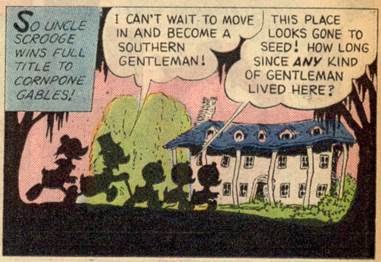
 Despite the large differences between the events of "Master" and the truncated race in "Dime," there is at least one instance in which there might have been some cross-pollination. Yes, I know that Rosa denied any swiping from "Time Teasers" when creating "On Stolen Time," and I'll grant him the benefit of the doubt again in this instance, but let's just say that I find the juxtaposition of the following images to be mighty... suggestive.

 There's a barb in the tail of the seemingly "cute" and simplified DT version of the race. True, the "fully functioning" Cornpone Gables of "Dime" appears to be a stereotypically great prize, whereas Barks' long-abandoned mansion turns out to be hardly worth the trouble that Scrooge and co. went through to secure it:

 At the same time, Uncle Catfish proves to be a TRUE McDuck by paying Young Scrooge a paltry wage for his help (I think it worked out to about 30 cents an hour). Not even Rosa's Uncle Pothole McDuck, who sold Scrooge the deed to his boat at precisely the time when riverboats were being phased out in favor of rail travel, can rival Catfish for classic skinflintery.
Following Young Scrooge's truncated traipse through the Klondike (Goldie? Never heard of her), "Dime" provides us with a few final memorable moments after the lad is bilked out of his gold stash by the "Oklahoma timberland" salesman. Given that the Scrooge of DT's "Back to the Klondike" was already as "tough as the wolves" and had arguably enjoyed a romantic relationship with the sexiest gal in the region, it requires some mental gymnastics to accept the idea that the post-Klondike Scrooge could be cheated so easily, but at least the sequence is consistent with the portrait of Young Scrooge presented earlier in this particular story. There follows the Beagles' train hold-up, Scrooge's "having a blast" (and temporarily losing Old #1, not to mention his plaid wardrobe), and Scrooge's use of "Scottish warfare" to bring the Beagles low. We'll also see bagpipes used as weapons in the second season's "Full Metal Duck," though the effects of the pipes are played more for laughs there. Here, given that one of the Beagles admitted earlier that Ma Beagle (who, let us be clear, is NOT the same as the Ma Beagle who appears in contemporary Duckburg) had committed murder to obtain clothes, I think it is entirely appropriate that the Beagles have a much harder time dealing with the squealing squash-machine.

 Sadly, once Scrooge hits the timber-less-land, the episode (to use a bagpipe-friendly metaphor) goes straight down the pipe. Scrooge striking oil (and thereby reestablishing his fortune -- for good, as it turns out) while trying to hide Old #1 from the wage-demanding workers truly is, in GeoX's words, "the most egregious example of the 'lucky dime' heresy we've seen yet." Heck, the doggoned Magic Hourglass didn't have as direct an influence on Scrooge's fortune as the dime does here -- and all due to sheer, dumb luck!
 And then, with all of those wonderful Barksian examples of "Scrooge the clever businessman" to draw upon, we get the stupid-beyond-words "coal patch stomp." I can't help but regard that scene in "Marking Time" in which Louie blows off "dummy" Dewey for thinking that the coal in Bubba Duck's cave should already have formed into diamonds as an indirect apology for this ridiculous scene. As if to twist the knife, Scrooge subsequently shoves his dubious diamonds into his giant mattress in what may be another reference to "The Invisible Intruder," in which Scrooge's ambition is to have a huge bed. Leave it to this episode to display its not-inconsiderable level of comics-derived detail as a tag end of one of the series' lamest incidents.

 "The greatest treasure is family"? Who didn't see that closing line coming? Admittedly, the presentation isn't quite as "goopily saccharine" as GeoX suggests; the Nephews do attempt to exploit the "family bonding" moment to get a raise in their allowance. (The gambit, of course, fails.)
So, overall, this "term paper" gets a failing grade, albeit one that is given with at least a twinge or two of regret. It's tempting to think that all would have been well had the series followed Greg's advice and turned "Dime" into a two-part story. Based on the available evidence, though, I'm not sure that Esckilsen, Koonce, and Weimers would have known how best to fill the extra space. 30 additional kilt and bagpipe jokes wouldn't have cut it, but I'm afraid that that would have been the most likely scenario.
.
.
.
"DuckBlurbs"
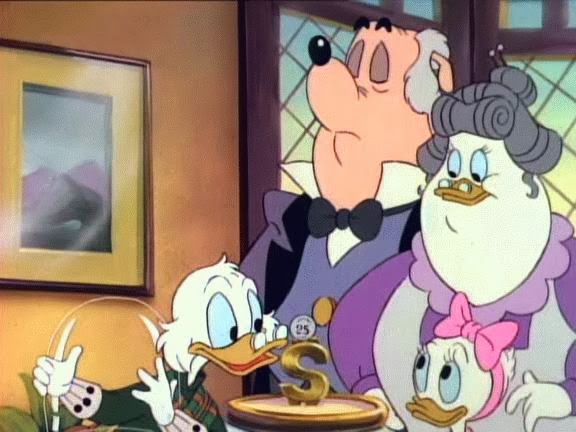
(Greg) Scrooge storms off as he tells Duckworth to begin the yearly polish as we cut to the downstairs drawing room as Mrs. Beakly and Webby ha[ve] joined in for fun. They gather around the room complete with dime on glass which I guess Scrooge moved from the Money Bin after Dime Enough For Luck which is quite smart methinks.
Based on "Magica's Shadow War," "Magica's Magic Mirror," and "Send in the Clones," the Money Bin location of "Dime Enough for Luck" was the exception, rather than the rule.
(Greg) Scrooge wants it all as the bank manage is hardly amused as Scrooge claims that he was the 8th grade treasurer and that's enough for him to get thrown out of the bank with a wussy bump.
Another unwarranted Americanism creeps into Scrooge's Scotland. I think that they call grades "forms" in the British system.
(Greg) Another scene changer as Scrooge is riding a bicycle towards the ruined river boat as Scrooge narrates that he hoped that Catfish's skills would rub off of him. Scrooge does an excellent chin up on the door entrance and crashes the bicycle off-screen inside since it had no brakes during the time period see.
A nice detail!
 (Greg) [Uncle Catfish] used to haul freight for Colonel Cornpone.
And so did a big, fat frog furry in weird clothes as he hops in and
he's Old Man Ribbit (William Callaway) and he's French see. Hew
sounds like he's talking African American for some reason and faking
the French. Somehow; I do not like where this is going.
(Greg) [Uncle Catfish] used to haul freight for Colonel Cornpone.
And so did a big, fat frog furry in weird clothes as he hops in and
he's Old Man Ribbit (William Callaway) and he's French see. Hew
sounds like he's talking African American for some reason and faking
the French. Somehow; I do not like where this is going.
As is stated later, Ribbit's accent is actually a Cajun accent. Actually, the strange thing about Ribbit is not his accent; it's the fact that he's a man-sized frog in the DuckTales "universe"! Doesn't it seem as though TaleSpin would be a more "natural" place to see a character like that?
 (Greg) So we get the scene changer as the [Cotton] Queen starts up again as we cut to inside as Scrooge was
shoveling coal like a bicycle on his makeshift bicycle because
working smarter is more effective than just working harder. It's what
McPoppa would always say.
(Greg) So we get the scene changer as the [Cotton] Queen starts up again as we cut to inside as Scrooge was
shoveling coal like a bicycle on his makeshift bicycle because
working smarter is more effective than just working harder. It's what
McPoppa would always say.
Forget coal, elephants, and diamonds: Scrooge's "coal slapper" is what I choose to regard as Scrooge's finest "business moment" in "Dime."
 (Greg) We continue [the railroad building] for a while and then
the workers stop dead in their tracks as Scrooge would say (and
Disney Captions would not) in the narration as Ma Beagle and the
Cowboy Beagle Boys stop them and it's stick up time... Scrooge calls [them] either robbers or the ugliest welcome wagon in
history.
(Greg) We continue [the railroad building] for a while and then
the workers stop dead in their tracks as Scrooge would say (and
Disney Captions would not) in the narration as Ma Beagle and the
Cowboy Beagle Boys stop them and it's stick up time... Scrooge calls [them] either robbers or the ugliest welcome wagon in
history.
The "forced" way in which Alan Young reads this joke is actually funnier than the joke itself. It's as if Scrooge, in an indirect "fourth wall" reference, is daring us not to laugh.
Next: Episode 63, "All Ducks on Deck."


Following Young Scrooge's truncated traipse through the Klondike (Goldie? Never heard of her), "Dime" provides us with a few final memorable moments after the lad is bilked out of his gold stash by the "Oklahoma timberland" salesman. Given that the Scrooge of DT's "Back to the Klondike" was already as "tough as the wolves" and had arguably enjoyed a romantic relationship with the sexiest gal in the region, it requires some mental gymnastics to accept the idea that the post-Klondike Scrooge could be cheated so easily, but at least the sequence is consistent with the portrait of Young Scrooge presented earlier in this particular story. There follows the Beagles' train hold-up, Scrooge's "having a blast" (and temporarily losing Old #1, not to mention his plaid wardrobe), and Scrooge's use of "Scottish warfare" to bring the Beagles low. We'll also see bagpipes used as weapons in the second season's "Full Metal Duck," though the effects of the pipes are played more for laughs there. Here, given that one of the Beagles admitted earlier that Ma Beagle (who, let us be clear, is NOT the same as the Ma Beagle who appears in contemporary Duckburg) had committed murder to obtain clothes, I think it is entirely appropriate that the Beagles have a much harder time dealing with the squealing squash-machine.


So, overall, this "term paper" gets a failing grade, albeit one that is given with at least a twinge or two of regret. It's tempting to think that all would have been well had the series followed Greg's advice and turned "Dime" into a two-part story. Based on the available evidence, though, I'm not sure that Esckilsen, Koonce, and Weimers would have known how best to fill the extra space. 30 additional kilt and bagpipe jokes wouldn't have cut it, but I'm afraid that that would have been the most likely scenario.
.
.
.
"DuckBlurbs"
(Greg) Scrooge storms off as he tells Duckworth to begin the yearly polish as we cut to the downstairs drawing room as Mrs. Beakly and Webby ha[ve] joined in for fun. They gather around the room complete with dime on glass which I guess Scrooge moved from the Money Bin after Dime Enough For Luck which is quite smart methinks.
Based on "Magica's Shadow War," "Magica's Magic Mirror," and "Send in the Clones," the Money Bin location of "Dime Enough for Luck" was the exception, rather than the rule.
(Greg) Scrooge wants it all as the bank manage is hardly amused as Scrooge claims that he was the 8th grade treasurer and that's enough for him to get thrown out of the bank with a wussy bump.
Another unwarranted Americanism creeps into Scrooge's Scotland. I think that they call grades "forms" in the British system.
(Greg) Another scene changer as Scrooge is riding a bicycle towards the ruined river boat as Scrooge narrates that he hoped that Catfish's skills would rub off of him. Scrooge does an excellent chin up on the door entrance and crashes the bicycle off-screen inside since it had no brakes during the time period see.
A nice detail!

As is stated later, Ribbit's accent is actually a Cajun accent. Actually, the strange thing about Ribbit is not his accent; it's the fact that he's a man-sized frog in the DuckTales "universe"! Doesn't it seem as though TaleSpin would be a more "natural" place to see a character like that?

Forget coal, elephants, and diamonds: Scrooge's "coal slapper" is what I choose to regard as Scrooge's finest "business moment" in "Dime."

The "forced" way in which Alan Young reads this joke is actually funnier than the joke itself. It's as if Scrooge, in an indirect "fourth wall" reference, is daring us not to laugh.
Next: Episode 63, "All Ducks on Deck."


