Despite its being originally broadcast on November 17, 1990, during the first season of The Disney Afternoon, it's hard not to regard "Scrooge's Last Adventure" as being the "moral and/or functional equivalent," at the very least, of the end of DuckTales' unexpectedly prolonged second season. Yes, "A DuckTales Valentine" was broadcast during the 1989-90 season, but it was not originally a syndicated episode, appearing instead as part of an NBC special, in the manner of the edited version of "Super DuckTales" the year before. I tend to regard "DTV" as inhabiting a sort of Limbo between the "second season" of Fall 1989 and the "third season" of Fall 1990. (It's an open question as to whether it should have stayed in "Limbo" permanently, but I'll address that when I review the ep.)
Of course, "Last Adventure," despite its 1989 copyright date, could kinda-sorta be legitimately counted as a 1990-91 episode as well, thanks to the good offices of Ken "Kopykat" Koonce and David "Double Your Pleasure" Weimers...
Though, to be fair to K&W, the differences between "Last Adventure" and "Bearly Alive" (which actually debuted a few weeks BEFORE "Last Adventure" finally aired) are clearly more distinct than those between "Allowance Day" and "The Time Bandit." The meshing of the two plots of "the main character mistakenly believes that he's dying" and "the main character participates in an adventure under the assumption that he's dying" is far more successfully executed in the TaleSpin episode than it is in "Last Adventure." Joe Torcivia and I recognized this immediately, and, in fact, Joe included his own suggestions as to how "Last Adventure" could have been "fixed" in an Appendix to our complete DUCKTALES INDEX. I'll highlight some of Joe's specific suggestions before I'm done. The main point is that, unlike "Ducky Mountain High" and "The Duck Who Knew Too Much," the flaws of which became somewhat clearer to me upon repeated close viewings, we KNEW that something was amiss with "Last Adventure" from the off. GeoX hit it square on the beak when he observed, "There's really two episodes here, and neither one gets the space it deserves." Which is a real shame, as "Plot A" (not to be confused with "Plan B"!) represents nothing less than an historical departure for Scrooge into what Joe termed "the incredible world of bits, bytes, glitches, and microchips," a full decade before the creation of the Nephews' I-Team and such "thoroughly modern" UNCLE $CROOGE stories as "World-Wide Witch" (UNCLE $CROOGE #320, August 2003). DuckTales fans may be permitted a bit of smugness when I note that, while these comic-book stories were panned by some readers who didn't cotton to the notion of Scrooge or any of the other Ducks getting involved with modern high-tech, no one of my acquaintance seemed to mind in the least Scrooge and Fenton's trip into the digital world, or, for that matter, Scrooge's earlier use of a PC and a word-processing program in "A Case of Mistaken Secret Identity."
An ENTIRE episode devoted to the interface between Scrooge and cyberspace, if executed properly, could have been one of the most memorable Duck-related media moments of all time. It also was certainly feasible for a good subplot to have been included; for example, Fenton's dogged determination to make up for the malfunction of the computer banking program could have been amped up a few levels, in order to show just how responsible even a bungler like Fenton can be when the stakes are high enough. But, no, K&W just HAD to fall back on the trope of Scrooge getting the impression that "[his] old ticker is beyond repair" and he's doomed (and therefore needs to think about preserving his fortune for all time). Adding to the "retreaded" feel of this plot line is the fact that the phone conversations that set up the misunderstanding in both "Last Adventure" and "Bearly Alive" both end with the same gag about "selling the spare parts."
In both "Adventure" and "Bearly," young characters' destruction of a precious inanimate object sets the plot-ball rolling down its well-established, Worry Room-depth groove. Kit Cloudkicker is probably technically more at fault than the Nephews, given his more mature character and HD&L's well-established reputation for rule-skirting, boyish hijinks, which has been downplayed a bit for their role in the TV series but has certainly popped up on occasion in the past. This is partially obscured by the amount and extent of the destruction seen on screen.
Both "Adventure" and "Bearly" also skirt the bounds of probability by having a "doctor who isn't really a doctor" break the "bad news." But then, we get the moment of true divergence when Scrooge, the party directly involved, receives the dubious diagnosis, as opposed to Rebecca Cunningham, who is the affected character's boss. Baloo subsequently gets the word from Becky, and the actions that follow (to wit, Baloo daring to enter "The Bearmuda Trapezoid" and make one final bid for eternal notoriety) flow directly out of that revelation. Moreover, those actions are entirely personal in nature, and, despite the ultimate introduction of the subplot involving Howard Huge and the Spruce Moose, would have limited repercussions on the world at large, whether or not they result in success. Scrooge's decision as to what to do with his money, and his subsequent loss of said money in the computer, would have far greater societal ramifications (as we saw in a far more dubious context in "Yuppy Ducks"), making the lengthy delay in his finding out the truth seem all the more aggravating. The fact that Fenton knows the real truth but never does tell Scrooge, even in the face of Scrooge verbally confronting his mortality on several occasions, also doesn't sit too well with the attentive viewer.
Once "Adventure" and "Bearly" shake loose from the "dying" conceit, they both lay out reasonably well-crafted adventure scenarios. The major reason why "Adventure" sustains more long-term damage is that it simply takes too long for the "dying" business to be cleared away, especially when one considers what's to follow in its wake. Before that "one giant leap for Duck-kind," we have to trudge through a painful first act in which HD&L do, as Greg suggests, channel a number of the less attractive characteristics of the cynical Quack Pack Nephews -- with the added abrasion of the hideous "Plan B" crying fit. The juxtaposition of the smarmy "false sincerity," the brute-force bawling, AND the po-faced dissing of "the good Junior Woodchuck thing to do" is terminally cream-curdling, to be honest, no matter what HD&L might (and, in fact, do) do later in the ep to express their concern for Scrooge and Fenton's well-being. (I'm less harsh on the boys' disruption of Scrooge and Fenton's progress inside the computer when they start to play "Quackman." They couldn't have known what was going on at the time. Even so, it might not have hurt for them to have asked who had been using the program that was currently running on screen before they went ahead and made the switch.) Are the boys as bad here as they were in "Yuppy Ducks"? No, but it's an uncomfortably close call.
The misled Scrooge's interactions with his household staff aren't much better. Scrooge's reported comment to Mrs. Beakley -- "The way [you] look, [you] must enjoy [your] cooking" -- really does come off as, in GeoX's words, just about "the most dickish thing" Scrooge has ever said, and the "X is for wimps" joke didn't justify multiple repetitions, each of which is less successful than the last. The confab with Fenton is a little more successful, mostly because Fenton's suggestion that Scrooge turn to computer banking really is a pretty clever idea (particularly in 1989), but, basically, we're just kind of spinning our wheels until the fateful moment when the "glitch" makes its appearance. The brief scene of Duckworth crying, even though he hasn't been told by Scrooge why he should be crying, is the only bit that really works. One of the few saving graces here is the early introduction of Scrooge's magnet-tipped cane, a classic example of a "small detail" being slipped into the picture well in advance of its ultimate use.
In a more philosophical sense, one reason that Scrooge's reaction to his fake fate never really rings true stems from the nature of Scrooge himself: Scrooge resigns himself to his apparent fate much too easily. It is more believable to imagine Scrooge, after he has absorbed the initial shock, doing everything that he possibly can to find a way to preserve his life against all odds, just as he has always fought to protect his fortune, not for its monetary value, but for its symbolic value as a reflection of his life of toil. In Carl Barks' illustrated prose story "Go Slowly Sands of Time" (UNCLE $CROOGE McDUCK: HIS LIFE AND TIMES [1981]; later redone as a comic-book story in 1983), Scrooge goes to the trouble of seeking out a distant land of long-lived people in order to find the "secret" of eternal vim and vigor, only to find that he's known the "secret" all along, which is to love your work and take pride in what you do. This proactive Scrooge is nowhere to be found in "Last Adventure." Instead, we get a carbon copy of the fatalistic, almost dazed Scrooge of an episode like "The Money Vanishes." Not until Fenton (rather insensitively) suggests that "there's nothing [Scrooge] can do" about the lost cyber-money does Scrooge snap back into form, snarling, "Never say that to Scrooge McDuck!" Better late than never, but still... um... late.
So how could this "pre-computer" portion of the episode have been improved? Joe suggested that a massive Beagle Boy raid on the Money Bin, similar in scope to, or perhaps even bigger than, the attack in "A Drain on the Economy" could have provided the setting for Scrooge's decision to seek a "terminally foolproof" way to secure his fortune. Joe theorized that Scrooge could have gotten steadily wearier and wearier during the course of the lengthy battle, reflecting the cumulative effect of his advanced age. Realizing that additional generations of Beagles are waiting on the horizon, Scrooge could then have made the decision to find an ultimate solution, giving Fenton the opening to suggest computer banking. This would do away with the need for a "Scrooge thinks he's dying" context, would include the subtheme of Scrooge wanting to preserve his fortune for the benefit of HD&L and Webby, and would allow for a more thorough exploration of the world inside the computer. Makes sense to me! (A more modern take on this scenario, reflecting the more reliable software of the 21st century, might include Scrooge being worried about identity theft and subsequently fighting with a cyber-villain for control of his electronic fortune.)
Even though the circumstances are quasi-tragic, it's hard not to get through the "Fenton's disrupted demo" sequence without emitting a chuckle or three. Fenton's exaggerated reactions are certainly a major reason why, and their combined effect is amplified by Alan Young's comparatively restrained, yet steadily more infuriated, verbal reactions to Fenton's obvious discomfiture.
Enter "accommodating source of miracles" Gyro, whose quality of performance here, after a somewhat up-and-down second season as a whole, can hardly be faulted. (No, not even that temporary detour for the broccoli sandwich. I'm speaking in technical terms here.) Flourishing a soon-to-be-obsolete floppy disk, Gyro proposes to digitize Scrooge so that Scrooge can hunt for the "glitch." Fenton then makes up for his mistake -- which, in truth, isn't necessarily a mistake at all, given that the appearance of the "glitch" couldn't have been predicted -- by demanding that he be allowed to accompany Scrooge. His methods of persuasion include... *sigh*... "Plan B." But his intent is still noble for all that.
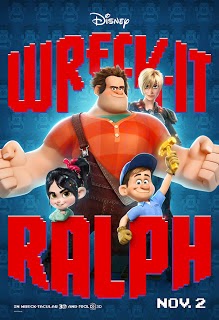
And off they go into the wired blue yonder! The "Cyberworld" visuals we see in Act Two and Act Three are appropriately impressive, though they're obviously not meant to be taken seriously -- at least, not as much as the visuals seen in Disney's original Tron (1982). A "cyber-vehicle" -- the "Diskdrive," in Scrooge and Fenton's case -- appears in both cases, but "Last Adventure" interprets it as a literal nautical vehicle, swimming on an "ocean of current." This is amplified when "Moby Glitch" reenacts a scene in Jaws (1975) and announces its presence by taking a chomp out of the Ducks' "butterfly net" (which the Ducks presumably produced in the time-approved "Toon" fashion). Fanciful, to be sure, but a lot more satisfying than, say, the scenario presented in the 101 Dalmatians: The Series episode "Virtual Lucky" (1997), in which the computer screen is, in effect, a glass partition, and the scene inside the computer is presented as a 3-D diorama, with the characters inside the computer able to talk to the characters on the other side of the glass. Wreck-it Ralph (2012) was rather more successful in pulling off this latter conceit, primarily because the characters "inside" and the characters "outside" could not communicate in any way, not to mention that the CGI characters were rendered in 3-D to begin with.
The parallel plot threads of Scrooge and Fenton trying to find their way through an ever-changing computer environment and Gyro trying to dope out a way to rescue them are developed in a thoroughly appropriate, tension-tightening manner. Ending Act Two with the "plug" literally being pulled on Scrooge and Fenton was exactly the right decision, not least because it allows for a glorious opening to Act Three, in which the "Cyberworld" literally reconstitutes itself before our eyes, climaxing with the reappearance of Scrooge and Fenton. (Cleverly, and correctly, the Ducks are deposited more or less right back at the place where they entered the computer, at the helm of the "Diskdrive.")
Once Scrooge and Fenton "reach out and touch someone through the telephone system," things begin to get just a bit wonky. Interpreting the phone wire as an empty tube is an acceptable metaphor, but it edges a bit closer to "diorama" territory than we had previously been. The references to phone modems are probably the single most technologically dated aspect of the episode, in the sense that this material would have to be completely revised and updated in a modern retelling of the story. (For example, Gyro would need a different manner of directly communicating with Scrooge and Fenton than literally talking through Scrooge's phone.) Thankfully, the climactic, though sadly off-screen, punch-up (with Fenton literally getting eaten!) and Scrooge's belated use of the magnetic cane make for an exciting ending and a climax that Captain Ahab could only have wished for in his dreams.
Now, how to get our heroes and Scrooge's money back to the world of flesh and feathers?...
Oh, boy... This is all kinds of "inoperative." Joe, who has worked in the computer field for his entire life, really didn't like the sloppy, almost defiantly lazy manner in which this was handled. In his alternate scenario, following the defeat of "Moby Glitch," Scrooge and Fenton were threatened with extinction by the "reformatting" of the floppy disk, only for Gyro to pull their digitized tailfeathers out of the fire at the last minute. With things back to normal, Scrooge then demanded that Fenton get his money out of the computer and back to the Money Bin. Refreshed by his adventure, Scrooge then turned with renewed enthusiasm to his battles with the Beagle Boys, now realizing that "there is much worse" than engaging in continual battles with a flesh-and-blood foe. Carrying this scenario out on screen would have required additional explanations of real-world computer terms, but it could certainly have been done in an imaginative manner. Moreover, since the theme of Scrooge dying would have been removed to begin with, we could have been spared this unfortunate fadeout scene...
As was the case with the other members of "The Tardy Trio," "Last Adventure" could have been considerably better than it was. The sense of loss is probably the most acute here, though, precisely because the core idea was so strong, not to mention exceptionally forward-thinking. It was a shame that the idea wasn't given sufficient "elbow room" to be exploited to its fullest.
.
.
.
"DuckBlurbs"
Believe it or not, The Disney Afternoon wasn't finished with the "mistaken mortality" trope once "Last Adventure" and "Bearly Alive" hit the airwaves. Never a series to create "something new" when "something borrowed" was already close at hand, Goof Troop gave us the 1992 episode "Terminal Pete," in which Pete learns that he's supposedly dying and decides to make the most of his remaining days in Spoonerville by... becoming a stuntman. What can I say, it was THAT kind of show.
(GeoX) …so why isn't this the last episode, then? Are they implying, thusly, that Scrooge Will Never Die? Or, more likely, was it planned to be the finale, but was shuffled around due to some desire to end with a two-parter?
It was almost certainly a clumsy attempt to telegraph the "dying" trope, but it wound up giving the wrong impression as to the series' future plans. When I read the synopsis in the Gladstone DUCKTALES comic, I originally believed that it really was Scrooge's "last" adventure, at least in a DuckTales context. That was why the appearance of new, 1990-copyright eps in Fall 1990 came as such a huge surprise.
(GeoX) If there's one thing I like, it's media about "cyberspace" from a time when nobody was really clear on what that entailed.
I think you've hit on the reason why Tron became such a belated cult favorite. "Last Adventure" had the potential for cult status, too, had it not been for... well, you know...
(GeoX) Note that this computer is actually in the bin, so now it's buried under huge mounds of cash--if Scrooge ever wants to get it out, he's got his work cut out for him.
Since Scrooge's home computer is in a convenient location (the workspace/TV room/conversation pit/etc.), it would stand to reason that his Money Bin computer should be in a similarly commodious place -- for example, next to his desk. The Money Bin computer was situated where it was only because Koonce and Weimers simply HAD to have their lame-o, "money-gushing" ending. Ugh.
(GeoX) "Nice game those Duckburg Dodgers had last night, huh?" The Mallards, the Stealers, and now a third baseball team??? Well, if the Stealers play baseball, I suppose the Dodgers can play football. You'd think there could at some point have been some sort of consultation on the subject among the writers, though.
There is a precedent for a football team being named the Dodgers, so I'm going with the football theory.
(Greg) Oh lord; how contrived and forced can you get? Are we supposed to believe that two nephews can destroy a grandfather clock THAT easily? Kit yanking out the compass in Bearly Alive is much more believable than this... And how did Mrs. Beakley NOT hear the noise?!
Well, if the clock is a fragile antique, I suppose that it would be more vulnerable to "mass destruction," provided that it was struck roughly enough. As for Mrs. B., she may have been out of earshot, for example, down in the kitchen area near the breakfast nook.
(Greg) Scrooge answers the phone and yes; it's Doctor Glockenspiel (late Hal Smith in case you didn't notice)...
Actually, it's Hamilton Camp. Likewise, Nurse Hatchett is voiced by Joan Gerber, rather than Kathleen Freeman. Though she received a credit, Freeman apparently did no voices here.
(Greg) Dewey wants to put it to a vote; and all of [the Nephews] put the money behind the[ir] backs and whistle. Memo to GeoX: I realize that you hate the fact that they betrayed the Woodchucks in such an insulting way; but seriously, the Woodchuck Guide Book has been such a hit or miss book in terms of creditability that at this point; the writers [have stopped] caring about it since it's already screwed up in this canon.
It's the principle of the thing more than anything else -- the long-established idea that HD&L, as GeoX says, take the ideals of the JWs very seriously. They would probably do that even if the Guidebook were more fallible than it is typically depicted as being in the comics. Carl Barks and the other people who wrote JUNIOR WOODCHUCKS stories certainly had more than their share of fun with the inflated pretensions of the Woodchucks as an organization, but they never depicted the boys as cynically playing with the notion of what they should do as JWs. I still think that HD&L came off FAR WORSE during "Yuppy Ducks" when they abandoned the comatose Scrooge, but Koonce and Weimers' reuse of the "Not the honest Junior Woodchuck bit again!" trope here is one of the strongest suggestions to date that the duo have well and truly burned out on the series. (They will, however, prove to have just enough gas left in the tank to make one more meaningful contribution -- albeit with considerable help -- before the curtain comes down.)
(Greg) The nurse hangs up thus showing that she has absolutely no sense of
humor whatsoever and then Fenton hears groaning and we head into the
vault to see that Scrooge has somehow appeared on the area where the
diving board used to be and now it's gone for no reason whatsoever. Not
to mention that we never saw Scrooge walk in; so was he in the vault all
this time? And since the vault is open; he surely had to hear Fenton
insult him.
I don't have an explanation for this, either. I can imagine Scrooge having a VERY explosive reaction when he walked in and found Fenton seated at Scrooge's desk!
(Greg) Scrooge goes nut[s] and swings the cane around getting off death reference #2 and nailing the cane right on the corn on his foot and yelping and doing the foot grabbing spot in pain. He clearly was aiming for Fenton and missed by a country mile. The "I'm not [about] to die a father!" makes no sense though; it should be "I'm not going to die pennyless in the gutter!".
Scrooge actually says "I'm not about to die a pauper!", which certainly makes sense in context.
Next: Episode 96, "A DuckTales Valentine."
Comics, book, and DVD reviews (and occasional eruptions of other kinds)
Showing posts with label Novels. Show all posts
Friday, August 22, 2014
Saturday, August 9, 2014
Book Review: WALT DISNEY'S MICKEY MOUSE, VOLUME 5: OUTWITS THE PHANTOM BLOT by Floyd Gottfredson (Fantagraphics Press, 2014)
By the time we run out of space in this latest Gottfredson collection, we're bumping up against what I consider to be THE ABSOLUTE prime period of the strip -- roughly, from 1940 to 1942. Every single story during this period is a winner in every way, and, as fate would have it, we're going to get just about the whole schlemozzle in Volume 6. Before that, however, we're obliged to crawl over a fair amount of the panelological equivalent of "broken glass." Despite the presence of the single most famous MICKEY story of them all, "Mickey Mouse Outwits the Phantom Blot," the 1938-1940 dailies reproduced here vary dramatically in quality and force the reader to choke down a carload of racial stereotypes, mostly of the black persuasion. (Even the appearance of the Blot himself was partially inspired by the looks of two Negro children called "The Blots" in the old comic strip JERRY ON THE JOB.) Some of the early reviews of Volume 5 have made quite a bit of this unfortunate coincidence. It doesn't really spoil a context-conscious reader's enjoyment of this collection, of course, but those who are made overly squeamish by "unacceptable" pop-culture conventions past are advised to proceed with some caution.
One of the problems here is that some of the worst examples of stereotyping are married to stories that are unusually weak by Gottfredson's standards. "Mickey Mouse Meets Robinson Crusoe" marks a significant turning point in Mickey's history, as the strip of December 22, 1938 suddenly finds The Mouse sporting pupiled eyes for the first time. The context, confusingly, is the start of filming of a new MICKEY cartoon, an adaptation of the Daniel Defoe classic. Not that Gottfredson hadn't tried framing gambits like this before -- see this volume for two such efforts -- but, given that the daily strip, unlike the Sunday page, had long since been dedicated to lengthy, real-world adventure narratives, using it here seems awkward. Gottfredson's use of the "make-believe" cordon sanitaire becomes more understandable once we bite into the heart of the story: a messy slumgullion featuring an irritatingly nebbishy, "pink-tea" version of Crusoe and "island natives" who talk like Stepin Fetchit. It's every bit as embarrassing as it sounds. Remarkably enough, Gottfredson did a sequel of sorts to "Crusoe" in "An Education for Thursday," wherein friendly (and lazy, and hungry) native Friday sends his "almost twin brother" Thursday to Mickey to acquire some "edumcation." IMHO, "Thursday" wears a bit better than "Crusoe" only because Thursday is a primitive savage, as opposed to a deep-Southern knockoff, and it's not hard to mentally replace Thursday with DuckTales' Bubba Duck and interpret Gottfredson's three months' worth of "fish out of water" gags as a sort of "early director's cut" version of "Bubba Trubba."
"The Miracle Master" and "The Plumber's Helper", while far more satisfying than "Crusoe" and "Thursday," suffer from another problem that seems to have been bothering Gottfredson during this period: an inability to wrap up his stories in a reasonable amount of time. "Master" takes a reasonably short time to make its basic cynical point about the futility of well-meaning reforms (even magical ones) in a fallen world, but taking the show to "Genieland" to make exactly the same point seems like overkill. The inadvisability of the double-dip becomes apparent when Mickey's visit to "Genieland" quickly devolves into a series of gags. Granted, many of the gags are pretty amusing, but you're ready for the story to be over long before it actually is, a rare experience for a Gottfredson reader. "Helper" is a cleverly written mystery featuring one of Gottfredson's more intriguing visiting characters, but, given that it lasts almost 40 strips longer than "Phantom Blot" and has almost no action, it's not hard to imagine that Gottfredson could have sped up the story a little and sharpened its impact.
Aside from "Phantom Blot," the quality of which goes without saying, the best story in the book is "Mickey Mouse, Mighty Whale Hunter," the last great "true adventure" of the "pie-eyed Mickey" era. It's got all the classic whaling tropes -- including, of course, a couple of ethnic stereotypes among the crew -- but Gottfredson doesn't fall into the trap of concluding the tale with the capture or destruction of the legendary whale "Ol' Barney." His solution to the problem is far more subtle and gives Mickey one of his more memorable "compassionate moments."
Ancillaries include reproduced pages from the "softened" 1955 reprinting of "Phantom Blot" in WALT DISNEY'S COMICS AND STORIES, in which the Blot's notorious deathtraps are redrawn by Paul Murry as considerably less perilous perils; a first-rate essay by Joe Torcivia on the history of the Blot; and a fascinating "Heirs of Gottfredson" piece detailing just how heavily the early works of Osamu Tezuka were influenced by "Phantom Blot." It ain't subtle, gaijin.
Labels:
Books,
Comic Strips,
Disney Afternoon,
Disney comics,
DuckTales,
Floyd Gottfredson,
Mickey Mouse,
Movies,
Novels,
Paul Murry,
WDC&S
Wednesday, June 4, 2014
DUCKTALES RETROSPECTIVE: Episode 82, "Blue Collar Scrooge"
"Blue Collar Scrooge" is perhaps best classified as a "guilty pleasure" -- an episode in which the lapses in storytelling logic are buck-naked and blatantly obvious, but an episode which still manages to entertain. OK, so Greg is right, it's no "The Old Man and the Sea Duck"; it's much more of a workmanlike, garden-variety amnesia story than a fanciful quasi-fable with spiritual overtones. But its low-key sentiment -- and a surprisingly non-trivial amount of character development -- make it a pleasant enough viewing experience.
David Weimers, who co-wrote this episode with veteran sitcom scrivener Sam Locke, was, of course, partially responsible for a somewhat similar treatment of "Scrooge the ruthless businessman" in "Down and Out in Duckburg." The question naturally arises as to whether the portrayal of Scrooge here is more negative than that one was. I'm inclined to say no, not just because we are invited to feel sorry for the old miser after he loses his memory, but also because the idea of Scrooge's "bad behavior" is based on presumptions that are never formally justified. The most important of these is the assumption that Scrooge's sale of his skateboard factory to the Overseas Competition Company will result in the factory workers losing their jobs. Everyone from Fenton (whose performance here is criminally underrated) to the workers themselves take this outcome as a given; our own GeoX does the same in his review. And yet... nowhere does Scrooge, OCC boss Mr. Trumpcard, or anyone else say that this is what is going to happen. Sure, I can understand the characters jumping to that conclusion, but assuming that it inevitably "must" take place is simply not the same as Scrooge walking around Duckburg and insouciantly stiff-arming a trio of unfortunates in full view of the audience.
The "shitty" (to quote GeoX) conditions at Scrooge's factory are also more ambiguously depicted than they might seem at first glance. Minimum-wage "cheap laborers" these folks might be, but let's not forget that they work for the same duck who pays his own relatives the fabled "thirty cents an hour" to assist him with treasure hunts. Under the circs, the workers seem reasonably content, not becoming really militant until they think (again, with no real justification) they are going to be pink-slipped. Perhaps this is merely a fatalistic acceptance of a world in which Scrooge-themed fast-food joints, cafes, and pizza parlors reflect the degree to which the McDuck empire dominates the local entrepreneurial scene, but you must admit that Scrooge's "exploitation" of his workers could have been portrayed in a far harsher manner than it actually was. This takes some of the edge off of what could have been a far cruder exercise in capitalist-bashing (and probably would have been were this show being made today!). Make no mistake, Scrooge is definitely walking on the "shady side of the street" here, but he came across much, much worse in "Down and Out."
The opening scenes, far from showing a completely antagonistic relationship between Scrooge and his employees, depict them as existing in amusingly synergistic relationship, with the skateboard workers knowing Scrooge's habits (of making surprise inspections, in this case) better than he himself does. (I gather that Mrs. Featherby and Henryetta, her friend and contact at the plant, must be regular correspondents.) Since Scrooge is a character who is, in many respects, "set in his ways," for the workers to be hip to Scrooge's quirks isn't so hard to believe. Scrooge, in fact, is so convinced that his workers can't possibly be in the know that he blows off Fenton's direct report of manager Egert Beaver's confession.
In the first big logical "WTF" of the story, Scrooge appears to forget his previously announced desire to "lick" the overseas competition -- an attitude that surely jibes with his proud contention in "The Uncrashable Hindentanic" that he can mine success out of ANY business venture -- when he informs the shocked Fenton that he plans to sell the factory. Fenton's immediate plea of concern for the factory workers is a watershed moment, the first time that he has ever expressed true empathy for someone who is not his own kin, and shouldn't be overlooked simply because Scrooge's lesson-learning consumes so much of the ep's oxygen. The ensuing conflict between Fenton's feelings of solidarity with the workers and his loyalty to "Mr. McDuck," muddled though it may be by the ep's loosey-goosey logic, is probably the most slighted aspect of the story as a whole.
Scrooge's loss of memory comes about in the most contrived manner possible, but isn't it usually thus with most amnesia stories? Scrooge's involuntary skateboard ride troubles me far less than the fact that the plunge into the water causes Scrooge to magically lose his glasses, hat, cane, AND spats at the same time. Since the dunking apparently leaves him penniless as well, one has to assume that his wallet and/or money belt was also "spirited away." It still seems somewhat unlikely that no one would recognize him -- that broadcloth coat, drenched and mottled though it might be, is still pretty distinctive -- but, in all other particulars, Scrooge couldn't have been more effectively "anonymized" if a computer glitch had swallowed his identity.
While his family tries ineffectively to search for him, the memoryless Scrooge (now speaking in Alan Young's natural, unaccented voice) wanders his way into an unlikely, yet endearing, quasi-relationship with Mrs. Crackshell, who, like her son, also displays some welcome personal growth here. To be sure, Mrs. C. may have an ulterior motive in getting involved with "Pops"; her second and third questions to him make it crystal clear that, for all of her outward crustiness, she's been hoping to snag another man. It's also hard to forget that her first reaction to Scrooge's "return to consciousness" is to bewail "what could have been" in a material sense. But let's give her due credit; the woman who can barely tear herself away from her soaps to acknowledge her own son's presence is willing to open her metallic home to someone she believes to be a perfect stranger. Can you imagine the rebarbative "M'Ma" of "Super DuckTales" acting in such a manner? Didn't think so. Ever so conveniently, Fenton never returns to the trailer during this romantic interlude, but he can perhaps be excused for staying away, since he is deeply involved in the search for Scrooge.
Fenton's decision to imitate Scrooge and complete the deal with Mr. Trumpcard opens the door to all manner of subsequent hilarity, thanks to Hamilton Camp's purposely overbaked Scottish accent (which gets funnier and funnier the more and more absorbed Fenton-Scrooge becomes in his role). But beneath the silliness, there's a serious dynamic at play. Fenton doesn't want the factory to be sold, but he also doesn't want to let his boss down, nor does he want the news of Scrooge's disappearance to cause a panic in the business world (funny -- I could have sworn that "Yuppy Ducks" clearly demonstrated that such massive economic maelstroms were nothing to fret about). Fenton won't face a dilemma this serious until he is torn between revealing his secret identity to HD&L and obeying Scrooge's orders to keep it a secret in "A Case of Mistaken Secret Identity." The skateboard strait is actually direr, because Fenton's battle in "Secret Identity" is strictly an internal one, whereas here, Fenton's decision will directly affect the lives of others. The change in Fenton's attitude as he becomes more "Scrooge-like" is an effective way of depicting the "dark side" of Scrooge's business-mindedness without putting Scrooge himself under the spotlight. It's not a big stretch to imagine a comic-book story in which Donald feels obligated to act as Fenton does here, which actually represents quite a compliment to Fenton as a character.
Having obtained a position at the skateboard plant -- and having been run through the usual gauntlet of "assembly-line agonies" that have been de rigueur in factory fables ever since Modern Times (1936) -- Scrooge is well-motivated to assume the Norma Rae role after the workers learn of the impending sale of the factory. Unfortunately, the ep's wonky logic undercuts the impact of the action, as we are naturally led to wonder how striking would make a difference in this situation. As daring as the strike scenario may seem at first glance, Weimers and Locke were actually playing it extremely safe. Imagine how things would have played out had the angry workers decided, not to strike, but to sabotage the factory or even try to destroy it in some manner, in a sort of blue-collar version of Howard Roark's dynamiting of his "compromised" housing project in Ayn Rand's novel, THE FOUNTAINHEAD. At least that would have fully justified Fenton-Scrooge immediately calling for police assistance!
As to why Mr. Trumpcard suddenly shies away from making the deal when he learns of the strike... Actually, his reaction lends credence to the idea that the workers weren't necessarily fated to lose their jobs. If the factory were going to be shut down anyway, then obviously Trumpcard wouldn't have cared about a strike one way or the other. But a reluctance to close a deal in the face of a work stoppage suggests that he simply wanted to take over the factory and is unwilling to sign the agreement until that little unpleasantness is cleared up. Clearly, Weimers and Locke wanted to make us sympathize the workers, and they probably figured that the best way to do that was to intimate that their jobs were on the line. Unfortunately, the "facts on the (factory) floor" simply don't justify the latter conclusion. In any event, Trumpcard's ultimate decision "to sign or not to sign" is irrelevant, because Fenton never signs the agreement himself... and, even if he had, the act would have carried as much weight as Fenton's unilateral "decision" to cut HD&L's allowances and Mrs. Beakley's salary. That is to say, none. Talk about spinning contrived drama out of "moonbeams and spider silk."
The obligatory "second knock on the noggin" restores Scrooge's memory, and the subsequent "who's who" debate between Scrooge and the by-now-clearly-delusional Fenton is the comedic highlight of the episode. But, just as Fenton's funny mastery of a My Fair Lady-style tongue-twister obscured a serious point about his feelings of responsibility to his employer and to the wider world, so too is Fenton's final exposure and humiliation (triggered by the arrival of Mrs. Crackshell -- how did she know that he was at the factory in the first place?) leavened by an admirable show of character, in which he bravely admits that Scrooge would have every right to fire him for getting so carried away. For a character whose primal drive is to achieve success in the business world, this is quite a remarkable statement; it's Fenton's version of Rainbow Dash's decision to leave the "Wonderbolts Academy" -- and thereby possibly lose her chance to achieve her dream of joining that fabled flying team -- over a point of honor. Thankfully, Scrooge, recognizing that Fenton's exaggerated portrayal of his attitudes and mannerisms reflect how the outside world views him, is quick to realize that Fenton actually did him a favor.
The concluding intimation that the relationship between Scrooge and Mrs. Crackshell may "have webs" after the episode is finished is cute and all, but I'd like to think that both of them correctly realized that they come from two different worlds. Besides, Scrooge probably has some unfond memories of how his old flame Goldie reacted to another extracurricular romance and doesn't want to tempt fate again.
So... a sloppy effort, but a fun one.
.
.
.
So... a sloppy effort, but a fun one.
.
.
.
Bumper #17: "Climbers"
.
.
.
"DuckBlurbs"
(GeoX) Scrooge is going to sell his skateboard factory to the overseas competition, which is, hilariously, actually called "The Overseas Competition Corporation." But he slips on a skateboard and bashes his head and--as I am led to believe generally happens when people get concussions--loses his memory. "What IS my name?" he wonders. "Who am I? And why am I talking in this funny accent?" Okay okay, I know it's just a joke, but it always bears repeating: everyone has an accent; you don't notice your own or those of people who sound like you because for you that's the default, but it is there nonetheless.
True enough, but the indirect reference to Alan Young's Scottish accent -- which, it should be remembered, did not originate with DuckTales or even Mickey's Christmas Carol (1983), but dates all the way back to Young's turn as Filby in The Time Machine (1960) -- is simply too enjoyable to let a small matter like logic get in the way. I've often wondered whether Young motivated the creation of this ep by asking for a chance to use his more familiar "Wilbur Post" (Mr. Ed) voice.
(GeoX) Scrooge calls off the sale...and dictates a modest improvement in working conditions. Characterwise, it's appropriate that he makes things better, but not too much better.
Agreed. It's kind of the equivalent of showing "generosity" by raising Donald and HD&L's salaries from thirty cents an hour to fifty cents an hour.
(GeoX) It's funny that Fenton has no idea what sort of accent Scrooge has, trying on French and German before getting it right (in an abbreviated "My Fair Lady" spoof).
This is the correct order of accents; Greg had it backwards. As for Fenton-Scrooge's Scottish... effort, it may have had a precedent; Hamilton Camp voiced a Scottish-accented character named Greensleeves in the esoteric, George Lucas-produced animated film Twice Upon a Time (1983). Alas, I can't seem to find a clip of Camp's voice work in that production, so I have no way of comparing it to what Fenton delivered here.
(Greg) Anyhow; Scrooge and the gang leave for the skateboard factory (clearly shown with a sign of Donald Duck on a skateboard. Don't ask me why).
Well, if that IS supposed to be Donald, then he's certainly not wearing his usual gear. I'm inclined to think that it's just a generic Duck illo.
(Greg) We head inside as a beaver fury called Mr. Beaver (LAME-O!) want[s] his employees to actually do what Scrooge wants them to do.
Here's another character who would seem more at home in a TaleSpin episode... especially since the Beaver Boys of "Once Upon a Dime" were normal-sized beavers who just happened to be sentient.
(Greg) So we head back to the mansion and into the hallways as the nephews are “testing out” the Sidewalk City Slicker behind Scrooge's back who is in his office (which seems to change room in each and every episode I might add) as he is making a house of dollar bills for his amusement.
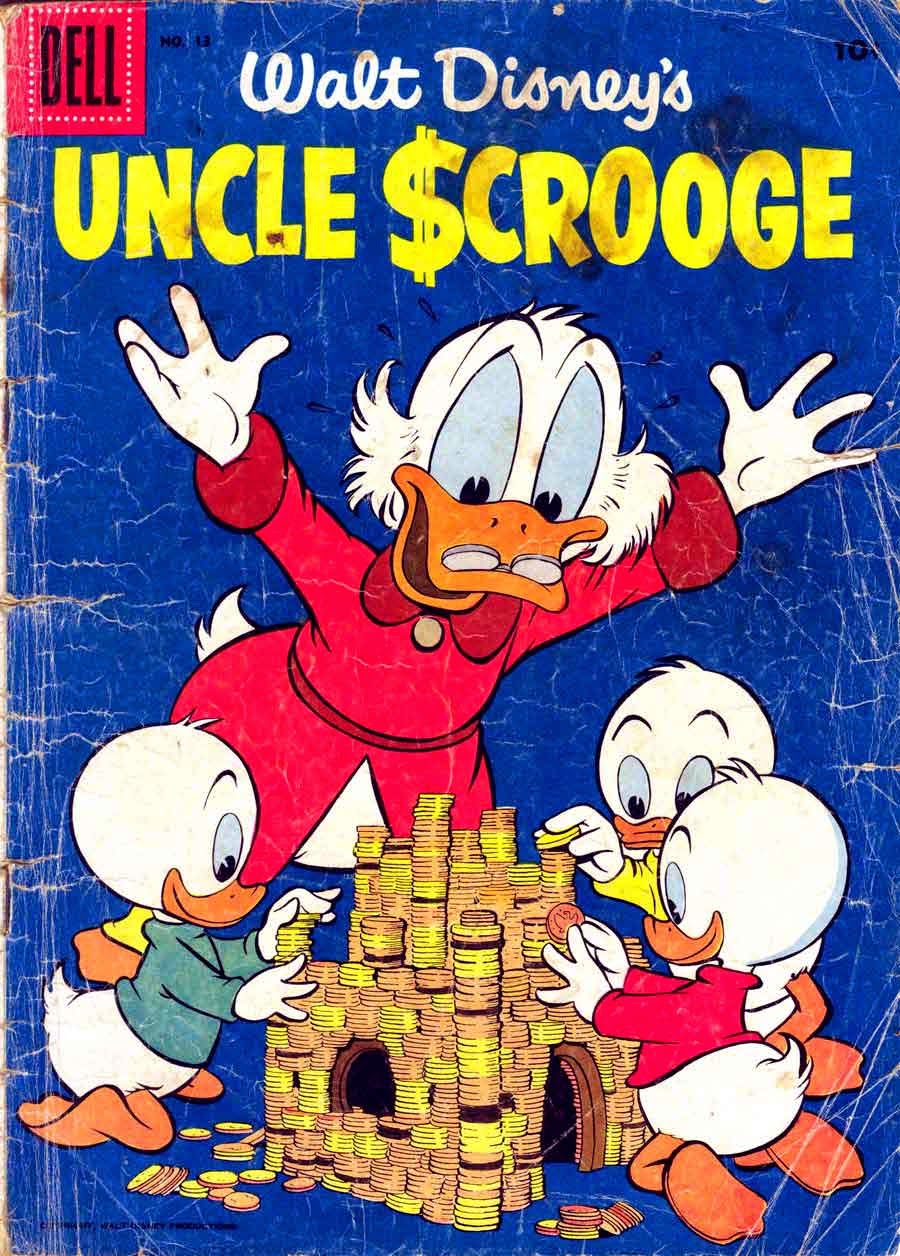
This may have been a reference to Carl Barks' cover to UNCLE $CROOGE #13 (March-May 1956). Granted, the medium of construction is different in the two cases, but, in "Metal Attraction" and "Beaglemania," both of which were produced very soon after this episode, far more obvious references to U$ gag covers were made. This may very well have been where the brief trend started.
(Greg) So we scene cut to Scrooge walking on the sidewalks of Duckb[u]rg as Captain Jack from "Down & Out in Duckb[u]rg" arrives and before Scrooge can speak; Jack throws him a quarter and calls him a bum before walking out.
I'd like to think that this was a veiled reference to that other "Scrooge the ruthless businessman" epic, but it was almost certainly just coincidence.
(Greg) Scrooge is pissed off as he walks to a phone booth and uses a quarter since he's going to give Scrooge a piece of his mind. So we head to Scrooge's office and Duckworth is answering the phone. How hilarious that Scrooge cannot remember anything; and yet he can remember the phone number to the mansion of all places. Logic break #1 for the episode nearly six minutes in.
Given that Scrooge's pay phone doesn't have a dial, perhaps he didn't need to remember the number; he could simply have called the operator and asked to be put through to the Mansion.
(Greg) So Fenton wants them to search high and low, Mrs. Beakly far and wide and Fenton here and there... Scene changer as everyone returns inside as Duckworth asks for Mr. McDuck and of course they cannot find them... Gizmo Duck's tire is flatten[ed] since he found a nail.
Of course, HD&L should now clearly recognize that Fenton is Gizmoduck, since Fenton departed on the search and Gizmo returned FROM the search. Or not. I'm beginning to be convinced that no clear directive regarding the extent to which characters other than Scrooge knew about Fenton's secret identity was ever given to the writers.
(Greg) Scrooge proclaims that he would put aside his hatred for Scrooge for [Mrs. Crackshell] and Ma is excited as the patrons watch some soccer (which even Scrooge calls a football game; which is a big no-no in American cartoons by the way Alan Young and logic break #2 for the episode since he's supposed to sound American and not have the Scottish accent) and Scrooge is tired of it.
Since one of the pizzeria patrons (voiced by Hamilton Camp) is clearly heard to shout, "Go team go, hit 'em again," I suspect that the animators may have misunderstood that the TV was supposed to show an American football game, opting to show the international version of "football" instead.
(Greg) Scrooge is pissed and grabs the glasses and top hat which shows the plunger which in any other universe would prove that [Fenton]'s not Scrooge.
Yeah, about that plunger... Funny how it seems to shrink in length anytime it needs to be short enough for Fenton to wear the top hat without the hat slipping down over his eyes.
Next: Episode 83, "Metal Attraction."
Labels:
Animation,
Carl Barks,
Disney Afternoon,
Disney comics,
DuckTales,
Live Television,
MLP:FIM,
Movies,
Novels,
TaleSpin,
Uncle $crooge
Subscribe to:
Posts (Atom)