Showing posts with label Painting. Show all posts

Thursday, August 28, 2014

Book Review: THE GREATER JOURNEY: AMERICANS IN PARIS by David McCullough (Simon & Schuster, 2011)

David McCullough's followup to JOHN ADAMS and 1776 -- both of which were immense best-sellers and critical favorites -- received critical hosannas which were, for the most part, deserved, but did not do nearly as well in terms of sales.  It's not hard to see why if you take a close look at McCullough's approach.  Here, he tells the story of various Americans -- writers, painters, medical students, inventors, etc. -- who traveled to, lived in, and worked in Paris during the period 1830 to 1900.  While certain figures get more time on the stage than others, so many individuals stroll past on the figurative "Champs Elysees of ideas" that the average reader probably can't be faulted for losing track of "who's who" on an occasion or two.  There's plenty of interesting and fascinating information to be found here, but be warned that considerable attention will have to be devoted to keeping one's mental "scorecard" updated.  The comparative lack of focus, culminating in an ending chapter and an epilogue that might best be described as a "fadeout" rather than a definitive conclusion, may help to explain why some readers found THE GREATER JOURNEY to be somewhat laborious going.

The Americans discussed here should not be confused with the "Lost Generation" who so famously came to Paris in the aftermath of World War I.  The earlier cohorts might be more accurately described as a "Finding Generation."  Leaving a much younger and rawer America, they sought enlightenment, polish, and education in one of the world's most cosmopolitan capitals.  Moreover, they did so without a trace of the world-weary rejection of American mores that so many members of the "Lost Generation" evinced.  The primary goal of such individuals as painter/inventor Samuel Morse, sculptor Augustus Saint-Gaudens, and medical student/writer Oliver Wendell Holmes Sr. was to use the knowledge and skills that they had gained in order to enrich their home country.  Some of them stayed in Paris for years, but they never stopped thinking of themselves as Americans first and foremost.  The interplay between the values that these individuals brought with them and the refinements that residence in Paris taught them provides much of the intellectual intrigue of the book (though, admittedly, certain figures, even some fairly famous ones, simply spend too little time in the spotlight to get full attention on that score).

Easily the most impressive part of the "bitty" narrative is the tale of Elihu Washburne, U.S. minister to France during the 1870-71 Franco-Prussian War, the subsequent siege and fall of Paris, and the short but bloody reign of the Paris Commune.  As the only diplomat from a major power to remain in Paris during the siege, Washburne did yeomanlike service in assisting stranded Americans and people of other nationalities to either escape the city or survive the effects of the siege.  This included protecting German nationals who had been trapped in the city and were in potential danger of being persecuted or killed by the locals.  McCullough makes heavy use of Washburne's diary to keep track of the day-by-day events, as well as Washburne's emotional state.  Significantly, this sequence is easily the most reminiscent of McCullough's sweeping narratives in his Revolutionary War books.

THE GREATER JOURNEY isn't McCullough at his very best, but even a McCullough at three-quarters speed beats the average ideology-bound academic historian every day of the week.  Highly recommended.

Tuesday, February 14, 2012

Comics Reviews: RICHIE RICH GEMS WINTER SPECIAL! and RICHIE RICH GEMS VALENTINE'S SPECIAL! (Ape Entertainment, February 2011)


The last two weeks have been SPECIAL! (sorry, force of overemphasized habit)... real, live dead-tree comics have actually shown up at the local store. And they're RICHIE RICH comics, to boot. While we wait for the "reboot" series to wend its way storewards, these two packages of reprint material will do very nicely, thank you... even if the seemingly inevitable Harvey-related screwups are all too noticeable.

I'm not certain of this, but I believe that VALENTINE'S SPECIAL! was prepared first -- and hurriedly. The huge number of artist-credit errors in this book can't possibly be a coincidence, and some of the goofs are positively egregious. How can you possibly mistake the art of Sid "Crouchey" (sic) for that of Ernie Colon (in the one-page gag "Garden Party")? It's the funnybook equivalent of confusing Norman Rockwell with Grandma Moses (and, since I once referred to Sid Couchey as the G.M. of comics, that's not meant to be an insult). In the gags "Box of Chocolate" and "Just Married," Ernie is mid-ID'd as Warren Kremer, which is at least a little more fathomable. Ben Brown fares the worst; his gag "Big Drink" is attributed to "Crouchey," and, in WINTER SPECIAL!, his longer story "Seems Like Real Fun" is given to Colon. I suppose you could call that a Couchey/Colon "confusance" of the second degree, or something. In any event, I sincerely hope that such avoidable errors can be minimized in future reprint books.

For all of its factual faults, VALENTINE'S SPECIAL! does best WINTER SPECIAL! in the area of variety. You get 13 separate stories and "storylettes" for your V-Day money; WINTER gives you only seven, not counting the four KEENBEAN'S CORNER reprints (from the RICH RESCUE mini-series) at the back of the book. (BTW, I'm not exactly crazy to see these reprints, as enjoyable as they originally were, in a title that's supposed to be devoted to classic RICHIE material. The source of the KEENBEAN gags is at least acknowledged on the back cover, but cutting them loose from their source material and presenting them out of context like this really cuts into their effectiveness.) Each book leads off with a Sid Jacobson/Ernie Colon original, and both efforts are decent enough, though Ernie seems to be having all sorts of trouble drawing Richie's eyes correctly for some reason.

Not only are there a lot of stories in VALENTINE'S SPECIAL!; a lot of eras from the classic Harvey are also represented. We get an Ernie Colon indicia-page gag from a mid-60s issue of RICHIE RICH SUCCESS STORIES (how can I tell? They helpfully left the SUCCESS logo in the first panel!), some Colon stuff from the prime period of the late 60s and early 70s, and two Mayda Munny appearances featuring two very different models of the character -- the early Warren Kremer edition of 1973 or thereabouts, and Ernie Colon's redesigned Cher lookalike of the post-1975 era. And that's just part of the mix. I do have to applaud Ape for selecting Colon's "The Great Mansion Mystery" as one of the featured (read: five-page) offerings. That brief but enjoyable tale doesn't have any specific tie to Valentine's Day, but its story of young love thwarted and then redeemed seems more in the spirit of the holiday than yet another story about Gloria's resentment of Richie's elaborate gifts. WINTER SPECIAL! has a tougher set of material to sell -- a bunch of stories set around winter sports and activities doesn't get the blood flowing, except perhaps when one is actively engaged in said activities -- but it does include the only ten-pager in these two books, Warren Kremer's "The Abominable Snow Plan." And, yes, they kept the "Continued in This Issue" reminder... even though part two of the story commenced on the very next page. Some traditions simply shouldn't be shattered.

Friday, May 27, 2011

Comics Review: WALT DISNEY TREASURY: DONALD DUCK VOLUME 1 by Don Rosa (March 2011, Boom! Studios)

Whatever the ultimate fate of Disney kaboom! may be, I sincerely hope that Boom! exerts every effort to publish its promised sets of "Treasuries" and "Archives" of classic Disney comics material. The company is off to a good (albeit delayed-by-two-months) start with this collection of Don Rosa DONALD DUCK stories from 1987-1990. The DONALD qualifier turns out to be rather consequential insofar as the book's contents are concerned. "Return to Plain Awful" (1989) makes the cut, while "Son of the Sun" (1987), technically an UNCLE $CROOGE tale, does not, even though Scrooge has just as substantial a role to play in the former story. (Indeed, it was Carl Barks' fanciful inclusion of Scrooge in an oil painting that prompted Gladstone to urge Rosa to draw a "Lost in the Andes" sequel in the first place.) Since there is no current indication that any creator other than Rosa will be featured in DD TREASURY -- all those non-Rosa panels used as cover background aside -- why not simply call the series DON ROSA TREASURY and reprint all of Rosa's non-LIFE AND TIMES OF $CROOGE Duck work from panel one? That would seem to make more logical sense.

These early Rosa Duck tales first saw print at a propitious time for American Duck fans. The first iteration of Gladstone Comics was in its heyday, and DuckTales was knocking 'em over with a (duck) feather in syndication. The same sunny spirit is reflected in many of Rosa's earliest stories. Artistically, Rosa's early works now admittedly look a bit crude compared to what the artist would do during the LIFE AND TIMES era and beyond, but there's a certain lightness and playfulness about them that Rosa was only rarely able to recapture following his dispute with Disney and consequent move to Oberon/Egmont at the end of the 1980s. It's refreshing to revisit Rosa's attempt to duplicate the verve and spirit of the Barks ten-pager, a creative template he would all too quickly abandon in favor of far grander (and more grandiloquent) conceptions. While most of these gag stories stick pretty closely to established Barks tropes, "Mythological Menagerie" (1987) kicks the standard "Donald vs. HD&L contest" and "escalation plot" notions up a notch with the help of some well-aimed authorial research, while "Metaphorically Spanking" (1988) gives the hooky-playing Nephews a brutal going-over that even Barks might have shied away from. The Oberon stories at the end of this book, plotted by Dutch writers and dialogued by Byron Erickson, are certainly more smoothly executed by Keno D. but are also less lively and distinctive.

The two longer works included here, "Return to Plain Awful" and "The Crocodile Collector" (1988), seemed "big" at the time but have since been dwarfed in scope by Rosa's LIFE OF $CROOGE. It's therefore easy to overlook just how well-told these stories are. "Return to Plain Awful" extrapolates in a most delightful way from Barks' one-off conceit of the isolated Plain Awfultonians' rush to imitate any new fashion or patois ("Just like Americans!", gripes Scrooge, in an unfortunate foreshadowing of Rosa's later petty sniping at the unenlightened "red-state" rubes who did not rush to hosanna him as Europeans did). "Crocodile Collector" (in which Rosa spun an entirely new story out of a Barks cover that originally illustrated a completely different tale) is packed with exposition regarding sacred crocs, Egyptian mythology, and such but is no less enjoyable for all that... and it gets "double-extra" points from me for actually allowing Donald to emerge from the fray having clearly bested Scrooge. Granted, Donald is the victim of several comical pratfalls during the story, but neither is he reduced to lying in a puddle of drool. It shouldn't be forgotten that these enjoyable works were among the stories that convinced Disney TV Animation to give Rosa a chance to write a couple of episodes of TaleSpin.

The collection's one curio is a "scribble-version" of a never-finished story entitled "The Starstruck Duck" (1989), created as a tie-in for the opening of the Disney-MGM Studios theme park. In a world where Donald is an average Joe but Mickey Mouse is a celebrity, Don literally knocks himself silly trying to procure Mickey's autograph. I'm sure that the mere thought of this "corporate commercial" project would cause Rosa acute gastrointestinal pains today. Come to think of it, it probably would cause similar pains for Disney bigwigs. At the time this story was conceived, Disney seemed poised to utterly dominate the 1990s, thanks to alliances with The Muppets, Dick Tracy, and Michael Jackson, plus a bevy of spin-offs from Who Framed Roger Rabbit (1988)... And we all know how those plans turned out. It seems shallow to call the late 1980s "a simpler and happier time," but, in some ways, they were.

Sunday, March 6, 2011

THE BEST (AND REST) OF KIMBA: Episode 5, "Fair Game"

Sometimes, refusing to accept the obvious can have severe consequences. Take this episode, for instance. An intriguing first glimpse into Kimba's past experiences in the civilized human world, a fairly dramatic conflict between the heir of Caesar and another heir (of sorts) who appears to resent the white lions' privileged status as jungle kingpins -- for most of its length, this ep has all the makings of a classic. Then, by refusing to acknowledge the obvious death of a character who perishes in pretty much the exact same way as did Caesar in "Go, White Lion!", the Titan crew in effect ties its own hands and forces the ep into a patently absurd ending. For mismanaged denouements, this makes the abandoned "super miniature bomb" of "The Wind in the Desert" look like a spent and sputtering Fourth of July squib. The episode still holds plenty of interest, but it could have been so much better had the performers trusted their audience just a bit more.

Lamenting a lost opportunity?


An OUT OF NOWHERE opening (and a nice one, with a catchy musical theme tossed in) provides us with our first glimpse of Mr. Pompus (aka "Old Man Mustache"), one of the most famous members of Osamu Tezuka's unusual "rota" of supporting players. Tezuka used and reused a number of distinctive-looking characters in several of his manga, always playing different roles in the story. Mr. P., for example, served as Astro Boy's teacher and as a freelance detective in the Paul Murry MICKEY MOUSE tradition (assisted by a young version of Roger Ranger in the latter role) before getting assigned to the duty of being the grown-up Roger's uncle in Kimba. The excitable Mr. P. is the kind of guy who spouts cliches (already in full evidence with his string of French-isms here) and refers to tourist guidebooks (as will be seen later). Gilbert Mack has pretty much the perfect voice for him.

Kimba makes it sound as if Roger and Mr. P. picked him up "on the coast" (the same one seen in "The Wind and the Desert"?) and then traveled directly to Paris as some sort of modern version of the "Grand Tour." As you might imagine, the white lion's "period of acculturation" in the manga was considerably longer; when he adopted Kimba, in fact, Roger was still a young boy. It would have been remarkable, in any event, for Kimba to have been trained so quickly, to the extent that he would be able to visit museums and use public bathrooms.

How can the animals know the countries? Well, the later ep "Two Hearts and Two Minds" reveals that Pauley Cracker spent part of his life among humans, too. Being a parrot, he might have picked up some French quite naturally. As for the others, perhaps Roger filled them in. It's still kind of amusing, especially when you compare Kimba with The Lion King, in which the animals seem to exist in a world without humans.

Before anyone gets the wrong idea, I ought to mention that Sonia Owens in real life is much nicer than Mary, who's even more of a whiny bitch here than she was in "A Human Friend," and for even less reason. Mary's so negative towards Kimba here that it's a wonder that she agreed to accompany Roger on his trip into the jungle in (the continuity-corrected version of) that episode. Her comment "why should we be kind to animals?" ties in with her attitude towards the human-animal relationship as displayed in the manga. For his part, Roger displays the patience of Job in putting up with her.

Dated visions of "The World of Tomorrow... Today!" are always interesting to mine for unintended laughs, and the "Paris World's Fair" -- entirely fictitious, BTW, though appearing to borrow the world globe from the 1964-65 Flushing Meadows fete -- certainly delivers at least some of the goods. "Melting the polar ice caps to make them livable" used to seem as good a way of dealing with the overpopulation crisis as allowing people to live on the ocean floor, but both "pipe dreams" have pretty much been fatally compromised. The obligatory robot exhibit, besides providing a golden opportunity for an Astro Boy cameo, is accompanied by the same "bleepy-bloopy" sound effects that frequently turned up in "lab scenes" in the Astro Boy series. (I wouldn't be surprised if some of those other robot models originally appeared on Astro Boy, as well.) And do we have "one-day flowers" by now? Perhaps the Coke Zero guy could inquire.

Geraldine's brief mention of the animals' farm "lets the white lion out of the bag" one episode early: the farm will be established in Episode 6, "Jungle Thief." It also suggests that this ep was recorded after that one.

Trivia question: Can you identify the two "farmer paintings" that Kimba sees in the museum? It took a bit of digging, but I found the originals online. Answers below.


The marble-mouthed Speedy Cheetah (Owens) gets the subplot of the episode going with a literal bang -- but where the holy hay did Speedy originally LEARN that Caesar "punished" his grandfather? As we'll soon see, this (false) charge may be all of a piece with a general sense of resentment that Speedy's clan harbors towards Kimba's "legendary" father.

Can you really blame Dusty (Sonia Owens) for "flushing" Kimba out of the bathroom? Even if he "really hadda go" (and it sure looks as if he did), Kimba couldn't have expected a human to take that "invasion of private space" lying down. The confrontation provides the (rather contrived) means whereby Kimba enters the domain of Ed Norton's hero, Pierre-Francois de la Brioche, and meets Speedy's Grandfather Quasimodo (Owens). Apart from his problems with "water on the face," Kimba, who must be pretty young at the time this tale takes place, actually handles himself reasonably well in the fight with the old cheetah, who seems to possess abilities far beyond those of the mortal Acinonyx jubatus. (To wit: Spider-Cheetah!)

The visit to the police, aside from providing a Gallic non sequitur (the Prefect [Ray Owens] quitting the premises with a "Bonjour!" -- no wonder we hear the flushing toilet again as a reaction), leads to an obvious question. From the looks of things (mostly the stains on his body -- and I'm not interested in their origin, thanks), Quasimodo has been in the sewers for quite some time. So why are the police just now getting around to searching for "the monster"? Did they make an earlier effort, only to -- I almost hate to say it -- surrender?

Hard luck and living underground for so long have evidently given poor Quasimodo a touch of schizophrenia. Consider:

(1) He promises to fight until he "destroys" Kimba, then suddenly stops when he realizes how much Kimba resembles Caesar and starts a conversation.

(2) He claims that he's "not complaining" about his status, then turns right around and begins to -- you guessed it -- complain.

(3) He "wants to go back to the jungle," then suddenly decides that he's too old to make the trip.

Addled though Quasi's mental state may be, he deserved much better than to be given a cheesy "extra lease on life" when he is obviously shot by the police. The police actually had more reason to shoot Quasi down than Caesar had to be killed by Viper Snakely, since the old cheetah was charging right at them. If Quasi's death had been acknowledged, then Speedy's angry, disbelieving reaction to Kimba's story of what Speedy would surely have regarded as a pathetic, unworthy death would have packed far more emotional punch. The last fight would have represented Speedy's last psychological stand against what he no doubt sees as the pride and arrogance of the "too-perfect" white lions, and the tender scene in which Kimba licks the defeated young cheetah would have symbolized Speedy's final acceptance of the truth.

The final sequence was originally a "dream idyll" in which Kimba imagines a future world in which humans and animals coexist peacefully. Given that humans show both nobility and meanness in this episode, this was probably intended to be sort of like an animal's-eye version of Martin Luther King, Jr.'s "Dream"; humans and animals have a long way to go to realize the promise of coexistence, but the goal is certainly worth striving for. Instead, thanks to the refusal to accept Quasimodo's fate, we're left wondering where the "animal airport" is, how Kimba's followers will exchange "animal money" for francs, and how one validates "animal passports." A real shame.

Trivia question answers: The Angelus and The Gleaners by Jean-Francois Millet, both on display in the Musee d'Orsay (though not in 1965, when this ep was produced; the Musee, a converted train station, did not open until the 1980s).

Up next: Episode 6, "Jungle Thief."

Saturday, July 17, 2010

European Trip Diary, Part 2: A Full Day in Budapest (July 9)

After a good night's sleep, Nicky, Mom, and I meet in the New York Palace's breakfast rooms and partake of one of our "semi-packaged" trip's key perks: an all-stops-out, included-in-the-price buffet breakfast. And we're not just talking "breadels," mini-muffins, and stale coffee here, folks. I've seen Golden Corrals with a narrower selection of menu items. In addition to cereal, juice, milk, coffee, fruit, yogurt, and croissants -- the standard lineup for what's commonly known as a "Continental Breakfast" -- the spread includes Hungarian and Italian cheeses and meats, prepared salads, compotes, scones, and cakes. These big breakfasts will prove to be a real money-saver as time goes on, since we will generally be able to "get away with" only one additional main meal each day.

Our first "target" of the day is one of Budapest's landmarks -- Heroes' Square on the city's original "Millennium" Metro line. This line dates back to the late 1890s and has carefully maintained decor and scrubbed wall tiles to match, but graffiti is still visible on the subway car. The same holds true, remarkably (and depressingly) enough, at Heroes' Square itself, despite the much nicer, parklike neighborhood. Given that the square commemorates the great heroes of Hungary's past, this is a little like someone spray-painting the Washington Monument or the Lincoln Memorial. One object that the vandals haven't disfigured is the imposing central monument representing the seven Magyar tribal leaders who founded what would become Hungary over 1100 years ago. You can easily imagine these fellows spurring their horses on in pursuit of Ring-bearing Hobbits in their off-duty hours.

The broiling sun soon convinces us to get off the shade-less square and find a cooler place to explore. The Budapest Museum of Fine Arts, which flanks the square on one side, seems like a good choice. A surprise awaits us, however: no air-conditioning! We'll need a water break before we're through with our exploration of the exhibits. An English-speaking docent gives us a brief introductory tour before leaving us in the "Old Masters" section, which features a wide variety of paintings from the 14th through the 19th centuries. The "Masters" include Velasquez, Goya, Tintoretto, "El Greco," Gainsborough, and Pieter Bruegel the Elder. These great works are, for the most part, left to brave the overheated conditions AND hot, incandescent overhead lights without any protection! Granted, the Museum is scheduled to undergo "renovations" soon, but what about the damage being done in the meantime? It's enough to cause an art-lover to despair...

Luckily, Rodin discontinued his usual practice of using me as a life model before going on to sculpt "The Thinker"

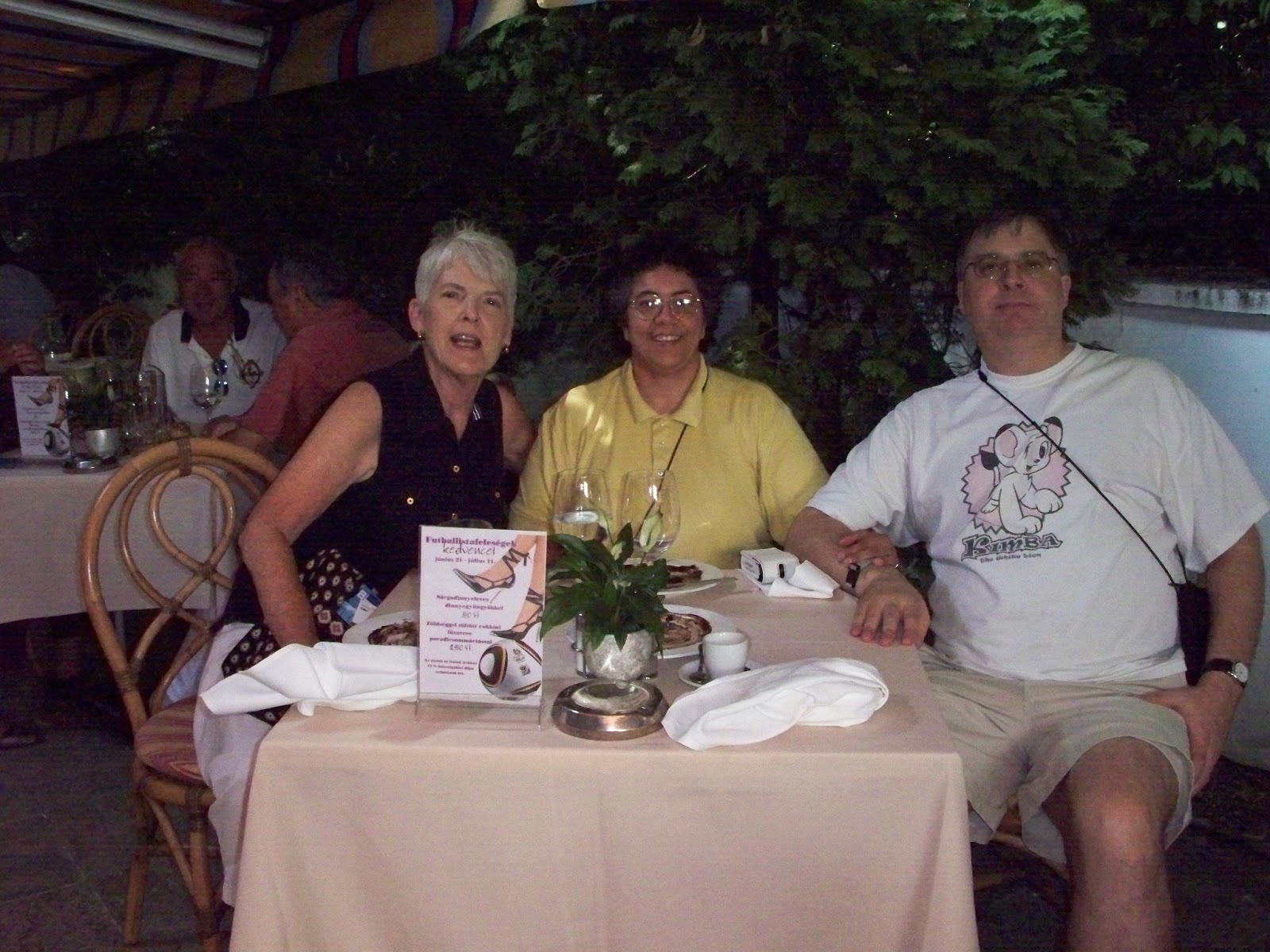
Right around the corner from the Fine Arts Museum is our lunchtime destination: Bagolyvar (Owl's Castle). This restaurant holds the unusual distinction of having won awards for the best place in Budapest to have a "power lunch," while, at the same time, having all of its food cooked and served by women, giving it a special "Mom's homemade" touch. The place's spread-eagle appeal is further illustrated by the giant plush figure of the 2010 World Cup mascot by the door coexisting with coy advertisements inviting "soccer widows" to come in for food specials during the tournament. Nicky decides to fulfill one of her culinary missions and have schnitzel, while I content myself with barbecued pork, garlic mashed potatoes, and the obligatory cucumber salad. For the three of us, the bill comes to about $55 US. Not bad, all things considered.


Having penetrated deep into Pest, it's now time to hie ourselves across the Duna to "Old Town" Buda and the Castle District. We take the Metro down to the river and walk across the famed Chain Bridge, taking care to keep in the shade as much as possible (which isn't easy at this torrentially warm time of day). Then, it's up the equally famed Budavari Siklo (funicular railway) to the Castle... come along with us for the ride!


We now begin to feel the effects of the unseasonably hot weather. We do manage to visit the courtyard of the Royal Palace, St. Matthias Church with its distinctive tiled roof, and the terrace at Fisherman's Bastion -- memorable sights all -- but we intersperse our wanderings with frequent breaks and one pit stop for water and sunscreen lotion. Nicky and Mom are having some trouble walking on the cobblestoned streets, as well. We finally decide to cut our losses and catch a bus to take us to Moszkva ter M2 Metro station, a Communist-era eyesore built like a badly-fashioned bundt cake. From there, we travel to downtown Pest and the Central Market -- sort of the Budapest equivalent of Baltimore's Lexington Market, only with much more class and much less crime -- but we get there only five minutes before the place closes. We take that as a suggestion to take a break back at the Palace.

A further word about the M2 Metro line. American lawyers would wet their drawers dreaming of potential personal-injury lawsuits if they saw how this line's escalators operate. The steps move at least twice as fast as an American escalator's -- and there's no disclaimer included to warn the terminally dim of the potential danger. Nicky took a video of one escalator ride; if you listen closely, you can hear the air whistling!


The New York Palace's pride and joy is the New York Kavehaz (Coffee House), a sip-and-sit salon where literary movers and shakers liked to gather during the halcyon days before World War I. It went into a long decline, along with the hotel itself, before the recent renovations restored it to something closely approximating its original splendor. Since the only other eating place "on site" has a dress code, we have our "snack-in-lieu-of-dinner" at the Kavehaz. Here is where I have my obligatory plate of authentic Hungarian goulash -- which many people think is a stew, but is actually more like Chunky Soup (did I really just draw that analogy? My bad). The place is pricey on the real New York level -- 16,000 forints (about $60) for what amounts to a deconstructed (the technical term is "reduced") sandwich, a cold plate, a plate of soup, two ice cream dishes, and drinks -- but we aren't cheated in terms of quality. I was a bit disappointed, however, with the repertoire of the piano player we shared with the snootier establishment next door. He could have done so much better than cycle through show tunes and tread-worn movie themes... like, play some Liszt, for example?


Before we went to the Kavehaz, we received an unexpected but gratifying piece of news: we've managed to make contact with my relatives! Before the trip, Mom had written my cousin Agnes (Agi) using an address Nicky had obtained from the internet. The letter arrived and was "processed" just in time for our arrival. Agi's husband Csaba, who speaks English, left a message with the front desk asking for a meeting. Mom calls Csaba, and we're now set to meet everyone at 5 pm in the lobby of the Palace, after the three of us take a planned side trip to Szentendre, an artists' colony a few miles up the Duna. We're not sure exactly who is going to be able to attend, but, whatever the lineup, it will be a much anticipated event and one that I'm so glad has finally come to pass.

Up next: Szentendre; Margaret Island and some heartfelt moments with the relatives.

Sunday, September 7, 2008

A Call from Sid Couchey

I'm temporarily postponing my review of the June issue of WALT DISNEY'S COMICS AND STORIES, and for a darn good reason. This past Thursday afternoon, I received one of the biggest surprises of my 30-plus years as a card-carrying comic-book fan when I got a phone call from former Harvey Comics artist Sid Couchey. Sid -- the definitive artist for LITTLE DOT and LITTLE LOTTA comics in the 50s, 60s, and 70s, and a regular delineator of RICHIE RICH stories during those years as well -- certainly wasn't the first pro with whom I'd ever exchanged words, nor even the first Harvey creator; I'd both spoken with and written to RICHIE RICH comics great Ernie Colon back in the early 80s. What made this contact unique was that I'd never had any dealings with Couchey whatsoever.

Sid was responding to my most recent RICHVILLE RUMINATIONS column in issue #70 of Mark Arnold's fanzine THE HARVEYVILLE FUN TIMES!. In that piece, I corrected an error made by Jerry Beck in the introduction to the RICHIE RICH volume of Dark Horse's ongoing HARVEY COMICS CLASSICS series. Jerry had claimed that "Couchy" (sic) drew the first RICHIE story in RICHIE RICH #1 (December 1960), when, in fact, Ken Selig did the honors. The goof struck me as especially peculiar because, as I noted, "Couchey's artwork is so distinctive that it's practically impossible to misidentify, even if one tries." Here's a sample of Sid's angular, uniquely stylized -- er, stylings -- from the 60s RICHIE tale "It's a Wild Idea":

In an earlier THFT! column, I'd labeled Couchey "the Grandma Moses of comics," and hopefully you can see why. Sid brought that comment up, by the way, but not to criticize me for it... simply to note that his home in upstate New York is not that far from the real Grandma Moses homestead.
Sid is pushing 90 but is still quite active locally and is preparing to celebrate his 50th wedding anniversary. (If you can believe it, he actually proposed to his wife Ruth through the medium of a LITTLE LOTTA story in a 1960 issue of LITTLE DOT.) I'm glad that he has gotten some attention for his work in these latter days, especially since most of his comic-book labors were devoted to characters who were, shall we say, not among the most inspired creations Harvey ever midwifed. As a loyal RICHIE RICH reader, I certainly saw plenty of the dot-loving Little Dot and the food-guzzling, super-strong Little Lotta, but only as five-page backup features in the RICHIE books. Couchey hardly got to do any 10- or 15-page adventure tales with these characters; one of the very few exceptions was a clever DOT story produced during the heyday of The Beatles, entitled (logically enough) "Dot's Rock 'n Roll Adventure":

Most of Sid's RICHIE RICH efforts were five-page quickies as well, but occasionally he'd be called upon to pen a longer story, and he did produce some excellent ones. At the top of this list is "Crash Landing" (RICHIE RICH #43, March 1966), a frankly weird, yet unsettlingly memorable, tale in which Richie and some companions crash on a Communist-run island. Without tearing down a single wall -- or even rhetorically urging the Commie leaders to do the same -- Richie and friends convince the government to reform itself. Don't laugh; Sid and his writer somehow made it all work. (How else were they supposed to pull it off -- by liberal use of radioactive cigars and poisoned beard trimmers?)

During our brief chat, Sid came across as a thoroughly nice man. I am flattered and grateful that he was moved to contact me, and I do intend to keep in touch with him. I've said it before in other venues, and I'll say it again: "My life as a fan" has led to some of my most cherished friendships and some amazing encounters. This one, though, truly knocked me for a loop.