Showing posts with label John Lustig. Show all posts

Thursday, October 9, 2014

A POST "DUCKTALES RETROSPECTIVE" PERSPECTIVE: "The City Under the Ice" (Gladstone DUCKTALES #12, March 1990)

There's a good deal of irony packed into that William Van Horn cover image.  Those of us who remember the original DUCKTALES comics line -- the one that Disney more or less forced upon a reluctant Gladstone Comics in 1988 as a way of promoting the red-hot TV series -- mentally divide the 13 issues that followed into two groups:

(1)  The Disney Studio stories, some of which directly adapted episodes of the series, such as "Armstrong" (DT #1) and "Jungle Duck" (DT #2).

While the adaptations may not have been top-notch, they were pure genius compared to the original Studio stories that followed -- stories that were notorious for gaffes in characterization (e.g., Webby calling her grammy "Mrs. Beakley" in "The Crown Jewels Affair" [DT #4]) and an UTTER, as opposed to a partial, lack of inspiration.  Just about the only things that these issues had going for them were the lively and detailed covers by Daan Jippes.  It certainly wasn't Daan's fault that these eye-catching covers promised adventure and excitement that the stories inside so miserably failed at delivering.

(2) In the back of DT #6, backing up yet another blah Studio lead, was an intriguing bauble that pointed directly to DUCKTALES Mark 2.0: "Coin of the Realm," a ten-page tale written and drawn by Bill Van Horn.  Recall that, up to this point, Van Horn was known to Gladstone readers primarily as "the guy who does the fillers and gag pages."  The former included a couple of humorous GYRO AND LAUNCHPAD four-page stories in DT #4 and 5.  "Realm" was of an entirely different scope and immediately seemed more entertaining than any of the mush and dribble that had been regularly doled out to us.

And so, beginning with DT #7, Van Horn -- with occasional assistance from John Lustig -- began to produce lead stories for the title.  These quickly became so popular that, when Gladstone temporarily reverted to Studio fodder with DT #9's "The Oil Pirates," the dropoff in quality was almost jarringly noticeable.  Van Horn was back on the job in DT #10, producing "The Whistling Ghost," a 16-page feature story that brought back Baron Itzy Bitzy, the whistling flea character that Bill had introduced in one of his non-DUCKTALES efforts.

Van Horn would likewise provide the lead stories for issues #11 and #13, the last of which, "The Billion-Bean Stampede," may well be the most memorable of all of these highly quirky efforts.  For sure, it had the zaniest cover.

These romps are warmly remembered, not least because they cemented the bond of fondness between American Disney comics fans and Van Horn, who, unlike Don Rosa, didn't make a splashy debut, but patiently worked his way up the ladder and amassed good will a bit at a time.  (Somehow, I think that Scrooge would approve.)  And yet... and yet... as enjoyable as these stories were, I think that fan-friend Pete Fernbaugh was correct when he said that they came across as VAN HORN stories more than they did DUCKTALES stories.  Van Horn seemed uninterested in using any original DuckTales creations other than Launchpad.  While Bill handled LP quite well, his approach seemed uncomfortably close to the lazy Studio practice of creating a DT story simply by plugging LP into the Donald slot in an otherwise conventional "Scrooge and the Ducks" narrative.  (The GYRO AND LAUNCHPAD stories, by contrast, didn't seem quite so atypical, primarily because Van Horn knew how to take advantage of Launchpad's nature and abilities in such a specialized setting.) Needless to say, there was never anything conventional about Bill's approach, but, the more he tried to "wacky" things up by dropping in zany rock concert promoters, lively legumes, and so forth, the more his tales got pulled away from anything resembling what DuckTales had given us during its wide-ranging first season.

The bottom line is that neither of the aforementioned groups contain what one might characterize as a legitimately authentic, high-quality comic-book adaptation of the TV series.  Pretty unfortunate for a title that was supposed to be providing readers with the equivalent of the DuckTales animated experience, only on the printed page.  But then, we get to issue #12, which... stands apart.  Boy, does it ever.

During the last several months in which it held the Disney comics license, Gladstone had converted its titles into a double-sized format, the better to pump out as much "classic" material and heretofore unseen overseas delights as possible before the "window of opportunity" closed and the Disney Company took over.  (These included lengthy stories by the Italian great Romano Scarpa, who was a complete revelation to us notoriously insular Americans at the time.)  In DT #12, Gladstone finally took full advantage of the extra space to showcase "The City Under the Ice," a 39-page French story.  I wonder how many folks saw the Van Horn cover, immediately began thinking of the crazy scenarios and gags that "Silly Billy" might be able to stage in that gelid setting, and then really froze up when the first page of "City" displayed "something completely different."

According to Inducks, "City" is the second longest standalone DUCKTALES comic-book story ever produced, trailing only "The Curse of Flabberge," which David Gerstein so memorably "reimagined" for Boom!'s UNCLE $CROOGE during its DuckTales phase.  The creation of the story was very much an international affair. It was written by Frenchman Patrick "Zack" Galliano, whose previous authorial credits included PIF LE CHIEN, a creation of the French Communist paper L'HUMANITE; penciled by the Spanish artist Maximino, who did quite a bit of work for Mondadori, the Italian Disney comics publisher at the time; and inked by the staff of the Barcelona-based Comicup Studio.  Oddly enough, a similar combination of French, Spanish, and Catalan talents worked on "The Curse of Flabberge."  The artwork for "City" is a little rougher and livelier, all things considered.

The "Americanization" of the story was done by Gladstone and Disney Comics stalwart Dwight Decker.  During the Gemstone and Boom! Comics years, we got used to imaginative, reference-packed transformations of the utilitarian English dialogue that was normally provided to scripters.  Even the more sedate efforts along these lines had a touch of class.  (At least, I like to think that I provided one.)  Decker's translation, while sturdy enough, is more of the vanilla variety, though he does throw in a contemporary reference to some briefly famous pop star whom I don't have the time to research right now.  I wonder whatever happened to the guy.

While it certainly doesn't have the sheer scope of "The Gold Odyssey," or even the more modest "Scrooge's Quest," neither is "City" a sprawling, shambolic wreck on the order of "Rightful Owners."  The best praise that I can offer to it -- praise that will seem more meaningful when you consider when this tale was produced -- is that it gets the DuckTales aspects right.  It has a few quirks of its own, but the plot is easily recognizable as one that might have sprung up in an episode of the TV show, the characters involved are bang-on in character, there is a splendid reference to an infamous event that occurred on screen, and there's a pleasing mix of action and humor.  For that reason, I consider "City" to be the first TRULY successful DUCKTALES comic-book story to appear in America, at least when "successful" is interpreted in a strictly DuckTales-oriented context.

** SPOILERS **

We start with that classic McGuffin: a long-lost, well-hidden treasure map.  During the skateboard mishap pictured above, the ambulating Eskimo drops a bone that proves to be hollow.  The map inside points the way to a stark Arctic peak on Chilblain Island where (according to... no, not the Junior Woodchuck Guidebook, but a convenient Arctic exhibit at the Duckburg Museum) a legendary "sun of gold" once fell and is now buried beneath the ice, along with the artifacts of a "mysterious civilization."  (Hey, if Golden Sun worship can occur on one peak, then it certainly can on another.)  Unfortunately, the Beagle Boys get wind of the find, as well, thanks to their capture of the unfortunate Eskimo.

Yup, them's the DuckTales Beagles, all right. And they're all in character, too, suggesting that Decker must have been paying attention when he viewed whatever episodes he viewed in order to prepare for this gig.  This should NOT be passed over lightly.  Not after a later story like "The Great Chase" (Disney Comics DT #16, September 1991, written by Frank Ridgeway of "Bermuda Triangle Tangle" fame) gave us the memorable sight of a kick-ass, take-charge Burger and a whimpering Big Time and Bankjob deferring to him. As things turn out, the Beagles of "City" will have far more to offer to the discriminating fan than simply looking and acting as they ought to.

Up in Canada's Northwest Territories, a somewhat headstrong Launchpad gets involved in a fracas at a honkytonk -- it isn't explicity referenced as such, but I think we all know better -- and is bailed out by Walking Mountain, a giant, stone-faced, and inscrutable Native American.  The grateful Ducks invite WM to accompany them to the treasure site... which, when you come to think of it, is rather peculiar.  He turns out to be helpful at various times and utters some (yep) appropriately inscrutable remarks, but welcoming the assistance of a complete stranger was, shall we say, not S.O.P. in the TV adventures... or in Carl Barks' adventures, for that matter.

The heart of the story features the Ducks' journey to the legendary Bear's Tooth peak and the Beagles' various efforts to stop them.  We start with a pretty bog-standard version of the "paper-thin disguise" routine...

 Well, their number plates aren't visible, at least.

... which leads to sabotage, a crash, and an unpleasantly close encounter with a polar bear.  The Ducks get out of the fix when Scrooge resorts to the somewhat extreme tactic of lighting the crashed plane on fire "to scare the bear away."  The Ducks' on-board flares subsequently go off, alerting a passing ship to their presence.  As solutions to dilemmas go, this is closely allied to suicide.  But then, the "Type A" Scrooge of this story would probably be tunnel-visioned enough to try it.  We soon see more evidence of Scrooge's mental state when Scrooge poor-mouths in dramatic style in order to rent a snowmobile at a lower-than-rock-bottom price.  A bit over the top, perhaps, for the Alan Young DuckTales Scrooge, but, hey... it's in character.

Upping the ante, the Beagles track the Ducks' snowmobile with one of their own... armed with a gun, no less.  Chisel McSue would be proud, fellas.  Walking Mountain displays some fancy driving in order to get the gang out of harm's way, but the Ducks soon discover that the Beagles had sabotaged their gas cans back at the Eskimo town.  Left to starve and/or die of cold on the Arctic ice, Walking Mountain suggests a rather unusual tactic to attract animals that could (per the JW Guidebook, which HD&L belatedly consult here) be used for food:

Another in-character moment.  It's easy to imagine Launchpad getting into the spirit of things that way.  Alas, the ululations only serve to "attract" the Beagles' ice-breaking submarine. (Did the Beagles have their working boots on in this story, or what?  Makes some of their feebler second-season efforts seem all the more annoying, doesn't it?)  Thrown into the sub's brig along with the Eskimo, the Ducks have little to do but wait out the ride to the Bear's Tooth.

As the Beagles prep for treasure-hunting, Walking Mountain gets his funniest moment of the adventure:

Thanks to a conveniently placed thin crust of ice, our heroes are sent hurtling down, down... to this:


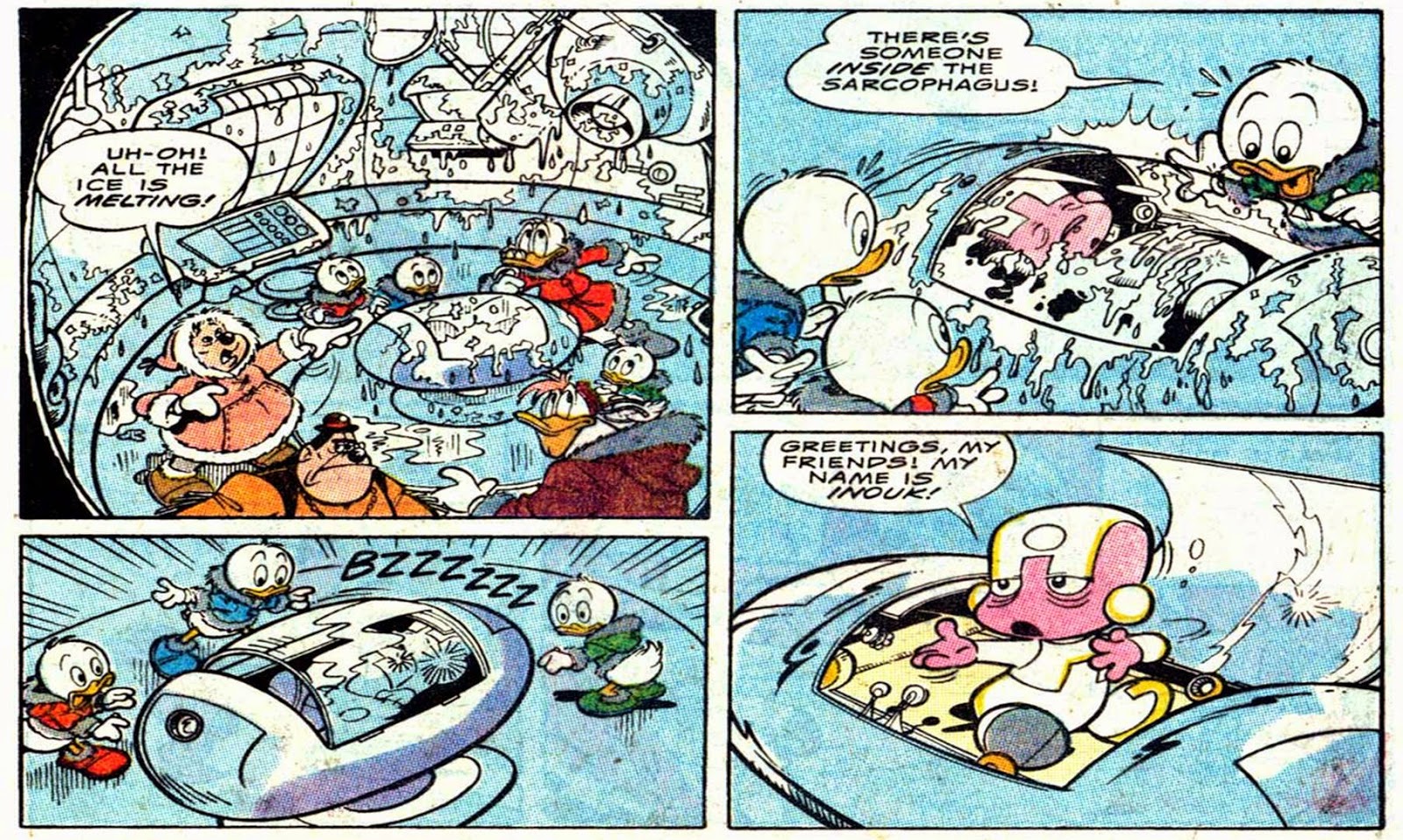
So, where's the gold?  The Ducks find out when they discover a hidden laboratory, a high-tech sarcophagus, and its completely unexpected owner:

Yes, folks, it's an alien, a Thulian (clever reference, that) who was left behind by an exploration party that had to retreat because of the cold weather.  Inouk was put into the deep freeze with the understanding that his friends would ultimately come back to get him.  The "sun of gold" turns out to have been the golden spaceship that brought Inouk and his people to Earth.  You realize what that means, Scroogie: these guys live on a planet where gold is so common that it can be used to build spaceships -- not the "structural metal" of first choice for me, but to each his (or its) own -- and therefore...

And Scrooge didn't even go through the intermediate stage of hiccuping: he went right to a dead faint.  Any direct reference to "Too Much of a Gold Thing" can't get enough praise from me.  This was the point at which I knew that Dwight Decker had REALLY, REALLY taken his responsibilities seriously. Bless him.

At this point, you're probably wondering whether the story is going to end in the cataclysmic manner of "Gold Thing."  Well, the Beagle Boys are tooling around while operating heavy machinery.  What do YOU think?  

The Ducks' plight isn't as desperate as it was in "Gold Thing," but it comes pretty close.  As if to make up for the shortfall, the mode of the Ducks' salvation is a bit more esoteric than Launchpad flying in the transport plane just in the nick of time.  Here, Inouk flies the gang out of danger using his "golden egg" sarcophagus (which turns out to be a small spacecraft, as well) as the City of Gold, in the manner of its namesake in a Kimba the White Lion episode, collapses into oblivion.  Scrooge takes this development with considerably less grace than he did at the end of "Gold Thing."  Perhaps writer Galliano was letting his inner "L'HUMANITE contributor" out for a little holiday here.


The story's final two pages are a bit displeasing, if only because:

(1) The Beagles are allowed to scuttle away, more or less scot-free.  After that performance, they deserved the dignity of a stay in a luxury high-security prison, at the very least.

(2) Inouk's "rescue ship" just happens to have been located on the Moon all along -- a fact of which Inouk himself appears to have been completely unaware when he went into hibernation mode.  What the heck, was this supposed to be a "monolith test," or something?  Why would Inouk even need one, since his civilization is capable of space travel?

Yeah, I'm just as confused as you are, buddy.

The fact that I have to pick such a tiny nit in order to give "The City Under the Ice" anything less than unqualified praise indicates just how strong this story really is.  It's easy to understand why it sort of flew beneath the radar at the time of its release: Van Horn's multiple stabs at the DUCKTALES lead story naturally left more of an impression than this one-shot, and Gladstone Comics itself was just about to go into its own form of "prolonged hibernation."  But let's give credit where credit is due.  Speaking strictly of DUCKTALES comic-book stories that appeared in America, "City" is one of the very few that can be said to have done full justice to the TV series.

"Golden Sun."  I like the sound of that...

.

.

.

My apologies for making you wait so long to see this.  Hopefully, you'll find the wait to have been worth it.  In my next comics review, we'll catch Disney Comics' DUCKTALES title on a similar back end, so to speak, and look at how the book's 18-issue run ended with Bob Langhans' post-"Gold Odyssey" offering, "A Dime in Time."  Is there any way that Langhans could have lived up to the standard set by "Odyssey"?  We shall see.

Friday, July 4, 2014

DUCKTALES RETROSPECTIVE: Episode 85, "Dough Ray Me"

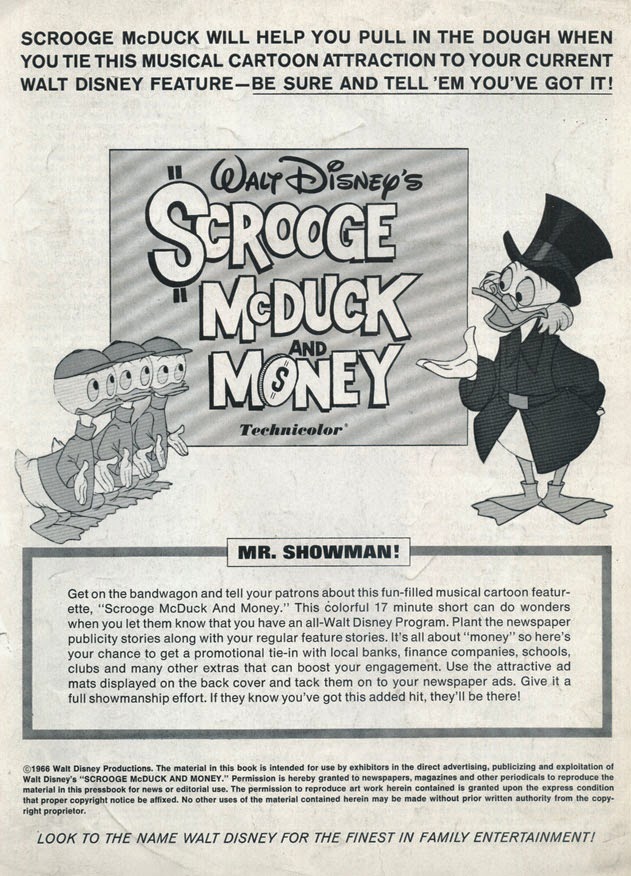
Funny thing: like Greg, I immediately realized that "Dough Ray Me" had certain antecedents in Disney Duck history.  They just weren't the ones you might think.  When Joe Torcivia and I commented on the episode for our DUCKTALES INDEX, the fiduciary connection between "Dough Ray" and the Disney "edu-tainment" short Scrooge McDuck and Money (1967)...


... seemed far less relevant than the ep's thematic similarity to a pair of humorous "escalation stories" penned by John Lustig and William Van Horn for the "Gladstone I" DUCKTALES title: "The Bedeviled Dime" (DT #9, August 1989) and "The Billion-Bean Stampede" (DT #13, May 1990).  In both of these fanciful tales, a small problem metastatizes into a huge one, causing massive trouble for Duckburg.  Needless to say, Carl Barks whelped several similar puppies during his long tenure, but Lustig and Van Horn's efforts came more quickly to mind, thanks to their use of the DuckTales characters (well, Launchpad, anyway) and their use of off-the-wall throwaway characters and gags.  In retrospect, "Dough Ray" doesn't seem quite as zany as it once did, but Burger Beagle's obsession with prison "puddin'" (inspired by that one Barks Beagle's affection for prunes, perhaps?), the "Scrooge McDuck's Money Mania" video game (which I half suspect that McDuck Industries itself had a hand in, given that the pixellated Beagles lose even when they win), and the presence of a couple of endearingly wacky supporting players speak to a generally lighter approach than one might expect under the circumstances.


That's not to say, of course, that "Dough Ray" doesn't follow, however tentatively, in the web-steps of Scrooge McDuck and Money in terms of teaching a useful lesson about the dangers of inflation.  The difference is that the proliferation of coins vibrating to the influence of Gyro Gearloose's Multiphonic Duplicator is the mere backdrop against which the comedic events of the TV production take place.  In Scrooge and Money, the whole purpose of the enterprise is to inform viewers about the history of money and banking and the importance of keeping a budget.  The level of seriousness of the "educational aspect" of "Dough Ray" can be gauged by the fact that Fenton -- you know, that accountant guy -- doesn't seem to grasp the concept of money losing its value any better than do Scrooge's alternately conniving and super-naive Nephews.  Granted, Fenton got his business education via mail-order, but you would think that he would have learned a little something about inflation's effects before now.  Despite a couple of cutting comments from Scrooge and HD&L about Fenton's intellect, he actually doesn't do all that much wrong here -- his plan to have the Beagle Boys gather up all the duplicated money makes sense, given that he and everyone else are working under the impression that the money will eventually explode -- but such a gaffe makes one wonder why Scrooge doesn't simply limit his contributions to money-bin guard duty in the guise of Gizmoduck.

HD&L don't come off as poorly here as they did in "Yuppy Ducks" -- that would be a well-nigh impossible task, to be frank -- but they don't cover themselves in glory, either.  After blowing their entire allowance on video games, they respond to Scrooge's suggestion to take up summertime work by becoming "Dirtbusters" for hire (I wonder how they managed to acquire those protective suits?  Wouldn't those cost money, too?), only to wreak chaos and ultimately cause Mrs. Beakley (who probably looks back with horror on this ep as her one unfortunate experience of "torture porn") to be showered with dust and grime.  They then proceed to trash Gyro's lab in similar fashion.  They haven't even done anything dishonest yet, and already they're several points in arrears.

After learning about Gyro's Multiphonic Duplicator, the lads... stop me (and time, while you're at it) if you've heard this before... spirit the device away under the guise of giving it a test run "to help Gyro out."  For several reasons, I'd argue that HD&L's swiping of the Duplicator is a more serious offense than their earlier borrowing of the Time Teaser.  Firstly, Gyro tells them that the gizmo doesn't yet have all the bugs worked out of it.  This notion of premature employment of a Gearloose invention, which will also play a role in the upcoming "The Big Flub," seems to be primarily a second-season conceit.  In the past, Gyro's creations generally either worked fine, worked "too well" (e.g., Armstrong), or were "hijacked" to perform nefarious deeds that were not in the original product description (e.g., the giant construction robots being turned into "Robot Robbers" by the Beagle Boys).  HD&L's ignoring of Gyro's warning, however, pales in comparison to the boys' inability to recognize that what they're doing is the functional equivalent of counterfeiting, which is, as a Barks character might say, "awful unlawful."  The script partially obscures this by having the Nephews start with duplicating the non-monetary contents of their room, but, like Fenton, the boys really should have picked up on such an obvious point much earlier in the game.  (Not that HD&L are alone in this oversight; Scrooge doesn't mention anything about illegality either, though he can perhaps be excused for the mental hiccup, since he is more concerned with the fact that the duplicated money has rendered his Binned lucre all but worthless.)

In another anticipation of "The Big Flub," Fenton starts the episode in go-getting mode, convinced that he deserves a raise and then seeking to justify his request for a salary boost by coming up with a new money-making idea.  It's nice to see Fenton's desire to "rise above the common Duck" reignited, since it generally makes for good comedy.  Here, though, not so much; Fenton's "Great Crackshello" act is pretty lame and probably owes its existence to the simple fact that Brooks Wachtel, who provided the story here, was a performing magician in between writing gigs.  If Scrooge weren't already in a bad mood when this scene started, then Fenton's performance would certainly have put him in one.

Thanks to HD&L's heedless getting and spending of the duplicated money and the replicated riches' vulnerability to redoubling at the sound of a bell, Fenton's cheerful comment, "What could go wrong?" (yet another harkening forward to "The Big Flub," in which he says almost exactly the same thing about Flubble Gum!), is soon overtaken by events.  Of the specific gags used here, only the scene of a car spinning its wheels in a pile of piasters, as if the latter were a snowdrift, strikes me as truly clever and inspired, in a physical sense at least.  That's OK, though, because the character-focused gags involving the put-upon mittel-European movie director, price-gouging dentist, Don Hills-voiced bank president, and several others partially make up for it.  These gags probably needed to be a little wackier in order to truly achieve Lustig and Van Horn-level quality, but they're definitely progressing along those lines.  Gizmoduck's brief contribution to the fun, in which he flies onto the scene only to crash into the movie-set bell, is arguably his lowest point of the series, simply because that is literally all he does.  It probably would have been better had he not gotten involved at all.

The tale's logic begins to turn wobbly once Fenton hatches his scheme to turn the Beagle Boys into unwitting collectors of the unstable duplicated money.  I'm not merely referring to the fact that, during their jail break, the location of the Beagles' prison cell appears to change two or three times, much as Scrooge and Mrs. Beakley's cell shifted around for plot convenience's sake in "The Billionaire Beagle Boys Club."  The real problem, which GeoX is quick to note, is that it would literally be impossible for the Beagles to gather up ALL of the duplicated money.  The money left in the streets, maybe, but it's more than likely than more than a few Duckburgians who have taken their money indoors or deposited it in banks (which, as we see in the bank scene, now appear to be jammed full with cash) would be unwilling or unable to turn it over to the Beagles.  This leads me to wonder: Did the Beagles really need to be used in this episode?  One might argue that a Beagle-less story could have unfolded along the same lines as Barks' "A Financial Fable" (WALT DISNEY'S COMICS AND STORIES #126), with the Duckburgians running hither and thither to spend their money, only to wind up paying it back to Scrooge, who has stuck to his last as the one remaining productive citizen in town.  The analogy breaks down, however, due to the fact that this particular money-storm is localized -- in "A Financial Fable," the tornado literally spreads Scrooge's wealth all over the country, making the breakdown of the economy much more dramatic and universal -- and, of course, the perceived undesirability of turning the "hero" of the series into a profiteer.  In order to restore the status quo, the episode as written needed a fall guy, and I suppose that the Beagles were as good a choice as anyone.

Even if you're willing to buy the improbable notion that the Beagles do manage to corral all of the duplicated cash (AND construct a Money Bin on short notice in which to store it!), you still have to deal with the "explosion/implosion" business.  Frankly, the ep doesn't handle this aspect of the story very well.  The problem is that Gyro's explanation of the misunderstanding -- that thinking that the coins will explode "was a slight miscalculation on my part" -- is worded in a hopelessly sloppy manner.  It implicitly assumes that Gyro had told the Ducks that the coins would explode in an earlier conversation... only he never actually did.  (For confirmation, refer back to the phone palaver at the end of Act Two.)  It would have been far more sensible for Gyro to have corrected Scrooge's mistake, mentioned that the coins weren't going to explode, and then tried to explain that they were fated to implode, only to be cut off by Scrooge's attack on Fenton.  The verbal assault is, of course, completely unjustified, since there was no way for Fenton to know that he had been operating under a false assumption.  Here is one instance in which making Fenton the goat (a decision that is fully confirmed at the end when Scrooge nixes his raise) bespeaks lazy writing more than it does humor that flows naturally out of the story.

The implosion sequence includes some nifty visuals, which makes it all the more unfortunate that the ep turns to the cheese-paring approach of reusing a sound clip from "Frozen Assets" (Fenton's yelping when he is first encased by the Gizmoduck suit) to accompany Scrooge's rescue of Fenton from the maelstrom.  It strikes me as funny that Fenton needed to be rescued from the disaster, whereas the Beagle Boys, who were inside the Bin as it imploded, wind up none the worse for wear, suffering only the dejection of losing their fortune.  It would stand to reason that the Beagles would have been far more likely to have perished in such a situation.

"Dough Ray Me" remains entertaining today despite the manifest weaknesses of its last act.  I'd be more likely to turn to Scrooge McDuck and Money as a Duck-themed primer on economic matters, but this offering still ranks as one of the more enjoyable second-season efforts.

.

.

.

Bumper #20: "Mummy"

.


.

"DuckBlurbs"

This isn't the first time that Gyro Gearloose and an "implosion scenario" have (quite forcefully) come together.  See the recent post on Joe Torcivia's THE ISSUE AT HAND blog in which Joe reproduces some panels from the obscure Gyro story "Operation Implosion" (UNCLE $CROOGE #82, August 1969) and links them thematically to the latest chapter in Dan Cunningham's discussion of the history of the Disney Comics line.

A few years after the DUCKTALES INDEX appeared, Van Horn, working solo this time, returned to the "duplication" theme in his famous adventure story "The Black Moon" (Gladstone DONALD DUCK ADVENTURES #24, February 1994).  Our own GeoX wrote an excellent review of this tale some time ago.  Suffice it to say that Van Horn's use of the "duplication" notion here is far less wacky, and far more ill-boding, than it was in those earlier joint efforts with Lustig.


(Greg) Gyro explains all through the fact that he has two of everything including his pal Light Bulb which makes his first cameo in Ducktales in a long while (The Money Vanishes comes to mind).

This was, in fact, Helper's first appearance since that episode.  Happily, it would not be the last.

(Greg) Gyro wants to discuss lunch as he brings out the tv dinners which are broccoli stew. He duplicates them and then pops them into the microwave as the nephews bail out the door.

In "Scrooge's Last Adventure," Gyro will acknowledge the receipt of a broccoli sandwich from Mrs. Beakley.  I sense a rather insipid trend here.

(Greg) [Gyro] gets more confused as he adjusts his glasses on an FPS shot as everything he duplicated already has increased from two to four. Gyro deduces that he needs to redo his calculations. Oh and apparently; he needs the adjust in the glasses because he never sees the fact that in the next scene changer, we see the nephews have stolen his duplicator. Logic break #1 for the episode six and a half minutes in. Now I'm confused. Did the nephews duplicate the stuff behind his back; or is there more to this?

This is actually a nice foreshadowing of the later discovery that the sound of a bell (in this case, the microwave timer) causes things to duplicate. 

(Greg)  So the nephews go to the drawers (NOT THOSE ONES!) and on top is a small box containing all their marbles... and [they] bring out the purple “Great Masher” marble from Pearl of Wisdom.

Which, by all rights, should no longer exist, since it was used to detonate a torpedo in that episode.  I guess that we need to take the Nephew's comment that "you can never have too many of these" to mean that the boys had stashed a few additional "Mashers" in reserve.

(Greg) Fenton proclaims that the device is from Gyro which surprises me since I don't recall the nephews ever informing him that it was from Gyro.

They actually did, which explains his subsequent remark: "I can't believe that crackpot actually hit the jackpot!"

(Greg)  So we head to Gyro's residence as Gyro is using the magnifying lens on three Light Bulbs (wait; three? We clearly saw four of them made. Logic break #1 for the episode for real at ten minutes in); and then Scrooge and Fenton barge in as Gyro deduces that the audio duplication machine (logic break #2: Now there are eight Light Bulbs on the table for no reason whatsoever)...

This isn't really a logical problem if you assume that an off-camera bell sound had previously caused the four Helpers to double to eight.  More problematic is the fact that, when HD&L ring the doorbell, everything duplicates BUT the Helpers.

(Greg) The nephews use the human chain ladder spot and go to the payphone and insert a silver dollar into it. Probably the only thing that hasn't risen in prices.

Which is somewhat peculiar, since the Nephews mentioned earlier that they were forced to pay $30 to use a gumball machine.  Public utility vs. private enterprise must be in play here.


(Greg) The heels load up the trucks with sacks of money. It should be noted that it's the same bank we [saw] in Super Ducktales among other episodes...

Yup, the good old "First Interfeather Bank," which dates all the way back to "Hero for Hire."

Next: Episode 86, "Beaglemania." 

Saturday, December 21, 2013

Comics Review: MY LITTLE PONY MICRO-SERIES #10: LUNA (IDW Publishing, December 2013)


** SPOILERS **

Katie Cook and Andy Price are starting to remind me of the team of John Lustig and William Van Horn back in the days of "Gladstone I."  In John and Bill's DUCKTALES comic-book stories, while the main characters (Scrooge, HD&L, and Launchpad) were certainly in character, the tales themselves had a certain zany, off-the-wall feel that was only occasionally reflected in the animated series itself.  In the case of MY LITTLE PONY, Katie and Andy take this tendency to, if not an extreme, then certainly much farther than John and Bill ever did.  The major reasons why are that Katie and Andy are big fans of the series (which leads them to pack their panels with in-jokes and references that only Bronies could be expected to get) and that they are more than willing to play with the personae of the main cast if it suits their purposes.  Occasionally, this gets them into trouble with the more literal-minded of fans, for example, when they got flak for couching the courtship of Princess Cadance and Shining Armor (MLP:FIM #11-#12) in the trappings of a 1980s "coming-of-age" movie.  I argued in my review of that issue that C&P were essentially free to do whatever they darn well pleased in telling that story, since the principal characters were so underdeveloped to begin with.  In their treatment of Princess Luna in the final issue of the MLP Micro-Series, Katie and Andy are on somewhat stabler ground, since their depiction of the Princess of the Night as a hyper-enthusiastic, endearingly naive "goddess with a slight case of Aspergers syndrome" doesn't deviate all that far from some other versions of this most volatile of major players.  Suffice it to say, though, that they take their interpretation of Luna pretty far down the road, so much so that at least a couple of "neigh-sayers" will probably take up the challenge to walk it back.  I am not one of them.

Various creators have characterized Luna as everything from a fearful child to an anachronistically imperious goddess to a regretful, guilt-ridden former villain (the latter referring to her age-old guise of Nightmare Moon).  In "The Day Shift," after Luna argues that her sister Celestia's stewardship of the Day can't possibly be as exciting as Luna's stewardship of the Night, the gals (a rather inappropriate term to use in this case, but, given the sitcom-esque trappings of the story, it seems quite fitting) agree to swap jobs.  More accurately, Celestia gets to spend a relaxing day at the spa while Luna assumes all of Celestia's "boring" bureaucratic duties, which prove to be nothing of the kind, making up in bulk what they lack in general interest level.  The Luna who must deal with business meetings, guard inspections, tea parties, and the like is essentially the same zizzed-up, socially awkward, archaism-spouting mare who was first seen (in somewhat decaffeinated form) in the TV ep "Luna Eclipsed" and who later strong-shanked Big Macintosh into being her partner in the Summer Wrap-Up competitions in Cook and Price's MLP:FIM #9-10.  Cook and Price's take on Luna is even funnier and more sharply etched here, as Celestia's long-suffering appointments secretary Kibitz does his best to keep the effervescent, perpetually unpredictable "Moonbutt" "on task."  Luna's confusion over how to verbally and psychologically handle her subjects -- actually, there's a fair amount of debate here over what she should call them besides "subjects" -- leads her to veer between (to take just two examples) rendering Solomon-like judgments on questions of "fair division" and using party guests as living chess pieces.  Needless to say, by the time the day is over, Luna has a newfound respect for Celestia's duties... but now, she is obliged to continue straight on to her standard "Night shift" while Celestia goes to bed.  Better start brewing that coffee, stat!

Outside the peerless Rarity issue, this is the best of the ten Micro-Series offerings, which, taken as a whole, were a real hodgepodge in terms of quality.  I expect consistently better results out of the upcoming FRIENDS FOREVER title, since the whole rationale behind that one is to pair up characters who do not always get a chance to interact, or who have never interacted before, period.  One of the problems with the weaker Micro-Series issues was that the writers tended to spin their stories out of fairly predictable situations (Twilight Sparkle working at a library, Rainbow Dash participating in a competition, Fluttershy overcoming her inhibitions).  The harder that the writers have to work to come up with believable reasons for characters to get together, the more interesting the stories are likely to be.

Friday, September 27, 2013

DUCKTALES RETROSPECTIVE: Episode 56, "The Uncrashable Hindentanic"

When it comes to out-and-out, no-holds-barred, no-messages-in-the-mix, fun-first DuckTales episodes, "The Uncrashable Hindentanic" is the unquestioned champion and probably will always be regarded as such.  "Scroogerello" and "Double-O-Duck" previously brought roughly comparable "levels of funny" to Duckburg, but those episodes could be considered special cases: a fantasy setting in the former, a single-character showcase in the latter.  In "Hindentanic," by contrast, the majority of the main cast gets to participate in a showy, guffaw-filled spoof that takes place solidly within an established Duck context -- in the case, the eternal "battle of bucks" between Scrooge and Flintheart Glomgold.

As they did in "Double-O-Duck," writers Ken Koonce and David Weimers manage to do the little things right here.  Their numerous pop-culture references treat the audience with respect and do not intrude upon the larger narrative (what there is of one, anyway).  They eschew facile moralizing (oh, there's a line or two about Scrooge ruing his initial decision to "gamble" with Glomgold, but that's strictly a throwaway bit) and stick doggedly to the task of making the viewers laugh.  The pacing is brisk, the lines (including the "so-bad-they're-good" ones) clever, and, despite all of the zaniness, there are only a small handful of plot points that could legitimately be criticized on a strictly logical basis.  They even manage to toss some surprisingly scary moments into the mix, though you have to be paying attention in order to fully appreciate them.  Watching this tale unspool makes one wonder all the more why Koonce and Wiemers, who could be so "on" in their best moments, could slip so badly off the beam in eps like "Down and Out in Duckburg" and "The Right Duck."  My own theory is that K&W began to flounder when they tried to force morals and/or extraneous gags into their scripts in an unnatural or clumsy fashion.  In terms of tone, "Hindentanic" is about as far from K&W's earlier gem "Hero for Hire" as could be imagined, but I think that both episodes possess the signal virtue of devotion to first principles. 

Perhaps Glomgold would have thought better of challenging Scrooge to "make money off of anything" had he realized that Scrooge somehow managed to sell the citizens of Duckburg "toys" (the old tires) that they could just as easily have procured themselves or picked up off the nearest junkpile.  Actually, rather than laughing at Scrooge for taking on the task of renovating the Hindentanic, Flinty should probably be looking at himself in the mirror and asking why HE hadn't tried doing that himself, since he had presumably possessed the contract for some time.  Someone watching this episode "cold" could perhaps be forgiven for not realizing that Glomgold is every bit the aggressive entrepreneur that Scrooge is.  How else could Flinty have gotten to be the world's second-richest Duck in the second... er, first place?

As for Greg's point that Scrooge seemingly forgot his earlier activities as "a gambling man," let's run down the existing evidence:

(1)  The money-piling contest in "Catch as Cash Can," like the similar duel in Carl Barks' "The Money Champ," did not involve any monetary betting (though I wouldn't have been surprised if the Duckburgian kibitzers watching the piling had made a few friendly wagers amongst themselves).  The only bet seen in either of these two adventures was Flinty's agreement to "eat Scrooge's top hat" if he lost in "The Money Champ."

(2)  The bet in "Wrongway in Ronguay" involved a similar ingestion of headgear (Glomgold's tam, this time).

(3)  There was no evidence that Scrooge and Glomgold placed any actual bets on the Kenducky Derby during "Horse Scents"; they were simply competing for the prize money that would go to the owner of the winning horse.

(4)  Scrooge's gambling at cards at Dangerous Dan's honkytonk during "Back to the Klondike" (Hah! Did you forget about that one?) was what Hergé of TINTIN fame might have termed "les péchés de jeunesse" (the sins of youth), and "The Goose Egg Nugget" was probably worth less than $1 million anyway.

I think we all would agree that Scrooge's wager on the outcome of the Hindentanic project is by far the largest monetary gamble that Scrooge has essayed to date.  In that sense, Scrooge truly is a "gambling man" here in a way that he never has been before, at least in a DT context.

True to his frugal nature, Scrooge eschews hiring outside workers and enlists his family to help him fix up the Hindentanic.  (Where was Webby during all this, I wonder?)  It's a fun little exercise to compare the Ducks' diligent activities here to those of the Cutie Mark Crusaders when they fix up their parade float in the My Little Pony: Friendship is Magic episode "One Bad Apple."  I actually think that the CMC's effort is just as impressive: they do their job overnight, do not have the assistance of adults (not to mention fingers and thumbs!), and sabotage their handiwork at the same time that they are completing it!  Sure, the Hindentanic was much bigger than the Golden Apple Float, but the CMC were working from a skimpier infrastructure.  Judge for yourself...


The "christening" and "all aboard" sequences, in which we are introduced to our cast of stereotyped passengers, may go on a bit too long for some folks' tastes -- cutting as they do into the time allotted for the Hindentanic's fateful flight -- but they're squarely in the tradition of the 1970s disaster movies that are the focus of parody here.  They also provide the tantalizing hint that, despite the director's credit being given to David Block, Terence Harrison just might have had a hand in putting this ep together.  The "jerk and jolt" animation during the christening scene has a definite Harrison-esque "vibe" to it...

... as does Scrooge's decidedly un-thrilled reaction to the appearance of skywriting Launchpad.

"Jerking and jolting" also combine to make Launchpad's "first crash" (at least in this episode) surprisingly violent, even by his standards.  The doomed plane bounces several times, shedding parts all the while, before settling into a pile of mashed metal, and the short time duration between the bounces is a little startling to the viewer.  If LP were ever fated to actually be injured in a crash, then this would probably have been the one that would have done the job.

Launchpad literally "pops" back into form with his out-of-nowhere Casablanca riff, which, in terms of imitating Humphrey Bogart's actual mannerisms (including Terry McGovern's voicing), is far more exaggerated that what we saw at the end of "Double-O-Duck."  Needless to say, the overplaying works well in this particular context.  (And, GeoX, regarding the "play it again [sic], Sam" error, at least this episode is in some pretty distinguished company in that regard.)

The episode's animation snaps back into a relatively conventional style once the Hindentanic gets off the ground, leaving some intriguing "behind the scenes" questions lingering in its wake.

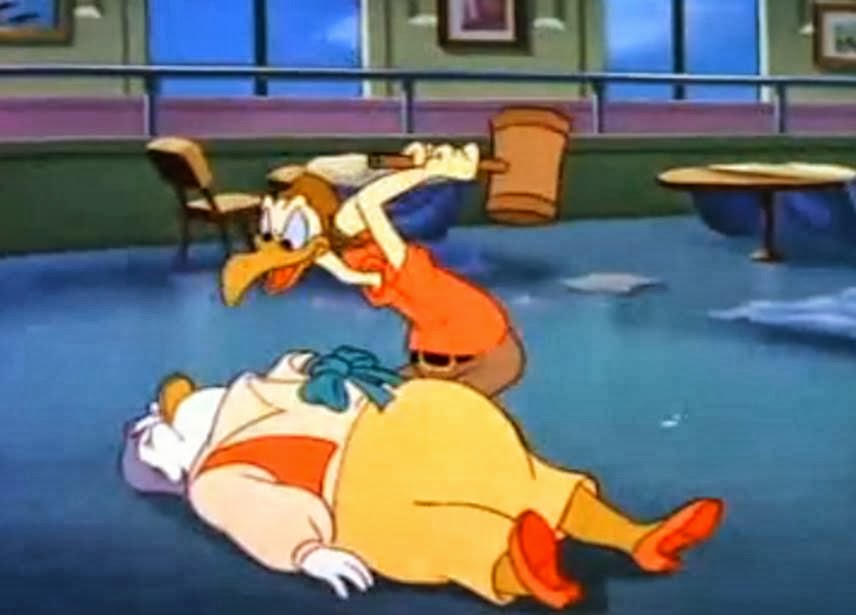
Of course, "the great Gloria Swansong" is by far the most memorable of the visiting players here.  Koonce and Weimers not only show considerable confidence in the ability of the viewers to recognize that Swansong and her porcine retainer Quax were spoofs of the Norman Desmond and Max characters from Sunset Blvd. (1950), but also showcase a fairly deep knowledge of arcane movie trivia by making Swansong's long-awaited "comeback" movie a disaster flickGloria Swanson had not made a theatrical movie since 1956 before agreeing to appear in Airport 1975 (1974) as, quite literally, herself.  The only explanation that I've ever seen for this decision was Swanson's announced desire to appear in an "old-fashioned family movie" of which she didn't have to be ashamed.  Well, there are different kinds of shame, as those who have seen Airport 1975 are well aware.

Compared to Swansong, the other celebrity parodies who board the blimp are relatively casual in nature, with no serious attempt being made to render the parodies in an accurate manner.  "Generic film director" Irwin Mallard and "bespectacled nerd scientist" Carl Sagander bear no real resemblance whatsoever to their real-life counterparts, apart from their professions and Sagander's constantly-evoked "billions and billions" catchphrase...

... while we don't even get a clear idea of what sort of critter Burt Quackarach is supposed to be.  (GeoX speculates that he's a parrot or a turtle; Joe and I always figured that he was meant to be a "lounge lizard.")  At least Koonce and Wiemers acknowledge the inspiration for Quackarach in an indirect manner; apart from his brief riff on "Light My Fire," all of Burt's little tunelets are swiped from Hal David and Burt Bacharach songs.

The slightly vague nature of these tribute characters (and poor, generic John D. Rockefeather and Mr. Webworth don't even qualify as vague tributes!) lends credence to the notion that "Hindentanic," like the eternally popular Airplane! (1980), was more attuned to the goofier, more exaggerated iterations of the disaster-movie genre.  Nowadays, films like Airport (1970) and Irwin Allen's The Poseidon Adventure (1972) are routinely lumped in with the likes of Airport 1975 and Allen's The Swarm (1978), but the former two are works of great art compared to the latter two, which begged to be taken seriously but could ultimately only be accepted as unintentional comedies.  The Hindentanic's Airport 1975-style lack of a pilot (once Captain Foghorn bails, that is), Mrs. Beakley's "Roy Rogers counter staff" wardrobe, and, of course, John D. Rockefeather's loosed bees are all clear signs that the "decadent era" of disaster movies was the target here.  That being said, K&W's inclusion of the mallet-wielding "hijackass" who wants to go to London is probably the single most memorable gag of the lot, because it is not instantly recognizable as 70s-inspired and, well, it is just so hilariously unexpected.  I don't recall "Hindentanic" being pulled off the air in the wake of 9/11, so evidently even the would-be "cleansers of potentially offensive imagery" managed to take this scene in the goofy spirit in which it was meant.

While I'm more than happy to give K&W the benefit of the doubt on most "plotular" twists and turns here, I can't ignore the ep's biggest gaffe: HD&L's inexplicable abandonment of their bee-watching post.  This whole sequence, starting with the boys' discovery that the disguised Glomgold has surreptitiously opened the bees' cage (as if they couldn't have gotten out through the mesh easily enough before that), does not appear to have been sufficiently thought through.  Why did HD&L open the door to the luggage compartment in the first place?  And, after they've discovered the truth and kept the bees "locked in," why did they suddenly leave the premises?  Surely all of them didn't need to go to the "little ducklings' room" at the same time?  Even HD&L's obligatory consultations of the Junior Woodchuck Guidebook reflect a certain lack of common sense: couldn't they have figured out how to trap bees and "keep a leaky blimp afloat" all on their own?  And then there's Huey's inability to pronounce "dirigible"...  Some people have complained that HD&L's intelligence level dropped precipitously during DT's second season.  One can argue that point, but the lads are certainly not at their best here.

"Let's get hopping"... yeah, right.

For all of Scrooge's pledges that he won't let Launchpad near the controls of the Hindentanic no matter what, the old miser should have realized that allowing LP to be part of the crew in any capacity wouldn't end well.  Fatalism that the Launchpad of "Top Duck" would have wholeheartedly embraced kicks in as LP accidentally bursts the blimp, Duckworth's attempt to take the controls leads to Poseidon Adventure-style upside-down sky-high hijinks, and the Ducks' efforts to keep the Hindentanic afloat with additional "hot air" quickly go up in smoke.  Scrooge finally bows to the inevitable and gives LP the controls for the final dégringolade, leading to the ep's best exchange:

Launchpad: I won't let you down, Mr. McD!
Scrooge: You'd better... why do you think I'm hiring you?

There follows a dramatic explosion-and-crash sequence that would probably have spelled a real-life finis for any non-Toons on board...

... and the "happy ending" rescue that leaves Scrooge with an unexpected profit, Glomgold with a familiar mad-on, Irwin Mallard with a free movie, Gloria Swansong with a new lease on her professional life, and... well, the viewers with a strange new respect for Captain Foghorn's psychic powers.  (I mean, really: first he knows that the steering mechanism is stuck without testing, or even looking at, the wheel, then he knows exactly where to bring the rescue ship to find the crash victims?  How can one not be impressed by that?)

Interestingly, during its "tribute to DuckTales" phase, kaboom!'s UNCLE $CROOGE title served up a brief morsel of a story that brought back distinct memories of this episode: "Big Blimp in Little Trouble."  It was a serviceable enough story, but the main reaction that it evinced from me was nostalgia for the genuine article.  Would it ever have been possible for a back-in-the-day DuckTales comic-book adaptation to have captured the spirit of "Hindentanic"?  At their best, John Lustig and William Van Horn might have been able to do so, and, if DUCKTALES comics were still being produced today, so might a moonlighting Katie Cook and Andy Price.  The mere fact that I have to invoke such comedic comics talents for such an imagined job tells you all that you need to know about the quality of "Hindentanic."

.

.

.

"DuckBlurbs"

(GeoX) ...you have the mentally incompetent captain [Foghorn] from "Bermuda Triangle Tangle"...

... who, despite that silly sojourn with the steering wheel in hand, does seem to possess a level of self-awareness that he didn't have in that earlier appearance.  "Bailing out" may not have been a brave thing to do, but it's a classic example of the truth of the quip, "I may be crazy, but I'm not stupid."


(GeoX) "I'll make this turkey fly even if it takes all the money in my money bin!" "But sir, turkeys can't fly either!" There's no good reason for me getting as annoyed as I do when people make this mistake, but the fact remains: TURKEYS CAN FLY.  Thank you.

Perhaps K&W should have substituted "white elephant" for "turkey."  That would have made pretty much the same point (since "white elephant" means "valuable but burdensome possession") and allowed for the same type of gag (Duckworth hearing a trumpeting elephant flying overhead).  They aren't the first people to make that mistake about flying turkeys, however.  I did the same thing when I reviewed a LITTLE LULU collection some time ago.

(Greg)  So we head into Scrooge's Money Bin office as Scrooge runs in and puts his cane on the vault door and sits down at his desk which has the oldest golden phone and name plate in history. Man; he is cheap to hire a gold polisher. Scrooge goes to his phone and dials the phone for the Duckb[u]rg Daily News. Scrooge wants to announce the return of the Hindentanic and [we hear] the gobbling on the phone as Scrooge blows it off because he knows turkey[s] cannot fly and orders them to print it. Nice to see Scrooge show that he gets the figure of speech.

But what happened to his phone?


(Greg) This is of course Gloria Swansong...  and she's voiced by Joan Gerber. The Mrs. Beakly voice gives it away. By the way; I also noticed a BS&P decision of using a weird rose in place of the long black smoke pipe. 

Good catch, and a clever SWERVE around the whole smoking issue.

(Greg) So we logically return to Flintheart's office as we pan over to Flint reading the newspaper proclaiming that according to Scrooge; a flight on the Hindentanic will be like a trip back in history. And you know Flint is a little bit of a sadist when he has a picture of Scrooge holding a golden cane and top hat in his office.

Was this some sort of an attempt at continuity with "Duckman of Aquatraz"?  If so, then someone must not have gotten the proverbial memo, both in terms of the appearance of the portrait and its placement in Glomgold's home.

(Greg) Scrooge has a champagne bottle in his hands and tries to break it; but stops and questions Duckworth on the cost of the bottle of alcohol. HAHA! Duckworth calls it the cheapest and that's enough for Scrooge to break it over the ship and it must be red wine because it sure as hell looks like it. Logic break #2 for the episode. I don't think champagne is red in color guys.

Um... and that's what makes it so cheap?  I guess. 

(Greg) [Swansong and Quax] go to Duckworth as she hands the ticket over and Duckworth answers the letter pleading for help because [Mr. Webworth] is having a beak transplant. Wow... I didn't expect them to allow dismemberment in any context in DTVA; but here it is.  

Don't forget the mamluks in the Aladdin seriesFor them, dismemberment was one of the common side effects of their profession.

(Greg) John [D. Rockefeather] gives [Duckworth] a yellow ticket (I guess the different colors and styles are for security reasons) and asks if there is trust that the honey bees are safe for this trip. Duckworth states that it will; just don't call him honey. 

Airplane! shout-out!  Rockefeather does not seem to be amused, which makes him one of the very few individuals who has not laughed at the gag being referenced.


(Greg) Farley [Foghorn] of course doesn't know how to pilot an airship and cannot pronounce it properly (Neither can I for that matter) as Farley walks up the stairs. Scrooge sulks on the fact that he made that wager on Flint. 

And, in so doing, he does a most un-Scrooge-McDuck-like thing and appears to break the fourth wall!  I mean, who ELSE would he be speaking to here, apart from the audience?  An unseen Cinnamon Teal?  I don't think so.


Don't worry, Scrooge -- you can't be expected to compete with an expert.

(Greg)  Gloria orders Quax to put Sheik Nurse of Baghdad in the projector at once. And yes; Webworth is a duck by the way as Quax agrees to [it]; reminding Gloria that people walked out over Kansas. I'm sure that they DIED in tears and frustration too. Geez; even this show is mocking suicide over a bad movie. 

Another unexpectedly "dark" reference in this "laugh riot" of an episode.


(Greg) So we head to the cleared dining room as Scrooge walks in and sees Launchpad sweeping the floors in his blue suit. I see he left his web boots at home today. Launchpad doesn't like this job because he has to stoop so low and Scrooge blows him off to stoop lower because he missed a spot. And there is a big dust bunny magically appearing from the floor out of nowhere.

Actually, you can see it when Scrooge first enters the scene: check at lower left.


(Greg) We continue inside the dining room with more running and panicking as the fire continues to burn and Irwin Mallard just keeps on filming. I['m] guessing the finish right now: Scrooge wins the bet on the profits coming from the disaster movie Irwin Mallard shoots in these scenes. I'm calling it right now. 

Evidently, Captain Foghorn isn't the only one around these parts with psychic powers.


(Greg) Now that was a balloon ride filled with old movie parodies and lots of chaos, destruction, terror and even Gloria Swansong's bad acting. Flint turned out to be the better terrorist than the real hijacking terrorist just to make the parody even funn[i]er. 

As I noted above, I don't believe that "Hindentanic" was blackballed due to 9/11, but, if it had been, then Flinty's "Middle Eastern gear" would probably have been the reason.  The getup, and even Glomgold's fake voice, aren't particularly offensive, but the mere juxtaposition of a "Middle Eastern character" with an air disaster might have been enough to tip the scales.  Thankfully, cooler heads appear to have prevailed in this case.


Next: Episode 57, "Dime Enough for Luck."