Showing posts with label Wuzzles. Show all posts

Sunday, August 18, 2013

DUCKTALES RETROSPECTIVE: Episode 49, "Scroogerello"

In all honesty, I don't savvy the lack of enthusiasm that both GeoX and Greg appear to have had for "Scroogerello," one of the more imaginative and risk-taking episodes of DuckTales' first season.  Greg inadvertently put his finger on the reason why this off-the-wall take on Cinderella deserves more than its share of respect when he comments, "Yeap; this is our first reality bending episode." Precisely -- and it's the first time that such "reality bending" has taken place within something close to an established "Duck context."  "Scroogerello" works because the storyline manages to respect the parameters of the Ducks' world (or the DT version of same) while putting the characters into some wholly unrecognizable situations.  The ep very rarely flags and keeps coming up with imaginative and amusing ideas to enliven the familiar fairy-tale tropes.  Several future episodes ("The Uncrashable Hindentanic" comes quickly to mind) would execute the trick more efficiently -- "Hindentanic," in particular, has a much stronger framing sequence -- but give "Scroogerello" full credit: It got there first.

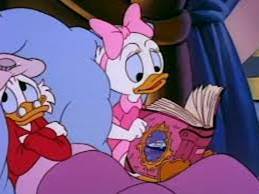
The opening could be considered something of an "indirect reboot" of the old idea of an "overly bossy" Scrooge.  Recall that this aspect of Scrooge's personality was toned down from original script drafts in parts three and five of "Treasure of the Golden Suns."  Here, we get a full faceful of the "Wrath of Scrooge," a mad-on exacerbated by his extremely atypical bout of illness.  I suppose that Scrooge could hardly be blamed for lashing out at anyone who tries to "help" him while he's in such a unusually vulnerable physical state.  "Difficult patients" are fairly common in hospital settings, after all.  Still, Scrooge's anger towards his family and servants in the opening minutes winds up playing a surprisingly small role in the context of the Cinderella parody.  Only Scroogerello's comment "Why do I feel so guilty?" when he encounters the aged, imprisoned Duckworth makes any sort of direct reference to it.  Usually, when a character has a "mental experience" like this, the "dream" or "hallucination" or whatever is chock full of references to the underlying reason for the "experience."  The "Cinderella Stone" episode of The Flintstones (which, for all I know, may have inspired this little experiment) is one good example of this.  Scrooge's illness, by contrast, basically creates only the physical reason for his mental adventure.

It's no surprise that Glomgold and the Beagle Boys (or an unusual combination of same: Big Time/Burger/Bebop-Bugle) play the roles of wicked stepfather and stepbrothers here.  The fun really starts to flow when HD&L are introduced as Junior Woodchuck cookie peddlers.  Teleplay writer Evelyn Gabai displays some cunning attention to detail when she depicts the Woodchuck cookies as being heavier than concrete.  This is at once a reflection of the TV series' somewhat more jaundiced view of the Junior Woodchuck Guidebook and the traditional vision of the Woodchucks as a hyper-competent organization.  Only such an organization, you must admit, could possibly create such utterly inedible cookies.

As the "fairy godchild in training," Webby produces one of her most winning performances of the series.  We have come to expect Webby's enthusiasm and desire to pitch in (though her gung-ho-ness does seem to tick the impatient Scroogerello off at one point), but she gets to display some additional character traits.  Later in the episode, after she's stopped the topiary-animal stampede in Prince Lilypad's garden, Webby gets to bask in universal approbation and even to flash a little bit of ego with the "When you've got it, you've got it" comments.  I would have liked to have seen this somewhat more assertive version of the character -- somewhat akin to the heckling Webby in "Take Me Out of the Ballgame," but with more inherent charm -- in a few additional episodes.

Speaking of making an impression -- wow, until my most recent viewings of the episode, I don't think I ever fully appreciated just how good a performance "Princess Goldie" puts in here.  It was natural enough that Goldie would serve as Scroogerello's love interest, but Gabai gives the Klondike gal far more to do than simply play the distaff version of Prince Charming.  The extremely feisty, lout-clouting, in-your-face-sandwich-shoving, karate-chopping Goldie we see here is a worthy predecessor to the Goldie who features in a number of chapters of Don Rosa's LIFE AND TIMES OF SCROOGE McDUCK.  In fact, the success of the characterization in "Scroogerello" may be even more remarkable considering that Goldie has been taken completely out of her standard "Klondike context" for the very first time, yet is immediately recognizable AS Goldie.  Joan Gerber's fine performance certainly helps make this impression, but it is clear that Gabai understands how Goldie works and what can believably be done with her.

I find it quite interesting that, while "Princess Goldie" is depicted in the younger form seen in the flashback sequence of "Back to the Klondike" (both Barks and DT versions), Scroogerello is the elderly Scrooge of the present day.  Perhaps Scrooge's dreaming of a young Goldie (not to mention his concluding remark, "I guess it didn't work out this time either, old girl") is a reflection of a long-held desire to return to some sort of "cohabitation" with her in the Klondike.  Surely, that is the underlying message of Don Rosa's "dreamscape" tale "The Dream of a Lifetime."  Amusingly, both "Scroogerello" and "The Dream of a Lifetime" include a rescue of Goldie, though the Goldie of the former is far more aggressive in fighting against her fate than the Goldie of the latter.

I began to fully realize that "Scroogerello" had taken Duck-based storytelling into what fans might call "a whole weird new area" when Scroogerello was provided with a... cookie-box limo... to get to the ball.  (I've heard rumors that George Harrison originally wrote "Crackerbox Palace" with that very title in mind.  No, not really.)  And, of course, the cookies didn't crumble there: we got more gags involving using chocolate chips and cookie crumbs as weapons before midnight struck and the whole shebang devolved into... well, um, cookie dough, I guess.  (That would certainly be preferable to some of the possible alternatives.)  The refusal to let go of the bizarre cookie-car idea, but instead to milk it for all it is worth (see what I did there?), is a clear indication of this episode's commitment to the off-the-wall.

Oddly enough, the characterization of Prince Lilypad is probably the most predictable part of the ep, except that he tends to splash, rather than crash.  (Note how many times he douses the unappreciative Scroogerello.)  Lilypad does get a priceless line when he channels The Elephant Man in declaring "I am NOT an animal... I am an amphibian!"  The biological mistake is more than compensated for by the cleverness of the reference.  More movie references follow as the topiary garden resurrects memories of both Disney's animated version of Alice in Wonderland and Stanley Kubrick's The Shining.  From my own peculiar perspective, I couldn't help but think of the Kimba the White Lion episode "The Red Menace" during the "bush-animal barbecue" scene.  The constant references to Lilypad's "cas-tull" do tend to annoy after a while, in the same manner as Bebop/Bugle's "Be-bop-a-lu..." rhyming scheme.  This ep is so good at coming up with new ideas that it's a shame that such old-fashioned jackhammering was found acceptable.

The "rescuing Goldie" sequence is reasonably conventional (or as "conventional" as anything in such a setting can be) apart from the decision to literally turn Glomgold and the Beagles into "bullfrogs."  That weird little bauble was presumably added simply to justify the concluding gag about the Wuzzlified villains finding "an ugly princess who'll kiss anyone on the first date!".  GeoX's negative reaction to this gag is a bit mystifying, since the innuendo is mild at best -- not to mention legitimately funny.  Besides, after the "silent cabin scene" in Rosa's "The Prisoner of White Agony Creek," I think it can be safely said that the "bar" for the appropriateness of sexually charged scenes involving the Duck characters has been raised considerably.

The "take a number" sequence is, of course, a somewhat anachronistic distaff reversal of the "post-ball search for Cinderella," and a clever one it is.  Several figures from the Pick-a-Prince Ball can be seen in the line of would-be matches, though none of them get featured lines.  Goldie's somewhat demure pilgrimage to find "Mr. Right" is also good for a chuckle; I get the impression that Gerber was making a particular effort to channel the spirit of Mae West here.  If only Goldie could have swung her hips just a bit more...

After Scrooge wakes up, of course, we get the old miser's expected apologies for his previous shortness, which (as noted above) would have carried even more meaning had the disputes with the family and servants been more in evidence during the dream-adventure itself.  I am not all that enamored of the decision to have Louie ask whether the penitent Scrooge is "feeling all right"; I think that it is safe to say that the Nephews should know full well by now that Scrooge's bark is rather sharper than his bite.  And, much as I hate to admit it -- because I find the gag to be hilarious -- I have to agree with GeoX and his correspondent "Christopher" (no relation, obviously) that the "fries and hamburgers" business does lead to all sorts of distasteful questions about exactly what the Ducks ate when Scrooge took them out to restaurants in the past.  The only way of getting around the dilemma is to assume that this is the first time that Scrooge has EVER taken his family out to dinner, but we know that such is not the case, because the whole gang went to Quack Maison during "Down and Out in Duckburg."  As GeoX suggested, this was probably a case of Gabai tripping over the "Law of Unintended Complications."  All of these issues combine to make the episode wrap-up a little bit of a letdown, despite the exquisite ending that brings back both the "magic gold topper" and the statue of Goldie from "Scrooge's Pet."  I guess that Scrooge moved the statue out of his Money Bin office after Lucky knocked it over and almost broke it in that episode.

Though it can certainly be flyspecked, "Scroogerello" deserves the respect of all Duck fans as a bold initial effort to use the TV medium to bring a certain approach to the world of the Ducks that had never been used before.  I think that my relative lack of experience with Barks' world at the time made me a bit more receptive than some of the more curmudgeonly "old sourdoughs" in the audience to what Gabai was trying to accomplish here.  (I wonder whether Barks ever screened this ep.  That would have been fun to watch.)  It is safe to say, that by this time, the comparative stateliness of the early DT eps has well and truly been jettisoned, leaving the field open for numerous other departures from the "Duck-expected."  Some of the latter failed, of course, but we tend to remember the ones that succeeded quite fondly indeed.  "Scroogerello" is not the least of them.

.

.

.

"DuckBlurbs"

(GeoX) Brief, non-speaking appearance by Ludwig [von Drake], as one of the guys who gets his head smashed in the food by a Beagle Boy.

Well, he certainly looks a bit like Ludwig, but I'm not quite willing to pin the definitive ID on him.  Unless Ludwig has suddenly taken to wearing contacts, that is.

(GeoX) The beatnik Beagle is now some sort of combination beatnik/disco Beagle. Very strange.
(Pan Milus) It's Scrooge dream man! For him disco and beatnik culture is the same thing ;)

I figured that it was appropriate to address Pan's comment on this issue along with GeoX's in a more "open" forum than the comments section.  It's pretty clear that the writers who used Bugle/Bebop -- Koonce and Weimers, Anthony Adams, and Gabai -- were provided with only a vague idea of how this character was supposed to be presented.  "Just make him a 'hip dude' who digs music" was probably the sum total of it all.  I do think that Pan comes up with a pretty good take on how Scrooge might have hallucinated about B/B being a "disco Beagle" (even though B/B seems more into a sloppy version of go-go than actual disco).  Just as comic-book writers in the late 60s used references to the Beatnik era when writing dialogue for their "far-out" characters, so too might Scrooge pack several strata of musical history into a single imagined character.

(Greg)  This episode was written by John Pirillo... John Pirillo's IMDB script reads almost exactly like Cherie Dee [Wilkerson]'s in terms of resume.

Actually, it looks more like James Markovich's ("Back Out in the Outback").  Pirillo's story (not writing) credit here is the only one listed under his name.  Just as I did for "Outback," when I interpreted the story as an example of teleplay writer Richard Merwin's work, I chose to regard "Scroogerello" as Evelyn Gabai's baby.  For all I know, Pirillo's "story" simply consisted of the suggestion, "Why don't we parody Cinderella using Scrooge?"

(Greg) Duckworth then brings out the cod liver oil (believe me; that would NEVER work in real life) as Scrooge blows him off (remembering to swear in DUBBED SCOTTISH STYLE to boot) for trying to poison him. HAHA! I agree; Cod Liver Oil is terrible, crappy and totally pointless. 

Actually, cod liver oil seems to be a pretty useful supplement, though I imagine that the liquid form has long since been superseded by capsules.

(Greg)  Scrooge wants to go warn the princess; but he of course loses his balance and screams loudly and drops with a wussy bump into the wheelbarrow as we see logic break #1 for the episode as somehow the Beagle Boys manage to provide the wheelbarrow and show up within about four seconds. I know this is a dream; but COME ON! Show some logic in your dreams guys. It makes it more believable. Even Scrooge is questioning the logic of that spot calling them speedy devils.

If the "speedy devils" line HADN'T been included, then this bit would indeed have stretched logic quite a bit.  But the self-referential comment by Scroogerello makes up for it, I think, especially in the context of such a "reality-bending" storyline.  No argument about Burger misplacing his mask, though...


(Greg) Dewey proclaims that [the boys] are spending their years shining Bebop's shoes. Then why was Bebop asking Scrooge to do it? Logic break #2 for the episode.

You'd have to ask Imelda Marcos about how many servants would be needed to service the number of shoes that B/B appears to own.

(Greg) So we cut to outside as Scrooge thanks the fairies for their spring out and I see Mrs. Beakly's dress has changed from pink to purple. How about that?! I guess Webby's magic does have out of control properties after all.

I'd like to think that this was a reference to the running gag in Disney's Sleeping Beauty in which the three good fairies couldn't agree upon the color of Aurora's dress and kept on changing it up until the very end of the movie.  The "coloring error" explanation seems more believable, somehow...

(Greg) I also sense logic break #4 for the episode as Huey the limo driver was changed to blue. Shouldn't that be Dewey since he wears blue?

...and this is why.

(Greg) Burger takes [Goldie's] hand as the food goes flying and Goldie calls this waltzing in a cheap cafeteria. HAHA! The music stops and Burger asks where is the movie? Huh? Explain THAT one kids! 

Obviously, some bit of dialogue was cut somewhere in the vicinity of this remark, but the continuity error wasn't caught in time.  Since "movies" have nothing to do with what's going on, I wonder what the excised material could possibly have involved.

(Greg)  Flint blows off Scrooge's tactics as they near a church which so happens to not have a Christian Cross on it. Ahh; I see that BS&P finally stepped in on these religious symbols. And then the clock on the front strikes midnight and I betcha everything turns back to normal for Scrooge and company. I check the DVD....Damn; I'm good as Webby explains that her magic doesn't last past midnight.

Note the "Donald Duck" watch here.


(Greg) So we go into the forest as Scrooge and the nephews walk looking defeated for some reason. Then he tells the lads to have courage as he picks up a trail of golden sequins from Goldie. Umm; check your internal logic there; there are no sequins on the blue dress. Logic break #6 for the episode. 

Had "Princess Goldie" been wearing her "Belle of the Klondike" garb, then there would have been sequins aplenty available for the purposes of falling and trailing.  The odd thing here is that the sequins don't resemble sequins as much as they do coins.  Might there have been some miscommunication here between what the script intended and what the Wang Films animators were told to portray?


(Greg) ...Duckworth and Mrs. Beakly panic and back up to the wall thinking that [Scrooge] is going to diss them again for being mother hens on him. Scrooge then goes over to them and breaks logic again as he's now wearing his purple robe with purple slippers again after wearing a red robe when he was sleeping. 

Actually, I think that the "red robe" was red pajamas, and that he was wearing pajamas under the purple robe.  Naturally enough, you wouldn't be able to see the PJs when the robe was on.  It would be unlikely that Scrooge would wear a robe to bed when he's running such a high temperature.  I imagine that Scrooge took off the robe when he got (or was put) in bed and stowed it under the covers, making it easier to put on when he finally did get out of bed.
Next: Episode 50, "Double-O-Duck."

Monday, April 29, 2013

DUCKTALES RETROSPECTIVE: Episode 31, "Much Ado About Scrooge"

The first season of DuckTales has now settled into what, in production terms, could be called its "middle period" -- and a fecund one it will prove to be.  "Home Sweet Homer" touches off a skein of 10 episodes that all (with one arguable exception) have reasonable arguments to rank among the series' best.  It's as if accomplishing the monumental task of completing "Treasure of the Golden Suns" served as a goad to maintain a similarly high standard of quality in the half-hour episodes.

Interestingly, a fair number of the eps in this remarkable run give Scrooge, if not exactly a second-banana role, then certainly a somewhat less central role than we have heretofore been accustomed to seeing him fill.  As I noted in my discussion of "Homer," Scrooge may have talked a good heroic game in that ep, but it was the Nephews who did most of the heavy lifting.  Now comes an episode with a highly misleading title, even granted that writers Karen Willson and Chris Weber were straining mightily to come up with a Shakespearean angle when they crafted it.  It would be very difficult to argue that Scrooge is the center of attention here -- not with one of the most indelibly memorable one-shot characters of the series primed and ready to grab center stage.  Indeed, Filler Brushbill the super-salesman takes up so much of the oxygen that I've always wondered whether another character, one much more familiar to Carl Barks fans, might originally have been slated for this starring turn.  But more on that anon, as a writer of cod-Shakespeare might put it.

For what is, at its core, yet another globe-crossing treasure-hunt story, "Much Ado About Scrooge" takes its own sweet time to get up to speed, as the audience luxuriates in a no-holds-barred battle of wits between the ever-persistent Brushbill and the determined-to-resist Scrooge.  A few of the gags here could probably have been omitted in favor of the characters spending more time on the "haunted" isle of Great Written, but, in all fairness, Willson and Weber aren't simply marking time waiting for Scrooge, HD&L, and Duckworth to give in and the main plot to kick into gear.  They plant an important character-relationship seed, quickly establishing that Louie, heavily in hock to Brushbill though he might be, has a sneaking admiration for the salesman.  When Huey and Dewey arrive in the midst of the standoff and Louie tells his brothers about Brushbill's arrival, the green-clad Nephew's "But Unca Scrooge isn't gonna let him in!" sounds decidedly wistful.  In the scene below, Louie looks almost dazed, as if Brushbill is exerting some sort of weird, Svengali-like power over him.  (Good thing Filler isn't really that sleazy, eh?)  I honestly hadn't taken full notice of these foreshadowing moments until my more recent viewings of the episode.  

Scrooge's ultimate surrender to Brushbill's blandishments could be considered a belated version of the old miser being "hoist by his own canard."  (At least, it would if a dogfaced character weren't involved.)  In the Tony Strobl-drawn comic-book tale "The Kitchy-Kaw Diamond" (DONALD DUCK #40, March 1955), Scrooge uses "Gabby Smoothtalker the super-hypnotic salesman" to get Donald hopelessly in debt, thereby forcing the destitute duck to perform an unpleasant task for him.  Since Brushbill causes Scrooge to "blunk-out" (for what should be obvious reasons, I prefer that description to Greg's "lose control of his bodily functions") just before the latter caves in, I suppose that it's at least possible that Willson and Weber were aware of the Strobl story.  In all honesty, though, it's not likely.  Despite the somewhat contrived manner in which Brushbill is used to get the "original editions" of William Drakespeare into Scrooge's hands, the salesman is far more than a simple gimmick to put a larger plot in motion.

Perhaps I'm not taking into account the full effects of inflation over the past 25 years, but it seems to me that original editions of Drakespeare "owned by 'The Bird' himself" would be worth rather more than a portion of $444,448.04 (the amount that Scrooge is obliged to shell out for all of his purchases -- and remember, that's counting the glow-in-the-dark socks).  This is especially true in view of the fact that entire volumes of the "original editions" seem to be taken up by single plays, as Scrooge notes when he picks up the bulky copy of Romeo and Julieweb.  Were the Drakespeare originals considerably longer than the versions that survived, only to be brutally slashed at some point, on the order of von Stroheim's Greed?  I'll go along with Scrooge's later line that acquiring these tumescent tomes for that relatively piddling amount of money was "cheap at twice the price." 

Emphasis on "complete."

With the Ducks' discovery of Drakespeare's note and subsequent dash for Great Written, we begin to glimpse the outlines of the original form that this story might have taken.  Specifically, the manner in which Brushbill learns of the existence of Drakespeare's lost play seems suspiciously similar to the implausible manner in which Gladstone Gander gets wind of Donald and HD&L's impending mission to recover Scrooge's lost documents in Carl Barks' "Secret of Hondorica" (DONALD DUCK #46, March 1956).  Granted, Scrooge and the boys aren't obliged to memorize the information on Drakespeare's note, as Donald and HD&L did for the map...

... but Gladstone's discovery of the map and the wind blowing Drakespeare's note onto Brushbill's beak seem to be "two pains in a pod":

This, combined with Brushbill's somewhat obnoxious personality (created, in very large part, by Charlie Adler's voice work) and quasi-mystical salesmanship abilities, has always inclined me in the direction of the opinion that Willson and Weber may have originally written "Much Ado" as some sort of vehicle for Gladstone.  (Heck, "Secret of Hondorica" itself might have given rise to an excellent DT adaptation, perhaps with Launchpad taking Donald's place.)  I have no way of knowing at this point whether my theory is correct, though I once had a chance to find out.  (No, really...  on one of my trips to the San Diego Comic-Con, I was briefly on an elevator with Chris Weber.  I still wonder why I didn't hazard the question at that time.)  In any event, it's not hard to visualize a version of this story in which Brushbill's siege of McDuck Mansion is replaced by a sequence introducing the audience to the power of Gladstone's luck, and Gladstone subsequently getting the chance to race Scrooge and the boys to find the lost play.  If such truly were the case, then evidently it was felt that Gladstone needed to be introduced in a somewhat more formal and less "plot-heavy" manner, as he ultimately was in the comparatively stripped-down "Dime Enough for Luck." 

At this point, GeoX raises a very significant question about the logic behind Scrooge's mad rush to secure the play:

There's a bit early on where one of the kids objects to this quest: "But Uncle Scrooge, Drakespeare said that last play wasn't very good!" To which Scrooge replies: "Who cares? It's still worth millions just because he wrote it!" I'm pretty sure we're supposed to view Scrooge as engaging in ethically shady profiteering here, but for rather obvious reasons, this is a very stupid idea.

Granted that Geo is far more familiar with matters literary than I am, this line of reasoning (by which I mean, casting Scrooge in a somewhat negative light for his interest in profiting from the play) isn't truly that far-fetched.  I mean, people really do try to pull stunts like this all the time.  Why else would anyone suddenly dig out a moldy manuscript by Woody Guthrie and try to recast the left-wing icon as a major novelist.  (Let's face it, if this thing had been any good at all, it would certainly have been published ages ago.)  Then, there's the once-burgeoning market for Carl Barks... well, "scribbles," I'll call them.  There's nothing at all wrong with owning original art, but there's art, and then there's faint scratches on tissue paper that miraculously avoided the trash can.  I can't help but look a little askance at those who tried to peddle the latter as "Barks art."

The set-up on Great Written Island is... well, strange.  We never do get an explanation as to why Drakespeare didn't want outsiders "sneaking, peeking, or exploring" around the place.  At some point, wouldn't such obsessive secrecy have hurt his reputation as "the greatest writer ever"?  (I don't know -- is J.D. Salinger still considered to be a major novelist?)  With Brushbill and the Ducks ultimately teaming up in a cooperative manner to explore the island, I suspect that the unfriendliness of the "Great Written Players" was an attempt by Willson and Weber to create some conflict and tension where none really existed.  Simply having the gang stroll through the woods to Drakespeare's castle without encountering any obstacles would have made for some rather dull visuals.

For my money, the highlight of the Ducks' pre-castle sojourn on Great Written comes in the very first scene -- the boat wreck.  This very atmospheric moment is memorably punctuated by the sight of Louie being swept away by the waves.  Fittingly, Brushbill saves Louie from harm by peddling brushes and such to the Weird Sisters from... er, Macbeak.  (The title Macduck, of course, is already taken, though the gang doesn't know that yet.)

In the ensuing "bonding scene" at the campfire, we once again note Louie's strange connection to Brushbill.  Having almost spilled the beans to Filler after the note blew out of Scrooge's limo back in Duckburg (and, incidentally, shouldn't Scrooge have gotten a little more bent out of shape about the loss of that note?  Wouldn't IT be worth a fair chunk of change in the literary-collectibles market, too?), Louie completes the job here when he accidentally reveals Scrooge's agreement with Brushbill's theory about the "value" of the terrible play.  I swear, my Svengali theory is starting to look better and better.  I do wish that we knew more about WHY Louie, in particular, seems so attuned to Brushbill.  For crying out loud, Louie even expresses interest in becoming a door-to-door salesman himself someday!  Given that (1) the boys will presumably inherit Scrooge's riches at some point and (2) Louie, like his bros, is considerably brighter than the average duckling, you'll forgive me if this ambition sounds a bit laughable.  None of the previous research about the differences between the Nephews (cf. Dan Haley's seminal work back in the 80s) gives us any clue here.  I'm certainly open to suggestions.

The "Great Written Players" remind me a bit of the character Fanny Featherbrain from Barks' "Isle of Golden Geese" (UNCLE $CROOGE #45, October 1963).  Like her, they're isolated from the outside world and are complete anachronisms in both attitude and appearance -- "fairy tale" characters of sorts.  Watching them go through their play-acting paces, one might also be tempted to compare them to the Druids in "The Curse of Castle McDuck," except that their self-entrapment in cultural amber seems to be far more, well, pointless than anything the Druids displayed.  In driving out intruders from Castle McDuck in order to enact their rituals, the Druids were merely attempting to preserve what was, by then, a dying culture.  But the whole world is presumably filled with acting troupes performing the Drakespeare plays, so why have the "Players" refused to contact the outside world?  Given the real-world existence of all the modernized versions of Shakespeare's works, it would have been an interesting plot twist had the "Players" known about altered versions of the Drakespeare plays and actively tried to make a point about keeping true to the texts of the originals (maybe even the uncut, book-length ones!).  But, no, we're supposed to believe that these guys and their ancestors have simply been spinning their creative wheels for some 400 years, to no apparent purpose other than a slavish devotion to Drakespeare's puzzling last request.  I didn't mind this angle so much when I first watched "Much Ado," because I was so impressed by the episode's ambiance (not to mention Willson and Weber's admirable resistance of the temptation to spoon-feed the audience and explicitly identify the different Shakespearean characters that the "Players" were playing).  But now, it does seem a lot more like a "myth-busting" episode of Star Trek, as GeoX noted.  For this reason alone, I probably wouldn't be able to give the episode full marks were I reviewing and rating it anew today.

The concluding business is admittedly a bit overcooked -- how convenient that the lightning storm broke out just when Brushbill decided to "go rogue" and pilfer Macduck -- but it still works quite well for me, GeoX's point about "cheating the customers" notwithstanding.  It might have worked even more smoothly had the issue of Brushbill's honesty been raised at the very beginning of the episode, as opposed to suddenly popping up about halfway through.  Planting the notion early on that Filler, for all his annoying persistence, is an "honest man" at heart would have made his sudden switch to the "dark side" seem all the more dramatic.  Another pre-planted "seedling" does flower here, though, as Louie makes his memorable plea to the "better angels" of Brushbill's gaudily-clad nature.  BTW, I think that this scene could very easily have been pulled off with Gladstone as well, perhaps with Louie or whoever reminding the lucky gander that "trying to cheat people is a form of work!".

"Much Ado" is a not-quite-perfect-but-reasonably-close illustration of what distinguished DuckTales from other animated TV series of the era -- and continues to do so today.  The pieces may not all fit together snugly, but the script takes for granted the fact that the viewers possess a modicum of intelligence, the spooky atmospherics of Great Written make up for some of the gaps in logic, and some clever character business pops up when there's really no need for it to do so.  Bottom line: you don't have to "sell me" on the quality of this episode.


.

.

.

"DuckBlurbs"

(Greg)  So we cut back to the rowboat as Scrooge asks Louie if he sees anything. And they are wearing life jackets (so they can be safe according to the LAW OF DORA) as Louie asks if fog counts and Scrooge blows him off. Then he panics as there are rocks coming. Louie panics as we get the FPS shot of a giant rock and the rowboat crashes into it and gets destroyed of course while the babyfaces fall into the sea. At least we now see a use for the life jackets this time around. We pan right to see Scrooge, Dewey and Huey pop up gurgling; but Louie seems to be missing. Scrooge uses the cane to get Huey and Dewey together. However; Louie gets caught in the rip tide and gets engulfed by a big wave. Scrooge yells for him and the rest of the ducks get swamped as well.

Actually, Louie may have been in more danger here than we were led to believe.  At some point between the boat crash and his arrival on shore, his life jacket slipped off!


(Greg)  Filler goes into his big ass doctor's bag and brings out the RIC FLAIR BROOMSTICK OF DOOM; and it has nylon bristles and used one with low mileage on them. He throws all the broom right at the witches just to annoy me some more. The witches take this well as Filler gives them cauldrons in small, medium, large and the Monster Size one. HOLY CRAP?! Did he skin Eleroo and his pouch or something?! HOW IN THE HELL DID HE KEEP THAT BIG ASS CAULDRON IN THAT DOCTOR'S BAG?!

I dunno; you'd have to consult an expert...


(Greg)  Scrooge and Dewey continue to comb the beach looking for Louie. And then they see: Julius Caesar and two Roman Guards?! Okay; this could be good. Julius cuts his promo (Lend me your ears) as I should point out that it wasn't Julius who spoke these words; I believe it was [Mark] Ant[h]ony or Brutus. It's been a long time since I read the original play; but I know it wasn't Caesar. Bad research there guys.

It was Mark Antony.  Even though I've always thought of and referred to the Will Ryan-voiced character in this episode as "the Caesar guy," you could just as easily think of him as Antony, I suppose.  He's never formally identified as Caesar.

(Greg)  Then we see the curtain flapping from behind as we clearly hear Filler cutting a Hamlet promo with a sales deal. That is the ultimate blasphemy! Scrooge is about to use the cane; but out comes Louie and Filler as Louie is giggling under his breath.

More evidence of Brushbill's sway over Louie, perchance?  The gag wasn't THAT funny.


Next:  Episode 32, "Top Duck."

Wednesday, August 1, 2012

DUCKTALES RETROSPECTIVE: Episode 4, "Micro Ducks from Outer Space"

Joe, GeoX, and I had an interesting exchange regarding just who the holy hay at WDTVA was responsible for (1) dreaming up the likes of Quacky McSlant and Vacation van Honk and (2) actually thinking that these characters possessed sufficient chops for any sort of meaningful role on DuckTales.  My own opinion is that there may have been a conflict between creators like Jymn Magon, who, thanks to Gummi Bears and Wuzzles, had some experience working in the WDTVA environment, and "outside people" who were brought in to beef up the crew in preparation for the production of the studio's first syndicated series.  Quacky and VVH have the feel of "gimmick characters" who fit right in with the approaches of such contemporary hit series as Smurfs (is it mere coincidence that DT story editors Tedd Anasti and Patsy Cameron-Anasti came to WDTVA directly from that series?).  So, for that matter, does the later Benzino Gasolini, who actually fared better than the earlier "dubious duo," garnering reasonably meaty roles in both "Hotel Strangeduck" and "Top Duck."  The cursory nature of these characters' ultimate contributions suggests that those who had a better sense of Duckdom than did the veterans of 80's kid-vid approaches got the better of the final argument.

Speaking of new characters, here's an interesting (and apropos, given the subject matter of this entry) comment from a 2004 Animation World Network interview with "Mr. Thaddeus Rockwell" himself, Tad Stones:

At that time [1988], I pitched three new characters for DUCKTALES.  I drew some pictures and I said, “Here's Space Duck, an alien duck; here's Bubba Duck, a caveman duck, and here's his personality. You know the big hit of last summer, Robocop? Kids, nobody knows the real hero is — Roboduck!” [Roboduck] eventually became Gizmoduck.

So now you know who to praise (or blame) for those second-season additions.  But... Space Duck?  That's distressingly... vague, don't you think?  Why not borrow directly from Carl Barks and bring back the much-loved Micro-Ducks for occasional return engagements?  I mean, the original story is well-regarded, and DT had already established the Micro Ducks (sans hyphen -- that sound you hear is Stan Lee sobbing) as viable characters in a first-season episode, right?  Only... well, um, er, not.  The way the Micros were characterized in that initial go-round, they might as well have been given generic names on the order of Space Duck #1, Space Duck #2, and so forth.  And that has always been my primary beef with this handsomely produced effort, in which the characterization of the Micros is kicked to the curb in favor of a well-imagined, frequently exciting, but ultimately hollow Land of the Giants-style exercise in which our shrunken heroes must make their way through super-colossal surroundings.  Others, including GeoX, have expressed very similar sentiments. 

The irony of the diminution (sorry) of the Micros' personalities and role is that, as set up by scriptwriters Jack Hanrahan and Eleanor Burian-Mohr, the little Ducks actually had the potential to excite more empathy in the audience.  One of the problems that I have with Barks' original story is the somewhat contrived rationale behind the Micros' journey to Earth.  I mean, establishing trade is all well and good, and it's cute to see Scrooge bargain with the tiny visitors over minuscule amounts of grain, but... a four-year one-way trip across deep space, just for that?  Shouldn't the Micros have a more compelling immediate reason for taking on such a daring mission?  The fact that the TV Micros need a large amount of grain because of a "terrible food shortage" on their planet -- though it may seem like a similarly contrived way of helping Scrooge get rid of his surplus -- gives the situation a certain urgency that the Barks story did not possess (at least, not until John the Con began trying to trap the spaceship so he could bring it to the Skeptics' Club).  Unfortunately, any ruminations over the Micros' desperate plight are pretty much shot to hell right at the start, when the Micros' stiff-as-a-stick female commander (who may be teentsy, but is definitely NOT a teen) insults a hapless, dangling Gyro to his face.

This acerbic initial exchange presages a series of script lines that teeter back and forth between cliched sci-fi movie exchanges and rather crude insults.  Lines like "A tiny spaceship, and tiny beings from outer space!", "We've scanned your grain, it is perfect for our needs," and "Farewell, Earthlings!" just don't have the homey, sympathy-inducing feel of:


And, no, the honorific-mangling, bumbling crewman Dekaduck is not an acceptable substitute.  (BTW, since the prefix deka- means "multiply by 10," which would imply that the Micros are larger than average Earth size, why not use a smaller unit to name the guy, say, Picoduck or Nanoduck?) As for poor Gyro, just as Scrooge will fling a whole flock of barbs Launchpad's way in the next episode, the old skinflint takes the skin off the inventor on several occasions here.  Not that Gyro comes off that well himself; his voice is finally rounding into form after Hal Smith's earlier "experiments," but he gets shocked, falls off a roof, practices grandiose speeches to "wel-come" the "space trav-lers," and falls asleep during his search for Scrooge, HD&L, and Webby.  Had it not been for Launchpad getting wrapped up in sticky "duck tape" (you may commence groaning now) and duplicating Gyro's plunge, Gyro would have been left naked and exposed as the ep's ranking stumblebum.  Even LP gets some glory when he winds up being the (admittedly cleverly set up) means by which Scrooge and the kids regain access to the Micros' "molecular manipulator" and are able to return to normal size.

While the Micros themselves have little substance, the run-up to Scrooge, HD&L, and Webby getting shrunk is generally well-done, with alterations both understandable (e.g., Scrooge using an insect sprayer, rather than smoke from an Indian peace pipe, to force the Micros' ship to land) and puzzling (do you keep a sledgehammer within arm's reach at all times, Scrooge?  I thought you already had plenty of traps for solicitors).  It does, however, seem rather unlikely that the mechanically efficient (except for Dekaduck, of course) Micros would have forgotten to take their "manipulator" with them, much less take so long to realize their oversight.

Well, at least he didn't trip and fall on them.

Of course, DuckTales debuted well before cell phones, laptops, and the like became common, else the shrunken Ducks might have found it a bit easier to communicate with the over-sized outside world and hence obviate the need for their cross-Duckburg trek to Gyro's "barn."  (Gyro's lab will also be described that way in "Armstrong," but the curious descriptor was dropped after that.)  Of course, then we wouldn't have gotten the fine travel sequence that graces the latter portion of this ep.  The miniaturized Ducks' trek contains numerous memorable moments, but the very best just may be the scene in the sewer, when Scrooge sets the Ducks' matchbox boat on fire to scare off the rats.  The rats are drawn in a very hardcore, realistic fashion, so their reaction to the threat packs a legitimate visual punch.

Legendary, too, is the scene in which Webby gets caught in the spider's web and famously wonders what this adventure will do to her dress.  I do wish in hindsight that the spider had been drawn in a more realistic manner to match that of the rats.  The two eyes don't bother me -- I get freaked out by seeing normal spider-eyes as it is -- but the lip-licking adds a cartoony element that detracts from the sense of peril.  If only there had been some way to flip-flop these scenes and allow the Ducks' encounter with the rats to be the pre-commercials cliffhanger.


One piece of business that I could have done without is Huey's OUT OF NOWHERE speech about the wonders of living in an over-sized world.  For one thing, it's redundant; we can already SEE, with our own normal-sized eyes, exactly what Huey is describing verbally here, so why overkill the point with unnecessary words?  For another, while he's waxing poetic, Huey draws the other Ducks' attention away from the task of piloting their matchbox craft, and the Ducks wind up literally going down the drain and nearly drowning.

The episode's conclusion is also a bit substandard.  After the all-but-tossed-off enlarging scene -- the least Hanrahan and Burian-Mohr could have done is to have given Scrooge a chance to apologize directly to the Micros for messing with their machine -- we get an awkward bit in which Duckworth dumps a tea-tray on Scrooge's desk, with Scrooge sporting what Greg called an "I'm going to hurt you" look and "wah-wah" trombone music playing in the background.  This is all a set-up for Scrooge to "bond" with Twitchy the lost ant (I thought that Webby was worried sick about Twitchy?  Have she and the boys forgotten about him?) and thereby "walk back" his earlier dismissive statement, "Anything smaller than a penny isn't worth ten cents!".  The problem, though, is that it would have seemed much more meaningful had Scrooge expressed such sentiments to the Micros themselves.  As GeoX pointed out, Twitchy doesn't actually contribute anything of importance to the story; Hanrahan and Burian-Mohr seem to be drawing attention to Twitchy in the early stages in order to set the ant up as an ally for the Ducks after the latter are shrunk down to Twitchy's size, but then they seem to have changed their minds, or something. 

My impression of this episode hasn't changed very much since I first viewed it in '87.  It's relentlessly mid-table, the result of one really good feature (the "Little Ducks, Big World" business) and one bad one (the reduction of the Micros' role to that of a convenient source of... well, reduction) cancelling one another out, matter- and antimatter-style.  Why couldn't Tad Stones have had his Space Duck brainstorm during 1986, when this ep was being made?  Then, perhaps, the Micros of Barks' story might just have stood a chance of showing up here.

.

.

.

DuckBlurbs

(GeoX)  I fail to see why the Micro-Ducks would want to shrink down Scrooge's wheat instead of just taking a few kernels. I mean, I do see why; it's so that Scrooge can get rid of all his wheat, hurrah, but Scrooge's enthusiasm for even a super-tiny deal is quite charming in the original, and now that's lost.

As I noted above, I do give the writers credit for trying to justify the changes by escalating the seriousness of the Micros' problems, but I certainly understand what you mean.  At this very early stage, perhaps we shouldn't be surprised that DuckTales' handling of Scrooge lacked the subtlety that would have been needed in order for the "charm" of Scrooge's micro-bargaining to be readily apparent.

(GeoX)  Dammit, if you're going to have a Micro-Ducks episode, I want my Donald/Princess Teentsy Teen romance!

IF the Micros had been handled better, and IF the DT powers-that-were had decided that they rated another appearance, then I certainly would have enjoyed seeing Launchpad fall for a comely young female Micro, if not for Princess TT herself.  It's not as if such off-planet romances were beyond him (cf. the Darkwing Duck episode "U.F. Foe").

(GeoX)  You know, spiders -- even scary spiders with glowing red eyes -- aren't trapped on their webs--there's no reason Shelob jr. here couldn't have given the ducks chase.

But that would have been mean.  Besides, the Ducks' subsequent rides on the skateboard and the pigeon were far more frightening, in terms of goosebumps per square inch of skin, than even Webby's near-miss with the spider.  How the Ducks managed to hang onto that skateboard under the circs is more than I can fathom, and Webby almost fell off the pigeon before being steadied by ScroogeWhat gave the spider scene extra points was the deathless "...ruin my dress" remark.

(GeoX)  In spite of the pointlessness of the ant-farm business, I do like the fact that HDL and Webby are equally enthusiastic about it--there's always this divide between them; you never (until now) see them all playing together like regular ol' kids.

And we will see the same dynamic in the next episode, as well.  The fact that HD&L and Webby can pal around like this at such an early juncture makes later episodes like "The Good Muddahs" and "Attack of the Fifty-Foot Webby", which really play up the "divide" you mention, seem a touch retrograde. 

(Greg)  So we head to a slow pan right shot of the STOCK FOOTAGE OF DOOM as we head to Scrooge's second office (I've accepted that he has another vault and office inside his mansion now; so it's no longer a logic break, just mere overkill on Scrooge's part.) as he continue to ink some papers and the phone rings.

Scrooge's having a "second" vault and office in his mansion is admittedly redundant, but, if you are going to posit the existence of a mansion right off the top, then it stands to reason that Scrooge should have a satellite office in his home.  Were DuckTales to be made today, Scrooge would no doubt have enough methods of communication to enable him to live inside his bin, as we always kinda-sorta assumed he did in the comics (the occasional appearance of a McDuck "mansion" or "house" aside).

(Greg)  So we go down the sewers as Webby does CPR on Scroogie. BWHAHAHAHAHAHAHA! That's the best spot I have ever seen out of Webbigail Vanderquack ever! 

Yes, and she really appears to be putting her "cute little all" into it, too:

 
(Greg)  We then go to a shot of the skateboarder nearing a sign that said: Don't go over the cliff with a picture and a walking motion X'ed out.

I think that that was meant to be a "Keep Off the Grass" sign.


(Greg)  We then go outside as we see Gyro driving his...I cannot say this on this rant...(Gyro: Just read the script Mr. Weagle.)..The VANILLA MANILLA UFO OF DEATH (Note from the future: It's Barks' canon so claims Chris Barat.) towards the mansion as he tells Scrooge not to worry and that he can fix the alien machine.

Wouldn't you know it, I can't remember the name of the story in which Gyro's hovercraft appeared.  Could someone kindly jog my memory? 

Next:  Episode 5, "Scrooge's Pet."