
Showing posts with label John Stanley. Show all posts
Showing posts with label John Stanley. Show all posts
Friday, July 5, 2013
Book Review: THE JOHN STANLEY LIBRARY: NANCY, VOLUME 4 by John Stanley and Dan Gormley (Drawn & Quarterly, 2013)
Sunday, October 30, 2011
Book Review: THE JOHN STANLEY LIBRARY: NANCY, VOLUME 3 by John Stanley and Dan Gormley (Drawn & Quarterly, 2011)
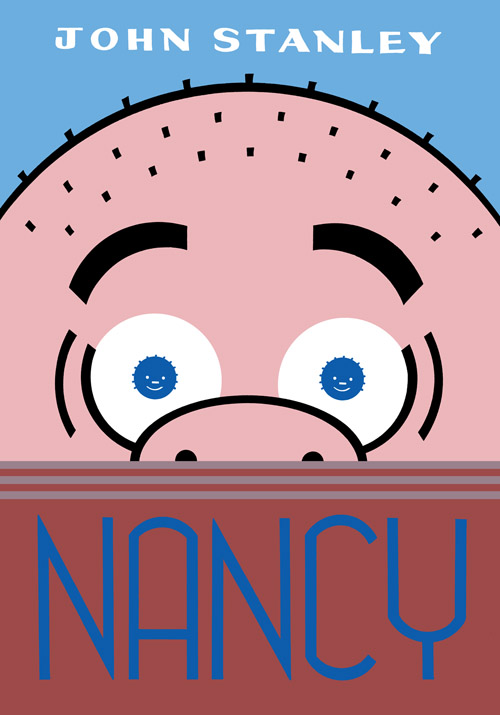 John Stanley continues to exude a sense of "liberation" in these stories from Dell NANCY #170-173. Evidently attempting to make a point, he leads off each issue with a wildly fanciful story in which Nancy, despite her own best efforts, is forced to brave bizarre perils in her friend Wednesday Addams', um, Oona Goosepimple's creepy mansion. This is the sort of stuff that Stanley had previously been obliged to run only in the backs of his issues of LITTLE LULU, plus a handful of issues of the TUBBY title. The weirdness seems to leach into other stories, as well; Nancy and Sluggo play ring-toss with hula hoops and a flag pole in #171's "The Hulahoops," Nancy's cat and bully Spike's dog converse with each other (in thought balloons, to be sure) in #173's "The Kitty's Collar," and a teeth-grindingly self-pitying Nancy literally clads herself in "sackcloth and ashes" in an effort to move an unyielding Aunt Fritzi in #170's "Nancy and the Cold Dinner." There is a zaniness here that many of the later issues of LITTLE LULU conspicuously lacked. Great fun, especially for those who've ever nodded their way through a series of Ernie Bushmiller's stultifying comic-strip gags.
Saturday, October 8, 2011
Book Review: THE SUGAR AND SPIKE ARCHIVES, VOLUME 1 by Sheldon Mayer (2011, DC Comics)
 Every so often, I make a "Why Not?" purchase at the comics store, based on both curiosity and some faint inkling as to the nature of the item being considered. This is my latest such buy, and one of my very best, I'd say. Apparently, some DC fans who've been waiting impatiently for the company to get around to reprinting Sheldon Mayer's fanciful series starring a pair of simpatico toddlers are quite miffed that DC decided to do so in the pricey "Archive" format. I can certainly sympathize, but I didn't recoil at the price tag. From what little I knew about SUGAR AND SPIKE, I was fairly sure that I was going to like it. I just didn't realize how truly enjoyable it would be.
Like PEANUTS, LITTLE LULU, and DENNIS THE MENACE, SUGAR AND SPIKE is a deceptively simple "kids' strip" in a deceptively benign setting. Little Sugar Plumm and Cecil "Spike" Wilson, like the kids in PEANUTS, appear to be eloquent beyond their years, but there's a catch; the "baby talk" in which they converse, helpfully translated for us by Mayer, is essentially a private language, one which turns out to be shared by babies of all sorts and species. This is a clever mingling of the real and fantasy worlds on a par with Charles Schulz' creation of the Snoopy-centered "parallel universe" in PEANUTS, with the difference being that the kids themselves fashion the fantasy element. This gives such mundane "adventures" as taking a trip to Grandma's or the zoo, or learning how light switches and mirrors "work," an extra dollop of intrigue. Mayer also starts out in the PEANUTS mode, or somewhere near there, by only showing the kids' well-meaning but (from the kids' perspective, anyway) clueless parents from the waist down and never showing their faces, but he soon changes that policy, which I think was a wise move. Trying to manufacture stories starring toddlers without getting the parents "completely" involved on occasion would have been far too confining a creative format.
SUGAR AND SPIKE has been described, not inaccurately, as a 1950s version of Rugrats -- to which I would quickly add, "with much better artwork." Actually, this last is anything but a minor point, as anyone familiar with Mayer's earlier artwork for such features as SCRIBBLY would agree. Mayer's style on SCRIBBLY -- and the backup feature LITTUL (sic) SNOONY in SUGAR AND SPIKE #1 (April-May 1956), which would never appear again (how did DC get around those persnickety postal regulations, I wonder?) -- could best be described as "Rough and Ready Urban," full of lumpy, rough-edged-yet-lovable denizens of the lower middle class. To be honest, it is unlikely that such a 1940s-esque style would have sustained SUGAR AND SPIKE if it had been used for the adventures of the suburbanite title characters. Instead, from the very beginning, Mayer's work on SUGAR AND SPIKE is slick and stylized. The kids start out a bit on the tall side before assuming the squat fireplug shape that they would keep for the duration of the series (and which Mayer undoubtedly found easier to draw and work into scenes).
In terms of scripting, I don't think that Mayer's imagination fully kicks in until the later stories in this volume (which reprints the contents of SUGAR AND SPIKE #1-#10). Early in the game, Mayer apparently got a lot of ideas from his own young children; in this respect, he was the exact opposite of John Stanley, who insisted that his kids gave him no story ideas of any kind for LITTLE LULU. The result of this, though, is that many of the early S&S stories, while funny enough, hew pretty closely to the "cute kids getting into innocuous trouble" template. As Mayer becomes more comfortable with the characters, however, some of the more charming aspects of Sugar and Spike's "child logic" come to the fore. Thus, Sugar describes the appearance of the kids in a mirror by exclaiming, "There's again of us!", and the duo figure that there's lots of sand on the beach because, like the sand in the kids' sandboxes, it must have followed its "owners" there. I expect that we'll be seeing a lot more of this kind of thing in the stories to come.
I don't think that one can overemphasize the importance of the creator-fan connection in explaining how this title managed to brave all the vagaries of the Silver Age and last until 1971. (Even then, SUGAR AND SPIKE was only cancelled because Mayer, who insisted on doing all of the stories himself, was having severe eye trouble.) In the 1950s and early 1960s, at a company like DC, taking such initiatives as giving readers credit for story ideas and allowing them to design wardrobes for the kids was legitimately meaningful. I've little doubt that Mayer's long and distinguished career as a DC editor and talent-groomer was the main reason for him being given the privilege of signing his work; for Mayer to "give back" in the way that he did is a credit to him.
I'll definitely be on board for as long as this particular series lasts -- and, if you like high-quality humor comics, then I'd suggest that you clamber on as well.
Thursday, September 15, 2011
Comics Review: TUBBY: THE ATOMIC VIOLIN AND OTHER STORIES by John Stanley and Lloyd White (2011, Dark Horse)
 I'm cleaning up a few loose ends here, as I wait for the bugs in my new computer (and have there ever been bugs -- verily, they are the size of pigeons!!) to be worked out. I sense a little bit of weariness in this newest collection of stories from the 1950s TUBBY title, a little less willingness to go far afield from the templates of the "typical" LITTLE LULU stories. Stanley's resorting to dream-dodges to explain a few of the more fanciful tales is actually rather disappointing. This collection also features more appearances by Iggy's "comically senile" Gran'pa Feeb, the first LITTLE LULU character whom I can say that I actively dislike. Joshing forgetful seniors is a staple of comedy from way back, of course, but the conceit seems a little more distasteful in an era in which we know more about the ravages of Alzheimer's disease. The ALVIN backup stories begin to include more dialogue, and there's an anticipation of the JUDY JR. tales from THIRTEEN GOING ON EIGHTEEN in the battles of wits between Alvin and a little girl named Kathy. These stories, however, are more palatable, less cruel, and give Alvin more interesting things to do than are his standard wont in LULU stories.
Apropos of the book's credits, I wish that someone would explain to me how Lloyd White "finished" Stanley's stories. I understand Stanley's partnership with Irving Tripp, but what made White's participation different enough that a different word had to be used? Here's where I miss ancillary commentary in these volumes...
Friday, September 9, 2011
Comics Review: LITTLE LULU, VOLUME 27: THE PRIZE WINNER AND OTHER STORIES by John Stanley and Irving Tripp (Dark Horse, 2011)
 My home computer has pretty much died, so I'm posting this latest review from Stevenson's super-soggy Greenspring campus, aka "Seattle East." (At least the forecast for tomorrow -- and SU's first home football game -- is promising.) My new Kimba post will probably be delayed for a bit until we can get the new home machine set up. I'll still try to post the promised football report using Nicky's laptop, though.
Dark Horse is now combing the corpus of John Stanley's "miscellaneous" LITTLE LULU work. This latest volume collects the entirety of two Dell Giants from 1957, LITTLE LULU AND TUBBY AT SUMMER CAMP and LITTLE LULU AND TUBBY HALLOWEEN FUN. You can read and view much more about the former of these hefty quarter-dollar mags here, and I suggest that you do, since SUMMER CAMP hangs together a lot better than does HALLOWEEN FUN. The structure of Stanley's signature chain of short features is relatively predictable -- kids get ready for camp, kids go to camp and meet new kids, kids scheme and have (mis)adventures, kids go home -- and there's no psychological quirkiness to wade through on the order of Charlie Brown developing a baseball-like rash on his head and becoming "Mr. Sack" or the PEANUTS gang visiting a weird camp for "born-agains," as they did in 1980. The little tales and vignettes link together quite nicely, however, and the sense of completing a satisfying whole is palpable. HALLOWEEN FUN is a bit more erratic; since there are only so many tales you can tell about getting costumes, cadging candy, and holding Halloween parties, we get a few Witch Hazel stories thrown in here and there to help "make weight." One of these last is a rather strained explanation of how Lulu's "poor little girl" character accidentally devised the name of the Halloween holiday. Suffice it to say that it's a surefire groan-inducer. The climactic Halloween-party story, though, is Stanley at his web-weaving best, combining several plots and subplots in a way that leaves you marveling (not to mention smiling) at the end. There are still several Giants to reprint, so we haven't quite seen the last of these Dark Horse collections -- and a good thing, too.
Tuesday, March 22, 2011
Book Review: THE JOHN STANLEY LIBRARY: MELVIN MONSTER, VOL. 3 (Drawn & Quarterly, 2011)
 By the time these stories from MELVIN MONSTER #7-#9 (1967) were published, John Stanley had pretty clearly fallen out of love (or, given that we are in the twisted "monster world" here, perhaps I should say "fallen out of hate") with the project. With the solitary exceptions of two gags at the end of MELVIN #9, "human beans" are nowhere in evidence in these three issues, so we get no further enlightenment on how the denizens of Monsterville interact with the human world. Instead, Stanley seems content to "ring the chimes" ("toll the bells"?) on a small handful of themes that are just sturdy enough to sustain extremely brief stories. We do get a little bit of closure on the theme of "witch-teacher" Miss McGargoyle's trying to keep Melvin from attending grade school; the old bat finally gives in and allows Melvin to "graduate," but soon the kid is back, asking to attend high school (made so because Melvin raised the "Little Black Schoolhouse" off the ground on boulders; not one of Stanley's more inspired moments, I'd say). Also, the story "Supermonster," with its theme of a giant monster who needs to be pacified at regular intervals to prevent him from waking up and wreaking havoc, bears a frankly unsettling resemblance to the Gummi Bears episode "Let Sleeping Giants Lie". A childhood comics-reading memory bubbling up in the brain of the TV writers, perhaps? Still, even half-speed, deracinated Stanley is better than the majority of works by other comics writers. I'm still hoping for the second volume of THIRTEEN GOING ON EIGHTEEN, D&Q!
Wednesday, November 10, 2010
Comics Review: LITTLE LULU: THE BURGLAR-PROOF CLUBHOUSE AND OTHER STORIES by John Stanley and Irving Tripp (Dark Horse Books, 2010)
 We're almost to the end, folks... according to Frank Young's STANLEY STORIES, John Stanley's long run on LITTLE LULU ended with issue #135, and this latest volume of LULU stories brings us up to LULU #129 (March 1959). I'm figuring that the next collection will be the last one, and it might not even be a "full package," since other creators apparently contributed to #134 and #135. It's become easy to take these volumes for granted, but, as one who'd had very little prior exposure to Stanley's LULU work, I really do appreciate Dark Horse's bringing it back into common circulation -- and in a portable, reader-friendly format, to boot.
Our latest package o' fun contains the usual ration of high-quality storytelling, plus, somewhat to my surprise, a couple of additional appearances by the cute little French girl, Fifi (whose last name, we learn here, is Fromage). GeoX thought that he had seen Fifi in other stories, and I'm happy to see his hypothesis verified. The final story in #129, the TUBBY tale "Big Dog," guest-stars The Little Men from Mars, who were, I believe, regularly featured in the TUBBY title. I don't recall seeing them in LULU before, however. Stanley obviously felt that people who read TUBBY were likely to read LULU and vice versa, which is solid puck in the eye to the notion that LULU was a "girls' comic" and TUBBY a "boy's comic."
Friday, September 10, 2010
Comics Review: LITTLE LULU'S PAL TUBBY: THE CASTAWAY AND OTHER STORIES by John Stanley (Dark Horse Publishing, 2010)
In my comments on Dark Horse's LITTLE LULU reprint volumes, I've frequently speculated about moments at which John Stanley seemed restless with the characters and ready to move on to something else. The formulaic formatting of the stories and the suburban "same-itude" of the settings must have palled on even as imaginative a creator as Stanley at some point. In 1952, thanks to Dell's decision to introduce comics headlining Lulu's rotund buddy Tubby as part of the FOUR COLOR series, Stanley was tossed something of a creative lifeline to stave off any encroaching boredom. After four successful FOUR COLOR appearances, Tubby got his own eponymous stand-alone title, which lasted a total of 49 issues. Stanley took full advantage of the new "sandbox" to try his hand at some book-length stories. Even better, after Irving Tripp helped him out on the first issue ("Captain Yo-Yo," FOUR COLOR #381, March 1952), Stanley got to write and draw each of the next eight issues, in one of his few artistic gigs during the 1950s. The result is a delightful reading experience that displays Stanley's storytelling powers at "full extension" and gives the doings a little extra frisson by virtue of their being depicted in Stanley's loose, sketchy, magazine-cartoon-like style.
 In these first half-dozen TUBBY issues, Stanley plays with the notion of unbridled fantasy in a way that he never did outside of the tightly constrained limits of the "Alvin Story Telling Time Tales" in LITTLE LULU. He does give himself "outs" of sorts -- Tubby's adventures as a pirate with a lethal yo-yo and as an "Indian fighter" (and yes, in case you were wondering, Dark Horse prefixes the latter with the annoyingly smug, we-know-better-than-this-today disclaimer) turn out to be dreams -- but what about "Tubby's Secret Weapon," in which Tub's horrific violin-playing causes a group of tiny Martians to shanghai the boy with the hopes of getting him to fork over a potential cosmos-conquering cudgel? Stanley leaves us no escape hatch to explain away the little greenies as the result of slumber or a plate of tainted food; Tubby and Gloria (who functions as Tubby's love/hate interest) must be rescued from the top of the "Umpire State Building" at story's end. Several other tales straddle the gap between "real" fantasy and "imaginary" fantasy, with Tubby stumbling into trouble despite himself (e.g., in "The Bank Robber," he gets mixed up with a bunch of midget crooks by innocently helping their "prank" robbery because he thinks they're kids in cowboy costume). In all instances, Stanley appears to be thoroughly enjoying himself. Stanley continued to write TUBBY for other artists until late in the title's life, but I have to wonder how his later work on LULU would have been different had he continued to have an artistic, as well as literary, outlet for these wilder flights of fancy. Or perhaps the workload would have been simply too much for him. In any event, these are stories worth owning.
 In these first half-dozen TUBBY issues, Stanley plays with the notion of unbridled fantasy in a way that he never did outside of the tightly constrained limits of the "Alvin Story Telling Time Tales" in LITTLE LULU. He does give himself "outs" of sorts -- Tubby's adventures as a pirate with a lethal yo-yo and as an "Indian fighter" (and yes, in case you were wondering, Dark Horse prefixes the latter with the annoyingly smug, we-know-better-than-this-today disclaimer) turn out to be dreams -- but what about "Tubby's Secret Weapon," in which Tub's horrific violin-playing causes a group of tiny Martians to shanghai the boy with the hopes of getting him to fork over a potential cosmos-conquering cudgel? Stanley leaves us no escape hatch to explain away the little greenies as the result of slumber or a plate of tainted food; Tubby and Gloria (who functions as Tubby's love/hate interest) must be rescued from the top of the "Umpire State Building" at story's end. Several other tales straddle the gap between "real" fantasy and "imaginary" fantasy, with Tubby stumbling into trouble despite himself (e.g., in "The Bank Robber," he gets mixed up with a bunch of midget crooks by innocently helping their "prank" robbery because he thinks they're kids in cowboy costume). In all instances, Stanley appears to be thoroughly enjoying himself. Stanley continued to write TUBBY for other artists until late in the title's life, but I have to wonder how his later work on LULU would have been different had he continued to have an artistic, as well as literary, outlet for these wilder flights of fancy. Or perhaps the workload would have been simply too much for him. In any event, these are stories worth owning.
Tuesday, August 31, 2010
Comics Review: LITTLE LULU, VOLUME 24: THE SPACE DOLLY AND OTHER STORIES by John Stanley and Irving Tripp (Dark Horse, 2010)

Friday, August 13, 2010
Book Review: THE JOHN STANLEY LIBRARY: NANCY, VOLUME 2 (Drawn & Quarterly, Volume 2)

Something weird is going on with D&Q's NANCY reprints, and, no, it doesn't have anything to do with anything in Oona Goosepimple's house -- or does it?? In my review of Volume 1 last fall, I made note of the confusion surrounding the exact issue of Dell NANCY in which Stanley introduced the freaky-yet-friendly little girl. This collection purports to reprint issues #167-169 (1959) of Dell NANCY, as well as FOUR COLOR #1034 (1959), the first NANCY SUMMER CAMP issue. In the second and third issues reproduced herein, Nancy visits (or, rather, is compelled into visiting) Oona's place and has dream-time encounters with mute little green characters called the Yoyos. Fair enough -- sounds like Stanley's adaptation of his "Story Telling Time" tales from LITTLE LULU to the NANCY "universe." BUT: The story "Nancy Meets the Yoyos" is in the third issue in the book, while the second Yoyos epic is in the second issue. I haven't been this confused since Darkwing Duck introduced a whole slew of characters in the two-parter "Just Us Justice Ducks", the "origin episodes" of which had not yet been broadcast. I'll take this as a simple printing mistake until a Stanley expert tells me different. The editor of the NANCY books, however, evidently needs a "time out," if not a knuckle sandwich from Spike and a side order of whoop-ass from The West Side Gang.
Flip-flopped freakfests aside, the highlight here is the SUMMER CAMP issue, the idea for which Stanley carried over from similar LITTLE LULU one-shots. It is nice to see Stanley attempting something resembling a continuous narrative (albeit one of the "thread-through-the-popcorn", "short-story-chunk" variety) with "funny" characters. But would Sluggo really vault from being a last-minute addition to the camp lineup to the lofty position of a junior camp counselor? (He must've threatened to beat a whole lot of people up.) The Oona Goosepimple stories got me to thinking about how Oona fits in with other "creepy family" characters in cartoons and on TV. Her relationship with her friends is decidedly peculiar. She isn't oblivious to her strangeness, like The Munsters, or convinced that she's normal and everyone else is warped, like the members of The Addams Family. Otherwise, she wouldn't act offended when Nancy makes up some lame excuse not to come and visit her, literally going to the extreme of forcing Nancy's unwilling legs to "work in reverse" and deliver Nancy to her doorstep. (I seriously doubt that this gambit, with its suggestion of abduction, would fly in kids' comics today.) At the same time, Oona takes steps to "protect" her guests from potential perils while they're in her home. Perhaps Oona is more "normal" than she would like to admit, while, at the same time, taking her "strangeness" in stride. But perhaps I shouldn't be surprised that Stanley found a unique take on a concept that has been exploited more than once in our popular culture.
It's a tribute to Stanley that he can make characters whom I frankly have never found appealing in the least both funny and interesting. Now, if only the editor would get with the program...
Thursday, May 20, 2010
Comics Review: LITTLE LULU, VOLUME 23: THE BOGEY SNOWMAN AND OTHER STORIES (Dark Horse Books, 2010)
Homework Assignment: Before reading this entry, please read this posting by Joe Torcivia. You'll thank me in a minute.

In reading this collection of stories from LITTLE LULU #112-117 (October 1957 - March 1958), one can definitely sense John Stanley suffering an attack of the "chafes." Stanley was still a couple of years away from abandoning the title for good, but a certain restlessness is evinced by his busting out of the long-established "mold" in one or two places. Stanley busts the string of "poor little girl" story-telling stories with a vengeance in #117's "Bedtime Story," in which little Alvin insists upon telling Lulu a story for once. Not surprisingly, Alvin comes off as the "hero" and Lulu as a fallible sidekick. Witch Hazel appears at the end, but only for a bit of self-referencing humor as she wonders why Lulu isn't in control of the story. The tale has more of the feel of a FRACTURED FAIRY TALE than do most of the increasingly mechanical "story-telling" exercises than had immediately preceded it.
Alvin's seizure of the controls in "Bedtime Story" pales in comparison with the preceding issue's "The Secret Girl Friend." Here, Stanley takes his apparent mental inquietude into a whole weird new area. Lulu becomes convinced that Tubby has bought her a beautiful Valentine with the message "To My Secret Sweetheart." After working herself into a state of mild hysteria, Lulu is crushed when Tubby's gift proves to be nothing more than a simple, "generic" card. The heartbroken Lulu plots revenge until she visits Tubby's house and... learns that Tubby's "secret sweetheart" is his MOTHER.
Now you know why I wanted to "soften you up" with that creepy BUGS BUNNY story. Stanley's version, however, is, if anything, even creepier. Lula Belle is, after all, a teenager, whereas Tubby is a LITTLE BOY. Sufferin' Sophocles! The implications are staggering. Even if you regard "sweetheart" as a more neutral term of endearment than "girl friend," there's still Stanley's choice of a story title to consider. A scenario like this is even stranger coming from a well-established, generally "well-behaved" writer like Stanley than from some anonymous scrivener who took on the BUGS job as only one assignment among many. It leads me to believe that Stanley was beginning to "mentally check out" of the LULU "universe" long before he actually did so.
In reading this collection of stories from LITTLE LULU #112-117 (October 1957 - March 1958), one can definitely sense John Stanley suffering an attack of the "chafes." Stanley was still a couple of years away from abandoning the title for good, but a certain restlessness is evinced by his busting out of the long-established "mold" in one or two places. Stanley busts the string of "poor little girl" story-telling stories with a vengeance in #117's "Bedtime Story," in which little Alvin insists upon telling Lulu a story for once. Not surprisingly, Alvin comes off as the "hero" and Lulu as a fallible sidekick. Witch Hazel appears at the end, but only for a bit of self-referencing humor as she wonders why Lulu isn't in control of the story. The tale has more of the feel of a FRACTURED FAIRY TALE than do most of the increasingly mechanical "story-telling" exercises than had immediately preceded it.
Alvin's seizure of the controls in "Bedtime Story" pales in comparison with the preceding issue's "The Secret Girl Friend." Here, Stanley takes his apparent mental inquietude into a whole weird new area. Lulu becomes convinced that Tubby has bought her a beautiful Valentine with the message "To My Secret Sweetheart." After working herself into a state of mild hysteria, Lulu is crushed when Tubby's gift proves to be nothing more than a simple, "generic" card. The heartbroken Lulu plots revenge until she visits Tubby's house and... learns that Tubby's "secret sweetheart" is his MOTHER.
Now you know why I wanted to "soften you up" with that creepy BUGS BUNNY story. Stanley's version, however, is, if anything, even creepier. Lula Belle is, after all, a teenager, whereas Tubby is a LITTLE BOY. Sufferin' Sophocles! The implications are staggering. Even if you regard "sweetheart" as a more neutral term of endearment than "girl friend," there's still Stanley's choice of a story title to consider. A scenario like this is even stranger coming from a well-established, generally "well-behaved" writer like Stanley than from some anonymous scrivener who took on the BUGS job as only one assignment among many. It leads me to believe that Stanley was beginning to "mentally check out" of the LULU "universe" long before he actually did so.
Wednesday, April 14, 2010
Book Review: THE JOHN STANLEY LIBRARY: MELVIN MONSTER VOLUME 2 by John Stanley (Drawn & Quarterly, 2010)
 My review of D&Q's first MELVIN MONSTER collection could just as easily stand as my review of this SECOND collection (issues #4-#6, 1966-67). Stanley continues to mine the "good little monster" vein with fair success but never really comes to grips with how, exactly, the world of "Monsterville" interacts with the world of "human beans." He can't even get straight how one travels from one sphere to the other. Case in point: In "Broom Ride," Melvin falls off his "ghoul-friend" Little Horror's broom and plummets into what appears to be a "human bean" city park. He then gets back home by another application of broom power. This suggests that you need some sort of magic to "cross the border." Later, however, in "Pickapicnic," Melvin and Little Horror (wouldn't it have been great if Stanley had gone for a direct Harvey Comics parody and named her "Little Loatha"?) go on the monster version of a picnic (to wit: getting food by stealing it from others) and run smack into a family of noshing humans. No broom power or magical transport is on display anywhere in this story. This is a good illustration of my friend Brent Swanson's observation in his Amazon review of Volume 1 that Melvin's milieu never really "coalesces." A few more long stories might have fleshed things out a bit, but Stanley sticks like glue (perhaps, the very same glue that caused a number of pages in my copy of Volume 2 to be stuck together) to the six- to eight-page format that served him well during the LITTLE LULU days. D&Q includes no accompanying text, which is a pity.
Thursday, February 18, 2010
Comics Review: LITTLE LULU: THE BIG DIPPER CLUB AND OTHER STORIES (Dark Horse, 2010)

Saturday, February 6, 2010
Book Review: THE JOHN STANLEY LIBRARY: THIRTEEN "GOING ON EIGHTEEN" Vol. 1 (Drawn & Quarterly, 2009)
 Drawn & Quarterly has already done well enough by John Stanley with its fine collections of the creator's work on Dell's NANCY and MELVIN MONSTER. What those earlier volumes (especially the latter) lacked was a sense of perspective for those of us who are still catching up with Stanley's LITTLE LULU work and want to know how, exactly, these lesser-known efforts compare with that justly celebrated series. For its third (and thickest) STANLEY LIBRARY offering, D&Q makes up for past omissions by fronting the first nine issues of THIRTEEN "GOING ON EIGHTEEN" -- by far, Stanley's most successful original creation -- with an essay by cartoonist and graphic designer Seth, who ranks this 1960s series among the best "mainstream" comics ever produced. As things turned out, I would have liked the collection under any circumstances, but I appreciate Seth's pointing out how THIRTEEN ties in with themes inherent in Stanley's earlier work. (Frank Young, in his fine review of the collection at his Stanley Stories Blog, provides additional insights for those who are interested.)
I've never been a big fan of "teenage" comics, but THIRTEEN already ranks as one of my two favorites of that genre, along with Harvey's BUNNY. Those familiar with both will probably laugh, but I'm serious. I like BUNNY, that well-meaning and completely addle-pated Valentine to the groovy, ginchy late 60s, precisely because it's so truly bizarre. (That, plus the fact that uncredited artist Hy Eisman, bless him, didn't fall into the trap of ripping off ARCHIE character designs, as Tower, Marvel, and DC so conspicuously did during that same period.) THIRTEEN, by contrast, is much more down-to-earth and believable, tracing as it does the lives and loves of a pair of occasionally lovable, occasionally aggravating teenage girls. Stereotyping of the ARCHIE variety is nowhere to be seen, though I'm sure Stanley must have received some pressure from the folks at Dell to compete directly with the Riverdale behemoth.
Stanley takes a while to get into a groove with Val and Judy, his teen stars. Issues #1-#2 of THIRTEEN, drawn by Tony Tallarico, are easily the weakest of the nine reproduced here. The gags aren't great, and Tallarico -- an artist about whom I've literally never heard a kind word -- draws petite blond Val and chunky brunette Judy as though they're somewhere around 11 or 12. Stanley himself takes over the drawing chores with #3, and the extra burden, oddly enough, appears to have liberated him a bit. Funny supporting characters begin to appear -- Judy's annoying boyfriend-for-lack-of-a-better-alternative Wilbur, an equally slothful loser named Charlie -- and Val's next-door neighbor Billy, who rotates between the roles of "good friend" and fallback date option, develops a wickedly impish sense of humor. Frenetic action and controlled hysteria of the LULU variety become a standard ingredient of most plots. Reminiscent of LULU, as well, is the book's decidedly distaff-friendly perspective (no big surprise, given that teenage girls were the target audience). Val may be a "drama queen" -- her occasional bouts of weeping and wailing on her bed are hilarious -- and Judy a bit mean-spirited, but they shine in contrast to the totem-like Paul Vayne (a "dreamboat" who becomes Val's first semi-serious steady), the calculatedly "kooky" Billy, and the utterly hopeless Wilbur and Charlie. To be sure, everyone has good and bad moments in these pages, but the girls -- including Val's older sister Evie, who sometimes functions as goad, sometimes as sounding-board, for her flightier younger sister -- come off better most of the time. Sometimes too much better, as I'll explain below.
THIRTEEN is very much a work powered by the "gas fumes" of the 1950s -- to the extent that one critic of these stories goes all postmodern on us and describe the comic as "a clear example of the concept of 'cultural hegemony.'" That in itself is a reason for me to enjoy the series; though the title's first issue appeared in 1961, it radiates that 50s sense of cultural contentment that drives the Left so crazy about any era over which it does not hold hegemony. Don't be fooled by the well-groomed setting, though. In this title, Stanley has some rather raw things to say about the quest for love, suggesting that, while unrequited love may be painful, requited love may be just as harsh. Val's relationship with Paul Vayne ends up causing no small amount of stress; she worries about losing him and is not a little nervous about what her relationship with Paul might do to her tie with Billy. Judy, less attractive than Val even after she suddenly drops a few dozen pounds, is desperate for the "right guy" but winds up settling for Wilbur, an oaf who refuses to pay for Judy on dates and insists on wearing a filthy hat everywhere he goes. Even Evie gets the fuzzy end of the lollipop when her steady throws her over (and we don't even get to see it "live"). Sure, some may carp that Val and Judy care more about impressing boys than they do about maximizing their career options or "finding their voices," but the former is where the "funny" is, no matter what era you're living in.
As with most Stanley collections I've read, the collective effect of reading Stanley stories is more significant than the impact of any one story. I do have some favorites in this collection, though. "A Maiden's Prayer" finds Val trying to enjoy a picnic with Paul Vayne even as she desperately tries to steer him away from trees, walls, and any other places where "Val and [fill in the blank]" carvings are present. We do get an odd moment when lightning strikes a shelter where Paul and Val are hiding from the rain. The way Stanley depicts the accident, the duo are lucky to have survived unscathed! Next thing you know, turkeys will start flying (yes, Mr. Stanley, I remember well that goof from a LULU story). The stories in which Val tries to dodge the unwanted attentions of a bespectacled "admirer" named "Sticky Stu" bring back wistful memories of a time when I, myself, was enamored with a high-school classmate and always had to be around her. I'd like to think that I was better company than the poker-faced Stu, however.
THIRTEEN does have one feature that I don't care for at all. Thanks to those strange postal regulations that gifted us with GYRO GEARLOOSE backup features in UNCLE $CROOGE and GOOFY quickies in DONALD DUCK, the title concludes every issue with a brief story starring Judy Junior (who looks like a younger, shorter, and even chunkier Judy) and a little boy, Jimmy Fuzzi. I've read those GYRO and GOOFY stories, however, and Judy Junior is no Gyro or Goofy. What she is is a painfully pushy, overbearing brat whose apparent sole purpose in life is to make Jimmy miserable. Sure, Stanley wanted to make the girls the star characters of the title, but this is going too far. Seth claims that he could read a "whole book" of these supposedly hilarious tales. They may work for him, but, for me, they simply seem cruel -- like an endless string of Lucy-pulls-the-football-away-from-Charlie-Brown gags without the pathos (and infrequency) that made those PEANUTS gags memorable (and tolerable). At least in LULU stories, put-upon characters generally get a chance for revenge; Jimmy almost never does. To make matters worse, the characters constantly refer to one another by name, a gambit which gets to be like Chinese water torture after a while. Stanley's LULU stories had an edge to them; the JUDY JUNIOR tales hone that edge down to razor-sharpness and then ask you to perch on same. I'll pass.
In his Introduction, Seth comments that Stanley wasn't greatly affected by the oncoming post-Camelot cultural tsunami in later issues of THIRTEEN, apart from an occasional Beatles reference. But then, Stanley's comics always seem to take place at a certain remove from the topical concerns of the real world -- all the better for Stanley to concentrate on his plots and characterizations. The fact that he can make this approach work in a quasi-realistic comic like this one is a considerable tribute to his talents. I'm definitely on board for future collections of this title -- and, if Dark Horse or someone else would only agree to publish the collected BUNNY, my "teen comics dream," such as it is, would be complete.
Sunday, December 13, 2009
Comics Review: LITTLE LULU: MISS FEENY'S FOLLY AND OTHER STORIES (Dark Horse, 2009)
A moment of silence to acknowledge the death of Irving Tripp, the man who inked John Stanley's pencils on LITTLE LULU for so many years. Tripp passed away on November 27 at the age of 88. Along with his seminal work on LULU, Tripp inked the Dell adaptations of Dumbo and The Reluctant Dragon (the latter of which was reprinted in one of the "Gladstone I" digests in the 80s) and also drew TOM AND JERRY and BUGS BUNNY in the 40s. He stuck with Western Publishing (almost) to the bitter end, retiring in 1982.
 What happened to John Stanley during the period covered by this volume, LITTLE LULU #100-105 (October 1956 - March 1957)? In issue #101, he seems to go slightly crazy, spinning off such wacky ideas as racing earthworms, a man bringing his pet mouse to the movies (and asking for a separate seat for her, no less), and riffs on I Love Lucy (in "The Deadly Weapon," Tubby suddenly starts calling Lulu "Lulusie" for no apparent reason) and simply flooding his panels with dialogue. Since I know that Stanley's break with LULU is just a couple of years away, this sudden upsurge in energy may be the comics writer's equivalent of a star burning itself out before entering the "white dwarf" phase. Whatever came over Stanley at this moment, it appears to have subsided by #102, in which Stanley goes in completely the opposite direction by telling a story (of the "fellers" ripping off lemonade-saleslady Lulu by stealing lemonade with their water pistols) with no dialogue whatsoever. The balance of the collection is more conventional and, as always, highly entertaining.
Sunday, November 15, 2009
Comics Review: LITTLE LULU: THE BAWLPLAYERS AND OTHER STORIES (Dark Horse, 2009)

Tuesday, September 22, 2009
Book Review: THE JOHN STANLEY LIBRARY: NANCY Vol. 1 by John Stanley and Dan Gormley (Drawn & Quarterly, 2009)
To start on an ominous note: a number of people appear to have the wrong idea about the issue numbers and dates for this volume. The title page says that the book contains stories from Dell NANCY #146-150 (1957-58). In searching out appropriate screen grabs for the blog post, however, I found an electronic copy of the first story, "Oona Goosepimple," complete with original Dell indicia -- and, guess what, it first appeared in NANCY #162 (April 1959). Wikipedia, and the estimable Don Markstein, come closer than D&Q, but they miss the target as well, with each citing NANCY #166 as the site of Oona's debut. So both the Internet and the "dead tree peddlers" struck out in this case.
 Actually, the first appearance of the Wednesday Addams-like Oona highlights an important point about Stanley's approach to Ernie Bushmiller's characters. Having pretty much burned out on LITTLE LULU, Stanley was probably delighted to put a new set of "Lulu-esque" characters through their paces. The fact that Nancy, Sluggo, and company were well-established figures in a popular, long-running comic strip, however, must have given the creator some pause. Lulu, who began her career as a pantomime character in gag cartoons, had had plenty of room for development when Stanley began to flesh out her neighborhood. Nancy and Sluggo may have had shallow, uninspired personalities, but Stanley must have felt that he needed to hew to them, at least for a while, as he settled down to his task. One can therefore regard the eccentric Oona's appearance as something of a "sowing of the wind" with an eye towards reaping a later "whirlwind" of story possibilities. The rest of the early stories in this collection are fairly unremarkable, making Oona -- a black-clad girl with beady eyes who gives everyone around her a case of nerves and lives in a spooky house with a surprise (usually of the nasty variety) around every corner -- stand out all the more starkly.

Stanley's innovations in handling the NANCY characters didn't prevent him from borrowing liberally from the LULU "template." Rich kid Rollo Haveall is basically Wilbur van Snobbe, take two, while the crook Bill Bungle (aka Bill Bungler, aka Bill Bumble -- perhaps Bill's incompetence was catching) reflects Stanley's apparent delight in using an adult figure who is hopelessly inept at his supposed specialty, a la the truant officer Mr. McNabbem in the LULU stories. If the NANCY stories -- even at their best -- fall a little short of the quality of the LULU oeuvre, then one reason may be the lack of a strong "bench" of supporting players. In the stories collected here, at least, Nancy has no "girl sidekick" to compare with Lulu's Annie; eager though Oona is to make friends and do things with Nancy, she's essentially a walk-on oddball. Likewise, the annoying neighbor kid Pee Wee isn't nearly as memorable (or annoying) as Alvin of "Story Telling Time" fame. Given the raw materials that he had to work with, however, Stanley's NANCY tales are unexpectedly fun and entertaining.
The last page of this volume has a picture of John Stanley (in the company of his editor Oscar LeBeck, Dan Gormley, and other worthies at Western's New York office) and a brief biography -- which just happens to be the same one that appeared at the end of the earlier MELVIN MONSTER collection. What this Library really needs is a volume-by-volume, bit-by-bit biography of Stanley in the manner of the articles that appeared in Another Rainbow's LITTLE LULU LIBRARY. As long as Fantagraphics keeps reprinting the same two-page Charles Schulz bio in THE COMPLETE PEANUTS, though, I guess it would be hypocritical of me to complain about D&Q dropping the ball.
Actually, the first appearance of the Wednesday Addams-like Oona highlights an important point about Stanley's approach to Ernie Bushmiller's characters. Having pretty much burned out on LITTLE LULU, Stanley was probably delighted to put a new set of "Lulu-esque" characters through their paces. The fact that Nancy, Sluggo, and company were well-established figures in a popular, long-running comic strip, however, must have given the creator some pause. Lulu, who began her career as a pantomime character in gag cartoons, had had plenty of room for development when Stanley began to flesh out her neighborhood. Nancy and Sluggo may have had shallow, uninspired personalities, but Stanley must have felt that he needed to hew to them, at least for a while, as he settled down to his task. One can therefore regard the eccentric Oona's appearance as something of a "sowing of the wind" with an eye towards reaping a later "whirlwind" of story possibilities. The rest of the early stories in this collection are fairly unremarkable, making Oona -- a black-clad girl with beady eyes who gives everyone around her a case of nerves and lives in a spooky house with a surprise (usually of the nasty variety) around every corner -- stand out all the more starkly.
Once Stanley gets his feet under him, he begins to pull Nancy and Sluggo in directions the unimaginative Bushmiller would never have contemplated (though Dan Gormley's art, if a bit more unpredictable than Bushmiller's, does give the comics the same stodgy look as the comic strip). You can see it coming when Stanley devotes an entire one-page gag to sending up Liberace in the person of "La Plunke," an impresario with a rhinestone-studded piano. For panel after panel, Nancy makes bitchy comments about La Plunke's talents, or lack thereof, climaxing by claiming that La Plunke, and not his piano, should be "hung" when she sees the latter getting lowered out of the stage door. Nancy's remarks scandalize her Aunt Fritzi a bit, which seems only right, as Nancy's relationship with her aunt is a lot more abrasive than Lulu's with her parents. Perhaps Stanley thought that Fritzi's not being Nancy's mother gave him a bit more leeway. Likewise, after treating Sluggo as a generic boy character in earlier stories, Stanley takes Bushmiller's notion of Sluggo as a "dead-end kid" and runs with it. In "Lower Education," Nancy forces Sluggo to go to school but thinks better of it after Sluggo starts fantasizing about using his education to become President. She ultimately convinces the janitor to keep Sluggo in the basement and have him sweep floors. Tubby may have played hooky on occasion, but the existence of parental figures in the LITTLE LULU "universe" wouldn't have allowed for this sort of a cynical resolution.
Stanley's innovations in handling the NANCY characters didn't prevent him from borrowing liberally from the LULU "template." Rich kid Rollo Haveall is basically Wilbur van Snobbe, take two, while the crook Bill Bungle (aka Bill Bungler, aka Bill Bumble -- perhaps Bill's incompetence was catching) reflects Stanley's apparent delight in using an adult figure who is hopelessly inept at his supposed specialty, a la the truant officer Mr. McNabbem in the LULU stories. If the NANCY stories -- even at their best -- fall a little short of the quality of the LULU oeuvre, then one reason may be the lack of a strong "bench" of supporting players. In the stories collected here, at least, Nancy has no "girl sidekick" to compare with Lulu's Annie; eager though Oona is to make friends and do things with Nancy, she's essentially a walk-on oddball. Likewise, the annoying neighbor kid Pee Wee isn't nearly as memorable (or annoying) as Alvin of "Story Telling Time" fame. Given the raw materials that he had to work with, however, Stanley's NANCY tales are unexpectedly fun and entertaining.
The last page of this volume has a picture of John Stanley (in the company of his editor Oscar LeBeck, Dan Gormley, and other worthies at Western's New York office) and a brief biography -- which just happens to be the same one that appeared at the end of the earlier MELVIN MONSTER collection. What this Library really needs is a volume-by-volume, bit-by-bit biography of Stanley in the manner of the articles that appeared in Another Rainbow's LITTLE LULU LIBRARY. As long as Fantagraphics keeps reprinting the same two-page Charles Schulz bio in THE COMPLETE PEANUTS, though, I guess it would be hypocritical of me to complain about D&Q dropping the ball.
Thursday, June 4, 2009
Book Review: THE JOHN STANLEY LIBRARY: MELVIN MONSTER, VOLUME 1 by John Stanley (Drawn & Quarterly, 2009)
Thanks to the success of Dark Horse's LITTLE LULU volumes, John Stanley "stock" is up, and now Montreal-based D&Q is joining the frenzy with the first of a promised series of volumes collecting Stanley's non-LULU works. MELVIN MONSTER dates from the mid-1960s, by which time (1) Stanley was working for a Dell Publishing outfit that had split off from Western Publishing and was attempting to establish itself as a comics-publishing contender; (2) Stanley was drawing, as well as writing, his stories; (3) Stanley was working entirely with characters of his own creation; (4) Stanley's attitude towards the comics industry was rapidly souring (he would quit the business altogether by the end of the decade). All four factors have a heavy influence on MELVIN, which, while entertaining enough, doesn't quite measure up to Stanley's peerless work with Marge's characters.
 At first glance, MELVIN appears to be drawing upon the same zeitgeist that gave rise to such contemporary TV series as The Munsters and The Addams Family. The title character is, after all, a monster and interacts on a fairly regular basis with humans (or, as Melvin calls them, "human beans"). A closer examination, however, suggests that the character of Melvin owes just as large a debt to that of Casper the Friendly Ghost. To the chagrin of his square-shouldered, hulking, overbearing "Baddy" and bandage-wrapped "Mummy," Melvin wants to be as close to a normal boy as one can possibly be in the abnormality-riddled community of "Monsterville." His attempts to actually attend "The Little Black Schoolhouse," as opposed to buying into the "normal" practice of playing hooky -- thereby scandalizing the "teacher" (a dyspeptic witch) on duty -- are particularly funny. Melvin's attitude towards "fitting in" veers between mild defiance and stoic acceptance (e.g., when he agrees to slide down his slide into a "daggerberry bush" without screaming, only to take refuge in a cave after the fact and painfully give forth with the requisite number of "Ow!"s). The family pet, a crocodile named Cleopatra, is perpetually trying to eat him. Even his "guardian demon," who's supposed to protect him from harm, is fairly useless. Given all of the above factors, Melvin is an easy character for whom to root and should make an appealing hero. His milieu, however, is not as well-defined as it ought to be, and much of that is Stanley's fault.
In the absence of the experienced editorial hands that had been employed by Western, Stanley appears to have had some trouble deciding how, exactly, Melvin should relate to the human world, or even how his work should be organized. Issues #1 and #2 consist of single narratives broken into distinctly titled parts (shades of Harvey Comics' 10- and 15-page stories) in which Melvin takes a "detour" into "Humanbeanville" along the way. These stories plainly suggest that humans live in, so to speak, a different dimension than monsters. With issue #3, we get a paradigm shift: the stories are now stand-alone, and Melvin runs into humans as a matter of course (even getting tracked by "monster hunters"). This is a bit disconcerting, to say the least. In both manifestations, the humans (whom Melvin appears to admire on principle) do behave pretty much the same -- namely, like jerks. A rich owner of a "private zoo" wishes to add Melvin to his collection (where are Superman and Lobo when you need them?); several human kids spin Melvin like a top; a rich couple living in a penthouse mock the "riff-raff" below; and, of course, there are the "monster hunters." The adult characters in the LULU stories never came off as badly as this. Creeping cynicism, you suggest? So do I.
Stanley's artwork in MELVIN reflects a comment that I recall him making about Irving Tripp's artwork on LULU (for which Stanley provided scripts and pencil roughs) being overly "static." Stanley's work is much livelier, if a bit inconsistent: the monster characters are very cartoony in appearance, while the humans look as if they've stepped out of a New Yorker cartoon. Melvin straddles these two extremes, being neither realistic-looking nor overly stylized. Again, a better editor might have suggested that Stanley bring the two disparate styles a bit closer together. Occasional misspellings in Stanley's lettering -- plus an awkwardly-placed caption that appears to have been shoehorned in at the last minute -- lend further credence to the theory that Stanley, working on his own, needed more editorial help than when he was part of a creative "team."
Subsequent volumes of the JSL will reprint Stanley's comic-book work on NANCY -- which, it goes without saying, will probably look and "feel" a lot more like LITTLE LULU -- and such additional all-Stanley enterprises as THIRTEEN, GOING ON EIGHTEEN. It will be interesting to see if the theory that I've posited here -- that Stanley was better working with established characters that he could "embellish" than with original creations -- continues to hold true.
In the absence of the experienced editorial hands that had been employed by Western, Stanley appears to have had some trouble deciding how, exactly, Melvin should relate to the human world, or even how his work should be organized. Issues #1 and #2 consist of single narratives broken into distinctly titled parts (shades of Harvey Comics' 10- and 15-page stories) in which Melvin takes a "detour" into "Humanbeanville" along the way. These stories plainly suggest that humans live in, so to speak, a different dimension than monsters. With issue #3, we get a paradigm shift: the stories are now stand-alone, and Melvin runs into humans as a matter of course (even getting tracked by "monster hunters"). This is a bit disconcerting, to say the least. In both manifestations, the humans (whom Melvin appears to admire on principle) do behave pretty much the same -- namely, like jerks. A rich owner of a "private zoo" wishes to add Melvin to his collection (where are Superman and Lobo when you need them?); several human kids spin Melvin like a top; a rich couple living in a penthouse mock the "riff-raff" below; and, of course, there are the "monster hunters." The adult characters in the LULU stories never came off as badly as this. Creeping cynicism, you suggest? So do I.
Stanley's artwork in MELVIN reflects a comment that I recall him making about Irving Tripp's artwork on LULU (for which Stanley provided scripts and pencil roughs) being overly "static." Stanley's work is much livelier, if a bit inconsistent: the monster characters are very cartoony in appearance, while the humans look as if they've stepped out of a New Yorker cartoon. Melvin straddles these two extremes, being neither realistic-looking nor overly stylized. Again, a better editor might have suggested that Stanley bring the two disparate styles a bit closer together. Occasional misspellings in Stanley's lettering -- plus an awkwardly-placed caption that appears to have been shoehorned in at the last minute -- lend further credence to the theory that Stanley, working on his own, needed more editorial help than when he was part of a creative "team."
Subsequent volumes of the JSL will reprint Stanley's comic-book work on NANCY -- which, it goes without saying, will probably look and "feel" a lot more like LITTLE LULU -- and such additional all-Stanley enterprises as THIRTEEN, GOING ON EIGHTEEN. It will be interesting to see if the theory that I've posited here -- that Stanley was better working with established characters that he could "embellish" than with original creations -- continues to hold true.
Wednesday, May 13, 2009
Comics Review: LITTLE LULU: THE ALAMO AND OTHER STORIES (Dark Horse Press, 2009)

Tuesday, May 5, 2009
Book Review: HARVEY COMICS CLASSICS VOLUME 5, THE HARVEY GIRLS edited by Leslie Cabarga, introduction by Jerry Beck (Dark Horse Books, 2009)

According to editor Leslie Cabarga, this will be the last HARVEY COMICS CLASSICS release for the foreseeable future. Before getting on to the material at hand, I wanted to make sure to thank Leslie, Jerry, and the folks at Dark Horse for a reprint project that, while far from flawless, surely did well by the "Harvey World" standbys. Hopefully the hiatus is strictly due to the economy and new volumes will appear anon.
Volume 5 is, of necessity, a bit scrapbookish, covering as it does the early four-color careers of three characters, of whom one (Audrey) never crossed over to visit any of the other Harvey stars (at least, not until she got a brief -- and quite enjoyable -- opportunity to pair with Richie Rich in the early-80's title RICHIE RICH AND HIS GIRL FRIENDS). While Audrey had a respectable run, I can't help but think that had Steve Mufatti, Larz Bourne, et al. not showed such fidelity to the world of the cartoon shorts in the early AUDREY stories, the feisty kid might have used the extra "wiggle room" to squirm out of her neighborhood and into team-ups with Dot, Lotta, and others, which would probably have prolonged her active career. As it turned out, once Audrey's neighborhood gang (Melvin, Tiny, and Lucretia) was introduced, the AUDREY books basically became Harvey's hermetically sealed version of LITTLE LULU -- fitting, in light of the fact that Famous Studios created Audrey to replace Lulu when they lost the rights to the latter, but ultimately damaging to Aud's reputation as a formidable character in her own right. There's no doubt that the artwork of Mufatti and Howie Post has it all over Irving Tripp (John Stanley's main illustrator on the LULU stories) insofar as liveliness and charm goes, but, especially after Lucretia and her Annie-like buck tooth arrive on the scene, it's tough not to look at Audrey and not think immediately of Ms. Moppet and her cronies. Even the use of the supposedly "black" Tiny -- admittedly, a rather bold move for the 50s -- has to be qualified somewhat, as Tiny looks more like a crew-cut white kid colored black than, say, the more obvious black child Bumbazine that Walt Kelly drew for the earliest POGO comic-book stories. These stories are lively and fun and partake liberally of the charming atmosphere of Aud's better cartoons -- I especially enjoyed the "dreamed" South Pacific parody with Aud as a native girl and Melvin as "Safety Pinsa" (get it?) -- but the aura of "knockoff" will always linger, and that's a real shame.
The volume's true revelation, from my point of view, are the earliest LITTLE DOT stories, in which Steve Mufatti does a complete makeover on the not-very-inspired character of the same name who had been a backup feature in SAD SACK for several years. Insofar as Mufatti was a major artistic influence on Warren Kremer, this relaunch was one of the key moments in the development of the "Harvey World" style. In his introduction, Jerry Beck describes Mufatti's artwork as "slightly anachronistic, recalling late 1920s and early 1930s cartooning." On the contrary -- though a guy who was supposedly born in 1880 and therefore would have been over 70 at the time he drew these stories, Mufatti was right on the cutting edge of kids' comics of the day. The early Dot is simply adorable (though Mufatti takes a story or two to settle on giving her one ponytail instead of two) without being "cutesy" in the slightest. Conspicuous by its absence in these opening salvos is the "dot obsession" that would come to define Dot's character in future years. According to "Alphabet Land," Dot's sort-of-origin story in LITTLE DOT #5, she didn't even originally have dots on her dress. "Pop Goes the Measles" (LD #13) is the first story in which Dot shows any unusual interest in dots at all, and there, she's merely marveling over the fact that she's developed a case of ultra-rare "black measles." Like several other early stories, "Measles" takes the form of a "tall story" that Dot tells to her friend Lotta and her soon-to-be-dropped friend Red. This is definitely Lulu territory, and I get the sense that Bourne and the other writers may have been scuffling to distinguish Dot from Audrey in a way other than the fact that she has scads of oddball uncles and aunts dropping in at all times. (Some of these early "relative adventures," such as the ones with mountain-climbing Uncle Alp, wire-walking Uncle Balance, and lion-taming Uncle Fang, start with Dot being all but shanghaied by her compulsive clansfolk.) By issue #16, Dot is trying to convince a bandleader to put dots on uniforms and dreaming of becoming "Queen of Dot-Land," and it's all downhill (rolling, naturally, since these are round objects we're talking about) from there. Stories by Sid Couchey, the artist most associated with Dot (and Lotta), appear at the tail end of the Dot section, but they're not from his prime period, in which Dot occasionally got to participate in stories extending beyond five pages. I would've liked to have seen "Dot's Rock & Roll Adventure," for example. Alas, Jerry and Leslie cut off their material at 1962.
Little Lotta runs the anchor leg of the volume, and, apart from being slightly smaller in bulk in the early days, she arrives on the scene pretty much fully-developed (stow the jokes about overeating, if you please!). There's no question in my mind that the fateful decision to allow Dot and Lotta to be pals (which they are from the very start, in LD #1's "Show Business") helped prolong the ladies' careers. A lot of the early LOTTA stories seem a little too willing to resort to the somewhat lazy "Lotta dreams up an adventure" gambit, but more fruitful developments, such as the introduction of Lotta's pint-sized boyfriend Gerald and her lively, irrepressible Grandpa -- for all intents and purposes, the "Harvey World"'s version of Poopdeck Pappy, and easily worth any two dozen of Dot's carload of uncles and aunts -- presage a career that, like Dot's and Audrey's, proved more than respectable. Like Dark Horse's fine LITTLE LULU volumes, this is an ideal collection to give a young girl who might be interested in comics, but, as Jerry Beck correctly notes, these stories will be enjoyable to readers of all predilections... not to mention both genders.
Volume 5 is, of necessity, a bit scrapbookish, covering as it does the early four-color careers of three characters, of whom one (Audrey) never crossed over to visit any of the other Harvey stars (at least, not until she got a brief -- and quite enjoyable -- opportunity to pair with Richie Rich in the early-80's title RICHIE RICH AND HIS GIRL FRIENDS). While Audrey had a respectable run, I can't help but think that had Steve Mufatti, Larz Bourne, et al. not showed such fidelity to the world of the cartoon shorts in the early AUDREY stories, the feisty kid might have used the extra "wiggle room" to squirm out of her neighborhood and into team-ups with Dot, Lotta, and others, which would probably have prolonged her active career. As it turned out, once Audrey's neighborhood gang (Melvin, Tiny, and Lucretia) was introduced, the AUDREY books basically became Harvey's hermetically sealed version of LITTLE LULU -- fitting, in light of the fact that Famous Studios created Audrey to replace Lulu when they lost the rights to the latter, but ultimately damaging to Aud's reputation as a formidable character in her own right. There's no doubt that the artwork of Mufatti and Howie Post has it all over Irving Tripp (John Stanley's main illustrator on the LULU stories) insofar as liveliness and charm goes, but, especially after Lucretia and her Annie-like buck tooth arrive on the scene, it's tough not to look at Audrey and not think immediately of Ms. Moppet and her cronies. Even the use of the supposedly "black" Tiny -- admittedly, a rather bold move for the 50s -- has to be qualified somewhat, as Tiny looks more like a crew-cut white kid colored black than, say, the more obvious black child Bumbazine that Walt Kelly drew for the earliest POGO comic-book stories. These stories are lively and fun and partake liberally of the charming atmosphere of Aud's better cartoons -- I especially enjoyed the "dreamed" South Pacific parody with Aud as a native girl and Melvin as "Safety Pinsa" (get it?) -- but the aura of "knockoff" will always linger, and that's a real shame.
The volume's true revelation, from my point of view, are the earliest LITTLE DOT stories, in which Steve Mufatti does a complete makeover on the not-very-inspired character of the same name who had been a backup feature in SAD SACK for several years. Insofar as Mufatti was a major artistic influence on Warren Kremer, this relaunch was one of the key moments in the development of the "Harvey World" style. In his introduction, Jerry Beck describes Mufatti's artwork as "slightly anachronistic, recalling late 1920s and early 1930s cartooning." On the contrary -- though a guy who was supposedly born in 1880 and therefore would have been over 70 at the time he drew these stories, Mufatti was right on the cutting edge of kids' comics of the day. The early Dot is simply adorable (though Mufatti takes a story or two to settle on giving her one ponytail instead of two) without being "cutesy" in the slightest. Conspicuous by its absence in these opening salvos is the "dot obsession" that would come to define Dot's character in future years. According to "Alphabet Land," Dot's sort-of-origin story in LITTLE DOT #5, she didn't even originally have dots on her dress. "Pop Goes the Measles" (LD #13) is the first story in which Dot shows any unusual interest in dots at all, and there, she's merely marveling over the fact that she's developed a case of ultra-rare "black measles." Like several other early stories, "Measles" takes the form of a "tall story" that Dot tells to her friend Lotta and her soon-to-be-dropped friend Red. This is definitely Lulu territory, and I get the sense that Bourne and the other writers may have been scuffling to distinguish Dot from Audrey in a way other than the fact that she has scads of oddball uncles and aunts dropping in at all times. (Some of these early "relative adventures," such as the ones with mountain-climbing Uncle Alp, wire-walking Uncle Balance, and lion-taming Uncle Fang, start with Dot being all but shanghaied by her compulsive clansfolk.) By issue #16, Dot is trying to convince a bandleader to put dots on uniforms and dreaming of becoming "Queen of Dot-Land," and it's all downhill (rolling, naturally, since these are round objects we're talking about) from there. Stories by Sid Couchey, the artist most associated with Dot (and Lotta), appear at the tail end of the Dot section, but they're not from his prime period, in which Dot occasionally got to participate in stories extending beyond five pages. I would've liked to have seen "Dot's Rock & Roll Adventure," for example. Alas, Jerry and Leslie cut off their material at 1962.
Little Lotta runs the anchor leg of the volume, and, apart from being slightly smaller in bulk in the early days, she arrives on the scene pretty much fully-developed (stow the jokes about overeating, if you please!). There's no question in my mind that the fateful decision to allow Dot and Lotta to be pals (which they are from the very start, in LD #1's "Show Business") helped prolong the ladies' careers. A lot of the early LOTTA stories seem a little too willing to resort to the somewhat lazy "Lotta dreams up an adventure" gambit, but more fruitful developments, such as the introduction of Lotta's pint-sized boyfriend Gerald and her lively, irrepressible Grandpa -- for all intents and purposes, the "Harvey World"'s version of Poopdeck Pappy, and easily worth any two dozen of Dot's carload of uncles and aunts -- presage a career that, like Dot's and Audrey's, proved more than respectable. Like Dark Horse's fine LITTLE LULU volumes, this is an ideal collection to give a young girl who might be interested in comics, but, as Jerry Beck correctly notes, these stories will be enjoyable to readers of all predilections... not to mention both genders.
Subscribe to:
Comments (Atom)