
Showing posts with label Nancy. Show all posts
Showing posts with label Nancy. Show all posts
Friday, July 5, 2013
Book Review: THE JOHN STANLEY LIBRARY: NANCY, VOLUME 4 by John Stanley and Dan Gormley (Drawn & Quarterly, 2013)
Sunday, June 30, 2013
Movie Review: MONSTERS UNIVERSITY (Disney/Pixar, 2013)... plus Some "Get Off My Lawn" style grousing about Pop-Culture Predictability

Reactions to Disney/Pixar's prequel to the highly successful Monsters Inc. (2001) seem to be falling into three distinct categories:
1. "Another Pixar Triumph!!!" hosannas from those for whom Pixar has never, and can never, do wrong.
2. "A Cold-Blooded and Aesthetically Lame Attempt to Cash In!" from disillusioned Pixar fans who are still recovering from the disappointment of Cars 2 and are worried that the huge success Pixar enjoyed with the Toy Story trilogy is leading it in the wrong, overly derivative direction.
3. "Hey, It's Revenge of the Nerds With Monsters! Cool!" from casual moviegoers.
I consider myself a Pixar fan, though not a blindly supportive one (I disliked the highly illogical Cars and have no interest whatsoever in seeing either Cars 2 or the upcoming Planes). Despite the company's high batting average when it comes to the crafting of imaginative, "Heart"-filled movies, I must admit to initially being a little skeptical about the idea of Monsters Inc.'s Mike (Billy Crystal) and Sully (John Goodman) in a "college frat movie" setting, simply because the track record of such movies in the human world is so notoriously mixed (to put it charitably). I've never been a huge fan of such movies and worried that Monsters University, thanks to the "extreme non-humanness" of the cast, would try to be even more loud, obnoxious, and gross than the norm, perhaps in an attempt to compete with the cruder, more pop-culture-saturated tone of many other recent animated releases (more about those later). Thankfully, MU eschews cheap laughs for the most part and sticks staunchly to the basics -- character development, the maturation of relationships, and even some sly commentary about social class. The result is a highly enjoyable film that I found myself liking even more than Monsters Inc.
S
P
O
I
L
E
R
S
The key to the movie's success, I think, lies in the decision to bring Mike and Sully to MU from two different social and psychological worlds. Mike, who's not really THAT scary on the surface, is the ambitious nerd who seeks to get through the School of Scaring by sheer force of effort and will. Sully, the shaggy scion of what appears to pass for "nobility" in the monster world, expects to glide through school on the strength of his family name alone -- and we learn rather late in the game that this is an elaborate cover to hide some legitimate insecurity about his own scare-abilities. The approach ensures that character will take precedence in this narrative, first and foremost, and that we will be full partners in the long, strange (even for a couple of monsters) journey that will end with Mike and Sully as best friends. All the frat gags and pranks in the world won't be able to obscure those simple facts. It goes without saying that the casting of Crystal and Sullivan, who clicked so well in the original movie, made the social-class aspects of MU much easier to believe.
Ultimately thrown together in an unwilling alliance with each other -- plus a friendly, much-put-upon fraternity of "geeks and feebs" who hold initiation ceremonies in a member's mother's basement -- Mike and Sully must prove their true mettle in the Scare Games, a fraternity event to determine which society is the scariest. I was a little nervous when the storyline narrowed down to this pursuit; it reminded me all too much of the contrived X-Games competition in An Extremely Goofy Movie (2000), in which Max and PJ's campus seemed to all but shut down academic activities to focus on extreme sports. We literally never saw Mike and Sully in class for the entire second half of the movie. In the case of the Scare Games, however, a version of official sanction was present in the forbidding form of the legendary Dean Hardscrabble (Helen Mirren), so I imagine that the monsters must have gotten co-curricular credit, or something similar, for participating. The Scare Games proceed as you might expect, and the finish seems eminently predictable, but then the narrative takes a clever swerve that carries us through to a somewhat unexpected, but emotionally satisfying, conclusion. Suffice it to say that Mike and Sully learn that you can achieve your lifelong ambition -- you just may have to take a different path than you originally anticipated.
The Blue Umbrella, the Pixar short that preceded MU, turned out to be a rarity -- a Pixar short that I found myself disliking intensely. The "animate inanimate objects fall in love, are separated, yet come back together in a contrived manner" plot has so been done, of course, but what made Umbrella particularly creepy was the fact that EVERYTHING in the city was alive -- drainpipes, walk signals, mailboxes, storefronts, you name it. Some might call this imaginative and whimsical; I call it something that might give an impressionable kid (the kind of kid who tiptoes past portraits at night because he or she is convinced that the eyes are moving) serious nightmares for weeks.
.
.
.
Monsters University was, of course, accompanied by a raft of "coming attractions" previews for various 3-D animated projects, some of which looked reasonably good (Despicable Me 2) and some of which... did not (The Smurfs 2, which is probably two too many). The thing that struck me about all of them was the utter SAMENESS of their approaches. No matter what sorts of creatures were involved, you saw the same kind of smart-ass humor, the same non-stop references to pop culture, the same wild physical action. Just as the immense success of The Little Mermaid and Beauty and the Beast locked the "Hollywood Musical" template in place for a decade, the Shrek movies unquestionably inspired the aesthetic directions of many of the subsequent 3-D animated films. (One could argue that Aladdin anticipated the trend, but that was more of a "Hollywood Musical" with contemporary throw-ins, most of which were confined to the Genie and Iago.)
By my reckoning, the Shrek cycle should have just about run its course. The problem is that the movie industry is even more aesthetically reactionary now than it was in the late 1980s and 1990s, and so it will take an even bolder creator to buck the play-it-safe mentality. Even Disney's own 3-D division seems to have joined the herd (though Wreck-it Ralph was certainly a high-quality example of the genre), leaving Pixar as the one 3-D animation factory that seems to be making an effort to keep its output somewhat diverse. (This, I think, is why Pixar's increased reliance on sequels and prequels has elicited such a negative reaction, even from those who have tended to like the results.) Also tempering the drive for innovation is the fact that, thanks to the omnipresent use of CGI, many of today's "big" movies are, in essence, mixtures of live-action and animation. This leaves precious little wiggle room for an animated director to produce something truly different from either a bog-standard, Shrek-style smirkfest or an action/adventure film that simply mimics effects-filled live-action fare without the human element. Among recent releases, The Adventures of Tintin came the closest to splitting this difference, and that movie's disappointing American b.o. is a cause for concern.
The "predictability factor" in animated films is, if possible, even more pronounced in newspaper comic strips. Nicky and I don't get a daily paper, so I hadn't glanced through a daily comics page for quite some time before perusing the KANSAS CITY STAR at breakfast during the AP Statistics Reading. Remember the old gags about Ernie Bushmiller preparing his comic strip NANCY using a rubber stamp and a joke book? Well, reading all of those "badly drawn domestic sitcom strips featuring badly drawn humans and/or sentient animals performing more or less funny verbal gags" made me think that Bushmiller was ahead of his time. There wasn't a SINGLE truly innovative strip -- and by "innovative," I mean in the narrow sense of simply not BEING one of the aforementioned offerings -- in the bunch. I knew that newspaper strips were in trouble, but I was unaware as to just how rotten things had gotten. The vast chasm between these space-fillers and the old strips in the book collections I've been enjoying and blogging about would give even Nik Wallenda pause before he attempted a crossing.
Unlike animated films, newspaper strips are probably not making an aesthetic comeback. The inability of syndicates to even comprehend a different "universe" is probably inherent at this point. The newspaper industry is in parlous shape (it's hard not to be so when half of the country thinks you're biased against it and the other half is busy texting, tweeting, and so forth), and so the most likely location for outstanding strips in the future will probably be the Internet. (Indeed, I think so highly of KEVIN AND KELL and DAY BY DAY that I have links to them on my Web site.) We are more likely to see renewed innovation on the large screen, provided that the creators can negotiate the corporate boardrooms, ethical back alleys, and sociopolitical prejudices that have made it so difficult for modern Hollywood to produce anything truly lasting.
S
P
O
I
L
E
R
S
The key to the movie's success, I think, lies in the decision to bring Mike and Sully to MU from two different social and psychological worlds. Mike, who's not really THAT scary on the surface, is the ambitious nerd who seeks to get through the School of Scaring by sheer force of effort and will. Sully, the shaggy scion of what appears to pass for "nobility" in the monster world, expects to glide through school on the strength of his family name alone -- and we learn rather late in the game that this is an elaborate cover to hide some legitimate insecurity about his own scare-abilities. The approach ensures that character will take precedence in this narrative, first and foremost, and that we will be full partners in the long, strange (even for a couple of monsters) journey that will end with Mike and Sully as best friends. All the frat gags and pranks in the world won't be able to obscure those simple facts. It goes without saying that the casting of Crystal and Sullivan, who clicked so well in the original movie, made the social-class aspects of MU much easier to believe.
Ultimately thrown together in an unwilling alliance with each other -- plus a friendly, much-put-upon fraternity of "geeks and feebs" who hold initiation ceremonies in a member's mother's basement -- Mike and Sully must prove their true mettle in the Scare Games, a fraternity event to determine which society is the scariest. I was a little nervous when the storyline narrowed down to this pursuit; it reminded me all too much of the contrived X-Games competition in An Extremely Goofy Movie (2000), in which Max and PJ's campus seemed to all but shut down academic activities to focus on extreme sports. We literally never saw Mike and Sully in class for the entire second half of the movie. In the case of the Scare Games, however, a version of official sanction was present in the forbidding form of the legendary Dean Hardscrabble (Helen Mirren), so I imagine that the monsters must have gotten co-curricular credit, or something similar, for participating. The Scare Games proceed as you might expect, and the finish seems eminently predictable, but then the narrative takes a clever swerve that carries us through to a somewhat unexpected, but emotionally satisfying, conclusion. Suffice it to say that Mike and Sully learn that you can achieve your lifelong ambition -- you just may have to take a different path than you originally anticipated.
The Blue Umbrella, the Pixar short that preceded MU, turned out to be a rarity -- a Pixar short that I found myself disliking intensely. The "animate inanimate objects fall in love, are separated, yet come back together in a contrived manner" plot has so been done, of course, but what made Umbrella particularly creepy was the fact that EVERYTHING in the city was alive -- drainpipes, walk signals, mailboxes, storefronts, you name it. Some might call this imaginative and whimsical; I call it something that might give an impressionable kid (the kind of kid who tiptoes past portraits at night because he or she is convinced that the eyes are moving) serious nightmares for weeks.
.
.
.
Monsters University was, of course, accompanied by a raft of "coming attractions" previews for various 3-D animated projects, some of which looked reasonably good (Despicable Me 2) and some of which... did not (The Smurfs 2, which is probably two too many). The thing that struck me about all of them was the utter SAMENESS of their approaches. No matter what sorts of creatures were involved, you saw the same kind of smart-ass humor, the same non-stop references to pop culture, the same wild physical action. Just as the immense success of The Little Mermaid and Beauty and the Beast locked the "Hollywood Musical" template in place for a decade, the Shrek movies unquestionably inspired the aesthetic directions of many of the subsequent 3-D animated films. (One could argue that Aladdin anticipated the trend, but that was more of a "Hollywood Musical" with contemporary throw-ins, most of which were confined to the Genie and Iago.)
By my reckoning, the Shrek cycle should have just about run its course. The problem is that the movie industry is even more aesthetically reactionary now than it was in the late 1980s and 1990s, and so it will take an even bolder creator to buck the play-it-safe mentality. Even Disney's own 3-D division seems to have joined the herd (though Wreck-it Ralph was certainly a high-quality example of the genre), leaving Pixar as the one 3-D animation factory that seems to be making an effort to keep its output somewhat diverse. (This, I think, is why Pixar's increased reliance on sequels and prequels has elicited such a negative reaction, even from those who have tended to like the results.) Also tempering the drive for innovation is the fact that, thanks to the omnipresent use of CGI, many of today's "big" movies are, in essence, mixtures of live-action and animation. This leaves precious little wiggle room for an animated director to produce something truly different from either a bog-standard, Shrek-style smirkfest or an action/adventure film that simply mimics effects-filled live-action fare without the human element. Among recent releases, The Adventures of Tintin came the closest to splitting this difference, and that movie's disappointing American b.o. is a cause for concern.
The "predictability factor" in animated films is, if possible, even more pronounced in newspaper comic strips. Nicky and I don't get a daily paper, so I hadn't glanced through a daily comics page for quite some time before perusing the KANSAS CITY STAR at breakfast during the AP Statistics Reading. Remember the old gags about Ernie Bushmiller preparing his comic strip NANCY using a rubber stamp and a joke book? Well, reading all of those "badly drawn domestic sitcom strips featuring badly drawn humans and/or sentient animals performing more or less funny verbal gags" made me think that Bushmiller was ahead of his time. There wasn't a SINGLE truly innovative strip -- and by "innovative," I mean in the narrow sense of simply not BEING one of the aforementioned offerings -- in the bunch. I knew that newspaper strips were in trouble, but I was unaware as to just how rotten things had gotten. The vast chasm between these space-fillers and the old strips in the book collections I've been enjoying and blogging about would give even Nik Wallenda pause before he attempted a crossing.
Unlike animated films, newspaper strips are probably not making an aesthetic comeback. The inability of syndicates to even comprehend a different "universe" is probably inherent at this point. The newspaper industry is in parlous shape (it's hard not to be so when half of the country thinks you're biased against it and the other half is busy texting, tweeting, and so forth), and so the most likely location for outstanding strips in the future will probably be the Internet. (Indeed, I think so highly of KEVIN AND KELL and DAY BY DAY that I have links to them on my Web site.) We are more likely to see renewed innovation on the large screen, provided that the creators can negotiate the corporate boardrooms, ethical back alleys, and sociopolitical prejudices that have made it so difficult for modern Hollywood to produce anything truly lasting.
Sunday, October 30, 2011
Book Review: THE JOHN STANLEY LIBRARY: NANCY, VOLUME 3 by John Stanley and Dan Gormley (Drawn & Quarterly, 2011)
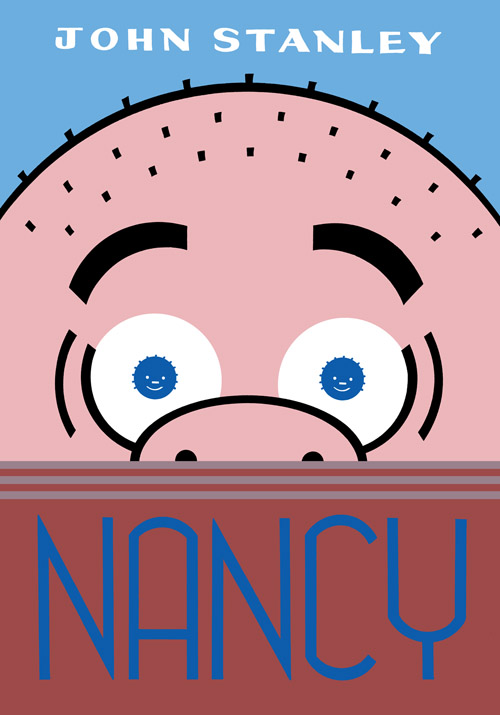 John Stanley continues to exude a sense of "liberation" in these stories from Dell NANCY #170-173. Evidently attempting to make a point, he leads off each issue with a wildly fanciful story in which Nancy, despite her own best efforts, is forced to brave bizarre perils in her friend Wednesday Addams', um, Oona Goosepimple's creepy mansion. This is the sort of stuff that Stanley had previously been obliged to run only in the backs of his issues of LITTLE LULU, plus a handful of issues of the TUBBY title. The weirdness seems to leach into other stories, as well; Nancy and Sluggo play ring-toss with hula hoops and a flag pole in #171's "The Hulahoops," Nancy's cat and bully Spike's dog converse with each other (in thought balloons, to be sure) in #173's "The Kitty's Collar," and a teeth-grindingly self-pitying Nancy literally clads herself in "sackcloth and ashes" in an effort to move an unyielding Aunt Fritzi in #170's "Nancy and the Cold Dinner." There is a zaniness here that many of the later issues of LITTLE LULU conspicuously lacked. Great fun, especially for those who've ever nodded their way through a series of Ernie Bushmiller's stultifying comic-strip gags.
Friday, August 13, 2010
Book Review: THE JOHN STANLEY LIBRARY: NANCY, VOLUME 2 (Drawn & Quarterly, Volume 2)

Something weird is going on with D&Q's NANCY reprints, and, no, it doesn't have anything to do with anything in Oona Goosepimple's house -- or does it?? In my review of Volume 1 last fall, I made note of the confusion surrounding the exact issue of Dell NANCY in which Stanley introduced the freaky-yet-friendly little girl. This collection purports to reprint issues #167-169 (1959) of Dell NANCY, as well as FOUR COLOR #1034 (1959), the first NANCY SUMMER CAMP issue. In the second and third issues reproduced herein, Nancy visits (or, rather, is compelled into visiting) Oona's place and has dream-time encounters with mute little green characters called the Yoyos. Fair enough -- sounds like Stanley's adaptation of his "Story Telling Time" tales from LITTLE LULU to the NANCY "universe." BUT: The story "Nancy Meets the Yoyos" is in the third issue in the book, while the second Yoyos epic is in the second issue. I haven't been this confused since Darkwing Duck introduced a whole slew of characters in the two-parter "Just Us Justice Ducks", the "origin episodes" of which had not yet been broadcast. I'll take this as a simple printing mistake until a Stanley expert tells me different. The editor of the NANCY books, however, evidently needs a "time out," if not a knuckle sandwich from Spike and a side order of whoop-ass from The West Side Gang.
Flip-flopped freakfests aside, the highlight here is the SUMMER CAMP issue, the idea for which Stanley carried over from similar LITTLE LULU one-shots. It is nice to see Stanley attempting something resembling a continuous narrative (albeit one of the "thread-through-the-popcorn", "short-story-chunk" variety) with "funny" characters. But would Sluggo really vault from being a last-minute addition to the camp lineup to the lofty position of a junior camp counselor? (He must've threatened to beat a whole lot of people up.) The Oona Goosepimple stories got me to thinking about how Oona fits in with other "creepy family" characters in cartoons and on TV. Her relationship with her friends is decidedly peculiar. She isn't oblivious to her strangeness, like The Munsters, or convinced that she's normal and everyone else is warped, like the members of The Addams Family. Otherwise, she wouldn't act offended when Nancy makes up some lame excuse not to come and visit her, literally going to the extreme of forcing Nancy's unwilling legs to "work in reverse" and deliver Nancy to her doorstep. (I seriously doubt that this gambit, with its suggestion of abduction, would fly in kids' comics today.) At the same time, Oona takes steps to "protect" her guests from potential perils while they're in her home. Perhaps Oona is more "normal" than she would like to admit, while, at the same time, taking her "strangeness" in stride. But perhaps I shouldn't be surprised that Stanley found a unique take on a concept that has been exploited more than once in our popular culture.
It's a tribute to Stanley that he can make characters whom I frankly have never found appealing in the least both funny and interesting. Now, if only the editor would get with the program...
Tuesday, September 22, 2009
Book Review: THE JOHN STANLEY LIBRARY: NANCY Vol. 1 by John Stanley and Dan Gormley (Drawn & Quarterly, 2009)
To start on an ominous note: a number of people appear to have the wrong idea about the issue numbers and dates for this volume. The title page says that the book contains stories from Dell NANCY #146-150 (1957-58). In searching out appropriate screen grabs for the blog post, however, I found an electronic copy of the first story, "Oona Goosepimple," complete with original Dell indicia -- and, guess what, it first appeared in NANCY #162 (April 1959). Wikipedia, and the estimable Don Markstein, come closer than D&Q, but they miss the target as well, with each citing NANCY #166 as the site of Oona's debut. So both the Internet and the "dead tree peddlers" struck out in this case.
 Actually, the first appearance of the Wednesday Addams-like Oona highlights an important point about Stanley's approach to Ernie Bushmiller's characters. Having pretty much burned out on LITTLE LULU, Stanley was probably delighted to put a new set of "Lulu-esque" characters through their paces. The fact that Nancy, Sluggo, and company were well-established figures in a popular, long-running comic strip, however, must have given the creator some pause. Lulu, who began her career as a pantomime character in gag cartoons, had had plenty of room for development when Stanley began to flesh out her neighborhood. Nancy and Sluggo may have had shallow, uninspired personalities, but Stanley must have felt that he needed to hew to them, at least for a while, as he settled down to his task. One can therefore regard the eccentric Oona's appearance as something of a "sowing of the wind" with an eye towards reaping a later "whirlwind" of story possibilities. The rest of the early stories in this collection are fairly unremarkable, making Oona -- a black-clad girl with beady eyes who gives everyone around her a case of nerves and lives in a spooky house with a surprise (usually of the nasty variety) around every corner -- stand out all the more starkly.

Stanley's innovations in handling the NANCY characters didn't prevent him from borrowing liberally from the LULU "template." Rich kid Rollo Haveall is basically Wilbur van Snobbe, take two, while the crook Bill Bungle (aka Bill Bungler, aka Bill Bumble -- perhaps Bill's incompetence was catching) reflects Stanley's apparent delight in using an adult figure who is hopelessly inept at his supposed specialty, a la the truant officer Mr. McNabbem in the LULU stories. If the NANCY stories -- even at their best -- fall a little short of the quality of the LULU oeuvre, then one reason may be the lack of a strong "bench" of supporting players. In the stories collected here, at least, Nancy has no "girl sidekick" to compare with Lulu's Annie; eager though Oona is to make friends and do things with Nancy, she's essentially a walk-on oddball. Likewise, the annoying neighbor kid Pee Wee isn't nearly as memorable (or annoying) as Alvin of "Story Telling Time" fame. Given the raw materials that he had to work with, however, Stanley's NANCY tales are unexpectedly fun and entertaining.
The last page of this volume has a picture of John Stanley (in the company of his editor Oscar LeBeck, Dan Gormley, and other worthies at Western's New York office) and a brief biography -- which just happens to be the same one that appeared at the end of the earlier MELVIN MONSTER collection. What this Library really needs is a volume-by-volume, bit-by-bit biography of Stanley in the manner of the articles that appeared in Another Rainbow's LITTLE LULU LIBRARY. As long as Fantagraphics keeps reprinting the same two-page Charles Schulz bio in THE COMPLETE PEANUTS, though, I guess it would be hypocritical of me to complain about D&Q dropping the ball.
Actually, the first appearance of the Wednesday Addams-like Oona highlights an important point about Stanley's approach to Ernie Bushmiller's characters. Having pretty much burned out on LITTLE LULU, Stanley was probably delighted to put a new set of "Lulu-esque" characters through their paces. The fact that Nancy, Sluggo, and company were well-established figures in a popular, long-running comic strip, however, must have given the creator some pause. Lulu, who began her career as a pantomime character in gag cartoons, had had plenty of room for development when Stanley began to flesh out her neighborhood. Nancy and Sluggo may have had shallow, uninspired personalities, but Stanley must have felt that he needed to hew to them, at least for a while, as he settled down to his task. One can therefore regard the eccentric Oona's appearance as something of a "sowing of the wind" with an eye towards reaping a later "whirlwind" of story possibilities. The rest of the early stories in this collection are fairly unremarkable, making Oona -- a black-clad girl with beady eyes who gives everyone around her a case of nerves and lives in a spooky house with a surprise (usually of the nasty variety) around every corner -- stand out all the more starkly.
Once Stanley gets his feet under him, he begins to pull Nancy and Sluggo in directions the unimaginative Bushmiller would never have contemplated (though Dan Gormley's art, if a bit more unpredictable than Bushmiller's, does give the comics the same stodgy look as the comic strip). You can see it coming when Stanley devotes an entire one-page gag to sending up Liberace in the person of "La Plunke," an impresario with a rhinestone-studded piano. For panel after panel, Nancy makes bitchy comments about La Plunke's talents, or lack thereof, climaxing by claiming that La Plunke, and not his piano, should be "hung" when she sees the latter getting lowered out of the stage door. Nancy's remarks scandalize her Aunt Fritzi a bit, which seems only right, as Nancy's relationship with her aunt is a lot more abrasive than Lulu's with her parents. Perhaps Stanley thought that Fritzi's not being Nancy's mother gave him a bit more leeway. Likewise, after treating Sluggo as a generic boy character in earlier stories, Stanley takes Bushmiller's notion of Sluggo as a "dead-end kid" and runs with it. In "Lower Education," Nancy forces Sluggo to go to school but thinks better of it after Sluggo starts fantasizing about using his education to become President. She ultimately convinces the janitor to keep Sluggo in the basement and have him sweep floors. Tubby may have played hooky on occasion, but the existence of parental figures in the LITTLE LULU "universe" wouldn't have allowed for this sort of a cynical resolution.
Stanley's innovations in handling the NANCY characters didn't prevent him from borrowing liberally from the LULU "template." Rich kid Rollo Haveall is basically Wilbur van Snobbe, take two, while the crook Bill Bungle (aka Bill Bungler, aka Bill Bumble -- perhaps Bill's incompetence was catching) reflects Stanley's apparent delight in using an adult figure who is hopelessly inept at his supposed specialty, a la the truant officer Mr. McNabbem in the LULU stories. If the NANCY stories -- even at their best -- fall a little short of the quality of the LULU oeuvre, then one reason may be the lack of a strong "bench" of supporting players. In the stories collected here, at least, Nancy has no "girl sidekick" to compare with Lulu's Annie; eager though Oona is to make friends and do things with Nancy, she's essentially a walk-on oddball. Likewise, the annoying neighbor kid Pee Wee isn't nearly as memorable (or annoying) as Alvin of "Story Telling Time" fame. Given the raw materials that he had to work with, however, Stanley's NANCY tales are unexpectedly fun and entertaining.
The last page of this volume has a picture of John Stanley (in the company of his editor Oscar LeBeck, Dan Gormley, and other worthies at Western's New York office) and a brief biography -- which just happens to be the same one that appeared at the end of the earlier MELVIN MONSTER collection. What this Library really needs is a volume-by-volume, bit-by-bit biography of Stanley in the manner of the articles that appeared in Another Rainbow's LITTLE LULU LIBRARY. As long as Fantagraphics keeps reprinting the same two-page Charles Schulz bio in THE COMPLETE PEANUTS, though, I guess it would be hypocritical of me to complain about D&Q dropping the ball.
Thursday, June 4, 2009
Book Review: THE JOHN STANLEY LIBRARY: MELVIN MONSTER, VOLUME 1 by John Stanley (Drawn & Quarterly, 2009)
Thanks to the success of Dark Horse's LITTLE LULU volumes, John Stanley "stock" is up, and now Montreal-based D&Q is joining the frenzy with the first of a promised series of volumes collecting Stanley's non-LULU works. MELVIN MONSTER dates from the mid-1960s, by which time (1) Stanley was working for a Dell Publishing outfit that had split off from Western Publishing and was attempting to establish itself as a comics-publishing contender; (2) Stanley was drawing, as well as writing, his stories; (3) Stanley was working entirely with characters of his own creation; (4) Stanley's attitude towards the comics industry was rapidly souring (he would quit the business altogether by the end of the decade). All four factors have a heavy influence on MELVIN, which, while entertaining enough, doesn't quite measure up to Stanley's peerless work with Marge's characters.
 At first glance, MELVIN appears to be drawing upon the same zeitgeist that gave rise to such contemporary TV series as The Munsters and The Addams Family. The title character is, after all, a monster and interacts on a fairly regular basis with humans (or, as Melvin calls them, "human beans"). A closer examination, however, suggests that the character of Melvin owes just as large a debt to that of Casper the Friendly Ghost. To the chagrin of his square-shouldered, hulking, overbearing "Baddy" and bandage-wrapped "Mummy," Melvin wants to be as close to a normal boy as one can possibly be in the abnormality-riddled community of "Monsterville." His attempts to actually attend "The Little Black Schoolhouse," as opposed to buying into the "normal" practice of playing hooky -- thereby scandalizing the "teacher" (a dyspeptic witch) on duty -- are particularly funny. Melvin's attitude towards "fitting in" veers between mild defiance and stoic acceptance (e.g., when he agrees to slide down his slide into a "daggerberry bush" without screaming, only to take refuge in a cave after the fact and painfully give forth with the requisite number of "Ow!"s). The family pet, a crocodile named Cleopatra, is perpetually trying to eat him. Even his "guardian demon," who's supposed to protect him from harm, is fairly useless. Given all of the above factors, Melvin is an easy character for whom to root and should make an appealing hero. His milieu, however, is not as well-defined as it ought to be, and much of that is Stanley's fault.
In the absence of the experienced editorial hands that had been employed by Western, Stanley appears to have had some trouble deciding how, exactly, Melvin should relate to the human world, or even how his work should be organized. Issues #1 and #2 consist of single narratives broken into distinctly titled parts (shades of Harvey Comics' 10- and 15-page stories) in which Melvin takes a "detour" into "Humanbeanville" along the way. These stories plainly suggest that humans live in, so to speak, a different dimension than monsters. With issue #3, we get a paradigm shift: the stories are now stand-alone, and Melvin runs into humans as a matter of course (even getting tracked by "monster hunters"). This is a bit disconcerting, to say the least. In both manifestations, the humans (whom Melvin appears to admire on principle) do behave pretty much the same -- namely, like jerks. A rich owner of a "private zoo" wishes to add Melvin to his collection (where are Superman and Lobo when you need them?); several human kids spin Melvin like a top; a rich couple living in a penthouse mock the "riff-raff" below; and, of course, there are the "monster hunters." The adult characters in the LULU stories never came off as badly as this. Creeping cynicism, you suggest? So do I.
Stanley's artwork in MELVIN reflects a comment that I recall him making about Irving Tripp's artwork on LULU (for which Stanley provided scripts and pencil roughs) being overly "static." Stanley's work is much livelier, if a bit inconsistent: the monster characters are very cartoony in appearance, while the humans look as if they've stepped out of a New Yorker cartoon. Melvin straddles these two extremes, being neither realistic-looking nor overly stylized. Again, a better editor might have suggested that Stanley bring the two disparate styles a bit closer together. Occasional misspellings in Stanley's lettering -- plus an awkwardly-placed caption that appears to have been shoehorned in at the last minute -- lend further credence to the theory that Stanley, working on his own, needed more editorial help than when he was part of a creative "team."
Subsequent volumes of the JSL will reprint Stanley's comic-book work on NANCY -- which, it goes without saying, will probably look and "feel" a lot more like LITTLE LULU -- and such additional all-Stanley enterprises as THIRTEEN, GOING ON EIGHTEEN. It will be interesting to see if the theory that I've posited here -- that Stanley was better working with established characters that he could "embellish" than with original creations -- continues to hold true.
In the absence of the experienced editorial hands that had been employed by Western, Stanley appears to have had some trouble deciding how, exactly, Melvin should relate to the human world, or even how his work should be organized. Issues #1 and #2 consist of single narratives broken into distinctly titled parts (shades of Harvey Comics' 10- and 15-page stories) in which Melvin takes a "detour" into "Humanbeanville" along the way. These stories plainly suggest that humans live in, so to speak, a different dimension than monsters. With issue #3, we get a paradigm shift: the stories are now stand-alone, and Melvin runs into humans as a matter of course (even getting tracked by "monster hunters"). This is a bit disconcerting, to say the least. In both manifestations, the humans (whom Melvin appears to admire on principle) do behave pretty much the same -- namely, like jerks. A rich owner of a "private zoo" wishes to add Melvin to his collection (where are Superman and Lobo when you need them?); several human kids spin Melvin like a top; a rich couple living in a penthouse mock the "riff-raff" below; and, of course, there are the "monster hunters." The adult characters in the LULU stories never came off as badly as this. Creeping cynicism, you suggest? So do I.
Stanley's artwork in MELVIN reflects a comment that I recall him making about Irving Tripp's artwork on LULU (for which Stanley provided scripts and pencil roughs) being overly "static." Stanley's work is much livelier, if a bit inconsistent: the monster characters are very cartoony in appearance, while the humans look as if they've stepped out of a New Yorker cartoon. Melvin straddles these two extremes, being neither realistic-looking nor overly stylized. Again, a better editor might have suggested that Stanley bring the two disparate styles a bit closer together. Occasional misspellings in Stanley's lettering -- plus an awkwardly-placed caption that appears to have been shoehorned in at the last minute -- lend further credence to the theory that Stanley, working on his own, needed more editorial help than when he was part of a creative "team."
Subsequent volumes of the JSL will reprint Stanley's comic-book work on NANCY -- which, it goes without saying, will probably look and "feel" a lot more like LITTLE LULU -- and such additional all-Stanley enterprises as THIRTEEN, GOING ON EIGHTEEN. It will be interesting to see if the theory that I've posited here -- that Stanley was better working with established characters that he could "embellish" than with original creations -- continues to hold true.
Subscribe to:
Posts (Atom)