To date, IDW's MY LITTLE PONY comics have done reasonably well by a number of characters who have either been undeveloped or underdeveloped in the TV series... which is why I was particularly interested in seeing what Jeremy Whitley and Agnes Garbowska would do with the second four-color coming of Babs Seed. Babs' first comics appearance, in MLP #21-22, pushed her characterization a considerable distance down the track, but it also may have taken a few too many liberties in its sudden expansion of Babs' problem-solving abilities. For Babs to progress from the somewhat insecure filly that lay underneath the "bully" surface in "One Bad Apple" to the hard-boiled junior detective who cracked the "Manehattan Mystery" and cleared Trixie's "good mane" (such as it is) required a certain suspension of disbelief. Happily, the Babs of FF #13 is back to being a little more of a passive, slightly bewildered character -- though not incapable of taking a stand when she has to -- and thus works quite well with the self-confident Rarity. Though the plot owes more than a small debt to the classic episode "Sisterhooves Social," with Rarity learning yet another lesson about the importance of "give and take" in dealing with a young'un, the conflict simmers at a much lower temperature, and Rarity doesn't have to go to such extreme lengths in order to put what she has learned into practice.
** SPOILERS **
Thanks to a thimbleful of contrivance -- namely, Sweetie Belle getting sick and being unable to accompany her sister on a business trip to Manehattan, where Sweetie was looking forward to reconnecting with Babs -- Rarity finds herself shepherding Babs around the town. (Rarity momentarily, and self-consciously, puts aside some impending work in order to do so, in order that Babs will not leave disappointed because of Sweetie's absence. Considering that Rarity barely knows Babs, this is a subtle but welcome reminder of her generous nature.) Regarding Babs as a sort of equina rasa on which to work her fashionista magic, Rarity is soon consumed with the notion of giving Babs a makeover. Babs becomes less and less enamored with the idea and finally takes her leave, albeit with no histrionics. It's pretty clear that Babs likes Rarity well enough; she just doesn't think that their lives have very much in common. Thanks to a talk with her client, the "Pony of Pop" Sapphire Shores, Rarity quickly realizes that she's been too concerned with "her own fashion and sense of style" to pay sufficient attention to Babs' more rough-hewn, "citified" idea of a good time. She uses her behind-the-scenes pull to treat Babs to a roller derby (hence the cover), and the two finally bond.
Simple, but effective, this is. I suppose that I should be annoyed that Rarity didn't completely internalize her epiphany in "Sisterhooves Social," but dealing with a sibling and dealing with a relative stranger involve very different emotional dynamics. Rarity is more puzzled than emotionally distraught as a result of Babs' unenthusiastic reaction to the makeover, but, true to her nature, she is determined to do right by Babs, and she ultimately does so.
Agnes Garbowska manipulates her static little dolls to pretty good effect here, though there are a couple of places in which a little artistic dynamism would definitely have helped. I can only imagine what one of the more daring MLP artists would have done with the roller-derby action sequences, or with the obsessed manedresser pony who is bound and determined to cut off Babs' long bang (the one that Babs is seen repeatedly blowing out of her eyes). There are also a few flareups of the seemingly inevitable "Repetitive Panel Syndrome." I did, however, like the running gag of Babs being "pulled off panel" by an overly excited Rarity. Needless to say, Babs gets to turn the tables before all is said and done.
The same creative crew will be handling FF #14, which will feature a teamup of Spike and Princess Luna. There's a pleasing consistency in this, in that Garbowska also drew the Spike-Celestia joint in FF #3. I'm hoping for livelier things from the Spike-Luna pairing, and at least one of the issue's covers -- which appears to be, of all things, a "hardboiled detective" parody of the "then, the tall, dark knockout of an alicorn sauntered into my office" variety -- suggests that I may get my wish.
Comics, book, and DVD reviews (and occasional eruptions of other kinds)
Showing posts with label General Comics. Show all posts
Tuesday, January 13, 2015
Thursday, January 8, 2015
Comics Review: MY LITTLE PONY: FRIENDSHIP IS MAGIC #25-26 (IDW Publishing, November and December 2014)
What is it about "Wild West" themes and the My Little Pony: Friendship is Magic franchise that causes the best of creative intentions to result in something... um, less than optimal? The TV show's two stabs at Western stories -- season one's "Over a Barrel" and season two's "The Last Roundup" -- are generally not that highly thought of, though, for my own part, I found their biggest sins to be ones of dullness. Katie Cook and Andy Price sent Rarity and Applejack on the Equestrian equivalent of a "West Coast road swing" during FRIENDS FOREVER #8, during which the "odd couple" took a stagecoach ride and dispatched a bunch of would-be cattle rustlers in the process, but it's hard to separate that incident from the issue's somewhat questionable (in my mind, at least) characterizations of the two "mane" principals. During that story, one of the defeated rustlers did the "fourth wall" thing with the reading audience, informing them that the gang would be back in a future issue. Well, here they are, terrorizing and extorting from a small town, like the "bullies" that they literally are. Everything seems to be in place for a good, new-fashioned Western parody. Instead, we get, by far, THE single worst story that has been dished up in ANY of the IDW MLP comics... and, yes, that includes even the weakest of the defunct MICRO-SERIES offerings. From Cook and Price, the bellcows of the entire MLP comics franchise?! Unfortunately, yes.
This failure is basically on Katie Cook, almost 100%. There's nothing at all wrong with Price's artwork. Cook, however, seems to have forgotten rule number one about dealing with well-established characters: Never let the desire to tell a particular story tempt you into pulling one of the characters completely OUT of character in order to achieve the goal. The damage that Cook inflicts in her handling of Twilight Sparkle here, combined with the problems we saw with Rarity and Applejack in FF #8, have combined to make me a little apprehensive about future stories by this creative duo. Why is Cook suddenly having so much difficulty getting the "Mane 6"'s characterizations right? And make no mistake, this was a BAD misstep... so much so, in fact, that some people immediately declared that they'd NEVER buy the comics again if the comics could get things THIS wrong.
** SPOILERS **
Given her magical powers AND her status as an alicorn princess, you would think that Twilight would be well-equipped to help Applejack and her other friends handle an invasion of the tiny town of Canter Creek by the massive steer, Longhorn, and his beefy buddies. Even if Twilight were too nice to get really rough with them, surely she could magically imprison them, or put a protective force field around the town and Applejack's Great Granduncle Chili Pepper's ranch, where the rustlers have squatted in Chili Pepper's absence. Evidently, however, things are more... um, nuanced than that:
As I said before... there are many different ways in which Twilight could use her magic to neutralize the bad guys, none of which involve the use of lethal magical force. For example, she could have tried flooding them out, using the same simple magic that she did when she and Rarity (!) knocked down a water tower in order to put out a barn fire that had been set by Longhorn and his meaty minions:
But, no... apparently, the rules for alicorns involve a liberal application of the old "Mutually Assured Destruction" doctrine from the Cold War years. When it comes to using magic against either "sentient non-magical beings" or "Equestrian citizens" -- Cook doesn't seem to be certain as to which -- Twilight appears to think that there's no alternative between doing nothing and using overwhelming force.
The "logic" behind this... uh... operational paradigm is simply mind-boggling. If you're a magically endowed villain, like Tirek in the season four finale "Twilight's Kingdom," then it's perfectly OK for Twilight to use any and all magical means to deter you, including... well, if there's a magical equivalent of advanced weaponry, then she certainly used it at some point during her battle with Tirek.
However, if you're a garden-variety, non-magical, "schemer/plotter" type villain, such as, say, The Phantom Blot... OK, I know that his "garden" is far more varied than most, but you get my point... then getting the best of Twilight and the other unicorns and alicorns of Equestria is cake. Simply find some way to get yourself declared an Equestrian citizen, and then, violate laws with impunity. St. Paul appealed to his Roman citizenship for a good cause, to demand a trial in Rome, so it would make perfect sense for a villain to use the same tactic for evil. Actually, the Blot would probably go it one better and get himself attached to an embassy in Canterlot. It's not as if he hasn't tried that before.
It would have been a simple matter for Cook to have written Twilight completely out of the story, letting her travel with Spike to the Pony Trek convention (now, there's one real-world Equestrian parallel that didn't need to exist...) and leaving Applejack to take the lead in fighting back against villains who have, after all, taken over HER relative's ranch. In fact, that's what Applejack eventually does, picking up the defeated Sheriff Tumbleweed's discarded star at the end of MLP #25 and becoming the sheriff herself. For AJ, this represents quite a nice bounceback from the "all ya gotta do to sell apples is sell apples" dumbitude that hamstrung her in FF #8.
The ponies' resulting plan to foil Longhorn, while it pleasantly brings to mind ideas from one of the most-beloved Western spoofs, isn't without its own share of nits. It only works because Longhorn, having basically already won the battle, decides to figuratively "sweep around the telephone poles" and legally take control of Chili Pepper's ranch. Uh, why? Why do the "Mane 6" figure that it's all right to temporarily kidnap a clerk and impersonate a legal official in order to flummox Longhorn, right after Twilight had freaked out over the others trying to destroy Longhorn's (notarized) paperwork? (Twilight definitely was schizophrenic in this story, wasn't she?)
At least Twilight puts her legalese where her magic normally is, when she zips off to Canterlot and returns with... no, not reinforcements, but a surefire legal way to allow her to finally use her magic against Longhorn. (Of course, it requires Longhorn's unknowing cooperation, but that doesn't prove to be much of an obstacle.) Alas, even the traditional "stroll into the sunset" doesn't work when the "Mane 6" exit without evincing any interest whatsoever in whatever happened to Chili Pepper.
Aside from Applejack and, yes, Rarity -- who flirts with multiple stallions, contributes more than her mite to the anti-Longhorn scheming, and gets to use her generally finesse-oriented magic to move houses, knock down water towers, and perform other intriguingly unladylike operations -- the rest of the gang walk through the story as if they're in a daze. Twilight's deficiences here are manifest, but Rainbow Dash and Fluttershy contribute virtually nothing -- you would think that both of them, especially the former, would be hacked off at the sight of their friend Applejack getting knocked through a barn wall by Longhorn, but no joy -- and even Pinkie Pie is somewhat lacking here. (A joke about a character eating a red-hot chili pepper, making faces, and then saying that they like it? That has SO been done... and, therefore, it probably isn't worth wasting Pinkie on.)
So... yeah, a really bad one. I'm not going to bail, of course -- Cook and Price are doing the very next arc in MLP #27-28, and I'll be interested in seeing how well they can bounce back. There is some work to be done here, though... if nothing else, to reassure those who, like me, have been on board from the very start.
This failure is basically on Katie Cook, almost 100%. There's nothing at all wrong with Price's artwork. Cook, however, seems to have forgotten rule number one about dealing with well-established characters: Never let the desire to tell a particular story tempt you into pulling one of the characters completely OUT of character in order to achieve the goal. The damage that Cook inflicts in her handling of Twilight Sparkle here, combined with the problems we saw with Rarity and Applejack in FF #8, have combined to make me a little apprehensive about future stories by this creative duo. Why is Cook suddenly having so much difficulty getting the "Mane 6"'s characterizations right? And make no mistake, this was a BAD misstep... so much so, in fact, that some people immediately declared that they'd NEVER buy the comics again if the comics could get things THIS wrong.
** SPOILERS **
Given her magical powers AND her status as an alicorn princess, you would think that Twilight would be well-equipped to help Applejack and her other friends handle an invasion of the tiny town of Canter Creek by the massive steer, Longhorn, and his beefy buddies. Even if Twilight were too nice to get really rough with them, surely she could magically imprison them, or put a protective force field around the town and Applejack's Great Granduncle Chili Pepper's ranch, where the rustlers have squatted in Chili Pepper's absence. Evidently, however, things are more... um, nuanced than that:
As I said before... there are many different ways in which Twilight could use her magic to neutralize the bad guys, none of which involve the use of lethal magical force. For example, she could have tried flooding them out, using the same simple magic that she did when she and Rarity (!) knocked down a water tower in order to put out a barn fire that had been set by Longhorn and his meaty minions:
But, no... apparently, the rules for alicorns involve a liberal application of the old "Mutually Assured Destruction" doctrine from the Cold War years. When it comes to using magic against either "sentient non-magical beings" or "Equestrian citizens" -- Cook doesn't seem to be certain as to which -- Twilight appears to think that there's no alternative between doing nothing and using overwhelming force.
The "logic" behind this... uh... operational paradigm is simply mind-boggling. If you're a magically endowed villain, like Tirek in the season four finale "Twilight's Kingdom," then it's perfectly OK for Twilight to use any and all magical means to deter you, including... well, if there's a magical equivalent of advanced weaponry, then she certainly used it at some point during her battle with Tirek.
However, if you're a garden-variety, non-magical, "schemer/plotter" type villain, such as, say, The Phantom Blot... OK, I know that his "garden" is far more varied than most, but you get my point... then getting the best of Twilight and the other unicorns and alicorns of Equestria is cake. Simply find some way to get yourself declared an Equestrian citizen, and then, violate laws with impunity. St. Paul appealed to his Roman citizenship for a good cause, to demand a trial in Rome, so it would make perfect sense for a villain to use the same tactic for evil. Actually, the Blot would probably go it one better and get himself attached to an embassy in Canterlot. It's not as if he hasn't tried that before.
It would have been a simple matter for Cook to have written Twilight completely out of the story, letting her travel with Spike to the Pony Trek convention (now, there's one real-world Equestrian parallel that didn't need to exist...) and leaving Applejack to take the lead in fighting back against villains who have, after all, taken over HER relative's ranch. In fact, that's what Applejack eventually does, picking up the defeated Sheriff Tumbleweed's discarded star at the end of MLP #25 and becoming the sheriff herself. For AJ, this represents quite a nice bounceback from the "all ya gotta do to sell apples is sell apples" dumbitude that hamstrung her in FF #8.
The ponies' resulting plan to foil Longhorn, while it pleasantly brings to mind ideas from one of the most-beloved Western spoofs, isn't without its own share of nits. It only works because Longhorn, having basically already won the battle, decides to figuratively "sweep around the telephone poles" and legally take control of Chili Pepper's ranch. Uh, why? Why do the "Mane 6" figure that it's all right to temporarily kidnap a clerk and impersonate a legal official in order to flummox Longhorn, right after Twilight had freaked out over the others trying to destroy Longhorn's (notarized) paperwork? (Twilight definitely was schizophrenic in this story, wasn't she?)
At least Twilight puts her legalese where her magic normally is, when she zips off to Canterlot and returns with... no, not reinforcements, but a surefire legal way to allow her to finally use her magic against Longhorn. (Of course, it requires Longhorn's unknowing cooperation, but that doesn't prove to be much of an obstacle.) Alas, even the traditional "stroll into the sunset" doesn't work when the "Mane 6" exit without evincing any interest whatsoever in whatever happened to Chili Pepper.
Aside from Applejack and, yes, Rarity -- who flirts with multiple stallions, contributes more than her mite to the anti-Longhorn scheming, and gets to use her generally finesse-oriented magic to move houses, knock down water towers, and perform other intriguingly unladylike operations -- the rest of the gang walk through the story as if they're in a daze. Twilight's deficiences here are manifest, but Rainbow Dash and Fluttershy contribute virtually nothing -- you would think that both of them, especially the former, would be hacked off at the sight of their friend Applejack getting knocked through a barn wall by Longhorn, but no joy -- and even Pinkie Pie is somewhat lacking here. (A joke about a character eating a red-hot chili pepper, making faces, and then saying that they like it? That has SO been done... and, therefore, it probably isn't worth wasting Pinkie on.)
So... yeah, a really bad one. I'm not going to bail, of course -- Cook and Price are doing the very next arc in MLP #27-28, and I'll be interested in seeing how well they can bounce back. There is some work to be done here, though... if nothing else, to reassure those who, like me, have been on board from the very start.
Labels:
Christianity,
Comic Strips,
General Comics,
History,
MLP:FIM,
Movies,
Super Goof
Saturday, December 27, 2014
Book Review: FUNNYBOOKS by Michael Barrier (University of California Press, 2014)
What Michael Barrier did for the history of classic Hollywood studio animation in HOLLYWOOD CARTOONS, he does here for the golden years of Dell Comics and its most accomplished and historically significant creators -- Walt Kelly, John Stanley, and, above all, Carl Barks. While devoting most of his critical attention to this trio of greats and the ways in which they helped shape the development of the American comic book into an art form with its own distinct verbal and visual language, Barrier also unearths facts and highlights overlooked personalities in a manner that is sure to surprise and delight even the most knowledgeable Dell/Western Publishing fan.
As was the case with HOLLYWOOD CARTOONS, FUNNYBOOKS had an extremely long gestation period, with Barrier using interview material from as far back as the 1960s to help craft his narrative. Barrier also draws upon material used in his 1981 book-length study of Carl Barks, but he expands greatly upon that earlier work. Perhaps his most important critical achievement here is his in-depth illumination of exactly how Barks, who famously worked in isolation and with minimal (at first) editorial interference, became one of the very first comics creators to "crack the code" and essentially discover how to tell effective stories in comic-book form. Barks fans have always known of the Old Duck Man's mastery of narrative, but they will come away from this discussion with a newfound appreciation of the wider importance of his work.
Barrier pretty clearly considers Barks to be primus inter pares even among the "really good ones," but Kelly and Stanley get their due and then some. Kelly's creation and development of the POGO characters is covered in detail, as is Stanley's work on LITTLE LULU, but Barrier brings their other notable comic-book works (e.g., Kelly's stories for OUR GANG and his fairy-tale and Christmas comics, Stanley's honing of his craft in NEW FUNNIES) under similar critical scrutiny. As was made quite clear in HOLLYWOOD CARTOONS, Barrier is a very astringent analyst, and it takes quite a lot for a story to wring praise out of him. Everyone who knows these creators will probably disagree with Barrier's assessments at some point -- for example, I think that he is much too harsh on Barks' more loosely-wound, but still immensely entertaining, UNCLE $CROOGE stories from the 1960s -- but he always has a well-considered reason for his opinions.
The "extra material" here is what really lifts FUNNYBOOKS to "instant classic" status. Anyone who has ever wondered about the precise relationships between the various corporate subsidiaries and allies grouped under the spreadeagled "Western Publishing" umbrella -- Whitman, K.K. Publications, Dell, Gold Key -- will have any and all questions answered to their satisfaction here. Interested in the early history of LOONEY TUNES AND MERRIE MELODIES, the Warner Bros. "answer" to WALT DISNEY'S COMICS AND STORIES, or in how Dell handled such significant "non-funny-animal" licensed properties as TARZAN and various movie cowboy heroes? You'll learn about some of these comics' most accomplished writers and artists here. Perhaps the biggest surprise is a brief discussion of "the Jim Davis shop," an association of artists who produced "funny-animal" challenges, of a sort, to Dell's humorous hegemony for the notorious comics entrepreneur Benjamin Sangor. It's nice to see the exquisitely obscure characters that came out of this outfit get some recognition, even if Barrier's primary purpose for bringing them up is to demonstrate how their comics failed while the best of Dell's succeeded.
If I have a small nitpick here, it is with Barrier's comparatively brusque brushing-aside of the Gold Key era. Yes, that era did see ill-considered format and price changes and increasing editorial restrictions, but there was a whole lot of high-quality material being produced at that time, as well. (See Joe Torcivia's 50th Anniversary tribute for numerous examples.) I fully realize that Barrier's intention was always to focus on the years before the Dell/Western split, but a few extra pages discussing some of the GK highlights couldn't have hurt. Anyone want to pick up the bracketed torch (as opposed to fallen; it's not as if Barrier failed, after all) and try writing a sequel?
So, what are you waiting for? If you care at all about the Dell Comics that truly WERE "Good Comics," or simply about the history of quality comics in general, FUNNYBOOKS virtually defines the term "MUST-GET."
As was the case with HOLLYWOOD CARTOONS, FUNNYBOOKS had an extremely long gestation period, with Barrier using interview material from as far back as the 1960s to help craft his narrative. Barrier also draws upon material used in his 1981 book-length study of Carl Barks, but he expands greatly upon that earlier work. Perhaps his most important critical achievement here is his in-depth illumination of exactly how Barks, who famously worked in isolation and with minimal (at first) editorial interference, became one of the very first comics creators to "crack the code" and essentially discover how to tell effective stories in comic-book form. Barks fans have always known of the Old Duck Man's mastery of narrative, but they will come away from this discussion with a newfound appreciation of the wider importance of his work.
Barrier pretty clearly considers Barks to be primus inter pares even among the "really good ones," but Kelly and Stanley get their due and then some. Kelly's creation and development of the POGO characters is covered in detail, as is Stanley's work on LITTLE LULU, but Barrier brings their other notable comic-book works (e.g., Kelly's stories for OUR GANG and his fairy-tale and Christmas comics, Stanley's honing of his craft in NEW FUNNIES) under similar critical scrutiny. As was made quite clear in HOLLYWOOD CARTOONS, Barrier is a very astringent analyst, and it takes quite a lot for a story to wring praise out of him. Everyone who knows these creators will probably disagree with Barrier's assessments at some point -- for example, I think that he is much too harsh on Barks' more loosely-wound, but still immensely entertaining, UNCLE $CROOGE stories from the 1960s -- but he always has a well-considered reason for his opinions.
The "extra material" here is what really lifts FUNNYBOOKS to "instant classic" status. Anyone who has ever wondered about the precise relationships between the various corporate subsidiaries and allies grouped under the spreadeagled "Western Publishing" umbrella -- Whitman, K.K. Publications, Dell, Gold Key -- will have any and all questions answered to their satisfaction here. Interested in the early history of LOONEY TUNES AND MERRIE MELODIES, the Warner Bros. "answer" to WALT DISNEY'S COMICS AND STORIES, or in how Dell handled such significant "non-funny-animal" licensed properties as TARZAN and various movie cowboy heroes? You'll learn about some of these comics' most accomplished writers and artists here. Perhaps the biggest surprise is a brief discussion of "the Jim Davis shop," an association of artists who produced "funny-animal" challenges, of a sort, to Dell's humorous hegemony for the notorious comics entrepreneur Benjamin Sangor. It's nice to see the exquisitely obscure characters that came out of this outfit get some recognition, even if Barrier's primary purpose for bringing them up is to demonstrate how their comics failed while the best of Dell's succeeded.
If I have a small nitpick here, it is with Barrier's comparatively brusque brushing-aside of the Gold Key era. Yes, that era did see ill-considered format and price changes and increasing editorial restrictions, but there was a whole lot of high-quality material being produced at that time, as well. (See Joe Torcivia's 50th Anniversary tribute for numerous examples.) I fully realize that Barrier's intention was always to focus on the years before the Dell/Western split, but a few extra pages discussing some of the GK highlights couldn't have hurt. Anyone want to pick up the bracketed torch (as opposed to fallen; it's not as if Barrier failed, after all) and try writing a sequel?
So, what are you waiting for? If you care at all about the Dell Comics that truly WERE "Good Comics," or simply about the history of quality comics in general, FUNNYBOOKS virtually defines the term "MUST-GET."
Saturday, December 20, 2014
Comics Review: MY LITTLE PONY: FRIENDS FOREVER #12 (December 2014, IDW)
Brenda Hickey's cover homage to the "Nowhere Man" sequence from Yellow Submarine (1968) isn't just for funsies. This issue is a no-holds-barred "psychedelic experience" complete with what THE OVERSTREET PRICE GUIDE (or at least the editions I've seen) would have no hesitation labeling as a "drug use motif." One could argue that it stands to reason that color-coordinated ponies with strange powers would inevitably have to endure a scenario like this at some point. And who better to experience the full brunt of the "trip" than Pinkie Pie?
My opinion of the issue as a whole could charitably be described as "mixed." I appreciate the immense effort that Hickey, who has sure as shootin' taken a long, strange trip since her MY LITTLE PONY: FRIENDSHIP IS MAGIC comic-book debut, puts into making this thing truly bizarre, and I did enjoy the cleverness of Barbara Kesel's dialogue. The problem is that, given the whisper-thin plot premise, I don't think that this tale merited a full issue. The vast majority of the story seems to take place in the "Pinkie Zone," and that's an area that is fun to visit in the short run but tends to drive the visitor away in the long run, simply because Pinkie is so over the top... and she's roughly 100 stories OVER "over the top" here. In the end, I think that Kesel and Hickey simply try TOO hard to punch the weirdness across. I can see this working better as one of the backup features that have appeared in most issues of the MLP:FIM flagship title.
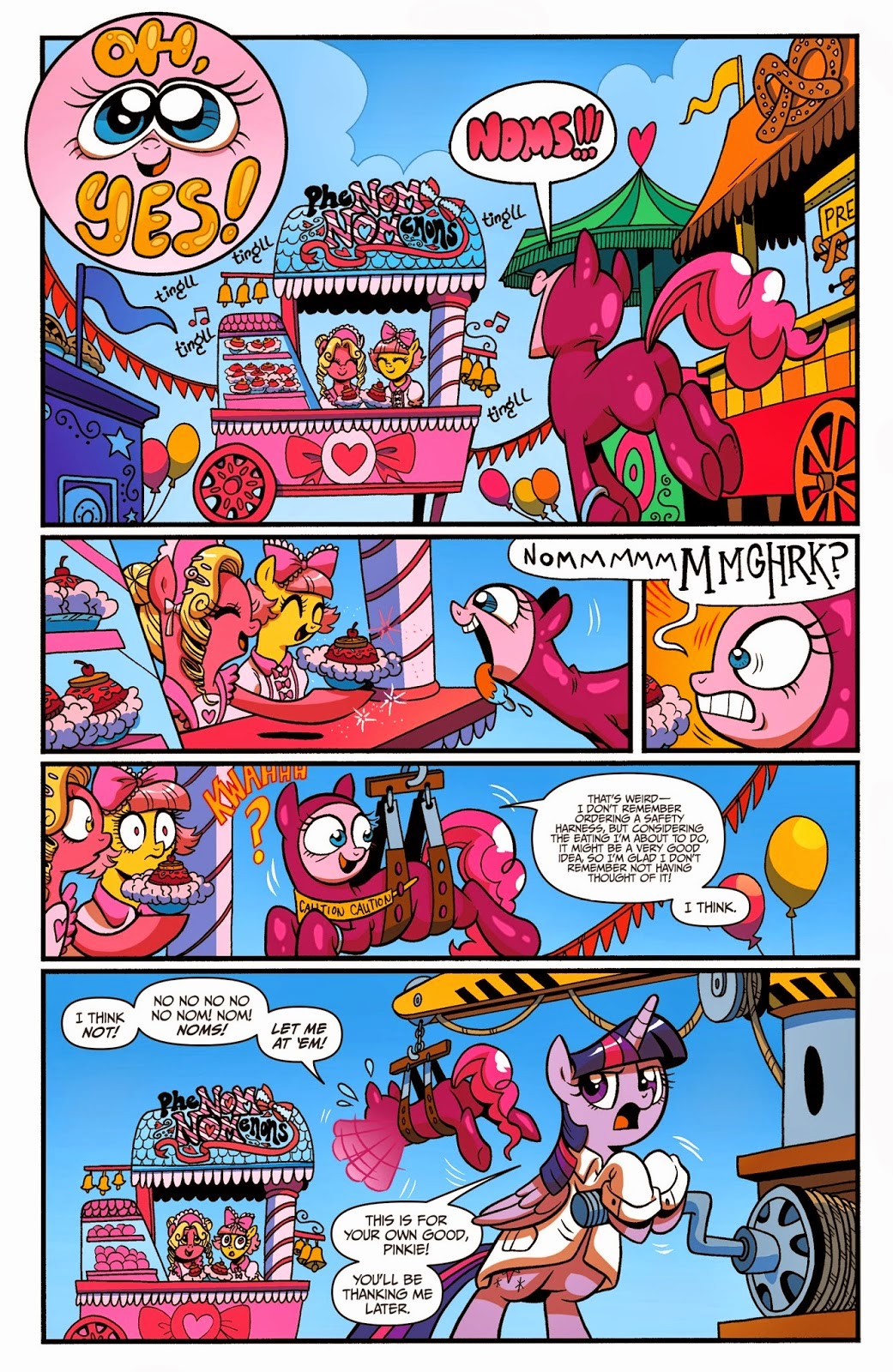
I'm not going to bother with SPOILERS here, since the plot could be scribbled on both sides of the paper in a Chinese fortune cookie, with room left over for the standard "lucky numbers" and one-sentence sliver of wisdom. Pinkie is obsessed with treats called "Phenomnomenons" and comes to ask for Twilight Sparkle's assistance in resisting their sugary Siren call, but she ultimately learns that the best way to "kick a habit" is by using one's own willpower. Welcome back to the 80's... "Just Say No" has returned with a vengeance! Kesel and Hickey would probably deny that such was their intention, but that's the way the message comes across. The only added feature here is Twilight's personal intervention, which is itself presented in considerably-further-than-off-the-wall fashion. For example, Twilight uses the hyped-up Pinkie's innate kinetic energy to trap the pink pony in a Mousetrap-style game-cum-prison.
Unfortunately, Kesel and Hickey muddy their supposed moral a bit in the last panel with Spike. He didn't really need to be in this issue at all, actually, which makes the coda all the more obnoxious.
My opinion of the issue as a whole could charitably be described as "mixed." I appreciate the immense effort that Hickey, who has sure as shootin' taken a long, strange trip since her MY LITTLE PONY: FRIENDSHIP IS MAGIC comic-book debut, puts into making this thing truly bizarre, and I did enjoy the cleverness of Barbara Kesel's dialogue. The problem is that, given the whisper-thin plot premise, I don't think that this tale merited a full issue. The vast majority of the story seems to take place in the "Pinkie Zone," and that's an area that is fun to visit in the short run but tends to drive the visitor away in the long run, simply because Pinkie is so over the top... and she's roughly 100 stories OVER "over the top" here. In the end, I think that Kesel and Hickey simply try TOO hard to punch the weirdness across. I can see this working better as one of the backup features that have appeared in most issues of the MLP:FIM flagship title.
I'm not going to bother with SPOILERS here, since the plot could be scribbled on both sides of the paper in a Chinese fortune cookie, with room left over for the standard "lucky numbers" and one-sentence sliver of wisdom. Pinkie is obsessed with treats called "Phenomnomenons" and comes to ask for Twilight Sparkle's assistance in resisting their sugary Siren call, but she ultimately learns that the best way to "kick a habit" is by using one's own willpower. Welcome back to the 80's... "Just Say No" has returned with a vengeance! Kesel and Hickey would probably deny that such was their intention, but that's the way the message comes across. The only added feature here is Twilight's personal intervention, which is itself presented in considerably-further-than-off-the-wall fashion. For example, Twilight uses the hyped-up Pinkie's innate kinetic energy to trap the pink pony in a Mousetrap-style game-cum-prison.
Unfortunately, Kesel and Hickey muddy their supposed moral a bit in the last panel with Spike. He didn't really need to be in this issue at all, actually, which makes the coda all the more obnoxious.
These are definitely NOT the weirdest pages in the story... just the ones I could readily find online.
Aside from its sheer "bizzaritude," this tale will wind up rating a footnote of sorts in MLP:FIM trivia lore, because it marks the first time that any sort of canonical or quasi-canonical pony story has spent any time inside Twilight's "Friendship Castle," the gaudy structure that first appeared at the end of the show's two-part season four finale, "Twilight's Kingdom." Most of Twilight's anti-temptation experiments take place inside the castle; things don't begin to fall apart for our favorite scholarly alicorn princess until the field of battle shifts outdoors to the open-air food market.
Not a flop, but not really what I prefer to see in an MLP:FIM comic-book story, either. At least, a full-length one.
Friday, December 5, 2014
"Not pony tales, but"... actually, YES, pony tales.
I have been pretty busy this past week and haven't gotten many opportunities to blog. I still have a couple of tomes on the old pile-a-roo to read and review. I'm also deciding on the next DUCKTALES comic-book story and fanfic to dissect. We're heading into finals week, however, so those features won't appear until the second half of December, at the earliest.
In the meantime, I have some delectable crossover matter for you to nosh on. I stumbled across these items while I was... OK, I'll admit it, I was searching for a DuckTales/My Little Pony: Friendship is Magic crossover fanfic. I did find one, but... let's just say that I would prefer to pass over it in silence. I'm sure that the writer did his or her best, but there's just not that much substance to the thing.
Graphical blandishers have been busier:
The image is from IDW's MLP MICRO-SERIES COMIC #8, the one featuring Celestia. Unfortunately, these kids were making fun of the aging and increasingly oblivious teacher Inkwell. I'd almost have preferred that they were playing hooky or something. Also... "A-WOOOOOO"? Is that the DuckTales theme song or a Warren Zevon hit from the 70s?
If you're not satisfied with ponified versions of HD&L, how about the real McCoys... and an entirely new distaff challenge. And the lads thought they had issues with Webby and Gosalyn...
Perhaps this faceoff took place during an adventure in which Scrooge found himself in Equestria and immediately did what comes naturally to him -- namely, search for treasure. Since the MLP:FIM TV episode "A Dog and Pony Show" clearly indicated that certain areas of Equestria are chock-full of gems, this would be a natural thing to do. Due to the completely alien territory, it would also be natural that Scrooge would seek assistance from a local expert, whose many talents include an ability to find gems with her magic:
I can't wait to see "the division of the spoils" after this adventure. Rarity's charm (and magic) vs. Scrooge's will (and proven ability to do effective battle with a magical adversary)! Which would prevail?
Apparently, someone was planning to write a fanfic with this title, but this picture is as far as they got. Maybe they'll get back to it someday. If they do, then I hope they'll consider changing the title. "Friendship is Money" doesn't sound quite as... well, warm as the show's actual title.
As for Launchpad, provided that he could fit his trusty 'copter through the gate, or portal, or continuity rift, or whatever would allow communion between the Ducks and the ponies, I'm sure that he'd get into the spirit of Equestria and make friends quite easily.
.
.
.
Promos have begun to appear on Discovery Kids (nee The Hub) promising the return of new MLP:FIM episodes in Spring 2015. I had to chuckle a bit at the teaser below, because it partakes so transparently of "movie trailer-style overkill." Where is the late Dan LaFontaine when you need him? "IN A WORLD where Twilight Sparkle discovers the magic of friendship..."
In the meantime, I have some delectable crossover matter for you to nosh on. I stumbled across these items while I was... OK, I'll admit it, I was searching for a DuckTales/My Little Pony: Friendship is Magic crossover fanfic. I did find one, but... let's just say that I would prefer to pass over it in silence. I'm sure that the writer did his or her best, but there's just not that much substance to the thing.
Graphical blandishers have been busier:
The image is from IDW's MLP MICRO-SERIES COMIC #8, the one featuring Celestia. Unfortunately, these kids were making fun of the aging and increasingly oblivious teacher Inkwell. I'd almost have preferred that they were playing hooky or something. Also... "A-WOOOOOO"? Is that the DuckTales theme song or a Warren Zevon hit from the 70s?
If you're not satisfied with ponified versions of HD&L, how about the real McCoys... and an entirely new distaff challenge. And the lads thought they had issues with Webby and Gosalyn...
Perhaps this faceoff took place during an adventure in which Scrooge found himself in Equestria and immediately did what comes naturally to him -- namely, search for treasure. Since the MLP:FIM TV episode "A Dog and Pony Show" clearly indicated that certain areas of Equestria are chock-full of gems, this would be a natural thing to do. Due to the completely alien territory, it would also be natural that Scrooge would seek assistance from a local expert, whose many talents include an ability to find gems with her magic:
I can't wait to see "the division of the spoils" after this adventure. Rarity's charm (and magic) vs. Scrooge's will (and proven ability to do effective battle with a magical adversary)! Which would prevail?
Apparently, someone was planning to write a fanfic with this title, but this picture is as far as they got. Maybe they'll get back to it someday. If they do, then I hope they'll consider changing the title. "Friendship is Money" doesn't sound quite as... well, warm as the show's actual title.
As for Launchpad, provided that he could fit his trusty 'copter through the gate, or portal, or continuity rift, or whatever would allow communion between the Ducks and the ponies, I'm sure that he'd get into the spirit of Equestria and make friends quite easily.
.
.
.
Promos have begun to appear on Discovery Kids (nee The Hub) promising the return of new MLP:FIM episodes in Spring 2015. I had to chuckle a bit at the teaser below, because it partakes so transparently of "movie trailer-style overkill." Where is the late Dan LaFontaine when you need him? "IN A WORLD where Twilight Sparkle discovers the magic of friendship..."
Labels:
Animation,
Disney Afternoon,
DuckTales,
Fan Fiction,
General Comics,
MLP:FIM,
Movies,
Music
Monday, November 17, 2014
Comics Review: MY LITTLE PONY: FRIENDS FOREVER #11 (IDW Publishing, November 2014)
FRIENDS FOREVER gets back on the beam with issue #11, doing what I always hope that this title will do... namely, use a limited cast of MLP characters to allow for a focus on certain aspects of a character that have never been examined, or perhaps even clearly defined, before. The task is trickier here than it might appear at first glance, certainly more so than when Katie Cook and Andy Price cast the hitherto characterization-challenged Princess Cadance and Prince Shining Armor as refugees from a John Hughes movie. Spitfire, the Captain of the Wonderbolts and thus something of an "aspirational peer" for the gung-ho Rainbow Dash, has a problem opposite to that of the Princess and her hubby; she has literally gotten a different characterization every time she has appeared on the show, and most of those did not exactly put her in the best of lights. Somehow, writer Ted Anderson manages to cut through the muck and give us a new take on the character that feels believable and does not entirely abandon what has gone before. It helps that Rainbow Dash, whose various foibles have been the subject of televised dissection more than once, gets one of her best "supportive adult" moments in any medium here.
** SPOILERS **
Think I'm kidding re: Spitfire? Glad-hoofing celebrity and partygoer ("The Best Night Ever"), bumbling co-conspirator in a surprisingly incompetent group of supposedly heroic pegasi ("Sonic Rainboom" and "Secret of My Excess"), bland sideline-watching executive ("Hurricane Fluttershy"), hardass drill instructor ("Wonderbolts Academy"), conniving bitch and colleague-betrayer ("Rainbow Falls")... Baskin-Robbins would be hard put to top the variety in that list. My hopes here were that Anderson would (1) not add to the damage caused by the character derailment in "Rainbow Falls," (2) bring Spitfire back to something resembling the "authority figure" setting of "Wonderbolts Academy," where I think she works the best, and (3) give her some relatable foibles without making her an overt figure of fun. All three missions accomplished!
Spitfire invites Dash to be an instructor at a "Junior Flyers Summer Camp" because... she simply isn't good at dealing with kids (beg pardon, fillies and foals). It seems that she doesn't know how to temper down her "mean" behavior as a Wonderbolt D.I. (I'd call it "demanding" rather than outright "mean," but potato, potahto...) and thus lets the littl'uns walk all over her. Dash suggests being "tougher" with the kids, but Spitfire promptly overdoes it, treating them just like adult recruits. Spitfire, however, does have a legitimate, inherent ability to motivate others -- though, as we are told in a flashback, it took a while for her to assert herself when she was a new recruit -- and Dash cunningly gives Spitfire a chance to literally show the little(r) ponies how it's done by whipping up a tornado for the Wonderbolt Captain to disperse before their eyes. (The meteorological danger is perhaps a bit extreme for the purpose, but, then again, this is Rainbow Dash we're talking about.) The "practical lessons" finally take, and Dash reminds Spitfire that the latter can always get better at working with kids by herself, yet still ask for a helping hoof when needed.
The plot is handled spot-on perfect. We get a look at what makes Spitfire the entire character, as opposed to Spitfire the icon/buffoon/meanie/bitch, tick. Anyone who has ever had to wield authority that they have earned, as opposed to authority that they have been awarded, will be able to both understand Spitfire's pride in her capabilities and recognize that any leader must be willing to keep learning, just as Spitfire does here. And all credit to Dash for being so understanding, thoughtful, and (what else?) friendly while playing a lower-key role than the "cheekily bombastic" one at which she normally excels.
The plot is strong enough by itself, but the artwork, by a newcomer named Jay P. Fosgitt (henceforth to be referred to "Fearless" for blog-obvious reasons), is really something special. It is at utter variance with any visual depictions of the MLP:FIM characters that we have been given in any of IDW's MLP titles, or on the TV show, for that matter: cartoonier, sweeter, softer-edged. I would even go so far as to call it "POGO-esque," but that may be setting the bar just a tad high, and, in any event, Fosgitt uses more exaggerated facial expressions and poses than Walt Kelly ever did. Having seen a preview page or two, I wasn't sure how this style was going to wear in a book-length tale, but it didn't take long for Fosgitt to win me over. It helped that the story, with its mix of slapstick, reminiscence, and sentiment, seemed to be complemented quite well by Fosgitt's approach. I don't think that the somewhat stiffer "official" visual versions of the characters would have carried the plot off with such panache.
You can get an idea of the amount of "cartoonification" involved here by looking at the cover at the top of this blog entry and comparing it to the Fosgitt cover. I hope we see more of Fosgitt in the future; I would be particularly intrigued to see how he would handle a more "action/adventure"-oriented story.
This title continues to mix gems with relative clinkers. Perhaps I should do some research and try to come up with a numerically-based reason for the inconsistency... you know, like the thing about "original Star Trek movies" only being good if they're even-numbered.
** SPOILERS **
Think I'm kidding re: Spitfire? Glad-hoofing celebrity and partygoer ("The Best Night Ever"), bumbling co-conspirator in a surprisingly incompetent group of supposedly heroic pegasi ("Sonic Rainboom" and "Secret of My Excess"), bland sideline-watching executive ("Hurricane Fluttershy"), hardass drill instructor ("Wonderbolts Academy"), conniving bitch and colleague-betrayer ("Rainbow Falls")... Baskin-Robbins would be hard put to top the variety in that list. My hopes here were that Anderson would (1) not add to the damage caused by the character derailment in "Rainbow Falls," (2) bring Spitfire back to something resembling the "authority figure" setting of "Wonderbolts Academy," where I think she works the best, and (3) give her some relatable foibles without making her an overt figure of fun. All three missions accomplished!
Spitfire invites Dash to be an instructor at a "Junior Flyers Summer Camp" because... she simply isn't good at dealing with kids (beg pardon, fillies and foals). It seems that she doesn't know how to temper down her "mean" behavior as a Wonderbolt D.I. (I'd call it "demanding" rather than outright "mean," but potato, potahto...) and thus lets the littl'uns walk all over her. Dash suggests being "tougher" with the kids, but Spitfire promptly overdoes it, treating them just like adult recruits. Spitfire, however, does have a legitimate, inherent ability to motivate others -- though, as we are told in a flashback, it took a while for her to assert herself when she was a new recruit -- and Dash cunningly gives Spitfire a chance to literally show the little(r) ponies how it's done by whipping up a tornado for the Wonderbolt Captain to disperse before their eyes. (The meteorological danger is perhaps a bit extreme for the purpose, but, then again, this is Rainbow Dash we're talking about.) The "practical lessons" finally take, and Dash reminds Spitfire that the latter can always get better at working with kids by herself, yet still ask for a helping hoof when needed.
The plot is handled spot-on perfect. We get a look at what makes Spitfire the entire character, as opposed to Spitfire the icon/buffoon/meanie/bitch, tick. Anyone who has ever had to wield authority that they have earned, as opposed to authority that they have been awarded, will be able to both understand Spitfire's pride in her capabilities and recognize that any leader must be willing to keep learning, just as Spitfire does here. And all credit to Dash for being so understanding, thoughtful, and (what else?) friendly while playing a lower-key role than the "cheekily bombastic" one at which she normally excels.
The plot is strong enough by itself, but the artwork, by a newcomer named Jay P. Fosgitt (henceforth to be referred to "Fearless" for blog-obvious reasons), is really something special. It is at utter variance with any visual depictions of the MLP:FIM characters that we have been given in any of IDW's MLP titles, or on the TV show, for that matter: cartoonier, sweeter, softer-edged. I would even go so far as to call it "POGO-esque," but that may be setting the bar just a tad high, and, in any event, Fosgitt uses more exaggerated facial expressions and poses than Walt Kelly ever did. Having seen a preview page or two, I wasn't sure how this style was going to wear in a book-length tale, but it didn't take long for Fosgitt to win me over. It helped that the story, with its mix of slapstick, reminiscence, and sentiment, seemed to be complemented quite well by Fosgitt's approach. I don't think that the somewhat stiffer "official" visual versions of the characters would have carried the plot off with such panache.
You can get an idea of the amount of "cartoonification" involved here by looking at the cover at the top of this blog entry and comparing it to the Fosgitt cover. I hope we see more of Fosgitt in the future; I would be particularly intrigued to see how he would handle a more "action/adventure"-oriented story.
This title continues to mix gems with relative clinkers. Perhaps I should do some research and try to come up with a numerically-based reason for the inconsistency... you know, like the thing about "original Star Trek movies" only being good if they're even-numbered.
Labels:
Comic Strips,
Dick Tracy,
General Comics,
Li'l Abner,
MLP:FIM,
Movies,
Pogo,
Star Trek
Wednesday, November 12, 2014
Book Review: THE COMPLETE DICK TRACY, Volume 17: 1956-57 by Chester Gould (IDW Publishing/Library of American Comics, 2014)... plus RIP Jay Maeder
** SPOILERS **
This latest TRACY collection begins by wrapping up the "Joe Period and Flattop Jr." continuity. The denouement features one of Gould's most (literally) haunting sequence of images, as the ghost/spirit of a murder victim of Flattop Jr.'s literally attaches itself to his neck and won't let go until he himself is gunned down. By the time Flattop meets his demise, he is white-haired and completely barmy. The fact that he is a teenager makes the images particularly compelling. Joe Period doesn't fare much better, getting arrested by Tracy and crew after scoring his first (and, since he's thereby doomed to the electric chair, only) notch on the old gun-butt. In another highly effective and eerily mounted series of strips, Joe's grieving mother comes to see him in prison, laments her inability to be a good and responsible parent for her boy... and promptly commits suicide by running out into city traffic. Gould applies a final twist of the knife when he refuses to let us see Joe's on-panel reaction to the shocking news; all we get is a panel of a guard coming to tell the "juvie" prisoner that something has happened.
The Joe Period/Flattop Jr. tale was the latest one in time order to be reprinted by Harvey Comics' old DICK TRACY COMICS MONTHLY. From here on in, easily accessible pre-IDW reprints of TRACY continuities will be conspicuous by their absence. Not quite "uncharted waters," but close enough to smell the salt air.
The year 1957, the very crux of the 50s, was once described as "the year it seemed that everyone graduated from high school -- or at least wished they had." As for Gould, well, he had certainly had better years. The Kitten Sisters, a trio of close-cropped, acrobatic, "butch" burglars who take a giant step up on the ladder of crime when they commit a revenge murder, are fairly interesting as characters, but they are almost captured too easily: these are the types of arrogant villains that I would have expected to have gone down in "a blaze of gory." There's actually more bloodshed in the next continuity, which is supposed to serve as comedy relief, or at least I heard some rumor to that effect. B.O. Plenty's father Morin Plenty (it only seems as if old B.O. has had as many relatives as Snoopy) spends many weeks of panels touting his amazing new invention, a screw-on shoe heel, only to vow bloody revenge after a pair of would-be swindlers cause the death of his barefooted, teenaged hillbilly wife Blossom. In his Introduction, Max Allan Collins calls this Gould's worst comedy continuity ever. I can't bring myself to go that far. OK, it's far from a laugh riot, but Morin is an engaging, genial sort, with an energy that belies his advanced age, and it's genuinely touching to see him break down after Blossom is killed. Some of Gould's comedy bits from the 30s -- the ones with half-witted wannabe rube detectives and stereotypical black servants -- were far more annoying than this. The whole affair comes to a classic DICK TRACY conclusion, with the requisite high body count. Thankfully, despite his vow of revenge, Morin wasn't involved in any of the carnage.
Atypically, the volume closes on the end of a continuity, the tale of the unfortunate Crystal family and the "mad" mother Elsa. Child abuse, fire, flood, drug pushing, and a gruesome form of murder all compete for attention in this story.
Several "this could only have happened in the 50s" moments are scattered about. Tracy and his partner Sam Catchem get crew cuts, and Tracy gets involved in a young men's organization that wants to combat the JD plague by having its members "dress like men," as opposed to outfitting themselves in leather jackets and skintight jeans. Collins sniffs at the idea, joking that he "must have missed" the day when that was discussed in school. But now that we have college students routinely coming to class wearing baggy pants and pajama bottoms... who's to say that Gould wasn't onto something?
.
.
.
This volume is dedicated to NEW YORK DAILY NEWS columnist Jay Maeder, who died in July of cancer. If any of you are wondering about the origins of my interest in DICK TRACY, you have a combination of Maeder and the first (sort of) incarnation of Gladstone Comics to blame. Back in the early Summer of 1990, as stores filled up with chatchkas of all sorts touting the Disney-Touchstone Dick Tracy movie and various local TV stations unwittingly set themselves up for various ethnic protests by planning a rerelease UPA's old Dick Tracy Show, Maeder published a paperback biography of the jut-jawed flatfoot. As fate would have it, Gladstone, trying to keep its hand in the comics game after Disney had stepped in and given the Disney comics license to its own comics subsidiary, had recently started publishing a DICK TRACY reprint title. Wanting to continue my support of Gladstone, I bought the reprint comics, liked them, saw the Maeder book in a local library, bought it, and thoroughly enjoyed Maeder's virtually year-by-year examination of the progress of Gould's strip. Having read all of the IDW volumes, I now know that Maeder simplified some things and got some other things wrong, but it was his enthusiasm for the strip and its milieu that grabbed me. I've maintained that level of interest ever since.
Some years after writing the TRACY bio, Maeder took over the writing chores on the near-moribund LITTLE ORPHAN ANNIE strip and boldly "reimagined" it for the 21st century -- changing Annie's dress and appearance, giving her a female adventuress for a companion, etc. That didn't prevent ANNIE from ultimately being "orphaned" for good and all, but it was Maeder's devotion to the idea of the classic newspaper adventure strip that should, and hopefully will, be remembered. Thanks, Mr. Maeder, for fighting the good fight.
This latest TRACY collection begins by wrapping up the "Joe Period and Flattop Jr." continuity. The denouement features one of Gould's most (literally) haunting sequence of images, as the ghost/spirit of a murder victim of Flattop Jr.'s literally attaches itself to his neck and won't let go until he himself is gunned down. By the time Flattop meets his demise, he is white-haired and completely barmy. The fact that he is a teenager makes the images particularly compelling. Joe Period doesn't fare much better, getting arrested by Tracy and crew after scoring his first (and, since he's thereby doomed to the electric chair, only) notch on the old gun-butt. In another highly effective and eerily mounted series of strips, Joe's grieving mother comes to see him in prison, laments her inability to be a good and responsible parent for her boy... and promptly commits suicide by running out into city traffic. Gould applies a final twist of the knife when he refuses to let us see Joe's on-panel reaction to the shocking news; all we get is a panel of a guard coming to tell the "juvie" prisoner that something has happened.
The Joe Period/Flattop Jr. tale was the latest one in time order to be reprinted by Harvey Comics' old DICK TRACY COMICS MONTHLY. From here on in, easily accessible pre-IDW reprints of TRACY continuities will be conspicuous by their absence. Not quite "uncharted waters," but close enough to smell the salt air.
The year 1957, the very crux of the 50s, was once described as "the year it seemed that everyone graduated from high school -- or at least wished they had." As for Gould, well, he had certainly had better years. The Kitten Sisters, a trio of close-cropped, acrobatic, "butch" burglars who take a giant step up on the ladder of crime when they commit a revenge murder, are fairly interesting as characters, but they are almost captured too easily: these are the types of arrogant villains that I would have expected to have gone down in "a blaze of gory." There's actually more bloodshed in the next continuity, which is supposed to serve as comedy relief, or at least I heard some rumor to that effect. B.O. Plenty's father Morin Plenty (it only seems as if old B.O. has had as many relatives as Snoopy) spends many weeks of panels touting his amazing new invention, a screw-on shoe heel, only to vow bloody revenge after a pair of would-be swindlers cause the death of his barefooted, teenaged hillbilly wife Blossom. In his Introduction, Max Allan Collins calls this Gould's worst comedy continuity ever. I can't bring myself to go that far. OK, it's far from a laugh riot, but Morin is an engaging, genial sort, with an energy that belies his advanced age, and it's genuinely touching to see him break down after Blossom is killed. Some of Gould's comedy bits from the 30s -- the ones with half-witted wannabe rube detectives and stereotypical black servants -- were far more annoying than this. The whole affair comes to a classic DICK TRACY conclusion, with the requisite high body count. Thankfully, despite his vow of revenge, Morin wasn't involved in any of the carnage.
Atypically, the volume closes on the end of a continuity, the tale of the unfortunate Crystal family and the "mad" mother Elsa. Child abuse, fire, flood, drug pushing, and a gruesome form of murder all compete for attention in this story.
Several "this could only have happened in the 50s" moments are scattered about. Tracy and his partner Sam Catchem get crew cuts, and Tracy gets involved in a young men's organization that wants to combat the JD plague by having its members "dress like men," as opposed to outfitting themselves in leather jackets and skintight jeans. Collins sniffs at the idea, joking that he "must have missed" the day when that was discussed in school. But now that we have college students routinely coming to class wearing baggy pants and pajama bottoms... who's to say that Gould wasn't onto something?
.
.
.
This volume is dedicated to NEW YORK DAILY NEWS columnist Jay Maeder, who died in July of cancer. If any of you are wondering about the origins of my interest in DICK TRACY, you have a combination of Maeder and the first (sort of) incarnation of Gladstone Comics to blame. Back in the early Summer of 1990, as stores filled up with chatchkas of all sorts touting the Disney-Touchstone Dick Tracy movie and various local TV stations unwittingly set themselves up for various ethnic protests by planning a rerelease UPA's old Dick Tracy Show, Maeder published a paperback biography of the jut-jawed flatfoot. As fate would have it, Gladstone, trying to keep its hand in the comics game after Disney had stepped in and given the Disney comics license to its own comics subsidiary, had recently started publishing a DICK TRACY reprint title. Wanting to continue my support of Gladstone, I bought the reprint comics, liked them, saw the Maeder book in a local library, bought it, and thoroughly enjoyed Maeder's virtually year-by-year examination of the progress of Gould's strip. Having read all of the IDW volumes, I now know that Maeder simplified some things and got some other things wrong, but it was his enthusiasm for the strip and its milieu that grabbed me. I've maintained that level of interest ever since.
Some years after writing the TRACY bio, Maeder took over the writing chores on the near-moribund LITTLE ORPHAN ANNIE strip and boldly "reimagined" it for the 21st century -- changing Annie's dress and appearance, giving her a female adventuress for a companion, etc. That didn't prevent ANNIE from ultimately being "orphaned" for good and all, but it was Maeder's devotion to the idea of the classic newspaper adventure strip that should, and hopefully will, be remembered. Thanks, Mr. Maeder, for fighting the good fight.
Labels:
Animation,
Books,
Comic Strips,
Dick Tracy,
General Comics,
Little Orphan Annie,
Movies,
Obituaries,
Peanuts
Friday, November 7, 2014
Comics Review: MY LITTLE PONY: FRIENDS FOREVER #10 (IDW Publishing, October 2014)
One of the more... ah... contentiously received episodes of My Little Pony: Friendship is Magic to date was season two's "Putting Your Hoof Down." The ep introduced a funny and promising new character in the form of the minotaur Iron Will, a bombastic "motivational expert" who frequently speaks in the "third equine" as he uses rhymed mantras to teach crowds of put-upon Equestrian ponies (who knew there were so many of them?) how to be more assertive. The decidedly nonassertive Fluttershy, who's recently been taken advantage of by numerous unpleasantly rude/bitchy/conniving denizens of Ponyville -- who, quite frankly, just seem to have been created for the specific purpose of metaphorically screwing her -- goes to one of Will's meetings and takes the lessons to heart. Or, should I say, to spleen... because she abruptly pivots and becomes a bigger asshole than ANY of the folks who'd been giving her the stick. This spasm of ugliness culminates in Fluttershy, as Youtube reviewer Mr. Enter described it, "attacking Pinkie Pie and Rarity's reasons for living." Going after the ponies who had earlier given her such a hard time evidently never entered Fluttershy's mind. No, it's much more satisfying to ream out one's closest friends. See why a lot of fans may have had a problem with this?
Through some strange alchemy of personal discovery and forced plot contrivance, Fluttershy ultimately figures out how to stand up for herself without being a jerk. She uses thismagical newfound knowledge to flummox Iron Will when he comes to demand payment for his services and 'Shy invokes his "you pay nothing if you're not satisfied" clause. The ep ends about as well as it could have, given its extremely contrived nature. Evidently, though, someone out there wasn't convinced that any future teamup of Fluttershy and Will would have to be handled v-e-r-y carefully in order to avoid the obvious mistakes of the first encounter. That someone was Christina Rice, the writer of MLP:FF #10, who blithely ignored the "storm of troubles" that dogged "Hoof Down" and launched yet another frail craft into the teeth of the maelstrom. The results are not pretty, in more ways than one.
Through some strange alchemy of personal discovery and forced plot contrivance, Fluttershy ultimately figures out how to stand up for herself without being a jerk. She uses this
** SPOILERS **
OK, try this one on for size: Iron Will returns to Ponyville and asks Fluttershy to help him with his family troubles. Specifically, Will needs to find "his inner pony" in order to reconnect with his "Mizzuz" and stop being so aggressive around the labyrinth. My jaw literally dropped at this notion. All Will knew about Fluttershy when he left Ponyville was that she had been timid and had applied his "assertiveness training" in a somewhat different manner than he had become accustomed to. Where in Equestria did he get the idea that 'Shy (1) was some sort of personal counselor and (2) would even be willing to take on his case after the events of "Hoof Down," which culminated with Fluttershy basically blowing him off? Say it with me, kids: "I'm going to have this thing happen, because I WANT this thing to happen!" The fact that Fluttershy is good-hearted enough to ignore her friends' warnings and accept the challenge doesn't make up for the essential falseness at the heart of the plot.
We subsequently see 'Shy escorting Will all around Ponyville, encouraging him to perform various tasks that are apparently meant to get him to connect with his "softer side." These include caring for animals, selling treats at Sugar Cube Corner, bucking apples, and going to the spa. Somehow, I fail to see the point of this. Fluttershy should be teaching Will to control and channel his assertiveness, not to polish up his domestic skills. Oh, right, that "teaching moment" does actually take place... once the domestic misadventures have provided eight pages of what is, for all intents and purposes, filler. We then get four more pages of comparative dross as Will demonstrates his newfound sense of calmness and respect to the entire "Mane 6" -- his cooking skills, as well, but that field test doesn't go nearly so well -- and 'Shy's friends marvel over her ability to win over "crackpots" with nothing more than kindness and patience. Which wasn't doing Fluttershy much good at the beginning of "Hoof Down," of course, but that was an entirely different plot contrivance.
I think that what we see here is the danger of using the FRIENDS FOREVER title to amplify relationships that have already been established by the TV series. Unlike, say, relationships between members of the "Mane 6" themselves, which have much more flexibility built in, Fluttershy and Iron Will originally interacted in a very specific, and atypical, manner. The very fact that the premise was so lame indicates that the whole idea of reuniting them was probably misguided from the off. Only a completely different scenario, one that had as little to do with "Hoof Down" as possible, might possibly have justified the return engagement.
Having Will tangle with one of the other members of the "Mane 6" would probably have produced better results. Since half of Fluttershy's friends didn't even appear in "Hoof Down" -- and, given that the ep implied that a repentant Fluttershy spent a good, long time in some sort of isolated self-exile, that should be filed in the "Huh?" folder as well -- and all that they actually know about him came from hearsay, it doesn't quite make sense that they all have the same, exact negative reaction to him when he reappears on the scene here. The excitable Rainbow Dash, for example, might have physically attacked Will for giving Dash's old flight-school pal Fluttershy such a "hard time." That disagreement would have taken some time to settle, for sure. By contrast, Twilight Sparkle, thinking of her responsibilities as a Princess of Friendship, might have taken after Will for disturbing the peace of Equestria by implicitly encouraging newly "assertive" ponies to bully one another. Whichever possible direction strikes your fancy, you've got to admit that any of them would probably have had more satisfying results than 'Shy's turning of Iron Will into some sort of Equestrian "Mr. Mom."
While Rice's plot annoyed me, Agnes Garbowska's artwork made me cringe. Not because it was particularly poor -- it was pretty much the same slightly clunky, head-shot-heavy, picture-booky art that she's employed from the beginning of her work on the MLP line -- but because she copied panels. Several times, in fact. Oh, she slightly changed one or two characters' facial expressions from panel to panel to mask the fact, or she used a different character in the foreground, but, good gravy, does the copying seem blatant. Perhaps she'd fallen behind with other jobs, or some other emergency came up, and she had to resort to desperate measures to get the work in on time. But the cheese-paring looks particularly bad when compared with the artwork we've been getting from other sources in these books. I will say that the opening panel, in which she depicts the Friendship Castle that debuted in "Twilight's Kingdom", looks quite nice. Since the place is designed as if it belongs in a picture book, it's no surprise that Garbowska was able to render it well.
Tuesday, November 4, 2014
Comics Review: MY LITTLE PONY: FRIENDSHIP IS MAGIC #24 (IDW Publishing, October 2014)
October is was Fluttershy Month at IDW's House of "MY LITTLE PONY Comics," with both the regular title and FRIENDS FOREVER giving featured roles to the diffident yellow pegasus. Let's just say that I had... markedly different reactions to these Flutter-focused efforts. OK, let me lift the veil completely: This was the good one. Hey, now you have a negative review to look forward to! Life is good.
** SPOILERS **
MLP #24 tackles a hitherto-underutilized (outside of fanfics, anyway) genre in the MLP canon, that of time travel. Twilight Sparkle used a special potion when she was flung back in time to witness dramatic events in Equestria's history in Part One of the season four opener, "Princess Twilight Sparkle." Given that Discord and the Cutie Mark Crusaders are involved in the MLP #24 story, we would expect a lighter tone, and we get one... for the most part. Granted, Fluttershy would find drying the dishes to be traumatic, so getting her to think that an event was a potentially deadly adventure would not be that much of a stretch. Leading the ever-excitable CMC on a wilderness journey to observe animals -- I'm assuming that the fillies called 'Shy in as a "visiting expert" for the purpose -- Fluttershy runs into former antagonist and newly-minted "friend" Discord, whose post-reformation relationship with the pegasus has become a recurring theme in the series. Since Discord has also had relatively pleasant dealings with the CMC, he sees no reason why he shouldn't butt into the field trip and take the girls off in his own time machine (um, isn't he supposed to be a god, or the local equivalent thereof? Why would he need to use a device?) to encounter strange beasties from the past. The group visit "the legendary lost civilization of Anugypt" -- no ponies there, but some startling and unexpected parallels to the origins of the Elements of Harmony nonetheless, not to mention an unresolved mess that Discord had made during his chaotic earlier life -- and take quick tours of "the underwater kelpie city of Coltlantis" (yep, every single fictional character runs across that dump sooner of later) and "the era of prehistoric ponies" (which actually look like normal dinosaurs, but whatever). Discord blithely ignores Fluttershy's placidly voiced entreaties that the gang should go home until the pegasus actually seems to be in danger. He then shows his newfound sense of responsibility by calling in an ancient "butterdragon," "the last friend he ever had" (until Fluttershy, of course -- and I do need to point out that Discord never HAD a friend prior to Fluttershy, according to the show itself), to save the day and bringing the ladies back to the present.
Jeremy Whitley's script is solid, especially in terms of how he handles Discord. Now that Discord is on the side of good, sort of, it will be tempting to write him as a sort of superpowered Quackerjack; Whitley avoids that trap. The real revelation, though, is Brenda Hickey's ever-improving artwork. That squash fiasco seems long ago and far away now. She even crafts an attractive and dynamic cover.
FRIENDS FOREVER #10 coming soon. Prepare yourselves for the impact.
** SPOILERS **
MLP #24 tackles a hitherto-underutilized (outside of fanfics, anyway) genre in the MLP canon, that of time travel. Twilight Sparkle used a special potion when she was flung back in time to witness dramatic events in Equestria's history in Part One of the season four opener, "Princess Twilight Sparkle." Given that Discord and the Cutie Mark Crusaders are involved in the MLP #24 story, we would expect a lighter tone, and we get one... for the most part. Granted, Fluttershy would find drying the dishes to be traumatic, so getting her to think that an event was a potentially deadly adventure would not be that much of a stretch. Leading the ever-excitable CMC on a wilderness journey to observe animals -- I'm assuming that the fillies called 'Shy in as a "visiting expert" for the purpose -- Fluttershy runs into former antagonist and newly-minted "friend" Discord, whose post-reformation relationship with the pegasus has become a recurring theme in the series. Since Discord has also had relatively pleasant dealings with the CMC, he sees no reason why he shouldn't butt into the field trip and take the girls off in his own time machine (um, isn't he supposed to be a god, or the local equivalent thereof? Why would he need to use a device?) to encounter strange beasties from the past. The group visit "the legendary lost civilization of Anugypt" -- no ponies there, but some startling and unexpected parallels to the origins of the Elements of Harmony nonetheless, not to mention an unresolved mess that Discord had made during his chaotic earlier life -- and take quick tours of "the underwater kelpie city of Coltlantis" (yep, every single fictional character runs across that dump sooner of later) and "the era of prehistoric ponies" (which actually look like normal dinosaurs, but whatever). Discord blithely ignores Fluttershy's placidly voiced entreaties that the gang should go home until the pegasus actually seems to be in danger. He then shows his newfound sense of responsibility by calling in an ancient "butterdragon," "the last friend he ever had" (until Fluttershy, of course -- and I do need to point out that Discord never HAD a friend prior to Fluttershy, according to the show itself), to save the day and bringing the ladies back to the present.
Jeremy Whitley's script is solid, especially in terms of how he handles Discord. Now that Discord is on the side of good, sort of, it will be tempting to write him as a sort of superpowered Quackerjack; Whitley avoids that trap. The real revelation, though, is Brenda Hickey's ever-improving artwork. That squash fiasco seems long ago and far away now. She even crafts an attractive and dynamic cover.
FRIENDS FOREVER #10 coming soon. Prepare yourselves for the impact.
Labels:
Animation,
Darkwing Duck,
Disney Afternoon,
General Comics,
MLP:FIM
Friday, October 24, 2014
Comics Review: MY LITTLE PONY ANNUAL 2014 (IDW Publishing, September 2014)
MLP ANNUAL 2014 isn't the first such animal... er, annual. A 2013 version was published, but I passed on it, because it was an adaptation of the Equestria Girls movie. I'm not into that aspect of the Pony fandom. This annual, however, spun right out of the fourth-season episode "Power Ponies." Better yet, it promised to showcase an adventure starring the REAL Power Ponies, rather than the approximations of same that the "Mane 6" were obliged to assume after the magical comic book sucked them into the imaginary world of Maretropolis. (Just go with it, OK?) Truth be told, this comic was fighting something of an uphill battle from the get-go, since the general consensus about "Power Ponies" was that it failed to deliver on what had been promised. Could the "Real MareCoys" with the flashy suits and the snazzy powers (some of which, conveniently enough, paralleled abilities that the "Mane 6" themselves already possessed) redeem the concept and avoid the pitfalls that had tripped up the TV episode? Unfortunately, no.
** SPOILERS **
Let's begin in a logical place, by showing the real Power Pony lineup from the comic...
... and the "Mane 6"ripoffs of tributes to the same from the TV episode...
Spike, by the way, takes the place of the Power Ponies' "superfluous sidekick" character, Humdrum. Not surprisingly, given the nature of this sort of thing, the "useless" Spike is the very character who saves the day after the "Mane 6" Power Ponies are captured and hair-sprayed into helplessness by the villain du jour, the cackling Mane-iac. (Just go with it, Take Two.) In the comic, Humdrum plays a similar role, motivating the Power Ponies to come back from what seems like a shattering defeat and exact revenge on their foes. The reason why the Power Ponies sink so low in the first place... that's where I take some real issue with Ted Anderson's script.
After watching the Power Ponies put beatdowns on several single-traited villains (including a crazed would-be pharaoh, a fashion plate who is obsessed with stealing shoes -- yep, shoes, they do exist in MLP land -- and a misanthropic mime lookalike who spreads "sadness gas"), we see them go back into their HQ, and they immediately start bickering with one another. We're talking really blunt and crude insults of the "I don't know why I waste my time working with you losers!" variety. What's worse, in the previous panel, The Masked Matter-Horn (the Twilight Sparkle Power Pony) tells a gathering feting the Power Ponies' success that the PPs' victory was due to "teamwork." Ladies and gentlemen, Our Heroes... jerks AND hypocrites!
I can see what Anderson was going for here -- a kind of Fantastic Four vibe -- but pulling that particular card out while playing the very first "trick"? The Power Ponies are supposed to be popular superheroes in Equestrian pop culture. If this is how they normally interact whenever they are off duty -- and, since this is the first time that we ourselves have seen the characters, I have no choice but to presume that it is S.O.P. for this bunch -- then I can't possibly imagine anypony (OK, I went there) ever learning to like the comic. Even the Fantastic Four are "a dysfunctional but loving family." Anderson's error lay in trying to create an existential crisis for the Power Ponies before they had even had an opportunity to face an external one.
The Power Ponies' main villains, mistakenly assuming that the PPs' success against them is due to simple cooperation, decide to beat the good gals at their own game and form a villain's cooperative. (They spend a good deal of time discussing the proper term for such an alliance. How very meta.) They wind up defeating and capturing the Power Ponies and, for good measure, transfer the PPs' powers to themselves. The transformation scene itself is quite impressive. Artist Ben Bates hadn't been seen since some of the earlier issues of the cancelled MICRO-SERIES. In the interim, he seems to have upped his game; his art maintains its liveliness without being quite so sketchy on the margins (especially when it comes to drawing background figures).
With his comrades bereft of powers and hope, Humdrum steps forward and tells the Power Ponies that what they're missing is... the power of friendship. He knows about the latter because he watches a TV show (My Little Donkey, hyuck-hyuck) with that message, you know. OK, that's pretty clever. So, too, is the somewhat mechanical manner in which the PPs go about trying to learn how to be friends, with The Masked Matter-Horn literally checking all the boxes on a "Friendship Bonding List." To no one's surprise, their first attempt at revenge fails. They ultimately succeed by, oddly enough, worrying less about their own friendship and more about making sure that the villains fall out. This is accomplished by the usual method of voice-throwing. Meanwhile, Radiance, the Rarity replacement, fixes up the villains' machine so that it will reverse the transformation process. (Even in a different context, there really IS nothing that mare can't do.) Things soon are "again as they were," with the villains captured and the Power Ponies thanking Humdrum for teaching them to act more like a real team.
The decision to make the Power Ponies bickerers from the off is arguably the biggest conceptual mistake that has been made to date in the handling of the entire IDW MLP:FIM franchise. Not only is it a terrible choice for an initial Power Pony adventure, but it may just compromise any Power Pony stories that may show up in the future, since said stories won't make any sense unless the Power Ponies build on what happened here and continue to learn lessons about friendship. In other words, any future Power Pony stories will almost have to parallel the development of the original My Little Pony series itself. That seems like a waste of a halfway-decent concept. I think that IDW would have been better off going the Super Friends route and simply treating these tales as light-hearted, cliche-tweaking romps, saving any unnecessary angst and character developments for the canonical show.
** SPOILERS **
Let's begin in a logical place, by showing the real Power Pony lineup from the comic...
... and the "Mane 6"
Spike, by the way, takes the place of the Power Ponies' "superfluous sidekick" character, Humdrum. Not surprisingly, given the nature of this sort of thing, the "useless" Spike is the very character who saves the day after the "Mane 6" Power Ponies are captured and hair-sprayed into helplessness by the villain du jour, the cackling Mane-iac. (Just go with it, Take Two.) In the comic, Humdrum plays a similar role, motivating the Power Ponies to come back from what seems like a shattering defeat and exact revenge on their foes. The reason why the Power Ponies sink so low in the first place... that's where I take some real issue with Ted Anderson's script.
After watching the Power Ponies put beatdowns on several single-traited villains (including a crazed would-be pharaoh, a fashion plate who is obsessed with stealing shoes -- yep, shoes, they do exist in MLP land -- and a misanthropic mime lookalike who spreads "sadness gas"), we see them go back into their HQ, and they immediately start bickering with one another. We're talking really blunt and crude insults of the "I don't know why I waste my time working with you losers!" variety. What's worse, in the previous panel, The Masked Matter-Horn (the Twilight Sparkle Power Pony) tells a gathering feting the Power Ponies' success that the PPs' victory was due to "teamwork." Ladies and gentlemen, Our Heroes... jerks AND hypocrites!
I can see what Anderson was going for here -- a kind of Fantastic Four vibe -- but pulling that particular card out while playing the very first "trick"? The Power Ponies are supposed to be popular superheroes in Equestrian pop culture. If this is how they normally interact whenever they are off duty -- and, since this is the first time that we ourselves have seen the characters, I have no choice but to presume that it is S.O.P. for this bunch -- then I can't possibly imagine anypony (OK, I went there) ever learning to like the comic. Even the Fantastic Four are "a dysfunctional but loving family." Anderson's error lay in trying to create an existential crisis for the Power Ponies before they had even had an opportunity to face an external one.
The Power Ponies' main villains, mistakenly assuming that the PPs' success against them is due to simple cooperation, decide to beat the good gals at their own game and form a villain's cooperative. (They spend a good deal of time discussing the proper term for such an alliance. How very meta.) They wind up defeating and capturing the Power Ponies and, for good measure, transfer the PPs' powers to themselves. The transformation scene itself is quite impressive. Artist Ben Bates hadn't been seen since some of the earlier issues of the cancelled MICRO-SERIES. In the interim, he seems to have upped his game; his art maintains its liveliness without being quite so sketchy on the margins (especially when it comes to drawing background figures).
With his comrades bereft of powers and hope, Humdrum steps forward and tells the Power Ponies that what they're missing is... the power of friendship. He knows about the latter because he watches a TV show (My Little Donkey, hyuck-hyuck) with that message, you know. OK, that's pretty clever. So, too, is the somewhat mechanical manner in which the PPs go about trying to learn how to be friends, with The Masked Matter-Horn literally checking all the boxes on a "Friendship Bonding List." To no one's surprise, their first attempt at revenge fails. They ultimately succeed by, oddly enough, worrying less about their own friendship and more about making sure that the villains fall out. This is accomplished by the usual method of voice-throwing. Meanwhile, Radiance, the Rarity replacement, fixes up the villains' machine so that it will reverse the transformation process. (Even in a different context, there really IS nothing that mare can't do.) Things soon are "again as they were," with the villains captured and the Power Ponies thanking Humdrum for teaching them to act more like a real team.
The decision to make the Power Ponies bickerers from the off is arguably the biggest conceptual mistake that has been made to date in the handling of the entire IDW MLP:FIM franchise. Not only is it a terrible choice for an initial Power Pony adventure, but it may just compromise any Power Pony stories that may show up in the future, since said stories won't make any sense unless the Power Ponies build on what happened here and continue to learn lessons about friendship. In other words, any future Power Pony stories will almost have to parallel the development of the original My Little Pony series itself. That seems like a waste of a halfway-decent concept. I think that IDW would have been better off going the Super Friends route and simply treating these tales as light-hearted, cliche-tweaking romps, saving any unnecessary angst and character developments for the canonical show.
Wednesday, October 15, 2014
Disney Comics: NEXT PUBLISHER UP!
While he was attending the New York Comic Con, Joe Torcivia passed word along to me that "classic" American Disney comics are finally on their way back. So, did Disney finally grow a brain and realize that, hey, it now owns one of the world's biggest comics outfits (Marvel), so Disney should oblige it to get cracking? Well, um, no. The publisher is actually going to be IDW. Surprise, surprise!
Let's look at IDW's official announcement of what it terms "a monumental collaboration" and see what we can glean from it:
This monumental collaboration kicks off with multiple monthly series featuring some of the most iconic characters of all time: Mickey Mouse, Donald Duck, Pluto, Minnie Mouse, Goofy, and many more! Re-presenting acclaimed comics from the past and today, these series will highlight the best and brightest of Disney’s impressive comic catalogue.
Looks as if the old standby titles -- MICKEY MOUSE, DONALD DUCK, UNCLE $CROOGE, and WALT DISNEY'S COMICS AND STORIES -- have some life left in them yet. Hopefully, IDW will know who to consult regarding identification of the "best and brightest," starting with those people who made the final few months of Boom!'s Disney comics line so enjoyable. Given IDW's interest in publishing adaptations of animated series (MY LITTLE PONY, ROCKY AND BULLWINKLE, and various CARTOON NETWORK series, just to name a few), could some Disney Afternoon-related titles also be in our future?
The award-winning Artist’s Edition line, pioneered by IDW, that showcases original artwork, will feature collections from the immense talents who have contributed to many beloved Disney comics over the years. Artist’s Editions featuring the legendary Carl Barks and Don Rosa will receive the spotlight in these gorgeous over-sized collections of original art reproduced at full size.
Sounds good, too. Given the collector-focused nature of the Artist's Edition line, it is likely that the regular comics will be pitched at both collectors and new readers. American Disney comics MUST do something to increase the pool of potential patrons, or we all are simply going to die out!
Launched in 2014, Micro Comic Fun Packs have enjoyed immense success with highly recognizable franchises, and will expand its line with multiple Disney properties. Packed with a mini-comic, stickers, posters, and more, the Micro-Comic Fun Pack has been captivating new comic audiences on a mass-market scale.
OK, as long as IDW doesn't try to stuff comics material into boxes of ice-cream treats. (A few of you will know what I am referring to there.)
Celebrating the rich history of the many facets of comics, the Library of American Comics offers detailed and insightful looks at specific comics and creators. Beginning in 2015, the LOAC will begin collecting the various newspaper strips that have featured iconic Disney characters.
Given that Fantagraphics is releasing the Barks and Gottfredson collections even as we read, what could IDW have planned here? Collections of the SILLY SYMPHONIES strips, perhaps? I can't see them simply taking over from Fantagraphics.
.
.
.
Back to personal musings... If IDW's handling of the MY LITTLE PONY franchise is any indication of how the Disney characters will fare in the company's hands, then there is every reason to believe that IDW will be good stewards. Management of American Disney comics has been so erratic, whimsical, and downright perverse over the decades that I, for one, could stand for a spell of honest, reliable craftsmanship. One open question at the moment is how "hands-on" Disney will be with IDW. Actually, I'm inclined to believe at this point that Disney couldn't care less. If Disney found it easy enough to ignore its alliance with Marvel, then Disney clearly saying that it's perfectly willing to let IDW take the comics off its hands (or somewhere near there), just as long as they don't have to deal with the issue any longer. "Ignorance is bliss," Disney style? It might actually be a blessing.
Let's look at IDW's official announcement of what it terms "a monumental collaboration" and see what we can glean from it:
This monumental collaboration kicks off with multiple monthly series featuring some of the most iconic characters of all time: Mickey Mouse, Donald Duck, Pluto, Minnie Mouse, Goofy, and many more! Re-presenting acclaimed comics from the past and today, these series will highlight the best and brightest of Disney’s impressive comic catalogue.
Looks as if the old standby titles -- MICKEY MOUSE, DONALD DUCK, UNCLE $CROOGE, and WALT DISNEY'S COMICS AND STORIES -- have some life left in them yet. Hopefully, IDW will know who to consult regarding identification of the "best and brightest," starting with those people who made the final few months of Boom!'s Disney comics line so enjoyable. Given IDW's interest in publishing adaptations of animated series (MY LITTLE PONY, ROCKY AND BULLWINKLE, and various CARTOON NETWORK series, just to name a few), could some Disney Afternoon-related titles also be in our future?
The award-winning Artist’s Edition line, pioneered by IDW, that showcases original artwork, will feature collections from the immense talents who have contributed to many beloved Disney comics over the years. Artist’s Editions featuring the legendary Carl Barks and Don Rosa will receive the spotlight in these gorgeous over-sized collections of original art reproduced at full size.
Sounds good, too. Given the collector-focused nature of the Artist's Edition line, it is likely that the regular comics will be pitched at both collectors and new readers. American Disney comics MUST do something to increase the pool of potential patrons, or we all are simply going to die out!
Launched in 2014, Micro Comic Fun Packs have enjoyed immense success with highly recognizable franchises, and will expand its line with multiple Disney properties. Packed with a mini-comic, stickers, posters, and more, the Micro-Comic Fun Pack has been captivating new comic audiences on a mass-market scale.
OK, as long as IDW doesn't try to stuff comics material into boxes of ice-cream treats. (A few of you will know what I am referring to there.)
Celebrating the rich history of the many facets of comics, the Library of American Comics offers detailed and insightful looks at specific comics and creators. Beginning in 2015, the LOAC will begin collecting the various newspaper strips that have featured iconic Disney characters.
Given that Fantagraphics is releasing the Barks and Gottfredson collections even as we read, what could IDW have planned here? Collections of the SILLY SYMPHONIES strips, perhaps? I can't see them simply taking over from Fantagraphics.
.
.
.
Back to personal musings... If IDW's handling of the MY LITTLE PONY franchise is any indication of how the Disney characters will fare in the company's hands, then there is every reason to believe that IDW will be good stewards. Management of American Disney comics has been so erratic, whimsical, and downright perverse over the decades that I, for one, could stand for a spell of honest, reliable craftsmanship. One open question at the moment is how "hands-on" Disney will be with IDW. Actually, I'm inclined to believe at this point that Disney couldn't care less. If Disney found it easy enough to ignore its alliance with Marvel, then Disney clearly saying that it's perfectly willing to let IDW take the comics off its hands (or somewhere near there), just as long as they don't have to deal with the issue any longer. "Ignorance is bliss," Disney style? It might actually be a blessing.
Friday, September 19, 2014
Comics Review: MY LITTLE PONY: FRIENDS FOREVER #9 (September 2014, IDW Publishing)
Another do-over of sorts, as the featured players in this latest issue are Granny Smith and the carny-con duo The Flim-Flam Brothers. Up until this point, the boys' character arc in My Little Pony has traced a path intriguingly similar to that of Flintheart Glomgold in Carl Barks' stories. The first time out, in season two's "The Super Speedy Cider Squeezy 6000," F&F were not out-and-out con artists so much as slick-talking rivals to the Apple Family, laid low by their own carelessness. Season four's "Leap of Faith" presented them in a much more conventionally negative manner, as they tricked Granny and other lame, halt, and blind ponies into shelling out for a phony cures-whatever-ails-ya tonic, subsequently slipping out of Ponyville after their scheme was discovered. Here's where the Glomgold analogy breaks down, as Christina Rice and Tony Fleecs' new story does NOT, repeat NOT, find the tricksters suddenly devolving into cold-blooded, would-be murderers. Instead, they're mutually alienated rivals in love, and it's up to Granny to restore their partnership. If you're wondering why Granny would even bother doing so, given the trouble F&F have caused the Apples to date, then you obviously aren't fully hep to the Apple Family credo of "family coming first."
That is pretty much all there is to the meat of FF #9; the real wonder is that Rice and Fleecs were able to stretch such a simple plot idea out to 22 pages. This is done through the media of, among other things, not one but two flashback sequences, a two-page spread showing the reunited F&F doing their usual singsong routine to a gaggle of excited ponies, and another two-pager display depicting the setting of the drama, AppleCon 45, which appears to be a combination of a Farmer's Market and a... do I even need to say it? Rice actually does surprisingly little to exploit the comic potential of a fruit expo serving as an agricultural equivalent of a "fanboy" mash-up. Granny complains a little about the Con getting too big and diverse over the years ("Comic-Con International," just saying), but the gripes soon narrow down to a specific mad-on about the presence of *gasp!* orange salesponies. I know that Granny's supposed to be a bit ossified and devoted to apple-mongering, but Rice overplays her comments to the point that the old greenish mare sounds, well, a bit "fruit-ist." The backstory on Flim and Flam's breakup over a comely librarian mare named Marian removes whatever picogram of a doubt may have remained that these characters were directly based on Professor Harold Hill of The Music Man. The fact that the young Granny found herself at the center of a similar set-to many moons ago seems a bit convenient, but I'm not complaining. Just about every background and foreground pony ever seen in the series, and even a few from the comics, appears here, as if to make up for the plot's comparative lack of substance.
A decent enough effort, but a bit too much on the slight side for my tastes (which encompass both apples AND oranges, if you don't mind, Granny).
That is pretty much all there is to the meat of FF #9; the real wonder is that Rice and Fleecs were able to stretch such a simple plot idea out to 22 pages. This is done through the media of, among other things, not one but two flashback sequences, a two-page spread showing the reunited F&F doing their usual singsong routine to a gaggle of excited ponies, and another two-pager display depicting the setting of the drama, AppleCon 45, which appears to be a combination of a Farmer's Market and a... do I even need to say it? Rice actually does surprisingly little to exploit the comic potential of a fruit expo serving as an agricultural equivalent of a "fanboy" mash-up. Granny complains a little about the Con getting too big and diverse over the years ("Comic-Con International," just saying), but the gripes soon narrow down to a specific mad-on about the presence of *gasp!* orange salesponies. I know that Granny's supposed to be a bit ossified and devoted to apple-mongering, but Rice overplays her comments to the point that the old greenish mare sounds, well, a bit "fruit-ist." The backstory on Flim and Flam's breakup over a comely librarian mare named Marian removes whatever picogram of a doubt may have remained that these characters were directly based on Professor Harold Hill of The Music Man. The fact that the young Granny found herself at the center of a similar set-to many moons ago seems a bit convenient, but I'm not complaining. Just about every background and foreground pony ever seen in the series, and even a few from the comics, appears here, as if to make up for the plot's comparative lack of substance.
A decent enough effort, but a bit too much on the slight side for my tastes (which encompass both apples AND oranges, if you don't mind, Granny).
Labels:
Carl Barks,
Disney comics,
General Comics,
MLP:FIM,
Movies
Tuesday, September 16, 2014
Comics Review: MY LITTLE PONY: FRIENDSHIP IS MAGIC #23 (September 2014, IDW Publishing)
"The Legion of MLP Pets" get to star in a comic all their own, as they must free their mesmerized mistresses and the other denizens of Ponyville from watery destruction at the hands (?) of a frankly self-deluded water sprite. Dialogue occurs on only two of the book's 22 pages, and you know what that means... REBUS TIME! Well, no, not exactly. The animals communicate through a series of simple symbols, most of which are tolerably understandable, a few of which are not. (Though I suppose that Pinkie Pie's pet alligator Gummy's non sequitur symbols are an accurate reflection of his personality, if not his actual thoughts, such as they are.) It will come as no surprise to anyone familiar with the show that Fluttershy's bossy bunny, Angel, does most of the heavy lifting when it comes to leadership. Besides the fact that he's easily the most aggressive of the sextet, he's the pet to whom it is easiest to give funny facial expressions and comical reactions. This might actually be Angel's most likable role of any sort in MLP, full- or semi-canon editions; most of the time, his appearance on screen leads to an immediate hankering for Hassenpfeffer. All of the other critters get useful things to do at various times, but Angel pretty effortlessly hogs the stage.
Amy Mebberson's art is just fine, particularly her renderings of Angel's reactions. As for Jeremy Whitley's script... Ehh, once he gets us through the symbolic portion, his conclusion could be considered a source of some potential disputation. The sudden existence of an old-fashioned dam in Ponyville (this, after the episode "The Mysterious Mare Do Well" depicted a sure-nuff hydroelectric dam in the vicinity!) is iffy all by itself, though I can see why Whitley created it, so that the inhabitants of Ponyville could be more easily hypnotized en masse. But the recovered Twilight Sparkle's blowing off of the water sprite's attempt to force the ponies to break the dam as "silly" and "the wrong act for the right reasons" (the sprite needed to get her baby sprites [I guess...] to the ocean but found the dam in her way), an action that was done in the name of friendship and therefore could automatically be excused... just... NO. Is the phrase "the road to Hell is paved with good intentions" unfamiliar to Equestrians? Twilight herself has engaged in "this is for your own good" actions that backfired horrendously, e.g., her decision to denounce Princess Cadance as evil in "A Canterlot Wedding, Part 1," which led to her being shunned by her friends, her brother, and even Princess Celestia. She's also one of the ruling Princesses of the land. Is it really conceivable that she'd be quite so forgiving of an action that would have destroyed Ponyville and a lot of its residents? At the very least, the sprites should have had to make some sort of recompense for the not-inconsiderable damage they caused.
Whitley also leaves the fate of one of the pets completely up in the air, which seems more like the ending of a Darkwing Duck episode (specifically, "Planet of the Capes") than the neater and tidier conclusions that we've become accustomed to in MLP eps. It's still a pretty good issue, on balance, but Whitley seems to have gotten so enamored with pet-sitting that he neglected to take care of the "plot wolf" at the door.
Amy Mebberson's art is just fine, particularly her renderings of Angel's reactions. As for Jeremy Whitley's script... Ehh, once he gets us through the symbolic portion, his conclusion could be considered a source of some potential disputation. The sudden existence of an old-fashioned dam in Ponyville (this, after the episode "The Mysterious Mare Do Well" depicted a sure-nuff hydroelectric dam in the vicinity!) is iffy all by itself, though I can see why Whitley created it, so that the inhabitants of Ponyville could be more easily hypnotized en masse. But the recovered Twilight Sparkle's blowing off of the water sprite's attempt to force the ponies to break the dam as "silly" and "the wrong act for the right reasons" (the sprite needed to get her baby sprites [I guess...] to the ocean but found the dam in her way), an action that was done in the name of friendship and therefore could automatically be excused... just... NO. Is the phrase "the road to Hell is paved with good intentions" unfamiliar to Equestrians? Twilight herself has engaged in "this is for your own good" actions that backfired horrendously, e.g., her decision to denounce Princess Cadance as evil in "A Canterlot Wedding, Part 1," which led to her being shunned by her friends, her brother, and even Princess Celestia. She's also one of the ruling Princesses of the land. Is it really conceivable that she'd be quite so forgiving of an action that would have destroyed Ponyville and a lot of its residents? At the very least, the sprites should have had to make some sort of recompense for the not-inconsiderable damage they caused.
Whitley also leaves the fate of one of the pets completely up in the air, which seems more like the ending of a Darkwing Duck episode (specifically, "Planet of the Capes") than the neater and tidier conclusions that we've become accustomed to in MLP eps. It's still a pretty good issue, on balance, but Whitley seems to have gotten so enamored with pet-sitting that he neglected to take care of the "plot wolf" at the door.
Labels:
Animation,
Darkwing Duck,
Dining,
Disney Afternoon,
General Comics,
MLP:FIM
Subscribe to:
Posts (Atom)