Showing posts with label Tintin. Show all posts

Friday, September 27, 2013

DUCKTALES RETROSPECTIVE: Episode 56, "The Uncrashable Hindentanic"

When it comes to out-and-out, no-holds-barred, no-messages-in-the-mix, fun-first DuckTales episodes, "The Uncrashable Hindentanic" is the unquestioned champion and probably will always be regarded as such.  "Scroogerello" and "Double-O-Duck" previously brought roughly comparable "levels of funny" to Duckburg, but those episodes could be considered special cases: a fantasy setting in the former, a single-character showcase in the latter.  In "Hindentanic," by contrast, the majority of the main cast gets to participate in a showy, guffaw-filled spoof that takes place solidly within an established Duck context -- in the case, the eternal "battle of bucks" between Scrooge and Flintheart Glomgold.

As they did in "Double-O-Duck," writers Ken Koonce and David Weimers manage to do the little things right here.  Their numerous pop-culture references treat the audience with respect and do not intrude upon the larger narrative (what there is of one, anyway).  They eschew facile moralizing (oh, there's a line or two about Scrooge ruing his initial decision to "gamble" with Glomgold, but that's strictly a throwaway bit) and stick doggedly to the task of making the viewers laugh.  The pacing is brisk, the lines (including the "so-bad-they're-good" ones) clever, and, despite all of the zaniness, there are only a small handful of plot points that could legitimately be criticized on a strictly logical basis.  They even manage to toss some surprisingly scary moments into the mix, though you have to be paying attention in order to fully appreciate them.  Watching this tale unspool makes one wonder all the more why Koonce and Wiemers, who could be so "on" in their best moments, could slip so badly off the beam in eps like "Down and Out in Duckburg" and "The Right Duck."  My own theory is that K&W began to flounder when they tried to force morals and/or extraneous gags into their scripts in an unnatural or clumsy fashion.  In terms of tone, "Hindentanic" is about as far from K&W's earlier gem "Hero for Hire" as could be imagined, but I think that both episodes possess the signal virtue of devotion to first principles. 

Perhaps Glomgold would have thought better of challenging Scrooge to "make money off of anything" had he realized that Scrooge somehow managed to sell the citizens of Duckburg "toys" (the old tires) that they could just as easily have procured themselves or picked up off the nearest junkpile.  Actually, rather than laughing at Scrooge for taking on the task of renovating the Hindentanic, Flinty should probably be looking at himself in the mirror and asking why HE hadn't tried doing that himself, since he had presumably possessed the contract for some time.  Someone watching this episode "cold" could perhaps be forgiven for not realizing that Glomgold is every bit the aggressive entrepreneur that Scrooge is.  How else could Flinty have gotten to be the world's second-richest Duck in the second... er, first place?

As for Greg's point that Scrooge seemingly forgot his earlier activities as "a gambling man," let's run down the existing evidence:

(1)  The money-piling contest in "Catch as Cash Can," like the similar duel in Carl Barks' "The Money Champ," did not involve any monetary betting (though I wouldn't have been surprised if the Duckburgian kibitzers watching the piling had made a few friendly wagers amongst themselves).  The only bet seen in either of these two adventures was Flinty's agreement to "eat Scrooge's top hat" if he lost in "The Money Champ."

(2)  The bet in "Wrongway in Ronguay" involved a similar ingestion of headgear (Glomgold's tam, this time).

(3)  There was no evidence that Scrooge and Glomgold placed any actual bets on the Kenducky Derby during "Horse Scents"; they were simply competing for the prize money that would go to the owner of the winning horse.

(4)  Scrooge's gambling at cards at Dangerous Dan's honkytonk during "Back to the Klondike" (Hah! Did you forget about that one?) was what Hergé of TINTIN fame might have termed "les péchés de jeunesse" (the sins of youth), and "The Goose Egg Nugget" was probably worth less than $1 million anyway.

I think we all would agree that Scrooge's wager on the outcome of the Hindentanic project is by far the largest monetary gamble that Scrooge has essayed to date.  In that sense, Scrooge truly is a "gambling man" here in a way that he never has been before, at least in a DT context.

True to his frugal nature, Scrooge eschews hiring outside workers and enlists his family to help him fix up the Hindentanic.  (Where was Webby during all this, I wonder?)  It's a fun little exercise to compare the Ducks' diligent activities here to those of the Cutie Mark Crusaders when they fix up their parade float in the My Little Pony: Friendship is Magic episode "One Bad Apple."  I actually think that the CMC's effort is just as impressive: they do their job overnight, do not have the assistance of adults (not to mention fingers and thumbs!), and sabotage their handiwork at the same time that they are completing it!  Sure, the Hindentanic was much bigger than the Golden Apple Float, but the CMC were working from a skimpier infrastructure.  Judge for yourself...


The "christening" and "all aboard" sequences, in which we are introduced to our cast of stereotyped passengers, may go on a bit too long for some folks' tastes -- cutting as they do into the time allotted for the Hindentanic's fateful flight -- but they're squarely in the tradition of the 1970s disaster movies that are the focus of parody here.  They also provide the tantalizing hint that, despite the director's credit being given to David Block, Terence Harrison just might have had a hand in putting this ep together.  The "jerk and jolt" animation during the christening scene has a definite Harrison-esque "vibe" to it...

... as does Scrooge's decidedly un-thrilled reaction to the appearance of skywriting Launchpad.

"Jerking and jolting" also combine to make Launchpad's "first crash" (at least in this episode) surprisingly violent, even by his standards.  The doomed plane bounces several times, shedding parts all the while, before settling into a pile of mashed metal, and the short time duration between the bounces is a little startling to the viewer.  If LP were ever fated to actually be injured in a crash, then this would probably have been the one that would have done the job.

Launchpad literally "pops" back into form with his out-of-nowhere Casablanca riff, which, in terms of imitating Humphrey Bogart's actual mannerisms (including Terry McGovern's voicing), is far more exaggerated that what we saw at the end of "Double-O-Duck."  Needless to say, the overplaying works well in this particular context.  (And, GeoX, regarding the "play it again [sic], Sam" error, at least this episode is in some pretty distinguished company in that regard.)

The episode's animation snaps back into a relatively conventional style once the Hindentanic gets off the ground, leaving some intriguing "behind the scenes" questions lingering in its wake.

Of course, "the great Gloria Swansong" is by far the most memorable of the visiting players here.  Koonce and Weimers not only show considerable confidence in the ability of the viewers to recognize that Swansong and her porcine retainer Quax were spoofs of the Norman Desmond and Max characters from Sunset Blvd. (1950), but also showcase a fairly deep knowledge of arcane movie trivia by making Swansong's long-awaited "comeback" movie a disaster flick.  Gloria Swanson had not made a theatrical movie since 1956 before agreeing to appear in Airport 1975 (1974) as, quite literally, herself.  The only explanation that I've ever seen for this decision was Swanson's announced desire to appear in an "old-fashioned family movie" of which she didn't have to be ashamed.  Well, there are different kinds of shame, as those who have seen Airport 1975 are well aware.

Compared to Swansong, the other celebrity parodies who board the blimp are relatively casual in nature, with no serious attempt being made to render the parodies in an accurate manner.  "Generic film director" Irwin Mallard and "bespectacled nerd scientist" Carl Sagander bear no real resemblance whatsoever to their real-life counterparts, apart from their professions and Sagander's constantly-evoked "billions and billions" catchphrase...

... while we don't even get a clear idea of what sort of critter Burt Quackarach is supposed to be.  (GeoX speculates that he's a parrot or a turtle; Joe and I always figured that he was meant to be a "lounge lizard.")  At least Koonce and Wiemers acknowledge the inspiration for Quackarach in an indirect manner; apart from his brief riff on "Light My Fire," all of Burt's little tunelets are swiped from Hal David and Burt Bacharach songs.

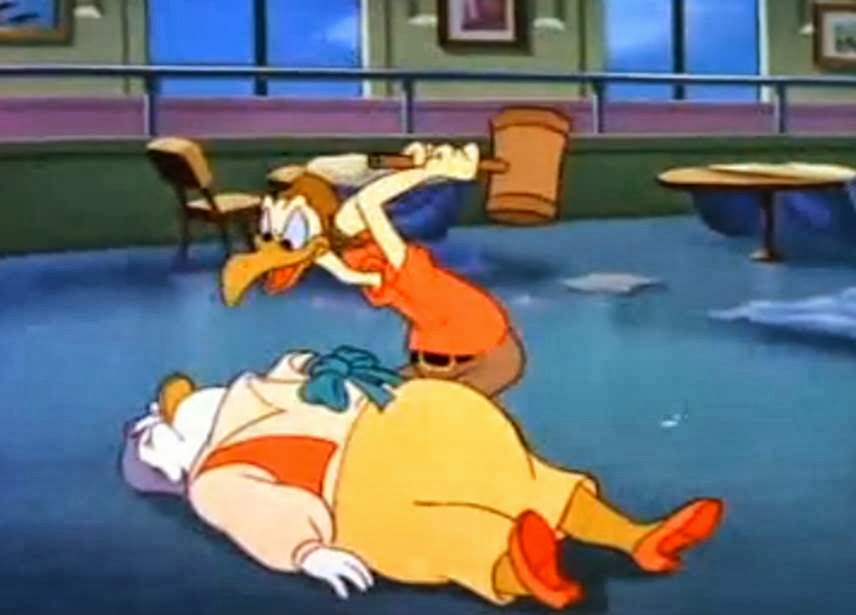
The slightly vague nature of these tribute characters (and poor, generic John D. Rockefeather and Mr. Webworth don't even qualify as vague tributes!) lends credence to the notion that "Hindentanic," like the eternally popular Airplane! (1980), was more attuned to the goofier, more exaggerated iterations of the disaster-movie genre.  Nowadays, films like Airport (1970) and Irwin Allen's The Poseidon Adventure (1972) are routinely lumped in with the likes of Airport 1975 and Allen's The Swarm (1978), but the former two are works of great art compared to the latter two, which begged to be taken seriously but could ultimately only be accepted as unintentional comedies.  The Hindentanic's Airport 1975-style lack of a pilot (once Captain Foghorn bails, that is), Mrs. Beakley's "Roy Rogers counter staff" wardrobe, and, of course, John D. Rockefeather's loosed bees are all clear signs that the "decadent era" of disaster movies was the target here.  That being said, K&W's inclusion of the mallet-wielding "hijackass" who wants to go to London is probably the single most memorable gag of the lot, because it is not instantly recognizable as 70s-inspired and, well, it is just so hilariously unexpected.  I don't recall "Hindentanic" being pulled off the air in the wake of 9/11, so evidently even the would-be "cleansers of potentially offensive imagery" managed to take this scene in the goofy spirit in which it was meant.

While I'm more than happy to give K&W the benefit of the doubt on most "plotular" twists and turns here, I can't ignore the ep's biggest gaffe: HD&L's inexplicable abandonment of their bee-watching post.  This whole sequence, starting with the boys' discovery that the disguised Glomgold has surreptitiously opened the bees' cage (as if they couldn't have gotten out through the mesh easily enough before that), does not appear to have been sufficiently thought through.  Why did HD&L open the door to the luggage compartment in the first place?  And, after they've discovered the truth and kept the bees "locked in," why did they suddenly leave the premises?  Surely all of them didn't need to go to the "little ducklings' room" at the same time?  Even HD&L's obligatory consultations of the Junior Woodchuck Guidebook reflect a certain lack of common sense: couldn't they have figured out how to trap bees and "keep a leaky blimp afloat" all on their own?  And then there's Huey's inability to pronounce "dirigible"...  Some people have complained that HD&L's intelligence level dropped precipitously during DT's second season.  One can argue that point, but the lads are certainly not at their best here.

"Let's get hopping"... yeah, right.

For all of Scrooge's pledges that he won't let Launchpad near the controls of the Hindentanic no matter what, the old miser should have realized that allowing LP to be part of the crew in any capacity wouldn't end well.  Fatalism that the Launchpad of "Top Duck" would have wholeheartedly embraced kicks in as LP accidentally bursts the blimp, Duckworth's attempt to take the controls leads to Poseidon Adventure-style upside-down sky-high hijinks, and the Ducks' efforts to keep the Hindentanic afloat with additional "hot air" quickly go up in smoke.  Scrooge finally bows to the inevitable and gives LP the controls for the final dégringolade, leading to the ep's best exchange:

Launchpad: I won't let you down, Mr. McD!
Scrooge: You'd better... why do you think I'm hiring you?

There follows a dramatic explosion-and-crash sequence that would probably have spelled a real-life finis for any non-Toons on board...

... and the "happy ending" rescue that leaves Scrooge with an unexpected profit, Glomgold with a familiar mad-on, Irwin Mallard with a free movie, Gloria Swansong with a new lease on her professional life, and... well, the viewers with a strange new respect for Captain Foghorn's psychic powers.  (I mean, really: first he knows that the steering mechanism is stuck without testing, or even looking at, the wheel, then he knows exactly where to bring the rescue ship to find the crash victims?  How can one not be impressed by that?)

Interestingly, during its "tribute to DuckTales" phase, kaboom!'s UNCLE $CROOGE title served up a brief morsel of a story that brought back distinct memories of this episode: "Big Blimp in Little Trouble."  It was a serviceable enough story, but the main reaction that it evinced from me was nostalgia for the genuine article.  Would it ever have been possible for a back-in-the-day DuckTales comic-book adaptation to have captured the spirit of "Hindentanic"?  At their best, John Lustig and William Van Horn might have been able to do so, and, if DUCKTALES comics were still being produced today, so might a moonlighting Katie Cook and Andy Price.  The mere fact that I have to invoke such comedic comics talents for such an imagined job tells you all that you need to know about the quality of "Hindentanic."

.

.

.

"DuckBlurbs"

(GeoX) ...you have the mentally incompetent captain [Foghorn] from "Bermuda Triangle Tangle"...

... who, despite that silly sojourn with the steering wheel in hand, does seem to possess a level of self-awareness that he didn't have in that earlier appearance.  "Bailing out" may not have been a brave thing to do, but it's a classic example of the truth of the quip, "I may be crazy, but I'm not stupid."


(GeoX) "I'll make this turkey fly even if it takes all the money in my money bin!" "But sir, turkeys can't fly either!" There's no good reason for me getting as annoyed as I do when people make this mistake, but the fact remains: TURKEYS CAN FLY.  Thank you.

Perhaps K&W should have substituted "white elephant" for "turkey."  That would have made pretty much the same point (since "white elephant" means "valuable but burdensome possession") and allowed for the same type of gag (Duckworth hearing a trumpeting elephant flying overhead).  They aren't the first people to make that mistake about flying turkeys, however.  I did the same thing when I reviewed a LITTLE LULU collection some time ago.

(Greg)  So we head into Scrooge's Money Bin office as Scrooge runs in and puts his cane on the vault door and sits down at his desk which has the oldest golden phone and name plate in history. Man; he is cheap to hire a gold polisher. Scrooge goes to his phone and dials the phone for the Duckb[u]rg Daily News. Scrooge wants to announce the return of the Hindentanic and [we hear] the gobbling on the phone as Scrooge blows it off because he knows turkey[s] cannot fly and orders them to print it. Nice to see Scrooge show that he gets the figure of speech.

But what happened to his phone?


(Greg) This is of course Gloria Swansong...  and she's voiced by Joan Gerber. The Mrs. Beakly voice gives it away. By the way; I also noticed a BS&P decision of using a weird rose in place of the long black smoke pipe. 

Good catch, and a clever SWERVE around the whole smoking issue.

(Greg) So we logically return to Flintheart's office as we pan over to Flint reading the newspaper proclaiming that according to Scrooge; a flight on the Hindentanic will be like a trip back in history. And you know Flint is a little bit of a sadist when he has a picture of Scrooge holding a golden cane and top hat in his office.

Was this some sort of an attempt at continuity with "Duckman of Aquatraz"?  If so, then someone must not have gotten the proverbial memo, both in terms of the appearance of the portrait and its placement in Glomgold's home.

(Greg) Scrooge has a champagne bottle in his hands and tries to break it; but stops and questions Duckworth on the cost of the bottle of alcohol. HAHA! Duckworth calls it the cheapest and that's enough for Scrooge to break it over the ship and it must be red wine because it sure as hell looks like it. Logic break #2 for the episode. I don't think champagne is red in color guys.

Um... and that's what makes it so cheap?  I guess. 

(Greg) [Swansong and Quax] go to Duckworth as she hands the ticket over and Duckworth answers the letter pleading for help because [Mr. Webworth] is having a beak transplant. Wow... I didn't expect them to allow dismemberment in any context in DTVA; but here it is.  

Don't forget the mamluks in the Aladdin series.  For them, dismemberment was one of the common side effects of their profession.

(Greg) John [D. Rockefeather] gives [Duckworth] a yellow ticket (I guess the different colors and styles are for security reasons) and asks if there is trust that the honey bees are safe for this trip. Duckworth states that it will; just don't call him honey. 

Airplane! shout-out!  Rockefeather does not seem to be amused, which makes him one of the very few individuals who has not laughed at the gag being referenced.


(Greg) Farley [Foghorn] of course doesn't know how to pilot an airship and cannot pronounce it properly (Neither can I for that matter) as Farley walks up the stairs. Scrooge sulks on the fact that he made that wager on Flint. 

And, in so doing, he does a most un-Scrooge-McDuck-like thing and appears to break the fourth wall!  I mean, who ELSE would he be speaking to here, apart from the audience?  An unseen Cinnamon Teal?  I don't think so.


Don't worry, Scrooge -- you can't be expected to compete with an expert.

(Greg)  Gloria orders Quax to put Sheik Nurse of Baghdad in the projector at once. And yes; Webworth is a duck by the way as Quax agrees to [it]; reminding Gloria that people walked out over Kansas. I'm sure that they DIED in tears and frustration too. Geez; even this show is mocking suicide over a bad movie. 

Another unexpectedly "dark" reference in this "laugh riot" of an episode.


(Greg) So we head to the cleared dining room as Scrooge walks in and sees Launchpad sweeping the floors in his blue suit. I see he left his web boots at home today. Launchpad doesn't like this job because he has to stoop so low and Scrooge blows him off to stoop lower because he missed a spot. And there is a big dust bunny magically appearing from the floor out of nowhere.

Actually, you can see it when Scrooge first enters the scene: check at lower left.


(Greg) We continue inside the dining room with more running and panicking as the fire continues to burn and Irwin Mallard just keeps on filming. I['m] guessing the finish right now: Scrooge wins the bet on the profits coming from the disaster movie Irwin Mallard shoots in these scenes. I'm calling it right now. 

Evidently, Captain Foghorn isn't the only one around these parts with psychic powers.


(Greg) Now that was a balloon ride filled with old movie parodies and lots of chaos, destruction, terror and even Gloria Swansong's bad acting. Flint turned out to be the better terrorist than the real hijacking terrorist just to make the parody even funn[i]er. 

As I noted above, I don't believe that "Hindentanic" was blackballed due to 9/11, but, if it had been, then Flinty's "Middle Eastern gear" would probably have been the reason.  The getup, and even Glomgold's fake voice, aren't particularly offensive, but the mere juxtaposition of a "Middle Eastern character" with an air disaster might have been enough to tip the scales.  Thankfully, cooler heads appear to have prevailed in this case.


Next: Episode 57, "Dime Enough for Luck."

Sunday, June 30, 2013

Movie Review: MONSTERS UNIVERSITY (Disney/Pixar, 2013)... plus Some "Get Off My Lawn" style grousing about Pop-Culture Predictability

 
Reactions to Disney/Pixar's prequel to the highly successful Monsters Inc. (2001) seem to be falling into three distinct categories:

1.  "Another Pixar Triumph!!!" hosannas from those for whom Pixar has never, and can never, do wrong.

2.  "A Cold-Blooded and Aesthetically Lame Attempt to Cash In!" from disillusioned Pixar fans who are still recovering from the disappointment of Cars 2 and are worried that the huge success Pixar enjoyed with the Toy Story trilogy is leading it in the wrong, overly derivative direction.

3.  "Hey, It's Revenge of the Nerds With Monsters!  Cool!" from casual moviegoers.

I consider myself a Pixar fan, though not a blindly supportive one (I disliked the highly illogical Cars and have no interest whatsoever in seeing either Cars 2 or the upcoming Planes).  Despite the company's high batting average when it comes to the crafting of imaginative, "Heart"-filled movies, I must admit to initially being a little skeptical about the idea of Monsters Inc.'s Mike (Billy Crystal) and Sully (John Goodman) in a "college frat movie" setting, simply because the track record of such movies in the human world is so notoriously mixed (to put it charitably).  I've never been a huge fan of such movies and worried that Monsters University, thanks to the "extreme non-humanness" of the cast, would try to be even more loud, obnoxious, and gross than the norm, perhaps in an attempt to compete with the cruder, more pop-culture-saturated tone of many other recent animated releases (more about those later).  Thankfully, MU eschews cheap laughs for the most part and sticks staunchly to the basics -- character development, the maturation of relationships, and even some sly commentary about social class.  The result is a highly enjoyable film that I found myself liking even more than Monsters Inc.

S
P
O
I
L
E
R
S

The key to the movie's success, I think, lies in the decision to bring Mike and Sully to MU from two different social and psychological worlds.  Mike, who's not really THAT scary on the surface, is the ambitious nerd who seeks to get through the School of Scaring by sheer force of effort and will.  Sully, the shaggy scion of what appears to pass for "nobility" in the monster world, expects to glide through school on the strength of his family name alone -- and we learn rather late in the game that this is an elaborate cover to hide some legitimate insecurity about his own scare-abilities.  The approach ensures that character will take precedence in this narrative, first and foremost, and that we will be full partners in the long, strange (even for a couple of monsters) journey that will end with Mike and Sully as best friends.  All the frat gags and pranks in the world won't be able to obscure those simple facts.  It goes without saying that the casting of Crystal and Sullivan, who clicked so well in the original movie, made the social-class aspects of MU much easier to believe.

Ultimately thrown together in an unwilling alliance with each other -- plus a friendly, much-put-upon fraternity of "geeks and feebs" who hold initiation ceremonies in a member's mother's basement -- Mike and Sully must prove their true mettle in the Scare Games, a fraternity event to determine which society is the scariest.  I was a little nervous when the storyline narrowed down to this pursuit; it reminded me all too much of the contrived X-Games competition in An Extremely Goofy Movie (2000), in which Max and PJ's campus seemed to all but shut down academic activities to focus on extreme sports.  We literally never saw Mike and Sully in class for the entire second half of the movie.  In the case of the Scare Games, however, a version of official sanction was present in the forbidding form of the legendary Dean Hardscrabble (Helen Mirren), so I imagine that the monsters must have gotten co-curricular credit, or something similar, for participating.  The Scare Games proceed as you might expect, and the finish seems eminently predictable, but then the narrative takes a clever swerve that carries us through to a somewhat unexpected, but emotionally satisfying, conclusion.  Suffice it to say that Mike and Sully learn that you can achieve your lifelong ambition -- you just may have to take a different path than you originally anticipated.

The Blue Umbrella, the Pixar short that preceded MU, turned out to be a rarity -- a Pixar short that I found myself disliking intensely.  The "animate inanimate objects fall in love, are separated, yet come back together in a contrived manner" plot has so been done, of course, but what made Umbrella particularly creepy was the fact that EVERYTHING in the city was alive -- drainpipes, walk signals, mailboxes, storefronts, you name it.  Some might call this imaginative and whimsical; I call it something that might give an impressionable kid (the kind of kid who tiptoes past portraits at night because he or she is convinced that the eyes are moving) serious nightmares for weeks. 

.

.

.

Monsters University was, of course, accompanied by a raft of "coming attractions" previews for various 3-D animated projects, some of which looked reasonably good (Despicable Me 2) and some of which... did not (The Smurfs 2, which is probably two too many).  The thing that struck me about all of them was the utter SAMENESS of their approaches.  No matter what sorts of creatures were involved, you saw the same kind of smart-ass humor, the same non-stop references to pop culture, the same wild physical action.  Just as the immense success of The Little Mermaid and Beauty and the Beast locked the "Hollywood Musical" template in place for a decade, the Shrek movies unquestionably inspired the aesthetic directions of many of the subsequent 3-D animated films.  (One could argue that Aladdin anticipated the trend, but that was more of a "Hollywood Musical" with contemporary throw-ins, most of which were confined to the Genie and Iago.)

By my reckoning, the Shrek cycle should have just about run its course.  The problem is that the movie industry is even more aesthetically reactionary now than it was in the late 1980s and 1990s, and so it will take an even bolder creator to buck the play-it-safe mentality.  Even Disney's own 3-D division seems to have joined the herd (though Wreck-it Ralph was certainly a high-quality example of the genre), leaving Pixar as the one 3-D animation factory that seems to be making an effort to keep its output somewhat diverse.  (This, I think, is why Pixar's increased reliance on sequels and prequels has elicited such a negative reaction, even from those who have tended to like the results.) Also tempering the drive for innovation is the fact that, thanks to the omnipresent use of CGI, many of today's "big" movies are, in essence, mixtures of live-action and animation.  This leaves precious little wiggle room for an animated director to produce something truly different from either a bog-standard, Shrek-style smirkfest or an action/adventure film that simply mimics effects-filled live-action fare without the human element.  Among recent releases, The Adventures of Tintin came the closest to splitting this difference, and that movie's disappointing American b.o. is a cause for concern.

The "predictability factor" in animated films is, if possible, even more pronounced in newspaper comic strips.  Nicky and I don't get a daily paper, so I hadn't glanced through a daily comics page for quite some time before perusing the KANSAS CITY STAR at breakfast during the AP Statistics Reading.  Remember the old gags about Ernie Bushmiller preparing his comic strip NANCY using a rubber stamp and a joke book?  Well, reading all of those "badly drawn domestic sitcom strips featuring badly drawn humans and/or sentient animals performing more or less funny verbal gags" made me think that Bushmiller was ahead of his time.  There wasn't a SINGLE truly innovative strip -- and by "innovative," I mean in the narrow sense of simply not BEING one of the aforementioned offerings -- in the bunch.  I knew that newspaper strips were in trouble, but I was unaware as to just how rotten things had gotten.  The vast chasm between these space-fillers and the old strips in the book collections I've been enjoying and blogging about would give even Nik Wallenda pause before he attempted a crossing.

Unlike animated films, newspaper strips are probably not making an aesthetic comeback.  The inability of syndicates to even comprehend a different "universe" is probably inherent at this point. The newspaper industry is in parlous shape (it's hard not to be so when half of the country thinks you're biased against it and the other half is busy texting, tweeting, and so forth), and so the most likely location for outstanding strips in the future will probably be the Internet.  (Indeed, I think so highly of KEVIN AND KELL and DAY BY DAY that I have links to them on my Web site.)  We are more likely to see renewed innovation on the large screen, provided that the creators can negotiate the corporate boardrooms, ethical back alleys, and sociopolitical prejudices that have made it so difficult for modern Hollywood to produce anything truly lasting.

Sunday, September 2, 2012

DUCKTALES RETROSPECTIVE: Episode 8, "Lost Crown of Genghis Khan"


As this RETROSPECTIVE grinds on, I'll occasionally post DuckTales-related findings that I've gleaned from Internet searches.  Today, I'm offering you a DT commercial of exquisite rarity.  Most of us have probably seen the commercials featuring Launchpad ("It's me, Launchpad McQuack!") and Scrooge ("He's the original million-dollar duck..."), plus perhaps the "Lights -- Camera -- DuckTales!" bit with the Beagle Boys.  (If some of you haven't, just let me know and I'll be sure to post them.)  This Webby-focused commercial, by contrast, I have no clear recollection of seeing at all.  I MUST have seen it at some point, but, if so, it was at most once.  It's of canonical significance because it marks only one of two times that Webby's last name, Vanderquack, was ever revealed; the other came during next week's featured episode, "Pearl of Wisdom."  It's curious that the beans were spilled so early in the game but that Webby's cognomen was never referred to in any other episode.  Perhaps the other writers simply forgot to pick up on the hint?


With its adaptation of Carl Barks' 1956 adventure "The Lost Crown of Genghis Khan" -- why the definite article was dropped is a mystery to me, too -- DuckTales replicates its success with "Scrooge's Pet" even as it takes far more liberties with the Barks story than it did with "The Lemming with the Locket."  I agree with GeoX that a number of the alterations are for the better; in fact, I'm willing to go him one better by heartily wishing that we'd seen more of The Explorers' Club, the gaggle of adventure-lovers that are competing with Scrooge to find Khan's fabled diadem in Shadow Pass.  Putting aside antagonist Sir Guy Standforth for the moment, Percival and the never-named "thin explorer with the monocle" might have played the same role in future Explorers' Club stories that Jackson and Finch do in the Egmont TNT stories, with their efforts serving as a comical contrast to Scrooge's during the course of various races for riches.  (Significantly, when we visit the Explorers' Club HQ early in the episode, a line of portraits depicting various adventurous exploits is shown, and Scrooge's is the only one not showing a slapstick "impending disaster" gag.)  Elderly Lord Battmounten appears to have been reduced to the role of "armchair expert" by this time, but he could have advised Scrooge as to the existence of treasures and otherwise served as a genteel kibitzer.  Scrooge has always had more than his share of foes; a group of adult characters who are at worst "friendly rivals" of his would have been a refreshing addition to the stable of supporting players.


This episode also takes a few notable chances by not being afraid to show the characters -- very much including the youngsters -- in legitimate peril.  As well-told as Barks' story was, you never got the feeling that Scrooge, Donald, and the boys were in any real danger; the Himalayan setting was as climatologically benevolent as such a setting can reasonably be expected to be, and the somewhat pathetic appearance and nature of "Gu," the Abominable Snowman who had the crown and imprisoned the Ducks only to be bought off by a ticking watch, made the Ducks' travails in the ice cave seem something a bit South of serious.  In the DuckTales version, by contrast, our gang survives sabotage and a plane crash, then endure a fierce mountain storm and an avalanche... and, in the gender-bended "Snowy"'s frigid subterranean home, Scrooge, Launchpad, and HD&L come within a feather's breadth of freezing to death!  The scene in which LP and the boys face their gelid fate seems more disturbing today than when I first saw it.  The "blue beaks" are a bit of overkill -- we've never seen the Ducks suffer that malady in other stories set in ultra-cold climes -- but the quartet's valiant efforts to stay awake and avoid falling into what might be an eternal sleep are truly nothing to chuckle at. Some real polar explorers, as we know, were not so lucky. 

The lengthy ice-slide sequence that lands LP and HD&L in this predicament is still visually impressive today, but I've come to appreciate the above sequence a lot more.  As feather-raising as the sliding business is, it's all of a piece with a good deal of more or less "conventional" cartoon action, with the only true frisson arising from the presence of children.  It took a lot more guts to show kids on the verge of hypothermia.  I believe that it was Greg who complained at one point that WDTVA seemed unwilling to skin HD&L up in the manner in which Kit Cloudkicker was often imperiled during TaleSpin.  A revisit of this scene might oblige him to do a rethink. 


Earlier in the episode, of course, our heroes aren't in much better shape.  Occasional gags -- Scrooge duplicating Kimba's "man-shake" of "The Day the Sun Went Out" comes immediately to mind -- lighten the mood just enough to make us temporarily forget that the Ducks are stranded in the mountains with few provisions.  Tellingly, one incident that writer Anthony Adams, about whom more later, did preserve from the Barks original involved one of the Nephews shivering with fear.  Remind me again... even if Scrooge DID intend to leave Webby and HD&L behind in the village while he and Launchpad headed for Shadow Pass, why did he bring the kids to the village in the first place?  Wouldn't it have been simpler to have left them in Duckburg?  Perhaps he remembered "Dinosaur Ducks" and figured that he'd be better off if the kids were under his watchful eye at all times, as opposed to being tempted to stow away.  Whatever Scrooge's rationale was, it's safe to say that it blew up right in his face.  He admits as much by deciding to abandon the search for the Crown and get the kids back to safety, only to have those plans fatally disrupted by Sir Guy's TNT-powered avalanche.  Those looking for prima facie evidence that the DT Scrooge is "softer" than Barks' Scrooge should probably make this episode one of their first stops... though the "softness" displayed here is entirely rational.


The substitution of Launchpad for Donald is this ep's third major advantage over Barks' story -- and here, unlike the series of insults that Scrooge shot LP's way during "Scrooge's Pet," the strength of LP's contribution seems as solid today as it did in 1987.  DT fans are well aware of the numerous references to Launchpad as a "ladies' man" during this episode, from the Russian dance that he does for the village females to the quip "Usually, it's the girls chasin' me!" to his ultimate fate of being pursued by the amorous "Snowy" after having rescued the snow beast from a fall off a cliff.  Less noticeable, but just as funny, is LP's stashing of dozens of glossies of himself in the airplane lockers where the parachutes would normally be stored.  That sounds much more like something Darkwing Duck would do.  (Perhaps all of that egotistical "life force" got sucked out of LP during those years of playing sidekick to DW?)  Adams cleverly pairs these examples of exalted self-regard with more than the usual number of situations in which LP makes a mental and physical fool of himself -- banging his head on an airplane wing, forgetting the chutes, plopping face-first into a snow bank.  LP even flirts with "hero hypocrisy" when he teases finking out of the Ducks' search for the missing Webby because he's scared of the as-yet-unseen "Snowy."

As for Sir Guy Standforth, I think that he makes a reasonably solid villain, a claim that is at least partially supported by his successful "return to action" in kaboom!'s DUCKTALES #4.  Sure, Pat Fraley's voice for the character is whiny, but then, you're supposed to dislike this guy.  If I have one complaint, it's that he would probably have seemed a stronger adversary had his villainy not come served with so many Looney Tunes-style trimmings.  Pulling cages of bunnies, sticks of TNT, and badly designed Yeti costumes out from behind one's back make it just a scoche harder to take one completely seriously.

As enjoyable as this version of "Lost Crown" is, a few logical lapses prevent me from awarding it the "Full LP" (you can only get the "Full Monty" when Rescue Rangers eps are involved).  Even with Launchpad operating at less-than-optimal mental capacity, I think that even HE should have been able to see that the gasoline was draining out of the plane -- and I'm truly shocked that none of the other Ducks picked up on it.  It's never made clear why "Snowy" has amassed such a stockpile of gold in addition to the Crown; "Gu" didn't seem to have a need for all that additional bling (quite the opposite, in fact).  Perhaps I should just mumble something vaguely offensive about "women needing accessories" and let it go at that.  Plus, of course, there's the old "attenuated ending" gambit that I really hate.  How on Earth did Scrooge get back to Duckburg quickly enough to literally pursue Sir Guy through the door of the Explorers' Club?  Since Scrooge and Launchpad both appear in this closing scene, are we to assume that the kids were simply left behind to fend for themselves? 

On balance, though, this is a splendid debut for Anthony Adams, who will turn out to be one of the series' most consistently successful writers.  Adams himself appears to be a rather fascinating individual; he's the head of his own entertainment company and has produced several well-received documentaries on the music of the "Summer of Love" and the history of the guitar, has written several TV movies, has produced a couple of feature films, and has composed and performed his own rock operas and musicals, including the oh-so-early-70s concoction excerpted below.  In his scripts for DuckTales, Adams seemed to have a particular predilection for exploring myth and legend.  I suspect that a combination of his personal artistic interests and (I'm purely speculating here) a youthful interest in Barks' Duck comics contributed to this bent.


For whatever reason, starting in 1987, Adams began writing cartoon scripts, but his contributions to series like Popeye and Son and Fraggle Rock were modest indeed compared to his commitment to DuckTales.  After 1989, however, he left the field for good.  A shame; I would have liked to have seen him tackle a Tale Spin episode or two, or perhaps even a Darkwing Duck episode featuring Morgana Macawber.  But I'll be forever grateful for his fanciful and frequently elegant contributions to DuckTales -- and I'm even willing to include THIS notorious scene in the credit column.  Fanciful and elegant it's not, but it's certainly become... um, mythic.


.

.

.

DuckBlurbs

(GeoX)  [T]he ending, where the yeti comes back to the explorers' club with Scrooge [sic; Launchpad] and chases around evil-dude? Egregiously silly, no question about it.

I kinda agree, though for different reasons.  See above.

(GeoX)  [P]ortraying the yeti as a more sympathetic character was definitely a good idea--I thought making him into a her would end up being kinda dumb, but it actually works, and most of the original's condescension is removed. 

I could have done without some of the female stereotyping -- the lips, the rouged cheeks, the skill at cooking (cooking soup in an ice fireplace, though??) -- but "Snowy" is certainly a more memorable snow beast than "Gu."  She bonds with Webby (one can see the "Webby's way with animals" theme taking real shape now) and interacts with the Ducks far more, and in far more varied ways, than did "Gu."

(GeoX)  There's also a lot of good character stuff--as when Scrooge finds the crown, excitedly declares himself "King of the Explorers once again!" and then wilts as he realizes that, having lost his entire party in the process, this is a hollow victory. Finally, there's a very atmospheric night blizzard scene, in which the ducks are sleeping in their tend as the winds howl until they are awakened by the yeti, who they can just make out heading off into the storm.

And this last scene makes me very suspicious of the role that Herge's TINTIN story, "Tintin in Tibet," may have played in Adams' development of this adaptation.  The presence of a "misunderstood" Yeti, the theme of a youngster falling in with the Yeti and being searched for by the heroes, and the central role played by a crashed plane are all suggestive of the fact that Adams may have been aware of Herge's famous story... and the blizzard scenes featuring "Snowy" are exceptionally suggestive.  I couldn't make a really good screen grab from "Lost Crown" to show "Snowy" trudging away after having pillaged the Ducks' camp, but here are several scenes from the animated version of "Tintin in Tibet" that may look somewhat familiar:

Need I point out (since Greg already did) that "Snowy" is the English translation of the name of Tintin's dog?  Very suggestive, ver-r-r-r-r-y suggestive.

(GeoX)  The persistence of Scrooge's anger at the yeti is somewhat inexplicable.

Not to me.  Scrooge was probably feeling guilty for bringing the kids with him, so it's entirely understandable that the pendulum has now swung in the opposite direction and he's being overprotective to a fault.

(Greg)  Launchpad goes over to Snowy and Snowy grabs his hand and of course she's just TOO FAT. However; Launchpad manages to do the old wrestling flip over his head and manages to get Snowy up over and landing safely. Now THAT is an amazing feat of strength on par with Kit getting Baloo up in L[a]st Horizons from LP there.

Yep, that was pretty amazing, almost on a par with Bubba Duck heaving Tootsie over his head and into the "Millennium Shortcut" at the close of "Marking Time."   It's almost enough to cancel out the egotism and stumble-bumble-itis from the earlier part of the episode.  Almost. 

Next:  Episode 9, "Pearl of Wisdom."