Showing posts with label Little Lulu. Show all posts

Saturday, December 27, 2014

Book Review: FUNNYBOOKS by Michael Barrier (University of California Press, 2014)

What Michael Barrier did for the history of classic Hollywood studio animation in HOLLYWOOD CARTOONS, he does here for the golden years of Dell Comics and its most accomplished and historically significant creators -- Walt Kelly, John Stanley, and, above all, Carl Barks.  While devoting most of his critical attention to this trio of greats and the ways in which they helped shape the development of the American comic book into an art form with its own distinct verbal and visual language, Barrier also unearths facts and highlights overlooked personalities in a manner that is sure to surprise and delight even the most knowledgeable Dell/Western Publishing fan.

As was the case with HOLLYWOOD CARTOONS, FUNNYBOOKS had an extremely long gestation period, with Barrier using interview material from as far back as the 1960s to help craft his narrative.  Barrier also draws upon material used in his 1981 book-length study of Carl Barks, but he expands greatly upon that earlier work.  Perhaps his most important critical achievement here is his in-depth illumination of exactly how Barks, who famously worked in isolation and with minimal (at first) editorial interference, became one of the very first comics creators to "crack the code" and essentially discover how to tell effective stories in comic-book form.  Barks fans have always known of the Old Duck Man's mastery of narrative, but they will come away from this discussion with a newfound appreciation of the wider importance of his work.

Barrier pretty clearly considers Barks to be primus inter pares even among the "really good ones," but Kelly and Stanley get their due and then some.  Kelly's creation and development of the POGO characters is covered in detail, as is Stanley's work on LITTLE LULU, but Barrier brings their other notable comic-book works (e.g., Kelly's stories for OUR GANG and his fairy-tale and Christmas comics, Stanley's honing of his craft in NEW FUNNIES) under similar critical scrutiny.  As was made quite clear in HOLLYWOOD CARTOONS, Barrier is a very astringent analyst, and it takes quite a lot for a story to wring praise out of him.  Everyone who knows these creators will probably disagree with Barrier's assessments at some point -- for example, I think that he is much too harsh on Barks' more loosely-wound, but still immensely entertaining, UNCLE $CROOGE stories from the 1960s -- but he always has a well-considered reason for his opinions.

The "extra material" here is what really lifts FUNNYBOOKS to "instant classic" status.  Anyone who has ever wondered about the precise relationships between the various corporate subsidiaries and allies grouped under the spreadeagled "Western Publishing" umbrella -- Whitman, K.K. Publications, Dell, Gold Key -- will have any and all questions answered to their satisfaction here.  Interested in the early history of LOONEY TUNES AND MERRIE MELODIES, the Warner Bros. "answer" to WALT DISNEY'S COMICS AND STORIES, or in how Dell handled such significant "non-funny-animal" licensed properties as TARZAN and various movie cowboy heroes?  You'll learn about some of these comics' most accomplished writers and artists here.  Perhaps the biggest surprise is a brief discussion of "the Jim Davis shop," an association of artists who produced "funny-animal" challenges, of a sort, to Dell's humorous hegemony for the notorious comics entrepreneur Benjamin Sangor.  It's nice to see the exquisitely obscure characters that came out of this outfit get some recognition, even if Barrier's primary purpose for bringing them up is to demonstrate how their comics failed while the best of Dell's succeeded.

If I have a small nitpick here, it is with Barrier's comparatively brusque brushing-aside of the Gold Key era.  Yes, that era did see ill-considered format and price changes and increasing editorial restrictions, but there was a whole lot of high-quality material being produced at that time, as well.  (See Joe Torcivia's 50th Anniversary tribute for numerous examples.)  I fully realize that Barrier's intention was always to focus on the years before the Dell/Western split, but a few extra pages discussing some of the GK highlights couldn't have hurt.  Anyone want to pick up the bracketed torch (as opposed to fallen; it's not as if Barrier failed, after all) and try writing a sequel?

So, what are you waiting for?  If you care at all about the Dell Comics that truly WERE "Good Comics," or simply about the history of quality comics in general, FUNNYBOOKS virtually defines the term "MUST-GET."

Friday, September 27, 2013

DUCKTALES RETROSPECTIVE: Episode 56, "The Uncrashable Hindentanic"

When it comes to out-and-out, no-holds-barred, no-messages-in-the-mix, fun-first DuckTales episodes, "The Uncrashable Hindentanic" is the unquestioned champion and probably will always be regarded as such.  "Scroogerello" and "Double-O-Duck" previously brought roughly comparable "levels of funny" to Duckburg, but those episodes could be considered special cases: a fantasy setting in the former, a single-character showcase in the latter.  In "Hindentanic," by contrast, the majority of the main cast gets to participate in a showy, guffaw-filled spoof that takes place solidly within an established Duck context -- in the case, the eternal "battle of bucks" between Scrooge and Flintheart Glomgold.

As they did in "Double-O-Duck," writers Ken Koonce and David Weimers manage to do the little things right here.  Their numerous pop-culture references treat the audience with respect and do not intrude upon the larger narrative (what there is of one, anyway).  They eschew facile moralizing (oh, there's a line or two about Scrooge ruing his initial decision to "gamble" with Glomgold, but that's strictly a throwaway bit) and stick doggedly to the task of making the viewers laugh.  The pacing is brisk, the lines (including the "so-bad-they're-good" ones) clever, and, despite all of the zaniness, there are only a small handful of plot points that could legitimately be criticized on a strictly logical basis.  They even manage to toss some surprisingly scary moments into the mix, though you have to be paying attention in order to fully appreciate them.  Watching this tale unspool makes one wonder all the more why Koonce and Wiemers, who could be so "on" in their best moments, could slip so badly off the beam in eps like "Down and Out in Duckburg" and "The Right Duck."  My own theory is that K&W began to flounder when they tried to force morals and/or extraneous gags into their scripts in an unnatural or clumsy fashion.  In terms of tone, "Hindentanic" is about as far from K&W's earlier gem "Hero for Hire" as could be imagined, but I think that both episodes possess the signal virtue of devotion to first principles. 

Perhaps Glomgold would have thought better of challenging Scrooge to "make money off of anything" had he realized that Scrooge somehow managed to sell the citizens of Duckburg "toys" (the old tires) that they could just as easily have procured themselves or picked up off the nearest junkpile.  Actually, rather than laughing at Scrooge for taking on the task of renovating the Hindentanic, Flinty should probably be looking at himself in the mirror and asking why HE hadn't tried doing that himself, since he had presumably possessed the contract for some time.  Someone watching this episode "cold" could perhaps be forgiven for not realizing that Glomgold is every bit the aggressive entrepreneur that Scrooge is.  How else could Flinty have gotten to be the world's second-richest Duck in the second... er, first place?

As for Greg's point that Scrooge seemingly forgot his earlier activities as "a gambling man," let's run down the existing evidence:

(1)  The money-piling contest in "Catch as Cash Can," like the similar duel in Carl Barks' "The Money Champ," did not involve any monetary betting (though I wouldn't have been surprised if the Duckburgian kibitzers watching the piling had made a few friendly wagers amongst themselves).  The only bet seen in either of these two adventures was Flinty's agreement to "eat Scrooge's top hat" if he lost in "The Money Champ."

(2)  The bet in "Wrongway in Ronguay" involved a similar ingestion of headgear (Glomgold's tam, this time).

(3)  There was no evidence that Scrooge and Glomgold placed any actual bets on the Kenducky Derby during "Horse Scents"; they were simply competing for the prize money that would go to the owner of the winning horse.

(4)  Scrooge's gambling at cards at Dangerous Dan's honkytonk during "Back to the Klondike" (Hah! Did you forget about that one?) was what Hergé of TINTIN fame might have termed "les péchés de jeunesse" (the sins of youth), and "The Goose Egg Nugget" was probably worth less than $1 million anyway.

I think we all would agree that Scrooge's wager on the outcome of the Hindentanic project is by far the largest monetary gamble that Scrooge has essayed to date.  In that sense, Scrooge truly is a "gambling man" here in a way that he never has been before, at least in a DT context.

True to his frugal nature, Scrooge eschews hiring outside workers and enlists his family to help him fix up the Hindentanic.  (Where was Webby during all this, I wonder?)  It's a fun little exercise to compare the Ducks' diligent activities here to those of the Cutie Mark Crusaders when they fix up their parade float in the My Little Pony: Friendship is Magic episode "One Bad Apple."  I actually think that the CMC's effort is just as impressive: they do their job overnight, do not have the assistance of adults (not to mention fingers and thumbs!), and sabotage their handiwork at the same time that they are completing it!  Sure, the Hindentanic was much bigger than the Golden Apple Float, but the CMC were working from a skimpier infrastructure.  Judge for yourself...


The "christening" and "all aboard" sequences, in which we are introduced to our cast of stereotyped passengers, may go on a bit too long for some folks' tastes -- cutting as they do into the time allotted for the Hindentanic's fateful flight -- but they're squarely in the tradition of the 1970s disaster movies that are the focus of parody here.  They also provide the tantalizing hint that, despite the director's credit being given to David Block, Terence Harrison just might have had a hand in putting this ep together.  The "jerk and jolt" animation during the christening scene has a definite Harrison-esque "vibe" to it...

... as does Scrooge's decidedly un-thrilled reaction to the appearance of skywriting Launchpad.

"Jerking and jolting" also combine to make Launchpad's "first crash" (at least in this episode) surprisingly violent, even by his standards.  The doomed plane bounces several times, shedding parts all the while, before settling into a pile of mashed metal, and the short time duration between the bounces is a little startling to the viewer.  If LP were ever fated to actually be injured in a crash, then this would probably have been the one that would have done the job.

Launchpad literally "pops" back into form with his out-of-nowhere Casablanca riff, which, in terms of imitating Humphrey Bogart's actual mannerisms (including Terry McGovern's voicing), is far more exaggerated that what we saw at the end of "Double-O-Duck."  Needless to say, the overplaying works well in this particular context.  (And, GeoX, regarding the "play it again [sic], Sam" error, at least this episode is in some pretty distinguished company in that regard.)

The episode's animation snaps back into a relatively conventional style once the Hindentanic gets off the ground, leaving some intriguing "behind the scenes" questions lingering in its wake.

Of course, "the great Gloria Swansong" is by far the most memorable of the visiting players here.  Koonce and Weimers not only show considerable confidence in the ability of the viewers to recognize that Swansong and her porcine retainer Quax were spoofs of the Norman Desmond and Max characters from Sunset Blvd. (1950), but also showcase a fairly deep knowledge of arcane movie trivia by making Swansong's long-awaited "comeback" movie a disaster flickGloria Swanson had not made a theatrical movie since 1956 before agreeing to appear in Airport 1975 (1974) as, quite literally, herself.  The only explanation that I've ever seen for this decision was Swanson's announced desire to appear in an "old-fashioned family movie" of which she didn't have to be ashamed.  Well, there are different kinds of shame, as those who have seen Airport 1975 are well aware.

Compared to Swansong, the other celebrity parodies who board the blimp are relatively casual in nature, with no serious attempt being made to render the parodies in an accurate manner.  "Generic film director" Irwin Mallard and "bespectacled nerd scientist" Carl Sagander bear no real resemblance whatsoever to their real-life counterparts, apart from their professions and Sagander's constantly-evoked "billions and billions" catchphrase...

... while we don't even get a clear idea of what sort of critter Burt Quackarach is supposed to be.  (GeoX speculates that he's a parrot or a turtle; Joe and I always figured that he was meant to be a "lounge lizard.")  At least Koonce and Wiemers acknowledge the inspiration for Quackarach in an indirect manner; apart from his brief riff on "Light My Fire," all of Burt's little tunelets are swiped from Hal David and Burt Bacharach songs.

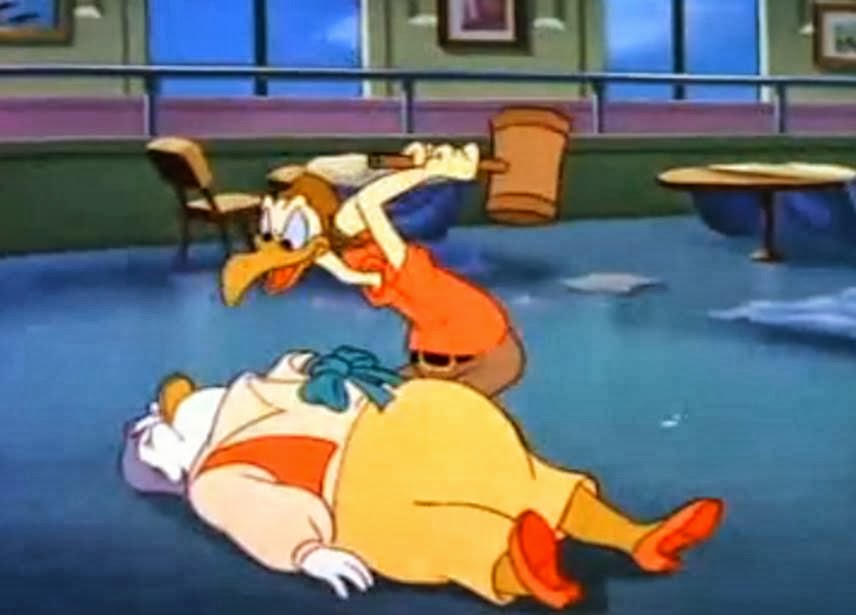
The slightly vague nature of these tribute characters (and poor, generic John D. Rockefeather and Mr. Webworth don't even qualify as vague tributes!) lends credence to the notion that "Hindentanic," like the eternally popular Airplane! (1980), was more attuned to the goofier, more exaggerated iterations of the disaster-movie genre.  Nowadays, films like Airport (1970) and Irwin Allen's The Poseidon Adventure (1972) are routinely lumped in with the likes of Airport 1975 and Allen's The Swarm (1978), but the former two are works of great art compared to the latter two, which begged to be taken seriously but could ultimately only be accepted as unintentional comedies.  The Hindentanic's Airport 1975-style lack of a pilot (once Captain Foghorn bails, that is), Mrs. Beakley's "Roy Rogers counter staff" wardrobe, and, of course, John D. Rockefeather's loosed bees are all clear signs that the "decadent era" of disaster movies was the target here.  That being said, K&W's inclusion of the mallet-wielding "hijackass" who wants to go to London is probably the single most memorable gag of the lot, because it is not instantly recognizable as 70s-inspired and, well, it is just so hilariously unexpected.  I don't recall "Hindentanic" being pulled off the air in the wake of 9/11, so evidently even the would-be "cleansers of potentially offensive imagery" managed to take this scene in the goofy spirit in which it was meant.

While I'm more than happy to give K&W the benefit of the doubt on most "plotular" twists and turns here, I can't ignore the ep's biggest gaffe: HD&L's inexplicable abandonment of their bee-watching post.  This whole sequence, starting with the boys' discovery that the disguised Glomgold has surreptitiously opened the bees' cage (as if they couldn't have gotten out through the mesh easily enough before that), does not appear to have been sufficiently thought through.  Why did HD&L open the door to the luggage compartment in the first place?  And, after they've discovered the truth and kept the bees "locked in," why did they suddenly leave the premises?  Surely all of them didn't need to go to the "little ducklings' room" at the same time?  Even HD&L's obligatory consultations of the Junior Woodchuck Guidebook reflect a certain lack of common sense: couldn't they have figured out how to trap bees and "keep a leaky blimp afloat" all on their own?  And then there's Huey's inability to pronounce "dirigible"...  Some people have complained that HD&L's intelligence level dropped precipitously during DT's second season.  One can argue that point, but the lads are certainly not at their best here.

"Let's get hopping"... yeah, right.

For all of Scrooge's pledges that he won't let Launchpad near the controls of the Hindentanic no matter what, the old miser should have realized that allowing LP to be part of the crew in any capacity wouldn't end well.  Fatalism that the Launchpad of "Top Duck" would have wholeheartedly embraced kicks in as LP accidentally bursts the blimp, Duckworth's attempt to take the controls leads to Poseidon Adventure-style upside-down sky-high hijinks, and the Ducks' efforts to keep the Hindentanic afloat with additional "hot air" quickly go up in smoke.  Scrooge finally bows to the inevitable and gives LP the controls for the final dégringolade, leading to the ep's best exchange:

Launchpad: I won't let you down, Mr. McD!
Scrooge: You'd better... why do you think I'm hiring you?

There follows a dramatic explosion-and-crash sequence that would probably have spelled a real-life finis for any non-Toons on board...

... and the "happy ending" rescue that leaves Scrooge with an unexpected profit, Glomgold with a familiar mad-on, Irwin Mallard with a free movie, Gloria Swansong with a new lease on her professional life, and... well, the viewers with a strange new respect for Captain Foghorn's psychic powers.  (I mean, really: first he knows that the steering mechanism is stuck without testing, or even looking at, the wheel, then he knows exactly where to bring the rescue ship to find the crash victims?  How can one not be impressed by that?)

Interestingly, during its "tribute to DuckTales" phase, kaboom!'s UNCLE $CROOGE title served up a brief morsel of a story that brought back distinct memories of this episode: "Big Blimp in Little Trouble."  It was a serviceable enough story, but the main reaction that it evinced from me was nostalgia for the genuine article.  Would it ever have been possible for a back-in-the-day DuckTales comic-book adaptation to have captured the spirit of "Hindentanic"?  At their best, John Lustig and William Van Horn might have been able to do so, and, if DUCKTALES comics were still being produced today, so might a moonlighting Katie Cook and Andy Price.  The mere fact that I have to invoke such comedic comics talents for such an imagined job tells you all that you need to know about the quality of "Hindentanic."

.

.

.

"DuckBlurbs"

(GeoX) ...you have the mentally incompetent captain [Foghorn] from "Bermuda Triangle Tangle"...

... who, despite that silly sojourn with the steering wheel in hand, does seem to possess a level of self-awareness that he didn't have in that earlier appearance.  "Bailing out" may not have been a brave thing to do, but it's a classic example of the truth of the quip, "I may be crazy, but I'm not stupid."


(GeoX) "I'll make this turkey fly even if it takes all the money in my money bin!" "But sir, turkeys can't fly either!" There's no good reason for me getting as annoyed as I do when people make this mistake, but the fact remains: TURKEYS CAN FLY.  Thank you.

Perhaps K&W should have substituted "white elephant" for "turkey."  That would have made pretty much the same point (since "white elephant" means "valuable but burdensome possession") and allowed for the same type of gag (Duckworth hearing a trumpeting elephant flying overhead).  They aren't the first people to make that mistake about flying turkeys, however.  I did the same thing when I reviewed a LITTLE LULU collection some time ago.

(Greg)  So we head into Scrooge's Money Bin office as Scrooge runs in and puts his cane on the vault door and sits down at his desk which has the oldest golden phone and name plate in history. Man; he is cheap to hire a gold polisher. Scrooge goes to his phone and dials the phone for the Duckb[u]rg Daily News. Scrooge wants to announce the return of the Hindentanic and [we hear] the gobbling on the phone as Scrooge blows it off because he knows turkey[s] cannot fly and orders them to print it. Nice to see Scrooge show that he gets the figure of speech.

But what happened to his phone?


(Greg) This is of course Gloria Swansong...  and she's voiced by Joan Gerber. The Mrs. Beakly voice gives it away. By the way; I also noticed a BS&P decision of using a weird rose in place of the long black smoke pipe. 

Good catch, and a clever SWERVE around the whole smoking issue.

(Greg) So we logically return to Flintheart's office as we pan over to Flint reading the newspaper proclaiming that according to Scrooge; a flight on the Hindentanic will be like a trip back in history. And you know Flint is a little bit of a sadist when he has a picture of Scrooge holding a golden cane and top hat in his office.

Was this some sort of an attempt at continuity with "Duckman of Aquatraz"?  If so, then someone must not have gotten the proverbial memo, both in terms of the appearance of the portrait and its placement in Glomgold's home.

(Greg) Scrooge has a champagne bottle in his hands and tries to break it; but stops and questions Duckworth on the cost of the bottle of alcohol. HAHA! Duckworth calls it the cheapest and that's enough for Scrooge to break it over the ship and it must be red wine because it sure as hell looks like it. Logic break #2 for the episode. I don't think champagne is red in color guys.

Um... and that's what makes it so cheap?  I guess. 

(Greg) [Swansong and Quax] go to Duckworth as she hands the ticket over and Duckworth answers the letter pleading for help because [Mr. Webworth] is having a beak transplant. Wow... I didn't expect them to allow dismemberment in any context in DTVA; but here it is.  

Don't forget the mamluks in the Aladdin seriesFor them, dismemberment was one of the common side effects of their profession.

(Greg) John [D. Rockefeather] gives [Duckworth] a yellow ticket (I guess the different colors and styles are for security reasons) and asks if there is trust that the honey bees are safe for this trip. Duckworth states that it will; just don't call him honey. 

Airplane! shout-out!  Rockefeather does not seem to be amused, which makes him one of the very few individuals who has not laughed at the gag being referenced.


(Greg) Farley [Foghorn] of course doesn't know how to pilot an airship and cannot pronounce it properly (Neither can I for that matter) as Farley walks up the stairs. Scrooge sulks on the fact that he made that wager on Flint. 

And, in so doing, he does a most un-Scrooge-McDuck-like thing and appears to break the fourth wall!  I mean, who ELSE would he be speaking to here, apart from the audience?  An unseen Cinnamon Teal?  I don't think so.


Don't worry, Scrooge -- you can't be expected to compete with an expert.

(Greg)  Gloria orders Quax to put Sheik Nurse of Baghdad in the projector at once. And yes; Webworth is a duck by the way as Quax agrees to [it]; reminding Gloria that people walked out over Kansas. I'm sure that they DIED in tears and frustration too. Geez; even this show is mocking suicide over a bad movie. 

Another unexpectedly "dark" reference in this "laugh riot" of an episode.


(Greg) So we head to the cleared dining room as Scrooge walks in and sees Launchpad sweeping the floors in his blue suit. I see he left his web boots at home today. Launchpad doesn't like this job because he has to stoop so low and Scrooge blows him off to stoop lower because he missed a spot. And there is a big dust bunny magically appearing from the floor out of nowhere.

Actually, you can see it when Scrooge first enters the scene: check at lower left.


(Greg) We continue inside the dining room with more running and panicking as the fire continues to burn and Irwin Mallard just keeps on filming. I['m] guessing the finish right now: Scrooge wins the bet on the profits coming from the disaster movie Irwin Mallard shoots in these scenes. I'm calling it right now. 

Evidently, Captain Foghorn isn't the only one around these parts with psychic powers.


(Greg) Now that was a balloon ride filled with old movie parodies and lots of chaos, destruction, terror and even Gloria Swansong's bad acting. Flint turned out to be the better terrorist than the real hijacking terrorist just to make the parody even funn[i]er. 

As I noted above, I don't believe that "Hindentanic" was blackballed due to 9/11, but, if it had been, then Flinty's "Middle Eastern gear" would probably have been the reason.  The getup, and even Glomgold's fake voice, aren't particularly offensive, but the mere juxtaposition of a "Middle Eastern character" with an air disaster might have been enough to tip the scales.  Thankfully, cooler heads appear to have prevailed in this case.


Next: Episode 57, "Dime Enough for Luck."

Friday, July 5, 2013

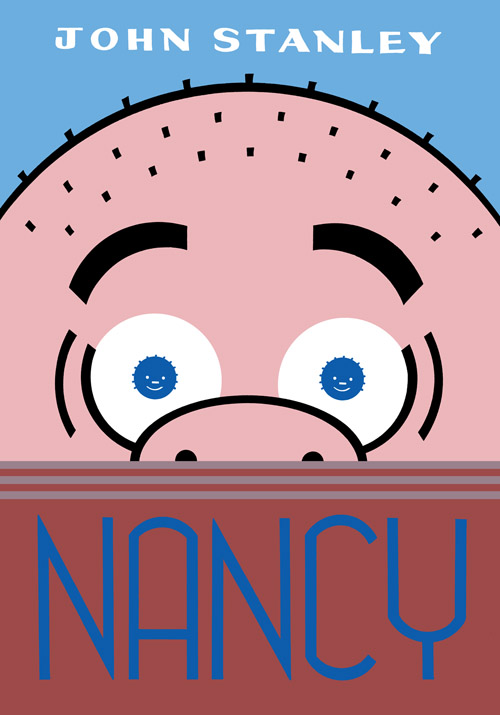
Book Review: THE JOHN STANLEY LIBRARY: NANCY, VOLUME 4 by John Stanley and Dan Gormley (Drawn & Quarterly, 2013)

D&Q's STANLEY LIBRARY series must be getting pretty close to winding down; MELVIN MONSTER wrapped up some time ago, and this volume is the last in the NANCY series.  NANCY VOL. 4 covers issues #174-177 (1960) of the Dell NANCY title, and it's pretty clear at this point that Stanley is engaged in the creative equivalent of punching the time clock with these characters -- and when I say "punch," I literally mean "punch."  There is a mean edge to a number of these short tales that even the sharpest stories in the LITTLE LULU drawer cannot match.  NANCY's "nasty rich kid" character Rollo Haveall doesn't just play pranks on Nancy and Sluggo, he does things like throw hundreds of pies at Nancy while the latter is stuck in an expensive vase at the Haveall mansion.  (No prizes for guessing what happens to the vase.)  Nancy's resentment of her weird friend Oona Goosepimple gets more and more transparent as time goes on, even though it is clear that Oona really does appreciate Nancy's friendship, in her own twisted way.  Nancy screws up her Aunt Fritzi's dates with scarcely a note of regret.  And so on.  The stories are still quite fun to read, but you'll have a tough time identifying someone to "root for" here.  From Stanley's increasingly sour perspective, perhaps that was the whole point.

Sunday, October 30, 2011

Book Review: THE JOHN STANLEY LIBRARY: NANCY, VOLUME 3 by John Stanley and Dan Gormley (Drawn & Quarterly, 2011)

John Stanley continues to exude a sense of "liberation" in these stories from Dell NANCY #170-173. Evidently attempting to make a point, he leads off each issue with a wildly fanciful story in which Nancy, despite her own best efforts, is forced to brave bizarre perils in her friend Wednesday Addams', um, Oona Goosepimple's creepy mansion. This is the sort of stuff that Stanley had previously been obliged to run only in the backs of his issues of LITTLE LULU, plus a handful of issues of the TUBBY title. The weirdness seems to leach into other stories, as well; Nancy and Sluggo play ring-toss with hula hoops and a flag pole in #171's "The Hulahoops," Nancy's cat and bully Spike's dog converse with each other (in thought balloons, to be sure) in #173's "The Kitty's Collar," and a teeth-grindingly self-pitying Nancy literally clads herself in "sackcloth and ashes" in an effort to move an unyielding Aunt Fritzi in #170's "Nancy and the Cold Dinner." There is a zaniness here that many of the later issues of LITTLE LULU conspicuously lacked. Great fun, especially for those who've ever nodded their way through a series of Ernie Bushmiller's stultifying comic-strip gags.

Saturday, October 8, 2011

Book Review: THE SUGAR AND SPIKE ARCHIVES, VOLUME 1 by Sheldon Mayer (2011, DC Comics)

Every so often, I make a "Why Not?" purchase at the comics store, based on both curiosity and some faint inkling as to the nature of the item being considered. This is my latest such buy, and one of my very best, I'd say. Apparently, some DC fans who've been waiting impatiently for the company to get around to reprinting Sheldon Mayer's fanciful series starring a pair of simpatico toddlers are quite miffed that DC decided to do so in the pricey "Archive" format. I can certainly sympathize, but I didn't recoil at the price tag. From what little I knew about SUGAR AND SPIKE, I was fairly sure that I was going to like it. I just didn't realize how truly enjoyable it would be.

Like PEANUTS, LITTLE LULU, and DENNIS THE MENACE, SUGAR AND SPIKE is a deceptively simple "kids' strip" in a deceptively benign setting. Little Sugar Plumm and Cecil "Spike" Wilson, like the kids in PEANUTS, appear to be eloquent beyond their years, but there's a catch; the "baby talk" in which they converse, helpfully translated for us by Mayer, is essentially a private language, one which turns out to be shared by babies of all sorts and species. This is a clever mingling of the real and fantasy worlds on a par with Charles Schulz' creation of the Snoopy-centered "parallel universe" in PEANUTS, with the difference being that the kids themselves fashion the fantasy element. This gives such mundane "adventures" as taking a trip to Grandma's or the zoo, or learning how light switches and mirrors "work," an extra dollop of intrigue. Mayer also starts out in the PEANUTS mode, or somewhere near there, by only showing the kids' well-meaning but (from the kids' perspective, anyway) clueless parents from the waist down and never showing their faces, but he soon changes that policy, which I think was a wise move. Trying to manufacture stories starring toddlers without getting the parents "completely" involved on occasion would have been far too confining a creative format.

SUGAR AND SPIKE has been described, not inaccurately, as a 1950s version of Rugrats -- to which I would quickly add, "with much better artwork." Actually, this last is anything but a minor point, as anyone familiar with Mayer's earlier artwork for such features as SCRIBBLY would agree. Mayer's style on SCRIBBLY -- and the backup feature LITTUL (sic) SNOONY in SUGAR AND SPIKE #1 (April-May 1956), which would never appear again (how did DC get around those persnickety postal regulations, I wonder?) -- could best be described as "Rough and Ready Urban," full of lumpy, rough-edged-yet-lovable denizens of the lower middle class. To be honest, it is unlikely that such a 1940s-esque style would have sustained SUGAR AND SPIKE if it had been used for the adventures of the suburbanite title characters. Instead, from the very beginning, Mayer's work on SUGAR AND SPIKE is slick and stylized. The kids start out a bit on the tall side before assuming the squat fireplug shape that they would keep for the duration of the series (and which Mayer undoubtedly found easier to draw and work into scenes).

In terms of scripting, I don't think that Mayer's imagination fully kicks in until the later stories in this volume (which reprints the contents of SUGAR AND SPIKE #1-#10). Early in the game, Mayer apparently got a lot of ideas from his own young children; in this respect, he was the exact opposite of John Stanley, who insisted that his kids gave him no story ideas of any kind for LITTLE LULU. The result of this, though, is that many of the early S&S stories, while funny enough, hew pretty closely to the "cute kids getting into innocuous trouble" template. As Mayer becomes more comfortable with the characters, however, some of the more charming aspects of Sugar and Spike's "child logic" come to the fore. Thus, Sugar describes the appearance of the kids in a mirror by exclaiming, "There's again of us!", and the duo figure that there's lots of sand on the beach because, like the sand in the kids' sandboxes, it must have followed its "owners" there. I expect that we'll be seeing a lot more of this kind of thing in the stories to come.

I don't think that one can overemphasize the importance of the creator-fan connection in explaining how this title managed to brave all the vagaries of the Silver Age and last until 1971. (Even then, SUGAR AND SPIKE was only cancelled because Mayer, who insisted on doing all of the stories himself, was having severe eye trouble.) In the 1950s and early 1960s, at a company like DC, taking such initiatives as giving readers credit for story ideas and allowing them to design wardrobes for the kids was legitimately meaningful. I've little doubt that Mayer's long and distinguished career as a DC editor and talent-groomer was the main reason for him being given the privilege of signing his work; for Mayer to "give back" in the way that he did is a credit to him.

I'll definitely be on board for as long as this particular series lasts -- and, if you like high-quality humor comics, then I'd suggest that you clamber on as well.

Thursday, September 15, 2011

Comics Review: TUBBY: THE ATOMIC VIOLIN AND OTHER STORIES by John Stanley and Lloyd White (2011, Dark Horse)

I'm cleaning up a few loose ends here, as I wait for the bugs in my new computer (and have there ever been bugs -- verily, they are the size of pigeons!!) to be worked out. I sense a little bit of weariness in this newest collection of stories from the 1950s TUBBY title, a little less willingness to go far afield from the templates of the "typical" LITTLE LULU stories. Stanley's resorting to dream-dodges to explain a few of the more fanciful tales is actually rather disappointing. This collection also features more appearances by Iggy's "comically senile" Gran'pa Feeb, the first LITTLE LULU character whom I can say that I actively dislike. Joshing forgetful seniors is a staple of comedy from way back, of course, but the conceit seems a little more distasteful in an era in which we know more about the ravages of Alzheimer's disease. The ALVIN backup stories begin to include more dialogue, and there's an anticipation of the JUDY JR. tales from THIRTEEN GOING ON EIGHTEEN in the battles of wits between Alvin and a little girl named Kathy. These stories, however, are more palatable, less cruel, and give Alvin more interesting things to do than are his standard wont in LULU stories.

Apropos of the book's credits, I wish that someone would explain to me how Lloyd White "finished" Stanley's stories. I understand Stanley's partnership with Irving Tripp, but what made White's participation different enough that a different word had to be used? Here's where I miss ancillary commentary in these volumes...

Friday, September 9, 2011

Comics Review: LITTLE LULU, VOLUME 27: THE PRIZE WINNER AND OTHER STORIES by John Stanley and Irving Tripp (Dark Horse, 2011)

My home computer has pretty much died, so I'm posting this latest review from Stevenson's super-soggy Greenspring campus, aka "Seattle East." (At least the forecast for tomorrow -- and SU's first home football game -- is promising.) My new Kimba post will probably be delayed for a bit until we can get the new home machine set up. I'll still try to post the promised football report using Nicky's laptop, though.

Dark Horse is now combing the corpus of John Stanley's "miscellaneous" LITTLE LULU work. This latest volume collects the entirety of two Dell Giants from 1957, LITTLE LULU AND TUBBY AT SUMMER CAMP and LITTLE LULU AND TUBBY HALLOWEEN FUN. You can read and view much more about the former of these hefty quarter-dollar mags here, and I suggest that you do, since SUMMER CAMP hangs together a lot better than does HALLOWEEN FUN. The structure of Stanley's signature chain of short features is relatively predictable -- kids get ready for camp, kids go to camp and meet new kids, kids scheme and have (mis)adventures, kids go home -- and there's no psychological quirkiness to wade through on the order of Charlie Brown developing a baseball-like rash on his head and becoming "Mr. Sack" or the PEANUTS gang visiting a weird camp for "born-agains," as they did in 1980. The little tales and vignettes link together quite nicely, however, and the sense of completing a satisfying whole is palpable. HALLOWEEN FUN is a bit more erratic; since there are only so many tales you can tell about getting costumes, cadging candy, and holding Halloween parties, we get a few Witch Hazel stories thrown in here and there to help "make weight." One of these last is a rather strained explanation of how Lulu's "poor little girl" character accidentally devised the name of the Halloween holiday. Suffice it to say that it's a surefire groan-inducer. The climactic Halloween-party story, though, is Stanley at his web-weaving best, combining several plots and subplots in a way that leaves you marveling (not to mention smiling) at the end. There are still several Giants to reprint, so we haven't quite seen the last of these Dark Horse collections -- and a good thing, too.

Wednesday, November 10, 2010

Comics Review: LITTLE LULU: THE BURGLAR-PROOF CLUBHOUSE AND OTHER STORIES by John Stanley and Irving Tripp (Dark Horse Books, 2010)

We're almost to the end, folks... according to Frank Young's STANLEY STORIES, John Stanley's long run on LITTLE LULU ended with issue #135, and this latest volume of LULU stories brings us up to LULU #129 (March 1959). I'm figuring that the next collection will be the last one, and it might not even be a "full package," since other creators apparently contributed to #134 and #135. It's become easy to take these volumes for granted, but, as one who'd had very little prior exposure to Stanley's LULU work, I really do appreciate Dark Horse's bringing it back into common circulation -- and in a portable, reader-friendly format, to boot.

Our latest package o' fun contains the usual ration of high-quality storytelling, plus, somewhat to my surprise, a couple of additional appearances by the cute little French girl, Fifi (whose last name, we learn here, is Fromage). GeoX thought that he had seen Fifi in other stories, and I'm happy to see his hypothesis verified. The final story in #129, the TUBBY tale "Big Dog," guest-stars The Little Men from Mars, who were, I believe, regularly featured in the TUBBY title. I don't recall seeing them in LULU before, however. Stanley obviously felt that people who read TUBBY were likely to read LULU and vice versa, which is solid puck in the eye to the notion that LULU was a "girls' comic" and TUBBY a "boy's comic."

Wednesday, October 20, 2010

Book Review: HARVEY COMICS TREASURY, VOLUME 1, edited by Leslie Cabarga (Dark Horse Books, 2010)


By and large, Jerry Beck and Leslie Cabarga did a fine job of repackaging old Harvey Comics material in the HARVEY COMICS CLASSICS series. They got some facts wrong -- Harvey projects, no matter who helms them, seem to attract factual goofs as readily as I attract mosquitoes on a hot summer evening -- and got some (largely undeserved) criticism for reprinting most of the material in black and white, but I gave them all due praise for bringing this enjoyable material back into circulation. Now that Dark Horse has decided to follow up the CLASSICS series with a line of less expensive, but full-color!, 200-page TREASURY volumes, one would think that I'd be ecstatic. Sorry to say, despite the generally high story quality in this first CASPER THE FRIENDLY GHOST AND FRIENDS issue, I'm less enthusiastic than expected... for in terms of granting due recognition to creators, or even simply telling us when and in what issues these stories first appeared, we've taken a big step backwards to the days of the original Harvey Digest line. Even the LITTLE LULU series gives basic info on creators and issue numbers. If you have kids, however -- or are a kid at heart -- you'll enjoy these whimsical, clever, and entertaining tales.

Friday, September 10, 2010

Comics Review: LITTLE LULU'S PAL TUBBY: THE CASTAWAY AND OTHER STORIES by John Stanley (Dark Horse Publishing, 2010)

In my comments on Dark Horse's LITTLE LULU reprint volumes, I've frequently speculated about moments at which John Stanley seemed restless with the characters and ready to move on to something else. The formulaic formatting of the stories and the suburban "same-itude" of the settings must have palled on even as imaginative a creator as Stanley at some point. In 1952, thanks to Dell's decision to introduce comics headlining Lulu's rotund buddy Tubby as part of the FOUR COLOR series, Stanley was tossed something of a creative lifeline to stave off any encroaching boredom. After four successful FOUR COLOR appearances, Tubby got his own eponymous stand-alone title, which lasted a total of 49 issues. Stanley took full advantage of the new "sandbox" to try his hand at some book-length stories. Even better, after Irving Tripp helped him out on the first issue ("Captain Yo-Yo," FOUR COLOR #381, March 1952), Stanley got to write and draw each of the next eight issues, in one of his few artistic gigs during the 1950s. The result is a delightful reading experience that displays Stanley's storytelling powers at "full extension" and gives the doings a little extra frisson by virtue of their being depicted in Stanley's loose, sketchy, magazine-cartoon-like style.

In these first half-dozen TUBBY issues, Stanley plays with the notion of unbridled fantasy in a way that he never did outside of the tightly constrained limits of the "Alvin Story Telling Time Tales" in LITTLE LULU. He does give himself "outs" of sorts -- Tubby's adventures as a pirate with a lethal yo-yo and as an "Indian fighter" (and yes, in case you were wondering, Dark Horse prefixes the latter with the annoyingly smug, we-know-better-than-this-today disclaimer) turn out to be dreams -- but what about "Tubby's Secret Weapon," in which Tub's horrific violin-playing causes a group of tiny Martians to shanghai the boy with the hopes of getting him to fork over a potential cosmos-conquering cudgel? Stanley leaves us no escape hatch to explain away the little greenies as the result of slumber or a plate of tainted food; Tubby and Gloria (who functions as Tubby's love/hate interest) must be rescued from the top of the "Umpire State Building" at story's end. Several other tales straddle the gap between "real" fantasy and "imaginary" fantasy, with Tubby stumbling into trouble despite himself (e.g., in "The Bank Robber," he gets mixed up with a bunch of midget crooks by innocently helping their "prank" robbery because he thinks they're kids in cowboy costume). In all instances, Stanley appears to be thoroughly enjoying himself. Stanley continued to write TUBBY for other artists until late in the title's life, but I have to wonder how his later work on LULU would have been different had he continued to have an artistic, as well as literary, outlet for these wilder flights of fancy. Or perhaps the workload would have been simply too much for him. In any event, these are stories worth owning.

Tuesday, August 31, 2010

Comics Review: LITTLE LULU, VOLUME 24: THE SPACE DOLLY AND OTHER STORIES by John Stanley and Irving Tripp (Dark Horse, 2010)

For me, the best in this latest collection of LULU tales (from issues #118-123, April-September 1958) was (literally) the last. The imaginatively titled story "New Girl" features, big surprise, a new girl in Lulu's neighborhood: a "Franglish"-speaking cutie named Fifi. Actually, that really should have been the name of her poodle dog, but said dog turned out to be a male named Gaston, with a bark that goes... "pif pif"? Isn't that a brand of peanut butter? Well, anyone who knows the i.d. of my favorite female Toon -- POGO's Miss Ma'amselle Hepzibah -- will not be surprised that this kid was a big hit with me. I wonder whether she appeared in any future LULU stories, either before or after Stanley left the title. Another fave in this issue: "The Super Puzzle," in which Tubby creates the headlined headscratcher by mixing a bunch of different puzzles together. It sounds contrived until you remember how many different flavors of Sudoku have been invented by now. Stanley only has one more year of LULU work in him, so there won't be many more of these ever-pleasing collections... more's the pity.

Friday, August 13, 2010

Book Review: THE JOHN STANLEY LIBRARY: NANCY, VOLUME 2 (Drawn & Quarterly, Volume 2)


Something weird is going on with D&Q's NANCY reprints, and, no, it doesn't have anything to do with anything in Oona Goosepimple's house -- or does it?? In my review of Volume 1 last fall, I made note of the confusion surrounding the exact issue of Dell NANCY in which Stanley introduced the freaky-yet-friendly little girl. This collection purports to reprint issues #167-169 (1959) of Dell NANCY, as well as FOUR COLOR #1034 (1959), the first NANCY SUMMER CAMP issue. In the second and third issues reproduced herein, Nancy visits (or, rather, is compelled into visiting) Oona's place and has dream-time encounters with mute little green characters called the Yoyos. Fair enough -- sounds like Stanley's adaptation of his "Story Telling Time" tales from LITTLE LULU to the NANCY "universe." BUT: The story "Nancy Meets the Yoyos" is in the third issue in the book, while the second Yoyos epic is in the second issue. I haven't been this confused since Darkwing Duck introduced a whole slew of characters in the two-parter "Just Us Justice Ducks", the "origin episodes" of which had not yet been broadcast. I'll take this as a simple printing mistake until a Stanley expert tells me different. The editor of the NANCY books, however, evidently needs a "time out," if not a knuckle sandwich from Spike and a side order of whoop-ass from The West Side Gang.

Flip-flopped freakfests aside, the highlight here is the SUMMER CAMP issue, the idea for which Stanley carried over from similar LITTLE LULU one-shots. It is nice to see Stanley attempting something resembling a continuous narrative (albeit one of the "thread-through-the-popcorn", "short-story-chunk" variety) with "funny" characters. But would Sluggo really vault from being a last-minute addition to the camp lineup to the lofty position of a junior camp counselor? (He must've threatened to beat a whole lot of people up.) The Oona Goosepimple stories got me to thinking about how Oona fits in with other "creepy family" characters in cartoons and on TV. Her relationship with her friends is decidedly peculiar. She isn't oblivious to her strangeness, like The Munsters, or convinced that she's normal and everyone else is warped, like the members of The Addams Family. Otherwise, she wouldn't act offended when Nancy makes up some lame excuse not to come and visit her, literally going to the extreme of forcing Nancy's unwilling legs to "work in reverse" and deliver Nancy to her doorstep. (I seriously doubt that this gambit, with its suggestion of abduction, would fly in kids' comics today.) At the same time, Oona takes steps to "protect" her guests from potential perils while they're in her home. Perhaps Oona is more "normal" than she would like to admit, while, at the same time, taking her "strangeness" in stride. But perhaps I shouldn't be surprised that Stanley found a unique take on a concept that has been exploited more than once in our popular culture.

It's a tribute to Stanley that he can make characters whom I frankly have never found appealing in the least both funny and interesting. Now, if only the editor would get with the program...

Thursday, May 20, 2010

Comics Review: LITTLE LULU, VOLUME 23: THE BOGEY SNOWMAN AND OTHER STORIES (Dark Horse Books, 2010)

Homework Assignment: Before reading this entry, please read this posting by Joe Torcivia. You'll thank me in a minute.


In reading this collection of stories from LITTLE LULU #112-117 (October 1957 - March 1958), one can definitely sense John Stanley suffering an attack of the "chafes." Stanley was still a couple of years away from abandoning the title for good, but a certain restlessness is evinced by his busting out of the long-established "mold" in one or two places. Stanley busts the string of "poor little girl" story-telling stories with a vengeance in #117's "Bedtime Story," in which little Alvin insists upon telling Lulu a story for once. Not surprisingly, Alvin comes off as the "hero" and Lulu as a fallible sidekick. Witch Hazel appears at the end, but only for a bit of self-referencing humor as she wonders why Lulu isn't in control of the story. The tale has more of the feel of a FRACTURED FAIRY TALE than do most of the increasingly mechanical "story-telling" exercises than had immediately preceded it.

Alvin's seizure of the controls in "Bedtime Story" pales in comparison with the preceding issue's "The Secret Girl Friend." Here, Stanley takes his apparent mental inquietude into a whole weird new area. Lulu becomes convinced that Tubby has bought her a beautiful Valentine with the message "To My Secret Sweetheart." After working herself into a state of mild hysteria, Lulu is crushed when Tubby's gift proves to be nothing more than a simple, "generic" card. The heartbroken Lulu plots revenge until she visits Tubby's house and... learns that Tubby's "secret sweetheart" is his MOTHER.

Now you know why I wanted to "soften you up" with that creepy BUGS BUNNY story. Stanley's version, however, is, if anything, even creepier. Lula Belle is, after all, a teenager, whereas Tubby is a LITTLE BOY. Sufferin' Sophocles! The implications are staggering. Even if you regard "sweetheart" as a more neutral term of endearment than "girl friend," there's still Stanley's choice of a story title to consider. A scenario like this is even stranger coming from a well-established, generally "well-behaved" writer like Stanley than from some anonymous scrivener who took on the BUGS job as only one assignment among many. It leads me to believe that Stanley was beginning to "mentally check out" of the LULU "universe" long before he actually did so.