Showing posts with label Biography. Show all posts

Monday, November 17, 2014

Book Review: THE RETURN OF GEORGE WASHINGTON by Edward J. Larson (William Morrow/Harper-Collins, 2014)

"What?" the reader may ask upon reading the title of Pulitzer Prize-winning historian Edward Larson's new book.  "How could George Washington have returned from anything?"  A good question, indeed... because, as Larson makes clear in this study of Washington's life and public works from the end of the Revolutionary War until he became America's first President under the new Constitution, Washington never truly stepped off the stage or shucked the role of America's "indispensable man," even after he shockingly resigned his commission and retired to Mount Vernon for what he hoped would be a pleasant retirement as a gentleman farmer and land speculator.  Indeed, his influence wound up being a -- Larson would no doubt say "the" -- deciding factor in persuading citizens to accept the paper version of an unprecedented form of popular government.  The belief that Washington would inevitably be the first President and could be trusted to set a good precedent for conduct in office was, of course, widespread, but Larson also reveals just how "hands-on" Washington was in aiding and abetting the Federalist cause "behind the scenes" during the ratification process

The tribulations of the newly independent United States (plural emphasized) under the Articles of Confederation, like the fabled Corleones, kept pulling Washington back into public life even as he insisted that he was "out" for good.  A trip to his western landholdings convinced him that only a strong central government could preserve property rights, protect settlers, and encourage commerce in the back country.  (Washington's hope for a Potomac River canal never really materialized, but he certainly was on the right towpath.)  Interstate squabbles, the inability of Congress to convince states to monetarily support what central authority there was, "hyperdemocratic" and faction-riven state institutions such as the unicameral legislature of Pennsylvania, and, above all, the insurrection in Massachusetts that became known as Shays' Rebellion convinced Washington, and many other "like-minded" nationalists, that a proposed convention to "reform" the Articles of Confederation needed to literally start the process over from scratch, creating a governmental framework for a nation, as opposed to "the several states."

Always expressing his reluctance to be dragged into the world of politics, Washington nonetheless played a critical role as President of the Constitutional Convention, albeit one that hardly ever intersected with the actual debates taking place on the floor.  While both large- and small-state advocates got some of what they wanted in the final document, the sheer weight of Washington's presence -- and the delegates' inherent, and justified, trust in him to do the right thing by the country -- guaranteed that the primary influence would be nationalist/Federalist.  Indeed, Washington appears to have assumed something of a protective role towards the Constitution, believing it to be the only alternative to chaos, and he took a dimmer and dimmer view of the "Antifederalists" as the ratification debates proceeded.  Never to the point of literally trying to ram the Constitution down its opponents' throats, however; Washington realized that "Antifeds" had to have their say, that they would have to be part of the new nation, and that the debates should be conducted with what he called "moderation, candor & fairness."

I am an immense admirer of Washington and greatly appreciated this discussion of a (relatively) lightly examined period in the great man's life.  Larson's portrait of the general/statesman depicts a man with strong opinions, forcefully expressed, but whose modesty, character, and ethical sense kept him firmly grounded at all times, as he displayed conduct that all too few "revolutionary heroes" have imitated in the centuries since.

Tuesday, September 30, 2014

Book Review: ALL THE GREAT PRIZES by John Taliaferro (Simon and Schuster, 2013)

If an award for "The Most Interesting Man in the World" had existed circa 1900, then John Hay would surely have been a candidate for the honor.  Along with John Nicolay, he was at Abraham Lincoln's side during the Civil War, serving as a secretary and gathering the information that would ultimately lead to a legendary 10-volume biography of the great President.  He served with considerable distinction as a diplomat in several important European posts, including France and Spain.  He was an eminence grise and a conscience of the Republican Party during its first 50 years, when the party dominated the national government.  In the last several years of his life, he served William McKinley and Theodore Roosevelt as Secretary of State, in which post he proposed the famous "Open Door" policy towards China and negotiated various treaties that led to the construction of the Panama Canal.  Socially, he was an eternally popular guest and raconteur; like our present-day "Most Interesting Man," he might even have been the life of parties he never actually attended. 

Remarkably, Taliaferro's major biography of Hay is the first such effort in some 70 years, and the result is an extremely entertaining read, albeit one that resembles a canoe with oarsmen in the bow and the stern and a small load in between the two of them.  Meaning, there's plenty of material at the beginning and the end of the book, but Taliaferro has to strain a bit to fill the middle of the tome.  Not that Hay didn't perform some useful services during that middle period, but, when an author has to devote paragraph upon paragraph to an infatuation and/or relationship that Hay may or may not have had with the beautiful wife of a rather dull Senator, the reader gets the sense that the author is "reaching" just a tad.

Refreshingly, Taliaferro sticks mostly to the facts, avoiding crude "presentism" about some of Hay's decisions and influences.  The "Open Door," meant to preserve Chinese territorial integrity during a period in which the European colonial powers would have been more than happy to simply carve up the rapidly decaying Empire as opposed to being granted fair dealings in one another's "spheres of influence," was an example of enlightened imperialism, but it was imperialism, nonetheless.  Likewise, the establishment of the Republic of Panama in 1903, which allowed the U.S. to start digging the canal there, involved some skullduggery that even "The Sharpie of the Culebra Cut" might have looked at with some disdain.  Taliaferro simply lays out what happened and basically leaves it to the reader to form his or her own conclusions about the consequences.

What I like about Hay is that, while he was a consummate cosmopolite, fluent in several languages and at home in the capitals of Europe, he never forgot his roots in Midwest America.  In that respect, he had much in common with a number of the expatriates who came to Paris during the 19th century.  Spending so much time with Lincoln surely gave Hay a sense of moral sureness and a respect for common American wisdom that he never lost, no matter how far afield he traveled.

ALL THE GREAT PRIZES is highly recommended for anyone with an interest in American history... or even just a very interesting man.

Wednesday, May 7, 2014

Book Review: JOHN WAYNE, THE LIFE AND LEGEND by Scott Eyman (Simon & Schuster, 2014)

Just when Scott Eyman though he was out, "they" pulled him back in!  "They," of course, being the Old Hollywood Right.  Eyman follows up his fine biographies of Louis B. Mayer and Cecil B. DeMille with an equally enjoyable book-length treatment of "The Duke."  In truth, as Eyman himself admits in the afterword, this effort is actually more of a spin-off of his biography of John Ford (not to mention his encounter and interview with Wayne in the early 1970s) than a conscious decision to continue a "listening to starboard" trend.

You'll arguably find more detail about Wayne's life and movies in Randy Roberts' and James Olson's 1995 biography JOHN WAYNE: AMERICAN, but Eyman is a better writer than those gentlemen.  He also does a more thorough job of analyzing Wayne's later (i.e., post-True Grit) movies, which isn't an easy task, given that most of them, save for the mournfully summative The Shootist, essentially coasted on Wayne's already-set-in-concrete reputation.  I already knew that Wayne turned down the chance to play the title role in Dirty Harry, but I was shocked -- shocked! -- to learn that Mel Brooks considered him for the role of the Waco Kid in Blazing Saddles.  It is positively frightening to consider how an appearance in that film might have affected Wayne's enduring reputation.  Among other things, it would have made it harder for his numerous artistic (by which I truly mean, political) critics to dismiss him as a relic of a bygone age.  I imagine, though, that Wayne, who learned early on the importance of maintaining a certain aura and being circumspect about the roles he took, was simply not temperamentally ready to feature in such a raunchy sendup of a genre that he always treated with utmost respect.


There are any number of movie fans who wistfully wish that "The Duke," or someone like him, were still with us.  A good deal of that nostalgia is certainly political in nature, but I think that the more pertinent point is that Wayne, who famously punched through a decade's worth of B movies before finally breaking through in the original Stagecoach, treated all those who worked with him with dignity and respect, a commendable personality trait that Eyman relates through numerous ancedotes.  To the very end of his career, Wayne's standard of professionalism remained high.  Studying Wayne's approach to his work wouldn't be the worst thing that a promising young thespian could do.

I was a little disappointed to see that Eyman cribbed a discussion of The Man Who Shot Liberty Valance directly from his Ford biography.  Apart from that gaucherie, Eyman maintains the high standards of his earlier biographies here.  Roberts and Olsen will certainly stay on my shelf, but Eyman's work will now repose right next to it (in theory -- I actually bought the Kindle version of the book).

Tuesday, December 3, 2013

Book Review: IKE'S BLUFF by Evan Thomas (Little Brown, 2012)

Dwight Eisenhower has long since been "rehabilitated" as an excellent Chief Executive, and Thomas' book contributes its own mite to the reassessment, demonstrating how Eisenhower managed to keep the peace during the supposedly placid, but actually quite perilous, 1950s. Ironically, Ike did this by keeping friends and foes alike guessing as to whether or not he would carry through on his administration's stated policy of "massive" nuclear retaliation against any Communist threat.  At the same time, drawing upon the immense fund of good will and trust that he had banked during his service as Supreme Allied Commander during World War II and later head of NATO, Eisenhower held the line as much as he could against "unnecessary" defense spending.  Hard as it may be to believe today, he had as much trouble defending his defense policies from ambitious Democrats (John F. Kennedy and Lyndon Johnson, to name just two) as he did calming the fears of right-wingers in the Republican party.  The famous farewell speech in which Ike warned against the "military-industrial complex" was his parting shot in this sometimes-visible, sometimes-subterranean internecine war.

This is not a full-fledged biography of Eisenhower so much as a review of his foreign and defense policies, though a fair bit of personal and cultural detail is included (Thomas appears to have cribbed energetically from William Manchester's THE GLORY AND THE DREAM on the latter score).  Even those who have a fair degree of familiarity with the 50s will find some interesting tidbits here.  For example, while I knew that Ike had some serious medical problems (including a heart attack) while in office, I was unaware of the extent and severity of many of these problems.  Eisenhower's ability to hold it together despite these physical issues and a terrible temper that only rarely surfaced in public reminded me of a bit of how George Washington suppressed his own inner demons to present that famed surface imperturbability.  With the fate of the world (if not humanity) at stake throughout his Presidency, Ike's balancing act may have been even more impressive.  Like many of the successful modern Republican Presidents, he had the self-confidence and self-discipline to allow himself to be "misunderestimated" while accomplishing many of his goals out of public view.  In that respect, he is a good role model for any ambitious GOP Presidential candidate of today.

Tuesday, November 5, 2013

DUCKTALES RETROSPECTIVE: Episode 62, "Once Upon a Dime"

Play along with me for a moment: Think of "biographies" of Scrooge McDuck as the equivalents of term papers.  In December 1987, at the time "Once Upon a Dime" first aired, the existing Scrooge bios -- Jack L. Chalker's AN INFORMAL BIOGRAPHY OF SCROOGE McDUCK (1974), Robert Weinberg's article "In the Days of My Youth" (FANZATION 5 [1970]) -- were what one might call "rough drafts" of Scrooge's past.  They chained together nuggets of information from Barks and non-Barks comic-book sources, attempting to link them into something remotely resembling a coherent narrative, but without adding much, if any, original interstitial material.  In that respect, they resembled papers from students who've clearly done their share of research but have ultimately contented themselves with stringing together a bunch of quotes from their various sources.

Half a decade on from DuckTales' stab (ouch!!) at biography, we got that peerless exemplar of four-color OCD, Don Rosa's LIFE AND TIMES OF $CROOGE McDUCK (UNCLE $CROOGE #285-296, April 1994-February 1996).  Sticking (for the most part) to Barksian "facts," Rosa went above and beyond a merely sequential approach.  He carefully filled in the cracks between Barksian adventures, fleshed out the personalities of Scrooge's previously shadowy relatives, and posited various encounters between the young (or, more precisely, the pre-"Christmas on Bear Mountain") Scrooge with future friends, future foes, and various historical figures.  One can certainly flyspeck some aspects of Rosa's flights of fancy, but one can't deny that, like the driven "A student" who wants to make his or her term paper something REALLY special, he put his all into this monumental effort.

By contrast, "Once Upon a Dime" resembles nothing so much as... well, as a well-meaning, but lazy and sloppy, effort by a "borderline" student who has at least a nodding acquaintance with some of the necessary source material (or at least a dubious, Wikipedia-flavored summation of same) but wound up cobbling everything together at the last minute, much like Charlie Brown notoriously finishing his book report on GULLIVER'S TRAVELS "at 2 o'clock in the morning" on the last day of holiday vacation.  The resulting product is a mishmash of interesting detail, frustrating anachronisms, and indescribable muddle, sort of the literary equivalent of... hmm, how should I put this?...

Thank you, Hortense.  Remarkably, "Dime" ultimately subsumes into a pile of incoherent goo despite a good deal of evidence that writers Ken Koonce, David Weimers, and Richard Esckilsen (more specifically, the mysterious Esckilsen, who provided the "story" and has no other credit listed on IMDB; K&W wrote the teleplay) performed at least some degree of moderately heavy lifting, to the extent that they consulted and used "facts" from not one but several stories that were not written by Barks.  Since they took the trouble to do that extra work, you would think that the end product would reflect a fair bit of care and thought.  No such luck.

Even at the time of the episode's original release, Joe Torcivia and I recognized that "Dime" was a rather poor excuse for a Scrooge biography, and we bombed on it rather savagely in our DUCKTALES INDEX.  I certainly don't want to retract that negative review, BUT... I will qualify it, just a bit, by specifying that the ep's most egregious sins are committed at the beginning and at the end.  The middle, including most of Act Two, actually isn't so bad (or, at least, is measurably less dreadful).  The "middle game" features a reasonably good, though rushed, take on the Barks story "The Great Steamboat Race" (UNCLE $CROOGE #11, Sept.-Nov. 1955), throwing in some amusingly cynical touches to match Barks' own.  Chapter two of Rosa's LATO$M, "The Master of the Mississippi," which relates the story of the original "steamboat race" of 1880 that formed the backdrop for the Ducks' 1955 adventure, is certainly more ambitious and detailed than "Dime"'s take on the competition, but at least the DT version of the tale, which supposedly takes place in the same time frame as Rosa's, can stand next to "Master" without looking completely ridiculous.

The heart of the episode also features a clever take on the notion of America as a "melting pot" (the kilted teenage Scrooge arriving in New Yolk [well, what else would it be?] and getting arrested by a vaguely homophobic and nativist cop, only to be bailed out by the equally kilted Judge Scotty McGillicuddy); a quick, but nonetheless appreciated, glimpse of Scrooge's Klondike mining days; and several encounters with the 19th century "cowboy-esque" version of the Beagle Boys.  OK, there are a few too many silly "kilt/skirt" gags thrown in here -- though I must admit to chuckling when Scrooge "showed some leg" to attract the attention of the female carriage driver and hitch a ride -- but most of this material is, at the very least, acceptable in context, provided that you check any residual memories of Rosa's stories at the door.

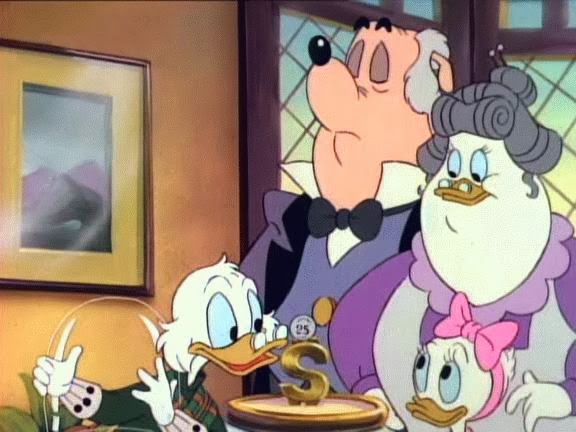
Unfortunately, the episode starts and finishes so poorly that even the better parts of the production can't come close to saving the day.  The first few minutes are horrific; even Scrooge's seemingly innocent desk calendar lets us down right off the bat:

As Duckworth notes, it's "Dime-Polishing Day," not "Kilt Day," and it appears as though an entire day in the last week of July has been skipped.  I guess that Huey, Dewey, and Louie must be angling for an extra allowance before their appointed time.  HD&L then pull the rock of all rocks with their lame excuse as to why they replaced the Old #1 Dime with their "lucky quarter."  Even in a strictly DT context, this makes absolutely no sense, and both GeoX and Greg rightly jumped on it with both (non-webbed) feet.  Having worked on one of the first episodes to feature Magica De Spell's quest to snare Old #1, Koonce and Wiemers should never have let this misguided idea get beyond the first draft.  Then again, the entire episode ignores previous DT "facts" about Scrooge's early life and emigration as revealed in "The Curse of Castle McDuck," and why should only one previous episode have the honor of being ignored?

Our first glimpse of Young Scrooge quickly slaps us upside the head with another of the episode's overarching problems: its inability to establish a precise time frame for the events of Scrooge's story.  Greg guessed that the initial scenes in Scotland took place in the 1920s, but the presence of the Klondike gold rush as a featured part of the narrative, Scrooge's use of a high-wheeled bicycle (velocipede) to get to his Uncle Catfish's dock, and the "Wild Western" appearance of Scrooge's forlorn "Oklahoma timberland" all indicate that most of the events of Scrooge's story (at least, up until the time he "goes international" in Act Three) must be taking place during the 19th century.  Which means, of course, that Young Scrooge's "newly-invented electric bagpipes" are a flat impossibility.  You tell me how the isolated Cottage McDuck is getting its electricity.

In chronological terms, the biggest difference between the Young Scrooge of "Dime" and the Scrooge of the first two chapters of Rosa's LATO$M (whom I'll call "Laddie Scrooge") is that the former emigrated to America at a somewhat older age.  The Pat Fraley-voiced Young Scrooge is certainly far more naive than his Rosa-crucian counterpart, who, even before he arrived in America, had already shown a hint of his inner steel by fighting off the Whiskervilles in "The Last of the Clan McDuck."  Young Scrooge's mindset may reflect the influence of an upbringing in the country, as opposed to the Glasgow cityscape in which Laddie Scrooge lived and labored.  Woefully ignorant of the way the business world really works, Young Scrooge comports himself in the insouciant-yet-secretly-insecure manner of Fenton Crackshell as he attempts to secure that elusive first job.  Even in the pre-LATO$M days of 1987, Young Scrooge's breezy attitude (not to mention his rather too modern concern with various fringe benefits) didn't quite jibe with what we felt to be true about the character -- that he started at the very bottom and made his way to the top by dint of dogged, old-fashioned effort.  It wouldn't surprise me, however, if the later characterization of Fenton Crackshell were influenced to some degree by this admittedly amusing portrayal.

In both "Dime" and LATO$M, Scrooge's shining of a ditchdigger's mud-caked boots to earn Old #1 is adapted directly from an incident in "Getting That Healthy, Wealthy Feeling" (UNCLE $CROOGE #50, July 1964, written by Carl Fallberg, drawn by Tony Strobl).  Rosa famously "rehabilitated" this non-Barksian factoid to use in his epic because the task "seemed completely appropriate for a young Glasgow lad," but let the record show that DuckTales got there first.  I wonder how Esckilsen came to know of this story.  Could it be because it was published in an early-80s issue of the Whitman UNCLE $CROOGE, a pile of which the DT crew might well have had lying around for browsing purposes (perhaps right next to that well-thumbed copy of the Celestial Arts $CROOGE volume)?  "Dime"'s take isn't precisely that of "Feeling" or Rosa -- the mud has clustered about the ditchdigger's boots in a suspiciously regular rectangular-box shape, because that was easier for the animators to draw, no doubt -- but there can be no question but that the Fallberg-Strobl story was consulted at some point here.

Young Scrooge's use of a "shoe-shining conveyor-belt system" to earn money for his passage to America is also drawn from a rather obscure Duck story, in this case "The Invisible Intruder" (UNCLE $CROOGE #44, August 1963, written by Vic Lockman, drawn by Barks).  This story was reprinted by Gold Key in 1978, so it might also have been part of that purported pile of comics references mentioned above.  I think you'd have to agree that the rationale for Scrooge's inventiveness presented in "Dime" is rather more convincing than the one given by Lockman.

For all of that effort in research, I emulate Vic Lockman and say, "Yay for you, Mr. Esckilsen!"... And then I have to yank the "Yay!" right back.  One of the important points about Laddie Scrooge's earning of the dime in "Clan McDuck" is that the fact that it is a "worthless" American dime teaches the youngster that he will need to be wary of "sharpies" in the future, which leads directly to his first verbal formulation of his famed "tougher than the toughies and smarter than the smarties" mantra.  "Dime" also plays with the implications of different media of exchange, but blows any chance of mining something meaningful out of them by using the idea as a source of cheap humor.  Scrooge's McMomma and McPoppa (is Scrooge's home country Scotland or McDonaldland?) do point out that Old #1 "isn't worth ten cents here in Scotland," and Young Scrooge does ultimately choose to regard the acquisition of the dime as a "sign" that his fortune is awaiting him across the sea.  Later, however, we are apparently expected to laugh when the successful Scrooge sends his McParents "worthless" American dollars.  Maybe they can exchange the dollars for British currency at the local branch of the "national bank" with the dollar signs prominently featured in its window.  $... £...  So what part of this didn't Esckilsen, Koonce, and Weimers understand?

The steamboat race pitting Scrooge and his scabrous Uncle Catfish (who, in a nice twist, had sent stereotypical reports of gold-paved American streets back to Scotland) against Old Man Ribbit dispenses with the "reclamation section" of Barks' story, in which Scrooge and "Horseshoe" Hogg must first pry their uncles' sunken boats out of the "Big Muddy" muck and get them river-worthy again before resuming the disrupted 1880 race.  Here, as is the case with Rosa's "Master of the Mississippi," we cut straight to the original chase for Cornpone Gables.  It's a shame that the faintly ridiculous "Beaver Boys," rather than the 19th century Beagles themselves, are used as Ribbit's helpers, but at least Ribbit is sufficiently conniving all on his own to be considered a "Beagle by proxy."

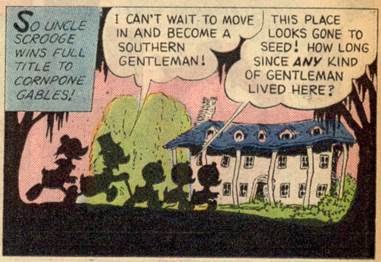
Despite the large differences between the events of "Master" and the truncated race in "Dime," there is at least one instance in which there might have been some cross-pollination.  Yes, I know that Rosa denied any swiping from "Time Teasers" when creating "On Stolen Time," and I'll grant him the benefit of the doubt again in this instance, but let's just say that I find the juxtaposition of the following images to be mighty... suggestive.

There's a barb in the tail of the seemingly "cute" and simplified DT version of the race.  True, the "fully functioning" Cornpone Gables of "Dime" appears to be a stereotypically great prize, whereas Barks' long-abandoned mansion turns out to be hardly worth the trouble that Scrooge and co. went through to secure it:

At the same time, Uncle Catfish proves to be a TRUE McDuck by paying Young Scrooge a paltry wage for his help (I think it worked out to about 30 cents an hour).  Not even Rosa's Uncle Pothole McDuck, who sold Scrooge the deed to his boat at precisely the time when riverboats were being phased out in favor of rail travel, can rival Catfish for classic skinflintery.

Following Young Scrooge's truncated traipse through the Klondike (Goldie?  Never heard of her), "Dime" provides us with a few final memorable moments after the lad is bilked out of his gold stash by the "Oklahoma timberland" salesman.  Given that the Scrooge of DT's "Back to the Klondike" was already as "tough as the wolves" and had arguably enjoyed a romantic relationship with the sexiest gal in the region, it requires some mental gymnastics to accept the idea that the post-Klondike Scrooge could be cheated so easily, but at least the sequence is consistent with the portrait of Young Scrooge presented earlier in this particular story.  There follows the Beagles' train hold-up, Scrooge's "having a blast" (and temporarily losing Old #1, not to mention his plaid wardrobe), and Scrooge's use of "Scottish warfare" to bring the Beagles low.  We'll also see bagpipes used as weapons in the second season's "Full Metal Duck," though the effects of the pipes are played more for laughs there.  Here, given that one of the Beagles admitted earlier that Ma Beagle (who, let us be clear, is NOT the same as the Ma Beagle who appears in contemporary Duckburg) had committed murder to obtain clothes, I think it is entirely appropriate that the Beagles have a much harder time dealing with the squealing squash-machine.

Sadly, once Scrooge hits the timber-less-land, the episode (to use a bagpipe-friendly metaphor) goes straight down the pipe.  Scrooge striking oil (and thereby reestablishing his fortune -- for good, as it turns out) while trying to hide Old #1 from the wage-demanding workers truly is, in GeoX's words, "the most egregious example of the 'lucky dime' heresy we've seen yet."  Heck, the doggoned Magic Hourglass didn't have as direct an influence on Scrooge's fortune as the dime does here -- and all due to sheer, dumb luck!

And then, with all of those wonderful Barksian examples of "Scrooge the clever businessman" to draw upon, we get the stupid-beyond-words "coal patch stomp."  I can't help but regard that scene in "Marking Time" in which Louie blows off "dummy" Dewey for thinking that the coal in Bubba Duck's cave should already have formed into diamonds as an indirect apology for this ridiculous scene.  As if to twist the knife, Scrooge subsequently shoves his dubious diamonds into his giant mattress in what may be another reference to "The Invisible Intruder," in which Scrooge's ambition is to have a huge bed.  Leave it to this episode to display its not-inconsiderable level of comics-derived detail as a tag end of one of the series' lamest incidents.

"The greatest treasure is family"?  Who didn't see that closing line coming?  Admittedly, the presentation isn't quite as "goopily saccharine" as GeoX suggests; the Nephews do attempt to exploit the "family bonding" moment to get a raise in their allowance.  (The gambit, of course, fails.)

So, overall, this "term paper" gets a failing grade, albeit one that is given with at least a twinge or two of regret.  It's tempting to think that all would have been well had the series followed Greg's advice and turned "Dime" into a two-part story.  Based on the available evidence, though, I'm not sure that Esckilsen, Koonce, and Weimers would have known how best to fill the extra space.  30 additional kilt and bagpipe jokes wouldn't have cut it, but I'm afraid that that would have been the most likely scenario.

.

.

.

"DuckBlurbs"

(Greg) Scrooge storms off as he tells Duckworth to begin the yearly polish as we cut to the downstairs drawing room as Mrs. Beakly and Webby ha[ve] joined in for fun. They gather around the room complete with dime on glass which I guess Scrooge moved from the Money Bin after Dime Enough For Luck which is quite smart methinks.

Based on "Magica's Shadow War," "Magica's Magic Mirror," and "Send in the Clones," the Money Bin location of "Dime Enough for Luck" was the exception, rather than the rule.

(Greg) Scrooge wants it all as the bank manage is hardly amused as Scrooge claims that he was the 8th grade treasurer and that's enough for him to get thrown out of the bank with a wussy bump.

Another unwarranted Americanism creeps into Scrooge's Scotland.  I think that they call grades "forms" in the British system.


(Greg) Another scene changer as Scrooge is riding a bicycle towards the ruined river boat as Scrooge narrates that he hoped that Catfish's skills would rub off of him. Scrooge does an excellent chin up on the door entrance and crashes the bicycle off-screen inside since it had no brakes during the time period see. 

A nice detail!

(Greg) [Uncle Catfish] used to haul freight for Colonel Cornpone. And so did a big, fat frog furry in weird clothes as he hops in and he's Old Man Ribbit (William Callaway) and he's French see. Hew sounds like he's talking African American for some reason and faking the French. Somehow; I do not like where this is going. 

As is stated later, Ribbit's accent is actually a Cajun accent.  Actually, the strange thing about Ribbit is not his accent; it's the fact that he's a man-sized frog in the DuckTales "universe"!  Doesn't it seem as though TaleSpin would be a more "natural" place to see a character like that?

 (Greg) So we get the scene changer as the [Cotton] Queen starts up again as we cut to inside as Scrooge was shoveling coal like a bicycle on his makeshift bicycle because working smarter is more effective than just working harder. It's what McPoppa would always say. 

Forget coal, elephants, and diamonds: Scrooge's "coal slapper" is what I choose to regard as Scrooge's finest "business moment" in "Dime."

(Greg) We continue [the railroad building] for a while and then the workers stop dead in their tracks as Scrooge would say (and Disney Captions would not) in the narration as Ma Beagle and the Cowboy Beagle Boys stop them and it's stick up time... Scrooge calls [them] either robbers or the ugliest welcome wagon in history. 

The "forced" way in which Alan Young reads this joke is actually funnier than the joke itself.  It's as if Scrooge, in an indirect "fourth wall" reference, is daring us not to laugh. 

Next: Episode 63, "All Ducks on Deck."

Tuesday, September 24, 2013

Book Review: THE MAN WHO SAVED THE UNION: ULYSSES GRANT IN WAR AND PEACE by H.W. Brands (Anchor, 2013)

The latest installment in Brands' "American Series" (my designation, not his or his publishers') of biographies of important figures in U.S. history takes on Ulysses S. Grant, whose status as one of America's leading military figures has long since been assured, but whose two-term Presidency (1869-1877) has generally been denigrated as a cesspool of incompetence and corruption.  Brands' book is virtually "all torso," concentrating on Grant's military exploits in the Mexican and Civil Wars and his eight years as President while paying relatively little attention to his boyhood, family life, and home life.  Just about the only "extraneous" part of the biography that rouses any real interest from the reader is the story of the cancer-stricken, dying Grant's struggle to finish his memoirs (and, by so doing, to make up for bad investments that had left him virtually penniless and thereby provide for his family after his death).

Brands doesn't gloss over Grant's mistakes as a military commander but makes it clear why he was such an effective leader of men.  Grant was the type of leader who picked intensely loyal subordinates (William T. Sherman being only the most famous) and relied upon them to do their jobs with minimal interference.  Alas, the good judgment that had served him so well during the war let him down at crucial times when it came time to pick associates and choose policies in his Presidential administration.  Brands argues that Grant deserves more respect as a far-sighted leader in the area of civil rights, supporting civil rights bills, using the military to protect the right of Southern blacks and Southern Republicans to vote, and crushing the first iteration of the Ku Klux Klan.  Grant also tried to do right by Native Americans in various ways during his two terms.  The problem was that he was unable to convince a sufficient number of followers that his more progressive approach to the problems of Reconstruction and Indian relations was the best way to proceed.  Famously reticent as a speaker, Grant lacked the ability or the willingness to use the "bully pulpit" to its fullest, which, given his heroic stature as the general who saved the Union, seems a great shame.  On the economic front, Grant's hard-money response to the Panic of 1873, while understandable in light of the strong desire to get back to "sound money" following the use of paper currency during the war, may have prolonged the hard times.  The scandals that all but ruined Grant's second term (none of which were directly Grant's fault, except insofar as he trusted some individuals who turned out to be untrustworthy) only added to the popular image of Grant as a financial ignoramus.  Even with all of the troubles, Grant ended his second term as a popular icon and was widely credited with helping to heal at least some of the wounds from the civil conflict by his sheer gravitas.

Brands' semi-revisionist work won't necessarily convince you that Grant deserves to be ranked among the greatest Presidents, but the author's more nuanced portrait of the soldier and the statesman may increase your respect for Grant as a humble man of integrity who too often poured his faith in fellow men into flawed vessels. 

Sunday, September 22, 2013

Book Review: LINCOLN UNBOUND by Rich Lowry (Broadside Books, 2013)

"Getting right with Lincoln" has long been a pastime of American politicians on both sides of the political spectrum.  More recently, progressives have expended much energy in reinterpreting "Honest Abe" as one of their own, someone who would have had no problem whatsoever with the growth of the welfare state and big government in general.  Lowry, the editor of NATIONAL REVIEW, doesn't contend the assertion that Lincoln was, in fact, a proponent of an activist federal government; indeed, a certain segment of conservative opinion regards Lincoln as a villain for some of the drastic actions he took during the Civil War to combat dissension and outright treason in the Northern states.  But he makes the compelling case that Lincoln's activism sought not to lock people into a cycle of dependency, but rather, to give them a chance to better themselves in a dynamic, ever-changing capitalist society.  At the same time, without being preachy, Lincoln, through his behavior and words, exemplified a "bourgeois morality" that would increase the chances for people to find and maintain success.

Lowry believes that today's Republican Party would do well to go back to "first Lincolnian principles" and emphasize the importance of rebuilding an "opportunity society," as opposed to simply opposing the growth of government.  The problem with this, as I see it, is that there is such a crying need for immediate governmental contraction that making simple progress on that front must necessarily precede any efforts towards making the government more efficient, less heavy-handed, and more capable of aiding citizens without trying to dominate their lives.  Still, it is refreshing to note Lowry's recognition that government can play its small part to encourage industry, education, and basic research and to improve infrastructure, provided that it imbibes a little Lincolnian common sense.  On the issue of cultural change, things are trickier, because popular culture is far more pervasive and easily disseminated today than in the 1850s and 1860s, and the "cultural elites" will need a change of heart (and, IMHO, stronger financial competition from cultural products with a friendlier view of traditional Judeo-Christian morality) before they are willing to play a more positive role in keeping the foundations of the culture strong.  Delivering messages of "uplift" imbued with a sense of humor and a clear recognition of human foibles, as Lincoln frequently did, would be a good start.

LINCOLN UNBOUND presents an unconventional view of our greatest President, but one that ought to be seriously considered and debated by all citizens in terms of how it might provide some guidance in our troubled times.

Thursday, May 16, 2013

Book Review: COOLIDGE by Amity Shlaes (Harper, 2013)

With abuse-of-power scandals popping like Fourth of July crackers in Washington, this seemed like a good time to kick back and read about a President who has long been patronized for doing too little while in office.  As Amity Shlaes makes clear in this new biography of Calvin Coolidge, purposely pulling back on the reins of government actually requires more effort than is typically expended by a more activist leader.  During his five years in office, President Coolidge certainly found it so.

For all of its considerable detail, I did find Shlaes' narrative to be lacking in certain areas and inartfully crafted in others.  Coolidge's money-saving economic policies get most of the attention, as they should, but there is little on Coolidge Administration foreign policy save for the last-minute drive to ratify the war-"outlawing" Kellogg-Briand Pact.  The U.S. was not "isolationist" during the 1920s in any meaningful sense of the word, but Shlaes inadvertently leaves that impression.  As to Shlaes' style, it is best described as "lumpy."  Characters are repeatedly reintroduced to us, while other figures who might have been expected to get much more attention, such as Coolidge's secretary C. Bascom Slemp, barely rate a mention.  The short-shrifting of Slemp (whom blacks, who at the time were still heavily Republican, harshly criticized) seems particularly unfortunate because he was a Virginia Republican at a time when Southern Republicans were rare; including him as a major player would have added some depth to the comparatively scanty discussion of Coolidge's policies towards the South and black civil rights.

If you are interested in learning about Coolidge's life, personality, and Presidency, this is a fairly decent introductory book, but I still came away somewhat disappointed.  Several more runs through the editorial mill would, I believe, have strengthened both the content and the prose.

Monday, May 6, 2013

Book Review: ROGER AILES, OFF CAMERA by Zev Chafets (Sentinel, 2013)

Zev Chafets' biographical sketch of the founder of Fox News begins with an amusing scene in which Ailes reconnects with actor Austin Pendleton, an old school chum whose life took a very different path.  The incident serves to shake up a reader's preconceived notions of Ailes as well as illustrate one of Chafets' main points: that Ailes, surely one of the most reviled media figures of our age, enjoys "the gift of friendship" with numerous individuals who violently disagree with his network's groundbreaking approach to the news. 

Readers looking for backstage gossip about Fox News personalities and policies will find a few nuggets of information here and there.  Ailes, however, stays in the spotlight throughout, though the book's modest scope ensures that the spotlight is on the narrow side.  Chafets' brief account of Ailes' youth, early experiences as a producer on The Mike Douglas Show, and career as a political consultant will no doubt be superseded at some point in the future by Ailes' own autobiography, on which he is apparently working.  Chafets does, however, do a credible job of explaining how Fox News came to be, how it was initially received, and exactly what Ailes had in mind when he decreed that Fox would carry the banner for "fair and balanced" TV journalism.

One topic that I wish Chafets would have examined in more detail is what a post-Ailes Fox News might look like.  Ailes has chronic medical problems that have made him acutely conscious of his own mortality, so there is every reason to believe that he has a well-planned strategy for handing over control of the network to someone who will maintain Ailes' general approach.  But the unusual stability of Fox' lineup of "talking heads" may hurt the network in the long run.  What happens when firmly established "brand names" like Bill O'Reilly have to leave the stage?  One intriguing possibility is an increased reliance on minorities, thanks to the Ailes Apprentice Program, which gives Fox News internships to several minority individuals each year.  This, at a time when the number of minority journalists has been declining for some time.  If these students stay at Fox and become regular "cast members," will they pull the network to the left, or will they become a countervailing force against the more conventional political views expressed by minorities on other networks?  Only time will tell.

Despite the revelations about Ailes' vast constellation of friends of various political stripes, I seriously doubt that anyone who hates Ailes is going to have his or her opinion changed by this book, but those who come to it with an open mind will find it enjoyable and a fairly quick read.

Thursday, April 25, 2013

Book Review: AL CAPP, A LIFE TO THE CONTRARY by Michael Schumacher and Denis Kitchen (Bloomsbury, 2013)

The contentious, cantankerous creator of LI'L ABNER has deserved a major biography for quite some time.  Alexander Theroux' glorified term paper THE ENIGMA OF AL CAPP (1999) could best be described as "an outline of a rough draft of a synopsis" and was marred by obvious political partisanship besides.  Though Schumacher and Kitchen indulge in their own share of tsk-tsking at Capp's abrupt swerve to the right late in his life, they do a far better -- and, no surprise, much more thorough -- job of placing Capp in the context of his time and explaining why his cartoon brainchild became such a massive hit in the mid-20th century.  Even so, there is quite a bit left unsaid here, and I can easily imagine a more comprehensive biography emerging at some point in the future.

LI'L ABNER is fondly remembered as one of the first comic strips to specialize in social satire.  It's not hard to understand why Capp should have gone that route; starting with the famous childhood accident in which he lost a leg, his rise to fame and fortune was anything but smooth and untroubled.  At a time of socially sanctioned anti-Semitism, his Jewish roots also cast him in the role of an outsider.  The result was a man with many rough edges.  Capp, for all of his surface geniality, was not a nice person, as Schumacher and Kitchen display in ample detail.  Capp's lengthy, nasty feud with his ex-boss Ham Fisher brings to mind Henry Kissinger's comment about the Iran-Iraq War, that it was too bad that both parties couldn't lose.  Fisher paid the ultimate price, losing all of his friends and committing suicide, but Capp's reputation also took a major hit as a result of the decades-long disagreement.  Arguments with family over LI'L ABNER marketing initiatives (Capp was also a pioneer in the public exploitation of his strip), serial infidelity, and the like paint a grim picture, culminating in several sex scandals in the early 1970s that wrecked Capp's reputation for good and all.  Even Capp's frequent parodies of other creators' comic strips, the most famous example of which is the DICK TRACY parody FEARLESS FOSDICK, could be considered a passive-aggressive form of fighting back against perceived rivals, however much Capp might have argued that he admired the original creations.

The major failing here is Schumacher and Kitchen's inability to articulate why, exactly, Capp took such a dramatic turn to conservatism during the 1960s, going on campus to hector students and such.  One comics encyclopedia of note trotted out the cliched rationale that Capp turned conservative after he had gotten rich.  This conveniently ignores the fact that Capp stayed a flaming liberal for a good while after LI'L ABNER's highest circulation figures and most lucrative licensing deals had been achieved.  The "he was a nasty guy" argument doesn't work either, since Capp was what he was for many years before the 60s.  My own opinion is that Capp, like a fair number of old-fashioned New Deal-style liberals, was genuinely appalled by what was going on during that giddy time and determined to attack and parody it, but that his satirical skills had gone off the boil since the salad days of the 40s and early 50s.  (Charles Schulz always argued that Capp's decision to let Abner and his perpetual romantic pursuer Daisy Mae get married in 1952 knocked the bottom out of the strip; Capp was not pleased and did a rather cruel parody of PEANUTS some years later, leading the mild-mannered Schulz to demand that Capp cease and desist.)  Capp had always sought publicity for himself and his strip, but, in the late 60s, the somewhat cruder execution of the LI'L ABNER storylines was mirrored in Capp's partaking of such harebrained stunts as confronting John Lennon and Yoko Ono during their "bed-in for peace."  Creatively, Capp had simply lost it, and the over-the-top insults and radical-baiting made it all too easy for the intelligentsia to write him off as a lost cause.  Had Capp been, say, twenty years younger, his assault on the left might have been more successful.

A fuller treatment of Capp's life and art must wait for the future, but Schumacher and Kitchen's book is a good place to start learning about both.

Thursday, May 31, 2012

Book Review: STORYTELLER: THE AUTHORIZED BIOGRAPHY OF ROALD DAHL by Donald Sturrock (Simon and Schuster, 2010)

It came as no surprise to me that Roald Dahl, as described by first-time biographer Sturrock, comes across as a "difficult" character.  Charming, generous, and convivial the great children's author could be, but also manipulative, cruel, and obstinate.  Sturrock is eminently fair in presenting both sides of the story, but I think that it is appropriate that he lingers a bit in describing how Dahl first whipped his first wife Patricia Neal into shape following the actress' debilitating 1965 stroke, then gradually pulled away from her in favor of another woman, finally divorcing her.  No incident in Dahl's life more vividly demonstrates the split personality of this complicated, frequently infuriating man.

The misanthropic bent of Dahl's stories for children and adults -- a tincture that also noticeably colors CHARLIE AND THE CHOCOLATE FACTORY (1964), his best-loved novel -- appears to have had many sources.  Along with the classic "bad time at a boarding school" (Repton, in his case), Dahl suffered a near-fatal plane crash as a young RAF pilot.  In keeping with his tendency to embellish the truth of events in his life, Dahl's smash-up, which was entirely due to "pilot error," was gradually transubstantiated into the tale of an heroic lost dogfight with enemy planes.  Dahl's opinion of human nature can't have been elevated by his subsequent service as an air attache and espionage agent in the United States, which gave him opportunities to both hobnob with the powerful (FDR, then Vice-President Henry Wallace) and bed-hop with willing older females.  How firmly established Dahl's jaundiced view of life had become by the end of the war is symbolized by the fate of The Gremlins, the little plane-sabotaging critters that represented his highest pre-CHARLIE flight of whimsical fancy.  Having seen the public take to the Gremlin idea and "wring it out" with remarkable speed -- so much so that Walt Disney's plans for a movie based on the creatures were ultimately shelved -- Dahl subsequently used The Gremlins as the dark-hearted, opportunistic inheritors of a world decimated by atomic war in his first, unsuccessful novel, SOME TIME NEVER (1948).  This novel was actually the first novel ever published about the aftermath of such a war; the mere fact that Dahl latched onto the idea gives us some idea of his mental state at the conclusion of World War II.  Dahl's ability to harness his "dark side" and use it to give his later, more whimsical children's tales that "cruel edge" that disturbed parents and professional do-gooders, but seemed to attract and intrigue children themselves, stands as arguably his most noteworthy contribution to children's literature.

The biography only really bogs down when Sturrock gets enmeshed in discussions of Dahl's frequent rows and disagreements with his American and English publishers.  Strangely, while Dahl felt loyal to certain individuals in the publishing business, his view of the business itself, like that of most manifestations of official authority, was extremely jaundiced.  Dahl's view of himself as the perpetual "naughty schoolboy" and rule-breaker makes it all the more surprising that, in the 1980's (his most productive decade insofar as children's novels went), he emerged as a fan of Margaret Thatcher.  Perhaps he sensed that Ms. Thatcher was, like him, something of an outsider, never really accepted by the British establishment?

My own impression of Dahl is that he was the type of man that you'd love to invite to a dinner party but wouldn't necessarily want to linger after the dishes had been cleared.  Whatever your previous impression of this significant children's author may be, you're bound to learn a number of new things about him in this well-written, well-researched biography.

Wednesday, May 9, 2012

Book Review: THE ADVENTURES OF HERGE by Bocquet, Fromental, and Stanislas (Drawn & Quarterly, 2012)

This project -- a sort of pictorial biography of the creator of TINTIN, drawn in a style at least faintly resembling Herge's famed "clear line" and formatted in the manner of a classic TINTIN album, right down to the page count -- is frankly a bit mystifying.  People familiar with Herge's life and work will not learn very much that is new.  At the same time, despite the presence of a helpful "cast of characters" (complete with headshots) at the back of the book, TINTIN neophytes will probably be quite confused the first time that they read it.  So who is most likely to mine enjoyment out of this?  Two groups come to mind: (1) the longtime "true TINTIN believers" who simply must own any and all Herge-related products and will thoroughly recognize and appreciate the various visual references to Herge's stories that crop up from time to time; (2) people who were intrigued by the recent feature film but aren't necessarily committed enough in their interest in TINTIN to essay a full-scale Herge bio, or even to read the albums.  For the latter group, THE ADVENTURES OF HERGE is a convenient, and highly enjoyable, "two-for-one" experience: a good place to learn a little something about Herge's life and get an idea as to what a TINTIN album is "supposed" to look like.

Artist Stanislas Barthelemy wisely doesn't essay a full-blown swipe of Herge's style.  His somewhat sketchy interpretation of same looks more like a cross between Herge's earliest work and the highly stylized approach of a John Held Jr.  This puts some useful artistic "distance" between the "hard-PG" narrative, with its scenes of nude portraiture, occasional use of harsh language, and depictions of marital infidelity, and a typical TINTIN narrative, which Herge famously said was created for everyone from ages 7 to 77.  The distinction is especially effective when Stanislas consciously parodies famous scenes from TINTIN albums.  Nowhere is it more so than in the scene in which Herge is freed from the jail where he had been held as a supposed collaborationist.  Even as Herge leaves to literally start his life over again, his cellmate, who'd also been imprisoned by the Resistance, is placed before a firing squad.  Several panels in this sequence bring to mind the scene in THE BROKEN EAR in which Tintin is about to be shot in the same manner.  Tintin famously got out of that one by getting drunk (!), with the tone of the scene strongly resembling that of the climax of DuckTales' "Allowance Day."  Suffice it to say that the denouement here is rather more sober.  The final two pages, depicting Herge's death, also make memorable use of props from Herge's stories and the opening scenes of THE SHOOTING STAR.

When I first heard of this project, I was worried that we might be getting a sort of deconstructionist deboning or ideological hijacking of Herge, in the manner of Frederic Tuten's novel TINTIN IN THE NEW WORLD or the anarchist rip-off TINTIN IN BREAKING FREE.  Thankfully, Jose-Louis Bocquet, who's written biographies of other European comics figures, avoids the pitfalls and pretty much tells the straight story, albeit with some exaggerations to accommodate the requirements of storytelling and the uses of Herge characters and scenes.  If you're a comics fan unfamiliar with the world of Herge, this isn't the worst place in the world to start finding out about the man, his times, and his works.

Monday, February 27, 2012

Book Review: HOWARD COSELL: THE MAN, THE MYTH, AND THE TRANSFORMATION OF AMERICAN SPORTS by Mark Ribowsky (W.W. Norton, 2011)

It's rather surprising that we haven't gotten a definitive biography of Cosell until now. Sports books trumpeting "The Best X Ever," "The Last Real Y," and "The Game that Changed Z Forever" seem to be a dime a dozen, and the titles of the vast majority of them punch far above their actual weight (to use a boxing metaphor that I think is fitting in this case). But Cosell really was a transformational figure. As author Ribowsky notes in this even-handed, frequently compelling book, the world of sports journalism could probably use someone with Cosell's outspokenness (as opposed to "mere" loudmouthedness) right about now. That someone, however, would best be advised to ditch the comically oversized ego as an optional accessory.

Cosell clearly had many positive attributes, such as a willingness to fight for the underdog and a strong loyalty to his family, but he is a classic example of someone who ultimately became a parody of himself. I remember watching the last fight broadcast he did, the 1982 heavyweight mismatch between Larry Holmes and Randall "Tex" Cobb, which would be mercifully forgotten today were it not for Cosell's steady hectoring of the referee and "the boxing world" in general for letting the fight drag on to the finish. In this instance, Cosell ceased to be a truth-teller and became simply an irritating scold. The "comical" bickering in the booth of Monday Night Football (which, as is now well known, papered over some extremely hard feelings and jealousies among the principals) followed a similar downward trajectory. Cosell's "using" of people for name-dropping purposes (Ribowsky describes this as "people collecting," a la Professor Horace Slughorn, but with a nastier edge), hypersensitive anti-anti-Semitism, drinking problems, and general obnoxiousness served to ensure that, when he gave his enemies swords with which to run him through (e.g. the infamous "little monkey" comment on MNF), the wounds they inflicted upon him would last far beyond their "heal-by" dates. Even so, there is something truly sad about his disintegration and withdrawal from the wider world following the death of his beloved wife. What price fame -- or infamy?

Ribowsky does a good job of covering the well-known high points of Cosell's career -- MNF, his long relationship with Muhammad Ali -- and manages to make Cosell a sympathetic figure even while playing up his many flaws. The short and decidedly unhappy story of Cosell's 1975 prime-time variety show (!) Saturday Night Live (!!!!) is unquestionably the funniest part of a read that, due to the serious issues with which Cosell was involved and his marked genius for ticking people off, is somewhat more dour than those seeking a gay romp through the funky late-60s and 70s might expect. Highly recommended for those who seek enlightenment as to why the guy with the bad toupee and big vocabulary was such a big deal back in the day, as well as those who witnessed the blow-by-blow themselves.