Blogger "Review or Die" recently laid out his vision of what a putative "Disney comics line of the future" should look like. He argues his points well and seems to respect the Disney comics tradition while acknowledging that new paths would have to be taken in order to give such a line a fighting chance to succeed. Here are my (brief) takes on his plans. Read them, read R.O.D., and let me know what you think.
(1) DARKWING DUCK -- Yes, just with an absolute minimum of editorial interference.
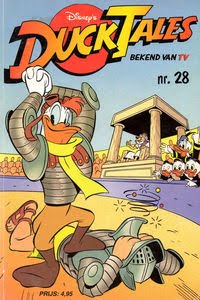
(2) DUCKTALES -- Yes, but not unless EVERY effort is made to do the job right. I'd even be willing to give Warren Spector a chance to redeem himself for "Rightful Owners" -- he certainly possesses the required enthusiasm -- provided that he worked with an accomplished editor who fully understood the TV series. If Warren isn't interested, then perhaps someone like Jonathan Gray could be called upon to serve as the title's regular writer, seeing as how Gray's scripting job for "The Arcadian Urn" (UNCLE $CROOGE #399) has received such high praise. Anyone who writes for DT, however, should be required to pass the equivalent of a Wonderlic test to prove that they are thoroughly familiar with the series and what makes it different from the UNCLE $CROOGE title.
(3) KIM POSSIBLE, replacing FILLMORE -- I do have a suggestion re: Fillmore (and others) which I'll mention below. But of the contemporary (by which I mean, post-2000) Disney productions, none deserves a comic-book title more than KP. The show has a legitimate following, a strong female lead, good supporting players, and obvious potential for long story arcs. A KIM POSSIBLE title done right could be for this line what DARKWING was (at least for a while) for Boom! -- an instigator of some badly-needed buzz.
(4) UNCLE $CROOGE AND DONALD DUCK -- This is a very intelligent way of avoiding the eternal dilemma of what stories "belong" in $CROOGE and what stories "belong" in DONALD. It would definitely have to be a 64-page book, however.
(5) DISNEY KIDZ -- Yes, that spelling is intentional. Here is where we can play to the 2013 version of the "Peanut Gallery" (can we really say that there is one?) and feature a rotating cast of child stars based on DTVA's numerous kid-centric offerings of the past decade-plus: FILLMORE, PHINEAS AND FERB, PEPPER ANN, TEAMO SUPREMO, etc. Heck, I'll even accept comic-book adventures for Hannah Montana and other live-action Disney Channel faves, provided that we can get someone like Stefan Petrucha to write them. He's got Disney comics "street cred" from his work for Egmont and has also written "comics-like" material for NANCY DREW.
(6) THE DISNEY AFTERNOON -- Another rotating title, more like the Disney-Marvel title of the same name, only executed with, well, competence. Various shows from the "Golden Age" of 1987-92 -- and even a little bit beyond those boundaries -- could be featured here.
(7) WALT DISNEY'S COMICS AND STORIES -- I wish that R.O.D. were a bit less vague about what he would like to go into this title. Even an "Anything Goes" approach needs a few ground rules. Classic supporting players from the "Golden" and "Silver" Ages of WDC&S, such as SCAMP and LI'L BAD WOLF, would of course need to be included, but stories featuring Disney movie characters would also be welcome. These could be tied in with recent cinematic releases. If the new line could score the rights to the Pixar characters, so much the better.
(8) MICKEY MOUSE ADVENTURES -- Here's my biggest beef with R.O.D.: the MICKEY material in the Gemstone books was, without question, some of the very best post-Gottfredson Mouse work that we've seen. What, Mickey's adventures in Shambor weren't good enough for you? Or some of Noel Van Horn's more off-the-wall offerings? Amp up the danger quotient if you like, but by all means, keep the artistic polish and the general attitude. Mix in (judiciously) some more material from Casty and look to the early issues of Disney Comics' MMA for more inspiration. If the "new" MMA can simply match the best of Gemstone's MICKEY stuff, then I'll be more than satisfied. That's not nostalgia, that's just the facts, Mouse.
(9) THE MUPPETS -- I'll take your word re: the high quality of Langridge's work for Boom!. Only one title, please, so as not to wear the man out.
Comics, book, and DVD reviews (and occasional eruptions of other kinds)
Showing posts with label Jonathan Gray. Show all posts
Friday, February 22, 2013
Friday, May 27, 2011
Comics Review: UNCLE $CROOGE -- DUCKTALES: MESSES BECOME SUCCESSES (May 2011, kaboom!)
This second collection of stories from the DUCKTALES phase of Boom!'s UNCLE $CROOGE (issues #396-#399) is a variegated popcorn bag of crunchy kernels, duds, and the occasional unexpected jujube (to wit: backup reprint stories from Carl Barks, William Van Horn, and even the old DUCKTALES ACTIVITY MAGAZINE). I will say that the best true DT tales on display -- "The Arcadian Urn" (U$ #399), "Double Indemnity" (U$ #396) and "The Last Auction Hero" (U$ #397) -- are much more successful than the well-meaning, but seriously bungled, effort that Warren Spector gave us this past week in the first (and, more than likely, one of the very few) issue of kaboom!'s DUCKTALES. But that's a story for another post... which you'll see later this weekend, once I finish my duties from May Term.
Wednesday, May 4, 2011
Comics Review: WALT DISNEY'S COMICS AND STORIES #718 (April 2011, kaboom!)
With ACTION COMICS about to hit issue #900 and WDC&S among the "classic" Disney titles supposedly "on the brink," anyone care to speculate on how high the WDC&S issue total will climb before "it's all over"? One is tempted to say that getting to #750 is not looking too good, but then, #700 looked fairly dubious until Boom! started publication. I'll keep my hopes up until more news about the future becomes available.One thing that can definitely be said about the future is that the best work of "modern Duck master" William Van Horn will not be found there. "Just in Time," this ish's cover feature and lead story, is nowhere near as poor as #717's "Scrooge for a Day," but neither does it display a single particle of the weird whimsy that informed Bill's best work of the late 1980's to early 2000's. Indeed, research center janitor Donald's boredom-induced narcolepsy here may almost be considered a subconscious meta-comment on the placidity of much of Van Horn's later work. While seeking a secluded snooze-spot in what turns out to be an experimental time capsule, Don accidentally gets whisked into the age of dinosaurs, has a couple of close encounters with the requisite (and decidedly non-nervous) T-Rex and similar creatures, and then is just as quickly whisked back to the present. If you're expecting a comical denouement involving Donald losing his job or getting an even worse job, think again; Donald gets lectured by the angry scientists and nothing more. Weariness hangs over this story like a dense fog bank. Of course, the aging Barks laid some eggs late in his career, but at least they tended to be spectacularly bizarre ones (17-foot-tall Venusian teenagers come to mind). This story, by contrast, defines the normally amorphous concept known as "meh."
Jonathan Gray, providing the dialogue for the three-page Dutch GYRO GEARLOOSE story "The Inventor's Inventor," gets our blood flowing again by providing some witty lines as Gyro builds a "Megahelper" that does its job entirely too well. The way in which the "Megahelper" is disposed of is particularly clever. But this is just the warmup act for Joe Torcivia's splendid wordsmithing on "To the Moon By Noon," a 1963 Disney Studios program story drawn by Paul Murry. The teamup of Ludwig Von Drake and Mickey Mouse might not seem very promising, but Joe outdoes himself by making Ludwig, a character with a comics past that could charitably be described as uneven, sound exactly like a comic-book version of the Paul Frees-voiced TV know-it-all ought to sound. It was very easy to imagine this Ludwig, with his scatterbrained forgetfulness (he keeps "greeting" the ever-present Mickey over and over again) and constant parenthetical digressions (typically rendered in smaller typeface), being performed by Frees in animation. Mickey can't help but seem a little bland by contrast, but even that seems fitting, as the comics Mouse of the period in which this tale originated was generally presented as a rather sedate figure, even when he was having adventures. The story of a moon trip is obviously anachronistic, obliging kaboom! to note the fact in an introductory note, but the early 1960s were Von Drake's salad days, and it's entirely reasonable to feature him in a story centered around concerns (especially scientific ones) of the era. Great job by Joe, and a rare case where the traditional "Mouse-ender" of an issue of WDC&S should have been featured as the lead story.
Saturday, January 8, 2011
Comics Review: UNCLE $CROOGE #399 (January 2011, Boom! Kids)
UNCLE $CROOGE's DuckTales detour (or, if that word sounds unfairly pejorative, then why not try "diversion"?) concludes here with a better-than-decent final issue that serves as a neat precis of the strengths and weaknesses of the past eight releases. In the lead story, "The Arcadian Urn," we once again see clever rescripting giving some extra life to what appears to have been relatively humdrum original material. Paul Halas and Tom Anderson's Egmont tale of the DuckTales gang "plus one" (read: Scrooge, HD&L, Launchpad, Webby, and Donald, who's conveniently "on shore leave from the Navy") exploring the "hidden land" of Arcadia in Ionian Greece would have been a more or less conventional treasure trek -- Scrooge is after an artifact that will trump the ancient urn that Flintheart Glomgold had earlier auctioned off for a pretty penny -- had the ever-reliable David Gerstein and Jonathan Gray not upped the ante by engineering what has to stand as Webby's finest moment in the comics medium. Consider that the much-mocked moppet:
(1) Wields a "Littlest Chickadees Field Guide" every bit as dexterously as the Nephews handle their Junior Woodchuck Guidebook. (This could be considered "retconning," at least by those who've seen the TV episode "Merit-Time Adventure", but I'm glad to see Gerstein and Gray returning to Barks' original intention of unisex scouting organizations. Besides, who's to say that the legendary Hypatia couldn't have scrounged up her own set of material from the lost Library of Alexandria and preserved it for posterity?)
(2) Is the first Duck to follow Launchpad into the magical underground pool that leads to Arcadia. (Yup, she's even quicker off the mark than HD&L.)
(3) Is trusted to get the other Ducks out of prison by slipping out of their cell by herself and knocking out the guard with "Morpheus' sleeping powder."
(4) Saves Scrooge's bacon (after the destruction of the pool and the treasure that Scrooge was bringing back) by bringing along figs in a jar made of Arcadian "blue glass."
Add all of this up, and it's hard to think of a story in which Webby more deserves the honorable title of "fourth Nephew." This, despite the Nephews offhandedly referring to her as a "danger-prone duckling" and Scrooge conveniently forgetting Webby's presence in the "ultimate" treasure hunt by claiming that she and Launchpad will "get used to the drill" of treasure-seeking with Scrooge, Donald, and the boys. (BTW, does the presence of Donald really make that much of a difference? He basically does nothing here, apart from playing Sancho Panza and making sarcastic remarks as the bumbling Launchpad confronts the dragon who's been menacing the Arcadians, going gaga over a frankly unattractive Arcadian lady, and dropping verbal references to Gyro Gearloose, Daisy, Admiral Grimitz, and Mickey Mouse. Since Launchpad's references to Darkwing Duck bring us right back to the same continuity issues that dogged "The Everlasting Coal" in #392, all of those otherwise-appreciated cross-references are pretty much canceled out, anyway.)
Despite Webby's superb performance, it's tough to rank "The Arcadian Urn" as anywhere close to the level of the TV series' two masterful encapsulations of Greek myth and legend, "Home Sweet Homer" and "Raiders of the Lost Harp." The magical pool provides too easy and convenient a route to Arcadia, the Arcadians are generic guys in togas rather than distinctly drawn characters, and Prince Baklava's treachery seems strange given that his father, King Metallia, is the one offering the treasure-prize to whoever can best the dragon, and thus the treasure already belongs to Baklava, in a manner of speaking. Jose Maria Millet Lopez' artwork, which has enlivened a couple of Boom!'s DT offerings, and a really fine coloring job by Diego Jourdan provide at least partial compensation for these drawbacks.
The use of "Scrooge's Nose Knows Gold," a four-page story from the DUCKTALES activity magazine, as the issue's backup tale -- written though it is by the accomplished John Lustig -- reveals the scarred and chipped "other side of the coin" of Boom!'s DuckTales phase. During the first year of Boom! Disney comics, the lack of backup features was often a negative. In the DT $CROOGE issues, by contrast, the choices of supplementary material cruelly revealed that, apart from the William Van Horn gag sequences featuring Launchpad and Gyro, really good short DT stories are very few and even further between. "Nose Knows" is better than the average mag quickie -- I should know, I have most of them in my collection -- but even Lustig has problems with the format, creating plot conveniences right and left. Would the more ruthless DT Glomgold really carry around "instant hay fever" as an ultimate deal-breaker? Isn't a more, um, decisive weapon more his speed? And how come Scrooge mistakes a mountain of yellow flowers for gold early in the story, a goof which seems to contradict the story's very title?
I'd have to give the DuckTales era of Boom! $CROOGE an overall B- grade. The lead tales were generally fairly good but could have been better at times, even with the frequently inspired scripting. If Boom! uses DT material in future issues of $CROOGE, then it would be well-advised to mix DT lead stories with more conventional backup material, much as the Carl Barks story "Christmas Cheers" was used as the backup in #398. In light of the great success of DARKWING DUCK and CHIP AND DALE'S RESCUE RANGERS, I think that we can pretty much count on more DT offerings in $CROOGE, and I'll certainly welcome them.
Saturday, December 11, 2010
Comics Review: UNCLE $CROOGE #398 (December 2010, Boom! Kids)
Well, it took three issues, but the current "we're-pretending-it's-a-story-arc-to-justify-a-paperback-collection-but-it-really-ain't-so," "Messes Become Successes," finally lives down to its name (the first part of it, at least) with this issue's lead (and leaden) tale, "The Belt of Time." This Brazilian story was originally published in 1993 -- a bit late in the game to be entering this particular field of play -- and, despite the fact that only a what Scrooge would term a "wee handful" of DT epics were ever produced in Brazil, its sheer tiredness is more appropriate for the tail-end of the Egmont or Disney Studio DT output. Wearing Gyro Gearloose's time-traveling "century belt," Launchpad bips and bops out of several scenes as counterpoint to Scrooge and HD&L racing Flintheart Glomgold to the Andes to claim the rights to a "frozen super-ape" trapped in an ice cave. Anyone who has seen the Darkwing Duck episode "Extinct Possibility" and can guess the climactic twist is hereby excused. Actually, it's not the plot, blah as it is, that truly fails here (thanks to the ever-energetic contributions of David Gerstein and Jonathan Gray); rather, it's Haroldo Guimaraes' artwork, which would have been much better suited to one of the four-page "quickie" stories that ran in the old DUCKTALES activity magazine. Given the high quality of some of the recently-published, previously-unseen DT tales, I find it difficult to believe that "The Belt of Time" was the best of the leftover lot. This may be an indication that the upcoming 400th issue of $CROOGE, with its promised turn in a more "classical" direction, may be arriving none too soon.Speaking of "classics," who's the talented fellow who provided the backup story for this issue? Carl Banks? No, he played football for the Giants. Karl Marx? Nope, the guest star is a capitalist who, while irritating at times, is not evil. Could it be... why, yes, indeed, it's The Old Duck Man himself, Carl Barks, bearing a "Christmas present" (so trumpeted by Boom! -- though they probably shouldn't have encouraged the simultaneous enjoyment of "a nice glass of eggnog," given the number of youngsters that may be reading this) in the form of the ten-pager "Christmas Cheers" (WDC&S #268, January 1963). Even a relatively minor Barks Christmas story is an occasion for rejoicing -- not to mention a nice foreshadowing of some of the "vintage treats" that Boom! has in store for us in 2011. This is one of those cleverly-woven Barks tales in which multiple individuals/entities want very different things -- Scrooge a gold mine, HD&L a "science set," Donald a dump truck (a real one, not a toy one -- don't be silly!), and the City of Duckburg a badly-overdue street-paving job -- and the plot-dominoes topple in such a way that everyone gets what they want, but not necessarily in the manner in which they want it. We also get what some (and I don't want to know who, thank you) might term "fan service" in the form of several panels' worth of the naked Nephews toweling off in a tub. Great fun, and a much-appreciated gift to the long-term fans.
Saturday, November 13, 2010
Comics Review: UNCLE $CROOGE #397 (November 2010, Boom! Kids)
"We rollin' now!", as Bubba Duck might put it. U$ #397 keeps the recent "beat" of high-quality DuckTales-themed material going strong, grabbing us right from the get-go with Diego Jourdan's marvelous cover, a heartfelt homage to Carl Barks' cover to WALT DISNEY'S COMICS AND STORIES #108 (September 1949). Granted, I'm an easy "sell" for any product that takes the links between DT and the world of Barks seriously, but this goes above and beyond the call of artistic duty. This is one instance in which I devoutly hope Launchpad does NOT add to his crash total. (BTW, exactly where are LP's feet located? It was a tight enough squeeze when it was just Donald and HD&L, but now...)
Joe Torcivia does the dialogue honors for the lead story, Paul Halas, Dave Angus, and Jose Millet's "The Last Auction Hero." I can certainly vouch for the fact that Joe knows how characters in a DT story "should" sound as much as anyone does, and he hits the mark squarely here. Among other things, this is by far the best and most in-character use of the DT Beagle Boys that I've ever seen... and I write as one who's witnessed such wince-inducing horrors as Burger Beagle being presented as the brains of the outfit, so I doubly appreciate the accomplishment. Joe's very funny introduction to Part Two of the split story (if Harvey had ever re-introduced a continuing tale with "Okay, here's the deal!", I probably would've keeled over in a dead faint) is also a highlight, as is the rare (for a DuckTales story, at any rate) characterization of Glomgold as a mere "rival" of Scrooge's, rather than as a deadly, ruthless villain. (At the same time, Joe gives a shout-out to such TV episodes as "My Mother the Psychic" by having Flinty refer to having employed the B-Boys in the past.) There is a flaw in the plot, however, that not even Joe can do much with. At the outset, Scrooge is conflicted about trying to win the much-prized Wrathakhan Emerald in a "mere" auction setting: "I found every emerald I now own! Will a purchased gem really feel... the same?" Fair enough, and certainly in character for someone who prides himself on having acquired his fortune through old-fashioned hard work. After losing (!) the bidding to Glomgold, however, Scrooge trumps Flinty by finding a much bigger gem... by sheer, dumb luck, as the result of an avalanche triggered by the battling Launchpad and Big Time Beagle. How much pride could Scrooge honestly pry out of that non-feat and still remain true to himself? Yet, the multiquadzillionaire seems to have no problem whatsoever with how things turned out. This seems strange to me.
David Gerstein and Jonathan Gray return to handle the anchor-leg story, "Big Blimp in Little Trouble." I'm not sure who originally penned this Millet-drawn opus; the comic's credits claim it was Halas and Tom Anderson, while InDucks gives the honors to Gorm Transgaard. Whoever it was, he/they produced it during the very late stages of Egmont's production of DuckTales tales, and the story reflects a certain weariness. No DuckTales fan can read a story in which Scrooge tries to rekindle Duckburgians' interest in airship travel and not think of the TV ep "The Uncrashable Hindentanic." But there's no inadvertent disaster movie a-brewing here, nor is the McDuck Air Tours blimp filled with a gallery of memorably kooky characters. No, the folks traveling here are nice, mannerly "generic" dogfaces who sing parodies of Disney feature-film songs and the like. When Gyro Gearloose's gargantuan gasbag springs a leak, we are fed the lesson that "little things mean a lot" in a most heavy-handed manner. Still, thanks in large part to the efforts of David and Jonathan, this is a masterpiece compared to the DuckTales Studio stories that were run in the early issues of the Gladstone DUCKTALES title... and you can't go wrong with the occasional subtle reference to The Simpsons (see if you can find it!).
Dividing the two parts of "The Last Auction Hero" is the biggest (pleasant) surprise of the issue: a reprint of a two-page LAUNCHPAD AND GYRO gag written and drawn by William Van Horn. "A Dolt from the Blue" (original appearance in WDC&S #618, November 1997) was one of a series of amusing L&G gags that Bill penned as a follow-up to his quirky but highly successful collaboration with John Lustig in the later issues of Gladstone's DUCKTALES. There have been very few "running gags" of this sort in Disney comics -- the famous series in which Scrooge bilks the diner owner out of free coffee is probably the best known -- and, when you think about it for a bit, pitting Gyro's inventive know-how against LP's amazing ability to crash anything seems like a perfect backdrop to a gag series. I count the reprinting of "Dolt" as yet another promising sign that Boom! is quite serious in its apparent intention to give more of a "Gladstonian"/"Gemstonian" flavor to its "classic" Disney books.
Monday, October 18, 2010
Comics Review: UNCLE $CROOGE #396 (Boom! Kids, October 2010)... plus just a tad extra
How strange... "Messes Become Successes," the follow-up to "Like a Hurricane" (Boom!'s catch-all title for the first four DuckTales-themed issues of UNCLE $CROOGE -- the better to package the unrelated stories in a trade paperback) was supposed to begin here, but you wouldn't know it from looking at the title page, which simply lists the titles of the two featured stories. It couldn't be that Boom! realized in the nick of time that not enough people would catch the reference to the rarely-heard second verse of the DT theme song! Could it? Or perhaps Launchpad obliterated the relevant copy when he crashed into the wall in James Silvani's amusing cover. (Was it really only nine years ago that TaleSpin was pulled off the air in the immediate aftermath of 9/11? And now we see this scene on a Disney comics cover, and no one probably batted an eye.)
Picking up where the ambitious, and generally successful, "The Eye of Flabberge" left off, #396 gives us a decent-to-good pair of Launchpad-focused stories, both of which were produced for Egmont in the early 1990s. Happily, given how late in the Egmont/DT production game they were created, "Lovelorn Launchpad" and "Double Indemnity" show plenty of enthusiasm, due in part to artist Millet's expressive artwork. It also doesn't hurt to have old reliables David Gerstein and Jonathan Gray back on dialogue duty -- though, if they were in fact responsible for "Lovelorn Launchpad" as well as "Double Indemnity," then they have a major temporal gaffe to answer for. Scrooge loaning the crash-prone Launchpad surplus warplanes for a "tax write-off" is a clever idea... but surplus Boer War planes (sic) that look like they were rejects from Rosie the Riveter's production line?! I could sooner believe that Snoopy's doghouse actually IS a Sopwith Camel.
"Lovelorn Launchpad" finds LP head over brown-booted webbed heels in love with comely pilot Bedelia Airheart... so much so that he tracks her to the forbidding Hamalaya Mountains, where she's disappeared while trying to set a speed record. It should be noted that LP's attitude towards women was anything but a settled issue in the TV series: he chortled "Usually it's the girls chasin' me!" in "The Lost Crown of Genghis Khan," fell hard for the exotic seer Sen-Sen in "The Duck Who Would Be King," and desperately welcomed possession of the Gizmosuit in "A Case of Mistaken Secret Identity" because "At last I'm gettin' the girls!"... and all of them, somehow, seemed in character. Here, too, the inept earnestness of LP's efforts to "save" the inconvenienced, but otherwise unimperiled, Bedelia (who ends up saving LP instead) flows naturally from the pilot's eternal willingness to laugh at danger and his equally persistent fallibility. I could have done without the walk-on by a particularly silly version of (I guess) the Abominable Snow...uh...woman -- suffice it to say that the Barksian version of the character seen in "Lost Crown" has little to worry about, even when it comes to impressing males -- but this is a cute story that succeeds in its modest goals.
"Double Indemnity," originally written by Bob "The Gold Odyssey" Langhans, is a little more ambitious than "Lovelorn Launchpad," if only because Magica De Spell is involved, but its logical holes make it hard to take too seriously. Magica's creation of a Launchpad clone who will waylay Scrooge during a trip to Faroffistan and steal the Old #1 Dime would have made for a great TV episode, but the mechanics of said cloning are Rube Goldberg-esque in their lack of plausibility. Why would placing a lock of LP's hair in the clone's pocket "activate" the simulated simpleton? Wouldn't the genetic info in the hair have to literally be part of the clone? Among other things, this gives Scrooge, HD&L, and Launchpad a convenient way of stopping the simulacrum without rendering it a pulpy mess, and the dubious deus ex machina is duly delivered by LP (who'd earlier been transformed by Magica into a simply hilarious "McQuack-friendly version" of a pigeon, complete with red topknot and brown booties). Gerstein and Gray do a wonderful job of characterizing the fake LP, making him gum up his catchphrases and such. Evidently, the "Nega-LP" (actually, given his inadvertent gaffes, he's more of a Launchpad McNothing, a la the Fred and Barney clones created by The Great Gazoo) should have slowed down when he speed-read the wall chart with Launchpad's characteristics on it. The story's ending is a jumble of chaotic action that simply cried out for a televisualization of same, but I'm not complaining; too many DT comic-book stories have simply gone through the motions without trying to capture the sheer energy that made the show so enjoyable. This issue is much more like what I had hoped UNCLE $CROOGE would be when it switched to DT mode. At least we're somewhere close to that point now.
.
.
.
Boom! Kids has released a "teaser" promising something called "Boom! Kids 2.0" for 2011. It's hard to know exactly what that means in terms of new material; RESCUE RANGERS debuts at the end of the year, but that isn't even a Boom! Kids comic, technically speaking (nor is DARKWING DUCK). Things are definitely looking up for the "old sourdoughs," however, at least in the short run. According to August Paul Yang, who attended a Boom! panel at the recent New York Comic Con and wrote up a report on the Disney Comics Mailing List, Boom! Kids will be feting the 70th anniversary of WALT DISNEY'S COMICS AND STORIES with some special issues featuring (to borrow a phrase from the post-"Implosion" version of Disney Comics) "The American Masters." This seems a lot more promising at first blush than the inappropriate, coitus interruptus-inflected manner in which MICKEY MOUSE AND FRIENDS #300 handled the "300 Mickeys" story. Now, only let Boom! bring back some version of the hardback "Classics" collections to mate with Fantagraphics' launching of the Floyd Gottfredson library, and I'll accept the "upgrade" most cheerfully.
Monday, October 4, 2010
Comics Review: WALT DISNEY'S COMICS AND STORIES #711 (September 2010, Boom! Kids)
We literally "blast off" to another Casty adventure with part one of "Mickey Mouse and the Orbiting Nightmare," which looks, at least at first blush, to be a melange of The Love Boat, The X-Files, Lost in Space, and Galaxy of Terror (without the alien worm rape scene and the disembodied, maggot-covered arm, of course). "Utterly ordinary everyman" Mickey is the odd mouse out in a bunch of A- (or at least A-minus) listers taking a space-shuttle trip to the newly launched Olympus Hotel, the world's first space hostel. But has the grandiloquent Olympus been infested by "space monsters"? Mickey's companions include a lunkheaded "Heismouse Trophy" winner, a bubble-brained actress, and an hysterical pseudo-journalist who's made her literary fortune off of books drumming up belief in extraterrestrial bogeymen, so Mickey is the prime candidate for the "Mystery Inc. Debaffler Award" almost by default. I'm already suspicious of the muckraking journo Cassandra Dot (should be pronounced with a long "o", I assume), who would certainly stand to personally profit from any "discovery" of space aliens. The fact that Olympus designer Alistair Zond happened to be "outside" just at the moment that a threatening message appeared is also troubling, though I can't see yet how he would gain any advantage from scaring customers away from his own creation. Dialoguists David Gerstein and Jonathan Gray are supplanted for this go-round by Stefania Bronzoni, who's done a decent job thus far. Indeed, botoxed B-list babe Bella Breakhearts gets off a priceless line when she screams, "What's going on here? I demand easy answers!" Because it's close to Halloween, I suppose -- at least, the two aisles in the local supermarket that have been given over to candy, costumes, and such suggest as much -- the back of the book features a reprint of "Tomb of Goofula" (1991), a four-page story produced by the team responsible for creating THE TOMB OF DRACULA (1972-79) for Marvel: writer Marv Wolfman, penciler Gene Colan, and inker Tom Palmer. This was quite literally the last story ever to appear in Disney Comics' GOOFY ADVENTURES, as the title was then canceled as part of the notorious "Disney Implosion." It got a (tiny) cover blurb but, sorry to say, fails to live up to whatever modest expectations there might have been for such a short story. Indeed, it points up one of the flaws that, two decades later, has become apparent regarding the Disney Comics era: Great comics creators don't necessarily make great Disney comics creators. Wolfman, whose Disney Comics track record was mixed to say the least, wends his weary way through some fairly predictable gags (and yes, the groan-inducing "baseball bat" gag is included, though at least "Mickey Harker" comments on the predictability of that occurrence). Goofy irritatingly substitutes "Ah" for "I", which seems more appropriate for Foghorn Leghorn, and there's a pretty bad continuity gaffe involving a "will" that Mickey Harker must fill out before entering Castle Goofula. The artwork is decent but a little cluttered. It's nice to see Boom! dipping into the Disney Comics archives, but I'd like to see something with a little more bite (hyuck!) in it next time.
Saturday, September 4, 2010
Comics Review: WALT DISNEY'S COMICS AND STORIES #710 (August 2010, Boom! Kids)
When is a happy ending not a happy ending? When, in order to fully accept the conclusion of Casty's marvelous "Mickey Mouse on Quandomai Island," you are forced to choke down one of the bleakest visions of the future that has ever been presented in a Disney product. Rune Meikle and Massimo Fecchi's Matrix-influenced "Time of Reckoning" (Gemstone DONALD DUCK ADVENTURES #1, July 2003) was easily digestible by comparison. In that case, at least, one could comfort oneself with the notion that the dystopian future Duckburg was (1) the result of specific actions that could be ameliorated by a more cautious Scrooge and (2) was so obviously a "media parody" that it could be taken with a grain of salt. Casty appears to give us no such loophole. The parched, litter-filled Disney Earth of "the Year 125QXX" -- into which Mickey and a soon-to-reveal-his-true-color-yellow-and-chicken-out Lord Hight of Konseet travel with a brace of captured bug-creatures -- is the result of "gross menz... poison[ing] and pillag[ing]" the planet and then going off-world to find another home. "You blame uzz, but we only collect your inheritance!" sneers one insectoid to Mickey, who has nothing to say in response. Pixar's Wall-E got its share of grief for its vision of the future, but at least the end of that movie held out the possibility of redemption for the remaining humanoids. What hope does Casty (aided by co-conspirators David Gerstein, Jonathan Gray, and Francesco Sperafino) provide us with here? Not bloody much -- and, for all the excitement of the rescue sequence in which Mickey, Prof. Baquater, and Pete (!) save their amber-encased pals and compatriots from the bug-men's palace and get back to Quandomai just in the nick of time before the panicked Duke Hight shuts down the Eon Vortex, I'll have to admit that the end of this otherwise first-rate story left something of a bitter aftertaste. Between the vision of "The Year 125QXX" and King Kontinento's "greenish" decision to completely scrap the "World to Come" project in Casty's first story, I'm beginning to wonder whether Casty can complete a tale without clambering onto some sort of environmentalist soapbox, however well-constructed. We'll soon find out, as WDC&S will apparently continue to be "Casty's Comics Corral" for a while yet. Pretty amazing, isn't it, that a creator we Americans hadn't even heard of a year ago has come to dominate the "flagship" U.S. Disney comics title as no creator ever has (apart from that one time in the 60s that Tony Strobl literally drew the whole book -- but that was probably more of a coincidence than anything else).We do get some decent catharsis here. Duke Hight's "man" Maximus suddenly acquires the power of speech and chases his no-doubt-soon-to-be-ex-boss over the horizon at story's end. Minnie gives the all-bluster, no-balls Duke a verbal hiding and apologizes to Mickey for being taken in by the con artist. Pete actually shows some real compassion when he insists on helping Mickey save the day so that his paramour Trudy will be safe -- and Mickey shows no hard feelings by letting Pete share in the glory. Even Goofy gets in a priceless line while flattening a bug-creature: "Take a 'Goofy Look' at THIS, pal!" By contrast, the pallid ending of "Minnie Runs out of Time" -- all she has to do is go home and smash the coffee maker to restart time? That's IT?! -- only leaves one to wonder why Minnie wasted so much time goofing around. "Minnie Runs of Time" ended up being only marginally better than "Peg-Leg Pete and the Alien Band," and I'd suggest that Boom! seriously consider replacing these not-meant-to-be-serialized backups with "done-in-one" gag stories featuring Donald, Scrooge, and other non-Mouseton-based characters. It may have "all started with a Mouse," but WDC&S really should show some measure of diversity in its contents.
Labels:
Casty,
David Gerstein,
Disney comics,
Jonathan Gray,
Movies,
Pixar,
Tony Strobl,
WDC&S
Friday, July 16, 2010
Comics Review: WALT DISNEY'S COMICS AND STORIES #708 (June 2010, Boom! Kids)... plus a little extra

Just when it looked as if Casty really was going to go the "been there, done that" route and serve us up a warmed-over goulash of equal parts Floyd Gottfredson's "Land of Long Ago" and the TaleSpin episode "Paradise Lost," part two of "Mickey Mouse on Quandomai Island" took a turn for the decidedly weird during its final panels, leaving the reader legitimately baffled as to what might happen next. It's clear as crystal, at least, that the preening Duke Hight of Conceet is a nogoodnik to the core, planning to turn the dinosaur-choked isle into "a game reserve for the ridiculously rich!" His alliance with Pete to that effect is one of the great "opposites attract" moments of recent Disney comics history. Duke Hight must have been fooling himself, though, to think that his speedy "heel-turn" wouldn't affect his play for Minnie, who slips quite naturally into hectoring Captain Planet mode when she learns what Hight is up to. The X-factor of the chapter is the stammering, white-haired scientist Baquater, who decided to stay behind with his beloved dinos when his colleagues decided to leave... or so he says. There's strong reason to believe that something much more sinister has happened to the researchers and that the timid, germophobic Baquater is in on the plot. Mickey has had surprisingly little to do in this adventure thus far, but that seems to be about to change. David Gerstein, Jonathan Gray, and Francisco Sperafico continue to do an excellent job of translation to complement the most exciting "hitherto unknown" talent that Boom! has uncovered to date.
Chapter two of "Minnie Runs Out of Time" offers little more than Minnie discovering the dramatic effects that her chronology-chilling coffee maker has had on the suddenly-still citizens of Mouseton. "I heard something like this happened in Duckburg once," she muses, which is true only if you count Don Rosa's "On Stolen Time" as canon but DON'T count DuckTales' "Time Teasers". Since "Time Teasers" got to the idea first, I'd prefer that the reasoning go in the opposite direction, if you don't mind too much. Minnie takes advantage of the situation to essay a few fairly limp "let's adjust things while time is stopped" sight gags, but then sees something that scares her silly. I'm guessing it isn't Keno Don or Anthony Adams (the author of "Time Teasers") demanding royalties (to say nothing of whoever wrote those Mr. Pem episodes of Voyage to the Bottom of the Sea). This fragile story is still miles better than "Peg-Leg Pete and the Alien Band"...
.
.
.
... and, just when you thought it was safe to put memories of that "nonstory" behind you, the just-released paperback edition of Casty's "Mickey Mouse and the World to Come" saw fit to reprint the whole thing as a backup to the main feature! Not only that, but we get a far-too-lengthy series of "previews" of other Boom! collections, as well. Personally, I'd have stuck with the five summary pages of "Graphic Novels Available Now" at the very end of the book and let it go at that. A "leaner and livelier" paperback collection of "World to Come," including only the Casty story and perhaps an extended version of Boom!'s interview with the creator, could probably have sold for a few dollars less and coaxed a few additional people who hadn't read the original story to open their wallets. Suddenly, I begin to understand why Boom! had so much trouble pushing these "collections of stuff we recently sold in another format" and finally had to cancel them.
.
.
.
On a more positive note -- surely, the most positive tocsin that Boom! has sounded for quite some time in a business-related sense -- DARKWING DUCK #1 sold more copies in comic-book stores than any other Boom! release since the line's first issues of WALT DISNEY'S COMICS AND STORIES and MICKEY MOUSE AND FRIENDS. (The first DuckTales-themed issue of UNCLE $CROOGE didn't do nearly as well, but, then, its iffy quality didn't merit higher sales than the ones it actually got.) Boom! appears to have itself a "keeper" in the DARKWING book, and I applaud its decision to keep the title going after the current mini-series is completed.
Saturday, May 8, 2010
Comics Review: WALT DISNEY'S COMICS AND STORIES #706 (Boom! Kids, April 2010)

Andrea Castellan's "Mickey Mouse and the World to Come", which wraps in this issue, is the best original material Boom! has presented to date, and "there is no second" -- at least, not yet. The Rhyming Man's scheme to refashion the world to his twisted liking through his mastery of high-tech and "the world equation" comes to grief, as we all knew it would. Before "all iss done und said," Mickey, Minnie, and Eega Beeva get their heroic licks in, and, right at the climax of the action, a Tale Spin episode suddenly breaks out as King Kontinento of Illusitania and his daughter Silvy lead the Illusitanian Royal Guard in an aerial assault on The Rhyming Man's massive turbo-prop plane. "Rhymes" even wears a Napoleon hat and epauletted jacket and brandishes a sword for the occasion, coming off like a Don Karnage with a better grasp of poetic meter (though, in fact, his rhyming shtick does disappear at several moments, with Minnie inadvertently completing one couplet in the best Bucky Bug tradition). The "retro" look of the big air battle is entirely fitting, as this entire story is the functional equivalent of a Floyd Gottfredson adventure from the fanciful Bill Walsh era. "Casty" (with help from translators David Gerstein, Jonathan Gray, and Stefan Bronzoni) is clearly the best thing Boom! has going for it right now insofar as fans of "classic" Disney comics material are concerned, and Boom! just as clearly recognizes the fact, as WDC&S #707 will bring us a new Castellan adventure. My hope is that either "Casty" gets the entire book next time or we get a non-Mouse backup of higher quality than the woebegone and forgettable "Peg-Leg Pete and the Alien Band". (I mean, we never even got to see Pete actually perform in concert. We deserved at least that minor payoff.)
One minor quibble about Castellan's story coda. King Kontinento's decision to scrap the entire "World to Come" project is entirely understandable, coming complete with a "greenish" comment about humanity needing to realize that "we are zis world's guests, not its masters!". But did it really have to be "all or nothing"? Couldn't the technology be used on a smaller scale to fix earthquake faults, calm volcanoes, bring water to parched deserts, and the like? I think that there was room for consideration, at least, of the "Open your borders some of the time!" option (cf. the Speed Racer episode "The Fire Race")... provided that security was much tighter, that is.
Tuesday, March 2, 2010
Comics Review: WALT DISNEY'S VALENTINE'S CLASSICS (Boom! Kids, 2010)
It isn't a violation of the "truth in advertising" laws -- quite -- but that charming Cesar Ferioli cover of Minnie bear-hugging Mickey with intent to cherish may be a little misleading. Only one of the stories in this compendium has any direct connection to Valentine's Day. (Sorry, Daan Jippes, but your "Raven Mad" gag story of Mickey getting more than he bargained for after capturing a raven to give to Minnie as a gift could have been set at any old time of the year.) Two of the four "featured items" center around characters cheesing one another off for romantic reasons, while a third, though it has its share of happy aspects, comes with a barbed tail of satire attached and winds up having been a dream all along. No "greeting-card garbage" (thank you, Scrooge) on display here, for the most part. That being said, the collection is an outstanding follow-up to MOUSE TAILS, not least because of the inclusion of one of my favorite Floyd Gottfredson MICKEY MOUSE strip continuities, "Mickey Mouse in Love Trouble" (1941)."Love Trouble" was reprinted fairly recently by Gemstone (and reviewed in installments by yours truly, here and here), but I'm delighted to see it preserved between hard covers; the 1979 Abbeville Press reprinting was marred by re-lettered dialogue (back-translated from Italian) and omitted the notorious strip in which an angry Mickey walks through a picture window. The story has its flaws -- the dated and unflattering characterizations of the females above all -- but, as the "ultimate test" of Mickey and Minnie's relationship, it stands as the quintessential domestic comedy of manners in an era in which the MICKEY strip was primarily recognized for adventure. (The story actually served as a "tipping point" of sorts in the strip's history; Gottfredson would plot only one more non-domestic tale, "The Mystery at Hidden River," before turning the strip over, first to a gag-a-day format, then to the writing talents of Bill Walsh.) It also features a "perfect storm" of strip talent -- Merrill de Maris was Gottfredson's best dialogue man in the pre-Walsh era, while Bill Wright's inking of Floyd's pencils is droolingly beautiful -- and has recently grown unexpected "legs" in the form of Minnie's new beau, the wiseacre Montmorency Rodent, being used as the model for the modern version of Mortimer Mouse. I can, however, blame it for one truly horrific precedent in Disney comics history. While Mickey's supposed "rival babe" Millicent Van Gilt-Mouse is plenty cute, her collagen-enhanced lips are a real turn-off. Alas, Minnie got "the treatment" later in her career and spent a long period of time with an unflattering pucker that, when coupled with her rather dowdy clothing of the era, made her look like a candidate for some "face time" in an Old Maid deck. Carl Barks and the Ducks fell into a similar trap, resulting in a string of femmes with full-figured flanges that ranged from the unnamed girl duck of "Lifeguard Daze" (1943) to DuckTales' Millionaira Vanderbucks. Even Clarabelle Cow, plain though she may be under the best of circs, took a step backward when she was stuck with "the big red ones" on House of Mouse. Let's get one thing straight: big lips DO NOT make anthropomorphic female Disney characters more attractive. Capiche?

Barks' "My Lucky Valentine" (1953) is the only true Valentine story herein, and it's a good one, despite a rather awkward ending in which a fuming (of course) Donald is pursued by a blathering HD&L for eight whole panels. The thing that I like about this story, actually, has little to do with the Valentine theme. Here, Donald actually succeeds in getting a responsible job (as a mail carrier) and does not fail in his work. He's so dedicated, in fact, that, after pitching away Gladstone's Valentine to Daisy in a fit of rage, he repents and tracks the letter down in the teeth of a snowstorm. Daisy doesn't acknowledge his efforts -- was Daisy channeling the "Thing That Wouldn't Leave" Daisy of the early Mickey Mouseworks era here? -- which explains why Don is so upset at story's end. Apart from that setback, however, Don still has his job and has proven that he is good at it. Too bad Barks had to "reset the clock" before the next ten-page story.
Romano Scarpa's "Lights Fantastic" (1963) is a fitting companion piece to "Love Trouble" in that the scheming Brigitta MacBridge seeks to stoke Scrooge's jealousy by apparently casting her lot with would-be business maven Jubal Pomp, who's out to market a line of "firefly mood lights." Scrooge, of course, never loved Brigitta in the first place, so his reaction is less romantically jealous than it is philosophical; he worries that by "resting on his laurels" and letting new ideas pass him by, his empire may be in peril. Scarpa plays up the "fiduciary midlife crisis" angle (which is somewhat similar to the approach writer Michael Keyes took in his adaptation of Barks' "The Giant Robot Robbers" for DuckTales) by giving Scrooge an imaginary living moneybag to talk to as a sort of combination conscience and goad, but the bit lasts a little past its sell-by (cash-in) date. This entertaining Scarpa romp is enlivened, as always, by superb dialogue from David Gerstein.
Gerstein, with Jonathan Gray, is also on hand to dialogue the 1987 Brazilian story "Wedding of the Century" (aka "A 'What-if' Love Story of Imaginary Proportions!"), in which Donald and Daisy finally (gasp!) get married and have kids, albeit (literally) in Don's dreams. This story was published in Brazil a couple of months before DuckTales debuted, and, if the "old sourdoughs" of the day had issues -- and they did -- about the TV show's fidelity to the Ducks' world, I can only imagine what they would have thought of this had "Gladstone I" seen fit to print it (fat chance). One gives "imaginary stories" some leeway in any event, but, in places, this qualifies as a "hallucinatory story," nowhere more so than in the pages immediately following Donald's long-awaited proposal to Daisy (after waking up from a coma into which he'd fallen upon getting the news that the long-suffering Daisy had finally agreed to get engaged to Gladstone). Four artists divided the duties here, and Luiz Podavin, the second member of the "tag team," gifts us with some of the weirdest Duck character designs I have ever seen. What the heck, let's show off some of Podavin's wares:
That's the sort of thing that can keep a Duck fan up nights. Thankfully, the other artists allow the characters to age more gracefully and do a good job with Don and Daisy's teenage offspring (who bear names like Denzel and Dilbert and are every bit as trouble-prone as you might expect, given their parentage). Gerstein and Gray, too, do a good job explaining some of the "squashing and stretching" of characters that takes place here. The story is a simple one at heart, but the combination of funny dialogue and the... erm... unconventional approach to the artwork help to make it entertaining. Boom! deserves credit for deciding to print it, just as it does for continuing to make its special hardbounds special.
Thursday, February 18, 2010
Comics Review: WALT DISNEY'S COMICS AND STORIES #703 (Boom! Kids, January 2010)
Now here's a comic re-establishing "first principles" with a vengeance! With the Ultraheroes having departed to their own title, Boom! returns to the original Disney comics hero -- the quick-witted, dashing Mickey Mouse of the Floyd Gottfredson era -- in "Mickey Mouse and the World to Come," a 2008 Italian story written and drawn by Andrea "Casty" Castellan (who is also interviewed herein). Castellan's art strongly resembles that of Gottfredson during the immediate post-World War II period when Bill Walsh was handling the writing chores -- his "smaller and squatter" rendition of Mickey's scientist pal Doc Static is a good "guesstimate" of how Gottfredson might have drawn Static had the character debuted in the late 40s -- and the resemblance is further strengthened by Castellan's decision to bring back The Rhyming Man, the villain of Walsh's 1948 continuity "The Atombrella," as the tale's apparent villain. (The "Atombrella" story, which co-starred Eega Beeva, was never reprinted in comic-book form in America, which renders editor Aaron Sparrow's sidebar note to "see" the original story "for Mickey's first duel with his rhyming foe!" rather pointless.) The plot (dialogued with great panache by David Gerstein, Jonathan Gray, and Stefania Bronzoni) isn't exactly clear as of yet, but we do know that (1) Doc Static may have been up to some sort of intrigue during a 1980's sojourn in Europe (does he seem like the nuclear freeze type to you?); (2) someone out in the desert built a giant flying robot some years ago, and it ain't Emil Eagle; (3) a bunch of sunglass-wearing "Men in Black" (OK, "in Tan," to be perfectly technical) didn't appreciate Mickey and Minnie snooping around that desert location. I may not quite know what's going on, but I do know that chapter one ends on a legitimate cliffhanger. After some of the awkward cutoff points we've seen in Boom! issues past, this is no small achievement. Castellan tops off the fine performance with a splendid cover that looks like a cross between an advertisement for The Rocketeer and a cover to Kit Cloudkicker's favorite pulp magazine, AMAZINGLY FANTASTICAL TALES.I certainly wouldn't have minded seeing a few extra pages from Castellan -- even if it would have messed up that great cliffhanger -- but Boom! serves up an out-of-left-field backup story, giving us part one of Alberto Savini and Abramo Leghziel's "Peg-Leg Pete and the Alien Band." This thing is just plain weird. To wit: (1) "Peg-Leg" Pete has both feet intact; (2) Pete is abducted bodily out of his bathtub in a manner not unlike that of the Elephant Girl in DuckTales' "Duckworth's Revolt" (the Elephant Girl's tub came with her, but I doubt that any force in the universe is powerful enough to lift both Pete's tub and his body at once); (3) Pete's alien abductors appear to be the "love children" of an unidentified Muppet and The Way-Outs. Evidently, the aliens intend to "change Pete's skin," for whatever cockamamie reason. A pre-story blurb attempts to tie Pete's travails, however loosely, to the events of "World to Come" ("With Mickey otherwise occupied, who will keep Mouseton safe from the sinister machinations of Peg-Leg [sic] Pete?"), but it hardly seems necessary. I will admit, though, that I can easily hear Jim Cummings providing Pete's voice in this story. I can hardly wait for Pete to snap out of his initial fright and try to sell the aliens a used spaceship...
Monday, October 5, 2009
Comics Review: MICKEY MOUSE AND FRIENDS #296 (September 2009, Boom! Kids)
The good news about Boom!'s first "classic" Disney release is also the bad news: it's a thoroughly professional, completely workmanlike -- and relatively uninspired -- effort. That immediately gives Boom! a solid head start on Marvel-Disney's ghastly DISNEY AFTERNOON title. However, Boom! still has a ways to go to catch up to the first incarnation of Gladstone Comics or the early issues of the better Disney Comics titles. Peg MM&F #296 at the "Gladstone II" level, and you've about got it. (Actually, Boom! may be a notch above that. Since overt plumping for the remainder of the Boom! Kids line is limited to several discreet ads at the back of the book, signs are hopeful that the company won't go the Bruce Hamilton route and try to sell us unwanted collectibles, or something similar. Judging by Editor Aaron Sparrow's heartfelt column describing Boom!'s desire to get kids to read comics again, the motivations here appear to be thoroughly admirable.)

I wasn't pleased by Boom!'s decision to start its "classic" Disney releases by playing games with cover variants. I simply accepted the issue the store had held for me, and it appears that I got the fuzzy end of the lollipop. "Cover A" has a nice pose of Mickey, Donald, and Goofy in their "Wizards of Mickey" garb, standing in front of what appears to be a leftover set from Lord of the Rings. If you're a kid and grabbing this book "cold," you may be a little confused as to why MD&G are doing the Harry Potter "thang," so I would have liked a small explanatory cover blurb. "Cover A," however, is far less confusticating than "Cover B":
Mickey dominates this cover to such an unhealthy extent that it's rather difficult to figure out what the heck he is, in fact, supposed to be. We get less of a feel for the "...and Friends" portion of the title, as well.
Part one of "Wizards of Mickey" is trumpeted with a nice, full-page set of credits, but, strangely enough, without an official title. (Even more of a reason to put that blurb on the cover, I deem.) Writer Stefano Ambrosio and artists Lorenzo Pastrovicchio, Roberto Santillo, and Marco Giglione penned the original story for the Italian TOPOLINO, so we're immediately hip-deep in the three-tiers-per-page format and artwork heavily influenced by the semi-exaggerated style of Giorgio Cavazzano. The story art is fine; the English translation, by Saida Temafonte, not so much. Judging by the flat, spare dialogue (check the amount of white space in those dialogue balloons) and unimaginative character names (neophyte wizard Mickey's nemesis is... "Peg-Leg Pete the Great"? Not too much of a stretch, eh?), I suspect that Temafonte simply did a literal translation of the original Italian dialogue. If one were dealing only with generic characters, this would be fine, but the sole hint of characterization amongst the "Big Three" is Goofy's use of "Hyuk!". There are a couple of hints that Temafonte may be drawing upon fantasy literature -- the tale is set in the "Dolmen Empire" and Donald's pet dragon is named "Fafnir" -- but such spasms of creativity are set alongside such generic descriptors as "Hawk Pass" and "The Valley of Solitude". Only when Mickey, who's traveled to the capital of Great Haven to recover the rain-making Diamagic crystal that Pete took from him, is harassed by magic-mongering street vendors does the tale briefly sputter to life with a handful of funny verbal gags. Then it's back to table-setting as Mickey, Donald, and Goofy meet, exchange notes, and decide to band together to enter a sorcery tournament and win Diamagics. Temafonte closes with a "next exciting episode" promo that reads like something lifted from Underdog, and we're left to wait for the real action to begin in the next issue (whenever that is -- I'm assuming MM&F will be a monthly, but there's no indication of that fact in the indicia).
This first Boom! offering was mildly enjoyable, but it's not hard to pick out ways in which the experience could be improved. Above all, more effort needs to be put into the translation. Perhaps other hands will be translating the Ultraheroes epic in WALT DISNEY'S COMICS AND STORIES and the Double Duck story in DONALD DUCK AND FRIENDS. If Temafonte's name appears there as well, however, I'll start to worry that Boom! is going for a cheap solution to the problem of turning translated dialogue into dialogue that is fun to read. A glance at the efforts of Joe Torcivia, David Gerstein, Jonathan Gray, and others who turned out first-rate Gemstone scripts might do Boom! some good. Boom! may want to go its own way with these "themed" titles, but there are other ways in which it can learn from the past.

I wasn't pleased by Boom!'s decision to start its "classic" Disney releases by playing games with cover variants. I simply accepted the issue the store had held for me, and it appears that I got the fuzzy end of the lollipop. "Cover A" has a nice pose of Mickey, Donald, and Goofy in their "Wizards of Mickey" garb, standing in front of what appears to be a leftover set from Lord of the Rings. If you're a kid and grabbing this book "cold," you may be a little confused as to why MD&G are doing the Harry Potter "thang," so I would have liked a small explanatory cover blurb. "Cover A," however, is far less confusticating than "Cover B":
Mickey dominates this cover to such an unhealthy extent that it's rather difficult to figure out what the heck he is, in fact, supposed to be. We get less of a feel for the "...and Friends" portion of the title, as well.Part one of "Wizards of Mickey" is trumpeted with a nice, full-page set of credits, but, strangely enough, without an official title. (Even more of a reason to put that blurb on the cover, I deem.) Writer Stefano Ambrosio and artists Lorenzo Pastrovicchio, Roberto Santillo, and Marco Giglione penned the original story for the Italian TOPOLINO, so we're immediately hip-deep in the three-tiers-per-page format and artwork heavily influenced by the semi-exaggerated style of Giorgio Cavazzano. The story art is fine; the English translation, by Saida Temafonte, not so much. Judging by the flat, spare dialogue (check the amount of white space in those dialogue balloons) and unimaginative character names (neophyte wizard Mickey's nemesis is... "Peg-Leg Pete the Great"? Not too much of a stretch, eh?), I suspect that Temafonte simply did a literal translation of the original Italian dialogue. If one were dealing only with generic characters, this would be fine, but the sole hint of characterization amongst the "Big Three" is Goofy's use of "Hyuk!". There are a couple of hints that Temafonte may be drawing upon fantasy literature -- the tale is set in the "Dolmen Empire" and Donald's pet dragon is named "Fafnir" -- but such spasms of creativity are set alongside such generic descriptors as "Hawk Pass" and "The Valley of Solitude". Only when Mickey, who's traveled to the capital of Great Haven to recover the rain-making Diamagic crystal that Pete took from him, is harassed by magic-mongering street vendors does the tale briefly sputter to life with a handful of funny verbal gags. Then it's back to table-setting as Mickey, Donald, and Goofy meet, exchange notes, and decide to band together to enter a sorcery tournament and win Diamagics. Temafonte closes with a "next exciting episode" promo that reads like something lifted from Underdog, and we're left to wait for the real action to begin in the next issue (whenever that is -- I'm assuming MM&F will be a monthly, but there's no indication of that fact in the indicia).
This first Boom! offering was mildly enjoyable, but it's not hard to pick out ways in which the experience could be improved. Above all, more effort needs to be put into the translation. Perhaps other hands will be translating the Ultraheroes epic in WALT DISNEY'S COMICS AND STORIES and the Double Duck story in DONALD DUCK AND FRIENDS. If Temafonte's name appears there as well, however, I'll start to worry that Boom! is going for a cheap solution to the problem of turning translated dialogue into dialogue that is fun to read. A glance at the efforts of Joe Torcivia, David Gerstein, Jonathan Gray, and others who turned out first-rate Gemstone scripts might do Boom! some good. Boom! may want to go its own way with these "themed" titles, but there are other ways in which it can learn from the past.
Subscribe to:
Comments (Atom)