Showing posts with label Daan Jippes. Show all posts

Thursday, October 9, 2014

A POST "DUCKTALES RETROSPECTIVE" PERSPECTIVE: "The City Under the Ice" (Gladstone DUCKTALES #12, March 1990)

There's a good deal of irony packed into that William Van Horn cover image.  Those of us who remember the original DUCKTALES comics line -- the one that Disney more or less forced upon a reluctant Gladstone Comics in 1988 as a way of promoting the red-hot TV series -- mentally divide the 13 issues that followed into two groups:

(1)  The Disney Studio stories, some of which directly adapted episodes of the series, such as "Armstrong" (DT #1) and "Jungle Duck" (DT #2).

While the adaptations may not have been top-notch, they were pure genius compared to the original Studio stories that followed -- stories that were notorious for gaffes in characterization (e.g., Webby calling her grammy "Mrs. Beakley" in "The Crown Jewels Affair" [DT #4]) and an UTTER, as opposed to a partial, lack of inspiration.  Just about the only things that these issues had going for them were the lively and detailed covers by Daan Jippes.  It certainly wasn't Daan's fault that these eye-catching covers promised adventure and excitement that the stories inside so miserably failed at delivering.

(2) In the back of DT #6, backing up yet another blah Studio lead, was an intriguing bauble that pointed directly to DUCKTALES Mark 2.0: "Coin of the Realm," a ten-page tale written and drawn by Bill Van Horn.  Recall that, up to this point, Van Horn was known to Gladstone readers primarily as "the guy who does the fillers and gag pages."  The former included a couple of humorous GYRO AND LAUNCHPAD four-page stories in DT #4 and 5.  "Realm" was of an entirely different scope and immediately seemed more entertaining than any of the mush and dribble that had been regularly doled out to us.

And so, beginning with DT #7, Van Horn -- with occasional assistance from John Lustig -- began to produce lead stories for the title.  These quickly became so popular that, when Gladstone temporarily reverted to Studio fodder with DT #9's "The Oil Pirates," the dropoff in quality was almost jarringly noticeable.  Van Horn was back on the job in DT #10, producing "The Whistling Ghost," a 16-page feature story that brought back Baron Itzy Bitzy, the whistling flea character that Bill had introduced in one of his non-DUCKTALES efforts.

Van Horn would likewise provide the lead stories for issues #11 and #13, the last of which, "The Billion-Bean Stampede," may well be the most memorable of all of these highly quirky efforts.  For sure, it had the zaniest cover.

These romps are warmly remembered, not least because they cemented the bond of fondness between American Disney comics fans and Van Horn, who, unlike Don Rosa, didn't make a splashy debut, but patiently worked his way up the ladder and amassed good will a bit at a time.  (Somehow, I think that Scrooge would approve.)  And yet... and yet... as enjoyable as these stories were, I think that fan-friend Pete Fernbaugh was correct when he said that they came across as VAN HORN stories more than they did DUCKTALES stories.  Van Horn seemed uninterested in using any original DuckTales creations other than Launchpad.  While Bill handled LP quite well, his approach seemed uncomfortably close to the lazy Studio practice of creating a DT story simply by plugging LP into the Donald slot in an otherwise conventional "Scrooge and the Ducks" narrative.  (The GYRO AND LAUNCHPAD stories, by contrast, didn't seem quite so atypical, primarily because Van Horn knew how to take advantage of Launchpad's nature and abilities in such a specialized setting.) Needless to say, there was never anything conventional about Bill's approach, but, the more he tried to "wacky" things up by dropping in zany rock concert promoters, lively legumes, and so forth, the more his tales got pulled away from anything resembling what DuckTales had given us during its wide-ranging first season.

The bottom line is that neither of the aforementioned groups contain what one might characterize as a legitimately authentic, high-quality comic-book adaptation of the TV series.  Pretty unfortunate for a title that was supposed to be providing readers with the equivalent of the DuckTales animated experience, only on the printed page.  But then, we get to issue #12, which... stands apart.  Boy, does it ever.

During the last several months in which it held the Disney comics license, Gladstone had converted its titles into a double-sized format, the better to pump out as much "classic" material and heretofore unseen overseas delights as possible before the "window of opportunity" closed and the Disney Company took over.  (These included lengthy stories by the Italian great Romano Scarpa, who was a complete revelation to us notoriously insular Americans at the time.)  In DT #12, Gladstone finally took full advantage of the extra space to showcase "The City Under the Ice," a 39-page French story.  I wonder how many folks saw the Van Horn cover, immediately began thinking of the crazy scenarios and gags that "Silly Billy" might be able to stage in that gelid setting, and then really froze up when the first page of "City" displayed "something completely different."

According to Inducks, "City" is the second longest standalone DUCKTALES comic-book story ever produced, trailing only "The Curse of Flabberge," which David Gerstein so memorably "reimagined" for Boom!'s UNCLE $CROOGE during its DuckTales phase.  The creation of the story was very much an international affair. It was written by Frenchman Patrick "Zack" Galliano, whose previous authorial credits included PIF LE CHIEN, a creation of the French Communist paper L'HUMANITE; penciled by the Spanish artist Maximino, who did quite a bit of work for Mondadori, the Italian Disney comics publisher at the time; and inked by the staff of the Barcelona-based Comicup Studio.  Oddly enough, a similar combination of French, Spanish, and Catalan talents worked on "The Curse of Flabberge."  The artwork for "City" is a little rougher and livelier, all things considered.

The "Americanization" of the story was done by Gladstone and Disney Comics stalwart Dwight Decker.  During the Gemstone and Boom! Comics years, we got used to imaginative, reference-packed transformations of the utilitarian English dialogue that was normally provided to scripters.  Even the more sedate efforts along these lines had a touch of class.  (At least, I like to think that I provided one.)  Decker's translation, while sturdy enough, is more of the vanilla variety, though he does throw in a contemporary reference to some briefly famous pop star whom I don't have the time to research right now.  I wonder whatever happened to the guy.

While it certainly doesn't have the sheer scope of "The Gold Odyssey," or even the more modest "Scrooge's Quest," neither is "City" a sprawling, shambolic wreck on the order of "Rightful Owners."  The best praise that I can offer to it -- praise that will seem more meaningful when you consider when this tale was produced -- is that it gets the DuckTales aspects right.  It has a few quirks of its own, but the plot is easily recognizable as one that might have sprung up in an episode of the TV show, the characters involved are bang-on in character, there is a splendid reference to an infamous event that occurred on screen, and there's a pleasing mix of action and humor.  For that reason, I consider "City" to be the first TRULY successful DUCKTALES comic-book story to appear in America, at least when "successful" is interpreted in a strictly DuckTales-oriented context.

** SPOILERS **

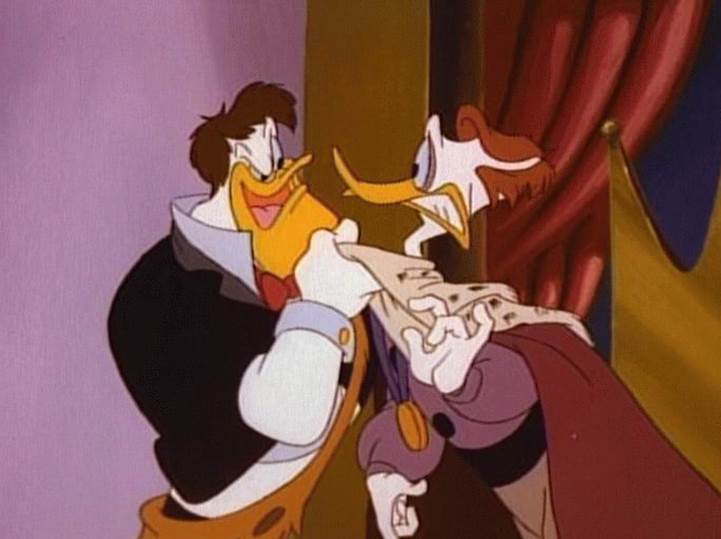
We start with that classic McGuffin: a long-lost, well-hidden treasure map.  During the skateboard mishap pictured above, the ambulating Eskimo drops a bone that proves to be hollow.  The map inside points the way to a stark Arctic peak on Chilblain Island where (according to... no, not the Junior Woodchuck Guidebook, but a convenient Arctic exhibit at the Duckburg Museum) a legendary "sun of gold" once fell and is now buried beneath the ice, along with the artifacts of a "mysterious civilization."  (Hey, if Golden Sun worship can occur on one peak, then it certainly can on another.)  Unfortunately, the Beagle Boys get wind of the find, as well, thanks to their capture of the unfortunate Eskimo.

Yup, them's the DuckTales Beagles, all right. And they're all in character, too, suggesting that Decker must have been paying attention when he viewed whatever episodes he viewed in order to prepare for this gig.  This should NOT be passed over lightly.  Not after a later story like "The Great Chase" (Disney Comics DT #16, September 1991, written by Frank Ridgeway of "Bermuda Triangle Tangle" fame) gave us the memorable sight of a kick-ass, take-charge Burger and a whimpering Big Time and Bankjob deferring to him. As things turn out, the Beagles of "City" will have far more to offer to the discriminating fan than simply looking and acting as they ought to.

Up in Canada's Northwest Territories, a somewhat headstrong Launchpad gets involved in a fracas at a honkytonk -- it isn't explicity referenced as such, but I think we all know better -- and is bailed out by Walking Mountain, a giant, stone-faced, and inscrutable Native American.  The grateful Ducks invite WM to accompany them to the treasure site... which, when you come to think of it, is rather peculiar.  He turns out to be helpful at various times and utters some (yep) appropriately inscrutable remarks, but welcoming the assistance of a complete stranger was, shall we say, not S.O.P. in the TV adventures... or in Carl Barks' adventures, for that matter.

The heart of the story features the Ducks' journey to the legendary Bear's Tooth peak and the Beagles' various efforts to stop them.  We start with a pretty bog-standard version of the "paper-thin disguise" routine...

 Well, their number plates aren't visible, at least.

... which leads to sabotage, a crash, and an unpleasantly close encounter with a polar bear.  The Ducks get out of the fix when Scrooge resorts to the somewhat extreme tactic of lighting the crashed plane on fire "to scare the bear away."  The Ducks' on-board flares subsequently go off, alerting a passing ship to their presence.  As solutions to dilemmas go, this is closely allied to suicide.  But then, the "Type A" Scrooge of this story would probably be tunnel-visioned enough to try it.  We soon see more evidence of Scrooge's mental state when Scrooge poor-mouths in dramatic style in order to rent a snowmobile at a lower-than-rock-bottom price.  A bit over the top, perhaps, for the Alan Young DuckTales Scrooge, but, hey... it's in character.

Upping the ante, the Beagles track the Ducks' snowmobile with one of their own... armed with a gun, no less.  Chisel McSue would be proud, fellas.  Walking Mountain displays some fancy driving in order to get the gang out of harm's way, but the Ducks soon discover that the Beagles had sabotaged their gas cans back at the Eskimo town.  Left to starve and/or die of cold on the Arctic ice, Walking Mountain suggests a rather unusual tactic to attract animals that could (per the JW Guidebook, which HD&L belatedly consult here) be used for food:

Another in-character moment.  It's easy to imagine Launchpad getting into the spirit of things that way.  Alas, the ululations only serve to "attract" the Beagles' ice-breaking submarine. (Did the Beagles have their working boots on in this story, or what?  Makes some of their feebler second-season efforts seem all the more annoying, doesn't it?)  Thrown into the sub's brig along with the Eskimo, the Ducks have little to do but wait out the ride to the Bear's Tooth.

As the Beagles prep for treasure-hunting, Walking Mountain gets his funniest moment of the adventure:

Thanks to a conveniently placed thin crust of ice, our heroes are sent hurtling down, down... to this:


So, where's the gold?  The Ducks find out when they discover a hidden laboratory, a high-tech sarcophagus, and its completely unexpected owner:
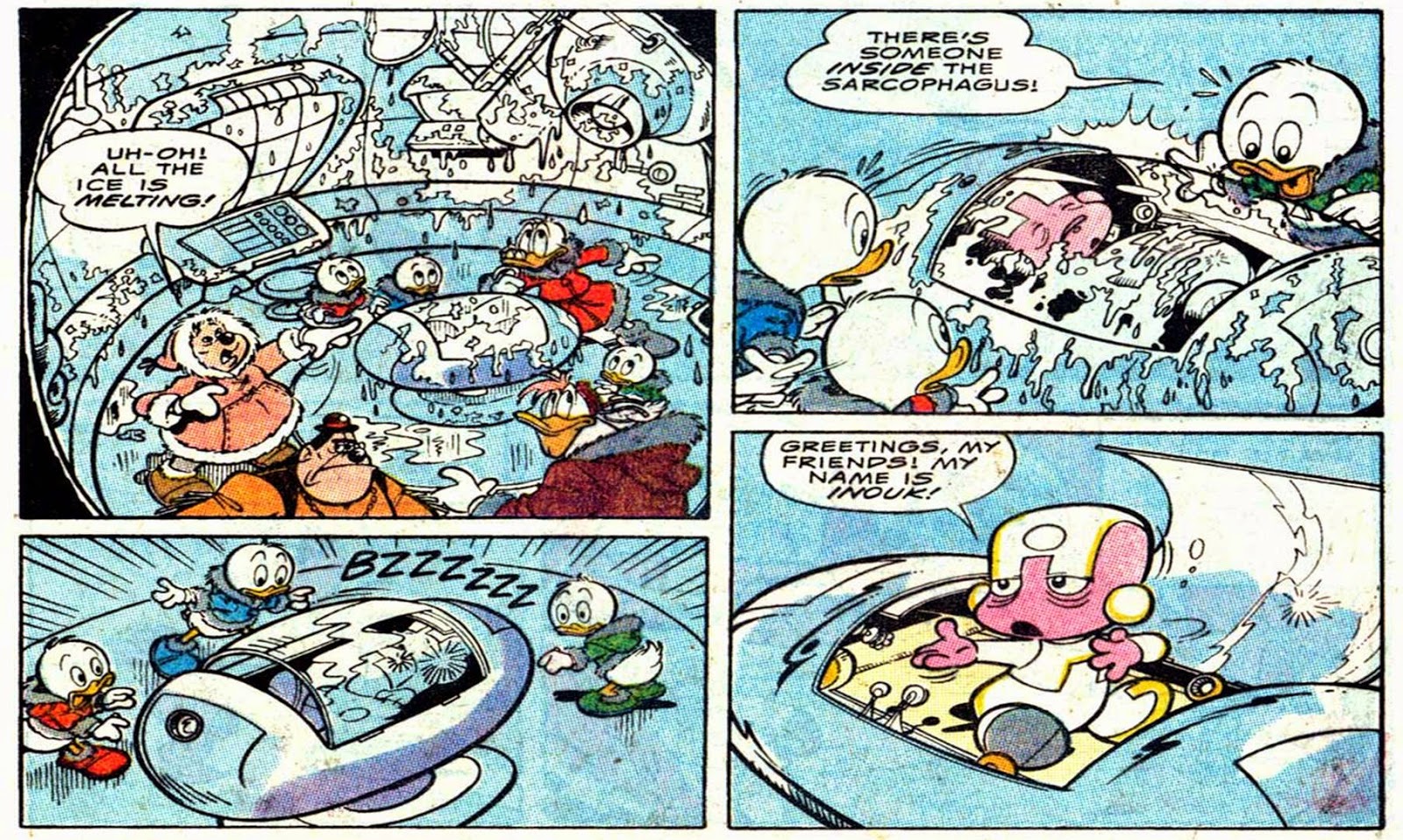
Yes, folks, it's an alien, a Thulian (clever reference, that) who was left behind by an exploration party that had to retreat because of the cold weather.  Inouk was put into the deep freeze with the understanding that his friends would ultimately come back to get him.  The "sun of gold" turns out to have been the golden spaceship that brought Inouk and his people to Earth.  You realize what that means, Scroogie: these guys live on a planet where gold is so common that it can be used to build spaceships -- not the "structural metal" of first choice for me, but to each his (or its) own -- and therefore...

And Scrooge didn't even go through the intermediate stage of hiccuping: he went right to a dead faint.  Any direct reference to "Too Much of a Gold Thing" can't get enough praise from me.  This was the point at which I knew that Dwight Decker had REALLY, REALLY taken his responsibilities seriously. Bless him.

At this point, you're probably wondering whether the story is going to end in the cataclysmic manner of "Gold Thing."  Well, the Beagle Boys are tooling around while operating heavy machinery.  What do YOU think?  

The Ducks' plight isn't as desperate as it was in "Gold Thing," but it comes pretty close.  As if to make up for the shortfall, the mode of the Ducks' salvation is a bit more esoteric than Launchpad flying in the transport plane just in the nick of time.  Here, Inouk flies the gang out of danger using his "golden egg" sarcophagus (which turns out to be a small spacecraft, as well) as the City of Gold, in the manner of its namesake in a Kimba the White Lion episode, collapses into oblivion.  Scrooge takes this development with considerably less grace than he did at the end of "Gold Thing."  Perhaps writer Galliano was letting his inner "L'HUMANITE contributor" out for a little holiday here.


The story's final two pages are a bit displeasing, if only because:

(1) The Beagles are allowed to scuttle away, more or less scot-free.  After that performance, they deserved the dignity of a stay in a luxury high-security prison, at the very least.

(2) Inouk's "rescue ship" just happens to have been located on the Moon all along -- a fact of which Inouk himself appears to have been completely unaware when he went into hibernation mode.  What the heck, was this supposed to be a "monolith test," or something?  Why would Inouk even need one, since his civilization is capable of space travel?

Yeah, I'm just as confused as you are, buddy.

The fact that I have to pick such a tiny nit in order to give "The City Under the Ice" anything less than unqualified praise indicates just how strong this story really is.  It's easy to understand why it sort of flew beneath the radar at the time of its release: Van Horn's multiple stabs at the DUCKTALES lead story naturally left more of an impression than this one-shot, and Gladstone Comics itself was just about to go into its own form of "prolonged hibernation."  But let's give credit where credit is due.  Speaking strictly of DUCKTALES comic-book stories that appeared in America, "City" is one of the very few that can be said to have done full justice to the TV series.

"Golden Sun."  I like the sound of that...

.

.

.

My apologies for making you wait so long to see this.  Hopefully, you'll find the wait to have been worth it.  In my next comics review, we'll catch Disney Comics' DUCKTALES title on a similar back end, so to speak, and look at how the book's 18-issue run ended with Bob Langhans' post-"Gold Odyssey" offering, "A Dime in Time."  Is there any way that Langhans could have lived up to the standard set by "Odyssey"?  We shall see.

Saturday, August 31, 2013

DUCKTALES RETROSPECTIVE: Episode 51, "Jungle Duck"

DuckTales' crack at the legend of Tarzan is probably the series' foremost example of a "neither fish nor (uncapitalized) fowl" episode.  Other adaptations of the story of the "wild man of the jungle" have played the story straight, frequently making reference to Edgar Rice Burroughs' original conception of Tarzan as the lost son of British aristocrats...

... used the Tarzan framework as an elaborate excuse to showcase popular sports/movie heroes in situations more or less convincing...

... or simply mined the idea for laughs, which (the reasonable success of the 1999 Disney animated feature notwithstanding) seems to be the version of the story of which folks are most fond today.


Unfortunately, "Jungle Duck," though it is pleasantly told, never does make up its mind as to whether it's supposed to be a Duckified version of the "Lord Greystoke" legend or a spoof of same.  There are enough serious elements -- the plane crash that stranded young Greystoke in the African jungle, the sympathetic portrayal of the relationship between Greydrake and his ex-nanny Mrs. Beakley, the fact that he's in danger of losing his impending kingship -- that I gather that the FOUR writers who labored over this thing (script by Evelyn Gabai, Jymn Magon, and Bruce Talkington; teleplay by WDTVA production assistant Judy Zook, getting the sole writing credit of her career) were leaning in the direction of playing things relatively straight.  The problem is that the "Jungle Duck" version of Greydrake is rather difficult to take seriously; though he doesn't bungle all that much, his brainpower certainly bears closer comparison to Jay Ward's George of the Jungle than it does to most movie Tarzans, and, far from fighting the idea of leaving his longtime jungle home, he's perfectly OK with it once he's convinced that his "evil uncle" was behind the plane crash.  (It's funny how Mrs. Beakley calls the uncle "evil" as if it were somehow common knowledge.  I agree with Greg and GeoX that this vague motivation seems badly contrived.)  Hopefully, Greyduckistan (or whatever the name of Greydrake's country is) will see fit to provide such a gullible ruler with a quality prime minister.

To me, the most intriguing thing about the episode is the brief, tantalizing hint we get about Mrs. Beakley's past career.  It stands to reason that, if she were able to earn the job of nanny to a prince, then she must have had numerous interesting jobs on her resume before that, much as the Rich family's "perfect butler" Cadbury worked for such masters as "Sir Ruddy Blighter" before being hired to care for the Riches.  RICHIE RICH comics featured plenty of backup stories in which Cadbury told Richie of these past exploits; it seems a shame that Mrs. Beakley didn't get more opportunities to do the same.  Since the Nephews have by now clearly accepted Mrs. B. into their hearts as "the best nanny a kid could have," they could certainly have eagerly taken on the Richie role of fascinated listeners.

We've seen the "You'll never fly a plane for me again!" bit from Scrooge vis-a-vis Launchpad before, of course, but the idea played a much more central role in "Hero for Hire" and "The Right Duck," among other episodes.  Here, it turns out to be a great, big, fat... well, nothing, resulting in ONE throwaway joke as the Ducks are preparing to fly the repaired "silver buzzard" out of the jungle.  In all honesty, I fail to see what was accomplished by including it here.

The "Phantom"'s abduction of "Mizbeaky," the Tarzan/Jane parodies, and the subsequent reveal of "Jungle Duck"'s true identity provide no surprises whatsoever, as GeoX makes exceedingly clear in his review.  Even if a definitive decision had been made to go the more serious route with the plot, this would have been an ideal spot to inject at least a little bit of humor, playing on audience expectations.  For sure, we were never going to get a whole lot of guffaws out of the broadly drawn "savage native" characters.  We never even learn WHY these guys have a swimming pool filled with boiling crude oil.  Why couldn't Scrooge have commandeered the wrecked village for McDuck Petroleum once the natives had been driven away and his hopes for finding the "giant silver mine" had been squashed?  He would be at least semi-justified in doing so, since the natives tried to kill him and the other Ducks for no reason.

The ep's front-loaded pacing -- with too much attention being paid to the Ducks' arrival in the jungle and the initial encounters with Greydrake and not enough time being left over to wrap things up properly -- really begins to work against it once the gang discovers the "silver buzzard."  Needless to say, refining the natives' crude oil and fixing the plane without the use of tools or special equipment requires us to suspend a whole honkin' lot of disbelief, but there simply isn't enough time to make all of this activity convincing.  The last-second creation of the runway (are "Jungle Duck"'s elephants related to the pachyderms who will later notoriously mash coal into diamonds in "Once Upon a Dime"?) is similarly tossed off.  Among other things, I'd be interested to know how Greydrake immediately knew what a runway was.  Perhaps Greg was correct in suggesting that Greydrake was the pilot of the plane.

The encounter with the "evil uncle" is as cut-and-dried as the rest of the episode, with the ruthless relation (whom the IMDB credits rather confusingly refer to as "Uncle Greydrake") rather stupidly revealing his possible complicity in the plane plot.  Even then, I can imagine the uncle filing a lawsuit that would muck the succession up for a while.  For one thing, in order to send the uncle to the slammer, the Ducks would have to prove that the crash of Greydrake's plane was actually caused by sabotage.

Joe and I originally rated "Jungle Duck" as an above-average episode, but I think that I would have to drop its rating a bit now.  I do appreciate the shout-outs to other entertainment entities, such as the comic-strip hero The Phantom (Captain Fargo's referring to "Jungle Duck" as "The Ghost Who Swings by Night"), The Beverly Hillbillies ("Black gold!  Texas tea!"), King Leonardo and his Short Subjects (Greydrake's jungle home being called the "Bongo Congo"), and perhaps even Captain Fargo himself (see "DuckBlurbs" below).  But the balance of the episode, uninspired, thematically inconsistent, and lumpily plotted as it is, is about as "meh" as it is possible for a DT ep to get.

.

.

.

"DuckBlurbs"

Given that it was produced rather late in DuckTales' first season, "Jungle Duck" got a surprisingly large amount of love when it came to adaptations in other media.  It was featured in one of the DT story books (along with a similarly "mid-table" episode, "Dinosaur Ducks" -- I guess that the editors figured that it would make logical sense to pair two "jungle-based adventures" together) and was the lead story in the second issue of Gladstone's DUCKTALES title (November 1988).  Jim Fanning's script for the latter replicates the TV episode's dialogue very closely, so reading the comic is the functional equivalent of watching the show itself.  Once again, Daan Jippes' lively cover contrasts dramatically with the "functional" Jaime Diaz Studios artwork inside.

(GeoX) There's no addressing at all of the moral/philosophical question of whether entering civilization is the right thing for [Greydrake] under the circumstances.

As I mentioned above, Greydrake's brief objection to the idea of leaving his jungle home is casually swatted aside thanks to the "evil uncle" dodge.  Including a more elaborate exploration of the dilemma would have required a full commitment to a serious storyline and some dramatic cutting of the episode's first half.  The writers apparently weren't willing or able to do that.


(GeoX) Someone at the coronation who looks awfully like Gladstone, though he lacks the usual curls.

The inclusion of the cravat definitely suggests that this was supposed to be Gladstone, though the flashy gander rarely dresses in such drab colors.   A number of the members of the Explorers' Club ("Lost Crown of Genghis Khan") can also be glimpsed in the bleachers at various times. 

(Greg) The nephews surprise me by being impressed with Beakly's juggling skills. My guess is her previous line of work was being in the circus. Now THERE'S a back story that Disney never looked into.

You don't want to go anywhere NEAR there.  Trust me. 

(Greg) We then see a window which is dark with white eyes inside and then it comes out as we see a sailor gray wolf (in sailor clothing which looks similar to Don Karnage; only the uniform is a dark blue.) as he asks how he can serve them. Scrooge asks for a guide and the wolf furry (who so happens to have worn gloves) proclaims he knows someone who is tough as nails and can wrestle a Hippo blindfolded. Now that's my kind of guy. Maybe he can wrestle Hoppo off her See Food Diet. AHHAHAHAHAHA! POW! OUCH! Ummm...And of course; it's the wolf who's name is Captain Fargo (Terry McGovern) as he shows his boat and it looks only slightly better than the airplane that Launchpad just crashed. 

I used to think that Captain Fargo might have been a reference to the Humphrey Bogart character in The African Queen (1951).  Since then, I've seen the John Huston film in its entirety and am no longer so sure.  Fargo is characterized in a fashion that simply shrieks "homage," but who else could be the target of the parody here?
 
Next: Episode 52, "Duck to the Future."

Sunday, March 3, 2013

DUCKTALES RETROSPECTIVE: Episode 28, "Treasure of the Golden Suns, Part Five: Too Much of a Gold Thing"

And it literally "started from scratch"...

(No, really.  Right after the title disappears, and as we zoom in on the impatiently waiting El Capitan, the "old wheezer" scratches himself.  A clever and subtle reference to the "madness" to come.)

I think that we can safely say that the vast majority of DT fandom is pretty much of one mind about the high quality of this climactic chapter of "Treasure of the Golden Suns."  Back in September of 1987, who WASN'T imitating the gold-hungry Scrooge by the end and shouting, "More, more, I want to see MORE!"?  The visual gloss of and excitement level engendered by the episode haven't dated one bit, with memorable sequence succeeding memorable sequence and the whole kit (not Cloudkicker) and kaboodle (not Kitten) ramping up to a third act that completely blew away anything on offer from any animated series of the first 40 years of television.  The levels of sophistication of such later series curtain-lifters as "Last Son of Krypton" and "Awakening" -- and, yes, Greg, I'm willing to throw in "Plunder and Lightning," at least when considered as a single, sustained narrative -- may have been somewhat higher, and I enjoyed all of these (and others) to one extent or another, but, as they famously say about sex, there can be only one "first time."  When it came to TV animation, "Golden Suns," with "Gold Thing" as its gilt-edged centerpiece, was the ultimate "first time."

*Phew*  Cigarette, darling?
(Or should I also say, "Here we go again!"?)

As spine-shakingly original as "Gold Thing" was in an animated sense, I think that a case can be made that Jymn Magon, Bruce Talkington, and Mark Zaslove had a particular template in mind when crafting their climactic narrative... namely, Carl Barks' "The Seven Cities of Cibola."  In my discussion of "Wrongway in Ronguay," I agreed with GeoX's argument that the "treasure ship" that Scrooge and HD&L find in the Ronguayian wastes may have been inspired by Captain Ulloa's ship in the Barks adventure.  This got me to thinking, and other similarities between the two tales soon began to suggest themselves to me.  It's a little surprising that these didn't originally attract my attention back in 1987; Gladstone had, after all, reprinted the story in UNCLE $CROOGE #217 in February of that year, complete with one of Daan Jippes' fine covers.  I hadn't yet gotten the set of the CARL BARKS LIBRARY containing "Cibola," and I do remember reading over the "new" story multiple times.  For some reason, I didn't pick up on the parallels when I first watched "Golden Suns" in the two-hour format.  But when you consider that "Cibola" was included in that handy-dandy, putative DuckTales reference source, the Celestial Arts UNCLE $CROOGE collection... well, as I said, there just may be a case to be made here.

HR 


Aside from the blindingly obvious (the ultimate destruction of the treasure site and the Ducks' by-the-skin-of-the-teeth-they're-not-actually-supposed-to-have survival), where else can we see possible links between "Gold Thing" and "Cibola"?

(1)  The "conquistador connection."  Why El Capitan, anyway, as opposed to Le Colonel or der Admiral?  Who knows but that reading "Cibola" triggered the creation of an adversary with a direct link to the conquistadors who, unlike Captain Ulloa and his men, had managed to survive the centuries, thanks to his obsession with the legendary Treasure of the Golden Suns?  The physiological likelihood of such a thing happening is, of course, remote, but the psychological understanding of what drove the ruthless Spaniards is accurate enough.


(2)  The dramatic ways in which the final destination is first revealed to the reader/viewer.  In Barks' story, the Ducks' climb up the cleft leading to Cibola is followed by one of the artist's great splash panels (or polygons, if you want to get geometrically technical).

"Gold Thing," by contrast, obliges the Ducks to pass through a "gauntlet of light," rather than a dark niche, but we wind up getting a very similar "open reveal," albeit from a different (and, for my money, almost equally effective) vantage point.


(3)  The "mounting tension" built into the plots.  Barks takes a fair number of pages to get the Ducks (and, tagging along behind, the Beagle Boys) to Cibola, just as "Golden Suns" takes its sweet time giving Scrooge his crack at the "ultimate treasure."  Once there, the various treasures that the Ducks find get more and more impressive, though we more or less have to take Barks' word on this (the artist shows us a few small-panel shots of various impressive treasures and otherwise assures us in a sidebar that "each 'city' is richer than the one before").  "Gold Thing," with a TV screen to play with, is far freer to sightsee on the trip up the "pecuniary curve."   

(4)  The presence of the "ultimate booby trap."  Barks, of course, lets the Ducks (specifically, Huey) dope out the danger in time to avoid causing catastrophe and gives the cluelessly greedy Beagle Boys the "dishonor" of activating the trap instead.  In "Gold Thing," with Jymn et al. having committed to plugging the infamous "Scrooge gets gold fever" angle from the get-go, it's only logical that Scrooge and the equally lucre-addled HD&L wind up tripping the... big sun clock-gear... uh, thing.  I wonder: had Barks thought up the idea for "Cibola" about five years earlier, when Scrooge was a somewhat more villainous character, might he have been tempted to teach the old miser a similar "lesson"? 

(5)  Scrooge "losing control."  Well, he comes close in "Cibola," though he never quite tips over the edge.  But isn't dizziness one of the first symptoms of, um, fever?  The dollar signs popping from Scrooge's head are a familiar enough motif, but in how many other Barks treasure-hunt stories does he show that weird, glassy-eyed stare?  Are hiccups truly that far behind?  Thank goodness Huey was there to pour the alcohol down the drain, so to speak.

(6)  "Picture talk."  Both stories make use of rebus writing (translated by the Junior Woodchuck Guidebook in both cases) to push the plot along, though the message in "Gold Thing" is rather more important in terms of the Ducks' immediate physical well-being.  The logic of Barks' message is admittedly a lot firmer; assuming that the "dead duck" who wrote the "Gold Thing" rebus died fighting over the gold before he had a chance to trip the booby trap -- and he must have, since, well, the Valley is still intact -- then how would he have known the consequences of tripping said trap?  But it is easy to imagine the "Gold Thing" writers looking at the Barks panels below and drawing some visual inspiration from them, even if they simplified the actual execution.

The one great advantage that "Gold Thing" has over "Cibola" is its ability to literally "bust the boundaries" of traditional comic-book panels and make static visuals "real."  Granted, Barks came pretty damn close to managing this himself on paper, in a famous scene that had an equally powerful impact on pop culture (just ask George and Steven about it sometime).


"Gold Thing," however, has the artistic freedom to stack the Ducks up against peril after peril, starting with dangers that are more or less self-imposed by an increasingly demanding and desperate Scrooge...


... and then, once inside the Valley, using various improbable means to keep the pressure on...


... leading to the unforgettable scene at the end of act two which -- and I give GeoX full marks for recognizing this -- is unquestionably the psychological climax of the story.  Here is how Geo describes it:

And here, we see what I would call a genuinely great moment; certainly the best in the series so far: [El Capitan] overtakes [the Ducks] and lowers them into a pit of lava to do away with them; as they get to the bottom, it becomes clear that it's actually a pit of molten gold, and in Scrooge's ecstasy at this revelation, we see that the ultimate satisfaction of his lust would be to immolate himself therein. It's really just a momentary thing, but it is authentically frightening.   


I'd add to this the comment that Scrooge is so far gone with "gold fever" by this time that he mindlessly puts his frightened companions in peril at the start of act three by twirling the basket around like some sort of demented ballet dancer.  Even when Scrooge punctured the raft to get away from the caymans, you got the sense that he knew what he was doing (well, sort of) and didn't intend to see the other Ducks get hurt.  Here, he doesn't seem to give a damn about anything but the improbable natural resource boiling away a few feet below.  In completely neglecting the immediate welfare of the other Ducks, Scrooge really does seem to have gone "mad for gold" here, just like El Capitan.  It takes the jealous El Capitan's decision to pull the Ducks back up in order to keep them from "tainting his gold" to finally restore some tiny bit of lucidity to Scrooge, even though it is entirely focused on "getting rid of" the rival to his treasure.


As things literally begin to fall apart, Mrs. Beakley finally gets through to Scrooge by... reminding him that he'll die if he doesn't think of saving his own tailfeathers first.  Unlike GeoX, I don't really see a problem here.  This restoration of the "life wish" to Scrooge seems a fitting response to the "death wish" that he displayed during the scene in the pit.  Once Scrooge decides that staying alive is the first priority, all else follows naturally: his ultimate compassion for the hopelessly insane El Capitan, his apology to Mrs. Beakley.  In other words, Scrooge was "back" well before the young Ducks "officially" welcomed him back.  (Incidentally, no explanation is ever given as to how the Nephews shook off their case of "gold fever."  Perhaps HD&L simply didn't have enough experience with treasure-hunting to be profoundly affected by the "disease" and thus found it easier to purge it from their systems.)

The final rescue sequence, of course, can hardly be faulted on any level, with Launchpad finally slipping out of his episode-long role of interstitial comedy relief and making the ultimate save -- and quite slickly, too.  (It probably helped that, by that time, there was no hard surface left in the Valley for him to crash into.)  The draft version of the script that I own, BTW, would have added to the degringolade by showing scenes of temple gargoyles spitting molten gold and melting away from the intense heat.  Apart from offending Gargoyles partisans, I don't think that this would have added much to the legitimate creepiness of the pre-pickup scenes that did make it to the screen.  These scenes were pretty darn chilling a quarter-century ago and retain their effectiveness today. 


Needless to say, I don't think that there was any way that DuckTales would have killed off El Capitan, especially given the dreadful options that were available for his demise.  There is something truly troubling, though, about El Cap's ultimate fate.  Just imagining him willingly scraping and scrabbling through that dirt and rubble for another few centuries gives me pause, try as Scrooge might to make his own comment on the matter sound a bit light.  El Cap had the "sheer willpower" to live this long already, so one can easily imagine him continuing this pseudo-existence for an indefinite period of time.  Images of the eternal trials and tribulations of some of the "damned" characters in Dante's Inferno immediately come to mind. 

As we prepare to fade out, one rather annoying false note clouds the sunset: Scrooge's claim that he can't be bothered to go on any more treasure hunts, since "there'll never be another prize this big again."  This was too obviously a contrived way to set up the final gag of Scrooge teasing the return of "gold fever."  As such, its logic is about as dubious as that of the whole notion of "gold fever" itself (which I'll address in "DuckBlurbs," in response to GeoX's comments on the issue).  As we all know, Scrooge will NEVER be too complacent, or too crotchety, or too miserly, or too... whatever, to take on a treasure hunt wherever it presents itself.  Indeed, such will be the theme of the remainder of the DuckTales series, just as it is in stories by Barks, Rosa, and other "Duck Masters."  It is the ability to bring the spirit of a Scrooge fortune-seeking adventure to life -- and to do so with style, grace, and visual splendor -- that gives "Golden Suns" its deservedly iconic status as a landmark in TV-animation history.


.

.

.

"DuckBlurbs"

Look what I found!  An image of the original title card from the two-hour version of "Golden Suns."  It's a bit blurry, but still.  I had forgotten that the title lettering was colored gold (seems fitting, don't you think?).  A leading "The" also seems to be canonical.  I think I'll stick with "Treasure of the Golden Suns" anyway; it seems snappier and more dramatic, somehow.

(GeoX)  The episode creates a parallel between Scrooge's lust for gold and that of Sinister Foreigner (yeah, I know he has a name, but it pleases me to just refer to him as Sinister Foreigner all the time)--fairly sophisticated, you might think, but, well, not really; what this amounts to is that Mrs Beakley ceaselessly and melodramatically maunders about how Scrooge is in the throes of the TERRIBLE GOLD FEVER. Subtle it ain't. I thought the show might make a connection with "The Fabulous Philosopher's Stone" and suggest that he might turn into gold if he keeps this up, but it never goes there. Nor is it at all clear why this particular quest rather than any other should trigger this TERRIBLE GOLD FEVER. Hey, I admire the effort, but I have to say the execution is kind of on the lackluster side.

The original script actually hit the theme considerably harder, especially in the early stages of the episode.  For example, in the first scene on the plane where the scratching and snarling Scrooge has begun his initial descent into "madness," we were originally supposed to get the following highly disquieting exchange:


Mrs. Beakley: Mr. McDuck, can't we please take the children home before you continue this treasure hunt?
Scrooge:  NO!  (whacking a crate with his cane) I want that gold NOW!
Mrs. Beakley:  But it may be dangerous...
Scrooge (swinging his cane like a saber and cutting off Mrs. B. in mid-sentence):  That's too bad, Beakley!  I didn't ask any of you to come along, did I?  So you'll just have to take your chances!

There follows Huey's suddenly-far-more-significant comment, "I've never seen [Unca Scrooge] like this before!"  As harsh as Scrooge's words may sound, I'm somewhat sorry that they weren't included in the final version of the script.  They would have given extra gravitas to Mrs. Beakley's comment that "gold fever" "makes you itch for wealth so much, you forget what's important," and infused the relationship between Scrooge and his companions with that much more tension.  (Imagine the extra edge it would have given the cayman-escape scene, for example.)  If you're going to give Scrooge a contrived malady like "gold fever" at all, then you might as well extract the maximum amount of conflict and turmoil out of it.

I've come to think of "gold fever" as just another example of "80s cartoon ethics" influencing DuckTales in a tangential manner.  It is noteworthy that the series' concluding adventure, "The Golden Goose," which also involved a battle over an "ultimate treasure," used the same theme of Scrooge turning away from his preoccupation with wealth (i.e., trying to save the petrified HD&L by recovering the goose and returning it to its rightful owners) but didn't feel the need to explain Scrooge's gold-lust by appealing to some dubious affliction.  The Scrooge of "Goose" acted much more like the Scrooge of "Cibola": he came close to tipping over the edge when he started turning various objects in and around his Mansion to gold, but he never quite did so.  The Scrooge of "Gold Thing" didn't have to suffer from "gold fever" in order for the adventure to work.  These days, the addition of the theme seems like a bit of moralistic overkill that wasn't really required.

So where did Mrs. Beakley learn all about "gold fever"?  Short answer:  She was the only other adult present (El Capitan doesn't count, for obvious reasons).  Longer, "what-if-fier" answer: during one of her previous periods of presumably exotic employment (her years "in the service of Sir Ruddy Blighter," for all of you RICHIE RICH fans in the audience), she participated in some other treasure hunt and learned about the affliction first-hand.

(Greg)  We begin this one in a bay with a rowboat as El Captain is wheezing about gold again. He also has the telescope which is awesome in one sense; but it's fashioned in banana yellow. El Captain decides that Scrooge is at the Valley of the Golden Suns by now and that he'll just follow him and grab the treasure. And then he'll MURDER Scrooge with his Gedo-laced telescope complete with evil laughter. Ooooo....that would be deadly to both Scrooge's head and his fashion sense if that thing connects. Sadly; he whacked his hand on the miscue and he sells it like a madman. HAHA! Well; with him that is completely apporos.

Actually, El Capitan seems to miss his hand, which makes his reaction seem all the funnier (or crazier).  The original script contained a fairly large bit of additional pre-Valley business involving El Cap jumping up and down for joy when Scrooge's plane arrives, getting knocked into the drink, vowing revenge as a result, etc.  Even the small bits that we ultimately did get were trimmed out of the two-hour version: Who can forget E.C. suddenly appearing from OUT OF NOWHERE on the ancient pathway and following Scrooge and company?  I rather wish that the latter had been preserved in the long version of the story.  The more screen time El Capitan gets at the beginning of the episode, the more time we have to wonder (1) how on Earth he managed to pick up Scrooge's trail again in the first place, (2) why he doesn't seem capable of locating the Valley without Scrooge's assistance now that he's so close to it, especially given that he can literally "feel" the gold's presence.  You would think that after 400 years of searching, having gotten thisclose to his goal, El Cap would have been just a wee bit more proactive.


(Greg)  So we get another scene changer as Scrooge and company go through the jungle pushing red leaf trees in their wake. Huey asks Dewey about the strangeness of this road and Dewey answers that there is not a burger place in sight. Huey corrects him because why build a road if the valley is supposed to be a secret. UH OH! The nephews deduce that this pathway is a trap. NO?! REALLY?!

Nowadays, I can't watch this scene without immediately thinking of the first panel of Barks' "Gall of the Wild":

It's all in the delivery, I guess.  The Nephews of "Gold Thing" sound like regular kids, the HD&L of "Gall" like... well, their Quack Pack selves.

(Greg)  And so we get an awesome running sequence which ends with Beakly and the children getting to the ledge on the sides and then we see the awesome running sequence of Scrooge and El Captain from the opening sequence. Oh; and the temple crumbles into the molten gold of course. Scrooge and El Captain make the leap of faith and manage to grab onto the ledge as the gold bricks fall into the molten gold. 

Just so we can end on a really high note... Sing along, everybody!
  
What to do?  Just grab onto some... ledges!

Next:  Episode 29, "Duckman of Aquatraz."