
Saturday, July 13, 2013
But What Happened to Ho Lee's Brother, Wat Ta?
Reporting on the recent plane crash at San Francisco Airport, a SFO news station fell for a prank pulled by an "intern" at the National Transportation Safety Board and actually presented this information on air:
 This ranks right up (or down) there with U.S. NEWS' referring to the first man to set foot on the Moon as "Neil Young."
Thursday, July 11, 2013
DUCKTALES RETROSPECTIVE: Episode 44, "Raiders of the Lost Harp"


Right at the start, we get an intriguing indication as to the level of care taken with this episode. As the Ducks break into the "lost city of Troy," note how Huey is consistently depicted as being somewhat nervous about what lies ahead. He lets his brothers go in front of him when the Ducks climb up the stairs to the wall...


Speaking of magic, another nice serving of subtlety is baked into Scrooge's comments regarding his feelings about the validity of magic and superstition. Scrooge's claim that "mindless superstition" has no place in exploration and treasure-hunting seems to be contradicted by his later declaration that he's seen many things that "only magic" could explain. In fact, Greg seemed surprised that the harp didn't call him out for speaking a falsehood in that latter comment. However, it doesn't take a lot of thought to recognize that there's no conflict here. In the former case, Scrooge is trying to say that superstition will not dissuade him from seeking out treasures, while in the latter, he is affirming that he realizes that magical powers do exist (how could it be otherwise when one of his most persistent foes is a witch?) and that he does respect them. Ironically, Scrooge gets into trouble in this ep by overlooking the possibility that some magical force may be guarding the carefully hidden harp. One would think that this might affect his attitude in the future. Not hardly; in the very next episode, "Luck O' the Ducks," he's once again mucking around with a "magic-tinged" treasure without giving it a second thought.
This is arguably the closest that Magica De Spell has ever come to being depicted as something of a supervillain. We know from way back, of course, that she's capable of changing her appearance, and she adopts several memorable guises here, including what seems to be a tribute to an old Carol Burnett sketch character...


... but she also augments her arsenal with goons (only one, true, but that's a necessary step towards having a whole gang of them, Batman-TV-series style) and a "themed" mode of transportation that even outdoes the "Satan 666 Jet of Death" seen in "Send in the Clones."


Of course, she's not averse to old-school methods of villainy, such as applying indiscriminate force and hiding out in more-or-less-likely places.


This diversity of approaches and accouterments seems apropos in view of the fact that Magica's scheme here goes well beyond her standard pursuit of Scrooge's Old #1 Dime. We never learn anything about what specific plans Magica has for the harp, apart from her egotistical claim that, if the "inferior" Helen of Troy achieved greatness with its help, then there's no limit to what Magica can accomplish. But, in a sense, it doesn't really matter. Supervillains, after all, tend to be interested in acquiring sources of boundless power simply because, well, that's what they DO. The details can be ironed out later.
Fittingly, given the episode's depiction of Magica, the conflict between Scrooge and the notorious necromancess has something of the flavor of a hero vs. villain battle that you'd see in a superhero comic, complete with multiple action scenes. In the process, Scrooge's work rate comes close to matching that seen in "Merit-Time Adventure." Right at the start, Scrooge gave a hint that he was "up" for the tussle to come by climbing the Minotaur statue and moving the stone lid to reveal the harp without any outside aid whatsoever. He subsequently performs a "car-to-car transfer" that is all the more impressive in view of his, er, somewhat advanced chronological state...

... rides the harp-holding desk through the streets of Duckburg, performing several vaults and an X-Games-fashion "flip stunt" along the way...


... and finishes with a flourish by hitching a ride on the escaping Magica's claw-copter, grabbing the harp, and free-falling into the bubble-gum-covered street. OK, the plunge isn't on the order of Kit Cloudkicker's various "dives to doom," or even the semi-comical free fall in "Working for Scales," but it shouldn't be lightly dismissed. Scrooge deserves some additional bonus points for enduring chokeholds, airplane spins, and the like while being Duck-handled by "wrestler Magica." Heck, he even evinces a high level of testosterone when he invites "Magica-Helen" into his office without a second thought! How can one fail to be impressed by all of this?


Of course, the Scrooge/Magica faceoff is far from being the only harp-centric conflict that manifests itself once Scrooge and HD&L get back to Duckburg. The dialogues between Scrooge and Duckworth are brief but take full advantage of such established character tropes as Duckworth's polished bemusement and Scrooge's cheapness. Duckworth doesn't make as big a deal of the matter as do HD&L, but the viewer gets the definite impression that he views a future in which the harp interferes with life in McDuck Mansion as something less than ideal.

The Nephews, of course, have the most to "lose" from Scrooge's possession of a "little golden tattletale"... which, by the bye, strikes me as a slightly ungenerous bit of characterization on Wilkerson's part. Are the boys in the habit of lying to Scrooge? I hardly think so, and the only "fiblet" they tell here doesn't mean anything at all in the "big picture" scheme of things. They've cleaned up their room as they were asked, and there's no indication that Scrooge explicitly told them NOT to put their junk in the closet. Where else could they be expected to put it, anyway?


I think that Wilkerson's peculiar treatment of HD&L here was a manifestation of something that occasionally pops up in both printed and animated depictions of the boys; namely, the desire to present them as "regular guys." It isn't "cool," after all, for HD&L to excel in school, which Wilkerson clearly hints that they are not doing here. However, it is "cool" to skate on down to a video arcade (or whatever has taken its place in the ensuing quarter-century) or make incongruously sly remarks while decked out in tuxes. Taken to an extreme, this sort of approach results in Quack Pack. Even in its mildest form, I do find it slightly annoying. I think the Nephews are plenty "cool" just as they are.


The character that looms over all else in "Raiders" is, of course, the Minotaur, and the stone statue's slow-motion invasion of Duckburg is one of the show's great set pieces. The only negative aspect of the Minotaur's performance is the "gleeful gurgling" that Frank Welker performs when Scrooge finally yields to the inevitable and returns the harp. A simple "snort of recognition" would have been more in character than this momentary slide back into Scooby-Doo territory.


I would argue that one additional character needs to be considered in this mix -- namely, the harp itself. The "bitchy, bitchy, bitchy" voice used by Russi Taylor may drive Greg and other people up the wall, but, in a sense, its irritating inflections are fitting. Most people, after all, don't WANT their lies to be called out, and so it makes perfect sense for "the voice of the truth" to grate on one's nerves. Note that, in the scene with Scrooge and "Magica-Helen," the voice becomes more annoying the more whoppers "M-H" tells. If consciences used Taylor's voice here as a template, then a more honest world would almost inevitably result.
"Raiders" is one of those DuckTales eps that no one gets tired of watching... and, more to the point, that no one should get tired of watching. In no other made-for-TV episode is the "feel of Barks" more palpable, or more authentically sustained -- albeit with a few clever twists.

And convincing HD&L to wear formal gear isn't the least of them.
.
.
.
"DuckBlurbs"
(GeoX) This is a pretty classy episode, I've gotta tell you. It's packed full of incident--maybe slightly too much so; I can easily see this working as a two-part episode...
There are a couple of indications that the episode had to be trimmed in order to meet the 22-minute running-time limit. The jump from Scrooge finding the harp to the Ducks carting their Trojan treasures away seems a bit abrupt, likewise the quick cut from the contents of the boys' closet burying the Ducks to Scrooge cackling with the harp in his hands. I noted above that Wilkerson's comic-book scripts have a "frantic" pace, and one of the reasons is that she literally tries to cram too much action and dialogue into each panel. Here, however, the "overbooking" seems to have been kept reasonably under control.
(GeoX) There is one thing that doesn't make sense: Scrooge locks the harp in
his desk and tosses the key in his vault for safekeeping, but…for some
reason he can open it just as easily with HDL's "skate key?" Wuh?
We're supposed to believe that Scrooge is so cavalier about security
that he'd have a desk that any key fits?
(Greg) After the commercial break [at the end of Act Two]; we get a
shot of the bay as the desk floats up (HA!) and Scrooge pops up
coughing and gasping for air. Scrooge gets on the desk and tries to
open it because he wants the harp. Umm; check your internal logic
there guys. The harp is in the right drawer; not the central drawer.
Then again; Scrooge might be going insane after the salt water has
infected him; so I'm going to not call it a logic break. The nephews
call it a solution to their harp problems. The nephews then recoil
because they don't want to suffer the insanity of Scrooge McDuck as
Huey throws the skate key over to Scrooge and he almost lets it drop
into the ocean. Scrooge takes the key and opens the central drawer
and takes out the harp. It's the top right one you idiot! Logic break
#1 for the episode 17 and a half minutes in which is a new record for
Ducktales thus far. And as he cheers for victory; the desk sinks into
the ocean again. HAHA! See; I'm always right about these certain
things in the end.
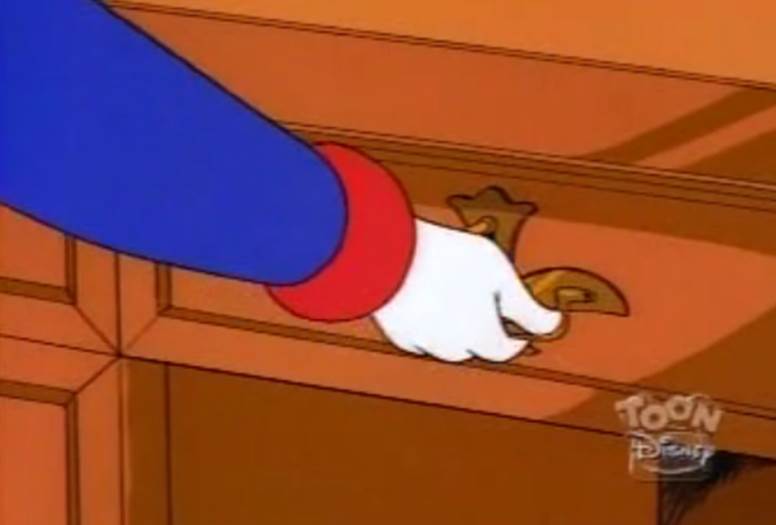
I figured I'd tackle both of these at once for obvious reasons. HD&L's "skate key" is probably a Junior Woodchucks-sanctioned key, which means that it has drawer-opening powers far beyond those granted to standard skeletons... and, since JWs wouldn't think of breaking into other people's property without permission, that takes care of the security issue right there. As for which drawer Scrooge used to hide the harp... well, it's pretty clearly the center drawer, since that's the only one with a keyhole. While it looks as though Scrooge pulled the upper-right drawer in the shot immediately following the one below, that's simply because he happens to be standing on the right side of the desk to begin with. That's more of an "inaccurate positioning" than an outright logic break.
(Greg) We get a shot of the city [of Troy] which looks
like a golden stone lost city as the nephews aren't too keen about
this discovery.
And they suddenly revert to their old habit of "completing a sentence together": "Yeah, Unca Scrooge... sure is... exciting!" This was probably Wilkerson's doing, since the boys did this on several occasions in her comics scripts. Unfortunately, it comes off as a bit awkward on screen, mainly because there are noticeable pauses between the phrases. When Clarence "Ducky" Nash did it in the old cartoon shorts, HD&L typically fired off the sentence in machine-gun fashion.
(Greg) Magica
grabs the scroll from her stone safe (I guess considering how it
crumbles) and we see some information on the magic harp in Greek
symbols (delta, pi, omega. I don't know what it means and I don't
think the writers do either) along with a picture of the harp.
There's actually a Delta Pi Omega sorority, but it appears to be a local organization, as opposed to a national one.
(Greg) The nephews still haven't decided on getting rid of that tattletale
bitchy harp yet. Dewey suggests talking to Scrooge about his side of
the story and speaking of the rich devil himself; Scrooge rides down
the street on his desk which makes the nephews panic. They race down
to help which the [Quack Pack] nephews would never do for their uncle. Because
they would blow off Scrooge as an old fuddy duddy and then go home
and fling forks in the ceiling whining about having nothing to do.
Now THERE'S a good home for that annoying harp: In Quack Pack; inside
the new nephews room; just to piss them off.
*Applause for a brilliant idea*
(Greg) Huey jumps in off-screen and grabs
Scrooge who nearly drowns...
... which is rather interesting, given that the Scrooge of "Merit-Time Adventure" demonstrated considerable proficiency at swimming and scuba-diving.
(Greg) So we go to a city roof top shot AFTER
HAPPY HOUR as the helicopters are spotlighting the entire city. We
then go to a ground shot of the police chief (in a green uniform; I
guess he's part of the army of Duckb[u]rg) with the MEGAPHONE OF JIMMY
HARTS (Chuck McCann) ordering everyone to leave and not panic. That
face and white beard looks familiar to an early Ducktales episode
where Scrooge was framed for stealing something.
"Duckman of Aquatraz" -- the warden. I guess that he pulled the duty when the Chief O'Hara clone (see "Robot Robbers") went on vacation.
Next: Episode 45, "Luck O' the Ducks."
Tuesday, July 9, 2013
Movie Review: DESPICABLE ME 2 (Universal, 2013)

S
P
O
I
L
E
R
S
P
A
C
E
The idea of ex-villain Gru (Steve Carell) being recruited by an "Anti-Villain League" to sniff out a new (or IS he new??) supervillain is a perfectly acceptable springboard for an action-filled plot. It's therefore surprising that DM2 hardly DOES anything substantial with the idea. The "AVL" seems to consist of only two people (snooty head Silas Ramsbottom and enthusiastic newbie agent Lucy Wilde), and our ultimate bad guy gets amazingly little screen time. You don't get the impression that the "threat to the world" is anything to lose sleep over, even vicariously. Add to that the fact that the supervillain's plot simply consists of turning the Minions into purple, caffeine-jagged, and decidedly inept monsters, and it's clear that the movie's priorities lie elsewhere... namely, with the antics of the Minions and the growing relationship between Gru and agent-partner Lucy. The latter is the best part of the movie, with Christine Wiig giving an energetic and extremely funny performance that complements Gru's generally saturnine personality. Gru's three adopted daughters are a larger presence than I had feared they would be, with Margo developing a crush on a suave Hispanic boy and Agnes... well, being cute, but "middle child" Edith gets almost no attention whatsoever, apart from occasional demonstrations of junior karate and nunchuk moves. (Jan Brady would certainly sympathize.) All else is subordinated to lengthy bouts of Minionism, some of which seem to have been thrust into the movie with no purpose whatsoever. What was the point of including that party sequence in which the Minions are pigging out on ice cream? At least the "Cinco de Mayo" party sequence helped moved the plot along. I am afraid that the Minions are one of those ideas that works well in small doses but gets more and more irritating with increased exposure. How the little yellow buggers could possibly sustain a movie all by themselves is beyond me, but, evidently, Universal is preparing to find out. Let's hope that the experiment doesn't result in the cinematic equivalent of PX-41.
The "importance of family" theme that gave the silliness of the original DESPICABLE ME a welcome dose of pathos and realism is still on display in DM2, but the execution of the theme is somewhat cruder. I had a particularly hard time buying Dr. Nefario's switches of loyalty. OK, so he decides to return to Gru's side because he wants nothing to happen to his old "family," which, I presume, would include the Minions... but he had no problem turning the Minions into monsters in the first place?? At least Gru and family wind up in "happy ending" territory, and there I hope they remain. I would like to retain positive memories of these characters.
Monday, July 8, 2013
Book Review: WALT DISNEY'S MICKEY MOUSE COLOR SUNDAYS Vol. 1: CALL OF THE WILD by Floyd Gottfredson (Fantagraphics, 2013)

During his time on the Sunday page, Gottfredson alternated sequences of "done-in-one" gag strips with short continuities. The complexity of the latter gradually ramped up until they approached daily continuities "in miniature" -- and with a slightly lower "seriousness" quotient. "Dr. Oofgay's Secret Serum" (1934) tackles the same basic trope as the earlier daily story "Blaggard Castle," with a scientist's invention altering Horace Horsecollar's personality, but the metamorphosis occurs in the context of a gag-laden camping trip, occurs by accident (Horace sitting on a serum-filled needle), and is caused by a much dottier and more "lovable" miracle-provider than the fearsome trio of Professors Ecks, Doublex, and Triplex. In "Hoppy the Kangaroo" (1935), Mickey undergoes a test run in the "training an unwanted gift animal to win an athletic contest" sweepstakes several months before having to deal with Oscar the Ostrich in the daily strip, but the stakes are nowhere near as high; Mickey's simply trying to best Pete and Pete's trained gorilla, as opposed to staying out of jail for non-payment of debts. "Rumplewatt the Giant" (1934) and "Foray to Mount Fishflake" (1934-35) is arguably the most "Sunday-centric" of this collection's continuities, primarily because they're very consciously constructed in a cliffhanger format within the general Sunday format itself, complete with "To Be Continued" boxes and first-panel recaps from Mickey.
Early on, Gottfredson seems to have realized that the Sunday page was a good vehicle for the introduction and/or development of new characters. Various bands of cute-on-the-surface-but-anarchic-underneath Nephews who come to disrupt Mickey's home life ultimately settle down to the twin urchins who will become Morty and Ferdie, while "The Case of the Vanishing Coats" (1935) gets several weeks' jump on the daily strip's "Editor-in-Grief" in terms of being the strip's first continued story to feature Donald Duck. "Coats" might be considered the template for all future Donald and Mickey teamups, albeit with a considerably rawer version of Donald (though Don's not really all that intolerable in this brief tale, with his antics mostly limited to one well-meaning false arrest) and a solution that is, in all honesty, pretty lame. In gag strips, Don "enjoys" (if that's the word) a brief period as the successor to Mickey's role as comical fall guy before literally being shifted "upstairs" to the SILLY SYMPHONIES "topper" page and, later, to his own stand-alone strip. Goofy (nee Dippy Dog/Dawg) makes appearances in "The Lair of Wolf Barker" (1933), the first of the major Sunday continuities, and "Mount Fishflake"; the sideways logic that will so memorably inform so many of his gag-strip appearances in the late 30s has just barely begun to blossom.
The volume's ancillaries include a fine essay by J. B. Kaufman detailing the development of the Sunday page, David Gerstein and Sergio Lama's description of the earliest attempts to bring MICKEY (or a strange-looking approximation of same) to Italy, and Joe Torcivia's not-to-be-missed explanation of why Mickey's tall tale of "Rumplewatt the Giant" qualifies as the "Longest Short Story Ever Told." Thankfully, we won't have to wait long for the other volume of Gottfredson's Sunday best to drop on our doorsteps; COLOR SUNDAYS VOL. 2 is scheduled to be released in October.
Friday, July 5, 2013
DUCKTALES RETROSPECTIVE: Episode 43, "Back Out in the Outback"

At long last, we've reached the edge of "Vanderquack Valley." "Back Out in the Outback" is arguably the first DuckTales episode the acceptance of which depends primarily on one's opinion of the show's most controversial first-season creation. Two main reasons why:
1. Webby gives her first extended "solo performance" during her lengthy sojourn out back of... er, the front of... (yeah, it was a pretty lame attempt at humor even when Launchpad used it). In all of Webby's previous appearances, including those like "Cold Ducks" and "Merit-Time Adventure" in which she was a focal character, she participated in the adventure as part of a larger group. Here, we are fed several stiff doses of 100-proof Vanderquack... and if you don't have a taste for the character in general, then you are REALLY going to have a tough time swallowing these.
2. The character trait of Webby's that is most emphasized here -- her famed "way with animals" -- is exactly the kind that tends to drive those who dislike Webby completely nutsoid. Even GeoX, who claims to have less of a problem with Webby's cuteness than some, used words and phrases like "sugar shock" and "vomitous" when describing Webby's bonding with the "shy" Australian critters.
Now, I'm a Webby fan from way back, so I have less of a problem with "Outback" than most folks... and Webby's performance is hardly the only reason why. It's yet another attempt by Richard Merwin to capture that old Scooby-Doo magic within the DT framework, and it's the most successful, primarily because Merwin dispenses with the whole idea of a "phony ghost" and makes the mysterious "willywisp" menace a technology-based one. He also makes a legitimate attempt, however transparent it might seem in retrospect, to chuck a "red herring" in our path at the end of Act Two. The supporting players are decently characterized, the animation is generally excellent, and, true to Scrooge's constant requests for "teamwork," everyone gets something to do -- though it takes certain individuals (I'm looking at you, HD&L and Launchpad) longer to get their duck-billed platypi in a row than others. The fact that the ultimate villain turned to the dark side because he resented Scrooge's exploitation -- a storyline that seems more appropriate for a first-season episode of Batman: The Animated Series -- gives the ep an extra dash of seriousness and is very much in line with Merwin's generally more negative characterization of Scrooge. Finally, Webby's activities are far from all being cutesy-wootsey; she does face some legitimate perils, with her reactions to them being sold well by Russi Taylor... and how many times does one get to see "The Wrath of Vanderquack" in all its infrequent glory, as we do when Webby directs the four-footed troops to pen up the villains?


"Outback" is actually the third Duck story of which I am aware in which the Ducks visited a besieged Aussie sheep station (or farm, or range, or ranch -- take your pick). Barks took two bonzer wallops at the task, one in the 40s and the other (with Scrooge added) in the 60s. As GeoX noted, "Outback" has relatively little in common with either of these. "Adventure Down Under" (FOUR COLOR #159, August 1947) finds Donald and the boys, who've been sent to Australia in a rather contrived manner, trying to help a rancher fight off a nasty "kangaroo queen," only to ultimately bond with the animal. Donald plays the Webby role in this story, though it's more out of sheer necessity/desperation than anything else.

One way in which I wish "Outback" could have borrowed from "Dog Pack" is for HD&L's neglect of Webby to have been the result of their sudden infatuation with pop singer Tweedy Teentwirp. The boys actually are treated rather harshly in the episode; Webby literally gives them NO CHANCE to begin looking after her before plunging into the forest after the joey. Having the boys be distracted by the music would have put something of an onus on them to match the arguments among Scrooge, Launchpad, Sundowner, and Dashing Duke Duggan.


And GeoX thought WEBBY's dialogue was "vomitous"...
I can certainly appreciate Greg's approval of "Sundowner" as the name of the Rob Paulsen-voiced heart-of-gold bloke with the malodorous clothes that could probably stand up all by themselves, but the use of this term could be considered misleading. According to Wikipedia, "sundowner" is one of the names given in Australia to a transient worker who drifts from ranch to ranch looking for employment. The movie The Sundowners (1960) centered around a conflict between characters who wanted to maintain the on-the-go lifestyle and characters who wanted to settle down. The irony of "Outback," of course, is that Sundowner is, in Scrooge's words, a "loyal, trustworthy, low-paid employee" who seems perfectly content with his stationary lot. Even the burly Duke Duggan (Peter Cullen) wants to stay at the ranch -- provided that he can run it and exploit the nearby opal mines, of course.

So, what was the source of those stains on Sundowner's pants?
As Greg might put it, "I smell a fanfic coming" -- and, boy, do I ever!
Greg, with tongue somewhat in cheek, compared Duke Duggan to the equally "D-riffic" Daring Dan Dawson from the TaleSpin episode "Stormy Weather." One way in which these "neat and tidy" nogoodniks are alike, of course, is that it's pretty clear early on that they are not to be trusted, even before they actually do anything underhanded. Dan Dawson sows seeds of conflict between Kit and Baloo, while Duke wrestles a pissed-off Launchpad for control of the "aeroplane" (much to Scrooge's ineffectual "teamwork"-touting dismay) and bullies Sundowner on a couple of occasions. I'd argue that Merwin is a little more successful at keeping us guessing than is "Stormy Weather"'s writer Jan Strnad, but that's mostly because Sundowner is on site to serve as a potential distractor. The "red herring" approach seems to have worked to a certain extent, as Greg goes from claiming "it's clear now that Sundowner is the boss of this heel operation" to later avowing that he easily saw through the "REALLY STUPID" ruse at the end of Act Two. C'mon, Greg, you can't have it both ways. Let's give Merwin some credit for his effort here.


As for those other menaces, the "willywisps," their animation is one of the true highlights of the episode; it really does leave you wondering what these mysterious gizmos could possibly be. Much like the level of punishment doled out to Webby, the "fear factor" of the "willywisps" could probably have been amplified a tad, in this case by including a few additional scenes in which the glowing disks imperil our friends in the "real" Outback. As seen on TV, the landscape around Scrooge's ranch is rather more lush than the barren region we might expect (and which Barks depicted in both of his Australian stories). The climactic attack on Scrooge and Sundowner, which takes place in a rocky area that wouldn't have been out of place in "Dinosaur Ducks," could have served as the template for similar action... though it must be admitted that the night assaults (including the one that opens the episode) are pretty cool, as well.


Unfortunately, I'm in agreement with GeoX that the Nephews' plan to smash the "willywisps" with real boomerangs is probably the ep's weakest point. It's not the "slingshot enough boomerangs into the air and hope that some will hit the target" business that bothers me so much as the fact that all of the 'rangs return to the Ducks' plane in perfect order, as if they'd originally been thrown in an orderly fashion. Not bloody likely, as any Australians watching this would no doubt put it.

Luckily, Webby compensates for the wobbliness of the older Ducks' designs by turning in a superb third act, belatedly fulfilling Scrooge's insistence on "teamwork" by getting the koala and kangaroo to help her rescue the stranded "wartyhog"...

... and then leading her "animal legion" to victory. You can't say that Merwin didn't pay off the "Webby's way with animals" theme in full here.


If you can tolerate the presence of Webby at center stage, "Outback" is an enjoyable enough episode, a pleasant reminder of America's infatuation with all things Australian in the mid- to late 1980s.
.
.
.
"DuckBlurbs"
(GeoX) Is it just me, or does Alan Young play up Scrooge's Scottish accent more than usual here? Most peculiar.
I didn't notice it. I wonder whether you were listening to Scrooge's line "That was a terrible landing, Launchpad!" and hearing an unusually lengthy rolling of the "R"'s. I think that that could be attributed to the fact that the plane was shaking violently when Scrooge spoke.
(GeoX) It was pretty obvious from the moment he appeared that the manager of
the ranch, Duke, would turn out to be a bad guy; I hoped briefly that
they'd surprise us by not having this come to pass, but no such luck. I
wonder if there's an intentional critique here: sure, Duke's bad and
all, but, as he explains it, "Scrooge has gotten rich off the sweat of
my brow long enough" (or something like that; I didn't write it down),
and Scrooge at one point remarks "you and Duke aren't just my
friends--you're my trustworthy, low-paid employees." It's a funny line,
but maybe if Scrooge weren't so exploit[at]ive, he wouldn't have problems
like this. Then again, the other employee, Sundowner, gets rewarded for accepting his lot, so I dunno. Highly questionable, is what I find this.
Since Scrooge is supposed to be the "hero" in both DuckTales and the UNCLE $CROOGE comics, it's not surprising that the "alienated employee" plot line doesn't turn up all that often. I think it's a reasonable hook on which to hang a story, at least if you're interested in characterizing Scrooge "warts and all." Scrooge does seem to have a lot of employees who tolerate low pay without complaint. They must feel that they have a high level of job security (and, given the longstanding ubiquity of Miss Quackfaster/Mrs. Featherby and Mr. Clerkly, perhaps they have reason to do so). Now, if Scrooge were to suddenly emulate Magica in "Duck to the Future" and institute a "Privilege of Working for Scrooge McDuck" tax, then I imagine you'd see a few more Duke Duggans.
(GeoX) Webby DOES ride (well, sleep, anyway, but close enough) in a kangaroo's
pouch, thus following the local, state, and federal laws that require
this for any cartoon set in Australia.
To his credit, Barks avoided this trope in "Queen of the Wild Dog Pack." However, he did have Scrooge and Donald dress up like sheep in that story. That ought to satisfy the law in spirit, if nothing else.

(Greg) So we cut to the ranch as Scrooge's plane arrives
and it looks like it is recycled from Ducks [of] The West; only
cheaper.
The two layouts aren't identical, but they're reasonably close.

(Greg) ...[W]e go to the tree shot as the
binoculars beckons as we cut to the bushes as Digger (weasel wearing
an orange shirt with a green vest and black pants) is watching on as
they realize that it is McDuck. I'm SHOCKED Chris Barat missed the
fact that one of the weasel's names is Digger.
The problem that I had here was that Ratbag (I'll call him that, too; it certainly seems apropos) says "Digger" just as Digger is noisily being choked by the binocular strap.

(Greg) Duke blows off Dingo's finding of the trail as he thinks it's a
wabbit..ERR...I mean rabbit. Sundowner blows him off for mocking
Dingo's brains and mocks Duke instead. Oh man; if that is all
Sundowner can do; then he is absolutely useless. More useless than
[Monterey Jack] and that's a rarity. Duke calls him a ratbag and Scrooge steps
in reminding them of teamwork. If we are doing the teamwork angle;
shouldn't Scrooge be doing SOME work other than shouting like a dick?
This episode puts me in mind of the original versions of "Three Ducks of the Condor" and "Too Much of a Gold Thing," in which Scrooge's abrasiveness and bossiness were played up big time. Here, it seems as though Merwin refused to go the same route and decided to keep the repetition of the "teamwork" line, which I think was a mistake. Scrooge hammers on the "teamwork" theme to the extent that it becomes rather annoying.
(Greg) Duke is PISSED off as he
decides to finish off Scrooge and Sundowner with the..wait for
it...the WIDOWMAKER OF DEATH. Now you know he's serious when he has
to employ the skills to kill husbands with a bread maker. Oh come on!
Why do you think they call it a _widow-maker_?! I have NOTHING...AND
THE ROCK SEZS NOTHING to work with here.
I'm not sure what "bread maker" has to do with "widow maker," unless you're referring to the fact that there's a sandwich called the "widow maker." The entry at allrecipes.com describes it as "a BLT on steroids." I suppose that it could be considered as lethal, in its own way, as Duke's fearsome black boomerang... but only in a long-term sense.


Next: Episode 44, "Raiders of the Lost Harp."
Subscribe to:
Posts (Atom)