Wednesday, September 29, 2010

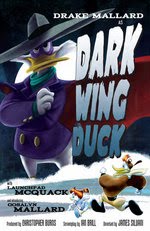
Comics Review: DARKWING DUCK #4 (Boom!, September 2010)

Ian Brill and James Silvani pilot the remarkable "The Duck Knight Returns" safely into port with a slam-bang, surprise-filled final issue that segues perfectly into the start of the continuing series. As a bonus, several more DuckTales regulars make appearances -- one hopes that the burgeoning St. Canard-Duckburg connection, which was barely explored in the TV series apart from Gizmoduck's occasional teamups with DW, will continue to feature in the future -- and we get a "bonding moment" between DW and Gosalyn that's every bit as good as the best such moments in animation. We also get frankly chilling call-backs to a couple of terrible DuckTales eps, but such is the quality of this miniseries that it actually gets some useful mileage out of them. Meet you on the other side of the...

S
P
O
I
L
E
R

S
P
A
C
E

Well, we did get our heroes-and-villains "cooperation sequence," but without Negaduck getting involved. Indeed, we never did find out what happened to Negs after Taurus Bulba's Crimebots arrested him. (Perhaps Negs' apparent alliance with Magica De Spell had its roots in Negs' getting Magica's magical help to escape from the pokey.) Once Megavolt made his "positively shocking" move, however, the "knob contingent" receded into the background (or through the floor) and we were left with Taurus vs. DW, Gosalyn, and Launchpad, which is what we really wanted to see all along. Thanks to Gos' completely unexpected transformation into Gosmoduck, DW got quite a lot of help with the "heavy lifting," but I still cherished seeing him and LP eschew fancy gadgetry and deck The Steerminator with that tooth-loosening "two-fer" punch. DW's apparent decision to sacrifice his life for the sake of the others was even more impressive, with our hero completely foregoing any alliterative amplification of his daring deed and proceeding in an almost deadpan manner. (I was actually disappointed when DW's dramatic freefall was broken in tongue-flapping, slapsticky fashion. I suppose that such exaggeration simply comes with the territory where these characters are concerned.) Despite his final defeat, Taurus fully lived up to his self-proclaimed status as "the greatest enemy [DW] will ever have." Since it's tough to say he was defeated "for good" -- wasn't his physical body left back at the space station? -- he'll surely appear again at some point, presumably with more hi-tech hardware than ever before. Actually, there's an even more compelling reason to believe he'll be back, as we'll see below.

Anyone who's watched "A Case of Mistaken Secret Identity" and "New Gizmo-Kids on the Block" knows that the track record of folks other than Fenton Crackshell (and where was HE while the Gizmosuit was in the lockbox? Attending an accountant's convention?) handling the Gizmosuit can charitably be described as mixed. Needless to say, for Gosalyn to get a shot at the honor (thanks to Gyro -- he really needs to consider random selection of a codeword next time) was completely unexpected. She turned out to be just as adept at using the suit as was Webby in "New Gizmo-Kids," though the "shocking" climax was genuinely frightening, making Gos' brief plummet in "Darkly Dawns the Duck" look like child's play and fully justifying DW's emotional reaction. Given the broad hints dropped at story's end, will we ever see Gos as The Quiverwing Quack again? Since Fenton has to return sometime, I imagine we probably will. Besides, Gos' own original "secret identity" has a charm all its own.

The backstory of and motivation for Taurus' creation of Quackwerks -- so helpfully sketched out by that handily available "Tuskernini Production" (plot contrivance? What plot contrivance?) -- was fascinating but contained one big, fat hole (no, Taurus, this is not a joke about your weight). The end of "Steerminator" found Taurus defeated but very much "alive," surviving a plunge into a waterfall and flying away. So what "uncharacteristic mishap" (1) destroyed Taurus' cybernetic body and (2) suddenly gave him the ability to "travel through and possess electronics"? I smell, if not a fanfic coming, then at least another Taurus story that makes things clearer.

I had painful flashbacks to "Yuppy Ducks" when I saw the besuited HD&L who accompanied Quackwerks "caretaker" Scrooge. At least they didn't do anything egregiously out of character -- or, indeed, anything much at all. Delighted as I was to see Scrooge and the boys interact with the St. Canardites, I thought the wrapup was the weakest part of the issue. Scrooge's dialogue seemed a bit clunky to me, and would he really entrust the safety of Quackwerks to Launchpad? (I don't think that Launchpad could even approximate a CEO "close enough for government work.") It would be great if the upcoming Negaduck-Magica story gave Scrooge something more significant to do. Kim McFarland's WTFB-APA story "Darkwing DuckTales" got to the idea first, but that was a long time ago.

Needless to say, I have every confidence that the regular DARKWING title will continue at a high level. If CHIP AND DALE'S RESCUE RANGERS is as good, then we have every reason to expect that other Disney Afternoon series will receive the four-color treatment as well. Of all the things that I would have predicted when Boom! took control of American Disney comics, this development would surely have ranked "next-after-last" on the list...

Sunday, September 26, 2010

Zine Review: THE HARVEYVILLE FUN TIMES! #74 (Summer 2010)


Conflict of interest? Yup, and who cares? I've been a contributor to Mark Arnold's "Harvey-themed" zine since 1993. This is the next-to-last issue before Mark hands over the reins to another individual... and it features the next-to-last RICHVILLE RUMINATIONS column that I plan to produce, though I'll certainly continue to post Harvey-related matter on this blog. The luscious "Queen of the In-Crowd," Bunny Ball, is this issue's featured cover girl. Jerry Boyd interviews BUNNY artist Hy Eisman and also provides an article on the BUNNY title, illustrated with enough eye-crossing late-60s psychedelic imagery to satiate even the "Deadest" of "Heads." Boyd throws in a nice reminiscence of the old Palisades Park theme park in New Jersey, where "Casper's Ghostland" was once one of the attractions. Throw in Mark Arnold's interview with SABRINA THE TEENAGE WITCH creator George Gladir, Joe Torcivia's penultimate "dead-tree" version of "The Issue at Hand", Milton Knight's memories of a brief sojourn at Harvey in the late 70s, and more reprints of Harvey-related ephemera than you can shake a Good Little Witch's wand at, and this is a bargain at $10.95 for 60 jam-packed pages. Even the formatting of the issue will surprise you (though not those who remember the earliest issues of SIMPSONS COMICS). Buy it, already!

Friday, September 24, 2010

Comics Review: MICKEY MOUSE AND FRIENDS #300 (September 2010, Boom! Kids)


OK, let's get the obligatory gag out of the way up front...

MICKEY, IN A SCREAMING FALSETTO: THIS... IS... MOUSETON!!
(Well, it officially has been since 1990, at least.)

But seriously... I'd like to toss the geniuses responsible for the $6.99 "Deluxe Edition" of this milestone issue into the nearest available "pit of doom." For your three extra bucks, you get (1) a Daan Jippes cover that I have a sneaking feeling I saw sometime back during the "Gladstone I" era and (2) a "foil-embossed" MICKEY MOUSE logo. Nothing so declasse, in other words, as, well, actually printing the lead story (Stefan Petrucha and Cesar Ferioli's "300 Mickeys") complete in an extra-sized issue. Just when it seemed as though Boom! were weaning itself off this multiple-cover routine, they squander a unique opportunity to do a "mega-issue" in favor of this cheesy gambit! The two "historical background" pages (including contributions from Casty, Jippes, and David Gerstein) don't really begin to make up for this, though they do add to the nostalgic feel associated with reading a "shoulda-coulda" Gemstone-issue-in-all-but-name.

"300 Mickeys" bears all the earmarks of a story that was originally slated to appear in Gemstone's MICKEY MOUSE ADVENTURES digest. Mickey uses Eega Beeva's "Pduplication Ray" to clone himself and keep simultaneous dates with Minnie (for dinner) and Goofy (at the arcade). Unfortunately, clones of "Mickey Nothing" unexpectedly continue to pop into existence even as Eega (who's suddenly got the "p"s back in his speech patterns -- this, plus the neat, MMA-style lettering, is a dead giveaway that this story was prepared a while back) returns to retrieve the gizmo. Adding to the inevitable chaos is the inconvenient fact that the clones, much like VHS tapes, "lose integrity" (in this case, become less intelligent) with every duplication. In the grand tradition of Pinky and the Brain's "Paper World," the increasingly mindless clones are soon fixing to set up shop for themselves on a newly-created island in the Tulebug River. Petrucha and Ferioli do their usual high-quality work, and the whiff of the Gemstone era is frankly quite refreshing after all those Italian WIZARDS OF MICKEY stories. Why Boom! didn't see fit to fit the entire story into issue #300 -- especially when the "300" conceit is part of the story's title -- is a complete mystery to me.

As he should, Floyd Gottfredson gets a nod at the back of the book with eight pages' worth of the quasi-continuity "Tanglefoot Pulls His Weight," essentially a string of gags in which Mickey tries to convert his knobbly-kneed horse into a "working animal," with decidedly mixed results. Now that MM&F has been re-established, I'd really like to see a "Gemstone-lite" issue like this now and again in between all the Italian imports. But, please, can we keep in mind that the drive to serialize may not always be appropriate?

Book Review: CHARLIE CHAN: THE UNTOLD STORY OF THE HONORABLE DETECTIVE AND HIS RENDEZVOUS WITH AMERICAN HISTORY by Yunte Huang (W.W. Norton, 2010)

There's an amazing amount of information jammed into this 350-page history of Earl Derr Biggers' Honolulu-based Chinese detective. Heck, we don't even get to talking about Charlie Chan per se until Huang, a professor of English at UC Santa Barbara, has doled out potted histories of Hawaii, Chinese immigration to the U.S., and early stereotypes of the Chinese in American culture (e.g. Bret Harte's once-famous poem, "The Ballad of the Heathen Chinee"). In tracing the links between the whip-cracking, incorruptible Honolulu police detective Chang Apana and the sleepy-eyed sleuth made famous by half a dozen Biggers novels and over 40 Hollywood movies, Huang lets the air out of some of the more fanciful claims about Chan, such as Biggers' declaration that he got the idea for the character by reading about Apana in a Hawaiian newspaper at the New York Public Library. (In fact, the NYPL didn't subscribe to any Hawaiian papers until after Chan had made his first appearance in the 1925 novel THE HOUSE WITHOUT A KEY.) Huang's goal is somewhat broader than a mere blow-by-blow description of how Chan came to be, though. As a post-Tiananmen Square immigrant to America, Huang has the considerable luxury of being able to write seriously about Chan and his appeal without being dismissed out of hand as a stereotype-mongering apologist for "Orientalism." He seems able to appreciate many of the sources of modern-day antipathy towards Chan (which led to the cancellation of a "Charlie Chan Film Festival" on Fox Movie Channel a few years ago, among other things) without being ideologically fettered to any sort of "politically correct" response to a character who, for all his aphorism-spouting and supposed "model-minority subservience," was almost certainly the single most proactively positive portrayal of a Chinese-American seen in American culture up to that time -- the good "yin," if you will, to the evil Dr. Fu Manchu's "yang."

How thorough is Huang's discussion of Chan's role in popular culture -- not to mention his love for the character? He describes the long-forgotten early-70s Hanna-Barbera cartoon The Amazing Chan and the Chan Clan as a "phenomenal success."  Given that Clan lasted only 16 episodes, you might as well also term the show's exact contemporary The Roman Holidays a "phenomenal success." One interesting feature of Clan was the presence of Robert Ito (then "Bob") in the voice cast as one of Chan's ten kids. After his live-action stint on Quincy, Ito would become animation voice-acting's main "go-to" guy for "Oriental" characters for a number of years. (Keye Luke, who played Chan's #1 son in many of the movies and voiced Chan on Chan Clan, was outspoken in his admiration for Chan as a role model, as Huang notes.)

While he does mention the Alfred Andriola-drawn CHARLIE CHAN newspaper strip, Huang's discussion of print-based Chinese pop-culture figures akin to Chan is lacking in some ways. He really ought to have mentioned Ching Chow, a spin-off character from THE GUMPS who dispensed philosophical one-liners in a panel that ran for many years (it was in the NEW YORK DAILY NEWS at least until the early 1990s). When it came to images of the Chinese, Ching Chow was neither fish nor fowl (General Tso's chicken?) in that he was dressed like and looked like a stereotypical "Manchu Dynasty Chinaman" throughout much of his career, yet steered "velly" clear of the pidgin English that numerous other Chinese comics characters of the day employed (and which, strangely, Huang claims Chan himself used, though he clearly did not). Chow certainly didn't contribute as much to a more positive image of Chinese people as Chan did, but he must have contributed something. It's too bad Huang didn't discuss him.

Fans of pop culture will enjoy this book, which really does have something for everyone -- even if Huang's narrative sometimes becomes fractured as a result of his multiple (and admittedly entertaining!) digressions.

Friday, September 17, 2010

Slatterys Back in Baltimore

Peter and Matthew Slattery are now back in Baltimore. Matthew is currently at Johns Hopkins Pediatric ICU and will be moving to the Kennedy Krieger Institute shortly. Peter, meanwhile, took his first shower in a month (I can relate, sort of -- Nicky just finished her first shower since her surgery on Tuesday) and is starting to put the pieces of his school year and so forth back together.

A scholarship fund has been established by Stevenson in memory of Dr. Slattery. If you are interested in contributing, please click here.

Comics Review: DONALD DUCK AND FRIENDS #358 (September 2010, Boom! Kids)


"The exciting conclusion to the fan-favorite [DOUBLE DUCK] saga," my pinfeathered white... Seriously, Boom!istas, do you really believe that you're going to fool anyone into thinking that "Total Reset Button" is "the final DOUBLE DUCK arc"?!? Yes, the story (or, rather, the nine-page fag-end of same -- see my review of #357) "ends" with Donald zapping ex-Agency head Felino Felinys back into happy obliviousness and using some trickery to keep Jana Smirnov and her goons from spiriting Felinys' repressed memories away in the "TRB" device. It's a nice reminder that Double Duck Donald has, more often than not, displayed a refreshing competence in the pursuit of his duties. But in the last several panels, we learn that the assassins who are after Double D (remember them?) are still very much at large AND are in a position to track Donald with relative ease. You can't simply slap a "THE END" logo on that "stinger" and walk away with a smug smile. I'd even have settled for a "Stay Tuned for Future Adventures" announcement. It would have been frustratingly vague, but at least it would have admitted that, no, the DOUBLE DUCK saga really isn't over, we're just putting it on hold for a while. The way that the sidelining of DOUBLE DUCK was handled is, quite frankly, an insult to the reader's intelligence. A real shame, too, for these stories weren't half bad.

"Bugged Duck" took away at least a portion of my pain with a funny, rousing climax that wouldn't have been out of place in an (unaccountably decent) Quack Pack episode. The tale of double- and triple-dealing skulduggery is rather more cynical that you'd even expect a Donald-vs.-Nephews free-for-all to be, with its two "Men in Black" on the make and a surprise ending that's meant to be -- and is -- more than a bit unsettling. Writers Laura and Mark Shaw even throw in an obscure DuckTales reference for good measure. The real star of the show, however, is artist Flemming Andersen, who does wonders with panel design (check out the "flow-of-action" special on the next-to-last page!) and facial expressions. I stand by my previous contention that DD&F should have wrapped up the DOUBLE DUCK material in #357 (without trying to pull a fast one, of course) and run this story complete in #358 as a "transition tale." The page counts might not have complied with Boom!'s S.O.P., but I would have preferred paying a little extra for a few more pages to the highly unsatisfactory solution that we got here.