Friday, February 15, 2013

Comics Review: RICHIE RICH GEMS #48 (Ape Entertainment, 2013)

A RICHIE RICH sighting!  After some eight months!  Well, that's not strictly true... the square-backed RICHIE RICH GEMS SPECIAL COLLECTION (rather confusingly subtitled "Winter Special" on the inside front cover) made it to stores in time for the holiday season.  You may have missed the headlines.  That offering was merely a repackaging of matter from the first several GEMS releases by Ape.  Since Ape obviously feels that familiarity does not breed contempt, all four of the KEENBEAN'S CORNER gags that originally appeared in Ape's "reimagined" RICHIE RICH title -- and ALSO appeared in the back of GEMS -- made another bow in SPECIAL COLLECTION, as well.  You can well understand that the release of a brand-new (in a manner of speaking) GEMS issue came as something of a surprise to me, especially since the rebooted RICHIE title seems to have stopped dead in its tracks.  So there might be some hope for the latter after all...

As GEMS issues have gone, #48 isn't bad.  Warren Kremer's "The Mad Mad Big Big Race" is one of the better long Richie-vs.-Cousin Reggie rivalry stories from the "Classic Harvey."  The back cover blurb makes an attempt to tie the round-the-world trek in with a certain long-running reality TV show, but an examination of the particulars suggests that a better parallel might be drawn with "Around the World in 80 Bucks," the story that Boom!, for some incomprehensible reason, chose to print in the first several issues of its version of UNCLE $CROOGE.  Richie and Reggie actually go Scrooge and John D. Rockerduck one better by agreeing to race one another with just $150 in cash on hand AND without using any "motorcycles, car, trains, planes, or boats!".  It goes without saying that Reggie cheats and Richie... well, doesn't.  "Big Big Race" winds up putting "80 Bucks" to shame, though that might be more of a comment on the Duck story than on the RICHIE tale.  The credit section claims that Ralph Newman wrote the story, but, to me, it definitely "feels" like one of the RICHIE RICH AND CASPER scripts that Stan Kay wrote for Kremer later in the 1970s.  Since we are STILL getting credit goofs even at this late date (to wit: the one-page gags "Bling-kini" and "How's Your Earring?" were drawn by Ernie Colon, not Kremer), I'll stick with my theory that it was Kay who did the work.  (BTW, another way that you can tell that the same writer did the RR&C stories and this story is...  the rather frequent... use of ellipses... in both venues.)

Ernie Colon and Sid Jacobson team up once again to produce an original four-page leadoff story, "On the Way to the Ball."  It features another reference to the bum economy (you know, the one that supposedly wrecked the Reginald Van Dough fortune, as revealed in GEMS #47?) and one of the most multi-ethnic crowd scenes in Harvey Comics history.  Richie gets to show his largesse to a poor community, in the classic tradition, and gets praise from his prom-date Gloria.  The five-page "Richie's Alphabet" feeds us some forced rhymes as it runs through Richie's connections to every letter in the alphabet, but it features some nice Kremer art from the mid-70s.  The rest of the book consists of gags, and among these is one VERY interesting one by Colon (early 60's version) that I don't recall having seen before, at least not in a Harvey contextRichie baffles Reggie by giving a young orphan's home solicitor one penny on day one, two pennies on day two, etc., and over $3 million on the last day of the month.  Yup, it's the exact same "mathematic [sic] stunt" that Donald pulled on Scrooge in the comic-book adaptation of Donald Duck in Mathmagic Land.  Was I surprised to see it in a "Classic Harvey" comic?  You bet.

Saturday, February 9, 2013

DUCKTALES RETROSPECTIVE: Episode 25, "Treasure of the Golden Suns, Part Two: Wronguay [sic] in Ronguay"

Ah, yes, about that "[sic]".  We need to pause at the title card for a moment before forging onward...

I'm "Ivory Soap" certain (that is, 99.999% sure) that this was ORIGINALLY supposed to read "Wrong WAY in Ronguay."  After all, the pun is directly referenced during the episode itself, when the Nephews realize that the "robot-jacked" Ronguay Airlines aircraft is literally heading in the wrong direction.  I hardly think that Jymn Magon (by far, the most likely suspect among the trio of writers who labored on "Golden Suns" to unleash this kind of groaner) would go to the trouble of cracking the joke without planning to foreshadow it here as well.  Someone along the production line must have slipped up here.

Thankfully, the (IMHO) spelling error is just about the only "uay" in which one can criticize this episode.  Though I remember being a bit puzzled by the seeming finality of the ending -- we wouldn't learn about the rest of the Treasure of the Golden Suns until the start of part three -- Scrooge and HD&L's trek to "the tiny country of Ronguay," their search for the "sunken" gold ship, and their battle with Flintheart Glomgold and El Capitan make for some absolute captivating viewing.  Adventure, rather than character development, is the main focus here; even so, we get one superb "moment of connection" between the boys and Scrooge and are also witness to the definitive revelation of the depth of El Capitan's obsession (though a few hints dropped during the episode as to the wrinkled one's past identity will not be picked up until future installments).  It takes quite a bit of doing to upstage the series' first authentic treasure hunt and the first animated appearance of Glomgold, but El Cap does so.  Fittingly, he gets both the final shot and the final words of the ep.

I've previously discussed some of my feelings as to why the DuckTales Glomgold turned out the way he did.  My idea that Flinty has moved from South Africa to Duckburg to keep closer tabs on Scrooge certainly isn't challenged by Glomgold's first few seconds on screen, in which he's seen watching the doings at Scrooge's candy factory on TV and perusing a massive mainframe that (I guess) keeps up-to-date stats on how his fortune compares to Scrooge's.  Imagine how much more easily Flinty could do this today with the help of the Internet.  The slightly goofy office nerds who "help" Glomgold in this scene are never seen again, more's the pity; at least one of them (my pick would have been the phone-toting guy with the overbite) should have served as Flinty's laugh-grabbing "bump machine" for the remainder of the series.  As it was, we had to wait until the final season's "Attack of the Metal Mites" for a guest-starring Dijon to fill a somewhat similar role.

In the jaundiced spirit of Carl Barks' "The Money Champ," Glomgold couches his initial challenge to Scrooge (which, we are easily led to believe, is not the first such ultimatum) in the form of a money-making contest.  Flinty's approach to the duel, however, is far more "John D. Rockerduck-ian" than it has ever been before (to those viewers who had not read Don Rosa's "Son of the Sun" earlier in 1987, that is).  Glomgold's relatively modest use of shrinking juice on Scrooge's money pile in "The Money Champ" pales in comparison to what the DT Flinty will stoop to in order to get what he wants.  Joe Torcivia once described the DT Glomgold as "a sort of Anti-Scrooge," a description which fits both Flinty's Scottish attire and accent and his flexible morals.

Ever so conveniently, Scrooge's need to dig up some kind of treasure before the two weeks of the contest are up arises just as HD&L have solved the mystery of the wooden ship... and, GeoX, I would argue that it's at least possible that the "insanely idiotic" code that the boys decipher could really, truly be as simple as this. There were more sophisticated ciphers available in the 16th century, when the ship was presumably built, but those other methods weren't much more complicated than the simple letter-number substitution used here.  Besides, if a person didn't know that "Gannaw Ondat" had to be a made-up name because it was carved on a ship originating in Spain, then he or she would glance at the craft and walk away without a clue that it was meant to be a message of some kind.  When HD&L do their "play dumb" routine as a ploy to convince Scrooge to let them come with him, they do so without evincing any fear whatsoever that Scrooge will be able to figure out the mystery by himself.  I think they're at least partially justified in doing so.

Scrooge's promise to let the boys come along with him "just this once!" resurrects some questions that I raised during my discussion of "Don't Give Up the Ship."  Judging by the boys' initial attitude towards Scrooge, I found it rather tough to believe that this version of Scrooge, Donald, and HD&L had gone on very many adventures together.  Scrooge's comment here seems to bear this observation out.  It also suggests that the ensuing adventure in Ronguay will further cement the relationship between the "old sourdough" and the young ducklings, to the extent that Scrooge will never again seriously question the boys' right to accompany him on globe-trotting trips.  This is correct, up to a point; the boys, after all, will have to sneak a ride aboard Launchpad's copter in order to share in the Antarctic adventure of "Cold Duck" and the subsequent trip to the Valley of the Golden Suns.  But the aforementioned "moment of connection" that the Ducks will share during the low point of their Ronguayian trek will have serious reverberations...

It's debatable as to whether any of the sights, sounds, and (plane) sputters of "inhabited" Ronguay would pass muster if they were being newly created in today's uber-sensitive climate.  The stereotypes are a little easier to accept here, I think, because so much of what we see and learn about Ronguay is, well, just plain bizarre -- perhaps not as ridiculously absurd as the depiction of Gwumpki's homeland of Blatismorkia in Quack Pack, but certainly more than sufficient to elicit a few head-scratching "Huh?" moments.  For example, we've seen ramshackle, livestock-filled vehicles like the "usually non-stop" Ronguay Airlines plane in other "Third World" contexts, but who the heck decreed that an old-fashioned, hand-cranked speaker phone should be placed in the cockpit?  What could that thing possibly be connected to?

After Scrooge helpfully comes to just in time to pull the plane out of a dive, the Ducks land at "Ronguay Airport" -- which is actually a soccer field:

Then we get a "Sam Peckinpah Moment" -- I call it such because one of the director's less successful (and more underfunded) movies was once criticized for including the same band of Mexican peasants in literally every crowd scene -- as the crowds of Ronguayians frantically leaving the country to avoid the "Monsapis" include a couple of folks who evidently decided to double their un-pleasure.  Note the stork with the serape and big sombrero, the mustachioed dogface with the green shirt and blue hat, and the bird-woman with the flower in her ear in these two completely separate scenes.  (To make matters worse, the first group is the one that tosses the Ducks out of the plane and then takes off, while the second group appears after the plane has departed.)

The normally censorious folks at Toon Disney must have been so baffled by all of this that they failed to notice the stereotyped fat guy who sells Scrooge the llama and let the entire sequence be rerun without complaint.  Of course, they were all over the scene of Dewey tearing the electrical cord out of the socket like mud on the proverbial pig (probably the same one that tripped Scrooge on the plane) and excised that, leaving the Glomgold robot to short-circuit with no explanation.  Well, I can't say that I can blame them.

Regarding the Ducks' subsequent voyage through the soon-to-be-inundated wastelands, Greg commented that the adventure focused on Scrooge to the extent of making HD&L look weak.  In the sense that Scrooge did most of the actual work and faced most of the actual perils, he's correct.  However, I think that the writers took this approach (if it was, in fact, even taken consciously) to introduce "the adventurous Scrooge" to a TV-watching audience that may never have seen that aspect of the character up to now.  The Nephews, after all, were in plenty of danger throughout "Don't Give Up the Ship," so their "quick, feisty, cunning, sharp, resourceful, etc." bona fides had already been highlighted.  Unless you came to the show already familiar with Scrooge's comic-book adventures, "Ship" didn't tell you very much about Scrooge the derring-doer.  Now, while taming bucking llamas, escaping quicksand (how did Scrooge get that box of scuba supplies open while buried in sand, I wonder?), and protecting the boys from the rain with the "Malaysian umbrella," Scrooge gets a chance to show his mettle and, as Geo points out, reveal some of his past exploits in a very Barksian manner.

While Scrooge may have enjoyed many adventures in the past, DuckTales delicately leaves aside the question of how many adventures he's participated in recently.  Scrooge comes across as such a miser and negative character at the start of "Don't Give Up the Ship" that a "newbie" viewer could perhaps be excused for wondering whether Scrooge had been living an isolated, sedentary life for some time before taking in the Nephews -- perhaps not to the extent of "The Recluse of McDuck Manor," but certainly along those lines.  The possibility that Scrooge's adventurous chops have not been tested in the recent past lends at least some degree of credibility to what would otherwise be a rather problematic scene, namely, the disappointed, rain-soaked Scrooge's declaration that "I'm finished."  A long-time comics fan would probably be taken aback by what would seem to be Scrooge's entirely too abrupt decision to abandon the "hopeless" search for the treasure ship.  Seen in the context of the series, however, this scene is extremely effective, not least because it demonstrates that Scrooge and HD&L can and will function effectively in the future as a mutually supportive team.

The visuals have been getting better and better throughout the episode, and they peak during the cave scenes.  The play of light and darkness, the atmospherics, the legitimate sense of peril, are all splendid.  When I first saw this sequence during "premiere weekend," it simply knocked me out, and I just couldn't wait to see it again during the subsequent rerun on another station.


But wait, there's more -- even though you have to "suspend disbelief" in a manner akin to the Sword of Damocles in order to fully take it in.  Regarding a scene like the "setting sail of the golden ship," sometimes you just have to ignore obvious logical problems and say "Ooooohhhh!" as the Nephews do here.  Perhaps accepting the scene is as simple as figuring that a ship which already held gold ropes and gold sails would probably have had some gold planks and nails lying around as well -- though that still doesn't explain how the boys were able to nail the nails into the planks in the first place.  Besides, Carl Barks himself posited the existence of a seaworthy boat carved out of a giant gold nugget in one of his later UNCLE $CROOGE adventure stories, so this unforgettable scene might be said to have had the indirect sanction of the Old Duck Man himself.

The abrupt return of Glomgold and El Capitan makes for an equally strong ending, the true power of which will not be fully understood until a few more facts about El Cap are revealed.  Huey's line "That guy acts like he used to own this ship!" will ultimately acquire a truly creepy vibe when we learn that (1) El Capitan really WAS the master of the craft all those hundreds of years ago and (2) he has literally refused to die until he finds "every bit of" his lost treasure.  Oddly enough, he seems uninterested in recovering this bit of said treasure after the ship sinks; I imagine he's been fixated on the treasure in the Valley of the Golden Suns for so long that he probably regards recovering the ship's treasure as a mere formality after the bigger prize is bagged.  Before the gold goes gurgling under, however, we see El Cap's grumbling and grousing about "el stupido" Glomgold, which up to now has not seemed all that different from his occasional complaints about working with the "mental midget" Beagle Boys, mutate into something far more sinister than we could have possibly expected when the "old wheezer" first came on the scene.  He's willing to treat one of Scrooge's classic rivals as nothing more than a means to an end, which makes even more of an impression on a viewer familiar with the comics than one who is seeing Glomgold for the first time in any medium.  How he'll get back into the story line, it's impossible to predict at the end of the episode, but there's absolutely no doubt that he WILL return and, moreover, will give Scrooge a hell of a challenge.

"Wrong Way in Ronguay" (sorry, but I am quite insistent about that change) is just about perfect and, though the next two installments are both excellent in and of themselves, won't be matched during this serial until the final chapter.

.

.

.

"DuckBlurbs"

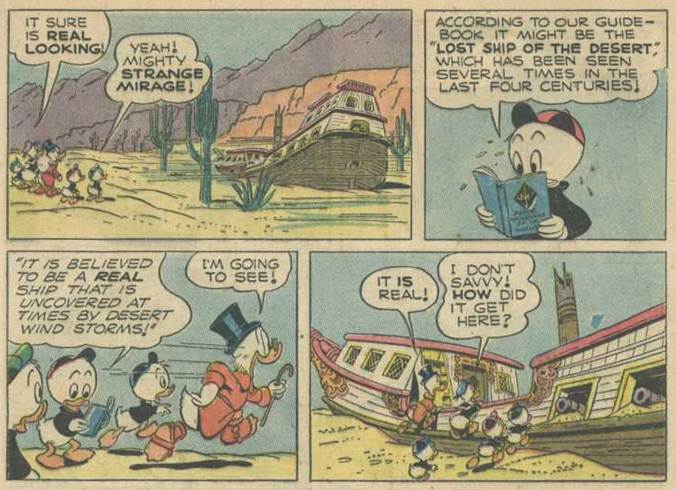
(GeoX) [T]here are three clear Barks call-outs [in the episode]: the ship stranded in the desert recalls "The Seven Cities of Cibola"; [El Capitan], as he's taking Scrooge's gold captain's hat, refers to it as a "golden helmet;" and then at the end...  Glomgold has to eat his hat (okay, so it was Scrooge's hat that he ate in "The Money Champ," but still).

I think that there's a case to be made for all of these references being intentional, but I'm most certain about the connection between the treasure ship and Captain Ulloa's "desert-ed" ship in "Seven Cities of Cibola."  For one thing, there's that pesky Celestial Arts connection to consider: "Cibola" was reprinted in that volume.  For another, the visuals are just too similar, though the treasure ship appears to be in surprisingly good shape for a wreck that has been alternately baked and inundated by water for X hundred years.

The golden helmet ("Check!") that Scrooge sports and El Capitan later reclaims might well be a reference to the miter that gives its wearer ownership of North America, but it could also be... just a plain, ordinary conquistador's helmet that happens to be made of gold.  This particular Barks story, and this particular Barksian artifact, are well enough known to Duck fans such as Jymn Magon that I'm willing to grant Jymn the benefit of the doubt in this case.

The hat-chewing connection is probably the weakest of the three.  Flinty's tam-o-shanter is so garish that the idea to make its consumption the forfeit to be paid by the loser of the bet might simply have occurred by chance.  An intended reference to "The Money Champ," however, certainly isn't impossible.


(Greg)  So we begin this episode back outside the oozing chocolate candy factory as the woman news reporter continues to talk and police continue to surround the place. The news reporter says nothing of note as we head inside and we basically get new footage of the finish from the last episode of the Beagle Boys Chocolate Statues being carried out by two officers as one white haired dogsperson officer proclaims that the bonbon is going to Sing-Sing. Okay; this makes sort of sense from a storyline point of view, but it's a waste of time. Why not show this at the end of the first episode and show El Captain's saying beware from the start? Not a big deal; just an observation. Then logic break #1 for the episode rears it's ugly head as [Burger]'s head gets un-cracked on site with a mallet and chisel as he pops up and eats chocolate. Cute spot though; but all three Beagle Boys were carried out still completely covered with chocolate in the previous episode!  We cut to the female reporter as she continues to fill in the details about the objet d'art that the Beagle Boys were after as the police continue to secure the area and clear out the Beagle Boys. And then more logic is broken as Scrooge takes the ship away from the chocolate wave and he walks off on his own even though we clearly saw him talking to his nephews during that sequence in the previous episode! Now I see why Disney started doing PREVIEWS for syndication episodes?! It was to KILL CONTINUITY ERRORS like this. 

This was rather peculiar, insofar as Disney, to the best of my memory, never tried to do anything like this in any other "recap" in a multi-part storyGenerally, the next part of the tale either struck off in a new direction, assuming that everyone remembered what had happened at the end of the previous episode, or used episode clips to get everyone up to speed.  (In a later series, of course, "Previously on Gargoyles..." became an expected part of EVERY episode.)  Perhaps it was felt that the retrofit was necessary in order to provide a fitting lead-in for the introduction of Glomgold.  It would have seemed rather strange if we'd gotten our first glimpse of Flinty reacting to something that had already happened in the previous ep.

(Greg)  And of course the plane goes into a nosedive as Louie has to go into the Junior Woodchuck Guidebook. If Kit [Cloudkicker] was here; this scene would be over in 15 seconds as this would be his wet dream realized. Besides; Kit doesn't need a book anymore he seems to have this down pat...  Sadly; the guide book has nothing about flying an airplane. HAHA! About damn time those nephews got licked; not let's see how well they do without that damn book...or why Kit is so much better you you three combined. 

And so the surprising fallibility of the DuckTales Junior Woodchuck Guidebook is revealed for the first (in "real" continuity) time.

(Greg)  So now Flint throws the dynamite down the hill as he want to bury Scrooge good... El Captain tells him to forget him because it's all about the gold see...  Flint wants to be [better] safe than sorry; but El Captain doesn't want to wait as Flint and El Capitan turn around and they are SHOCKED and APPALLED (in that order) as their jackass is EATING THE MAP on the rock! Wait a minute?! Wasn't it in the pouch?! That's logic break #3 for the episode.

As this screen shot reveals, the map had indeed been taken out of the ice cream cart (by Flinty) before Flinty and El Capitan's mule started noshing on it.  You can see it here lying on the rock in the foreground, with the mule already eying it hungrily.  Nice foreshadowing there.

(Greg)  All hands on deck as the nephews get on board as the sail is also made of gold. Okay that makes even less sense along with the floor repairs. Seriously; and some question Plunder and Lightning's breaks in logic. Why? Because they are Cartoon Ducks and when you see Cartoon Ducks; you accept them without. Since bears are Russian and Russians are EVIL Communists (which is so absurd no one should be caught dead...oh never mind); they are booed. Now you understand the psychology of why people thought Ducktales and Darkwing Duck was better than TaleSpin; even if the quality would prove otherwise in hindsight (not to see the two duck cartoon sucked in any way; but still). It's the “American” way see. Then again; I'm Canadian; and that's why I'm so biased the other way.

"Sorry, lads, I dinna understand that either."
  
Next:  Episode 26, "Treasure of the Golden Suns, Part Three: Three Ducks of the Condor."

Tuesday, February 5, 2013

Goo(l)d Things Come to Those Who Wait... For 400 Years, or Otherwise...

 
The recent rough weekend -- and yes, that very much includes the Super Bowl -- meant that I will have to postpone the "Wrongway in Ronguay" review until this coming weekend.  Hopefully, you're not reacting to the delay with the noted grace of El Capitan.

Tuesday, January 29, 2013

Book Title: TEN-GALLON WAR by John Eisenberg (Houghton Mifflin Harcourt, 2012)

Here's some ideal reading for the "slow" week before the Super Bowl, when a football fan's thoughts turn to the Muse of History... a fast-paced look at the battle for pro football's future in Dallas in the early 1960s.  Lamar Hunt's Dallas Texans were part of the fledgling American Football League, while Clint Murchison's Dallas Cowboys were the NFL's strong-armed response.  In the tradition of two ornery gunslingers in a Western movie, the town wasn't big enough to handle both entities.  John Eisenberg, of the BALTIMORE SUN, explains in detail why the Cowboys ultimately won out.

Ironically, the Texans moved to Kansas City and became the Chiefs immediately after winning the 1962 AFL championship in a double-overtime struggle with the Houston Oilers.  The Cowboys, meanwhile, despite the best efforts of a full-of-beans young Tom Landry, were still struggling to put together a decent campaign.  Hunt, however, realized the built-in advantage that the Cowboys possessed in terms of league affiliation; the AFL was growing quickly, but still not considered to be on a par with the NFL.  Hunt certainly had the money to compete -- his family and the Murchisons were among the cadre of Texas oil baronets who gained national notoriety in the 1950s and kicked off the whole "everything's bigger & better in Texas" mythology -- but the Cowboys were built for the long haul, and would indeed enjoy a long period of dominance once they found their cowhide boot-clad feet.

So, Was the Fight on "Paw Per View"?

"Kimba the White Lion's Corner of the Web," which was the best Kimba-related Web site out there in the ether for a good long time, has apparently been transformed into a "mere" bazaar for various Kimba-related products... including this intriguing one:

That's the 1966-model Kimba, all right, but in which episode did he box?  I think I know:

This is from the dream sequence during "The Wild Wildcat."  Evidently, the cut "boxing" sequence that must have preceded this completely-out-of-nowhere snippet was considerably more elaborate than I could have imagined when I did my Kimba episode reviews.

Sunday, January 27, 2013

DUCKTALES RETROSPECTIVE: Episode 24, "Treasure of the Golden Suns, Part One: Don't Give Up the Ship"


The above, of course, is NOT the original title card for this scene; for the edited, two-hour "movie" version of the pilot adventure, "Treasure of the Golden Suns" greeted our eyes here.  Whatever the specific message, this is quite simply one of the most meaningful moments in the history of TV animation.  The impact that "Golden Suns" had on the TV-toon landscape -- especially on those who (like Pete Fernbaugh) literally grew up during the series' initial run -- is, I believe, best encapsulated by Burger Beagle here:


Though I was 24 years old at the time, "Golden Suns" shook up my fannish world in a very similar fashion.  The show hit me at precisely the right time; I was two years removed from diving into Duck-comics fandom in a major, albeit unorthodox, way (by buying two sets of the Another Rainbow CARL BARKS LIBRARY), and I was slowly starting to catch up with Barks stories that I'd not previously seen, thanks to the year-old Gladstone Comics line.  I therefore came to the series with a relatively modest number of preconceived notions about how the characters "should" act.  At the same time, I had learned enough about the Ducks' world that I was able to appreciate how well DuckTales went about the business of interpreting it.  The element of surprise was at work as well; having "uncoupled" from contemporary TV animation a long time before, I only learned of the series' impending debut through a blurb in Geoffrey Blum's CROSSTALK column in the Summer of 1987.  Even then, the main purpose of the shout-out was to trumpet a new, adventure-focused DUCKTALES comic (which would ultimately be renamed UNCLE $CROOGE ADVENTURES, so as to make room for a DUCKTALES title that actually featured stories set in the slightly different DT universe).

In order for "Golden Suns" to score, of course, the success of the first installment, "Don't Give Up the Ship," was absolutely crucial.  This was, after all, the second of what would ultimately turn out to be three "McDuck Milestone Moments" in which Scrooge McDuck had what amounted to a coming-out party, postdating Barks' introduction of the character in "Christmas on Bear Mountain" and preceding "The Recluse of McDuck Manor," the final chapter of Don Rosa's LIFE AND TIMES OF $CROOGE McDUCK.  These "rich duck debuts" all had very different purposes, but I would argue that "Don't Give Up the Ship" had the trickiest task of them all.  The fact that it succeeds so comprehensively is probably THE single biggest factor in the overall success of the "Golden Suns" cycle.

"Bear Mountain" introduces Scrooge as a gimmick character, a means to the slapsticky end of getting Donald and HD&L to a remote mountain cabin, there to have their (theoretically) hilarious encounters with DA... BEARS!  Barks himself admitted that in thinking up "rich old Uncle Scrooge," he was simply swiping from Charles Dickens' A CHRISTMAS CAROL -- hardly a stable platform from which to launch the career of an iconic comics legend.  Of more concern to us at present is the prior relationship (if any) between Scrooge, Donald, and the boys.  Barks gives us vague hints, and nothing more, on this score, but it's pretty obvious that the relationship is tenuous at best.  Donald and HD&L know of Scrooge and his skinflint reputation, but they clearly don't know him particularly well, while Scrooge knows enough about Donald to recognize that he's chicken ("That quivering waterfowl would flinch at his own shadow!") but not well enough to understand that any show of "bravery" on Donald's part would almost certainly have to be the result of an accident or coincidence, as indeed it turns out to be here.

Symbolic of the disconnect between the Ducks in this story is the "forced" nature of the party scene on the final page -- the only time during the story when the Ducks are actually together, by the way.  Scrooge's "act" as the largesse-dispensing grand seigneur seems so artificial that it's fairly obvious that he's rarely been asked to fill such a role before.  The story ends with a gag, rather than with any sort of meaningful "bonding moment" between Scrooge and his kin.  At this moment, it seems very unlikely that Scrooge has established enough of a connection with Donald and HD&L to justify bringing Scrooge back in another story.  Barks, however, saw some potential in the character and decided to bring him back -- albeit in a somewhat more pleasant and genial form -- and the rest, as they say, is history.

The atmospherics of "The Recluse of McDuck Manor" are quite different.  Following the vector of the relentless logic that he used to illuminate the growth, development, maturation, and ultimate calcification of Scrooge's character in the previous chapters of LIFE OF $CROOGE, Don Rosa presents the 1947 version of the old miser as a defiant anchorite who has achieved near-mythical status during the period of his total withdrawal from the outside world.  Duckling Donald's juvenile booty-kicking during "The Empire-Builder from Calisota" aside, this truly IS a "first encounter" between Scrooge and his relatives -- a meeting that's initially so cold and formal that it might as well be a first encounter between representatives of alien civilizations.  Scrooge even feels the need to formally define his relationship to Donald:

In stark contrast to what will be their attitude towards Scrooge at the start of "Don't Give Up the Ship," HD&L seem keen on establishing a link with their forbidding great-uncle right from the start of "Recluse" (not that Scrooge initially appreciates the gesture):

As things turn out, not even a successful cooperative battle against the Beagle Boys is enough to turn Scrooge's attitude completely around and convince him to commit to a life of renewed adventure.  Instead, the boys literally have to goad Scrooge into formally restating his philosophy of "the strenuous life" and then deciding to go about the task of living up to his own words.  As we'll see, the manner in which the Scrooge/HD&L bond is developed during "Don't Give Up the Ship," while not without its logical difficulties, is far less manipulative, and, to my mind, somewhat more emotionally satisfying to the audience.
The situation depicted in the first act of "Don't Give Up the Ship" is quite an interesting hodgepodge -- and it needs to be in order to have a chance of pleasing both complete Duck "newbies" and longtime fans of the Duck comics.  The Ducks' pre-series relationship appears to be more akin to "Bear Mountain" than "Recluse"; that is, they seem to know each other, but not intimately.  Even at this late date, for example, Scrooge seems surprised by Donald's decision to join the Navy ("You can't be serious about this crazy idea!"), which would seem to suggest that he just recently found out about it, possibly at the very moment when Donald asked him to take care of the Nephews.  That doesn't bespeak a very close relationship between the adult Ducks.  Compared to the Scrooge/HD&L "bond," however, it's practically lovey-dovey.  I mean, the boys don't even want to acknowledge Scrooge's physical presence during the leave-taking scene at the dock.  I'd almost have preferred the yawning indifference that the Quack Pack Nephews would probably have evinced here.  The boys' reaction is so negative that it can't possibly be explained by Huey's stereotypical complaint that Scrooge is "so cheap!".  Instead, we get the impression that whatever past dealings the Nephews have had with Scrooge can't have been pleasant ones.  I can't imagine this set of characters having gone on exciting adventures in the past, can you?


As if to set the stage for the boys' blow-off, the scenes with Scrooge prior to the dock encounter (and following that wonderful, Barks-inspired "swimming scene" in the Money Bin) trade heavily on well-established stereotypes of Scrooge's cheapness.  I'd even argue that Scrooge comes off worse here than he does in a typical comic-book gag where he reads newspapers at the library to save money or tries to chisel a free cup of coffee.  Blowing off a charity worker, greedily snatching a hatful of cheese samples, and "tipping" a cab driver with mousetrap bait seem to be going "below and behind" what we would expect of a hopeless miser.  Indeed, such moments would later be treated much more seriously (though with highly debatable results) in "Down and Out in Duckburg."  It must be admitted, however, that gags of this type indicate that writers Jymn Magon, Bruce Talkington, and Mark Zaslove -- the heaviest of heavy hitters among DuckTales scriveners -- were clearly paying close attention to all of the featured items in Barks' UNCLE $CROOGE comics.

If the Scrooge/HD&L relationship doesn't seem to promise a happy McDuck Mansion household -- but wait, it gets better -- then the Donald/HD&L relationship is a pleasant surprise.  Personally, I find the affection shown between Donald and his Nephews here, and, in fact, throughout the series, to be most refreshing.  This is all the more remarkable in view of the fact that the DuckTales Donald is consistently portrayed as something of a stumblebum.  The Nephews of many Barks and Rosa stories would no doubt respond to such repeated fallibility with a mixture of exasperation and cynicism -- that is, when they weren't rescuing Donald from the consequences of his (frequently self-defeating) actions.  Not here -- the DT HD&L are always legitimately excited to see their uncle, always unhappy when they have to part company with him, generally compliant with his requests, and devoted to making him look good whenever they can.  There's a hint that the boys can still be hellions (why else would Donald have to warn them about "backtalk" and "spitballs"?), but I don't get the sense that Donald was the standard target of their pre-series hijinx.  The boys' pivot from a heartfelt embrace of the departing Donald to a refusal to raise their eyes to Scrooge is one of the most striking moments of this ultra-significant scene.

The early days of HD&L's confinement, er, domicilage at McDuck Mansion (the nature of which building, BTW, they appear to be completely unfamiliar with -- another indication that they haven't had much contact with Scrooge) find the boys copping something uncomfortably close to a "Quack Pack Nephews" attitude.  "We haven't been allowed to do a single thing in this whole house!"?  Really?  I don't see Duckworth guarding the stairs (yet).  Plus, as GeoX notes, HD&L's accommodations don't seem all that incommodious.  Perhaps they would have seemed more abhorrent had a couple of additional gags about the lousy reception and programming on the boys' TV (not to mention some cutting comments about a lack of gifts from Scrooge!) not been cut from the final draft of the episode script.

Flicked forks heading for the ceiling in 5... 4... 3...

Happily, once HD&L decide to follow Scrooge to the Money Bin, the "establishment of harmonious coexistence" is well and truly UNDERWAY!  We start with the boys trying to get closer to Scrooge but instead getting in his hair, leading to fairly predictable misunderstandings between the Ducks.  The boys get into some mild trouble here -- breaking some vases, fishing in Scrooge's Money Bin, trying to take the "junky, old" boat without asking Scrooge first -- but the writers wisely avoid making them act too terribly bratty towards their great-uncle, instead depicting their peccadilloes as the results of juvenile high spirits and enthusiasm.  When interacting with Duckworth, however, the boys' notorious, Cain-raising past is given a little more latitude.  HD&L's "battle of wits and wills" with Scrooge's tight-lipped butler is a cute sidelight throughout this episode (though, strangely enough, it will never again get quite the same amount of attention in any future ep, with the arguable exception of certain moments during "Take Me Out of the Ballgame").  Duckworth alerts us as to what's coming with his easily-overlooked reaction to the boys' glee at moving into McDuck Mansion:

Shortly thereafter, we get the verbal fencing in the attic, during which Duckworth teases not knowing which Nephew is which and covertly questions the boys' literacy.  HD&L get revenge when they escape Duckworth's watchful eye and follow their uncle, in the process pulling a trick that certainly wouldn't have been out of place in a cartoon short of the 1930s or 1940s.


As if all of these introductions and historical shout-outs aren't enough, the first act of "Ship" also features the introduction of the Junior Woodchucks, the Beagle Boys, and our "VERY special guest villain" El Capitan!  I think you'd be hard-pressed to find ANY 11-minute span in the history of TV animation so overstuffed with milestones of such meaty moment.  Starting the boys' membership in the JW's at "ground zero" is, of course, the only reasonable choice under the circumstances, since the mass audience needed to be formally introduced to the organization with a minimum of fuss.  One particularly intriguing thing about the "recruitment scenario" is the specific reason why Scrooge decides to let the Woodchuck recruiter make his fateful spiel.  With HD&L already having been depicted as rambunctious and (under certain circs) moody, it would make perfect sense for solicitor-scourge Scrooge to embrace the Woodchucks as potentially having a positive effect on the boys' behavior.  This "origin moment" is very different from Barks' introduction of the JWs as a self-important outfit that HD&L just happened to have belonged to all along, but it works extremely well in this context.

It takes a lot to upstage the Beagle Boys in their first (in a manner of speaking) series appearance, but El Capitan manages to do so.  El Cap is a major reason why "Golden Suns" rocks, of course, and the writers show admirable restraint in their initial handling of the character by refusing to rush into a detailed investigation of his creepy backstory.  Here, he simply seems to be a mysterious old guy who's searching for the key to a treasure -- something that every fan of UNCLE $CROOGE comics, or even RICHIE RICH comics, can relate to quite easily.  We only get occasional flashes illuminating the obsessive madness that drives him and will ultimately make him such a memorable foe.

Scrooge's sudden "swerve" at the start of Act II -- which he performs even as HD&L, having overheard his unkind comments, are unhappily leaving the Mansion -- is probably the most debatable moment of "Ship."  Granted, Scrooge does at least try to justify his change of heart regarding HD&L, though for somewhat self-centered reasons; he softens towards the boys because "[they] remind me of myself at that age... cunning, sharp, resourceful."  The timing of his admission still seems rather too neat and convenient.  Perhaps I'd be more impressed with his attitude adjustment had he come to that conclusion after a strenuous spell of walking and pondering in the Worry Room.  Or... say, is it possible that that was where he was supposed to BE in this scene?  He's wearing gym clothes (of a sort) and walking around in circles, Duckworth has post-workout accoutrements handy, there's padding on the walls and a table in the center... did the animators not get the memo that Scrooge was supposed to be wearing a rut in the floor here?

After the Beagles' heist of the model ship at the Money Bin museum, the relationship between Scrooge and HD&L hits the nadir that we all knew it would have to reach before the real bonding process could begin.  The boys "formally" don the mantle of Junior Woodchucks, begin to take advantage of the wealth of knowledge concealed within the Junior Woodchuck Guidebook...

... and somehow manage to avoid getting themselves killed.  Seriously, there are VERY few episodes in which HD&L find themselves in as many different varieties of peril as they do in the last third of this one.  Perhaps none of the dangers reach the standard Kit Cloudkicker level, but let's give credit where credit is due.  (Let's also admit that some of these perils would probably not be countenanced by present-day animated series.  "Professional juvenile derring-doers on closed set!  Smashing face-first through a glass window is NOT advisable in real life!")

(Incidentally, how much time elapsed between these four scenes?  The boys leave the Mansion via glider at nighttime, but, by the time they reach Scrooge's candy factory, it's mid-morning at least.  How long were they hanging around the L'Orange Theater waiting for the Beagles and El Capitan to show up?  Six, eight hours?  I'm surprised they didn't question Dewey's supposedly outstanding deductive skills at some point.)

The climactic action in the world's most unsanitary candy factory -- seriously, I can't imagine How It's Made countenancing a visit to the place, what with gumballs, pies, and liquid chocolate flying every which way -- ties the episode up in a neat bow in that it gives Scrooge a chance to witness and appreciate the Nephews' quality as heroes in and of themselves, as opposed to "mere" reflections of Scrooge's past.  In responding to the reporter's questions about "family" by appealing to the similarities between HD&L and himself, Scrooge seems to be reiterating the self-centered justifications for tolerating the boys that he previously displayed in the not-Worry Room...

 
... but there's nothing like a cooperative quest to defeat a common foe to help one appreciate what one's allies bring to the table.  Fittingly, the episode (almost) fades out with a heartfelt hug that "bookends" the embrace that HD&L gave Donald at the start.  Scrooge and HD&L are now officially a "team," and the basic character dynamic of the series has been firmly established.

This one 22-minute slab of entertainment was more than enough to sell me on the merits of the series... and I hadn't seen anything yet.

.

.

.

"DuckBlurbs"

(GeoX)  The nitpicker in me has to note: the episode screws up the nephews' names: my understanding is that, 'officially' Huey is red, Dewey is blue, and Louie is green (though, of course, this order is violated all the time). Here, Huey is consistent, but the show can't decide which of the other two is which. This would be okay if this was meant to be a running joke, but no, I'm pretty sure they just screwed up.

(Greg)  Donald admits that [Scrooge] is [cheap] but he is family and I'll take his word for it because if I try to do mallard family relationships with Donald Duck/Scrooge McDuck comics; my brain will fry on cue... Then we get logic break #2 for the episode as Donald tells Louie not to back talk on Scrooge and Dewey is the one who sells it. Wouldn't it hurt for BS&P to change one word so that it would make sense here. Even Plunder and Lightning didn't make THAT mistake. And then when Donald tells Dewey no more spitballs; he's addressing Louie. Oh; great, they ARE going to RUIN the CHALLENGE for Plunder and Lightning's crown barely two minutes in?! Even the movie version of P&L didn't make this kind of mistake. Louie sells it anyway as Donald wants a big hug as the dramatic music beckons. This scene would have been pretty good if the writers didn't SCREW up the addressing of the kids here. Dewey is in blue and Louie is in green. It's always been like this for DECADES! How could the writers SCREW this up?!  

Uh, guys, I don't think they did.  I don't know how Disney Captions rendered the opening verbal exchange between Donald and HD&L, but I sure as heck heard it as:  "No backtalk, Dewey" (Donald looking at Dewey) and "Louie, be good, etc." (Donald looking at Louie).  Granted, interpreting what Donald is saying is often a tough task, but I honestly didn't see or hear any mistakes being made here.  Incidentally, I believe that DuckTales is actually the place where the Huey = red, Dewey = blue, Louie = green color-coding was first explicitly codified.  I imagine that this was done for the same reason that the Beagle Boys were given different names, appearances, and personalities -- to help viewers keep straight who was who.

(Greg)  So we head to jail and inside a jail cell as three dogspeople dressed up in the same gear (green hat, black masks, red shirts, blue pants, brown shoes) are doing jail things like reading...  counting days on the wall with chalk and sleeping on the bed. If you thought the mallard family relationships are confusing; try figuring out the Beagle Boy names; besides Ma Beagle of course. I could NEVER get them straight and I don't think I [am] going to here in this series. The Air Pirates were much easier to figure out. Beagle Boy #1 (we'll call him Chalk Boy until we get him his official name- the pitfalls of ranting on episodes cold.) proclaims that they hit Scrooge's Money bin 299 times which is the number of times they have been arrested.  And here comes the dumb police guard (Jim Cummings) with the JOKEY SURPRISE OF DOOM which is something to sweeten your disposition. Oh boy! After 299 attempts; you would think that...  Oh wait; it's the beginning of the LAW OF DTVA which is that the police force is more stupid than everyone else; including the heels.

And there's worse, much worse, to come, of course.  Would it be too much to ask the Duckburg Police Department to put the Beagles in separate cells, at least?

(Greg)  Huey proclaims that he was going to send the boat to Donald Duck. So Huey admitted that he was going to STEAL from Scrooge? You just made Scrooge look like a even bigger babyface now. Scrooge blows that off because it's not junky; it's priceless. Ummm; Scrooge; it's not just that...it's because they were STEALING it from you. And then he tell them that they are grounded until further notice. Huh?! Didn't Scrooge ground them from the start?! 

Actually, it was more like the Nephews grounded themselves

(Greg)  The nephews then break all logic and reason by walking on the power lines!! NOW WAIT A MINUTE! Were they not inside the roof tube just a moment ago? Shouldn't they be on ground level? Logic break #4 for the episode and the first one I don't accept at all. And it makes no sense for ducks to step on power lines either. 

I always said that those lads were well grounded.  (See what I did there?)  And who's to say where that "roof tube" led to?  Recall the scene in "All Ducks on Deck" in which Admiral Grimitz dove into the tube to avoid the missile, the missile followed him and exploded, and Grimitz poked his charred head out of the remains of the tube immediately thereafter.  Perhaps the "roof tube" was a false-front tube just like that one?

Next:  Episode 25, "Treasure of the Golden Suns, Part Two:  Wrongway in Ronguay."