Sorry I haven't had the chance to post any additional reviews this weekend. On Friday, Nicky and I received the news that my sister-in-law's brother had been killed in a head-on collision in Delaware on Thursday. Chris was 42, was married and has an eight year old son. A passenger in the car with Chris was also killed. The culprit -- who apparently had a long rap sheet of driving and other infractions and had been involved in two hit-and-runs that very same day -- is in critical condition in the hospital.
Thoughts and prayers would be appreciated.
Sunday, February 28, 2010
Wednesday, February 24, 2010
Comics Review: WALT DISNEY'S MICKEY MOUSE CLASSICS: MOUSE TAILS (Boom! Kids, 2010)
 CHRISTMAS CLASSICS may have beaten it into print by a couple of months, but this unquestionably ranks as Boom!'s first true Disney comics "classic." Its production values are far superior to those of the Christmas volume; it features a fine cross-section of MICKEY MOUSE comics stories from (almost) the beginning to the present day, including Carl Barks' only MICKEY story; and, I'm happy to say, it displays a sense of history that provides a sound counterpoint to the superheroics, spy capers, and wizardry of Boom! Kids' "New Direction" newsstand releases. Though none of Mickey's most truly memorable heroic moments are reproduced here -- indeed, the cliched scenario of "Mickey saving the day," which is trumpeted in the back-cover blurb, is conspicuous by its relative absence -- MOUSE TAILS succeeds admirably in its stated intent to help readers "acquaint [themselves] with the mouse of yesterday to better understand the Mickey of today."
As he should, Floyd Gottfredson gets pride of front-of-the-book place with the reprinting of a continuity from early 1931, Mickey Mouse vs. Kat Nipp. Neither Gladstone, Gemstone, nor Disney Comics ever got around to giving us this opus, and its only previous reprinting in the U.S., in a 1934 David McKay volume, omitted a number of strips. Gottfredson was just getting his feet under him as a writer, and it must have seemed natural to pit feisty Mickey against the preening bully Kat Nipp, who'd appeared in several Mickey cartoons a couple of years earlier. In a sense, Mickey deserves the somewhat painful treatment meted out to him, as he insisted on finding out the identity of the hidden Nipp -- the self-proclaimed "toufest (sic) guy in the county" -- even after being victimized by a number of booby traps. The gags are very much of the animated-cartoon variety, but Floyd milks a surprising amount of mileage out of the simple scenario, especially after "nepeta cataria" is shown to be Nipp's great weakness. It's funny stuff, if not particularly profound, and David Gerstein's brief afterword is much appreciated.
One of my favorite stories in the short-lived Gladstone Comics digest line was Ken Hultgren's 1943 adventure, Mickey Mouse and the Seven-Colored Terror. The muddy coloring and poor reproduction couldn't hide the quality of Hultgren's artwork (and it was real quality; Hultgren drew several beautiful BAMBI comics at about this same time and handled "funny animals" every bit as well). MOUSE TAILS gives Hultgren's tale the quality reprinting it's long deserved. Since Hultgren also wrote the story, Terror (and its backup stories in FOUR COLOR #27, The Great Swami Moo-Lah and Villain of the Victory Garden, which I also hope to see reprinted someday) is an artifact of a great "might-have-been" in American Disney comics history. Had Hultgren stayed with Western, rather than going off to script and draw now-forgotten animal characters for most of the rest of the 1940s, might he have developed into the Mouse version of Carl Barks? He certainly doesn't write a "formulaic" Mickey, depicting the Mouse's quest to solve the mystery of the headlined "monster" of idyllic Lake Tranquil as a product of Mickey's headstrong (albeit always well-intentioned) nature. Hultgren has a nice way with words -- "I've got to use my brains, or a reasonable facsimile," grumbles Mickey at one point -- and even characterizes the minor players well. Topping it all off is an unexpected wartime tie-in, as the "Terror" winds up being connected to a search for a rubber substitute. There's only one false note: when Mickey has a climactic fistfight with the putative villain of the piece, the "sounds of the battle" apparently can be heard for an amazingly long distance! Kermit Washington didn't hit Rudy Tomjanovich nearly as hard.
Asked to draw Mickey due to wartime manpower shortages, Carl Barks drew and scripted The Riddle of the Red Hat, then immediately forgot it. "My old pay vouchers prove I did do the work," he commented 25 years later, "so I'll puff out my chest and brag that I did a pretty fair Mickey and Goofy." They're actually better than fair, though some have claimed to have found swipes from Gottfredson in several character poses. Barks' dialogue is decent, as well. Where this story (which was reprinted not that long ago as a Gemstone contribution to "Free Comic Book Day") falls short is in the plotting, which appears to have been the work of Western managing editor Eleanor Packer. Mickey and Minnie's involvement in a jewel-thieving caper turns entirely upon the improbable coincidence of Minnie and her crazy new hat looking the same (from the back) as a female jewel courier. Chester Gould would be proud, but Barks probably wouldn't have thought up so clumsy a device himself, even at this early stage of his career. At least we get to see Mickey and Minnie packing heat when they corner the crooks (among whose number is Pete, though he's just a hired goon in this case).
The inclusion of Romano Scarpa's Lost in the Microcosmos (1957) in a volume supposedly devoted to examples of Mickey's "just generally saving the day" is a bit curious, as it's Eega Beeva who does most of the heavy lifting (or traveling, in his microscopic sort-of-spacecraft), especially early in the story. Mickey, Eega, and Chief O'Hara have to cooperate to foil a counterfeiting scheme masterminded by an "old fiend" disguised as a fruit salesman with a surprisingly stereotypical Italian accent (not to mention a mustache that disappears and reappears at least once). Dialogue mavens David Gerstein and Jonathan Gray are hereby sentenced to 100 lashes with a wet piece of linguine for their un-progressive transgression. They do, however, deserve credit for giving a semi-scientific basis to a weird "microcosmic" scene in which multiple microscopic copies of the villain go on a rampage. In Carl Fallberg and Paul Murry's The Last-Minute Mutiny (1959), Mickey likewise is drawn into the story as opposed to making it happen, with Goofy inviting him to participate in a ship-sailing contest to celebrate the founding of Mouseton "by thuh early Spanish explorers five hundred years ago!". Mickey more than gets his (sword) licks in before the end, though, as he and Goofy foil (heh) an attempt by the inevitable Pete to pilfer the prize. Fallberg and Murry did better stories than this, but it's wholly representative of their output.
The volume's last offering (apart from a handful of newspaper and strip gags), Byron Erickson and Cesar Ferioli's Trading Faces (2008), is by far its strangest. Erickson and Ferioli have teamed up Mickey and Donald Duck before, and in that adventure story they played with the theme of Donald resenting the two pals' diametrically opposed experiences of good fortune. Here, the entire story turns on the latter notion. Thanks to Gyro Gearloose's "holographic body switchers," Don and Mick spend virtually the entire story in one another's bodies (so to speak). Convinced that "Fate doesn't like my face!", Don wants to prove his theory by watching Mickey absorb punishment while clad in Duck feathers. The real charm of this tale is watching Ferioli (who also provides MOUSE TAILS' cover) tackle the task of portraying Mickey displaying Donald-like emotions while Donald "underplays" scenes as Mickey would under the circs. If any modern artist could pull that off, Ferioli could, and he does. It's not an adventure or anything close to it, but it's a nice way of tying Mickey into the other main segment of the Disney comics "universe."
If MOUSE TAILS is any indication of what is to come from Boom!'s hardback "classics" line, then that segment of the Boom! Disney line, at least, is in sure hands. My review of the next (in chronological order of reception, that is) release, VALENTINE CLASSICS, will appear in this space soon.
Our "Predominantly Losing" Season
(Advance apologies to Pat Conroy for riffing on his title.)
Stevenson University's death march of a basketball campaign is finally over. The men finished 2-23 (with both wins coming against Gallaudet), the women 5-18. Though some unintentional levity was provided along the way, it seriously remains to be seen whether the programs can be competitive in the Capital Athletic Conference. The men are a combined 15-61 in their three years since joining the CAC, while the women have gone 18-56. With a new gym set to open next year and football set to debut as a varsity sport at SU in 2011, the need for basketball to improve becomes all the more imperative. Far be it from me to dismiss out of hand SU's current status as a D3 power in lacrosse, but, once the pigskinners begin their fall exercises, the old-fashioned pecking order in college sports -- 1. football, 2. basketball, 3. all else -- is bound to assert itself.
SU's student newspaper, THE VILLAGER, tried to put the best face on things by describing the men as suffering through a "predominantly losing" season. I know the writer's heart was in the right place, but I couldn't help but be reminded of Jimmy Carter's description of the failed Iranian hostage rescue mission as an "incomplete success."
Stevenson University's death march of a basketball campaign is finally over. The men finished 2-23 (with both wins coming against Gallaudet), the women 5-18. Though some unintentional levity was provided along the way, it seriously remains to be seen whether the programs can be competitive in the Capital Athletic Conference. The men are a combined 15-61 in their three years since joining the CAC, while the women have gone 18-56. With a new gym set to open next year and football set to debut as a varsity sport at SU in 2011, the need for basketball to improve becomes all the more imperative. Far be it from me to dismiss out of hand SU's current status as a D3 power in lacrosse, but, once the pigskinners begin their fall exercises, the old-fashioned pecking order in college sports -- 1. football, 2. basketball, 3. all else -- is bound to assert itself.
SU's student newspaper, THE VILLAGER, tried to put the best face on things by describing the men as suffering through a "predominantly losing" season. I know the writer's heart was in the right place, but I couldn't help but be reminded of Jimmy Carter's description of the failed Iranian hostage rescue mission as an "incomplete success."
Sunday, February 21, 2010
Comics Review: UNCLE $CROOGE #388 (Boom! Kids, February 2010)
 (Huh? Another cover in which Disney characters ride motorcycles without wearing the proper headgear? Is that why Donald is trying to protect his head with the map?)
The rehabilitation of Boom!'s UNCLE $CROOGE begins modestly enough, but I'll accept any improvement, however slight, over the train wreck we got in the last issue. "Around the World in 80 Bucks" gives the familiar story of Phileas Fogg a clever Scrooge-ian twist, with penny-pinching Scrooge betting spendthrift John D. Rockerduck that he can make a globe-girdling trip with only the titular amount of money. Just to prove his point, Scrooge decides to take Donald along. To no one's surprise, the unscrupulous John D. sends Lusky, one of his henchmen, after Scrooge to gum up the works. Scrooge gets across the U.S. and picks up a little extra cash to boot (by contracting to drive an agency's car to New York), then signs himself and Don aboard a luxury liner as hired help. The cliffhanger is a little shaky in a logical sense; why would the cruise line force Scrooge to pay for his passage even if his identity were revealed? Still, despite the somewhat formulaic script (by some outfit called "Staff di IF") and decidedly pedestrian artwork (by no less than the Francesco Bargada Studio, the Catalan folks responsible for "The Great Paint Robbery," which I dialogued for U$ #353), this shapes up to be a pretty decent, if fairly bland, effort. Let's hope the thread of the plot doesn't snap, as it did during the concluding roundabout of the "European Vacation" cycle.
Dickie Duck, a Romano Scarpa creation from the 1960s -- she's a teenager and Glittering Goldie's granddaughter, Goldie's niece, and/or a cousin/pal of Donald's Nephews, depending upon which Scarpa story you read -- makes a surprise appearance in the story, hitching a ride to New York with Scrooge and Donald. The real surprise isn't that she appears; she had made brief appearances in several of the Gemstone "pocket book" stories and can even be glimpsed in a piece of animation previously posted on this blog. This, however, is the first time that she has ever been referred to by name in American Disney comics. Yep, we're back to the "Who the heck are you?" territory previously mined so diligently by Ultraheroes. Happy as I am to see a Scarpa character of more than 40 years' standing get some attention in this country, I could have hoped for a more "formal" introduction. Perhaps Dickie's origin story can some day be printed in one of Boom!'s hardback collections -- which, by the bye, are quickly turning out to be the true gems of the line. More on that subject later this week.
Comics Review: STAR COMICS ALL-STAR COLLECTION, Volume 2 (Marvel Comics, 2010)
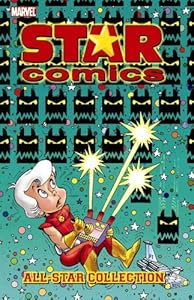
Second volume, pretty much the same as the first... in terms of generally outstripping my expectations, that is. This issue collects PLANET TERRY #3-#4, TOP DOG #4-#6, WALLY THE WIZARD #3-#4, and ROYAL ROY #3-#4, taking us through the end of 1985 and the latter stages of the Star "shakedown cruise." For the most part, the original writers and artists are still on the job, though another Harvey stalwart from the 70s and 80s, Ben Brown, bows in by both writing and drawing both stories in WALLY #4. Most of Brown's previous work on RICHIE RICH can charitably be described as uninspired, but here he turns in some first-rate work, though inkers Jon D'Agostino and Vince Colletta may have helped his cause considerably. Bob Bolling returns to WALLY with issue #3's book-length "Folkquest" and turns in the best single story of this collection, a touching tale of Wally's efforts to find his kidnapped parents and help his young Viking pal, Vikk, track down his own father. Wally shows genuine nobility of spirit throughout. By contrast, ROYAL ROY is already beginning to stagger despite the best efforts of Stan Kay, Warren Kremer, and new writer Angelo DeCesare. DeCesare's "The Curse of the Gold-Engaged Bridge" (RR #4) delivers a wretched title pun worthy of Harvey at its peak but, at bottom, is nothing more than a riff on one of my favorite Richie Rich-Mayda Munny stories, "Wedded Blitz." We learn something of Top Dog's past in TOP DOG #4 and #5 as federal agent Morrison calls upon TD to reprise his role as mental jockey of the government's "Brainstrain" computer (the usual Colossus-like beep-and-flash monstrosity that the the PC revolution was then in the process of rendering somewhat obsolete) and save America from, in turn, an embittered Treasury engraver who plans to flood the country with fake currency and a crook who intends to use the power of an "ancient Egyptian amulet" to make himself "King Invisible of America." It's good fun, but the fact that Lenny Herman resorted to two such plots back-to-back is a bit troubling, especially since the relationship between TD and his "owner" Joey Jordan still needs development. Ish #6 sags badly with a poor lead story in which nasty Mervin Megabucks hires two unfunny "mildly peeved" scientists, Frank and Stein, to hypnotize TD into becoming his dog, and offers up what may be a sinister portent for the future with some shoddy non-Kremer art in one of a pair of one-page gags. Finally, Planet Terry, Robota, and Omnus continue their search for Terry's mom and dad (I should really create a key function that prints all that in one fell swoop, since it'll be operative for the book's entire run) and make the acquaintance of Elvin, a cute, no-doubt-Ewoks-influenced character. Terry must be a bit older than he looks, since the beautiful Princess Ugly, ruler of the World of the Gorkels, appears to have the hots for him. That only happened to Richie Rich in the Christmas Wish movie, and, even then, the female rock-band groupies were talking about "someday" getting together with Richie when he had become a bit older. These may be Harvey Comics in all but branding, but at least one or two modest chances were being taken...
Thursday, February 18, 2010
Comics Review: WALT DISNEY'S COMICS AND STORIES #703 (Boom! Kids, January 2010)
 Now here's a comic re-establishing "first principles" with a vengeance! With the Ultraheroes having departed to their own title, Boom! returns to the original Disney comics hero -- the quick-witted, dashing Mickey Mouse of the Floyd Gottfredson era -- in "Mickey Mouse and the World to Come," a 2008 Italian story written and drawn by Andrea "Casty" Castellan (who is also interviewed herein). Castellan's art strongly resembles that of Gottfredson during the immediate post-World War II period when Bill Walsh was handling the writing chores -- his "smaller and squatter" rendition of Mickey's scientist pal Doc Static is a good "guesstimate" of how Gottfredson might have drawn Static had the character debuted in the late 40s -- and the resemblance is further strengthened by Castellan's decision to bring back The Rhyming Man, the villain of Walsh's 1948 continuity "The Atombrella," as the tale's apparent villain. (The "Atombrella" story, which co-starred Eega Beeva, was never reprinted in comic-book form in America, which renders editor Aaron Sparrow's sidebar note to "see" the original story "for Mickey's first duel with his rhyming foe!" rather pointless.) The plot (dialogued with great panache by David Gerstein, Jonathan Gray, and Stefania Bronzoni) isn't exactly clear as of yet, but we do know that (1) Doc Static may have been up to some sort of intrigue during a 1980's sojourn in Europe (does he seem like the nuclear freeze type to you?); (2) someone out in the desert built a giant flying robot some years ago, and it ain't Emil Eagle; (3) a bunch of sunglass-wearing "Men in Black" (OK, "in Tan," to be perfectly technical) didn't appreciate Mickey and Minnie snooping around that desert location. I may not quite know what's going on, but I do know that chapter one ends on a legitimate cliffhanger. After some of the awkward cutoff points we've seen in Boom! issues past, this is no small achievement. Castellan tops off the fine performance with a splendid cover that looks like a cross between an advertisement for The Rocketeer and a cover to Kit Cloudkicker's favorite pulp magazine, AMAZINGLY FANTASTICAL TALES.
I certainly wouldn't have minded seeing a few extra pages from Castellan -- even if it would have messed up that great cliffhanger -- but Boom! serves up an out-of-left-field backup story, giving us part one of Alberto Savini and Abramo Leghziel's "Peg-Leg Pete and the Alien Band." This thing is just plain weird. To wit: (1) "Peg-Leg" Pete has both feet intact; (2) Pete is abducted bodily out of his bathtub in a manner not unlike that of the Elephant Girl in DuckTales' "Duckworth's Revolt" (the Elephant Girl's tub came with her, but I doubt that any force in the universe is powerful enough to lift both Pete's tub and his body at once); (3) Pete's alien abductors appear to be the "love children" of an unidentified Muppet and The Way-Outs. Evidently, the aliens intend to "change Pete's skin," for whatever cockamamie reason. A pre-story blurb attempts to tie Pete's travails, however loosely, to the events of "World to Come" ("With Mickey otherwise occupied, who will keep Mouseton safe from the sinister machinations of Peg-Leg [sic] Pete?"), but it hardly seems necessary. I will admit, though, that I can easily hear Jim Cummings providing Pete's voice in this story. I can hardly wait for Pete to snap out of his initial fright and try to sell the aliens a used spaceship...
Subscribe to:
Posts (Atom)