Sunday, July 20, 2014

DUCKTALES RETROSPECTIVE: Episode 90, "The Unbreakable Bin"

For obvious reasons, I'm not sure when I'll be able to do the next one of these. Take some solace from the fact that this final pre-surgery post is a honkin' huge one.
The last DuckTales adaptation of a Carl Barks story ("The Unsafe Safe," UNCLE $CROOGE #38, June 1962)... and I don't care whether you're an "old sourdough" who has every Barks re-re-re-reprint in your collection or a relative young'un who came to the comics through DT, but you REALLY have to be impressed with the job that Alan Burnett turns in here.  No sludginess as was seen in some of the earliest adaptations, no unwanted and unnecessary injections of "morals" as in "Down and Out in Duckburg," not even the introduction of made-for-TV characters into roles more or less unobtrusive, as in "Scrooge's Pet" and "The Land of Trala La."  Yes, yes, I know that Fenton/Gizmoduck appeared in this episode.  The point is that Burnett simply includes the trials and tribulations of Gizmo -- chucked into abrupt unemployment as the result of Scrooge's adaptation of Protectoglass as a new, and presumably the ultimate, bin-defense -- as an additional subplot.  At the same time, Barks' narrative -- leavened with what I believe to be judicious borrowings from a couple of other Barks stories -- is presented with only minor alterations.  That's a lot of material to pack into 22 minutes, and yet, Burnett's script never seems rushed or incoherent.

After reading through "The Unsafe Safe" and observing the story's relatively modest quotient of action, Burnett evidently felt that something needed to be added.  The Beagle Boys, in their brief appearance in Act One, do get the chance to directly imitate their Barksian counterparts, assaulting Scrooge's glass safe with sledgehammers and high explosives.  (Since the DT Beagles only try the explosive approach once, while the Barks Beagles repeatedly fail to use "the right amount" of TNT to blow up the safe, this sequence might be counted as one of the few times when the former could legitimately be said to have outperformed the latter.)

For Magica's mission, however, Burnett hauls out the big guns -- or celestial cannons, if you will -- and borrows from Magica's attack on the Bin in Barks' "For Old Dime's Sake" (UNCLE $CROOGE #43, July 1963).  Seeing as how the Magica of "The Unsafe Safe" tries to crack the vault with the dulcet tones of a series of musical instruments -- a gambit that one would expect a character like Pinkie Pie to be more apt to use -- one can understand Burnett wanting to permit Magica, in her only appearance of the Fenton-Bubba era, to display the full extent of her magical powers.

Magica only gets to hit the "Unbreakable Bin" with one comet, as opposed to the series of celestial objects that Barks' Magica uses, but the balance is redressed by the fact that we're getting to see the attack "live."  The visuals of the comet approaching the bin and the immediate aftermath of the impact are impressive, and I'm glad that the animators eschewed the cliched "dollar sign cloud" effect that we got at the end of "Money to Burn" in favor of what one might term a cleaner and more "classical" approach.  There's something just slightly comical about the manner in which Barks' comet and meteor strike the bin -- the pronounced sound effects may have something to do with it -- and letting the visuals and natural sounds speak for themselves was probably the correct choice for the TV version of the assault.

In case you're wondering... I don't regard this lifting of an aspect of another Barks story for use in an unrelated episode in quite the same manner that I did the use of material from, say, "Only a Poor Old Man" in "Liquid Assets."  "For Old Dime's Sake," created at a time when Barks wasn't doing Magica stories so much as gushing them out, is itself little more than a "string of incidents," so picking one incident to use somewhere else doesn't seem like such a big deal.  Like the added subplot involving Gizmoduck, I regard the "Dime's Sake" detour as an enhancement of the original story, as opposed to the plugging of important matter from another source into a completely different narrative.

Apart from "The Unsafe Safe," Barks' other significant tale of "material Money Bin encasement" is the ten-pager "Too Safe Safe"/"The Money Preserver"/"Imperviwax-ing the Money Bin" (WALT DISNEY'S COMICS AND STORIES #171, December 1954), and I think that's there's a case to be made that Burnett consulted this story as well.  Not so much because DT, like Barks, portrayed its protected Bin as having no easily definable means of reentry into the structure...

... as because Scrooge takes advantage of the situation in both cases to divest himself of what he now regards as superfluous help (Donald in Barks' case, Gizmoduck in DT's).  It's not difficult to imagine Burnett drawing inspiration from Donald's post-Impervi-wax fate and reasoning that Gizmoduck was a logical candidate for a layoff.  In both cases, of course, Scrooge lives to know better... though Donald, unlike Gizmoduck, doesn't get a chance for satisfying redemption.

While Burnett may have gathered the material for his adaptation from several sources, the opening of "The Unbreakable Bin" is wholly original, a dazzling departure from the series' past visual practice.  In what looks for all the world like a dry run for the Frank Miller-inflected visual stylings of "The Masked Mallard" -- but one with even more of an abstract flair -- Scrooge's nightmare is a charcoal-tinted farrago of weird angles, exaggerated dimensions, curving corridors, and menacingly omnipresent Beagle Boys (who, significantly, are drawn in Barks "clone" mode, the better to emphasize Scrooge's subconscious paranoia).  Even the normally chipper DT background music becomes tense and ominous.  The looser drawing style of the later episodes helps here, as the various distortions don't seem quite as "detached from reality" as they would have been had this been a first-season effort.  Even so, the potency of the "nightmare fuel" is readily apparent.

GeoX draws a parallel between this opening and that of Marco Rota's Italian classic "The Money Ocean" (ALMANACCO TOPOLINO #215, November 1, 1974), and it's easy to see why.  In both cases, a sleeping Scrooge is unconsciously undermined by hordes of invading Beagle Boys.  The Scrooge of "The Money Ocean," however, keeps his fortune in a series of numbered Bins, so, even though the Beagles' imaginary raid climaxes with the "main" (#1) Bin, their string of sieges doesn't really have the impact of a single attack on the "One True Bin."  To his credit, Rota does slightly modify his normally elegant art style here in favor of a somewhat sketchier approach, especially when drawing background details such as a crumbled Money Bin, but the results simply don't compare to "The Unbreakable Bin" insofar as visceral imaginative impact is concerned.  There's nothing in "The Money Ocean," for example, as creepy as the scene in which Scrooge, having retreated to the "safety" of his vault, finds Beagles popping out of his money and, even worse, grabbing him by the webs and trying to drag him under.  Not even the Rota Beagles reenacting the famed attack of the Zulus as they lay siege to Bin #1 can match this.

Once the resistant properties of Protectoglass are displayed to Scrooge -- with Gyro Gearloose and Gizmoduck using tests very similar to the ones Scrooge employed at the start of "The Unsafe Safe" in the process -- the old miser is immediately eager to put the substance to the ultimate test, even going so far as to challenge the Beagle Boys to see if they can crack it.  In this respect, he is quicker off the mark than Barks' Scrooge, who didn't see the light shining through the glass, so to speak, until yet another Beagle assault on his Bin.  The glass of "The Unsafe Safe" is attributed to unnamed "scientists" in Scrooge's employ, since, thanks to an obscure postal regulation that was then applied to periodicals with second-class mailing privileges, Gyro, who starred in the backup story in UNCLE $CROOGE at the time, wasn't permitted to appear in both "his" story and the main story.  "The Unbreakable Bin" gives Gyro back some of his inventive dignity by letting him be the one who creates Protectoglass spectacles for Scrooge in the first place, just as he created Impervi-wax in WDC&S #171.

After trying and failing to best Protectoglass, the Beagles, as they did in "The Unsafe Safe," quietly retreat from center stage, allowing Magica to assume the role of antagonist.  Scrooge, meanwhile, takes HD&L on a celebratory trip around the world, on which he "splurges" -- but only up to a point.  To me, at least, this behavior makes far more sense than the equivalent jaunt in Barks' story, in which the cost of the trip is never mentioned.  Scrooge's line, "Now that I've stopped worrying about my money, I don't mind spending it!" may not sound right, but his actions here speak far louder than his words.  It's reasonable to think that it would take a while for Scrooge to really loosen the old purse strings -- if he ever will.

"The Unbreakable Bin" also takes the logical step of asking what might happen to the rest of Duckburg if it were to find out about the wonders of Protectoglass.  (It'd be hard not to notice how well the Bin withstood that Beagle assault; even "the little old lady across the street" who repeatedly complained about the noisy attacks in Barks' story might have stopped kvetching long enough to take notice.)  Since there is no indication that Gyro invented Protectoglass for Scrooge's exclusive use -- he does have many other customers, as even DuckTales recognized in "Sir Gyro de Gearloose" -- this is one instance in which all of society reasonably stands to benefit from one of Gyro's McDuck-inspired creations.  The consequence, of course, is that Gizmoduck isn't the only security guard thrown out of work.

So the cops from "The Good Muddahs" washed out ALREADY?  You might say I'm not surprised.

Having learned of Scrooge's absence (as she will later learn of Protectoglass' fatal flaw) thanks to her crystal ball -- if Scrooge ever gets wind of this method of omnipresent surveillance, then he'll REALLY have a reason to be paranoid! -- Magica blows into Duckburg, there to have a funny exchange with Gizmoduck the reluctant traffic cop.  The fact that Magica flies in on a broom is noteworthy in and of itself; she rarely did that in the comics, preferring instead to travel in comparative comfort on Vesuvius Airlines.  The use of the broom also complicates matters a bit later in that Magica, just as she did in "The Unsafe Safe," reaches Tanganyika/Quackanyeeka via canoe, leading one to wonder why she didn't just hop on the ol' stick and cut down on travel time.

Back in Tanganyika/Quackanyeeka, Burnett lightens the mood a bit by inserting the bad-comedy guide (did Chuck McCann suggest some of those jokes?) before returning to Barks "book" as Scrooge and HD&L encounter the Yeeker bird and learn of the damage it can do to Protectoglass.  The fateful moment of "initial breakage" is pretty much identical in both cases, right down to the close-up shot of Scrooge's specs being blasted to smithereens.

Scrooge's subsequent drafting of the natives to help him round up "all the Yeekers" (which, as in Barks, turns out to be surprisingly easy) is similarly kept intact, though Scrooge only agrees to pay $1 per Yeeker, as opposed to the $10 and $20 he offered in "The Unsafe Safe."  Nice consistency there from Burnett regarding Scrooge's maintenance of a thrifty attitude.  The DT Quackanyeekans, unlike their Tanganyikan brethren, don't speak, or, in fact, possess much of anything in the way of personality.  Not that Barks' natives said anything particular dicey, but, judging by DT's last attempt to depict an indigenous culture, perhaps it's all for the best that Burnett chose not to go there.

After "blowing into town" in perhaps the silliest and most pointless moment of the episode -- really, what did Magica channeling Launchpad's ability to crash accomplish that a simple fidelity to Barks' original would have? -- Magica uses her "stun ray" to immobilize Scrooge and the boys (not exactly a "foof bomb," but I'll take what I can get) and takes off for Duckburg with her Yeekers in tow, or, rather, towing her.  Again, Burnett sticks firmly to the Barks template here, auditory rip-off of a scene in "Frozen Assets" aside.

As the opposing forces make their way back to Duckburg, Gizmoduck is enduring the final indignity, serving as lunch wagon to a crew of hardhats with decidedly plebeian tastes.  (I suppose that Gizmo must simply have quit the traffic job; he certainly didn't do anything to justify being fired from that gig, at least not that we could see.)  As they have throughout the episode, Gizmo's travails provide a healthy number of laughs, but they also provide an additional comment on the utility of a hero, sort of a comedic counterpoint to Fenton's dilemma in "A Case of Mistaken Secret Identity," or even the fate of Mr. Incredible and the other "supers" in The Incredibles (2004).  When a superhero is laid low by the vagaries, hassles, and petty annoyances of everyday life, how does he or she cope?  The solution to Fenton's problem would seem to be to cut loose from conventional duty and set himself up as, well, a "Hero for Hire."  But Fenton's imagination doesn't, or can't, stretch that far; he sticks with more mundane employment opportunities.  At least Mr. Incredible tried to keep his heroic hand in, even as he was forced to hide his deeds from the public eye.

The two main narratives, which have been tracking one another like hounds on a scent up until now, finally diverge just a bit when Magica brings the Yeekers to the Money Bin and tries to break in.  (Technically, in Barks' story, she gets into the Bin easily enough but is balked by the safe, whereas she can't even get through the door in "The Unbreakable Bin.")  For my money, the windup of "The Unbreakable Bin" is far superior.  In both cases, a sleepy Yeeker puts a crimp in Magica's plans...

... but Barks' Magica then succeeds in breaking through and stealing the Old #1 Dime, only to be foiled when the other Ducks arrive and she literally runs out of juice to fight them.  (As with her use of air travel, Magica's use of a mechanical aid here is part and parcel of her original portrayal as what might be called a "practical" sorceress.)  This makes for an ending that is frankly underwhelming, as the Ducks grab Old #1 and the foiled Magica is reduced to a spasm of ineffective rage.  Burnett's approach is a little more cliched, using as it does the classic tropes of "the last-minute rescue" (the rehired Gizmoduck flying in at the last minute to spirit Magica away before the Yeeker can sing) and "the evil attack that backfires" (Magica's Wind Powder "turning against her" after the Yeeker busts the beaker), but I'm not complaining.  Gizmoduck needed to save the day in order to fully justify his renewed employment, and there is something satisfying about seeing Magica being "hoisted by her own pet bird," as it were.

Barks' story simply stops after the end of Magica's final attack, leaving behind one big, whomping plot hole -- what's to become of Protectoglass after this?  It's easy to imagine the security-obsessed Scrooge swearing off the stuff, reasoning that, even if all the Yeekers can be captured and caged, there's always the chance that they might be freed.  The baby Yeeker's inadvertent destruction of all of the Protectoglass in Duckburg, however, would seem to provide a more visceral motivation for Scrooge to abandon the idea.  It's not made clear who will be responsible for paying for all the damage, but it's easy to imagine Scrooge feeling a certain obligation to help Gyro out of any legal difficulties that might ensue.  The resulting payout would probably be sufficiently stiff to scare Scrooge away from using Protectoglass permanently.

Greg disliked the ending because it made Scrooge and the boys look "dumb."  This strikes me as unfairly harsh.  The boys' plea that they be allowed to keep the Yeeker "for a little while" reflects (1) their understanding that they won't be able to keep it when it's able to sing in all its "gory" and (2) their perfectly reasonable belief that a baby Yeeker may not be as dangerous as an adult.  Far from asking "what harm could it do?" -- Dewey gets that line -- Scrooge simply stops and briefly weighs his options before the degringolade strikes.  Nothing wrong here that I can see.

Burnett's feat here is probably a bit less impressive than the one Doug Hutchinson pulled off in "The Land of Trala La." The story being adapted there was a much more challenging one, and a new, more visually appealing "adventurous ending" had to be created.  "The Unsafe Safe," by contrast, is a relatively simple story and could be absorbed pretty much "as is."  It's safe (heh) to say, however, that "The Unbreakable Bin" ranks with "Scrooge's Pet," "The Status Seekers," and "Robot Robbers" on the link just below "Trala La"'s on the "Great Chain of Barks Stories Brought into Animated Being."  It might even be granted some extra points on the grounds that it appeared so late in the series' run, with the show's metaphorical shirt collar having long since been loosened and any lingering sense of reverence towards the characters and the concept having been shunted to the side.  In any event, it's a pleasant note on which to conclude this subgenre of DT offerings.

.

.

.

"DuckBlurbs"

(GeoX) The idea -- as if you didn't know -- is that Gyro invents new, unbreakable glass for Scrooge's new glasses[;]he uses this to sheathe the bin (actually, he appears to not just sheathe it, but actually replace the metal with glass, given that you can see through it to the money -- cool effect; not necessarily that practical)...

In "The Unsafe Safe," Scrooge sheaths the bin in glass AND replaces the original safe with a glass one; the former action seems a bit extravagant, in view of the fact that the front door to the Bin is left unlocked anyway.  The "cover-up job" in "The Unbreakable Bin" handles things in a similar manner but does not make it clear how one would get into the Bin after it has been glassed-in.  There must be a way to do so, since Scrooge can let the Beagle Boys in after the fact, but we never see it demonstrated.

(Greg)  Anyhow; we hear noises and here come the "real" Beagle Boys. It's the usual idiots: Big Time, Baggy and Burger with digging objects. Here's the obvious problem with this: Dig underneath the domed glass and you get in easily. The only way this works is if the bottom has the Protecto glass. So I already see a scratch in the armor in this plan guys.

I'd like to think that Scrooge planned for that contingency, based on his unpleasant experience in "A Drain on the Economy."  The fact that he went to the trouble to plate the entire bin suggests that he did the same to the bin's bottom.

(Greg) Scrooge runs to the vault as he wants to take the vacation he has been planning for 40 years or so and the nephews will get to see the world as the nephews are happy. Okay; there is one problem with that: Whomever wrote this episode has NEVER watched Ducktales because the nephews have been around the world in almost 80% of these episodes anyway.

"Vacation" vs. "business" (read: treasure-finding) trip.  There IS a difference, no? 

(Greg) After the commercial break; we head into the jungle with Scrooge and the nephews wearing safari hats. The guide is a dogperson in complete safari gear with the Mickey Mouse gloves. The guide makes the worst jungle jokes ever in a cartoon and it's clearly intentional because Scrooge blows him off for it.

Funny thing about this "safari": The Ducks and the guide haven't brought any gear with them!  It's as if they are going on a tour of a zoo.  Scrooge's cheapness is all over this one like white on rice (because rice is cheap).

(Greg) So we see Magica fly to the Money Bin and apparently; we break logic again since the whole bin is now plated with glass. Okay; then how does Scrooge and everyone else get in?

There must be a way.  See "Scrooge/Beagles."

(Greg) Magica scratches the glass and proclaims that she'll find a way to break the glass if it's the last thing she ever does and she uses her elbow to pound on the glass; but then sells an injury by grabbing her foot. Huh? Explain THAT one kids! If that was BS&P again; that is one of the dumbest spots ever. 

It does look as if her elbow makes contact with the glass, but the main action here is unquestionably the foot-fault.  Note how Magica's shoe is "squished" in the image below.

(Greg) So we see Scrooge and the nephews in the streets with Gyro driving a NASA rocket car. Seriously. I'm sorry; but the VANILLA MANILLA UFO OF DEATH from Micro Ducks From Outer Space was much cooler (Gyro: Really Mr. Weagle? I thought you were breaking from the script there for a second.). 

It's somewhat difficult to get a detailed image of the hovercar here, but it does appear as though the Wang animators were at least TRYING to duplicate the look of the vehicle in "Micro Ducks."  TRYING, I said.  In its flexibility, the "new version" of the hovercar looks and acts more like a rubber raft than a rigid flying object.  The "racing stripe" and two front lights (or whatever they are) look the same, though the color of the interior has been changed from red to white.

Next: Episode 91, "Attack of the Fifty-Foot Webby."

Comics Review: MY LITTLE PONY: FRIENDSHIP IS MAGIC #17-20 (March-June 2014, IDW Publishing)

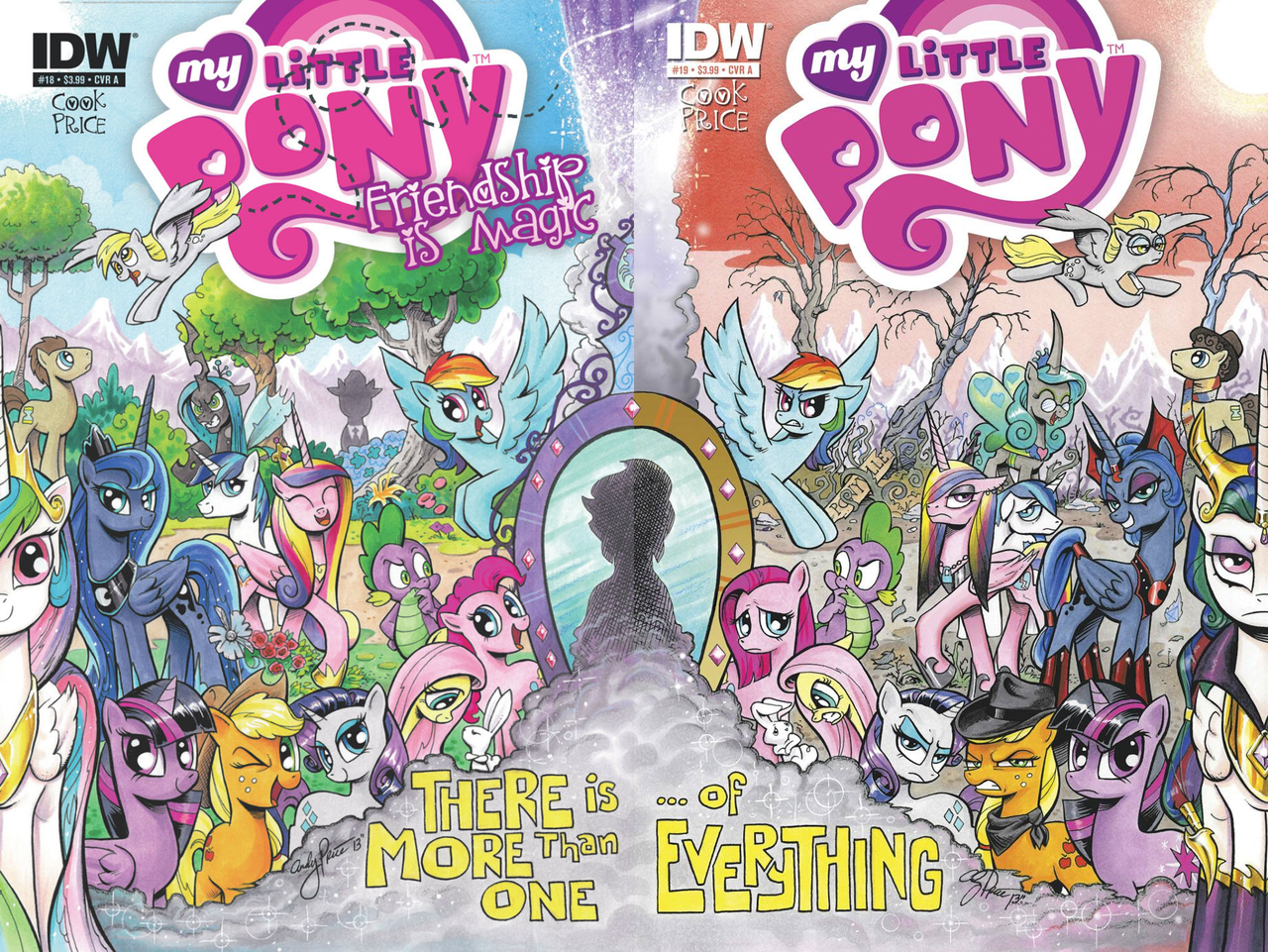
Katie Cook and Andy Price are through playing around.  Turning the romance of Princess Cadance and Shining Armor into a pony version of an 80s "teen movie" seemed daring at the time, but the duo's most recent four-issue story arc, "Reflections," is dead-certain sure to boost the blood pressures of a certain class of continuity-obsessed Bronies.  The "target" this time is none other than Princess Celestia, who, while possessing a bit more personality than Cadance and Shining did before C&P signed them up for the Equestrian Breakfast Club, has never been what one would consider a fully realized character.  Earlier IDW MLP comics have nibbled at the problem of making Celestia interesting, giving her a chance to defend an old friend and colleague and allowing her to team up in an adventure with Spike, but even these efforts stuck closely to the established template of "the wise and supportive ruler."  For their part, C&P have previously added some welcome humor to Celestia's daily activities, allowing her to partake in day-long sauna trips, dressing her in a bathrobe, giving her an "I Hate Mondays" coffee mug, and injecting similar homey touches into the quotidian life of an alicorn quasi-goddess.  But giving the princess a romance-tinged, bittersweet backstory -- one that she has kept hidden from her closest friends and even from her own sister, Luna -- is something else again.  As the consequences of the actions of a younger, somewhat more heedless Celestia begin to manifest themselves in modern-day Equestria and in a mirror-world counterpart, we begin to see Celestia in a new light, as a flawed but noble heroine.  One commenter on Equestria Daily observed that Celestia seems "perfect" now only because she's lived so long that she's had time to make every possible mistake.  "Reflections" does a remarkable job of recounting her biggest mistake of all and the sacrifices that she and other characters are forced make in order to put things right.
** SPOILERS **

One of the things that distinguishes this "alternative universe" story is that it resists the temptation to try to do too much.  We don't see the "nega-versions" of the "Mane 6," for example, except in a single gag page at the end of the last chapter.  That isn't too bothersome, though, because the Elements of Harmony are essentially supporting players here.  The gals do get to perform in concert as the Elements in #20, but they're basically knocked out of commission before the denouement.  Twilight Sparkle might be unnerved at C&P's refusal to hit all of the expected bullet points, but I appreciate the restraint.  Throwing a "Mean 6" into the mix would have detracted from the main conflict and cluttered up the story unnecessarily.  The "Mane 6" will have more than enough future opportunities to take center stage in this title, after all. 

The alternative version of Equestria, in which Celestia and Luna are villains, the "evil King Sombra" is a noble hero, and so forth, is depicted in a fairly sketchy manner; we see and read just enough details to get a general gist of the place.  Again, this is acceptable, because this is less of a sprawling mega-adventure and more of an examination of the consequences of following the dictates of one's heart.  As a youthful (comparatively speaking), impetuous, and somewhat uncertain princess, Celestia accompanies the legendary magician Starswirl the Bearded on trips to various dimensions through the medium of a magic mirror (no funny faces required for activation).  These chronological cruises culminate in a visit to "Nega-Equestria," where Celestia and Nega-Sombra meet and fall in love.  Though Starswirl warns Celestia of the dangers of using the mirror too often, Celestia can't help making a series of quick trips to be with her beloved.  Now, with the two Equestrias "leaking into" one another and the evil Celestia and Luna plotting to take advantage of the fact and literally find a new world to try and conquer, Celestia must attempt to repair the damage with the help of the "Mane 6" while facing up to the fact that her own actions have placed everything that she loves and cares for in peril.

The story unspools with great sensitivity, more than ample "Heart," and just enough humor to make the grimmer parts go down more easily.  The romance between Celestia and Nega-Sombra is handled with the correct touch, being neither overamped nor downplayed.  Physical action, somewhat lacking in the first three chapters, dominates the final issue, as we get the expected "conflict between worlds" and a "final sacrifice" that is one of the more stunningly mature things that I've ever seen in a "kid's comic" (hey, Pinkie Pie called it that, not me, and she would know).  Suffice it to say that the "sacrifice" is far more complicated than simply "laying down one's life for one's friends."  It even promises to have aftereffects, as Celestia, even though her regime has been saved, will always be aware of what had be done in order to restore the "balance" between the two worlds.  I have to think that we will see references to that in future stories.  In a soft-pedaled and easily overlooked subplot, Twilight, who is still trying to grow into the role of a princess -- or, rather, what she expects a princess to be -- learns that, while others can serve as one's role models, one must ultimately fashion a personal "leadership style."  This high-octane, emotionally sophisticated version of the familiar "Be yourself" trope ties what Celestia did long ago back into what Twilight will presumably have to deal with as she accepts more responsibilities in the future, starting with her accession to the nebulous, but unquestionably challenging, title of "Princess of Friendship" in "Twilight's Kingdom."

I really wish that Cook and Price could do every issue of MLP:FIM, but, if occasional hiatuses are needed in order for them to maintain the remarkable level of quality seen in "Reflections," then I'm OK with that.  Breaking with the expected while still maintaining the spirit of the source material is a very tricky business, but C&P have proven to be masters of the form, and I look forward to seeing what they will conjure up next.

Thursday, July 17, 2014

DUCKTALES RETROSPECTIVE: Episode 89, "The Bride Wore Stripes"

We haven't seen a split decision like this since... when?  "Ducky Horror Picture Show," perhaps?  As in that earlier case, GeoX -- B-I-I-G surprise -- condemned "The Bride Wore Stripes" to the depths of Tartarus, while Greg rather enjoyed it, despite its glaringly obvious logical shortcomings.  Even Joe and I found ourselves disagreeing on it, though not quite to the same degree.  Joe's life experiences had, in a sense, prepared him to better appreciate the episode's sardonic portrayal of the supposed "marriage" of Scrooge and Ma Beagle and, more to the point, of the core notion that Ma intends to exploit the vagaries of divorce law in order to take Scrooge for half of his fortune.  Not being all that worldly-wise or "battleax-scarred" at the time, I was more inclined to focus on the jaw-dropping silliness of the whole concept.     

While Ken Koonce and David Weimers (running dangerously close to "creative empty" by this point) get the writing credit for "Bride," the story is attributed to George Atkins.  Here was a unique intersection of talents from two different eras of (and, more to the point, approaches to) great TV animation.  Atkins was one of the original writers for Jay Ward's Rocky and His Friends, toiled on several other Ward series, and provided scripts for UPA's Mister Magoo and The Dick Tracy Show.  "Bride" marked the first and only time that a writer from one of the Ward series (as opposed to voice talents like June Foray and Bill Scott) contributed to a WDTVA production.  But do we see any traces here of that distinctive Ward sense of oddball humor?  It'd be hard for me to say "yes."  Whatever cleverness may have been wedged into Atkins' original concept is pretty much swamped by the exact same kinds of gags that have been eating away over time at whatever residual respect the audience has maintained for the by-now-standard trio of Big Time, Burger, and Baggy.  (Where's Bouncer, you ask?  As we learn at the very start of the ep, he is serving a jail sentence, presumably to be followed by yet another unsuccessful re-re-re-re-rehabilitation.)  Ma's rant at the beginning, in which she lambastes her "dim" sons and complains about having to live in a "rat shack," could almost be taken as a meta-comment on what has become of the Beagle brood in general.  If you want to interpret this long-simmering explosion as the G-rated equivalent of "a long string of disconnected profanity," Geo, then feel free to do so.

Another familiar genre of gag is also on display as HD&L drag a reluctant Scrooge all over town to gather various goodies for Mrs. Beakley's birthday.  Repetitive ribs at Scrooge's cheapness have been used off and on in the series, most famously in "Don't Give Up the Ship" and "Down and Out in Duckburg."  The triptych of tightwaddery to which we are subjected here doesn't make Scrooge look as bad as he does in those earlier episodes... quite.  Buying seeds instead of flowers is an ingenious enough gag that it could have appeared in a Carl Barks one-pager, but purchasing a cheap, frosting-denuded cake and a completely inappropriate "birthday card" simply make Scrooge look careless and hard-hearted.  The Nephews' increasing frustration with Scrooge's unwillingness to part with his cash provides a nice, if easily overlooked, counterpoint to Ma's eruption in the opening scene.  It's as if the boys somehow realize that this story is fated to be packed with predictable humor and are rebelling against that fact.

As Scrooge is being pushed through his parsimonious paces, Ma is setting her cockamamie scheme in motion to create the impression of a bogus marriage out of whole cloth.  (We will pass without comment over the question of where she was able to cadge a striped bridal gown in such short order.)  The plan is irritatingly slipshod from the get-go, culminating in that infamous "family faketrait" onto which Scrooge's face has been crudely taped.  Then again, how many times have we seen the Beagles fool Scrooge and others with "disguises" while not even bothering to hide their number plates?  Isn't Ma simply going with the flow here, trusting in the stupefying incompetence of the Duckburg judicial system to backstop anything she might try to pull off?  This particular cabal, however, is heavy-handed enough that one can easily imagine the Law of Diminishing Returns kicking in and Ma being found out...

... until Scrooge and Ma meet in court before a judge whose ineptitude puts all those Barksian owl judges in the comics to shame.  Those guys may have provided some comical moments, but they never took the law to the depths explored in the courtroom of Judge B. Fair, who seizes on a slip of Scrooge's tongue and declares the couple "duck and wife."  (Interesting verbal formulation, there.  Are there similar phrases used when male dogfaces and pigfaces get married?)  Not that Scrooge is entirely blameless here.  We meet his lawyer later in the episode, but she's nowhere in evidence during this hearing.  The experience of "Duckman of Aquatraz" should have taught Scrooge NEVER to enter a court case against a longstanding foe without some legal assistance, ESPECIALLY when he's dealing with what passes for Duckburgian "justice."  Despite Ma's presentation of a marriage license -- I would think that both parties would have to have signed said license in order for it to stand as an official record of the marriage -- calling this setup "contrived" would be an insult to unlikely coincidences everywhere.

The episode has been pretty draggy up until this point, and it continues to be so until the end of Act One.  Ma and her boys set up housekeeping in McDuck Mansion, leading to the expected string of "mass Beagle destruction" gags and a concurrent rise in Scrooge's blood pressure.  The Beagles' increasingly amped-up childishness really grates here, so much so that the half-adult gag involving Scrooge going to bed and finding a mud-masked Ma Beagle "lying in state" seems more mature and risque than it truly is.  The only thing that might have livened this whole sequence up a bit is for Webby and Bubba to have run afoul of the Mansion-ransacking Beagles.  Where are those two, anyway?  One can understand K&W wanting to sort of put Bubba "out of sight and out of mind" by this time, but, given that the disruption of the extended McDuck family is the focal point here, shouldn't Webby have been included?  Did K&W somehow forget the precedent set by "Send in the Clones," for which they provided the script?

Act Two opens with one more silly-time gag (the clueless Beagles monopolizing the bathroom -- actually, shouldn't a mansion as large as Scrooge's have multiple bathrooms, thus sparing the aggravated miser the small Calvary of waiting until the Beagles are finished? -- and inexplicably causing a flood that washes Scrooge down the staircase), and then the script abruptly begins to grow something resembling a brain, as Scrooge consults with his lawyer on what to do.  The lawyer character, who speaks in what appears to be Russi Taylor's natural voice, is something of an eye-opener in a series in which the depiction of females has, shall we say, not always been all that progressive.  She even wears a suit and tie, nudging us intriguingly close to cross-dressing.  Too bad that her advice is distressingly generic (and that she had earlier responded to Scrooge's news about his "marriage" by offering to buy him a wedding gift). 

The flowering and subsequent deflowering of Scrooge's plan to rid his home of Ma's ministrations is the funniest thing in the episode.  The Nephews finally get to play a bratty role for a good cause, and the list of demands gets longer and longer until Ma topples over in a dead faint.  Remarkably, she then picks herself up and rises to the challenge... and, as she does so, the latest OCD that she'd earlier displayed in "Beaglemania" snaps back to the fore.  It isn't enough that she display simple competence at her various household tasks; she turns into a super homemaker, even going so far as to (gasp!) refuse to give Burger between-meal snacks.  By the time she tells a dumbfounded Scrooge that "housework has fulfilled me in a way no bank heist ever could!", we're almost tempted to believe that she's prepared to scandalize the "Crime Mothers" club and go legit.  I'd like to think that Atkins was primarily responsible for thinking up this amusing sequence, which is just satirical enough to faintly resemble something a former Ward writer, even one in the twilight of his career, might have cooked up. 

Having made its point about Ma's metamorphosis, the episode proceeds to jump on it repeatedly and hammer it into the ground.  References to The Brady Bunch and Father Knows Best provide a clear indication that Ma's newfound enthusiasm for domestic life is starting to curdle into something obnoxious.  Things come to a head with the drawing-room scene in which Ma coerces Burger (who, like his brothers, has now been coaxed into wearing grotesquely ill-fitting HD&L outfits) into reciting poetry.  Toon Disney was having none of the idea that Ma would need to brandish and fire a pistol to get Burger to spout his doggerel (Beagle Boy?  Doggerel?  Get it?) and cut out the brief scenes in which Burger blows Ma off and Ma literally "fires back."  TD shouldn't have bothered; the scene was already off-putting enough, so how would subtracting firearms enhance it?

HD&L's, Duckworth's, and Mrs. Beakley's precipitate retreat begs a small but nagging question.  In order to set up the scheme that will ultimately entrap Ma, Scrooge needed the cooperation of HD&L, at least, since Louie winds up tape-recording Ma's inadvertent confession.  But when the boys run off in protest, how does Scrooge know where they're going?  It can't be to the servants' "homes," since said "homes" are presumably in the Mansion.  Perhaps Scrooge played the odds and, thinking back to "The Billionaire Beagle Boys Club," reasoned that his servants and Nephews must have retreated to the comparative security of Launchpad Unlimited.

Both Greg and GeoX ripped on the "brilliant" plan wherein Scrooge fakes his own death and gets the cops to suspect Ma of murder.  I agree that the fact that a videotape of the fake drowning incident would work against that charge in a (competent) court of law... BUT... I think that Scrooge was banking on the fact that Ma would panic and blurt out the truth if she were put on the spot.  In that case, the existence of the tape becomes irrelevant.  Of course, the revelation that HD&L and the servants were in on the plot all along would have gone down much more smoothly had Koonce and Weimers made it clearer that the good guys had been in some sort of contact after HD&L, Duckworth, and Mrs. Beakley had vamoosed.  As presented, the compliance of the Nephews and the servants in the plot just seems to drop out of the clear blue.

I think that K&W missed an opportunity in not making more of the comically sinister moment in which Scrooge momentarily gets the "perfectly demented idea" of bumping off Ma.  No, I DON'T mean to suggest that Scrooge should have tried to go through with it!  But, if you're going to set up a comedic Hitchcockian situation, then you might as well roll with it and see where it leads.  Just imagine, for example, if Ma's panicky confession had been motivated by her mistakenly thinking that Scrooge was trying to kill her.  Thankfully, the upcoming "The Duck Who Knew Too Much" will not make the same mistake, presenting Fenton as a befuddled, put-upon Hitchcockian fall guy. 

The safest thing to do regarding "The Bride Wore Stripes" is probably to file it in the "writing for a paycheck" cabinet.  The ep could have been a lot more subversive and envelope-pushing had Koonce and Weimers decide to delve more deeply into some of the plot's darker implications.  Either they consciously chose not to or, far more likely, they decided that putting that much thought into the episode simply wasn't worth the trouble.  "Bride" has enough laugh-getting moments to lift it out of the category of a flat failure, but it would be a stretch to call it either memorable or satisfying.

.

.

.

Bumper #24: "Dino-Lick"
  
And with that, my bumper collection is officially exhausted.  I'll post additional bumpers if they exist, but I'll need your help to find them.

.

.

. 

"DuckBlurbs"

(GeoX) Actually, there is one good thing about [this episode]: when some Beagle comments that Ma "sure [has] been on edge lately," she respond with what sounds for all the world--I replayed it a half dozen times--like "Well, what do you expect--after living in this rat s**t all these years!" Another good thing that's at least related to the episode: in comments on youtube you can hear some dude elaborating on his desire to f*** Ma Beagle. So that's very edifying.

Sorry to burst your bubble, Geo, but I distinctly heard her saying "rat shack."  And I believe that the Youtube you mentioned was taken down some time ago... unfortunately (?).  

(GeoX) "If I were married, my wife would own half my fortune! And if she ever divorced me, she'd take half of it with her!" No such thing as a prenuptial agreement in Calisota, then?

No, folks just fill out a standardized, one-sacrament-fits-all form.  Saves time. 

(GeoX) I was sort of okay with Ma Beagle at first. After this extended exposure to her…not so much anymore.

Well, she has one more appearance to go, "New Gizmo-Kids on the Block," and... let's just say that she's far from the worst feature of that episode.  So there's that. 

(Greg) Scrooge wants something lower and [the bakery salesperson] offers a generic cake which looks like it has mold frosting on it for $2 and Scrooge asks how much without the frosting and the nephews blow it off because it's in awful shape. Scrooge counters by saying that Mrs. Beakly is in awful shape too. Yeah; let's be cheap AND sexist all at the same time Scroogie.

I think you mean "weightist."  And this isn't an isolated incident, far from it; there are a distressingly large number of second-season episodes in which Mrs. Beakley's plus size is the butt of unfunny jokes.  The really sad thing is that Scrooge himself is the source of a good number of them. 

(Greg) All the babyfaces then run off to the door stage left as Duckworth and Mrs. Beakly quit because they are about to throw up. Scrooge blocks the door in front of the nephews and the nephews blow him off because this family is dead to them and they run past Scrooge in spite of his pleas.

HD&L actually say something much more intriguing here: "Where Mrs. Beakley goes, we go!".  How far they have come from the days of "Three Ducks of the Condor," eh?  The declaration has the additional effect of (1) making all those cracks about Mrs. B.'s weight seem even more insensitive and (2) making it all the more noticeable that Webby is mystifyingly absent. 

(Greg) Scrooge sinks like a stone into the money and does a three count and then sinks and is out of sight allowing the heels to panic on cue. Now anyone who knows Scrooge's gimmick knows this is bullcrap; but the heels fall for it anyway and run out of the dining room to get shop. Burger wants a symbol paramedic which is pretty funny.

It's actually "single medic," which is even funnier. 

(Greg) Then Scrooge pops up and proclaims that this is what they wanted to hear. Scrooge walks up the ladder as he asks Louie about the evidence and Louie shows the evidence on tape.

Those intrigued by Duck anatomy, take note: the "impossible hip pocket" first seen at the end of "Yuppy Ducks" is back!  And Louie is the "pocketeer" in both cases!  Do Huey and Dewey have such accoutrements as well?  If not, then why is Louie the only Nephew with them?  There's a paper in this for an ambitious "Donaldist" with time on his or her hands.

Next: Episode 90, "The Unbreakable Bin." (My hope is to get this one out before my surgery on Monday, leaving me with a nice, round ten episodes to go.  I'll do my best.)

Wednesday, July 16, 2014

Book Review: THE COMPLETE LITTLE ORPHAN ANNIE, Vol. 10: 1941-43 by Harold Gray (IDW Publishing, 2014)

** SPOILERS **

For LITTLE ORPHAN ANNIE, World War II can be said to have "begun" in May 1942, when "Daddy" Warbucks, supposedly killed after leading a "mysterious" (and non-American) army aboard, suddenly returns stateside (albeit only temporarily).  The mere fact that Harold Gray doesn't perform any sort of buildup to the Prodigal Tycoon's latest comeback is the signal for a quickening of the strip's pace, as if Gray were trying to match America's rapid buildup for war.  Soon, "Colonel" Annie is performing her most noteworthy homefront service by organizing neighborhood children into the Junior Commandos.  The idea quickly spread to the real world and inspired thousands of children to mimic Annie and her compadres in collecting scrap metal and fats, keeping the perimeters around the homes of sleeping war workers quiet, and performing similar useful tasks.  While developing the JC's activities, Gray struck a brief but noteworthy blow for equal rights by devoting a Sunday page to a young black child's acceptance into the organization.  Jeet Heer's introduction to this latest collection of strips details the reader blowback -- both positive and negative -- that resulted from this departure.  Gray never used the black character again, which seems a shame.

Heer points out that making Annie the head of the Junior Commandos helped Gray get around the dilemma that, as a young girl, she couldn't imitate other comic-strip heroes of the era and join the armed forces.  Still, he couldn't help giving Annie opportunities to blow up the occasional marauding U-boat, culminating in a lengthy -- entirely too lengthy, to be honest -- early-1943 continuity in which Annie and her friends trap dozens of Nazis in a creepy, trap-ridden castle that wouldn't have seemed out of place in an episode of Scooby-Doo.  The similarity to Scooby is more than superficial, as the plot peters out into a series of repetitive confrontations with the Nazis.  (Thankfully, these are not accompanied by forced group laughs.)  The sag in storytelling acumen is matched by a sudden decline in the quality of the strip's art.  Heer speculates that Gray might have been feeling the emotional aftereffects of his father's death in a car crash.  Just as significant may have been a slight change in the dimensions of the daily strip, with panels elongating vertically and narrowing horizontally.  Suddenly, Gray shifts from his usual practice of drawing figures from the waist up to drawing full figures, and the change is not a fruitful one, especially since many of the new drawings are "shot from a distance."  Gray seems to have had problems with this perspective, as far too many of the adult human full figures frequently resemble peas awkwardly perched atop open ladders.

Gray's inability to corral the unwieldy castle sequence, coupled with renewed irritation at the inconveniences of wartime life, seem to have goaded him into doing a rethink.  The immediate future will see the return of more nakedly partisan material to the strip, culminating with the notorious "FDR is dead, so 'Daddy' Warbucks is alive" incident of 1945.  It can't be said that the cartoonist hadn't already done his bits for the war effort, though.