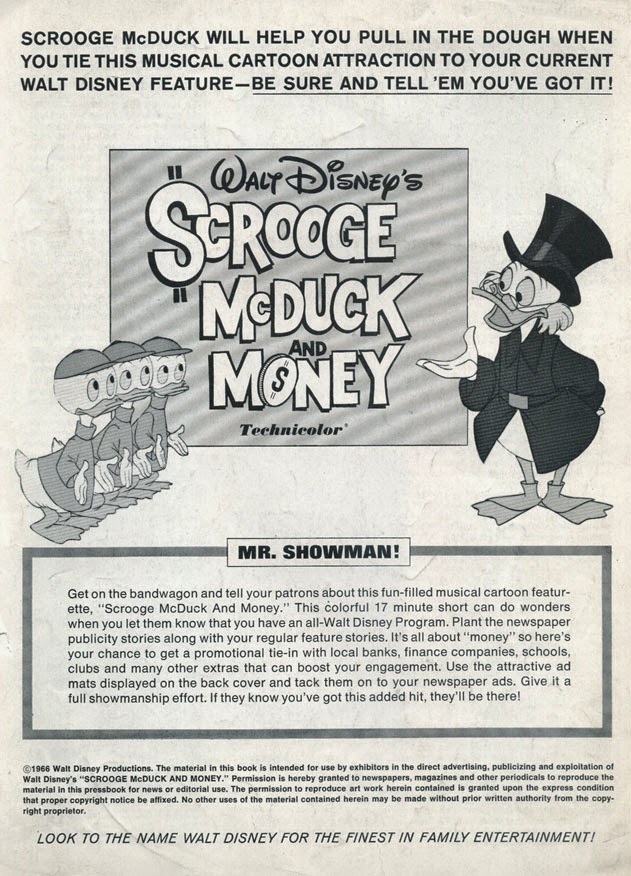
Don't tell ME this guy can't be bought.
On the back end of the episode, we get what must be one of the ultimate tests of the Barksian dictum that, no matter what trials and tribulations the characters may endure during a story, things must always conclude "as they were." The vengeful Ma Beagle's audience-aggravating anthem causes the Beagles to "bomb" for good and all... but there's still that small matter of the fortune that the Beagles had accumulated in the interim, sitting there in yet another version of a Beagle Money Bin. And this fortune is not likely to explode, implode, or otherwise dissipate. So how to get the Beagles back to "Square Want" (as in, "We want Scrooge's money")? The episode doesn't know and, apparently, doesn't care. My best guess is that Scrooge, as the Beagles' employer (!!), used some legal muscle to get the Beagles' betrayal of their fans interpreted as some sort of "breach of contract" and was able to take the Beagles' boodle away from them. That seems rather cold-blooded, but, let's remember, the Scrooge of "Beaglemania" is willing to go beyond mere "cooperation for convenience's sake," a la the arrangements with Glomgold in "Robot Robbers" and Magica in "Magica's Shadow War," and exploit the Beagles in a mutually beneficial money-spinning enterprise. This doesn't take Scrooge as far down the path of ethically dubious doings as have some Italian adventures of Paperone di Paperone, wherein Scrooge is known to have committed actual crimes, but there's something unnerving about it, nonetheless. A Scrooge who is willing to cut deals with his most persistent foes would probably be capable of commandeering the Beagles' profits through clever legal means.


"Beaglemania" also suffers from some irritating production problems. Some are of the cheese-paring variety, such as the three identical crowd-pan shots we see during the Beagles' performance of "Boogie Beagle Blues." To be fair, many of the same characters that we see in the pans can also be seen ripping up seats and rioting during the Beagles' final, fatal gig (a sequence that seems to have been cut from the episode at some point, given the visual evidence I've been able to dig up on YouTube). So I'll give the Wang animators the benefit of the doubt, for consistency, if nothing else.

Rally, rinse, repeat.

On second thought, scratch that...
It's a bit harder to overlook the opening of the scene at the Dukka Records recording studio. Before the Frank Welker-voiced engineer gives the corpulent Melvis Pigsley the go-ahead, we hear the muffled word "Take" in a voice that DOESN'T sound like Welker's. Evidently, one of voice director David Weimers' cast instructions got onto the master tape, and no one caught the error or bothered to edit it out. This goof is particularly troublesome in light of the fact that, while the quality of the animation in DuckTales isn't always consistent, the audio production has hitherto been impeccable. (I'm also aware that some of the YouTube posts of this ep have sound out of sync with picture in Act Three. I don't recall this problem during the initial episode airings, so I'm figuring that this was some sort of transfer problem.)

Sloppy framing and teetering production values aside, the remainder of the episode can best be described as one continuous laugh riot. Not all of the jokes hit home, but most of them do, including the easily overlooked, yet nonetheless amusing, scene at the Mothers of Criminals meeting. Here, we see a side of Ma Beagle that we've never before been privy to, namely, her twisted "pride" in her family's criminal accomplishments (which was earlier lampshaded in the "Duckburg's Most Wanted" TV-watching scene). Ma's proclamation in "Take Me Out of the Ballgame" that "Cheating is a family tradition!" is something of a precursor of this, but her admission of shame that "four of my boys have... gone legit" adds an extra dose of irony or three to the mix. Ma's later desire to be "Bramble Soups' Mother of the Year" in "New Gizmo-Kids on the Block" is but a pale echo of this "bad is good" theme, which wouldn't have been out of place in one of Barks' sourer stories.
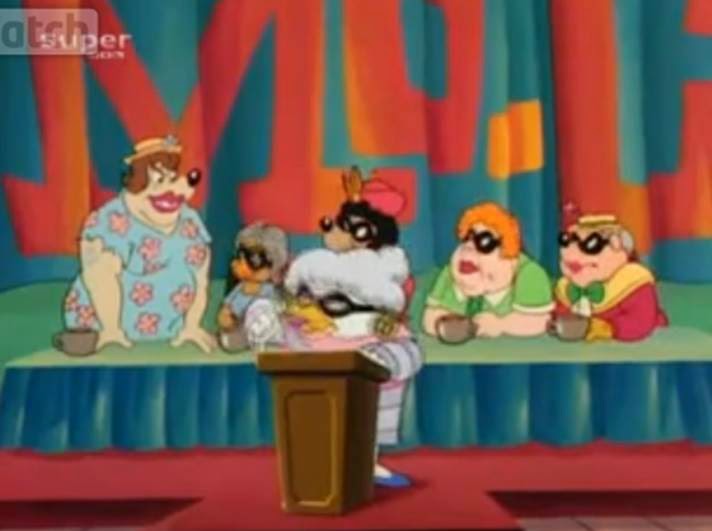
We also learn here -- though the lesson won't really be rammed home until "The Bride Wore Stripes" -- that Ma might suffer a tad from OCS. It isn't enough for her that the Beagles have become rock stars; instead, she pushes them and pushes them to "suffer for [their] art" until they finally snap and throw her out. And it isn't just verbal nagging, either, as her threatening of Big Time with those "little piggies" makes clear. Perhaps we can formulate a new theory as to why Ma has "as many boys as a toad has warts." She just can't HELP herself.


Of course, the juxtaposition of the Ducks' world with that of popular music isn't exactly new. As one might expect, the Nephews were the first of the clan to express any sort of appreciation of rock and roll, starting with a dogface simulacrum of the original rock star ("Mutilated Music," DONALD DUCK #53, May 1957, drawn by Tony Strobl and John Liggera):

I like that "weeks ago." Yes, there once was a time when people thought that rock and roll, like mambo and other briefly trendy musical forms, would eventually fade away...
HD&L were back in fanboy mode several years after this in "The Paper Route Panic" (DONALD DUCK #66, July 1959, written by Bob Gregory, drawn by Strobl and Liggera). This time, they were the fans (literally -- the ONLY fans) of a cowboy-hatted crooner named Paisley Mantee. I suppose that you could drape the mantle of rock over this obsession by calling Mantee a practitioner of rockabilly. HD&L must have really had it bad if they were willing to spend a $50 newspaper delivery prize on Mantee's records. That's $50 in 1959 money, folks.
HD&L were back in fanboy mode several years after this in "The Paper Route Panic" (DONALD DUCK #66, July 1959, written by Bob Gregory, drawn by Strobl and Liggera). This time, they were the fans (literally -- the ONLY fans) of a cowboy-hatted crooner named Paisley Mantee. I suppose that you could drape the mantle of rock over this obsession by calling Mantee a practitioner of rockabilly. HD&L must have really had it bad if they were willing to spend a $50 newspaper delivery prize on Mantee's records. That's $50 in 1959 money, folks.


Carl Barks, however reluctantly, dipped a toe into the "pop pool" with his late Scrooge adventure "Queen of the Wild Dog Pack" (UNCLE $CROOGE #62, March 1966), which finds the boys enamored with the music of Tweedy Teentwirp. Oddly enough, when Scrooge confronts the kids over the noise from their TV set in "Beaglemania," Huey holds a "boomlet box" in a manner that is disquietingly similar to the ways in which various characters in "Dog Pack" zone out while listening to Tweedy on transistors.


Perhaps more relevant to the current discussion is Barks' invocation of The Beatles in "The Great Wig Mystery" (UNCLE $CROOGE #52, September 1964), both in general theme (Duckburg having gone wiggy for moptop wigs) and in explicit mention. If you're perturbed at the idea of "Beaglemania" showing direct parodies of Bruce Springsteen, Madonna, Elton John, and Michael Jackson, consider that Barks was striking while the iron was red-hot in his own way; he composed "Wig Mystery" in the early months of 1964, when America was enduring the virulent early stage of Beatlemania. Barks may not have shown a version of the moptops, but he wasn't above invoking their actual names for the purposes of a gag.


He could be diddling MUCH WORSE things, believe me...

During "Time is Money," the series had prepared the groundwork for the kids' immense enthusiasm over the Sky McFly show. Indeed, Bubba's immediate commandeering of McFly phrases like "Get rude, dude!" and "Bop till you drop!" was supposed to help define his personality (more's the pity, but I digress). That being said, I find the depiction of the kids' love of McFly in "Beaglemania" to be a whole lot cuter, primarily due to the inclusion of Webby. After so many instances of the boys blowing Webby off for her choices of favored pastimes "just because she's a girl," it's refreshing to see her fully accepted as part of a fan-group. And not simply accepted; Dewey even dances with her! I wonder why Webby didn't do the "change partners" routine at some point and dance with Huey or Louie. Perhaps Dewey's being the cleverest of the Nephews (cf. "Duck in the Iron Mask") held some sort of cachet for her.


The Beagles' performance of "Boogie Beagle Blues" is... well, unlike Babyface, Bankjob, and Bebop/Bugle's harmonizing in "Time Teasers," it'd be a stretch to call it an actual song. In the original performance, Welker and McCann only sing the actual phrase "... and sing the Boogie Beagle Blues," "talking" through everything else. It's easy to overlook this because of the flashy accompanying visuals, which include Burger biting through his guitar neck, the drum set being blown up, and Bouncer firing pistols directly into the camera. In case you're wondering, no, that last bit has never been censored to my knowledge. Presumably, the blue-pencil people would have been more offended had Bouncer fired the pistols up in the air, or, heaven forbid, twirled them around in his hands, the way Fenton did during the scene on the dam in "Liquid Assets." The version of "Blues" that you're more likely to be familiar with, the one on the 1990 Disney Afternoon Songbook CD, has somewhat smoother production values, and Welker and Chuck McCann sing just a little bit more, but basically, it's six of one, six and a quarter (Scrooge: "Not one of mine... but I can give it a good home!") of the other.
It goes without saying that this performance would have been a perfect time to bring Bebop/Bugle back as a supporting player. Heck, in one of that character's several incarnations (the "Scroogerello" one), he even talks in rhythm! Tell me that that wouldn't have been a useful contribution to the production. By this time, unfortunately, the DT writers have settled upon Big Time, Bouncer, Burger, and Baggy as THE de facto Beagle Boys, and over-familiarity has long since started to breed contempt (not that some didn't possess such an attitude about the DT Beagles from the beginning). The constant post-season-one use of the "Feckless Four" can usually be put down to laziness. Here is one instance in which the lassitude made the ep something distinctly less than it could have been.
It goes without saying that this performance would have been a perfect time to bring Bebop/Bugle back as a supporting player. Heck, in one of that character's several incarnations (the "Scroogerello" one), he even talks in rhythm! Tell me that that wouldn't have been a useful contribution to the production. By this time, unfortunately, the DT writers have settled upon Big Time, Bouncer, Burger, and Baggy as THE de facto Beagle Boys, and over-familiarity has long since started to breed contempt (not that some didn't possess such an attitude about the DT Beagles from the beginning). The constant post-season-one use of the "Feckless Four" can usually be put down to laziness. Here is one instance in which the lassitude made the ep something distinctly less than it could have been.


Through the mysterious alchemy of instant stardom, the Beagles' song is soon "#1 with a bullet... and I'm not kidding" (my choice for the single cleverest gag of the episode). I suppose that I should be surprised that the strongarm tactics that the Beagles use to crash the music biz -- first forcing Dukka Records to sign them to a contract by threatening to torch the recording studio, then putting the gun on the KDUK DJ to get him to play their platter -- didn't get them into legal trouble before they got involved in contract disputes with Scrooge. It's long been crystal-clear, however, that the denizens of Duckburg (the DuckTales version, at least) can be conned or browbeaten into doing just about anything.

Ma soon takes full charge of her boys' affairs, making demands on Scrooge and hounding the Beagles into all manner of fan-propitiating activities. We're invited to blame her for the costume changes that turn the new pop stars into what can only be called "The Village Beagles," since Big Time is heard protesting the wardrobe choice at the record store. The truth might be a little more complicated, though; the Beagles had already been seen wearing the garish gear on the cover of ROLLING DUCK, presumably before Ma had muscled her way into the Brian Epstein role, and they don't seem to be having any problem with it there. Actually, Big Time has much less reason to be unnerved by his costume than does Bouncer. Somewhere, Gyro's Helper is shuddering silently, and the members of Electric Light Orchestra are fuming that they didn't think of this first.


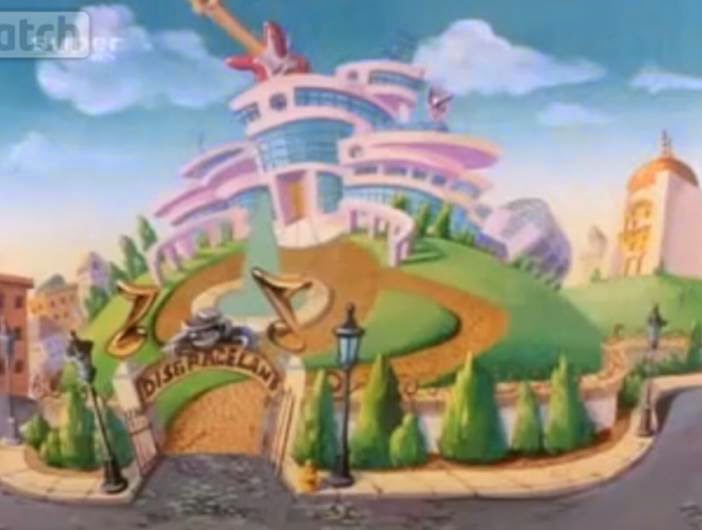
Most of the subsequent gags, like that of the Beagles' sartorial invocations of various genres of rock music, are pretty broad in nature -- a fact that GeoX brings up as one of the ep's negative aspects. In truth, I think that GeoX missed the point here. The fact that the gags are broad and silly pales in comparison to the overwhelmingly bizarre nature of the episode's context in and of itself. It's shocking enough that we got an episode in which the Beagles become rock stars and move into a mansion called Disgraceland; let's not quibble too much about authentically subversive rock-industry-satire tropes.
After being given the heave-ho by her rebellious brood, Ma resorts to the time-tested approach of a cheesy disguise, posing as ROLLING DUCK reporter Nina Quackwell in order to frame the Beagles for a robbery. In a further indication that she's playing for keeps, Ma goes beyond the earlier fistic threat she'd made to Big Time and actually mugs the real Nina on camera in order to steal Nina's clothes. OK, it isn't as bad as killing someone to get a dress, as the 1800s Ma of "Once Upon a Dime" did, but it's bad enough. Ma evidently has come a ways from the days of "Robot Robbers" when she merely evaded the security guard at Glomgold's construction site.


Ma benefits from the wonders of Spandex.
The "robbery" itself has two interesting features: the victimized bank is our familiar four-walled friend, the "First Interfeather Bank," and one of the cops who arrest the Beagles is female. The Duckburg legal system may be terminally inept, but you can't say that the city's law enforcement operatives don't practice progressive hiring methods.


Of course, in the manner of tone-deaf celebrity worshippers everywhere, the Beagles' fans aren't bothered by their arrest, and thus Scrooge and Ma must join forces in order to burst the band's balloon. I do wish that Seidenberg had avoided the obvious trap and had had the desperate Scrooge say something less drastic than "I don't think that my bank account can take this much punishment!". Scrooge's "entire fortune" doesn't always have to be at putative stake in order for the consequences of an episode to be meaningful. Any reasonable loss should be enough to pitch Scrooge into panic mode, since he values a portion of his fortune just as much as he values the whole. The oversight is less fatal here than in "Yuppy Ducks," but it's still annoying.
The Beagles' final scene with McFly is arguably the sharpest jab of all at the hypocrisies of the rock business, as McFly's cheerful attitude quickly sours and is replaced with a threatening one once it becomes clear that the boys don't have a new song ready to perform. Ma then pounces and extracts a promise to be good in exchange for a "new" (lyrically, at least) ditty. A rain of refuse from the indignant audience subsequently renders the Beagles "multiply-hit one-hit wonders." They're left to lick their wounds and, presumably, to find access to their accumulated wealth barred for some vaguely plausible reason that we're apparently expected to work out ourselves.
The Beagles' final scene with McFly is arguably the sharpest jab of all at the hypocrisies of the rock business, as McFly's cheerful attitude quickly sours and is replaced with a threatening one once it becomes clear that the boys don't have a new song ready to perform. Ma then pounces and extracts a promise to be good in exchange for a "new" (lyrically, at least) ditty. A rain of refuse from the indignant audience subsequently renders the Beagles "multiply-hit one-hit wonders." They're left to lick their wounds and, presumably, to find access to their accumulated wealth barred for some vaguely plausible reason that we're apparently expected to work out ourselves.


.
.

Bumper #21: "Quadricycle"
.
.
.
"DuckBlurbs"
Terry Talks: I've long wondered whether Terry McGovern based the persona of Screamin' Sky McFly on his own persona as a DJ in the San Francisco Bay area. I couldn't find a recording of his dating that far back, but I was able to find a clip from one of his shows on the Internet oldies station, Boss Boss Radio. (Insert blibbering lips where desired.)
In addition, here's an interview with
McGovern conducted for the California Historical Radio Society. The
revelation that Terry was responsible for one of the many iconic lines
from the original (and I do mean ORIGINAL) Star Wars movie will be a great "I did not know that" moment for many of you.
Dickie Bird is the Word: Italian comics maestro Romano Scarpa plunged more deeply than Barks would ever have dared to into the pop-music waters with his original character Paperetta Ye-Ye, aka Dickie Duck, who first appeared in TOPOLINO #577 (December 18, 1966). Like most Americans, I haven't had that much exposure to Dickie, but, judging from the fact that she's seen wearing (and grooving to) a transistor radio ring in that initial appearance, I gather that "musical fangirl" was one of her defining traits, at least during the late 60s.


(Greg) We begin this one with the STOCK FOOTAGE OF DOOM and down in the basement as Scrooge is giving the dollar bills a bubble bath and drying them on clotheslines. Duckworth just stands there; probably wondering about Scrooge's sanity at this point. Scrooge puts the dollar bill through the ringer and Duckworth pins the bills on the clothesline. Apparently; in Duckberg, Scrooge can launder money and get away with it.
At least, he has been able to since UNCLE $CROOGE #6 (June-August 1954), when Carl Barks drew him doing the same thing for the issue's cover.
At least, he has been able to since UNCLE $CROOGE #6 (June-August 1954), when Carl Barks drew him doing the same thing for the issue's cover.


(Greg) Duckworth even references Frank Sinatra and some other guy which earns a blow off from the nephews as they call Scrooge a fuddy duddy. Well screw you nephews! Frank Sinatra is awesome! Rock and roll is great; but that doesn't mean Frank Sinatra automatically sucks because he doesn't do rock and roll.
"Some other guy" wasn't too bad, either. I might even have voted for him over Frank as "the winner of the hog-calling contest."
"Some other guy" wasn't too bad, either. I might even have voted for him over Frank as "the winner of the hog-calling contest."
(Greg) Scrooge blows it off because he has work to do and the kids walk upstairs calling Scrooge more ancient than Bubba. Bubba is as confused as I am.

"My God! I'm either a gimmick character or an unnecessary
extra Nephew. Rock, hard place."
(Greg) So we head to KDUK radio studio (with big ass D on top of the building) and then pan down to floor level and then go inside the studio as a pig Elvis [sings] so badly that he has to mangle the words to avoid infringement.
The building is actually the Dukka Records building; the Beagles don't infiltrate KDUK until they threaten the DJ (which makes more sense, given that they'd have to sign a record contract before a record actually existed).
Is the Elvis parody here cruel, or what? I know that the "fat-farm" and "overdressed" tropes have long since been beaten to death -- or, given that we're talking about Elvis in the context of death, maybe they haven't been -- but Melvis Pigsley doesn't catch anything resembling a break here. You almost find yourself feeling embarrassed that Scrooge winds up hiring Melvis to replace the Beagles.
Is the Elvis parody here cruel, or what? I know that the "fat-farm" and "overdressed" tropes have long since been beaten to death -- or, given that we're talking about Elvis in the context of death, maybe they haven't been -- but Melvis Pigsley doesn't catch anything resembling a break here. You almost find yourself feeling embarrassed that Scrooge winds up hiring Melvis to replace the Beagles.


(Greg) Mrs. Featherby goes to the door and she gets MURDERED by the Beagle Boys and Ma who are running away from their fans... [Later] the fanboys and fangirls break down the door and use it as a bridge to squash Mrs. Featherby (Again; what is this no male on female contact rule again?) and head to the window.
Remember Fenton and HD&L asking for "hazard pay" and "hazard allowances" in "The Land of Trala La"? Poor Mrs. F. ought to consider putting in for similar compensation here. OUCH!!


(Greg) Ma gives Scrooge a list of demands which Scrooge blows off because it will cost a fortune. Ma blows it off because it's in their contract and if Scrooge violates the deal, they split. There's one problem to this: Scrooge can simply end the deal now and the episodes ends in less than a minute.
Scrooge probably was scared to death of what he might have to pay in legal costs if the Beagles took him to court over the matter. Considering that it's the Duckburg legal system we're talking about here, and considering that the Beagles once succeeded in taking said legal system over, I can forgive Scrooge for eschewing a separation, at least until the odds are clearly on his side.

(Greg) After the commercial break; we head to the Money Bin Desolate version as we go to the vault and the Beagle Boys dive into the money and the law of heavy metals has forsaken us.
(GeoX) And from there [the Beagles] become big stars with their own money bin. Which they're able to swim in, contradicting previous episodes.
Well, they were seen swimming and playing in Scrooge's Bin in "Bubba Trubba." Plus, they're not swimming in their own Bin so much as they're sort of wallowing in it. No biggie, I deem.
Next: Episode 87, "The Big Flub."