Thursday, August 22, 2013

DUCKTALES RETROSPECTIVE: Episode 50, "Double-O-Duck"

We're halfway home!  This weekend, I plan to write up some reflections on the "journey" thus far, including some comments (similar to those put forth by Joe Torcivia in the comments section not long ago) on how this retrospective has thus far influenced my overall view of DuckTales.  First, though, we have one of the series' unquestioned classics to plow through, an episode that seems to have a secure place on everyone's "Top 5" list.

It's pretty safe to say that, in terms of its influence on other creative entities, "Double-O-Duck" has enjoyed the longest "half-life" of any single DT episode.  The fans' interest in extending their exposure to super- (or should that be stupor-?) spy Launchpad immediately became apparent when the Gladstone Comics DUCKTALES title ran a poll to determine which ep readers most wanted to have turned into a comic-book story.  "Double-O" was the webs-down winner.  Alas, we ultimately had to content ourselves with...

I don't own this book, but something tells me that the version of the story presented therein is rather more... sedate... than the wild, Terence Harrison-fashioned version that we saw on screen.  Why else would the publisher have seen fit to put a scene from the "equivalent of the flip side" on the cover. In all honesty, the lack of a "Double-O" comic in the late 1980s was probably a blessing in disguise, as the artistic chores would almost certainly have been handled by the Jaime Diaz Studios, whose offerings were famously bland (though, admittedly, very rarely off-model -- which might actually have been an additional disadvantage for artists trying to capture the ep's squash-and-stretch, "pop from pose to pose" style).

On his blog, Mike Peraza fills in the details of the next stage quite thoroughly.  A fateful flip-flop turned Launchpad from the star of a proposed new Double-O-Duck show into the sidekick to a brand-new mallard, who eventually emerged as the re-branded Darkwing Duck. 

After his Disney Afternoon and re-run... um, runs, the popular DW enjoyed a well-received (though all-too-brief) revival in 2010, getting the regular comic-book title he had never previously enjoyed.  The tremors from "Double-O"'s original "Big Bang-Up Job" could still be felt as late as the Fall of 2011, when an episode of My Little Pony: Friendship is Magic featured a masked hero character named "The Mysterious Mare-Do-Well" and sporting a costume with a suspiciously familiar color scheme.

Of course, "Double-O" was far from being Disney's first crack at the spy genre.  In one of its boldest moves ever, Western Publishing completely made over the rather staid MICKEY MOUSE comic-book title in 1966, turning Mickey and Goofy into "Super Secret Agents" operating in a world of realistically drawn humans.  Paul Murry and Dan Spiegle tried hard to make it work, but the "new look" lasted only three issues.

Overseas Disney comics readers, meanwhile, were given an original spy character in the feathered form of 0. 0. Duck.  (By the way, those are zeroes, not O's.  The Inducks search engine told me so.)  Created by writer Dick Kinney and artist Al Hubbard, the team behind Fethry Duck (among others), 0.0. made his debut in 1966 and, to my considerable amazement, continues to appear in new stories to this day, though his appearances seem to have slowly petered out after the 1980s.  I suppose that as long as James Bond movies continue to be made, this character's existence in the "Duck universe" will continue to be justified, if only just.

Cover to a 1967 Australian comic (which seems to have made the zeroes/O's error)

I was able to find only one 0. 0. DUCK story in English, and, from what I could gather, the character resembles Maxwell Smart more than anyone else.  He's not a comical bumbler so much as he is comically oblivious to and/or unconcerned by what is going on around him.  Notice how he and his female partner Mata Harrier react to their car careening off a cliff...

... and compare it to Launchpad's somewhat different take on a very similar situation at the end of Act One of "Double-O-Duck":
I would argue that LP's unique combination of physical bunglage, general attitude, and mental confusion makes him a far more successful potential spoof-spy than 0. 0. could ever hope to be.  The fact that "Double-O" maximizes the potential of the basic idea so well, however, should not be overlooked.

So what works so well in "Double-O-Duck"?  As the saying goes, if you have to ask, then you obviously haven't seen the episode.  Start with the opening sequence in which agent Bruno von Beak leads the DIA spies on a merry chase -- arguably, the single best opening of any DT ep, period.  Is it any coincidence that the jazzy "chase music" we hear here is the same music that accompanies the car chase at the end of the equally outstanding "Hero for Hire"?  I think not.

After Bruno winds up on the plane's wing, the episode's visual aesthetic begins to appear with a vengeance.  Characters don't react in this ep, they lunge; they don't vault gracefully, they hang in midair and defy gravity; above all, they pose.  Harrison foreshadowed this approach in "The Golden Fleecing," but he totally commits to it here.  The ending gag, with Bruno, having survived all of those perils, being trampled by a mob of frenzied commuters, is the perfect capper.


BTW, what's up with that strangely suggestive advertisement on the station wall in the fourth image?  And that won't be the only such wink-wink moment that we'll see.

After LP is mistaken for Bruno and taken to see J. Gander Hoover (Arrest warrant?  What's that?), the storyline rolls smoothly into the well-established James Bond plot-ruts.  As GeoX notes, everything that should be covered in the spoof is in fact covered, though some things are admittedly covered more thoroughly and/or effectively than others.  Take Scrooge's relationship to the DIA, for example.  In "The Right Duck," it was strongly intimated that Scrooge funded or supported DASA in some way, else he would not have had access to the information that Launchpad had been launched aboard the "Voyager."  The fact that LP uses his presumed "one phone call" to contact "Mr. McDee" here suggests that (1) he knows how much weight Scrooge pulls in Duckburg in general and (2) Scrooge has some level of interest in the DIA's activities, most likely a financial one.  Since it is far less likely for a single city to have its own intelligence force than even to have its own space program, it's quite possible that Scrooge is financing the DIA single-handedly.

As described by Hoover, Dr. Nogood's scheme has glaringly obvious flaws, of course.  Simply destroying the paper money in all the Swiss banks (interesting how the country retains its "real" name here but is turned into "Swizzleland" in "The Duck Who Knew Too Much") wouldn't affect the paper money elsewhere, much less hard currency.  In my comments on "The Money Vanishes," I made the same point regarding Scrooge inexplicably forgetting that the "money moths" wouldn't attack his gold coins.  Perhaps writers Ken Koonce and David Weimers should have thought on a more modest scale and had Nogood's plans involve the destruction of one single, precious substance in which Scrooge might have a very large stake.

I was a bit disappointed to see that K&W overlooked "Sir Gyro de Gearloose" when they explained why Gyro was serving as "G" (or, as the lab door with the even-then-anachronistic slide rule painted on it proclaims, "Dr. G").  I know that they didn't write that episode, but it wouldn't have taken much effort to check and note that Gyro is a general inventor-for-hire, not some sort of hireling of Scrooge's who depends upon Scrooge's generosity to stay in business.

If you asked me to finger the single cleverest idea in "Double-O-Duck," it would probably be the use of maps to show Launchpad's globe-hopping travels.  Yes, I know that it's a bit of a "cheater," but some thought was put into the creation of these things.  The peculiar placement of Duckburg in what seems to be the general vicinity of Roanoke, Virginia will, of course, be questioned by many...

... but another map shows what looks like a cartoon explosion where Israel would be (talk about getting crap past the radar -- good luck getting away with that today, fellas).  Some good continuity is also shown when Launchpad "fills up in Istanbul" (yes, Greg, check the unmistakable form of the Anatolian peninsula; that wasn't Iraq!) and refers to that fact during the ep's iris- (and crash-) out scene.  The geographical ingenuity is, of course, partially undercut by the surprising Indian stereotyping.  It's not the snake-charmers, flutists, and bazaar salesmen that bother me so much as the line about LP going to New Delhi (yeah, the Delhi/Deli stuff was fairly lame, but what the hey) and meeting "beggars who'd love a pastrami on rye."  Jokes involving starvation... oh, what fun.  It reminded me a little bit of the RICHIE RICH comic-book stories involving the comically poor Latin American nation of El Squalid, where "El Presidente" ate a tiny pellet of food each day because "a Presidente must keep up his strength."

As the side-switching femme fatale with the (no surprise) first-rate Tress MacNeille voice, Feathers Galore brings quite a lot to this episode, so I suppose that I shouldn't complain too much about the fact that, since Nathan Yodel's Deli and Dr. Nogood's hideout are in Geneva already, it would have been far easier for Launchpad to have met her there (in a different locale in the city, of course) than to have gone all the way back to New Delhi to do so.  After all, without that side trip, we wouldn't have had the hilarious scene in Feathers' room in which her desire for some "smoochy smoochy" gets out of hand and she gets to show off her karate skills.  When LP boasted in "Lost Crown of Genghis Khan," "Usually, it's the girls' chasin' me!", I don't think that this is what he had in mind.  Interesting how Feathers' "sexy" dancing-girl outfit is actually far LESS sexy than the outfit she's wearing during this sequence.

The first of two Toon Disney cuts occurs soon after this, as Launchpad's comment that Feathers is the sort who "gives women drivers a bad name!" was removed for TD rebroadcast.  Since LP's comment was actually critical of the familiar stereotype, I don't see what the problem was here.  As we'll see, the second excision makes even LESS sense.

The encounter with Dr. Nogood is a massive mash-up of more-or-less direct swipes from James Bond films.  Nogood and his silent henchman Odduck are clearly meant to evoke memories of Auric Goldfinger and his body servant Oddjob, the cat Flower (Bambi reference?) dates back to the earliest movies to feature SPECTRE mastermind Blofeld, while the DIA forces' "dropping in on" Nogood's troops on rappel lines is lifted from the climax of You Only Live Twice.  (Since Nogood's setup is already far underground, I wonder what obstacles the DIA troops had to obliterate in order to blast that giant hole.  Scratch one pseudo-deli, I guess.)  Unfortunately, I can't recall a Bond flick during which Bond was put in a death trap with carnivorous animals.  It must have happened sometime, wouldn't you think?


Despite the quick response of the DIA troops -- even Jimmy John's probably wouldn't have been that "freaky fast" -- I'd be hard-pressed to say that the DIA pulled off this caper more efficiently than even the bureaucracy-bound SHUSH of Darkwing Duck would have.  A number of the problems encountered by Launchpad are the direct result of the operators at the DIA not being told that LP was going to be calling in on "unauthorized" equipment.  That's a pretty big oversight, even though J. Gander Hoover would more than likely brush it off as an example of "details, details!".  Greg's theory that Hoover was put out to pasture after this caper, with the agency changing its name and bringing in J. Gander Hooter as a more competent replacement, begins to look plausible now.

As menacing as Harold Sakata's Oddjob was in the original Goldfinger, the silent Odduck goes him two better here by catching Launchpad's toupee bullet in his teeth and then grabbing some additional bullets and crumbling them to dust.  Toon Disney kept the first scene (though it dropped LP's line "Is this what they mean by 'bite the bullet'?") but eliminated the second.  THIS MAKES NO SENSE WHATSOEVER.  It would have been better (not to mention more consistent) had TD purged ALL references to Odduck stopping bullets and limited the big goon's hench-activities to chasing after Launchpad and Feathers and dumping LP into the lions' den.


The demise of Nogood, and the subsequent tearful goodbye between Launchpad and Feathers, could have been handled a little better.  We don't get to see Odduck or Flower meet their demises; instead, Nogood clambers up a catwalk and gives himself no reasonable avenue for escape apart from plowing straight through LP and Feathers.  If nothing else, he should not put himself in the position of having to defeat Feathers, since he presumably knows something about her karate talents.  The death-dive remains pretty "gruesome" (GeoX's description), though, and that's true regardless of whether the bubbling vat contained acid or (as is more likely) "vanishing fluid" (which Nogood, oddly, was previously able to store in a test tube without the tube itself dissolving).

GeoX is right in fingering the Casablanca-inspired farewell scene as being somewhat awkward.  The major issue is Launchpad's declaration that Feathers belongs with her "true love" Bruno.  Even if this were true, there's still the inconvenient fact that Bruno is now in jail and is presumably going to stay there for a long time.  If Feathers takes LP's suggestion seriously, then she'll be placed in the awkward position of being forced to pine after two former colleagues.  That seems rather harsh to me.  As Greg notes, it is possible that Feathers herself will have to lose her liberty for a short time due to her association with FOWL, and who knows what will happen after she is released?  (For a very believable -- and somewhat bittersweet -- fanfic take on what might have happened to Feathers after the events of "Double-O-Duck," I highly recommend Kim McFarland's Darkwing Duck story "Here a Slug, There a Slug.")  At least the Casablanca riff gives us some legitimately fine visuals -- atypically serene ones given the manic tone of most of the episode, but affecting ones nevertheless.

In a sense, "Double-O-Duck," despite its free-swinging approach, takes less risks with the DT characters than does a "reality-bending" ep like "Scroogerello."  You pretty much know what to expect here; the fun lies in getting to the final goal.  And great fun it certainly is.  This is an episode that no one gets tired of rewatching.

.

.

.

"DuckBlurbs"

Thanks to Greg, I was able to confirm that my name was, in fact, listed in the "Special Thanks" credits of DuckTales Remastered.  Go here and scroll to 30:48.  Regarding those names preceding my own... Yossi, I really don't know what to say.  I consider that a HUGE compliment in and of itself.

(Greg)  So we head outside the D.I.A. Headquarters (Note to self: Never show thy name in front where everyone can see it)

It's all good, thanks to the ingenious use of an extra letter to throw enemies off the track.  (I'm assuming that the "H" stood for "headquarters.")
(Greg)  So we logically go to the scene changer of doom as LP re-enter[s] disguised as a stereotypical German [actually, I think it's a Bavarian] carrying a barrel of pickles that Peter Piper picked....apparently. 

Between that beard-obscured lower beak and the lederhosen he's wearing, LP resembles no one so much as a larger version of Super Duck here.

(Greg)  Other than the usual Wang screw ups and logic breaks; this episode was perfectly written and pretty much the high watermark in terms of writing from the KK/DW duo. I also like Feathers and her chemistry with LP as well since she had some killer moves while at the same thing not being a total super feminist. 

In terms of precise writing, I'd have to vote for "Hero for Hire" and "The Uncrashable Hindentanic" as superior to "Double-O," but "Double-O"'s sheer "energy and panache" (thanks, GeoX) place it right behind those.  And I do agree that Koonce and Weimers managed to walk the fine line with Feathers, making her competent to handle herself while somewhat vulnerable at the same time.

Next:  Episode 51, "Jungle Duck"... but first, those aforementioned reflections on reaching the halfway mark.

Tuesday, August 20, 2013

Back to the Beach

On the blustery and rainy night of July 20, Nicky and I trundled down to Pier 6 -- site of previous concert visits to hear the Cetera-shy Chicago and to partake of Hippiefest -- to enjoy the ultimate trip in the rock & roll Wayback Machine: a concert by the well-worn remnants of The Beach Boys.  Nicky had seen the B-Boys in concert somewhere on the order of ten-odd times, including three of their famous holiday concerts in DC.  This was the first time for me, which seems remarkable in view of the fact that the B-Boys, along with DuckTales and Gladstone Comics, helped take some of the pressure off me during graduate school in the late 80s.  That's right, most of the infamous "notes" that made up much of the foundation of the DUCKTALES INDEX were composed and edited while listening to cassette tapes of the band.


It won't come as any surprise to you to learn that the B-Boys pulled no surprises out of the duffle bag during this two-hour gig.  It was strictly old favorites for the most part, though Mike Love (who, with Bruce Johnston, comprised the only two "old standbys" in attendance) did insist upon singing an obscure song inspired by his guru.  Would that the guru had been on hand to broker a reconciliation between Brian Wilson, Al Jardine, and the currently touring band.  Unfortunately, it doesn't seem likely that such a reunion is on the cards anytime soon.


Mike Love was the literal "front man" for the crew, as you might expect, and his stage "antics" (if you exaggerated and called them that) bespoke someone who had been through the grind far too many times to count.  He pantomimed various familiar lines and words from the songs as if he were conducting a class in American Sign Language.  Perhaps he was preserving his strength, for the night was hot and muggy, at least until a sudden thunderstorm came up and lashes of rain started filtering into the tent-like structure. This cut the mugginess for, oh, about 10 minutes, but performers and audience alike left the venue thoroughly "sweated out."

Amusingly, the crowd was far less well-behaved than either the crowd that came to hear Chicago or the crowd at Hippiefest.  Several inebriated ladies wandered up to the stage during the show and had to be led away by security guards.  A couple of them were old enough that it was probably foolish of them to have partaken of "the grain and the grape" so freely.  Or perhaps stronger substances were involved, since the smell of burning cannabis was annoyingly pervasive.  Needless to say, several beach balls were being bounced and thrown around, leading several small kids to run through the aisles after errant passes.  Would that I had brought a hatpin (do they even manufacture those anymore?).  

Until the next "Over the Hill Gang" blows into town...

Sunday, August 18, 2013

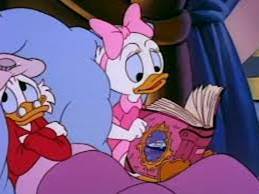
DUCKTALES RETROSPECTIVE: Episode 49, "Scroogerello"

In all honesty, I don't savvy the lack of enthusiasm that both GeoX and Greg appear to have had for "Scroogerello," one of the more imaginative and risk-taking episodes of DuckTales' first season.  Greg inadvertently put his finger on the reason why this off-the-wall take on Cinderella deserves more than its share of respect when he comments, "Yeap; this is our first reality bending episode." Precisely -- and it's the first time that such "reality bending" has taken place within something close to an established "Duck context."  "Scroogerello" works because the storyline manages to respect the parameters of the Ducks' world (or the DT version of same) while putting the characters into some wholly unrecognizable situations.  The ep very rarely flags and keeps coming up with imaginative and amusing ideas to enliven the familiar fairy-tale tropes.  Several future episodes ("The Uncrashable Hindentanic" comes quickly to mind) would execute the trick more efficiently -- "Hindentanic," in particular, has a much stronger framing sequence -- but give "Scroogerello" full credit: It got there first.

The opening could be considered something of an "indirect reboot" of the old idea of an "overly bossy" Scrooge.  Recall that this aspect of Scrooge's personality was toned down from original script drafts in parts three and five of "Treasure of the Golden Suns."  Here, we get a full faceful of the "Wrath of Scrooge," a mad-on exacerbated by his extremely atypical bout of illness.  I suppose that Scrooge could hardly be blamed for lashing out at anyone who tries to "help" him while he's in such a unusually vulnerable physical state.  "Difficult patients" are fairly common in hospital settings, after all.  Still, Scrooge's anger towards his family and servants in the opening minutes winds up playing a surprisingly small role in the context of the Cinderella parody.  Only Scroogerello's comment "Why do I feel so guilty?" when he encounters the aged, imprisoned Duckworth makes any sort of direct reference to it.  Usually, when a character has a "mental experience" like this, the "dream" or "hallucination" or whatever is chock full of references to the underlying reason for the "experience."  The "Cinderella Stone" episode of The Flintstones (which, for all I know, may have inspired this little experiment) is one good example of this.  Scrooge's illness, by contrast, basically creates only the physical reason for his mental adventure.

It's no surprise that Glomgold and the Beagle Boys (or an unusual combination of same: Big Time/Burger/Bebop-Bugle) play the roles of wicked stepfather and stepbrothers here.  The fun really starts to flow when HD&L are introduced as Junior Woodchuck cookie peddlers.  Teleplay writer Evelyn Gabai displays some cunning attention to detail when she depicts the Woodchuck cookies as being heavier than concrete.  This is at once a reflection of the TV series' somewhat more jaundiced view of the Junior Woodchuck Guidebook and the traditional vision of the Woodchucks as a hyper-competent organization.  Only such an organization, you must admit, could possibly create such utterly inedible cookies.

As the "fairy godchild in training," Webby produces one of her most winning performances of the series.  We have come to expect Webby's enthusiasm and desire to pitch in (though her gung-ho-ness does seem to tick the impatient Scroogerello off at one point), but she gets to display some additional character traits.  Later in the episode, after she's stopped the topiary-animal stampede in Prince Lilypad's garden, Webby gets to bask in universal approbation and even to flash a little bit of ego with the "When you've got it, you've got it" comments.  I would have liked to have seen this somewhat more assertive version of the character -- somewhat akin to the heckling Webby in "Take Me Out of the Ballgame," but with more inherent charm -- in a few additional episodes.

Speaking of making an impression -- wow, until my most recent viewings of the episode, I don't think I ever fully appreciated just how good a performance "Princess Goldie" puts in here.  It was natural enough that Goldie would serve as Scroogerello's love interest, but Gabai gives the Klondike gal far more to do than simply play the distaff version of Prince Charming.  The extremely feisty, lout-clouting, in-your-face-sandwich-shoving, karate-chopping Goldie we see here is a worthy predecessor to the Goldie who features in a number of chapters of Don Rosa's LIFE AND TIMES OF SCROOGE McDUCK.  In fact, the success of the characterization in "Scroogerello" may be even more remarkable considering that Goldie has been taken completely out of her standard "Klondike context" for the very first time, yet is immediately recognizable AS Goldie.  Joan Gerber's fine performance certainly helps make this impression, but it is clear that Gabai understands how Goldie works and what can believably be done with her.

I find it quite interesting that, while "Princess Goldie" is depicted in the younger form seen in the flashback sequence of "Back to the Klondike" (both Barks and DT versions), Scroogerello is the elderly Scrooge of the present day.  Perhaps Scrooge's dreaming of a young Goldie (not to mention his concluding remark, "I guess it didn't work out this time either, old girl") is a reflection of a long-held desire to return to some sort of "cohabitation" with her in the Klondike.  Surely, that is the underlying message of Don Rosa's "dreamscape" tale "The Dream of a Lifetime."  Amusingly, both "Scroogerello" and "The Dream of a Lifetime" include a rescue of Goldie, though the Goldie of the former is far more aggressive in fighting against her fate than the Goldie of the latter.

I began to fully realize that "Scroogerello" had taken Duck-based storytelling into what fans might call "a whole weird new area" when Scroogerello was provided with a... cookie-box limo... to get to the ball.  (I've heard rumors that George Harrison originally wrote "Crackerbox Palace" with that very title in mind.  No, not really.)  And, of course, the cookies didn't crumble there: we got more gags involving using chocolate chips and cookie crumbs as weapons before midnight struck and the whole shebang devolved into... well, um, cookie dough, I guess.  (That would certainly be preferable to some of the possible alternatives.)  The refusal to let go of the bizarre cookie-car idea, but instead to milk it for all it is worth (see what I did there?), is a clear indication of this episode's commitment to the off-the-wall.

Oddly enough, the characterization of Prince Lilypad is probably the most predictable part of the ep, except that he tends to splash, rather than crash.  (Note how many times he douses the unappreciative Scroogerello.)  Lilypad does get a priceless line when he channels The Elephant Man in declaring "I am NOT an animal... I am an amphibian!"  The biological mistake is more than compensated for by the cleverness of the reference.  More movie references follow as the topiary garden resurrects memories of both Disney's animated version of Alice in Wonderland and Stanley Kubrick's The Shining.  From my own peculiar perspective, I couldn't help but think of the Kimba the White Lion episode "The Red Menace" during the "bush-animal barbecue" scene.  The constant references to Lilypad's "cas-tull" do tend to annoy after a while, in the same manner as Bebop/Bugle's "Be-bop-a-lu..." rhyming scheme.  This ep is so good at coming up with new ideas that it's a shame that such old-fashioned jackhammering was found acceptable.

The "rescuing Goldie" sequence is reasonably conventional (or as "conventional" as anything in such a setting can be) apart from the decision to literally turn Glomgold and the Beagles into "bullfrogs."  That weird little bauble was presumably added simply to justify the concluding gag about the Wuzzlified villains finding "an ugly princess who'll kiss anyone on the first date!".  GeoX's negative reaction to this gag is a bit mystifying, since the innuendo is mild at best -- not to mention legitimately funny.  Besides, after the "silent cabin scene" in Rosa's "The Prisoner of White Agony Creek," I think it can be safely said that the "bar" for the appropriateness of sexually charged scenes involving the Duck characters has been raised considerably.

The "take a number" sequence is, of course, a somewhat anachronistic distaff reversal of the "post-ball search for Cinderella," and a clever one it is.  Several figures from the Pick-a-Prince Ball can be seen in the line of would-be matches, though none of them get featured lines.  Goldie's somewhat demure pilgrimage to find "Mr. Right" is also good for a chuckle; I get the impression that Gerber was making a particular effort to channel the spirit of Mae West here.  If only Goldie could have swung her hips just a bit more...

After Scrooge wakes up, of course, we get the old miser's expected apologies for his previous shortness, which (as noted above) would have carried even more meaning had the disputes with the family and servants been more in evidence during the dream-adventure itself.  I am not all that enamored of the decision to have Louie ask whether the penitent Scrooge is "feeling all right"; I think that it is safe to say that the Nephews should know full well by now that Scrooge's bark is rather sharper than his bite.  And, much as I hate to admit it -- because I find the gag to be hilarious -- I have to agree with GeoX and his correspondent "Christopher" (no relation, obviously) that the "fries and hamburgers" business does lead to all sorts of distasteful questions about exactly what the Ducks ate when Scrooge took them out to restaurants in the past.  The only way of getting around the dilemma is to assume that this is the first time that Scrooge has EVER taken his family out to dinner, but we know that such is not the case, because the whole gang went to Quack Maison during "Down and Out in Duckburg."  As GeoX suggested, this was probably a case of Gabai tripping over the "Law of Unintended Complications."  All of these issues combine to make the episode wrap-up a little bit of a letdown, despite the exquisite ending that brings back both the "magic gold topper" and the statue of Goldie from "Scrooge's Pet."  I guess that Scrooge moved the statue out of his Money Bin office after Lucky knocked it over and almost broke it in that episode.

Though it can certainly be flyspecked, "Scroogerello" deserves the respect of all Duck fans as a bold initial effort to use the TV medium to bring a certain approach to the world of the Ducks that had never been used before.  I think that my relative lack of experience with Barks' world at the time made me a bit more receptive than some of the more curmudgeonly "old sourdoughs" in the audience to what Gabai was trying to accomplish here.  (I wonder whether Barks ever screened this ep.  That would have been fun to watch.)  It is safe to say, that by this time, the comparative stateliness of the early DT eps has well and truly been jettisoned, leaving the field open for numerous other departures from the "Duck-expected."  Some of the latter failed, of course, but we tend to remember the ones that succeeded quite fondly indeed.  "Scroogerello" is not the least of them.

.

.

.

"DuckBlurbs"

(GeoX) Brief, non-speaking appearance by Ludwig [von Drake], as one of the guys who gets his head smashed in the food by a Beagle Boy.

Well, he certainly looks a bit like Ludwig, but I'm not quite willing to pin the definitive ID on him.  Unless Ludwig has suddenly taken to wearing contacts, that is.

(GeoX) The beatnik Beagle is now some sort of combination beatnik/disco Beagle. Very strange.
(Pan Milus) It's Scrooge dream man! For him disco and beatnik culture is the same thing ;)

I figured that it was appropriate to address Pan's comment on this issue along with GeoX's in a more "open" forum than the comments section.  It's pretty clear that the writers who used Bugle/Bebop -- Koonce and Weimers, Anthony Adams, and Gabai -- were provided with only a vague idea of how this character was supposed to be presented.  "Just make him a 'hip dude' who digs music" was probably the sum total of it all.  I do think that Pan comes up with a pretty good take on how Scrooge might have hallucinated about B/B being a "disco Beagle" (even though B/B seems more into a sloppy version of go-go than actual disco).  Just as comic-book writers in the late 60s used references to the Beatnik era when writing dialogue for their "far-out" characters, so too might Scrooge pack several strata of musical history into a single imagined character.

(Greg)  This episode was written by John Pirillo... John Pirillo's IMDB script reads almost exactly like Cherie Dee [Wilkerson]'s in terms of resume.

Actually, it looks more like James Markovich's ("Back Out in the Outback").  Pirillo's story (not writing) credit here is the only one listed under his name.  Just as I did for "Outback," when I interpreted the story as an example of teleplay writer Richard Merwin's work, I chose to regard "Scroogerello" as Evelyn Gabai's baby.  For all I know, Pirillo's "story" simply consisted of the suggestion, "Why don't we parody Cinderella using Scrooge?"

(Greg) Duckworth then brings out the cod liver oil (believe me; that would NEVER work in real life) as Scrooge blows him off (remembering to swear in DUBBED SCOTTISH STYLE to boot) for trying to poison him. HAHA! I agree; Cod Liver Oil is terrible, crappy and totally pointless. 

Actually, cod liver oil seems to be a pretty useful supplement, though I imagine that the liquid form has long since been superseded by capsules.

(Greg)  Scrooge wants to go warn the princess; but he of course loses his balance and screams loudly and drops with a wussy bump into the wheelbarrow as we see logic break #1 for the episode as somehow the Beagle Boys manage to provide the wheelbarrow and show up within about four seconds. I know this is a dream; but COME ON! Show some logic in your dreams guys. It makes it more believable. Even Scrooge is questioning the logic of that spot calling them speedy devils.

If the "speedy devils" line HADN'T been included, then this bit would indeed have stretched logic quite a bit.  But the self-referential comment by Scroogerello makes up for it, I think, especially in the context of such a "reality-bending" storyline.  No argument about Burger misplacing his mask, though...


(Greg) Dewey proclaims that [the boys] are spending their years shining Bebop's shoes. Then why was Bebop asking Scrooge to do it? Logic break #2 for the episode.

You'd have to ask Imelda Marcos about how many servants would be needed to service the number of shoes that B/B appears to own.

(Greg) So we cut to outside as Scrooge thanks the fairies for their spring out and I see Mrs. Beakly's dress has changed from pink to purple. How about that?! I guess Webby's magic does have out of control properties after all.

I'd like to think that this was a reference to the running gag in Disney's Sleeping Beauty in which the three good fairies couldn't agree upon the color of Aurora's dress and kept on changing it up until the very end of the movie.  The "coloring error" explanation seems more believable, somehow...

(Greg) I also sense logic break #4 for the episode as Huey the limo driver was changed to blue. Shouldn't that be Dewey since he wears blue?

...and this is why.

(Greg) Burger takes [Goldie's] hand as the food goes flying and Goldie calls this waltzing in a cheap cafeteria. HAHA! The music stops and Burger asks where is the movie? Huh? Explain THAT one kids! 

Obviously, some bit of dialogue was cut somewhere in the vicinity of this remark, but the continuity error wasn't caught in time.  Since "movies" have nothing to do with what's going on, I wonder what the excised material could possibly have involved.

(Greg)  Flint blows off Scrooge's tactics as they near a church which so happens to not have a Christian Cross on it. Ahh; I see that BS&P finally stepped in on these religious symbols. And then the clock on the front strikes midnight and I betcha everything turns back to normal for Scrooge and company. I check the DVD....Damn; I'm good as Webby explains that her magic doesn't last past midnight.

Note the "Donald Duck" watch here.


(Greg) So we go into the forest as Scrooge and the nephews walk looking defeated for some reason. Then he tells the lads to have courage as he picks up a trail of golden sequins from Goldie. Umm; check your internal logic there; there are no sequins on the blue dress. Logic break #6 for the episode. 

Had "Princess Goldie" been wearing her "Belle of the Klondike" garb, then there would have been sequins aplenty available for the purposes of falling and trailing.  The odd thing here is that the sequins don't resemble sequins as much as they do coins.  Might there have been some miscommunication here between what the script intended and what the Wang Films animators were told to portray?


(Greg) ...Duckworth and Mrs. Beakly panic and back up to the wall thinking that [Scrooge] is going to diss them again for being mother hens on him. Scrooge then goes over to them and breaks logic again as he's now wearing his purple robe with purple slippers again after wearing a red robe when he was sleeping. 

Actually, I think that the "red robe" was red pajamas, and that he was wearing pajamas under the purple robe.  Naturally enough, you wouldn't be able to see the PJs when the robe was on.  It would be unlikely that Scrooge would wear a robe to bed when he's running such a high temperature.  I imagine that Scrooge took off the robe when he got (or was put) in bed and stowed it under the covers, making it easier to put on when he finally did get out of bed.

Next: Episode 50, "Double-O-Duck."

Thursday, August 15, 2013

Nicky and the Brains

After searching for almost a year, Nicky has finally secured a new full-time position at the Lieber Institute for Brain Development, a Johns Hopkins-affiliated research facility studying abnormalities in brain development.  Her first official day on the job was today.  She will be serving as Lab Manager, assisting researchers in various capacities.

All together now...

"Magic FROG?!"

We found this little fellow hanging on the side of our (gray) car the other day.  Nicky snapped this picture after putting him on the ground in what we both hoped was a safe place.  Needless to say, seeing an albino frog in the wild is a real rarity...


...er, sorry.