Tuesday, August 13, 2013

DUCKTALES RETROSPECTIVE: Episode 48, "The Right Duck"

In order to fully enjoy most comics and animated cartoons, some degree of "suspension of disbelief" is usually a necessity.  We don't expect the logic in shows about talking Ducks with bins full of cash to resemble that of the "real world."  (Of course, given how screwed up the world can appear to be sometimes, the simpler logic of cartoons and comics is frequently quite refreshing, especially when it's based on the works of a master storyteller like Carl Barks.)  BUT, even the most fanciful of animated confections has to pay at least some attention to wider reality.  That, in its essence, is the major beef I have with "The Right Duck," the closest DuckTales equivalent to Barks' own unfortunate extraterrestrial misfire, "Island in the Sky."

https://blogger.googleusercontent.com/img/b/R29vZ2xl/AVvXsEh8GkNS5yjdfVI-20v0Z1x6Zqc3EDg125kZ84Z8mrfwV3saR1oUjNjzmhv4R0mKadCNJ4wlG7k7_IcG3J1Qr2KEABYhiA8o19SHdvm_Pk7Sv_F69JNxtCa-_K48wsMGJNefTJDAQh479A4/s1600/island1.jpg

I know that a number of folks (including some who haunt this blog) love "Island," and the story, considered strictly in context, is a fairly effective piece of sentimentality, with Scrooge demonstrating compassion for the humanoid aborigines onto whose Edenish planetoid the old miser originally planned to move his money for safekeeping.  It's the context itself that bothers me -- this whole notion that Duckburg has suddenly become this off-the-wall foreshadowing of The Jetsons.  At least in a story like "Monsterville," the "futurization" of Duckburg is carried out in a conscious fashion.  In "Island," it just springs into existence from nowhere in particular.  Where's the logic?

The situation in "The Right Duck" is slightly different, of course, arising out of a reasonable (if somewhat contrived) premise: Launchpad picks up on an offhand remark by Doofus and decides to become an astronaut to "prove to Mr. McDee what a great pilot [he is]." But Ken Koonce and David Weimers then proceed to throw literally everything they know, or SHOULD know, about space travel right out the window and produce a script that, in its basic level of intelligence and respect for its audience, resembles nothing so much as the "childlike scrawl" that LP submitted to the Duckburg space agency as an application.  GeoX's description of the resulting ep as "just plain dumb" seems a bit of an understatement, to be honest.  Given that K&W will put forth an infinitely superior parody of another film genre just two episodes down the road, the lack of care with which "The Right Duck" was slapped together seems infuriatingly mystifying.

In all honesty, the episode doesn't begin too terribly badly -- at least, once we get past the iffy reason for Scrooge's "firing" of Launchpad (note that Scrooge doesn't even originally look upset when LP runs out of gas and falls into the pool -- he only explodes after LP has safely emerged from the copter).  The "astronaut training" business is reasonably well grounded in the reality of what human astronauts have to face, so the slapstick gags resulting from Ronnie the chimp's sabotage (or, in the case of the G-force simulator, LP's attempt to turn the tables) are completely acceptable.  K&W slip up badly, however, when they have Dr. von Geezer suggest that drafting LP as an "idiot" pilot means that DASA won't have to send Ronnie into space.  Um, guys, the whole idea of having chimps as test pilots is to AVOID having to send humans into space in order to beta-test unproven aircraft.  Why would DASA have a vested interest in protecting Ronnie anyway?  Is he some sort of "superchimp" like the "simps" in Arthur C. Clarke's novel RENDEZVOUS WITH RAMA?


I don't think that K&W's choice of a name for Ronnie was a coincidence.  I suspect that they might have been referring to a certain future President who once starred opposite a chimpanzee, especially since Ronnie winds up ruling Mars after Emperor Ping the Pitiless has been kicked to the celestial curb.  The fact that the duo included an out-of-nowhere rib of George H.W. Bush ("Presidents have better things to do than play horseshoes!") in a TaleSpin episode ("Bearly Alive") lends further support to my hypothesis, I think.

The ep begins to fall fast, and hard, once LP and Doofus accidentally find themselves aboard a "Voyager probe" headed for Mars.  Even BEFORE the episode had presented us with the proposition of a stereotyped Martian civilization -- domed cities, green skins, antennae, and all -- I found myself tearing my hair out over K&W's complete and utter ignorance of what an unmanned space probe is supposed to look, behave, or move like.  I'm not talking about piddly stuff, such as the historical fact that the Voyager craft were originally sent to explore the outer planets and enter interstellar space.  No, K&W's "unmanned" probe has windows, seats, and a manual guidance system.  Even if you allow for the fact that the robot probe belched out of the "Voyager"'s vitals is meant to "collect data und specimens" and return them to Earth, there would be NO NEED WHATSOEVER for the DT "Voyager" to look like anything remotely resembling one of the Apollo spacecraft that went to the Moon.  (The really infuriating thing is that K&W's inclusion of the gags involving Von Geezer's recorded message suggests that they knew something about the details of the Voyager missions, so the silly simplifications may have been a result of willful neglect, as opposed to garden-variety benightedness.)  Even the real Voyagers didn't travel as quickly as their DT equivalent, the speed of which allows Doofus to crack that lame gag about possibly missing supper.  I mean, kids shooting off bottle rockets probably have more of a grasp of the elementary principles of space flight than K&W display here.

There's little I can say about DT's depiction of the Martians; it is every bit as cut and dried as that seen in the infamous Santa Claus Conquers the Martians (1964).  With the possible exception of the amusingly paranoid Ping the Pitiless, the sticky-fingered robot probe disgorged by the "Voyager" displays more personality than any other inhabitant of the Red Planet, surreptitiously swiping the clothes of the guards tasked with imprisoning it...

... and then showing out-of-the-blue consciousness by helping Launchpad, Doofus, and the "lifers" in "Ping's Pit for the Pitiful" to escape:

You just know that the wandering whatsit will figure in the ultimate defeat of Ping, which shows a good sense of continuity, if nothing else.  Would that K&W could have been as consistent in its depiction of Doofus' attitude towards Launchpad, which is supposedly the central character-based focus of the episode, but instead "morphs" more times than one of the energy beings from Salusasius Delta (don't ask).  Greg made several comments about this issue; let me go into a bit more detail concerning the various phases of the relationship:

1.  Doofus starts by backing LP's astronaut ambitions to the hilt, as you would expect.  Check out the quasi-rapturous look on Doofus' face in the opening DASA scene:

2.  When Von Geezer finally spills the beans about the reason for LP's employment, Doofus is more concerned with stopping LP from blasting off than with arguing over Von Geezer's description of LP as an "idiot."

3.  Doofus is "glad" that Launchpad is a "smart pilot" when the two get caught in the "Voyager" probe.

4.  Doofus reacts to LP's inept attempts to get them out of Ping's Pit by wondering aloud whether Von Geezer might have been right after all.

5.  Doofus encourages his "hero" to ride the Martian bomb-rocket back to Earth and "warn them about Ping's attack."

6.  Doofus channels Von Geezer in angrily explaining why LP got to be an astronaut in the first place.

7.  Doofus claims that Launchpad will save the day because he's "the best."

8.  Well, maybe not...  (Plug your ears!)

9.  Doofus proclaims, "I knew you'd come through!" when Launchpad locates the steering mechanism (again... on an unmanned rocket carrying a "thermonuclear detonator"??).

10.  The final embrace at the testimonial for Launchpad.

Doofus' "awful, passive-aggressive whining" may have been the single lowest point of all of this, but the overall lack of coherence is even more maddening.  It would have been better had the episode followed the template of, say, "Merit-Time Adventure" and kept Doofus in consistent "rapture" mode until stage 8., at which time Doofus' sudden loss of faith in his "role model," as inexpertly acted as it might still have been, would have had more of a meaningful impact.

Scrooge's brief role is, as intimated by GeoX, in unfortunate line with the ep's dumbness as a whole: the business involving him hiding valuables from a Martian invasion (wouldn't he have prioritized securing his Money Bin above all else?) is embarrassing.  Also, given that he apparently knows that Launchpad has taken a trip to Mars (his spies aren't just on Mount Vesuvius anymore, it would seem -- either that, or he finances DASA), Scrooge really ought to have considered the possibility that LP was responsible for the terrible "flying skills" displayed by the pilots of the Martian rocket.  Scrooge does get one fairly clever bit, though, when he channels the radio announcer from Orson Welles' War of the Worlds (1938) while describing the opening of the rocket hatch.

As Greg says, "The Right Duck" is certainly better than Chip and Dale's Rescue Rangers' "Out to Launch," if only because it ISN'T a total snoozefest.  Its logic is equally as shaky, though the shambles probably could have been partially salvaged had Koonce and Wiemers deigned to do even a smidge more homework regarding space travel, had avoided falling back on lazy, out-of-date tropes about Mars, and had tried to characterize Doofus more in the "Hero for Hire" mode.  "The Right Duck" isn't a complete disaster; like an ultramarathon race who's just finished a race, it's just sort of lame all over.

.

.

.

"DuckBlurbs"

(GeoX) [In] the training sequence[,] Launchpad is judged to be incompetent even though it's obvious that all of his "failures" are mechanical in nature and not remotely his fault...

This logical breakdown is most apparent during the "simulated space-walk in water" test.  Dr. V.G. and his assistant, looking down into the water as they are, should be able to see that Ronnie has deliberately sabotaged Launchpad's space suit.

(GeoX) Two Martians die offstage. Is this the first time death has occurred in a Ducktales episode? 

Interestingly, the on-screen death we'll be seeing in two eps' time also occurs in an episode played for laughs.  It's amazing what a difference some authorial care can make.

(Greg)  So we logically go to the space building which is called D.A.S.A. (Take one guess what the D stands for.) as the male receptionist greets him to the Duckb[u]rg Aeronautics and Space Administration. Basically N.A.S.A in Duckb[u]rg which is funny considering that this takes place in America according to Carl Barks' vision. I guess Duckb[u]rg has a local space program. Wonder if Scrooge had anything to do with it? Hmmmm...

See my comment above.  The notion that Duckburg runs some sort of quasi-independent space program has a long history: see, for example, Barks' story "Raven Mad" (WALT DISNEY'S COMICS AND STORIES #265, October 1962).

(Greg)  So we go to a shot of the planet Mars as the space rocket lands down and Doofus realizes that he will miss supper. Okay; we then cut to a far shot of the alien city as we cut to inside the throne room of the King of Mars as we see green dogspeople wearing purple outfits. Man; even the aliens are like humans only greener...  They spread out and form a line and then declare to their king who is a thinner dogsperson with the same purple outfit but with a red cape and a ruby crown on his head. I'm guessing the guards in question are Terry McGovern and Frank Welker. They call him Ping The Pitiless which absolutely sucks as a name and title. He is voiced by Ronnie Schell...

... and, Greg, you should immediately turn in your Canadian citizenship card for neglecting to mention that Schell was the voice of the immortal Peter Puck!  (BTW, "Ping the Pitiless" wasn't plucked out of thin air; it is a riff on FLASH GORDON's Ming the Merciless.)

 
(Greg) After the commercial break; we return to the building of DASA as we head to Mission Control with Von Geezer pacing back and forth while the rest of the science guys are on the computers are having heart to heart talks. I wonder: dogspeople are the smart ones; ducks are the unemotional ones and the pigs are just pigs. What's wrong with this picture?

I think that Duckburg's equivalent of the Fair Employment Practices Commission might find something wrong with the fact that ALL of the employees of DASA appear to be dogfaces.

Next: Episode 49, "Scroogerello."

Monday, August 12, 2013

Ponapalooza

I have stared directly into the maw of multi-tinted, multi-accessorized, multi-scented MY LITTLE PONY fandom, and yet live!

No, that's not me in the center there, but an amazing simulation.

Right from the time I learned that the sixth BronyCon was being held in Baltimore and expressed an interest in attending, Nicky insisted on coming with me.  Not because she's experienced a "pony epiphany" -- I'm still trying to sell her on the virtues of DuckTales and Kimba the White Lion (without much success).  No, she was concerned about "how it would look" for me to be attending a convention devoted to a pop-culture phenomenon "meant for little girls" without a (grown) female companion at the very least.  I gave her the whole spiel about the show's adult fan base (for some reason, I forgot to pull the Star Trek card and tell her of the role that John "Q/Discord" De Lancie has played in encouraging the fandom) and said that I wanted to attend for just one day, on Sunday when most of the youngsters would probably have gone home and most of the attendees would be adults.  This seemed to satisfy her, so we purchased our one-day tix.
As luck would have it, Sunday's activities included the one thing I definitely wanted to see -- the panel featuring the main talents behind the MY LITTLE PONY comic.  Better yet, the panel occurred right around lunchtime, so we could take our time getting down to the Inner Harbor area via the Metro and get some lunch at Jimmy John's before braving the "mane" crowd inside the Convention Center.  It was a great day for people-watching: in addition to the colorful MLP crowd, baseball fans were walking to Camden Yards for an Orioles game, and there was a seminar for "female entrepreneurs" (Rebecca Cunningham, BE JEALOUS!) in the hotel where we picked up our Con badges and ditty bags.  Said bags contained a program (the cover of which is shown above), a lanyard, and a pair of purple sunglasses with a unicorn horn attached to the temple.  Nicky wouldn't let me wear the latter, potential temporary acquisition of Twilight Sparkle's magical powers be damned.

BAGS, man!

The comic-book panel took place in a gigantic room, which made the attendance seem smaller than it actually was.  (Having attended San Diego on a number of occasions, I had a familiar feeling.)  We sat mid-room and so didn't get any good pictures of the panelists themselves.  I imagine that if you search on the Internet long enough, you'll find a copy or transcription of the panel.  Not that all that much was revealed -- Andy Price and Katie Cook spent most of the time talking about how awesome it was to be working on the comic, about their working methods, and so forth.  I was pleased to hear that Hasbro has been ruling over the MLP franchise, including the comics, with a relatively light hand; would that Disney had followed that policy consistently with its TV-animation properties.  The creators also refuse to look at any of the massive mess of MLP fanfic, partly for legal reasons (not wanting to inadvertently steal others' original characters) but also because they prefer to extrapolate from the TV series itself.  Maybe they'll look at some fic "when they've retired," which will hopefully not be for a long time.

We had made tentative plans to attend a second panel run by a guy who is doing a Ph.D. thesis on the whole "brony" phenomenon, but the comic-book panel ran a bit late, and the panel's (much smaller) room was packed when we got there.  Judging by the pretentiousness of the subtitles on the first PowerPoint slide, it was probably all for the best that we adjourned downstairs to the vendors' room.  I had planned to get some little figurines of the "Mane 6" to add to my extensive figurine collection, but the cheapest ones I could find started at $20 (!!).  Most of the other collectibles on display were priced in a manner that helped me to understand why one of the panels earlier in the weekend was entitled "Brony on a Budget."  You'd almost have to be on one, in self-defense if nothing else.

An amazingly large number of people in the vendor hall were toting pony plushies, which you could buy ready- or custom-made.  Thankfully, the hall wasn't that crowded, so we didn't have to worry too much about unauthorized plushy whackage.  The most unusual vendor billed herself as "The Sudsy Squirrel" and was selling anthropomorphic soap (that's soap in the shape of animals, as opposed to soap that is sentient).  We couldn't help but notice that no one was stopping to look at her wares, which was unfortunate, because some people in the crowd... well, smelled as if they had been bunking with real ponies of late.  We even had to wait for a minute before examining a table of figurines, simply because the guy who was there before us reeked so badly.  He also made some sort of loud proclamation to the proprietor that might have held some pony-related significance to certain people but otherwise creeped us out.  Apart from that, and one oddball making random cackling sounds in the line to get into the comic-book panel, the attendees were well-behaved.  It probably helped that there were relatively few children running hither and thither; these were the hardcore fans, including the "reverse macho male fans" (as in: Are you man enough to love MLP?), and a good number of them were all business, dropping serious coin to acquire some pony bling.

The rumor is that BronyCon 2014 will be held in "Baltimare" (yes, they did "officially" call it that) as well.  Next time, I think that I might try to attend at least one additional day, perhaps to see some of the voice-actor panels and the like.

Sunday, August 11, 2013

Comics Reviews: MY LITTLE PONY: FRIENDSHIP IS MAGIC #5 - #8 (IDW Publishing, March-June 2013)

Nicky and I attended the last day of BronyCon last Sunday, and I'll have a write-up of the experience on the blog sometime tomorrow.  In the interim, it's time to catch up on the second four-issue story arc of the popular MLP comic title, known to all as... well, um, *blank*.  That's right, the arc doesn't have an "overarcing" title of any sort. I'm calling it "The Nightmare Rarity Mash-Up Moonfest" for reasons which will soon become clear.


** SPOILERS**

IDW assigned what would seem to be its MLP "B" team -- writer Heather Kuhfer and artist Amy Mebberson -- to this arc.  All things considered, they perform almost as well as "A" listers Katie Cook and Andy Price, but I was nonetheless disappointed to see that they fell back on the first arc's basic premise of an old enemy coming back to menace the ponies.  This time, it's "The Nightmare Forces" that possessed Princess Luna in the two-part pilot episode of the TV series.  Now, waitasec:  I recall that Luna became Nightmare Moon because she was so bitter over being forced to make way for Princess Celestia and the dawn.  That is, her (temporary) downfall was self-inflicted.  As a result, the reprieved Princess Luna comes across as something of a star- (or moon-) crossed figure, capable of great evil as well as great good.  Pinning the blame for her corruption on nebulous "Nightmare Forces" would seem to be missing the point.  Anyway, after intimidating the "Mane 6" with visions of their worst nightmares (and no, neither giant bananas nor limo monsters play a role in the mental attack), the "Forces" carry Rarity off to the "Nightmare Dreamscape" on the Moon.  I suppose that it does make reasonable sense for the nebulous goonies to try to turn the most conceited of the "Mane 6" into an empress of darkness...

Proof positive that the "Earth" on which the events of MLP:FIM take place is definitely not "our" Earth: In order to reach the Moon and help Rarity, Princesses Luna and Celestia and Twilight Sparkle use their magic to pull the Moon closer to the Earth, then attach a rope between the two bodies to help the non-flyers reach the Moon.  Worldwide tidal chaos?  Lack of air in space?  Mere "bags of shells" in the "ponal" scheme of things.  (Needless to say, the Moon is back in its normal location when the "Nightmare Forces" begin their invasion of Ponyville later in the arc.)  Adding to the verisimilitude, the Moon harbors native creatures that the "Nightmare Forces" have turned into evil smog monsters for the duration.  We get more "facings of fears" and a dramatic reveal of "Nightmare Rarity" ("Nightmarity"?) on the last page.  Fittingly, Luna still expresses worry at the prospect of slipping back into her "Nightmare Moon" persona, a return to the "flawed titan" characterization that was mucked up a bit in issue #5.

Spike gets a good chunk of attention in this issue as he attempts to rescue Rarity, only to be tempted by a vision of ruling at "Nightmarity"'s side.  (As far as I am aware, no one has ever commented on the sheer weirdness of the notion of a "baby dragon" harboring a major lech for a pony.)  The rest of the "Mane 6" get thrown into the dungeons by the smog monsters and react pretty much as you would expect: Fluttershy makes friends with a hideous little Moon creature, Pinkie Pie engages in pointless wiggling, Rainbow Dash bitches a lot, etc.  But without Rarity around to complete the "Elements of Harmony," how are they going to fight back effectively?

Here's how: Spike resists temptation, Pinkie Pie materializes a dungeon key out of her mane (huh??), and the "Mane 6 minus 1" manufacture enough "friendship power" to convince some of the smog monsters to help them.  Back in Ponyville, the gang convinces the invading "Nightmarity" that she doesn't need to worry about being forsaken by her friends (actually, this is a reasonable "greatest fear" for a character who can sometimes get a bit full of herself), and Rarity disentagles herself from the forces of evil.  Fittingly, Spike provides the killing blow of kindness.  Given that the "Nightmare Forces" aren't destroyed so much as brushed aside with the power of love, I don't doubt that they will be back to menace Luna and Ponyville again.

Not as good as the "Return of Queen Chrysalis," but certainly a decent read.  I would like to see a little more originality of thought in the basic plots, however.  Issues #9 and #10 are reportedly going to be something of a departure from what we've gotten so far.  We shall see.

Saturday, August 10, 2013

Book Review: THE COMPLETE LITTLE ORPHAN ANNIE, VOL. 9: 1940-41 by Harold Gray (IDW/Library of American Comics, 2013)

As was the case with the latest DICK TRACY volume, unwelcome signs of editorial corner-cutting can be seen in the ninth ORPHAN ANNIE collection.  Jeet Heer's introductory essay is the only substantial "extra" we get here, apart from a couple of Al Capp parody strips on the inside back cover.  More significantly, the "My Most Recent Adventures" feature has been eliminated.  Given the meticulousness with which Harold Gray typically crafted his continuities, this represents a major omission.  It took me a short while before I could get back up to speed with the ongoing "Nick Gatt/Axel" story.  IDW really ought to consider restoring the "Last time..." features in future ANNIE and TRACY collections.

* SPOILERS *

Gray seems to be repeating himself just a tad as the 1940s begin and the world lurches into war.  Our "bullseye boy" for this volume's cover, the arrogant bandleader and movie star Pete La Plata (nee Bill Slagg), undergoes a thorough rehabilitation, just as Rose Chance's estranged husband Ace did during the "Shanghai Peg" storyline.  There is a moral catch, however; the change takes place as the result of a brain operation that clears up the aftereffects of a long-ago injury.  Therefore, Slagg's redemption cannot be considered to be a change of character so much as a change of a physical affliction affecting character.  In much the same manner, the surprisingly likable gangster Nick Gatt does good "by accident" when he determines to smash Axel's band of would-be revolutionaries.  Given that Gray generally takes a rather dim view of what one might call "professional" do-gooders, his inclusion of "goodness by stealth or accident" in the Gatt/Axel tale reflects a much more nuanced vision of good and evil than he is typically given credit for.  Matters moral are further muddled by Gray's introduction of the character of Sam the pants-presser, who is pretty clearly meant to be a Jewish refugee from Hitler's Europe -- and, Jeet Heer convincingly argues, is treated as something of a Christ-figure.  Sam even "sacrifices himself" by going back to Europe at the end of the Gatt/Axel story, presumably to help his people.  Given Gray's somewhat unorthodox religious views -- Heer describes him as a "deist" who was strongly affected by his membership in the Masonic order -- I probably shouldn't be surprised that his handling of moral issues here takes so many different forms.

I'd rate Nick Gatt as one of the most memorable figures in comic-strip history.  Significantly, Gray can't bear to show his eventual death on screen; his death during a gunfight with the police and would-be mob usurper Byron Bolo (who, ironically, is hailed as just the man to clean up the crooked Gatt operation by the usual "do-gooder" suspects) takes place between the end of a Sunday strip and the beginning of the following Monday strip.  Gray depicts numerous deaths and "disappearances" in this volume, so his decision not to show how Gatt died speaks volumes about his undeniable feelings for the character.

"Daddy" Warbucks returns from a tortuous stay in a foreign concentration camp (run by either the Germans or the Soviets -- at this time, remember, they were in cahoots) and immediately lives (back) up to his name by devoting his factories to military production in the name of "preparedness."  In doing this, Gray was obviously flying in the face of the isolationist sentiments trumpeted by his flagship paper, the CHICAGO TRIBUNE, but he also tweaked the New Dealers by having Warbucks ostentatiously refuse to profit from his work.  Warbucks must dodge several attempts at industrial sabotage, including one engineered by the bitter Pete La Plata, who nearly gets himself and "Daddy" killed before finally coming right, thanks to the wonders of medical science.  With remarkable speed, Warbucks proceeds to make the rechristened Bill Slagg his right-hand man.  The volume closes with another rerun of sorts, this one of the "I'm trapped and I can't get out" variety, as Warbucks, Annie, and Punjab (disguised as an Indian guide) investigate strange goings-on at a Warbucks mine, only to be imprisoned in the mine's depths -- a scenario very similar to one seen early in the "Axel" story.  Gray's "Injuns" mimic most of his "ethnic" characters in that they are presented in a stereotyped manner (1941 natives with medicine men, tepees, the whole bit), yet are characterized with respect.  At one point, Warbucks comments that Indians, unlike white men, are almost always trustworthy.  If this is "condescension to the savages," then, by all means, let's have more of it.

There are surprisingly few direct references to the war in this collection, but that will change soon as Annie becomes involved with the Junior Woodchucks, er, Commandos.  (I wonder whether Carl Barks' choice of a name for the Nephews' scouting organization was affected by Gray in some manner.)  The strip remains a bulwark of solid storytelling and is well worth diving into even if you haven't sampled any of the earlier volumes. 

Friday, August 9, 2013

Book Review: THE COMPLETE PEANUTS, VOL. 19: 1987-88 by Charles M. Schulz (Fantagraphics, 2013)

On February 29, 1988, shocked fans of PEANUTS discovered that Charles Schulz had abandoned the "four squares [as in panels] a day" daily-strip format that had served him so well for 37 1/2 years (less a couple of quirky experiments in the strip's very early days).  Schulz actually took his sweet time in exploiting the new format, with most of the remaining 1988 dailies being presented in the form of three identically-sized larger panels.  Single- and double-panel strips soon began to appear, however, a foreshadowing of the strip's aesthetic bounceback in the 1990s.  The shakeup came just in time, as the strips enjoyed (or, in all too many cases, yawned over) by the American version of "the DuckTales generation" weren't much of an improvement over the rather tired stuff that Schulz had been dishing out since the early Reagan years.  Even Fantagraphics seems to have recognized that putting this latest collection together was something of a drag for all concerned; the introduction by Garry Trudeau is simply a reprint of a column Trudeau wrote at the time of Schulz' retirement in 1999.  With so many recycled gags being used here, what was the harm in using a recycled commentary?

The much-mocked Tapioca Pudding has dropped from sight by the start of 1987, but her female replacement (of sorts), a little girl named Lydia with whom Linus shares a number of surreal conversations, makes up the difference simply by virtue of her weirdness.  She constantly asks Linus, "Aren't you kind of old for me?" and quite literally changes her name on a daily basis.  Remarkably, this character would hang around the strip for the better part of a decade, arguably mining more out of an obvious case of schizophrenia than any fictional character ever has.  With Sally's unrequited crush on Linus having become something of a cliche -- let's not even talk about Lucy's thing for Schroeder anymore -- I do credit Schulz for trying to approach the "bizarre romance" theme from a somewhat different angle.  Lydia, however, is so peculiar that I must count her introduction into the main cast as a mixed blessing at best.  Perhaps she will be given more "normal" personality traits as time goes on.

The tone of this volume is summed up by the "Lucy/Charlie Brown/kicking the football" strip of October 23, 1988, in which the two characters trundle through their notorious routine without a single word being spoken until the last panel.  At the end, Lucy sighs, "Eventually, everything in life becomes so routine."  Supposedly, Schulz was completely burned out on ideas for this yearly ritual and managed to dredge up another one only because President Reagan once told him that the bit was his favorite PEANUTS moment.  I suppose that one could call this minimalist version of the routine "inspired" because it strips everything down to its existential essence, but I'd prefer to call it an indication of a very tired and jaded creator.  What I've seen of the 90s PEANUTS, however, suggests that much better things are to come in Schulz' final decade.

Thursday, August 8, 2013

DUCKTALES RETROSPECTIVE: Episode 47, "Down and Out in Duckburg"

I've been given the medical "green light" to resume normal blogging activities -- and, like the old swamp dweller in "Sweet Duck of Youth," I've got a lot of catching up to do.  Unlike him, I'm not planning on delaying a reentry into the worldly fray by taking a trip to Tahiti.  It will, however, take a while to clean up all those loose ends, so please be patient with me.

It's crystal clear now that my stated ambition to get through season one of DuckTales by the end of the Summer was laughably overoptimistic.  My new goal is to finish the initial set of 65 eps by the end of the Fall semester.  This estimate is based on my maintaining a one-ep-per-week posting schedule once school begins in the last week of August, which I should be able to do.  I've already written my infamous "notes" and clipped the images for the two episodes immediately following "Down and Out in Duckburg," so I should be able to pop those out in short order before the "time-vise" really begins to bite down on me.

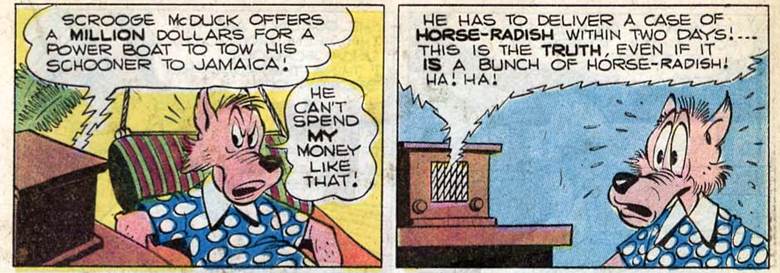
While I certainly respect Greg's stated desire to interpret DuckTales' Carl Barks adaptations independent of any acquaintance with the original stories, "Down and Out" is arguably the textbook case of how familiarity with a Barks tale -- in this case, the early $CROOGE adventure "Trouble from Long Ago," more popularly known as "The Horseradish Story" -- is absolutely ESSENTIAL in order to fairly assess the TV version of the story.  Ken Koonce and David Weimers turn what was, in its original incarnation, a pretty straightforward "race against time" story into an unwieldy combination of a now-dated media parody and a none-too-subtle morality play in which a hard-hearted Scrooge is pauperized and made to learn the meaning of the "Golden Rule." This might have played better had it been produced during the Obama era, in which the mere possession of wealth is all too often taken as prima facie evidence of questionable character.  In light of the manner in which Scrooge's character had been developed during the course of the series, though, it seemed at the time like a tremendous step backwards into the mindset of far inferior "moralizing" cartoons of the 80s.

Taking the ep at face value, Greg described it as "awesome and depressing at the same time."  The thing is, even if one is not familiar with "Trouble from Long Ago," the K&W version of the story has more than enough of its own share of problems.  Logical lapses and inappropriate slapstick abound, and even the draftsmanship lets the ep down in several instances.  Most frustrating of all is the fact that "Trouble from Long Ago" presented Scrooge with a real "moral dilemma" that was far more believable than any of the chump-change-chiseling in which he indulged on screen.  Had K&W showed more faith in the simple power of the Barks narrative, they could have had their "moral moment" and some legitimately exciting undersea action as well.  It was all right there, laid out for them in the persistently perused pages of UNCLE $CROOGE McDUCK: HIS LIFE AND TIMES.  Given such a beautiful canvas to copy, why settle for primary colors and finger-painting?  

K&W's opening gambit of Scrooge sowing discontent and confusion amongst a trio of "regular Duckburgian folks" immediately brings to mind the opening scenes of "Don't Give Up the Ship."  The Scrooge featured at the start of "Treasure of the Golden Suns" was purportedly an isolated, grumpy guy who hadn't yet softened up and returned to an "active lifestyle" with the Nephews.  I'd argue, though, that the supposedly more "civilized" Scrooge who raises Mr. O'Flannel's rent, avoids giving boat-repair money to Captain Jack, and dodges donating to Salvation Mary comes across as a far more questionable, if not downright sinister, character.  These three one-shot characters were obviously created to put a "human face" on the monetary misery that Scrooge causes others (never mind that the "real" Scrooge would probably have dealt with these folks through intermediaries), and the twisted logic that Scrooge employs during these confrontations (especially the one with Jack) winds up seeming more like a personal insult than the standard "sorry, it's just business" behavior in which you might expect a mogul to indulge.

Just so we fully realize how eminently despicable Scrooge is supposed to be here, we soon learn that Scrooge's favorite TV show is... Lifestyles of the Filthy Rich.  Moreover, Scrooge is going to be a special guest on an upcoming episode.  This is highly problematic, to say the least.  If anything, Scrooge has traditionally resented any prying into his personal life; in Barks' "North of the Yukon," to take just one example, he had to be arm-twisted into giving an interview and his picture to a magazine (and was subsequently proven prescient when the unwanted media exposure caused him some major difficulties).  Nor has Scrooge ever expressed any interest in how any other rich person lives, except insofar as it directly infringes upon his personal space and/or property values (e.g., his resentment of the lottery-winning Blurfs' nouveau riche crudeness in "Bubbeo and Juliet").  K&W must have found the temptation to satirize Lifestyles of the Rich and Famous (and, by extension, the self-indulgence of the boom-time 80s) too much to resist.  Never mind that the Scrooge I know and love would probably have run screaming from any intrusion by anyone remotely resembling "Robin Lurch." 


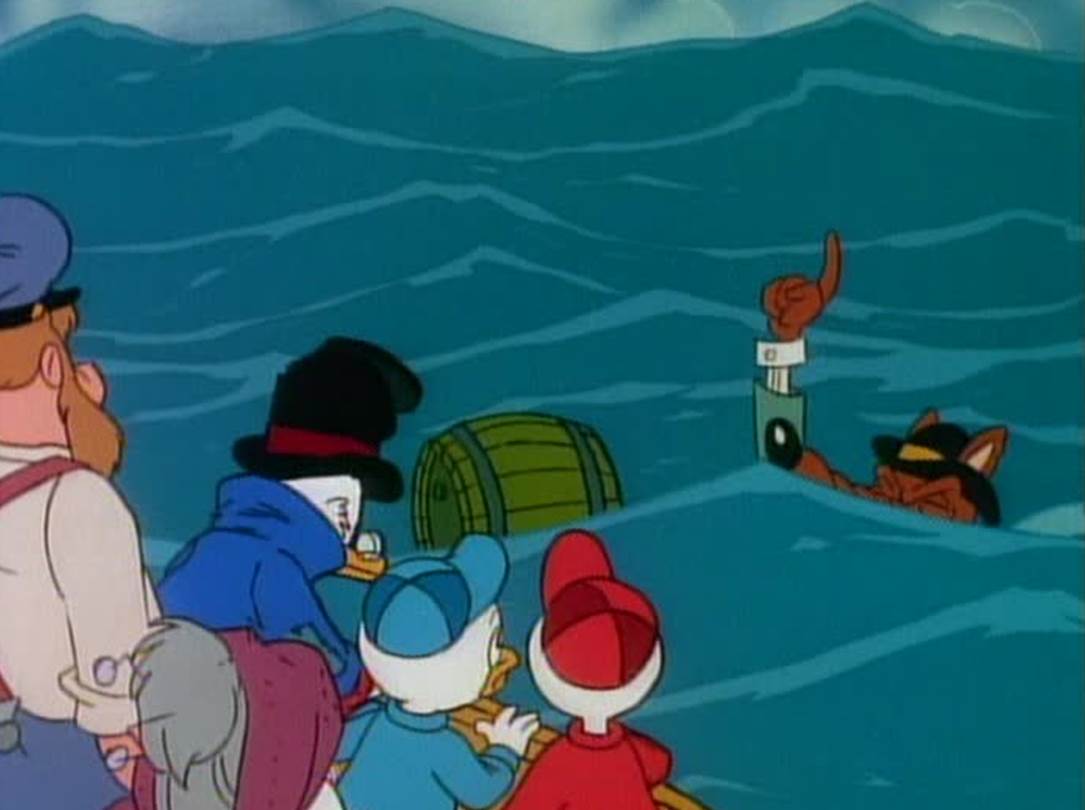
The substitution of the free-spending Fritter O'Way for Barks' Chisel McSue is, of course, another sledgehammer blow to our collective moral sense (Hey, this guy is the exact opposite of the chintzy-cheap Scrooge!  How ironic is it that HE'S claiming Scrooge's fortune??).  While K&W at least try to give Barks his due by basing Fritter's claim on Scrooge's riches on a long-ago delivery disaster, they don't seem to realize that their version of the story's antagonist makes far less logical sense.  Because of the stipulation (not used by K&W) that McSue can't take possession of Scrooge's money for 30 days -- strangely enough, McSue's ancestor also seems to forget about this, demanding the unfortunate Seafoam McDuck's gold teeth immediately after the sinking of the Golden Goose -- McSue has a vested interest in Scrooge not spending any money in the interim.  This is most clearly seen when McSue learns of Scrooge's attempt to salvage the horseradish:

By contrast, with Fritter gleefully spending money right and left as Scrooge festers in his "palatial underpass" and later goes on a desperate search for the marbles, it is clear that Scrooge is going to take a major financial hit even if he does manage to deliver the lost cargo.  Why, he might even cede the title of "world's richest duck" to Glomgold as a consequence.  The later "Yuppy Ducks" got slammed big-time for the whole idea of HD&L's deals getting cancelled and Scrooge not losing a penny of his fortune as a result.  It seems to me that "Down and Out" is equally vulnerable to criticism for failing to follow through on the consequences of Fritter's many (supposedly) legitimate deals.

What's the matter, Scrooge?  Feeling a bit low today?

I still have no clue as to why K&W saw fit to change the shipment of horseradish to a barrel of marbles.  Were they afraid that viewers wouldn't know what horseradish is?  (Talk about showing contempt for your audience...)  Did they want the freedom to employ the tiresome "He's lost his marbles!" pun at any time they chose?  My guess is that, during their radical simplification (and that's a kind way of putting it) of the original salvage sequence, in which the "power" of horseradish played a key role in helping the Ducks locate the Golden Goose, K&W realized that they simply didn't need such a "complicated" McGuffin and jettisoned it.  Besides, shortening the salvage action would free up more time for the middle-game parody of Lifestyles of the Rich and Famous around which the entire adaptation was presumably built.

The use of marbles is actually only a mild irritant compared to the clumsy manner in which K&W handle the circumstances surrounding the sinking of the Golden Goose.  Barks makes it very clear that McSue's ancestor set up poor Seafoam for a fall...

... whereas Diddle O'Way's entire "plot" against Seafoam McDuck rested on the assumption that the Golden Goose was fated to sink.  That's on the order of planning to pay for your child's education by investing in "sure-to-be-valuable-someday" comic books.  Bag those suckers and hope for the best, that's the surefire way to proceed!

There's a reason why several of his fingers are crossed.

I'm going to have Diddle pick my Powerball numbers next time.

Frankly, it's somewhat surprising that Scrooge and his family hung around McDuck Mansion and "worked for" Fritter as long as they did.  One would think that simple pride, if nothing else, would have driven them out to seek a solution to their dilemma almost immediately. What was to prevent them from asking their old friends Launchpad or Gyro to put them up... oh, that's right, the only characters who can possibly help Scrooge in this episode are the ones whom he dissed in the opening scenes.  That looks even sillier in retrospective than it did in 1987.  Scrooge needs a job, so his first application goes to... Mr. O'Flannel?  That has got to end well, right? 

After they (apparently) blow off the silly notion of calling upon legal assistance and experience the remarkably rapid deterioration of their collective raiment, it's time for the Ducks to get the ironic "Robin Lurch" treatment.  Actually, even if you don't remember Lifestyles of the Rich and Famous, this dream sequence (BTW, GeoX, that clears up the question of "why would Robin Lurch still want to do this") features some decent gags, most of them courtesy of Duckworth.  "Ba-roke" and "This is the best cardboard money can't buy" still work for me, as does the brief scene in which Scrooge wrestles the Pluto-wannabe for the bone.  I will admit, however, that Greg has a point when he remarks that, the longer this business goes on, the more depressing it gets.  (Even Robin Lurch appears to realize this; witness his reaction after he sees HD&L burning newspapers to keep warm.) Surely, Scrooge's subsequent spell of temporary insanity (there is no other word for it) leaves a bad taste in the beak, not least because it seems to undercut the whole notion of Scrooge personally learning a meaningful lesson from his spell of poverty.  As it stands, Scrooge doesn't really get the message until Duckworth challenges him to recover the marbles and Captain Jack shows him some unmerited kindness by lending the Ducks his leaky boat.


"Down and Out" might still have been salvaged (pun intended) had K&W maintained the adventurous, detection-oriented tone of the search for the horseradish in Barks' story.  No such luck.  After chucking the Ducks' detailed doping-out of the horseradish's location in favor of Captain Jack's dubious use of maritime charts to determine where "the ocean currents" must have dragged the wreck of the Golden Goose in the course of the past century, K&W abruptly decide that laughs have been lacking and turn the salvage operation into a series of goofy gags.  Needless to say, semi-comical sharks are involved and diving suits are overinflated along the way.  At least Mrs. Beakley gets one of her very rare moments to shine as a (sort of) action heroine.

Just as Scrooge and co. have succeeded in bagging the marbles, Fritter shows up on Scrooge's unrecognizable yacht (how'd Fritter get to the Cape of No Hope so fast?  At least Chisel McSue was already in Havana when he heard of Scrooge's "sitch" on the radio), and we seem to get back on track with Barks' original.  Seem, I said.  Here is where Barks gives his story an extra-cruel edge, depicting McSue as cold-blooded enough to follow up on his destruction of Scrooge's vessel (using a machine gun, mind you, rather than a "mere" blunderbuss) with an attempt to "silence" the henchman who has been helping him...

... and then giving Scrooge an opportunity to do exactly the same sort of thing after McSue falls out of his boat and is in danger of drowning:

So why couldn't THIS have been the "moral dilemma" that K&W used to test Scrooge's character? Kimba the White Lion faced challenges like this on a fairly regular basis (to take just one example, consider Kimba's reluctance to kill "The Gigantic Grasshopper"), so surely Scrooge was capable of handling a similar situation?  K&W did tease the notion of "going there," at least for a moment, but unfortunately, they had already sabotaged their opportunity to do so in any sort of effective manner.  The fact that Fritter had already taken over Scrooge's fortune pretty effectively neutralized any temptation on Scrooge's part to "let the rat drown."  Had Fritter refused to sign the delivery paper and Scrooge then followed through by refusing to take him on board the lifeboat -- an action that would have come across as far more cold-hearted than anything Scrooge did to Mr. O'Flannel et al.-- then, at least according to the terminally screwed-up Duckburg legal system, Fritter's fortune would probably have passed into legal limbo, as opposed to reverting back to Scrooge.  Thus we see the domino effect in action: decisions made early in the episode undercutting the effectiveness of later scenes.  


Of course, we have to conclude the episode with scenes of Scrooge making up for his past sins by showing generosity to all the folks he'd dissed earlier.  It doesn't appear to have occurred to K&W that they were undercutting their own parody of Lifestyles of the Rich and Famous here by positing an entire episode of Lifestyle of the Filthy Rich centered around how generous a rich person could be to others.  (Or perhaps Rich and Famous actually DID this on occasion?  I never watched the show, so I can't be sure.)


"Down and Out" isn't a total loss, quite.  As I noted above, some of the Filthy non-Rich gags are OK, as are some of Fritter's more... um, inspired redecoration schemes.  This episode must also be regarded as one of Duckworth's more memorable performances.  In addition to the butler providing Robin Lurch with the memorable tour of the "palatial underpass," the byplay between Scrooge and his butler here is rivaled only by the Senor Wences-esque "closet gags" during "Nothing to Fear."  One's memory immediately leaps to the "You mean like..." "Yesss..." routine quoted by Greg, but I actually find the dialogue at the start of the episode, as Duckworth is ferrying Scrooge around Duckburg to sow financial tares, to be much funnier (not to mention much less preachy).  Then, too, Duckworth is the character who shakes Scrooge out of terminal decline by reminding him of his adventurous past and challenging him to retrieve the marbles.

It'd be difficult not to rank "Down and Out" at the bottom of the list of DuckTales' "full" (as opposed to semi-) adaptations of Barks stories.  Early episodes like "Micro Ducks from Outer Space" and "Earth Quack," while disappointing, at least tried to stick to the Barks template for the most part, even if their departures from "book" were generally found to be wanting.  Koonce and Weimers commit a far more serious error: they fail to trust the template of "Trouble from Long Ago" and, in their insistence upon turning the story into a moral lesson, fatally compromise what was already a perfectly solid storyline that already contained a number of the thematic elements that they wanted to include.  The phrase "shooting yourself in the foot" comes to mind.

.

.

.

"DuckBlurbs"

(GeoX) Has anyone ever actually been required to wash dishes to pay for a restaurant bill? Regardless, for some reason I find the trope far more hilarious than I think it really is. 

The classic example of this in comics is probably the early sequence in LI'L ABNER in which Abner, freshly arrived in New York, gets himself trapped in a vicious circle by going to a restaurant and eating a big meal without having the money to pay for it.  By the time he finishes his kitchen penance, he's hungry again, so he orders another big meal, and... you take it from there.

(Greg)  Scrooge wonders if that came out right as he catches himself...and then here comes the nastiest brown weasel with a black umbrella and green suit with tie; and black hat out of the closet! 

Actually, he's supposed to be a fox.  Of course, given the average level of craft displayed by the animators in this episode, it's easy to see how you could make such a mistake.

It's Polygonal Scrooge!

(Greg) He is Fritter O'Way who is voiced by Aron Kincaid (according to the USIMDB; so take that one with a grain of salt) who started on the television show This Is The Life in 1952; then Fall of Nineveh (which he wrote, directed and produced along with acted in it!), and as a beekeeper in The Wasp Woman. He went on to do mostly movies such as Spartacus, The Girls On The Beach, Ski Party, Beach Ball, Dr. Goldfoot & The Bikini Machine, The Ghost In The Invisible Bikini, The Secret Sharer, The Happiest Millionaire, and the New Wife. He didn't land much in terms of roles on television until he got into animation as The Iron Sheik in Rock'N'Wrestling in 1985. He then became Sky Lynx in Transformers and Killer Croc in Batman: The Animated Series.

Maybe Fritter should have thrown a big rock at Scrooge.  :-)  Kincaid passed away in 2011, BTW.  I recall having all sorts of trouble matching names and voices in this episode for much the same reason that I had trouble in "Sphinx for the Memories."  All those one-shotters.  

(Greg) So we head to the flashback as we go to the docks as we see the Golden Goose as Fritter explains that it's owned and sailed by his ancestor. We then see cargo being put into the hull as we see a duck with white shin guard and a sailor uniform which Fritter address as Seafoam McDuck. See Seafoam was charged with making a delivery for his ancestor Diddle O'Way (who happens to be like Fritter; only with a mustache and wearing brown and green striped pants). He is carrying a barrel that isn't so funny. Diddle (Aron Kincaid again through Fritter's narration) asks how much will it be to deliver the barrel of marbles to the Cape of No Hope. Seafoam proclaims that it's two schilling; or be gone. Diddle agrees; but he wants insurance so he gives him a paper and Seafoam signs it which is clearly the deed and then proclaims that they leave with the tide. However; we head to sea and it's stormy and the sails are tattered now. The ship sank and the marbles with it; but everyone was able to make it to the rowboats safely back to shore. So we head back to the docks as we see Seafoam explain to Diddle on the docks about the storm; but there are no excuses and according to the fine print; he now owns everything. Seafoam states that everything he owned went to sea; except for the golden pocket watch. Diddle wants that; but Seafoam runs away with it stage left. Diddle tries to get it; but gets MURDERED by the net filled with cargo and falls into the sea. I guess he died or something.

Probably not, else how could Fritter have gotten the contract?  BTW, note how the size of the contract changes dramatically in the two scenes below.  I do give K&W credit for including a version of the Barks hypothesis that Scrooge used his "golden inheritance" (watch on TV, gold teeth in the comics) to set himself up as a prospector.  For sure, it's a heck of a lot more palatable than the manner in which the situation would later be presented in "Once Upon a Dime."
Next: Episode 48, "The Right Duck."