Saturday, January 8, 2011

Comics Review: UNCLE $CROOGE #399 (January 2011, Boom! Kids)


UNCLE $CROOGE's DuckTales detour (or, if that word sounds unfairly pejorative, then why not try "diversion"?) concludes here with a better-than-decent final issue that serves as a neat precis of the strengths and weaknesses of the past eight releases. In the lead story, "The Arcadian Urn," we once again see clever rescripting giving some extra life to what appears to have been relatively humdrum original material. Paul Halas and Tom Anderson's Egmont tale of the DuckTales gang "plus one" (read: Scrooge, HD&L, Launchpad, Webby, and Donald, who's conveniently "on shore leave from the Navy") exploring the "hidden land" of Arcadia in Ionian Greece would have been a more or less conventional treasure trek -- Scrooge is after an artifact that will trump the ancient urn that Flintheart Glomgold had earlier auctioned off for a pretty penny -- had the ever-reliable David Gerstein and Jonathan Gray not upped the ante by engineering what has to stand as Webby's finest moment in the comics medium. Consider that the much-mocked moppet:

(1)  Wields a "Littlest Chickadees Field Guide" every bit as dexterously as the Nephews handle their Junior Woodchuck Guidebook. (This could be considered "retconning," at least by those who've seen the TV episode "Merit-Time Adventure", but I'm glad to see Gerstein and Gray returning to Barks' original intention of unisex scouting organizations. Besides, who's to say that the legendary Hypatia couldn't have scrounged up her own set of material from the lost Library of Alexandria and preserved it for posterity?)

(2)  Is the first Duck to follow Launchpad into the magical underground pool that leads to Arcadia. (Yup, she's even quicker off the mark than HD&L.)

(3)  Is trusted to get the other Ducks out of prison by slipping out of their cell by herself and knocking out the guard with "Morpheus' sleeping powder."

(4)  Saves Scrooge's bacon (after the destruction of the pool and the treasure that Scrooge was bringing back) by bringing along figs in a jar made of Arcadian "blue glass."

Add all of this up, and it's hard to think of a story in which Webby more deserves the honorable title of "fourth Nephew." This, despite the Nephews offhandedly referring to her as a "danger-prone duckling" and Scrooge conveniently forgetting Webby's presence in the "ultimate" treasure hunt by claiming that she and Launchpad will "get used to the drill" of treasure-seeking with Scrooge, Donald, and the boys. (BTW, does the presence of Donald really make that much of a difference? He basically does nothing here, apart from playing Sancho Panza and making sarcastic remarks as the bumbling Launchpad confronts the dragon who's been menacing the Arcadians, going gaga over a frankly unattractive Arcadian lady, and dropping verbal references to Gyro Gearloose, Daisy, Admiral Grimitz, and Mickey Mouse. Since Launchpad's references to Darkwing Duck bring us right back to the same continuity issues that dogged "The Everlasting Coal" in #392, all of those otherwise-appreciated cross-references are pretty much canceled out, anyway.)

Despite Webby's superb performance, it's tough to rank "The Arcadian Urn" as anywhere close to the level of the TV series' two masterful encapsulations of Greek myth and legend, "Home Sweet Homer" and "Raiders of the Lost Harp." The magical pool provides too easy and convenient a route to Arcadia, the Arcadians are generic guys in togas rather than distinctly drawn characters, and Prince Baklava's treachery seems strange given that his father, King Metallia, is the one offering the treasure-prize to whoever can best the dragon, and thus the treasure already belongs to Baklava, in a manner of speaking. Jose Maria Millet Lopez' artwork, which has enlivened a couple of Boom!'s DT offerings, and a really fine coloring job by Diego Jourdan provide at least partial compensation for these drawbacks.
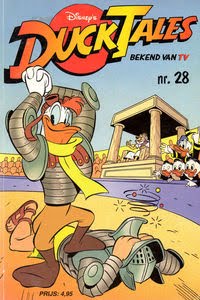

The use of "Scrooge's Nose Knows Gold," a four-page story from the DUCKTALES activity magazine, as the issue's backup tale -- written though it is by the accomplished John Lustig -- reveals the scarred and chipped "other side of the coin" of Boom!'s DuckTales phase. During the first year of Boom! Disney comics, the lack of backup features was often a negative. In the DT $CROOGE issues, by contrast, the choices of supplementary material cruelly revealed that, apart from the William Van Horn gag sequences featuring Launchpad and Gyro, really good short DT stories are very few and even further between. "Nose Knows" is better than the average mag quickie -- I should know, I have most of them in my collection -- but even Lustig has problems with the format, creating plot conveniences right and left. Would the more ruthless DT Glomgold really carry around "instant hay fever" as an ultimate deal-breaker? Isn't a more, um, decisive weapon more his speed? And how come Scrooge mistakes a mountain of yellow flowers for gold early in the story, a goof which seems to contradict the story's very title?

I'd have to give the DuckTales era of Boom! $CROOGE an overall B- grade. The lead tales were generally fairly good but could have been better at times, even with the frequently inspired scripting. If Boom! uses DT material in future issues of $CROOGE, then it would be well-advised to mix DT lead stories with more conventional backup material, much as the Carl Barks story "Christmas Cheers" was used as the backup in #398. In light of the great success of DARKWING DUCK and CHIP AND DALE'S RESCUE RANGERS, I think that we can pretty much count on more DT offerings in $CROOGE, and I'll certainly welcome them.

Tuesday, January 4, 2011

The Carl Barks Library -- Take Two!

The "Golden Age of Comics Reprints" just keeps getting "spanglier and flashier." Fantagraphics, which is already planning to launch a Floyd Gottfredson MICKEY MOUSE reprint project later this year, has now unveiled a new hardcover Carl Barks Library series, with the first volume scheduled to be published in Fall 2011. FG boss Gary Groth clearly intends for this to be a collection that immediately grabs the attention of a mass audience, much as the COMPLETE PEANUTS did (remember how the first PEANUTS volume cracked the best-seller lists?). In lieu of a chronological reprinting schedule, the first several volumes will draw upon Barks' strong suit -- his DONALD DUCK and UNCLE $CROOGE stories of the late 1940s and early 1950s.

For me personally, "things Ducky" have now come full circle. I started the Duck-phase of my comics-collecting career in the mid-1980s with the Another Rainbow Barks library. I've often said that, if I were forced to sell my comics collection for some reason, then those oversized black-and-white volumes would be the last things to go. For the most part, I eschewed buying the various softcover Barks albums put out by Gladstone, even though they were in color. The FG volumes, however, I think I will buy -- though I do hope that there is plenty of ancillary material present to offset the familiarity of the reprinted material. Now, if FG could only get the COMPLETE POGO off the ground...

Movie Review: THE KING'S SPEECH (The Weinstein Company/UK Film Council, 2010)

This movie is only getting a limited theatrical release in the U.S. at the moment -- if it snaps up the Best Picture Oscar in a few months, as seems distinctly possible, then the hinterlands may be graced with it -- but if you're fortunate enough to live in an area where it's playing, then hie yourself to the appropriate playhouse and see it. King George VI's fumbling efforts to conquer a speech impediment may not strike you as promising fodder for a crowd-pleasing movie plot, but this is that rare "Oscar-bait" film that chooses to celebrate the best of the human spirit, as opposed to focusing voyeuristically on the worst human sins. In its depiction of the growing relationship between the reluctant monarch (who only became King because his brother abdicated the throne to marry an American divorcee) and the puckish Australian speech therapist Lionel Logue -- whose unorthodox therapies fluster, enrage, puzzle, and at long last win over his unlikely client -- the movie also comments with wit and warmth on the social divisions of Great Britain on the brink of World War II. The social fabric that had been badly torn by World War I was still sturdy enough to affect everyday interpersonal exchange, but it was already clear that the future of British society was going to be quite different. The film's ability to make this point without hammering us over the head with some sort of political statement is one of its biggest strengths.

George VI (Colin Firth, in a performance that will almost surely be rewarded with an Oscar) came to the throne at a moment when, as acidly noted by his father George V (Michael Gambon), the British monarchy was being forced into "playing a role" as opposed to wielding real political power. Kings and queens, who were now expected to address their subjects directly via the medium of radio, had begun their slow transition from political figures to mass-media celebrities. Though enjoying a happy home life with the devoted Queen Elizabeth (Helena Bonham Carter) and daughters Elizabeth and Margaret -- and, after all the tabloid travails of recent decades, don't think that I didn't appreciate the positive portrayal of a royal family -- George VI lacks confidence in his ability to connect with his subjects on even a superficial level. The quirky, opinionated Logue (Geoffrey Rush), as part of his therapy, gradually probes into his reluctant client's past, revealing the dark side of royal life -- an overly demanding father, an insensitive brother -- but also pulling "Bertie" out of his shell. After surviving several rocky patches and one apparent breakup, the George-Logue axis comes into its own when George is obliged to rally the country at the outset of World War II. The set-piece speech that concludes (and gives title to) the film is a fitting triumph for both the King and the man who literally helped him to find his voice.

The King's Speech gets what must be the softest "R" rating on record, simply because "Bertie" is made to spout some "f-words" as part of his unusual therapy. In context, this passes almost unnoticed. (Of course, this being the 1930s, there is plenty of smoking, so perhaps the movie gained back its "R" that way.) In all honesty, the "offensive" material is no more "offensive" than a particularly high-gloss episode of Masterpiece Theatre, which the film certainly resembles at times. Don't let the highbrow trappings put you off; this is definitely a feel-good movie in the "classic" Hollywood tradition.

Friday, December 31, 2010

DVD AND Movie Reviews: TRUE GRIT (Paramount, 1969) / TRUE GRIT (Paramount/Skydance, 2010)

N&V closes out 2010 with a bang by coupling a review of The Coen Brothers' impressive remake (or, taking a cue from Ape Entertainment, perhaps I should say "reimagination") of the beloved 1969 classic with some notes on the original, the DVD of which Nicky and I watched immediately after letting the Coens have their head. The obvious temptation is to take sides on which film is better, but I don't really feel comfortable doing so without having read Charles Portis' original novel. It suffices to say that both cinematic interpretations work extremely well in the context of the expectations of their times, and that I have no doubt that the Coens' film, like the original, will "wear" as well as a comfortable pair of chaps over the next several decades.


The 1969 True Grit, directed by the notoriously exacting Henry Hathaway, made a wagon load of money and, as is well known, earned John Wayne that long-awaited Best Actor Oscar for his memorable portrayal of the raffish, one-eyed Marshal Rooster Cogburn. Seeing it again on the heels of viewing the Coens' movie, I was struck by how unnaturally neat and clean it looks -- fer gosh sakes, outlaw Lucky Ned Pepper (Robert Duvall) has a fresh white sheet handy to bind up the wounds of the hapless Tom Chaney (Jeff Corey) after the latter is winged by the teenaged Mattie Ross (Kim Darby)! -- and how thoroughly Wayne dominates the action, even though revenge-seeking Mattie is technically the main protagonist. The cast is made up of neophytes (Glen Campbell as the popinjay Texas Ranger LaBoeuf, Darby in her first major big-screen role) and a raft of indelibly distinctive character actors (Strother Martin, John Fiedler, James Westerfield, Dennis Hopper), and all but a few scraps of action take place in the blazing light of the Colorado mountain-country day, suggesting that Wayne's salary took up a generous chunk of the overall budget. No matter, Wayne's avuncular interpretation of Rooster is a delight, and, for a G-rated movie, the film's scary moments still pack a punch, especially the scene in which Mattie shoots Chaney and then topples into the snake-haunted cave. (The trailer above lists the movie as having an "M" rating, but Paramount was able to get it changed. It's actually somewhat surprising decision in light of the film's use of words like "bastard" and "bitch." Today, I imagine the film would be re-rated "R" simply because of all the smoking that goes on.) Scriptwriter Marguerite Roberts tees up the plot by actually showing us how Mattie's father came to grief at the hands of Chaney, and, while this has the undoubted effect of stripping some of the "evilness" away from Chaney (since he is clearly drunk when he shoots Mr. Ross), the more straightforward narrative approach has the advantage of getting the audience to fully commit to Mattie's "mission" from the start. It also gives the '69 Grit more of the feel of a high-class contemporary TV Western of the time, which isn't necessarily a bad thing. Elmer Bernstein's brass-heavy musical score often sounds "TV-ish," as well, but sometimes lightens the mood at inopportune moments; for example, Mattie's trek through Fort Smith to scare up help for her revenge-quest is "tracked" at one point by a chorus of whooping trombones that momentarily had me wondering when the clowns and bareback riders were going to appear. The "happy ending" and memorable Wayne "ride-off" sequence were created for the movie, but no one seemed to mind the changes at the time. Excellent craftsmanship, touches of humor and humanity, and a charismatic performance by the star -- what's not to like? Well, maybe Glen Campbell's mostly woodenish performance as LaBoeuf, but even he isn't completely hopeless -- and he does provide a good title song, which made the Summer of '69 pop charts.


I went to the new edition of Grit never having seen any of the Coen Brothers' previous films, which I remember being festooned with words like "dark," "grotesque," and "weird" in the past. I had been encouraged by what I had heard of the Coens' adaptation -- which reportedly had stuck very close to the novel and consciously avoided any attempts to ape the '69 version -- but I couldn't help but feel that, at some point, I was going to witness the postmodern equivalent of someone peeing on "The Duke"'s grave. I shouldn't have been concerned. The palette is considerably drabber -- all brown, tan, and sepia tones -- and the moments of violence are (as I fully expected) more brutal and more realistic, but the Coens play things reasonably straight, allowing Portis' lyrical narrative to do most of the heavy lifting. The cast, rather than resembling the pyramid of the '69 Grit (with Wayne sitting serene and unquestioned at the top), instead resembles an inverted pyramid: the leads are uniformly excellent, while the supporting players are generally forgettable. You'll need to bring Mumbles along to interpret some of Jeff Bridges' dialogue as Cogburn, but Matt Damon is amazingly good as LaBoeuf, while someone named Hailee Steinfeld acts rings around the occasionally whiny Kim Darby as Mattie. Steinfeld takes Mattie's calm, calculating personality closer to what I would call "spawn of Beelzebub" territory -- think of those horror movies with deathly deadpan evil children -- but a child forced to "grow up before her time" in the still-wild West of the late 1800s would probably have needed this kind of an emotional carapace around her in order to cope with the dirt, death, and disappointment she would encounter on a regular basis. The trio's relationship is spikier in the Coens' version, but not so much so that you actually want to see the gang break up before the job is done, while the ending, which is lifted straight from the novel, is anything but warm and fuzzy, yet nonetheless satisfying.

I have considerable affection for the 1969 Grit, but the Coens have proven that a redo doesn't have to smash all the existing crockery and put a perverse spin on what came before in order to seem fresh and interesting. And with that happy thought, I wish all my readers a Happy New Year.

Wednesday, December 29, 2010

DVD Review: THE BAND WAGON (MGM, 1953)

Nicky loves Fred Astaire and strongly urged me to watch this, one of her favorite Astaire flicks. This Arthur Freed musical, aside from featuring a number of sprightly tunes (including one stone-cold classic), is an interesting comment of sorts on a peculiar phenomenon that accompanied Dwight Eisenhower's ascendancy to the White House -- namely, the installation of the overly intellectual "egghead" as a figure of fun. Venerable Hollywood singer/dancer Tony Hunter (Astaire), feeling a bit behind the times, agrees to star in a comeback show penned by two Broadway friends (Nanette Fabray, Oscar Levant), only to have artistically pretentious director Jeffrey Cordova (the British stage actor Jack Buchanan in his most memorable film role) masticate the simple tale and regurgitate it in the form of a modern-day version of Faust. The full-of-itself production bombs, Cordova mends his ways, and soon, we're back to a far more light-hearted show that culminates with a memorable musical tribute to the popular "tough guy" novels of Mickey Spillane. Oh, and Astaire winds up falling in love with his graceful ballerina co-star (Cyd Charisse). Add the introduction of the iconic Hollywood "theme song" "That's Entertainment" as part of the festivities, and you've got a thoroughly enjoyable piece of craftsmanship. Granted, the thing has about as much intellectual "nutritive value" as a Mallomar, but it's refreshing to watch a film that exists for no other reason than to make people smile as they're leaving the theatre.

Speaking of smiling, Nicky can personally vouch for the fact that I guffawed out loud while watching the "Triplets" number.  Now, I know that a lot of modern-day stars have taken on rather strange roles, but just try to imagine an A-lister's reaction to being asked to recreate this business. In animation, maybe, but in live-action?!

The DVD we watched also included a bunch of trailers from other Astaire efforts, ranging from The Broadway Melody of 1940 (1940) to Finian's Rainbow (1968). Viewing these clips in succession provides sort of a mini-history of the development of Hollywood musicals, from the "let's put on a show and to heck with the plot" era to the "let's try to recapture that old Sound of Music magic" compulsion that nearly drowned several studios in oceans of red ink. Astaire's class, however, remains a welcome constant.

Sunday, December 26, 2010

Comics Review: MICKEY MOUSE AND FRIENDS #303 (December 2010, Boom! Kids)

Mickey's snazzy new wheels -- provided by the Mouseton Police Department, which, judging by the number of high-tech accouterments packed into the vehicle, must be doing double duty as an affiliate of Double Duck's "Agency" -- take The Mouse and his lady into something resembling an adventure in "Mickey Mouse and the Tools of the Trade." For what is basically a six- to eight-page plot from a Dell/Gold Key issue of MICKEY MOUSE stretched out, like the proverbial piece of discarded gum attached to one's shoe, to over 20 pages, this 2002 Italian story is surprisingly enjoyable. The antagonists (a pair of supermarket thieves who intend to use the proceeds of their petty theft to "escape to South America"? Uh huh...) are easily dismissed, allowing us to focus on the wonder-car's many attributes. Minnie kvetches in somewhat annoying fashion before getting caught up in the chase, and the two mice don't even get (or deserve) the lion's share of the credit for sacking the bad guys, but this story rises above the humdrum for two reasons: Saida Temafonte's good scripting (Temafonte has improved a great deal since those early installments of WIZARDS OF MICKEY, HERO SQUAD, and Double Duck) and Giorgio Di Vita's artwork, which preserves the liveliness of the best Italian artists without stepping "over the line" into rampant sloppiness. Not a deathless work by any means, but a nice time-passer while we gin ourselves up for 2011 and the return of "classic" Mouse material.