Thursday, January 14, 2010

B'ball Bevue

Last night, Nicky and I went to see Stevenson's men's and women's basketball teams take on Marymount. Both teams have been struggling mightily this season, but the two of us supported the Mustangs during the good times, and it just wouldn't feel right to abandon them during their moment of need. Early in the second half of the men's game, SU took the ball out of bounds, ran a play, and connected on a shot from outside. Nothing unusual in this... except that the Mustangs were attacking the same basket they had used during the first half. For those scoring at home, this meant that their score counted for Marymount.

Those with a deep knowledge of sports know that this sort of gaffe has happened before. Take the infamous case of Cal's Roy "Wrong Way" Riegels in the 1929 Rose Bowl, for example. Then there's Vikings' lineman Jim Marshall, who scooped up a fumble in a game in 1964 and ran it into Minnesota's end zone. Both of these mistakes were individual goofs, however. When's the last time you saw a team collectively lose its sense of direction? The only case I know of is that of Purdue in the second round of the 1988 NCAA Midwest Regional. At the start of the second half, the Boilermakers broke in the wrong direction and allowed Memphis State to score an uncontested basket.

These are the times that try fans' souls... are they ever.

Tuesday, January 12, 2010

Comics Review: MICKEY MOUSE AND FRIENDS #299 (Boom! Kids, December 2009)

The blurb-writer at Boom! needs assistance, stat! Here's the innocent-on-the-surface plot summary for this issue, per Comic Book Resources:

Student of the great wizard Grandalf, Mickey Mouse, along with friends Donald Duck and Goofy, must face off against the Phantom Blot and his nefarious Team Black Phantom!

The same aggressively genetic blurb was used for MM&F #298, but, since "Wizards of Mickey" is a continuing story with a single general theme, no big deal, right? Er, not so much...


(1) The Phantom Blot, aka "The Lord of Deception," does appear here for a two-page rant of little consequence, but Peg-Leg Pete and the Beagle Brothers are nowhere to be found; "Wizards of Mickey"'s only thaumaturgical tiff in this relatively uneventful issue is with "Team Tapestry" and its "knitted warrior" come to life.

(2) Another team on the side of the magical "angels" makes its debut here: "Team Diamond Moon," consisting of our old friends Minnie, Daisy, and Clarabelle. (No, they don't dress in schoolgirl pinafores, though Minnie, somewhat to my dismay, sports the unbecoming "lipstick look" that various comic-book artists gave Mickey's girlfriend in the 50s and 60s.) The distaff diviners claim a victory of their own in the ongoing sorcerers' tournament, do the character-interaction "thang" with the boys, and then conveniently vanish from the scene during the battle with "Team Tapestry." They'll no doubt appear again soon enough, given that Donald is enamored with Daisy (even to the point of enlisting Goofy's help in an attempt to serenade her) and Minnie, the self-described "Princess of Moonland" (hm, maybe she and Usagi Tsukino have more in common than I thought!), appears to be something of a "big cheese" in this still-rather-nebulously-defined "universe."

(3) Who is this "Grandalf" they blurb of? Mickey's master Nereus is still imprisoned by "The Lord of Deception" but finds time to perform another "information dump" on Mickey through the medium of a magical medallion. Apparently, The Blot's minions all wear medallions bearing the letter M. Unless M stands for "Magic" -- which seems rather silly in this world, given the pervasive use of sorcery -- this ranks as the most mystifying use of that initial since the English translation of Go Mifune's name was not accompanied by a similar updating of his clothes.


Hopefully, Boom!'s PR people will catch up with the actual story in time for the next issue. Lest you think that I'm dissing #299, it's actually not that bad, despite the relative lack of forward plot movement. I even got an extra laugh out of Clarabelle's magical shtick of divining fortunes; it reminded me in a weird way of her House of Mouse role as "cast gossip." Needless to say, the shtick does come with something of a catch...

Saturday, January 9, 2010

Comics Review: DONALD DUCK AND FRIENDS #349 (Boom! Kids, December 2009)

The preliminaries are over. Donald, alias Double Duck, finally gets to do some real, live spy work in this issue. And -- surprise of surprises -- he actually pulls it off! Well, with a bit of help from the sexy Kay K and an agent of... wait for it... SHUSH. (Though this may not be Darkwing's SHUSH, as I'll explain below.) In the guise of a waiter at supercrook Marlo Burke's party, Don does throw in a coincidental screw-up by accidentally queering a business deal that his Uncle Scrooge has got cooking. Even there, he has an excuse of sorts: he was reacting (violently, of course) to Gladstone's smug blowoff of his supposed "new job." I'm glad that writers Fausto Vitaliano and Marco Bosco avoided the obvious cliche and allowed Don to get away with the "Agency" laptop computer in Burke's possession. The problem, of course, is that now Burke is out for revenge. The whereabouts of rogue "Agency" agent B-Berry (who's revealed to have stolen the laptop in the first place) still need to be clarified -- I'm still leaving open the possibility that B-Berry turns out to be a Bourne-style antihero -- but the "Double Duck" saga continues to both entertain and intrigue.

We again get a somewhat clumsy "transition point" in this issue, with the "new chapter" being cut off after just five pages this time. Given what those pages contain, I'd almost have preferred five additional pages of ads. Having spied Donald and Kay K together in Don's car, a pissed-off Daisy shows up at Don's door demanding the proverbial "answers." She's a fine one to talk, having previously thrown Don over in favor of Gladstone. Given how well Don and Kay are getting along -- indeed, Kay slips in her most blatant "come-on" to date during the escape from Burke's mansion -- there is no longer any serious doubt in my mind that a major catfight lies in our future. I'd give the edge to Kay at this point; Daisy's acceptance of Don's improbable excuse for being with Kay caused me to mentally knock about 20 points off Daisy's purported IQ.

Kay describes SHUSH agent Wilson, who'd been serving as a double agent in Burke's gang, as a "federal agent." My memory may be faulty, but I don't recall the SHUSH of Darkwing Duck as being a "formal" government agency; it seemed more like the peculiarly "localized" Duckburg Intelligence Agency of DuckTales' "Double-O-Duck," an outfit based in one city that nonetheless battled international crooks. Maybe the feds swooped in and "nationalized" SHUSH in the years after Darkwing Duck aired?

Book Review: NOW I CAN DIE IN PEACE by Bill Simmons (ESPN Books, 2005)


It will come as no surprise to any sports fan that the mixing of sports with pop-culture references has become a quick (and, to be honest, rather cheap) way for a commentator to establish "regular guy" credentials with the audience. Simmons, aka "The Sports Guy," takes this trend "several steps beyond," making Dennis Miller's gig on Monday Night Football seem like the return of the business-first Al DeRogatis. Simmons has just come out with a book about the history of basketball that purports to be somewhat Bill James-like in its handling of NBA teams and players. Before getting it from the library, however, I wanted to make sure that I could tolerate Simmons' too-hip-for-words style, so I read this earlier effort, which is subtitled "How ESPN's Sports Guy Found Salvation, with a Little Help from Nomar, Pedro, Shawshank, and the 2004 Red Sox." The phrase "acquired taste" quickly came to mind, but this taped-together, freshly-annotated collection of Simmons' columns on the Red Sox from 1999-2004 was entertaining enough. It helped that I took Linus' advice about reading the Russian names in THE BROTHERS KARAMAZOV and "bleeped right over" Simmons' wonkier references to movies, celebrities, music, etc. I wouldn't recommend that any Yankee fan read this, but, if you like baseball and don't have a dog in this particular AL East fight, you will enjoy Simmons' ramblings.

Sunday, January 3, 2010

Movie Review: THE PRINCESS AND THE FROG (Walt Disney Pictures, 2009)


It CAN'T end this way. Such was my reaction when I saw Home on the Range, Disney's "last" traditionally-animated film, five years ago. The studio that gifted us with Pinocchio, Fantasia, Lady and the Tramp, 101 Dalmatians, and so many other classics couldn't POSSIBLY depart the scene with a trivial movie featuring cows with razor-sharp glutes and a villain whose gimmick was a hypnotic yodel. Things looked bleak there for a while, but, thank goodness, Disney came to its senses and decided to reactivate the 2-D unit... for a good, old-fashioned fairy tale, no less. And the revival wasn't a simple exercise in nostalgia, either, as The Princess and the Frog turned out to be a first-class entertainment with an uplifting message (though, IMHO, not the one on which the "culture warriors" have spent most of their critical gabble).

Despite relatively forgettable songs, TPATF is fully worthy of comparison with the best Disney movies of the post-Little Mermaid (read: "Let's Put on a Broadway Musical!") era. The main reason is its relentless celebration of the old-fashioned, up-by-your-bootstraps virtue of getting ahead through hard work. Originally, Tiana, the African-American heroine, was supposed to be a maid in an upper-class home, which drew the expected accusations of racial stereotyping. The reboot -- in which she's an ambitious waitress who dreams of owning her own restaurant -- is immeasurably more satisfying. Though the film makes clear that Tiana may have sacrificed too much of her life to scrimping and saving for that precious down payment, this can't be considered a major fault; she's a winning, compassionate personality in all other respects, especially in the way in which she demonstrates to her partner-in-green, the playboy wastrel Prince Naveen, the virtues of "do-it-yourself." The black viewers and critics who've been hosanna-ing Disney's first use of a black "princess" may not recognize that the message being telegraphed here is much more in the spirit of the out-of-fashion Booker T. Washington than, say, Malcolm X.

In keeping with Tiana's emphasis on sticking to the basics, TPATF goes back to some of the best Disney features' cardinal rules. "Stunt casting" is kept to a minimum, with Oprah Winfrey's performance as Tiana's mother a low-key one and John Goodman giving the wealthy white sugar baron Le Boeuf (the father of Tiana's man-crazy friend Lottie) Goodman's ebullient personality without any Goodman-specific shtick. Two of the best performances, by Keith David as the villainous voodoo master Dr. Facilier and Jim Cummings as the Cajun firefly Raymond, are given by Walt Disney TV veterans. The obligatory "wacky sidekick characters" (Raymond and Louis the jazzman-wannabe alligator) don't arrive on the scene until the movie is half over and, thank goodness, refrain from anachronistic pop-culture references (apart from those appropriate for early-20th-century New Orleans, that is). Like the best Disney villains, Dr. Facilier is both menacing (especially when seen in tandem with his voodoo allies from "the other side") and somehow funny, taking a little of the edge off of several potentially chilling scenes. Best of all, the movie is entirely free of the snarky cynicism that passes for wit in so many contemporary animated films and was never present in the best Disney movies. If anything, the movie errs on the side of being too genial; race relations in New Orleans during this period were no doubt much more relaxed than elsewhere in the Deep South, but the cozily integrated New Orleans of TPATF strikes me as something of a stretch. The film does brush up against the realities of the time, however gently, when the white realtors from whom Tiana is trying to purchase a building for her restaurant refer to the latter's "background" as being an issue. They might be referring to Tiana's class (since she, unlike another potential buyer, doesn't have the full payment for the property, only a down payment). Then again, they might be referring to her race.

The animation of TPATF is, as you might expect, top-notch, with only a few jarring notes. A couple of scenes, such as crowd scenes in New Orleans and a bank-side view of a riverboat, are too obviously CGI. Other studios, of course, have had the same problem of seamlessly integrating computer animation into 2-D films, but Disney has set a high standard in this area in the past, so I was a bit disappointed that they hadn't improved their technique over the last half-decade. The grown-up Lottie, when seen next to "classically" designed Disney "types" like Tiana and Naveen, looks like -- I'm not making this up -- a cross between a "Southern Belle" version of Elmyra and one of those female characters from the Bruce Timm WB animated series whose immense mouths are shaped like orange wedges. I realize that Lottie is something of a comedy-relief character -- albeit one capable of genuine nobility of spirit -- but, at times, she seemed to have dropped in from another movie. Even Le Boeuf looks a shade more realistic than Lottie. Naveen's put-upon manservant Lawrence is also something of a caricature compared to the main human characters --though I've seen previous Disney characters who resembled him -- and the inept Cajun frog-hunters who menace the unintentional anurae look and act like extras left over from Home on the Range. (The one who mumbles his lines might even be a swipe of King of the Hill's Boomhauer. If so, then that ain't right.) For all of this grousing about artistic inconsistency, my favorite piece of animation in the film, oddly enough, is the stylized sequence in which Tiana fantasizes what her restaurant will look like; it reminded me a bit of the "Rhapsody in Blue" sequence from Fantasia 2000.

The Randy Newman score mixes together Dixieland, zydeco, and gospel material to no particular effect. I honestly don't expect any song from TPATF to become a standard, although "Dig a Little Deeper" (the gospel bit, performed well by the film's "good voodoo" character, Mama Odie) was kind of catchy. It doesn't really matter, however, as all other aspects of the movie were rock-solid (or perhaps I should say jazz-solid, given the theme here). Disney still has the touch, so let's hope that the movie does well enough to touch off a new series of 2-D features. The studio would do well to stagger the new films' releases, however. Look what the "assembly-line" approach of the last regime led to, after all: Cows with tail fins.

Friday, January 1, 2010

Comics Review: STAR COMICS ALL-STAR COLLECTION, Volume 1 (Marvel Comics, 2009)

My "Silver Age of Comics Collecting" (not to be confused with the "Golden Age" of 1975-1982, during which I concentrated solely on RICHIE RICH) began in a peculiar way that sort of typifies my decidedly atypical comics-collecting experience. Here's how I described it in a piece I wrote for THE HARVEYVILLE FUN TIMES! (issue #41):

In the Spring of 1985, in a last, defiant gasp of my overweening interest in "classic" Harvey comics, I buy a small number of Marvel's late and decidedly unlamented Star Comics when they start appearing on the sparsely populated magazine racks of a small food store located down the street from the Brown [University] Graduate Center. In this year of CRISIS ON INFINITE EARTHS, I derive considerable pleasure from the likes of TOP DOG, PLANET TERRY, and EWOKS. Don't get me wrong -- even I can see that the Star offerings are, by and large, pale imitations of Harvey comics (especially the notorious ROYAL ROY, which pisses me off... uh, royally). What excites me the most is the presence of creator credits. At long last, I have incontestable proof that the artist who I always thought was Warren Kremer was, in reality, Warren Kremer! I'm so happy to be proved right that I compose a personal letter to Mr. Kremer on my manual typewriter (yep, this WAS a while ago...) and send it to the Marvel offices.

If it sounds like I'm setting up the duckpins for a revisionist bowl-a-rama, you're correct... up to a point. Marvel's recent out-of-nowhere release of the first of a planned series of volumes reprinting the (short-lived) exploits of Star Comics' original creations was a pleasant surprise, given the generally low esteem in which these comics are held. I couldn't help but snap the book up, and I'm delighted to say that these works hold up much better than I'd recalled -- with one big, gold-plated, starts-with-Rs exception. It's no Dark Horse LITTLE LULU line, for sure, but you could certainly do worse than purchase this collection with an eye towards getting a young child interested in comics. If you really want to go "above and beyond," you might also get a couple of the Dark Horse HARVEY COMICS CLASSICS volumes and do a direct "compare-and-contrast," so as to fully understand the tangled Star-Harvey relationship.


Star Comics came into existence because the notoriously deal-happy Harvey family couldn't make a deal. The original Harvey Comics line, unable to cope with the "brave new world" of the direct-market distribution system, ceased publication in 1982. Over the next several years, Marvel, seeing an opening in the kids' comics market -- an opening that would become a gaping maw once Western Publishing finally gave up the ghost in '84 -- dickered with Harvey over the rights to print Harvey comics. When the two parties couldn't come to terms, Marvel hired away some of Harvey's idled personnel and set up shop for itself, giving the line a new title in order to establish a cordon sanitaire between the newbies and the superhero-dominated Marvel Universe. Featuring a mixture of licensed properties and original creations, Star sputtered along for a couple of years before the new line was jettisoned and the few ongoing titles (ALF and BARBIE, most notably) were gathered under the Marvel banner. While no original title lasted longer than TOP DOG's 14 issues, it is these titles that have come to symbolize what minimal profile Star has retained among comics fans -- and it is these titles that are at the center of the controversy over whether Star really was just a bald-faced Harvey knockoff.
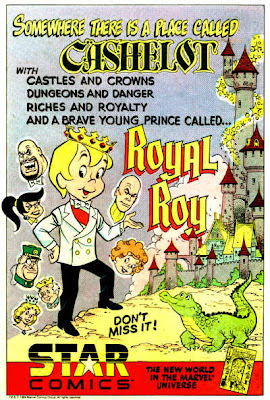

ROYAL ROY is the one title reprinted in this collection that truly deserves all the scorn heaped upon it. Roy was a Richie Rich ripoff -- nothing more, nothing less -- and the cast of supporting characters have direct parallels to Richie's cast in a manner not seen again in popular culture until The Lion King's "borrowings" from Kimba the White Lion. Reportedly, young prince Roy's facial features had to be changed at the last minute to make the resemblance to Richie less grindingly obvious. The change in setting from Richville to the kingdom of Cashalot didn't fool anyone -- in fact, the decision to make Cashalot a rich kingdom seemed calculated to twist a painful knuckle into RICHIE fans' spines -- and, I would argue, gave what was already an idea doomed to failure even less of a chance to succeed. For all of his immense wealth, Richie remained, at heart, a fairly typical American kid who could "connect" with readers in a manner that the regal Roy never could, not even when he took a "commoner" girl friend, Crystal Clear (read: Gloria Glad), in ROYAL ROY #2. The cynicism of the whole enterprise almost beggars (heh) belief. Marvel's decision to cancel the title after six issues (in, I might add, the face of the Harvey family's most justified lawsuit ever) didn't remove the bad taste from people's mouths. Indeed, the whole affair wound up curdling Star's overarching reputation for good. More's the pity, as the other, legitimately original Star creations ranged from good to excellent.


While less ambitious than PLANET TERRY (the first "children's comic" of my acquaintance to essay a continuing story line) and less artfully produced than WALLY THE WIZARD (to my mind, the real revelation of this collection), Top Dog was at the beginning, and probably always will be, my favorite Star character. The concept is simple enough -- "typical kid" Joey Jordan meets and adopts (in a manner of speaking) an opinionated talking dog who's something of a "Renaissance mutt" -- but the execution is charming. Kremer, inked by Harvey associate Jacqueline Roettcher in a manner that will be instantly familiar to anyone who's read Kremer's work on RICHIE RICH AND CASPER in the 1970s, makes TD, Joey, and the supporting players very appealing. Lennie Herman's scripts for TD #1-#3 are also excellent, though the Cold War-flavored "Spies" (TOP DOG #2) has aged a bit. (The prolific Herman actually died before the first Star comics appeared on the shelves; it'll be interesting to see how the stories' quality will hold up once other hands take the controls.) If I have any modern complaints with these engaging stories, they lie in (1) the use of a wealthy snob, Mervin Megabucks, as Joey and TD's main antagonist -- he's much too reminiscent of Richie's "mean" Cousin Reggie van Dough for my taste -- and (2) the fact that TD, wisecracker though he may be, isn't as big of a smart-aleck as he probably ought to have been. He's a Bugs Bunny type, but rendered in pale pastels. If Herman had combined the likability of Richie Rich with the sassiness of, say, a Hot Stuff or a Little Audrey, then we would really have had something.


PLANET TERRY looks a lot like a conventional Harvey comic -- same page layout, same division into "chapters" with different titles, etc. -- but just look at the characters once and the novelty is obvious. Terry, an (extremely) prematurely graying teenager, is on a galaxy-spanning quest to find his lost parents. Along the way, he acquires a comely female robot and a scaly green muscle-monster as allies. The temptation to link Terry to Timmy Time -- the young, white-haired time-traveler (created by one of Alfred Harvey's sons, BTW) who appeared in a single issue of Harvey's RICHIE RICH AND TIMMY TIME (1977) -- is as strong with me as "The Force" was with young Luke Skywalker, but I don't honestly think that Terry was a ripoff. Star had already tweaked the Harvey family's nose once with Royal Roy, so what could have been gained by antagonizing them again? Terry's adventures (which ceased prematurely when the comic was cancelled with issue #12) are good, solid "space opera" with definite Star Wars overtones. Even though the story arc was never resolved, I only read a couple of issues of the comic, so a lot of the future goings-on will be entirely new to me.


Speaking of new experiences, I had never read WALLY THE WIZARD before sampling issues #1-#2 in this collection. Perhaps I've been softened up by a combination of the HARRY POTTER novels and the ongoing Wizards of Mickey story line in MICKEY MOUSE AND FRIENDS, but I found these adventures of an apprentice wizard in a vaguely defined medieval setting to be utterly winning. For all of Wally's boss Marlin's muttering "To think that I had my pick of apprentices!", Wally's mastery (or lack thereof) of magic isn't really germane to his success; he relies more on a combination of quick-wittedness and thoughtfulness to get his ju-ju jobs done. In "A Plague of Locust" (WW #1), Wally's willingness to help a dragon's offspring turns the dragon into an ally in a battle against a metal locust (Duke Igthorn is probably feverishly taking notes even now) that is threatening the royal family. Wally then wins "The Magic-a-Thon" (WW #2) through what Marlin, somewhat patronizingly, describes as "sheer intelligence." Wally's creator, Bob Bolling of LITTLE ARCHIE fame, peppers "Locust" with sight gags and verbal jokes while also breaking the "Harvey boundaries" by using multiple splash panels and three-tiered pages. Howie Post (with inker Jon D'Agostino) takes up the drawing reins from Bolling in #2 and gives all of the characters that goofy Post "spin" so familiar to Harvey Comics readers, while Sid Jacobson's plot is every bit as good as Bolling's. WALLY, like PLANET TERRY, lasted 12 issues even though, unlike the other titles mentioned above, it did not lean on Harvey (in the time-honored manner of the drunk leaning on the lamp post: "for support, not illumination") as a clear aesthetic inspiration. Too bad: this is one comic that could (and probably should) have survived Star's later "engulfment" by Marvel.

Kudos to Marvel for finally making this material available again. These characters, for the most part, deserve a chance to gain the attention of a new comics-reading generation.