"
The Duck Who Would Be King" is unquestionably the strongest of the five chapters comprising "Time is Money." This is at once a good thing and a bad thing. Normally, one couldn't possibly complain about a fun Duck adventure in a foreign land (the Oriental city of Toupay, or Too-Pei, or Toupei, depending upon who's doing the spelling) featuring a strong villain (albeit one who gets knocked around a lot), a first-class distaff supporting player, an effective mating of several literary and comics influences, and even a hint of some romance involving the supposed "girl magnet" Launchpad, who turns out to be more vulnerable to feminine wiles than we would ever have guessed. The problem is that "King" is
too easily identifiable as the high point of the serial, making the drop-off in the following three episodes all the more painfully noticeable... and, to be perfectly honest, for all that the adventure contributes to the
rest of Bubba Duck's debut story, it might as well have been created as a stand-alone episode.
Aside from the mere fact that he's
present, Bubba actually plays a pretty minor role here; most of the "heavy lifting" that is done to fulfill the prophecies of "The Great One" is accomplished by others. In that respect, the apparent similarity of the plot to that of "
Sphinx for the Memories" is a little misleading. The attitude of "King" towards the viability of prophecy and the manner in which legends can be fulfilled and/or manipulated for others' purposes is considerably more cynical than that seen in "Sphinx." Notably, the Ducks time-travel away from Toupay at the end with nary an apparent worry that their rather radical interference in Toupayian history will have any meaningful aftereffects on the history of the world at large. Where is Gyro Gearloose and his warnings about "poking a hole in the puzzle of time" when you need him?
"King"'s snarkier approach to its subject matter is, of course, reflective of
the Rudyard Kipling short story that inspired the title. The major difference is that the two British soldiers in Kipling's tale hatched an active scheme to make themselves rulers of Kafiristan, whereas Bubba does little more than "ride atop a giant lizard." Scrooge then takes the notion of Bubba as "The Great One" and runs with it, using his stature as Bubba's grand vizier, or whatever, to convince the Toupayians to help the Ducks repair the Millennium Shortcut. When compared to Mung Ho's cynical use of "The Great One" to stay in power and keep the citizens cowed, this is minor manipulation, but it is manipulation nonetheless. Bubba just happens to be a pawn, rather than a prime mover, in the game.


Of course, Scrooge's attitude changes when he realizes that "The Great One" is expected to face the "horde of ruthless bandits" who regularly attack Toupay. Previously, his only real display of affection (if one could call it that) towards Bubba was when he thought that he was leaving the caveduck behind for good in 1,000,000 BC. Now, with Bubba an unexpected part of the traveling party, Scrooge insists that, however annoying Bubba might be, "that kid is not going out to face a band of cutthroats!" and takes on the duty himself. Bubba still has to come to Scrooge's rescue after the laser pen (remember it?) fails, but Scrooge's decision to stand in for the "pea-brained prehistoric" is what we remember from this scene. We're still a good ways away from Scrooge's final reconciliation with Bubba at the end of "Ducks on the Lam," but this moment is a major breakthrough... and an especially notable example of quasi-nobility in an episode that tends to emphasize the seamier and more gullible sides of human nature.


The fact that the tone of "King" diverges to a considerable extent from that of "Sphinx for the Memories" doesn't mean that the two episodes don't share quite a lot of similarities. These include:
(1) A plot centering around the fulfillment of an age-old prophecy by one of the Duck characters;
(2) The presence of a corrupt "high priest" character who has a motive to oppose or thwart the fulfillment of the prophecy;
(3) The presence of a "true believer" female character in a significant role.
I would argue, however, that, as generally enjoyable as "Sphinx" is, the manner in which "King" mixes and serves up these ingredients is more interesting, more ingenious, and, if such a term can be used in this situation, more realistic. Consider:
(1) The fulfillment of the prophecy of "The Garbled One" in "Sphinx" is as straightforward as it can be: Donald really is "the spirit of 'The Garbled One' reborn." Had Scrooge and HD&L not intervened, Don would presumably have ruled Garbabel indefinitely (or been killed by Khufu, whichever came first). Bubba, as noted above, does very little on his own to demonstrate his identity as "The Great One," aside from the manner of his arrival and the occasional show of outsized caveduck strength. Heck, by the same criteria, we could have identified Bamm-Bamm as "The Great One" of The Flintstones.
"OK, everyone, stare at the nothing... stare at the nothing over there...
nothing to see here... OK, cut and print."
Over and above actually being "The Garbled One," Donald can't help but make an impression in the role, because (as
Pete Fernbaugh first noted) he injects so much of his own personality into the new persona. Bubba's comparative
lack of personality means that he functions better as a vessel for change, as opposed to a prime cause of it.
(2) Mung Ho is far more of a "con artist"
than Sacos. Mung Ho makes it clear that he doesn't even believe in "The Great One" and is just using the legend (and his "un-gentlemanly agreement" with the bandits) to maintain his hold on Toupay and milk the citizens of their possessions ("protection money"? I guess). Think Bubbles in
Rescue Rangers' "
The Case of the Cola Cult" without the intermediary figure of "supposed cult head" Pop Top. Sacos
DOES believe in "The Garbled One" -- or at least, like King Herod at the time of Christ's birth, he is deathly afraid that the promised one may actually show up at any time and threaten his privileged place in society. Both scenarios can and have happened throughout religious history, but I think it is fair to say that Mung Ho's scam-stance is more common.


(3) The most obvious difference between Sen-Sen and the unnamed priestess character of "Sphinx" is that the latter is in a position of authority, whereas Sen-Sen is not. (Not that Sen-Sen doesn't have her allies; otherwise, we wouldn't have heard cheering when Scrooge commanded the guards to let Sen-Sen free. I can imagine Toupay being divided between those who regard Sen-Sen as a "rabble-rousing" troublemaker, those who believe that she is a wise seer, and the "mushy middle" who simply go with the current flow.) As I noted in my comments on "Sphinx," there is reason to believe that the priestess is having
trouble keeping the people of Garbabel convinced that "The Garbled One" will return, but her sincerity cannot be questioned. Nor can Sen-Sen's... up to a point. In ways both subtle (playing "little piggies" with Mung Ho in the palace) and flashy (wielding the sword with deadly intent to lower the portcullis), Sen-Sen demonstrates her understanding that "destiny"
does sometimes need a helping hand. Needless to say, she comes across as a far stronger and more memorable character than "Sphinx"'s priestess. Is there a better one-shot non-antagonistic female player in the entire series? I don't think so, though one could probably argue for the reformed-in-midstream
Feathers Galore of "Double-O-Duck" as a close competitor.


Of course, Sen-Sen's cause isn't hurt by her relationship with Launchpad, who will never get closer to "true love" in the series than he does here. (By the time of
Darkwing Duck, of course, the objects of his desire will have devolved to various varieties of junk food.) In his clumsy attempts to win Sen-Sen's favor, Launchpad acts in a manner far removed from that of the supposed devil-may-care rake ("Usually, it's the girls chasin'
me!") of "
Lost Crown of Genghis Khan," but neither is he the somewhat desperate figure ("At last I'm gettin' the
girls!") of the second season's "
A Case of Mistaken Secret Identity." He is bashful and mistake-prone, but he doesn't hesitate to protest the treatment of Sen-Sen by Mung Ho, his carving of an ice sculpture of Sen-Sen displays considerable ingenuity (not to mention a previously-unseen streak of artistic creativity -- unless you count crashes as artistic manifestations), and he should get full credit for quickly figuring out how to make the giant statue "walk." I think he earned his "final reward." (To
GeoX: yeah, it is somewhat unrealistic that LP would go from "mak[ing] out with Sen-Sen" to leaving the premises without an apparent backwards glance, but I'd like to think that, at some level, LP realized that bringing Sen-Sen back to modern-day Duckburg might be as problematic as was bringing Bubba in the first place.)


Launchpad's clumsiness appears to be catching for once, as both Mung Ho and Scrooge are turned into what
Greg would term "bump machines" at various points in the story. This made a distinct impression on me when I first saw "Time is Money" simply because we had so rarely seen it in the first season. Overstated
reactions, yes, in eps like "Double-O-Duck" and "
The Golden Fleecing," but "Toon whacks" of the sort that would normally be seen in Warner Bros. TV Animation productions? That was something new. By contrast, the rough treatment of Millionaira Vanderbucks during the camping trip in "
Till Nephews Do Us Part" was positively dignified. More of this sort of thing would be on the way soon enough, especially after the introduction of Fenton Crackshell and Gizmoduck.

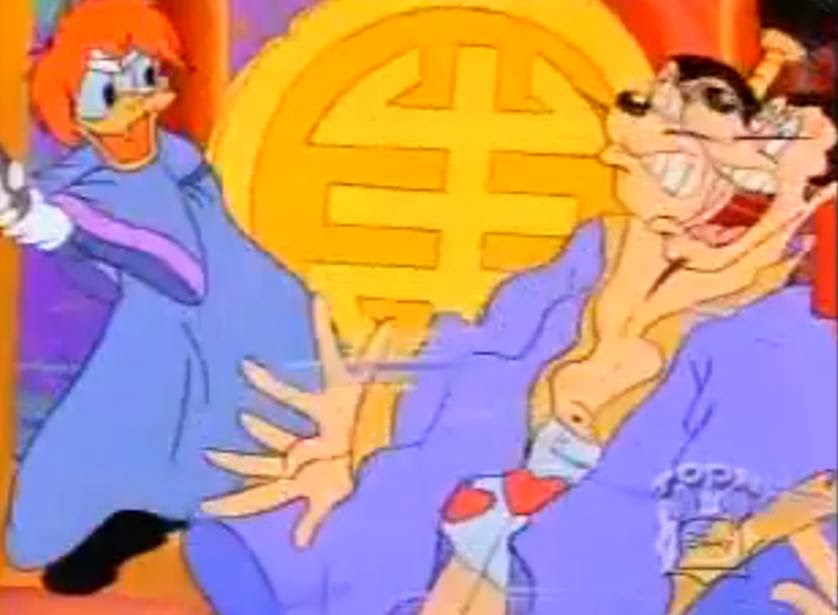
The only truly questionable aspect of "King" involves the ending. In "Sphinx for the Memories," after the spirit of "The Garbled One" has departed, the Garbabelians make a conscious decision not to "[live] in the past of our ancestors" any longer, but instead to enter the modern world. This decision may be a bit too neat for the "real world," but it is certainly a logical extension of what has gone before. In the wake of "The Great One," by contrast, Toupay becomes... what, exactly? Some sort of utopia? Is this Toupay's version of "
The End of History"? Given the rather rancid portrayal of human cupidity to which we have just borne witness, would such a scenario be entirely realistic? I get a disturbing vision of a united, self-confident Toupay becoming an expansionist regime and spreading the gospel of "The Great One" far and wide, with who knows how many unintended consequences trailing along behind. Perhaps Scrooge should not be so sanguine about the Ducks' gross violation of whatever their world's equivalent of "
The Prime Directive" is. After all, he's still bringing Bubba along with him, and we'll soon learn what kind of chaos
THAT causes...

.
.
.
Bumper #2: "Canoe"
.
.
.
"DuckBlurbs"
(GeoX) "Luckily, Gyro discovered bombastium, a substance that made time travel
possible!" sez the opening voiceover. The show appears to forget that
there have already been multiple time travel episodes.
Well, Magica ran out of the "Sands of Time" during the course of "
Duck to the Future," though I assume she could scare up some more, just as the Ducks went to "The Oasis of No Issa" to refill Scrooge's "
Magic Hourglass."
As for Gyro's
Time Tub, well... no one said that Gyro had to wait until his
old age to turn it into a birdbath.
(GeoX) Anyway, no surprise, really, but there's very little semblance of
continuity between parts of this multi-part thing. I mean, I know why
they DID this multi-part business: it's so they could first market the
whole thing as a big TV MOVIE EVENT! and then have a bunch of regular
episodes on their hands into the bargain. Still, a little more
narrative ambition would not come amiss.
"
Treasure of the Golden Suns" was also a "big event" in its initial two-hour broadcast, but, considered as a single lengthy narrative, it hangs together a lot more convincingly that "Time is Money." Even "
Catch as Cash Can," which never appeared in "movie" format, has a more meaningful throughline.
(GeoX) Meanwhile, it is also necessary to find a way to refreeze the defrosted
bombastium--the stuff's much more durable than it ever was in the Barks
story, it would appear.
Perhaps this has to do with the fact that the DT version of bombastium appears to be a manufactured element, as opposed to a naturally occurring one. It might still have a short half-life and need to be handled with extreme care, but I would assume that Gyro, having the ability to "cook up" more bombastium as needed (as is seen in "Ducks on the Lam"), might also have been able to control the element's stability to a certain extent.
(GeoX) "Wait a minute! If this is the great one's treasure, where did it all
come from?" "Mung Ho took it from the people of Toupai!" "You mean he
didn't earn it square?!?" My inner Marxist is unsure whether to laugh
or scream at this. But either way, he's gonna do it hysterically.
I guess it all depends on what one means by "square." Presumably, Mung Ho took the treasure in the form of taxes, which would help to explain why some of the Toupayians seem resentful of him even as they accept his protection. (Again, think of all those people who cheered when Sen-Sen was freed.) The Cola Cultists, by contrast, had no reason to resent the Cult taking their belongings, because they believed that the stuff had been destroyed ("fizzed").
Is that statue at upper right supposed to be a depiction of "The Great One"?
("Christopher," to GeoX) When I first saw this episode years ago, I only knew that Sen-Sen was a
hard candy commonly used to cover up alcohol on the breath because of
Fitzgerald's "Great Brain" series, where the titular character frames an
abusive schoolteacher by filling his rooms with liquor and Sen Sen,
much to the shock of the heavily Mormon town. Add another adult
reference that slipped past the Disney censors.
Apparently, Sen-Sen was produced until very recently. And I do remember THE GREAT BRAIN; it was one of the books that was read to us during "group reading period" in my elementary school. Can't recall any reference to Sen-Sen, though.
(Greg) Yes
folks; this story arc does have a recap and it's 45 seconds long. I'm
taking this as a given for the rest of the story arc and it probable
also applies to Super Ducktales.
Indeed it does. I wonder why the recaps were included in these second-season epics when they were not used in either "Treasure of the Golden Suns" or "Catch as Cash Can." Viewers' attention spans couldn't have atrophied that quickly, could they?
(Greg) [HD&L] blame Scrooge for bumping the
controls. WAIT A MINUTE! What bumping of the controls? I can
understand blaming Scrooge and Launchpad for not noticing that it was
the T-Rex who started the whole chain of events (even if it is
projection on their part since they went ALONG with dumping the bones
and ALLOWING Bubba and Tootsie to enter the Shortcut); but I didn't
see Scrooge BUMP into the controls at all. So we get logic break #1
for the episode and #5 for the story arc barely 45 seconds in.
I concur. Recall that while Launchpad was doing the "delayed countdown," Scrooge was busily engaged in ranting at stowaways Bubba and Tootsie.
(Greg) So we go to the top of a hill (with no
CONTINUITY in between the scenes to indicate that they left the
previous scene either. Bad shortcut by Wang Films)...
I'm tempted to call the scene in which Scrooge appears over the crest of the hill an homage to the opening scene of The Sound of Music (1965). But I suppose that the similarity could also have been a coincidence.
(Greg) [Sen-Sen] is going to face Death By Boiling Gold. We
then cut to ground level with a green hiryu looking pot of boiling
gold which foams really good too.
This is a nifty piece of animation, no? It almost looks as if it was clipped from another source. Note the detail work on the decorative dragon heads.
Young's other major contribution to WDTVA role was his performance as the noble "Great Eastern" Prince Yen Moon in the 1988
Gummi Bears adventure "The Magnificent Seven Gummis." A more dramatic opposite to Mung Ho could hardly have been imagined.
(Greg) I'm beginning to wonder:
If Bubba is really Buddha in this world according to Sen-Sen; then I
shudder to think what would happen if Chinese Americans FOUND out
about it. They were not too kind with L[a]st Horizons in any way and
this is somehow more offensive than L[a]st Horizons.
Well, if anyone ever lodged a protest against "King," I've not heard of it. The episode was certainly never banned from Toon Disney, to the best of my knowledge. "King" may have gotten a pass because Mung Ho was clearly not representative of ALL Toupayians, whereas the citizens of Panda-La invaded Cape Suzette en masse.
(Greg) This time according to Mung-Ho; it will
be different as [the bandits] will ransack the city and destroy Scooge see.
When they are done; Toupay will be his once more as we cue the evil
laugh.
So what would Mung Ho be ruling over in the aftermath? Ruins?
(Greg) Bubba and Sen-Sen are on top of the main gate doors as the
Chinese Stereotypical Music Plays and we pan down to the Chinese
Dragon Doors of Doom (Weren't they showing someone slaying a dragon
earlier in the episode?)
The outer door depicts a pair of dragons...
... but the inner door shows a scene of a warrior facing off against a two-headed dragon, with a large tree in the background (or somewhere near there). It looks as if Wang Films tried to keep the look of the inner door the same from shot to shot; they just had a rather hard time doing so.
I can see the dragon behind the guards, but where's the warrior?
Ah, speak of the samurai, there he is again. Seems to be holding the sword a bit differently, though.
(Greg) So we see Scrooge, Sen-Sen and Tootsie already
out as Launchpad climbs out and call this one; one for the diary.
HAHA! He crashed a snowball and a statue on the same day. HAHA! Too
bad the insurance company doesn't count those ones because he should
be getting that toaster by now.
I would have
loved to have seen a callback to "
The Status Seekers." Unfortunately, overt connections between the first season and the newer eps tended to be conspicuous by their absence.
Next: Episode 68, "Time is Money, Part Three: Bubba Trubba."