Twenty days since my last retro-post...
NOT good. I hope to get back into rhythm now that the Spring term has begun and resume a once-a-week posting schedule.
I think that it goes without saying that "
Launchpad's Civil War" couldn't possibly have been made in the modern era. Perhaps
Seth Macfarlane or
Trey & Matt might have been able to avoid the slings and arrows of politically correct censors by crafting "Civil War-themed episodes" that succeeded in offending
ALL points of view regarding the conflict. But an ep that, while comedic, invites us to consider such heavy matters as reconciliation and restoration of honor
and treats both sides with a reasonable amount of respect? Just no way. "Civil War" can be said to have slipped through a crack in time -- a period during which Civil War symbols could still be shown without the heavens falling in, and an animated series that thought highly enough of the intelligence of its audience to be able to present such an episode without a surfeit of dumbed-down explanation.
For those who, like
GeoX, have a problem with the whole notion of an ideology-free presentation of the war, I think that I have a solution to your dilemma. Remember the "Parachute Postulate" of
TaleSpin, in which
every pilot of
every doomed plane had a parachute at the ready? Or the "Animal Apothegm" of
Rescue Rangers, which posited an elaborate animal "subsociety" mimicking the activities of the human society? For your kind consideration, may I present the
"Taxes and Tariffs Tenet": in the Ducks' world (called "Quackeria" by
Greg Weagle and simply the "Mouse and Duck 'universe'" by other, somewhat less imaginative souls), the Civil War arose solely as a dispute over
tariff policy! No pesky "involuntary servitude" involved
whatsoever! Given the huge number of
pig villains known to infest the Ducks' world -- very much including
19th century representatives -- it's not hard to imagine the country being led to sectional blows thanks to the machinations of porcine economic malefactors. So GeoX gets his capitalist villains
without having to concern himself with slavery. What's not to like?

By coming up with the "Taxes and Tariffs Tenet," I've already done better than "LCW" writers
Pamela Hickey and
Dennys McCoy at addressing some of the more annoying logical inconsistencies in the Duck Ridge reenactment saga. Admittedly, some of these loopholes have only become visible with time. Take, for example, the fundamental notion that Launchpad accepts the invitation to role-play his "heroic" ancestor General Rhubarb McQuack without knowing that Rhubarb's blundering helped give the Confederates, er, "Low-Tariff Guys" the victory. Remarkably, it would seem that the organizers of the celebration sent the invitation to Launchpad
without checking on his familiarity with the true story of the Battle of Duck Ridge. Why else would Mayor Rufus B. Pinfeathers and Col. Beauregard DuBarque act so surprised when LP declares that it would be an "honor" to play the Rhubarb role? It evidently didn't occur to them that, if LP
had known the truth, then he could just as easily have refused to cooperate and stayed home to clean the Joyrider. These issues didn't much bother me when I first encountered this episode 25 years ago, but they seem a little more irritating now. For consistency's sake, Hickey and McCoy really
should have recognized a small problem here.

Once LP is safely in Duck Ridge, you'd think that Pinfeathers and DuBarque would strive to keep the truth from him until literally the very last minute. Instead, as Pinfeathers might put it, they seem bound and determined to "upset the applecart" after the apples have already been taken off the trees. Case in point: as LP struggles to extract himself from a car door, Pinfeathers reminds him that "you don't have to act like General Rhubarb McQuack until tomorrow." Way to almost louse up your elaborate scheme, Genius. Later, DuBarque imperils the whole operation by insulting Launchpad to his face (you know, the face only DuBarque "can't wait to see") during the "I'll stupidly repeat everything you say" sequence.


Pinfeathers and DuBarque manage to pull their scheme off because, as noted by GeoX, Launchpad is mind-numbingly dumb-de-dumb-
DUMB in this episode. The opening scene at the hangar quickly sets the tone: Launchpad undergoes a silly, self-inflicted pratfall (pumping the tire too full of air, hopping around on the air pump, etc.) and then pulls a mental rock (evincing surprise that he "missed" the Civil War and then suddenly remembering that Rhubarb was a hero in said war). Launchpad is nothing if not fallible, of course, but many of his mishaps in other episodes occur during "the flow of the action." Here, no matter what he tries to do, he literally seems to be operating under some sort of a curse. He doesn't even get the satisfaction of "saving the day" through direct action, as was the case in "
Hero for Hire." Instead, he inadvertently starts the old Union, er, "High-Tariff Guys" soldiers' decisive "second charge" by accidentally falling onto and dislodging the brake on the
Merriquack. As if to drive home the point that Launchpad is operating a few struts short of a functioning wing here, other characters' comments to and about LP tend to be cutting, if not outright crude. Even Doofus (whose personality, like his voice, seems to be tuned about a half-pitch too "shrill" in this ep) damns his idol with faint praise when he complains about having to always remind people that Launchpad's not ignorant. Incompetence is a part of Launchpad's persona, but here, Hickey and McCoy slide over the "tipping point," and incompetence becomes entirely
too dominant a part of LP's makeup.
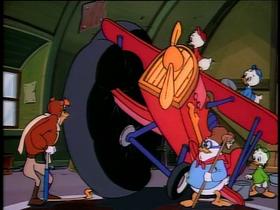


How does Launchpad shame thee? Let me count the WHOOPS!
Contra Greg, if you're willing to accept the idea of a
400-year-old Spanish sea captain keeping himself alive through "sheer willpower,"
then swallowing the notion of 150-year-old Union soldiers staying alive to redeem a long-ago humiliation should be, as the saying goes, "cake." In fact, I'm even more impressed at the old soldiers' resilience than I am at El Capitan's, since the "no-longer-boys in blue" don't have the potential for substantial material gain egging them on. The Duck Ridge reenactors don't bother to get the details of "McQuack's Marauders"' defeat right -- the pretend soldiers "flee," as opposed to silently slipping away -- so can you
really blame the old guys for wanting to set things right? The old soldiers' sense of despair is probably the most affecting part of the episode, though their comically repeated lament about "that lousy, rotten, bunglin' polecat McQuack" puts something of a humorous spin on the situation.

After two extremely talky opening segments, Act Three of the episode gives us the "big action payoff" that we've been waiting for, and it delivers the goods. Not even Launchpad's fatalistic imitation of Rhubarb's unfortunate mishap -- a moment that, ironically enough, is one of LP's better moments of the episode, since he's not simply acting like a clueless stumblebum but instead has gotten caught up in the excitement and simply wants to help "his men" -- can flatten the taste of the old soldiers' sweet vindication. (Not that Hickey and McCoy were about to let the episode end with the "Confederates" maintaining the upper hand. Political correctness of a sort did exist in 1987, after all.)


While not quite as good as I remember it being back in the day -- largely because of the occasionally squirrelly logic and the one-sided characterization of Launchpad -- "Launchpad's Civil War" still entertains, amuses, and instructs. Modern-day cartoon-makers should ponder on the basic level of sophistication displayed in this storyline and use it for inspiration, as opposed to "running away from" the episode's supposed ideological implications. After all, we wouldn't want to have to wait 150 years for eps like this to be permitted to grace our TV screens again.
.
.
.
"DuckBlurbs"
(GeoX) Huey, upon learning that Launchpad's been invited to be in this thing:
"Wow! The Civil War happened a long long time ago!" That's a rather
bizarre non-sequitur.
Thankfully, this rather unimaginative line doesn't turn out to be a harbinger for the intellectual content of the rest of the episode; the Civil War ambiance (small-town parades, reenactments, souvenir shops, observation balloons, etc.) is generally treated quite well. The line
does, however, foreshadow the contribution that HD&L make to the episode, which is basically nil. They're just kinda
-sorta
there. At least Doofus gets to show off his photography skills. Given the minor roles played by the boys, "
Launchpad's Civil War" seems just the right title for the episode.
"A
DuckTales Civil War" would have made much less sense (not to mention given viewers a false idea of the series as a whole!).
(Greg) The kids try to help [Launchpad] from the carnage as we
cut to the entrance to see a dogperson wearing blue; a helmet and
glasses with pants, a white scarf and a red bicycle. He rings the
bell and proclaims that he has a Quack-a-Gram... Launchpad is tied up
by the tires and tries to grab it from the boy; but he's basically a
rocking tire chair. HAHA! He does have enough to pay the boy and the
boy thanks him as Doofus grabs the Quack-A-Gram.
Hard to believe, but the "Quack-a-Gram delivered by messenger boy" bit now seems almost as dated as the Civil War itself!
(Greg) So we cut to Launchpad talking to the
Larry, Curley and Moe of Civil War Re-enactments as LP gives the pep
talk about recreating a great battle in the Civil War. The three
stooges giggle with their backs turned of course as LP is so dense
that it's funny. This will be their finest hour. For Launchpad's it's
already happened as they must work as one to win the battle.
Launchpad's pep talk is so hilarious given the context that this is
an re-enactment and LP's treating it as if the civil war is happening
RIGHT NOW! The Three Stooges laugh their asses off on THAT one.
Again, I can't be
too hard on Launchpad here, since he is only trying to get into the spirit of his role. It's the
incidental stupidity that hurts
LP more in this episode.
(Greg) After the commercial break; we see
Grace and Launchpad huddled together in mortal fear of being MURDERED
by ghost soldiers. The soldiers proclaim that the horse and LP look
awfully familiar as the kids arrive and swear in DUBBED DUCK STYLE
(Holy Quackamole!). The soldiers think Launchpad is Rhubarb McQuack
and that he has aged well. Now if they are truly real; then we have a
logic break since the Civil War took place about 100+ years ago. LP
gets off a religious reference (heavens to helicopters!) as they are
the lost soldiers of General Rhubarb McQuack as they get flashed by
Doofus and the guns go off. Okay; the joke is seriously overplayed
now Doofus. Their guns go away as they huddle and surrender.
The "guns firing accidentally" bit was cut by Toon Disney at some point. Hey, I'm grateful that TD at least left in the scenes of the old soldiers training their guns on people. Scrooge and Fenton Crackshell should have been so fortunate during "
Liquid Assets."
Next: It's "Back to the Beginning" at last! Episode 24, "Treasure of the Golden Suns, Part One: Don't Give Up the Ship."


