Showing posts with label The Issue at Hand. Show all posts

Saturday, December 27, 2014

Book Review: FUNNYBOOKS by Michael Barrier (University of California Press, 2014)

What Michael Barrier did for the history of classic Hollywood studio animation in HOLLYWOOD CARTOONS, he does here for the golden years of Dell Comics and its most accomplished and historically significant creators -- Walt Kelly, John Stanley, and, above all, Carl Barks.  While devoting most of his critical attention to this trio of greats and the ways in which they helped shape the development of the American comic book into an art form with its own distinct verbal and visual language, Barrier also unearths facts and highlights overlooked personalities in a manner that is sure to surprise and delight even the most knowledgeable Dell/Western Publishing fan.

As was the case with HOLLYWOOD CARTOONS, FUNNYBOOKS had an extremely long gestation period, with Barrier using interview material from as far back as the 1960s to help craft his narrative.  Barrier also draws upon material used in his 1981 book-length study of Carl Barks, but he expands greatly upon that earlier work.  Perhaps his most important critical achievement here is his in-depth illumination of exactly how Barks, who famously worked in isolation and with minimal (at first) editorial interference, became one of the very first comics creators to "crack the code" and essentially discover how to tell effective stories in comic-book form.  Barks fans have always known of the Old Duck Man's mastery of narrative, but they will come away from this discussion with a newfound appreciation of the wider importance of his work.

Barrier pretty clearly considers Barks to be primus inter pares even among the "really good ones," but Kelly and Stanley get their due and then some.  Kelly's creation and development of the POGO characters is covered in detail, as is Stanley's work on LITTLE LULU, but Barrier brings their other notable comic-book works (e.g., Kelly's stories for OUR GANG and his fairy-tale and Christmas comics, Stanley's honing of his craft in NEW FUNNIES) under similar critical scrutiny.  As was made quite clear in HOLLYWOOD CARTOONS, Barrier is a very astringent analyst, and it takes quite a lot for a story to wring praise out of him.  Everyone who knows these creators will probably disagree with Barrier's assessments at some point -- for example, I think that he is much too harsh on Barks' more loosely-wound, but still immensely entertaining, UNCLE $CROOGE stories from the 1960s -- but he always has a well-considered reason for his opinions.

The "extra material" here is what really lifts FUNNYBOOKS to "instant classic" status.  Anyone who has ever wondered about the precise relationships between the various corporate subsidiaries and allies grouped under the spreadeagled "Western Publishing" umbrella -- Whitman, K.K. Publications, Dell, Gold Key -- will have any and all questions answered to their satisfaction here.  Interested in the early history of LOONEY TUNES AND MERRIE MELODIES, the Warner Bros. "answer" to WALT DISNEY'S COMICS AND STORIES, or in how Dell handled such significant "non-funny-animal" licensed properties as TARZAN and various movie cowboy heroes?  You'll learn about some of these comics' most accomplished writers and artists here.  Perhaps the biggest surprise is a brief discussion of "the Jim Davis shop," an association of artists who produced "funny-animal" challenges, of a sort, to Dell's humorous hegemony for the notorious comics entrepreneur Benjamin Sangor.  It's nice to see the exquisitely obscure characters that came out of this outfit get some recognition, even if Barrier's primary purpose for bringing them up is to demonstrate how their comics failed while the best of Dell's succeeded.

If I have a small nitpick here, it is with Barrier's comparatively brusque brushing-aside of the Gold Key era.  Yes, that era did see ill-considered format and price changes and increasing editorial restrictions, but there was a whole lot of high-quality material being produced at that time, as well.  (See Joe Torcivia's 50th Anniversary tribute for numerous examples.)  I fully realize that Barrier's intention was always to focus on the years before the Dell/Western split, but a few extra pages discussing some of the GK highlights couldn't have hurt.  Anyone want to pick up the bracketed torch (as opposed to fallen; it's not as if Barrier failed, after all) and try writing a sequel?

So, what are you waiting for?  If you care at all about the Dell Comics that truly WERE "Good Comics," or simply about the history of quality comics in general, FUNNYBOOKS virtually defines the term "MUST-GET."

Tuesday, October 21, 2014

A POST-"DUCKTALES RETROSPECTIVE" PERSPECTIVE: "A Dime in Time"

Let's get right into the spirit of things and (mentally) travel 20 years back in time, to that fateful moment in 1994 when Joe Torcivia introduced himself to the "small but mighty" audience of the late, great Disney Afternoon-themed APA WTFB with the first installment of his now-legendary THE ISSUE AT HAND.  The comic that Joe reviewed in that first effort was Disney Comics' UNCLE $CROOGE #259 (October 1991).

U$ #259 was the third installment of an ingenious "Duck comics crossover event" dreamed up by Disney Comics Managing Editor Bob Foster.  "The Time Tetrad" linked together four unrelated Duck stories, all of which featured a spheroidal time machine created by Gyro Gearloose.

"Book One": "The Secret of Atlantis" by Byron Erickson (English dialogue) and Vicar, in DONALD DUCK ADVENTURES #17.  Any relationship to a story by Carl Barks, or, for that matter, a certain DuckTales adventure of more recent vintage, is hereby discounted with extreme prejudice. 

"Book Two": "Dirk the Dinosaur," the featured story in WALT DISNEY'S COMICS AND STORIES #564, again by Erickson and Vicar.  Interestingly, this story was the first installment -- officially, it was labeled "Chapter 0" -- in an actual series of much lengthier time-traveling adventures which Inducks flags as the "Time Machine graphic novels." 

"Book Three": "The Only Way to Go/Travel," in the aforementioned U$ #259, yet another Erickson/Vicar joint.  Disney Comics' BETWEEN THE LINES list of the month's releases uses "...Travel," while the story itself uses "...Go."  Both versions of the title appear in Inducks.  And now my head hurts.

"Book Four" is our main concern for the nonce: DUCKTALES #17's "A Dime in Time", written by Bob Langhans and drawn by the usual assortment of "credited-by-name-but-in reality-all-but-anonymous" Argentinians who toiled for the Jaime Diaz Studios.

Unlike the other stories in the "Tetrad" series, "A Dime in Time" takes up the entire issue.  What's more, it ends with a scene the setting of which would have seemed quite familiar to those who had been following the DUCKTALES title.

That's right, we're going into overtime.  It's yet another Bob Langhans cliffhanger, of the exact same sort which so enlivened "The Gold Odyssey" (DT #9-15).  My opinion of the latter story has been on record for quite some time, and I see no reason to alter it in the wake of the short-lived Boom! revival of the DUCKTALES title.  When it comes to DT comic-book stories that appeared in America and captured the authentic spirit of the series... well, this is as good as it gets, folks.

Thankfully, "A Dime in Time, Part Two" turned out to be the actual conclusion of the story, as DT #18 (November 1991) ran smack into the onrushing shock wave that was "The Disney Implosion."  Dan Cunningham's coverage of the "Implosion" era (the link shown above) as part of his survey of the history of Disney Comics is as thorough an exposition as we are likely to get of the affair.  If the details are unfamiliar to you -- or even if you think they are familiar -- then I highly recommend that you read the whole thing.

Well, at least another Langhans multi-part story got into print before the heavens fell, right?  And this one is bound to rival "Odyssey," if not in scope, then in terms of overall quality.  Right?

When I reread "A Dime in Time," I found that I could remember no details about it whatsoever.  Evidently, my "memory bone" was unconsciously doing me a favor.  "Time" doesn't measure up to "Odyssey" in any way, shape, or form.  It doesn't come close.  From the evidence provided in the story, I'm not even sure that anyone who directly worked on this story -- writer, artists, editors -- was paying it more than the most cursory attention.

Even the much-admired Bob Foster can't escape some criticism here.  He had to vet the tale on the American end, and I can only excuse his signing off on some of the egregious continuity errors and sloppy storytelling that fatally compromise Part One as the result of a desperate desire to find SOME way to give DUCKTALES its place in the "Tetrad."  Part Two flows more smoothly, but is also somewhat duller, due to all of the action basically taking place in a single venue, and it doesn't end so much as stop, with an abruptness that is violent enough to give one literary whiplash.

We begin Part One with a typical DuckTales Beagle Boy raid on the Money Bin that proceeds in the expected fashion, "expected" being in the second-season sense.  (By contrast, "The Gold Odyssey" started with Scrooge already in the throes of high adventure, stubbornly snow-catting his way through an Alaskan blizzard.  Steee-rike One.)  Magica De Spell has been crystal-eye-balling the Beagle siege and has a better (but aren't they always?) plan to snag her eternal heart's desire, Scrooge's Old #1 Dime.  She's going to use a time machine to literally go "back to the Klondike" and snag the coin from young miner Scrooge.

Magica later describes the pictured gizmo as, and I quote, "a time-warper from the 23rd century."  And Magica acquired it how, exactly?  Sure, she's a sorceress, but she's not capable of something like THIS, is she?  Or perhaps she is.  As Langhans writes her throughout the story, Magica's powers appear to be "whatever is necessary to perform a particular task," including those tasks the achievability of which would seem to be above her pay grade.  Apparently, Langhans never stopped to consider that, if Magica had the inherent magical ability to nip ahead in time and steal a time-travel device, then she wouldn't have NEEDED a time-travel device in the first place.

I also have a problem with the whole notion of Magica snookering Scrooge in his virile, full-of-beans Klondike phase.  I had certain issues with Don Rosa's "Of Ducks, Dimes, and Destinies" (UNCLE $CROOGE #297, April 1996) when it first appeared, mostly related to the whole idea of mucking around with the charmingly simple (and, lest we forget, non-Barksian) idea of Scrooge obtaining Old #1 after shining a Glaswegian ditchdigger's boots, but Magica going back to 19th-century Scotland to take advantage of a 10-year-old Scrooge makes much more logical sense. 

Magica decides to put the device to a test (she should really have done that in the 23rd century, I'm thinking) by making the Beagle Boys younger.  In the process, she leaves the rest of Duckburg in the present.  I have NO earthly idea how that works. Nor can I savvy how the Ducks (well, Scrooge and Louie, at least) are literally able to sense that "something weird is going on here" in the space of a single panel:

Scrooge had last been seen chasing the Beagles with murder in mind two pages back, but mentioning that fact seems a bit like piling on at this point.  Seriously, HOW did Scrooge and Louie figure that out?!  I suspect that even "ol' Al Einstein" (how colloquial of you, Magica) would be unable to come up with a good explanation for this.  At this point, the story is falling faster than my old pants did when I tried to put them on after my post-surgery weight loss.

Magica takes off for the past in the Ducks' very faces, conveniently explaining her plan in the process. She even tells Scrooge her exact destination; she's headed for "Uppa Creek" in the Klondike, where she'll presumably find a general store selling "Ahilla brand beans" and "Aloafa brand bread".  Evidently, Magica has done enough research on Scrooge that she knows exactly where he hung out during his mining days, at least in this somewhat dubious version of his past.  Scrooge corrals Launchpad (whose participation, along with a couple of early-Barks-style HD&L rescues, arguably comprise the sum total of high points in this entire effort) for assistance, and the Ducks ask Gyro to get his Time Coupe out of mothballs.  It appears that the events of "A Dime in Time" are taking place a good deal of time after the events of the other three stories in "The Time Tetrad."  Well, Gyro did once say, "Toy with time and you're asking for trouble."  Perhaps he finally admitted to himself that he had been right all along.

See Gyro there, in the lower right hand corner, hiding the Time Coupe in the bushes?  Take a good, long look... because you won't be seeing him again.  That's right; the story still has 40-odd pages to go, and Gyro is nowhere to be found on any of them, even after the Ducks have moved on to another point in time.

Seriously... there are no words.  After this scene, Langhans evidently forgot that Gyro had been a member of the cast, and no one editing or reviewing the story caught the error!

Are there sharks in the Klondike, and is there a location where one can jump them?

Leaving Gyro in limbo for the duration, the Ducks head to town, where Magica successfully gets them in Dutch with the local authorities by framing them as wanted bank robbers.  In so doing, she proves able to materialize and manipulate whatever she requires in order to make the ruse seem at least reasonably convincing to the rubes.  I can kinda-sorta accept the magical puppeteering, but creating material objects out of thin air with her own bare hands?  Has Magica ever displayed that sort of ability before?

If the bottom panel of that page looks a bit more like the Old West than the Klondike... well, that's because the town of Uppa Creek gradually does morph into a Western town as the story goes on, with the snow cover being the only material difference between the two venues.  I guess that either Langhans didn't know about the true nature of the Klondike, or he simply didn't care and went with what he did know.

The captured Ducks are soon in jail, faced with a grim fate, which Langhans describes sans veils of any sort.

"We'll string up them no-good polecat varmints, eh?"

A wee echo, there, of some of the grimmer moments of "The Gold Odyssey," such as the magus being buried alive or Flintheart Glomgold being marooned on the planet Sarros.  Granted, HD&L are ultimately let off with life in prison -- perhaps their jail cell will be renamed the "uninvited guest room"? -- but this is pretty stern stuff for a DuckTales romp.  Or limp, "as the bee may case."

Meanwhile, Scrooge confronts young(er) Scrooge and demands Old #1, though she goes about doing so in a fairly slipshod manner:

Er, Magica, "that shiny dime" may not BE Old #1.  How can you be certain from that distance?  And how do you know that Scrooge's entire fortune is lying on his bed?  (Actually, we are led to believe that it is, but Magica couldn't have been expected to have known that.) 

The believably feisty young Scrooge doesn't take kindly to Magica labeling him a "jerkymonger" (isn't that someone who works for the Slim Jim company?) and knocks her down a hill, turning her into a giant snowball in the process.  She must get knocked unconscious, or something, because we quickly move back to Scrooge and Launchpad's meet-up with impending doom.

HD&L subsequently escape and, taking advantage of the fact that all of the spectators at the hanging are conveniently standing on one side of the gallows, pile up sacks below the trap door to break S&L's fall.  Before the supposedly-fatal-but-now-not-so-much drop, Scrooge commits what he really ought to know is a big boo-boo, especially in this venue.

Earlier, when faced with denying his ID as the notorious outlaw, Scrooge had tried to pass himself off as the fictitious "Jim Smith," which makes logical sense.  This... does not.  The potential effects of the goof are subsequently exacerbated when the newly-free Scrooge and Launchpad join with HD&L in helping Klondike Scrooge try to keep the dime away from Magica.  To be fair, Scrooge doesn't fall into the same trap again, saying more or less cryptic things like "we have a lot in common" and "[we are] kindred spirit[s]."  But I'm afraid that the empty bag is already lying on the ground, and the cat is nowhere to be found.

Now... when you consider that I had a major problem with the ghosts of departed members of the McDuck Clan helping to shape Scrooge's destiny in Rosa's "The New Laird of Castle McDuck" (UNCLE $CROOGE #289, December 1994), how easily do you think I bought THIS little scenario?  Putting aside the issue of the "lucky" dime for the moment, given the immense symbolic relationship that Scrooge will come to have with Old #1, it is tough to imagine him completely forgetting this series of incidents, which were most likely the first such to distinguish Old #1 from the rest of Scrooge's stash.  The possible impact of "remembering a meeting with his future self" on Scrooge's subsequent progress is, well, monumental.  For example, modern-day Scrooge makes the offhand comment that young Scrooge should "hold tight to that dime" because "it's going to carry you far in life."  Can you imagine a memory of that comment helping to buck up young Scrooge's spirits at difficult points in his future life... and consequently helping to dictate some of his actions?  I certainly can.  The fact that young Scrooge sees the Ducks and Magica taking off in their time machines, and that Old #1 suddenly returns to him, as if by magic, at the end of Part Two, would most definitely set him to thinking about the true nature of the mysterious visitors whom he'd previously called "daft."  He'd need something on which to cogitate during those long winter nights on Uppa... er, White Agony Creek.

When it comes to Scrooge's origins, I prefer keeping things as straightforward as possible.  No time-traveling interventions, ghostly buttinskys, or dumb-lucky oil strikes, please.  Rosa's LIFE AND TIMES OF SCROOGE McDUCK was a monumental and, generally speaking, worthwhile endeavor, but I tend to lean a bit towards the sentiment of longtime fan-friend Dana Gabbard, who opined (re Rosa's epic in WTFB) that Scrooge's background, as presented by Barks, was part fact and part fiction, thus rendering Scrooge a classic example of a mythical or legendary figure, like Paul Bunyan. Pinning such a character down with too many specifics tends to reduce him to "just another adventure hero with a well-detailed past."  When you start throwing fantastic elements into the mix... well, just as Gyro said happens when you "toy with time," you're asking for bad vibes to rear up and bite you.

Part One ends on that cliffhanger panel of Magica (who had just stolen Old #1 back from the Ducks) and our gang flying through... the intertemporal medium, I guess.  Launchpad's attempt to hitch a ride on the surface of Magica's time device proves unsuccessful but has the side effect of knocking her progress askew, sending her to the Old West (not to be confused with the Klondike, unless you're reading this story).  Not that the Ducks themselves know quite "when" they're going, of course... though, when the dime slips into a time vortex, Launchpad seems mighty confident in his ability to track it, no matter "when" it goes.  Nice of Gyro to have given the Ducks all the information they needed to artfully manipulate the Time Coupe before he... he... heeeeeeee...

Hopefully, someone will reseal the "Universal Plug" in time.

For the vast majority of the story's 19 remaining pages, we'll be spending our time in ancient Rome, shuffling through our dog-eared index cards listing all the "ancient Roman" cliches that have accreted over the millenia.  Greedy, self-centered, bloodthirsty emperor... check.  Arrogant Roman soldiers and gladiators... check.  Ducks (well, Scrooge and Launchpad) being thrown to the lions... check.  Vaguely appropriate "period insults" like "rabble," "cur," "carbuncle," "toad," "harpy," "plebian [sic] dog," and "wretch"... check.  (Scrooge is also called an "infidel," which belongs to another period entirely.)  Sticking "-us" at the ends of words... check.

What saves the sequence, at least for me, is Launchpad's performance.  By doing nothing more than just being himself -- with all the good and bad that that implies -- he inadvertently creates crisis after crisis for the other Ducks, who ultimately become so spooked by his presence that they literally run away from him when it seems like he's about to step in it once again.

In classic LP style, Launchpad uses his own improvisational skills to best the most persistent of his tormentors, an overbearing, Bluto-like "greatest gladiator" named Detractus Finalus.  Say what you will about Langhans' performance here, but he definitely knows how to write Launchpad.

HD&L once again do their part as well, neutralizing the lions slated to gobble up Scrooge and Launchpad in a manner strikingly similar to (that's a politically correct way of saying "exactly the same as") a gambit they used in a well-aged Barks adventure.

At least Scrooge and Launchpad weren't summarily thrown out of Rome for being such "disgraces to the Empire" that even tigers wouldn't touch them.

Somewhere in the midst of all this, Magica has arrived, using her crystal ball as a sort of temporal GPS (there's that "rubber-sheet flexibility" of her powers turning up again...) and subsequently disguising herself as the Emperor's bitchy wife in a failed attempt to trick Scrooge out of Old #1.  Thereafter, she resorts to good, old-fashioned zappery.  The gang nonetheless manage to take off in the Time Coupe, leaving Magica behind, and fly back to Duckburg, where, in Scrooge's absence, the ever-persistent Beagles have broken into the Money Bin with the aid of what Bouncer calls "this super acid we swiped from the lab."  You know, you know... THAT lab.  The Time Coupe arrives just in time to decisively squash their hopes...

Bozhe Moy!  Baggy is Russian?!

... and, if you can believe it, that's a story.  No return of Magica, no explanation as to what became of Gyro.  That's it.

So, was Bob Langhans just the Duck comics writers' equivalent of a one-hit wonder?  Hard to say.  He wrote a number of other DUCKTALES stories, some of which were published in the UK, but most of the images I've been able to find of them on Inducks are from Dutch publications.  Most of the other stories appear to be of the fairly modest variety, ranging from 6 to 16 pages.  For sure, "A Dime in Time" and "The Gold Odyssey" were, by a considerable margin, the most ambitious DT tales he ever wrote.  If one of these epics had to be second-rate, I'm glad it wasn't "The BIG One."

.

.

.

Next, I'm going to turn my attention to DuckTales fanfic that can be found on the Internet.  As I mentioned before, while there isn't all that much of it to be found, I have found a couple of works worth commenting upon.  Any illustrations will have to be of the generic variety, of course, but that's what comes of working with text stories.

My first review along these lines will be of a rather modest, lighter-veined story, but more ambitious efforts are on the docket.  Here's one preview that may intrigue you:

Imagine that someone took Don Rosa's famous image of Scrooge's 1967 gravesite seriously... very seriously... and used it as a jumping-off point for the Nephews' future lives.  In the world of DuckTales.  And Darkwing Duck.  And TaleSpin (circa 1970 or so).  And even Goof Troop.  Now imagine that the story rated somewhere between PG-13 and a "hard" R.

Yes, really.

Wednesday, October 15, 2014

Disney Comics: NEXT PUBLISHER UP!

While he was attending the New York Comic Con, Joe Torcivia passed word along to me that "classic" American Disney comics are finally on their way back.  So, did Disney finally grow a brain and realize that, hey, it now owns one of the world's biggest comics outfits (Marvel), so Disney should oblige it to get cracking?  Well, um, no.  The publisher is actually going to be IDW.  Surprise, surprise!

Let's look at IDW's official announcement of what it terms "a monumental collaboration" and see what we can glean from it:

This monumental collaboration kicks off with multiple monthly series featuring some of the most iconic characters of all time: Mickey Mouse, Donald Duck, Pluto, Minnie Mouse, Goofy, and many more! Re-presenting acclaimed comics from the past and today, these series will highlight the best and brightest of Disney’s impressive comic catalogue.

Looks as if the old standby titles -- MICKEY MOUSE, DONALD DUCK, UNCLE $CROOGE, and WALT DISNEY'S COMICS AND STORIES -- have some life left in them yet.  Hopefully, IDW will know who to consult regarding identification of the "best and brightest," starting with those people who made the final few months of Boom!'s Disney comics line so enjoyable.  Given IDW's interest in publishing adaptations of animated series (MY LITTLE PONY, ROCKY AND BULLWINKLE, and various CARTOON NETWORK series, just to name a few), could some Disney Afternoon-related titles also be in our future? 

The award-winning Artist’s Edition line, pioneered by IDW, that showcases original artwork, will feature collections from the immense talents who have contributed to many beloved Disney comics over the years. Artist’s Editions featuring the legendary Carl Barks and Don Rosa will receive the spotlight in these gorgeous over-sized collections of original art reproduced at full size.

Sounds good, too.  Given the collector-focused nature of the Artist's Edition line, it is likely that the regular comics will be pitched at both collectors and new readers.  American Disney comics MUST do something to increase the pool of potential patrons, or we all are simply going to die out! 

Launched in 2014, Micro Comic Fun Packs have enjoyed immense success with highly recognizable franchises, and will expand its line with multiple Disney properties. Packed with a mini-comic, stickers, posters, and more, the Micro-Comic Fun Pack has been captivating new comic audiences on a mass-market scale.

OK, as long as IDW doesn't try to stuff comics material into boxes of ice-cream treats.  (A few of you will know what I am referring to there.) 

Celebrating the rich history of the many facets of comics, the Library of American Comics offers detailed and insightful looks at specific comics and creators. Beginning in 2015, the LOAC will begin collecting the various newspaper strips that have featured iconic Disney characters.

Given that Fantagraphics is releasing the Barks and Gottfredson collections even as we read, what could IDW have planned here?  Collections of the SILLY SYMPHONIES strips, perhaps?  I can't see them simply taking over from Fantagraphics.

.

.

.

Back to personal musings... If IDW's handling of the MY LITTLE PONY franchise is any indication of how the Disney characters will fare in the company's hands, then there is every reason to believe that IDW will be good stewards.  Management of American Disney comics has been so erratic, whimsical, and downright perverse over the decades that I, for one, could stand for a spell of honest, reliable craftsmanship.  One open question at the moment is how "hands-on" Disney will be with IDW.  Actually, I'm inclined to believe at this point that Disney couldn't care less.  If Disney found it easy enough to ignore its alliance with Marvel, then Disney clearly saying that it's perfectly willing to let IDW take the comics off its hands (or somewhere near there), just as long as they don't have to deal with the issue any longer.  "Ignorance is bliss," Disney style?  It might actually be a blessing.

Friday, July 4, 2014

DUCKTALES RETROSPECTIVE: Episode 85, "Dough Ray Me"

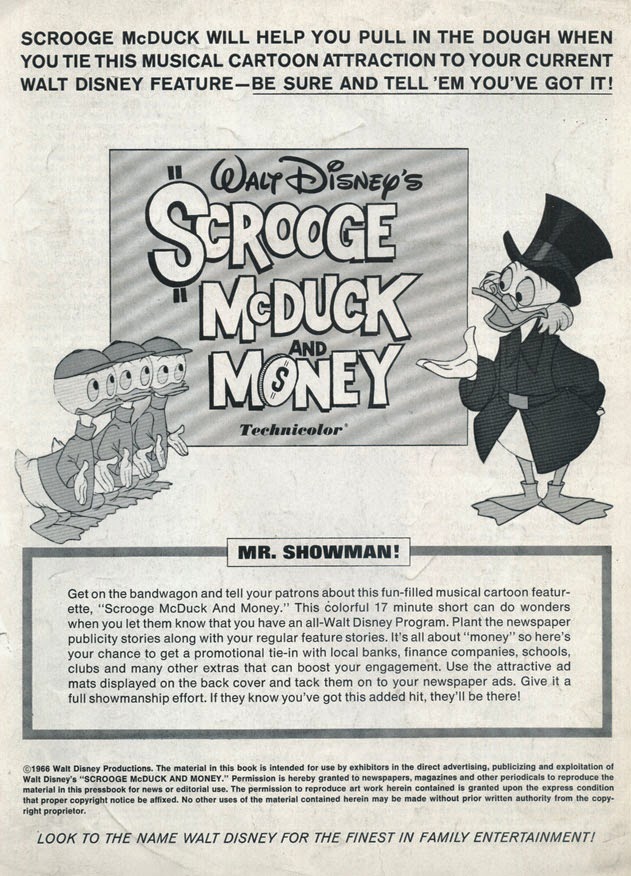
Funny thing: like Greg, I immediately realized that "Dough Ray Me" had certain antecedents in Disney Duck history.  They just weren't the ones you might think.  When Joe Torcivia and I commented on the episode for our DUCKTALES INDEX, the fiduciary connection between "Dough Ray" and the Disney "edu-tainment" short Scrooge McDuck and Money (1967)...


... seemed far less relevant than the ep's thematic similarity to a pair of humorous "escalation stories" penned by John Lustig and William Van Horn for the "Gladstone I" DUCKTALES title: "The Bedeviled Dime" (DT #9, August 1989) and "The Billion-Bean Stampede" (DT #13, May 1990).  In both of these fanciful tales, a small problem metastatizes into a huge one, causing massive trouble for Duckburg.  Needless to say, Carl Barks whelped several similar puppies during his long tenure, but Lustig and Van Horn's efforts came more quickly to mind, thanks to their use of the DuckTales characters (well, Launchpad, anyway) and their use of off-the-wall throwaway characters and gags.  In retrospect, "Dough Ray" doesn't seem quite as zany as it once did, but Burger Beagle's obsession with prison "puddin'" (inspired by that one Barks Beagle's affection for prunes, perhaps?), the "Scrooge McDuck's Money Mania" video game (which I half suspect that McDuck Industries itself had a hand in, given that the pixellated Beagles lose even when they win), and the presence of a couple of endearingly wacky supporting players speak to a generally lighter approach than one might expect under the circumstances.


That's not to say, of course, that "Dough Ray" doesn't follow, however tentatively, in the web-steps of Scrooge McDuck and Money in terms of teaching a useful lesson about the dangers of inflation.  The difference is that the proliferation of coins vibrating to the influence of Gyro Gearloose's Multiphonic Duplicator is the mere backdrop against which the comedic events of the TV production take place.  In Scrooge and Money, the whole purpose of the enterprise is to inform viewers about the history of money and banking and the importance of keeping a budget.  The level of seriousness of the "educational aspect" of "Dough Ray" can be gauged by the fact that Fenton -- you know, that accountant guy -- doesn't seem to grasp the concept of money losing its value any better than do Scrooge's alternately conniving and super-naive Nephews.  Granted, Fenton got his business education via mail-order, but you would think that he would have learned a little something about inflation's effects before now.  Despite a couple of cutting comments from Scrooge and HD&L about Fenton's intellect, he actually doesn't do all that much wrong here -- his plan to have the Beagle Boys gather up all the duplicated money makes sense, given that he and everyone else are working under the impression that the money will eventually explode -- but such a gaffe makes one wonder why Scrooge doesn't simply limit his contributions to money-bin guard duty in the guise of Gizmoduck.

HD&L don't come off as poorly here as they did in "Yuppy Ducks" -- that would be a well-nigh impossible task, to be frank -- but they don't cover themselves in glory, either.  After blowing their entire allowance on video games, they respond to Scrooge's suggestion to take up summertime work by becoming "Dirtbusters" for hire (I wonder how they managed to acquire those protective suits?  Wouldn't those cost money, too?), only to wreak chaos and ultimately cause Mrs. Beakley (who probably looks back with horror on this ep as her one unfortunate experience of "torture porn") to be showered with dust and grime.  They then proceed to trash Gyro's lab in similar fashion.  They haven't even done anything dishonest yet, and already they're several points in arrears.

After learning about Gyro's Multiphonic Duplicator, the lads... stop me (and time, while you're at it) if you've heard this before... spirit the device away under the guise of giving it a test run "to help Gyro out."  For several reasons, I'd argue that HD&L's swiping of the Duplicator is a more serious offense than their earlier borrowing of the Time Teaser.  Firstly, Gyro tells them that the gizmo doesn't yet have all the bugs worked out of it.  This notion of premature employment of a Gearloose invention, which will also play a role in the upcoming "The Big Flub," seems to be primarily a second-season conceit.  In the past, Gyro's creations generally either worked fine, worked "too well" (e.g., Armstrong), or were "hijacked" to perform nefarious deeds that were not in the original product description (e.g., the giant construction robots being turned into "Robot Robbers" by the Beagle Boys).  HD&L's ignoring of Gyro's warning, however, pales in comparison to the boys' inability to recognize that what they're doing is the functional equivalent of counterfeiting, which is, as a Barks character might say, "awful unlawful."  The script partially obscures this by having the Nephews start with duplicating the non-monetary contents of their room, but, like Fenton, the boys really should have picked up on such an obvious point much earlier in the game.  (Not that HD&L are alone in this oversight; Scrooge doesn't mention anything about illegality either, though he can perhaps be excused for the mental hiccup, since he is more concerned with the fact that the duplicated money has rendered his Binned lucre all but worthless.)

In another anticipation of "The Big Flub," Fenton starts the episode in go-getting mode, convinced that he deserves a raise and then seeking to justify his request for a salary boost by coming up with a new money-making idea.  It's nice to see Fenton's desire to "rise above the common Duck" reignited, since it generally makes for good comedy.  Here, though, not so much; Fenton's "Great Crackshello" act is pretty lame and probably owes its existence to the simple fact that Brooks Wachtel, who provided the story here, was a performing magician in between writing gigs.  If Scrooge weren't already in a bad mood when this scene started, then Fenton's performance would certainly have put him in one.

Thanks to HD&L's heedless getting and spending of the duplicated money and the replicated riches' vulnerability to redoubling at the sound of a bell, Fenton's cheerful comment, "What could go wrong?" (yet another harkening forward to "The Big Flub," in which he says almost exactly the same thing about Flubble Gum!), is soon overtaken by events.  Of the specific gags used here, only the scene of a car spinning its wheels in a pile of piasters, as if the latter were a snowdrift, strikes me as truly clever and inspired, in a physical sense at least.  That's OK, though, because the character-focused gags involving the put-upon mittel-European movie director, price-gouging dentist, Don Hills-voiced bank president, and several others partially make up for it.  These gags probably needed to be a little wackier in order to truly achieve Lustig and Van Horn-level quality, but they're definitely progressing along those lines.  Gizmoduck's brief contribution to the fun, in which he flies onto the scene only to crash into the movie-set bell, is arguably his lowest point of the series, simply because that is literally all he does.  It probably would have been better had he not gotten involved at all.

The tale's logic begins to turn wobbly once Fenton hatches his scheme to turn the Beagle Boys into unwitting collectors of the unstable duplicated money.  I'm not merely referring to the fact that, during their jail break, the location of the Beagles' prison cell appears to change two or three times, much as Scrooge and Mrs. Beakley's cell shifted around for plot convenience's sake in "The Billionaire Beagle Boys Club."  The real problem, which GeoX is quick to note, is that it would literally be impossible for the Beagles to gather up ALL of the duplicated money.  The money left in the streets, maybe, but it's more than likely than more than a few Duckburgians who have taken their money indoors or deposited it in banks (which, as we see in the bank scene, now appear to be jammed full with cash) would be unwilling or unable to turn it over to the Beagles.  This leads me to wonder: Did the Beagles really need to be used in this episode?  One might argue that a Beagle-less story could have unfolded along the same lines as Barks' "A Financial Fable" (WALT DISNEY'S COMICS AND STORIES #126), with the Duckburgians running hither and thither to spend their money, only to wind up paying it back to Scrooge, who has stuck to his last as the one remaining productive citizen in town.  The analogy breaks down, however, due to the fact that this particular money-storm is localized -- in "A Financial Fable," the tornado literally spreads Scrooge's wealth all over the country, making the breakdown of the economy much more dramatic and universal -- and, of course, the perceived undesirability of turning the "hero" of the series into a profiteer.  In order to restore the status quo, the episode as written needed a fall guy, and I suppose that the Beagles were as good a choice as anyone.

Even if you're willing to buy the improbable notion that the Beagles do manage to corral all of the duplicated cash (AND construct a Money Bin on short notice in which to store it!), you still have to deal with the "explosion/implosion" business.  Frankly, the ep doesn't handle this aspect of the story very well.  The problem is that Gyro's explanation of the misunderstanding -- that thinking that the coins will explode "was a slight miscalculation on my part" -- is worded in a hopelessly sloppy manner.  It implicitly assumes that Gyro had told the Ducks that the coins would explode in an earlier conversation... only he never actually did.  (For confirmation, refer back to the phone palaver at the end of Act Two.)  It would have been far more sensible for Gyro to have corrected Scrooge's mistake, mentioned that the coins weren't going to explode, and then tried to explain that they were fated to implode, only to be cut off by Scrooge's attack on Fenton.  The verbal assault is, of course, completely unjustified, since there was no way for Fenton to know that he had been operating under a false assumption.  Here is one instance in which making Fenton the goat (a decision that is fully confirmed at the end when Scrooge nixes his raise) bespeaks lazy writing more than it does humor that flows naturally out of the story.

The implosion sequence includes some nifty visuals, which makes it all the more unfortunate that the ep turns to the cheese-paring approach of reusing a sound clip from "Frozen Assets" (Fenton's yelping when he is first encased by the Gizmoduck suit) to accompany Scrooge's rescue of Fenton from the maelstrom.  It strikes me as funny that Fenton needed to be rescued from the disaster, whereas the Beagle Boys, who were inside the Bin as it imploded, wind up none the worse for wear, suffering only the dejection of losing their fortune.  It would stand to reason that the Beagles would have been far more likely to have perished in such a situation.

"Dough Ray Me" remains entertaining today despite the manifest weaknesses of its last act.  I'd be more likely to turn to Scrooge McDuck and Money as a Duck-themed primer on economic matters, but this offering still ranks as one of the more enjoyable second-season efforts.

.

.

.

Bumper #20: "Mummy"

.


.

"DuckBlurbs"

This isn't the first time that Gyro Gearloose and an "implosion scenario" have (quite forcefully) come together.  See the recent post on Joe Torcivia's THE ISSUE AT HAND blog in which Joe reproduces some panels from the obscure Gyro story "Operation Implosion" (UNCLE $CROOGE #82, August 1969) and links them thematically to the latest chapter in Dan Cunningham's discussion of the history of the Disney Comics line.

A few years after the DUCKTALES INDEX appeared, Van Horn, working solo this time, returned to the "duplication" theme in his famous adventure story "The Black Moon" (Gladstone DONALD DUCK ADVENTURES #24, February 1994).  Our own GeoX wrote an excellent review of this tale some time ago.  Suffice it to say that Van Horn's use of the "duplication" notion here is far less wacky, and far more ill-boding, than it was in those earlier joint efforts with Lustig.


(Greg) Gyro explains all through the fact that he has two of everything including his pal Light Bulb which makes his first cameo in Ducktales in a long while (The Money Vanishes comes to mind).

This was, in fact, Helper's first appearance since that episode.  Happily, it would not be the last.

(Greg) Gyro wants to discuss lunch as he brings out the tv dinners which are broccoli stew. He duplicates them and then pops them into the microwave as the nephews bail out the door.

In "Scrooge's Last Adventure," Gyro will acknowledge the receipt of a broccoli sandwich from Mrs. Beakley.  I sense a rather insipid trend here.

(Greg) [Gyro] gets more confused as he adjusts his glasses on an FPS shot as everything he duplicated already has increased from two to four. Gyro deduces that he needs to redo his calculations. Oh and apparently; he needs the adjust in the glasses because he never sees the fact that in the next scene changer, we see the nephews have stolen his duplicator. Logic break #1 for the episode six and a half minutes in. Now I'm confused. Did the nephews duplicate the stuff behind his back; or is there more to this?

This is actually a nice foreshadowing of the later discovery that the sound of a bell (in this case, the microwave timer) causes things to duplicate. 

(Greg)  So the nephews go to the drawers (NOT THOSE ONES!) and on top is a small box containing all their marbles... and [they] bring out the purple “Great Masher” marble from Pearl of Wisdom.

Which, by all rights, should no longer exist, since it was used to detonate a torpedo in that episode.  I guess that we need to take the Nephew's comment that "you can never have too many of these" to mean that the boys had stashed a few additional "Mashers" in reserve.

(Greg) Fenton proclaims that the device is from Gyro which surprises me since I don't recall the nephews ever informing him that it was from Gyro.

They actually did, which explains his subsequent remark: "I can't believe that crackpot actually hit the jackpot!"

(Greg)  So we head to Gyro's residence as Gyro is using the magnifying lens on three Light Bulbs (wait; three? We clearly saw four of them made. Logic break #1 for the episode for real at ten minutes in); and then Scrooge and Fenton barge in as Gyro deduces that the audio duplication machine (logic break #2: Now there are eight Light Bulbs on the table for no reason whatsoever)...

This isn't really a logical problem if you assume that an off-camera bell sound had previously caused the four Helpers to double to eight.  More problematic is the fact that, when HD&L ring the doorbell, everything duplicates BUT the Helpers.

(Greg) The nephews use the human chain ladder spot and go to the payphone and insert a silver dollar into it. Probably the only thing that hasn't risen in prices.

Which is somewhat peculiar, since the Nephews mentioned earlier that they were forced to pay $30 to use a gumball machine.  Public utility vs. private enterprise must be in play here.


(Greg) The heels load up the trucks with sacks of money. It should be noted that it's the same bank we [saw] in Super Ducktales among other episodes...

Yup, the good old "First Interfeather Bank," which dates all the way back to "Hero for Hire."

Next: Episode 86, "Beaglemania."