Ah, yes, about that "
[sic]". We need to pause at the title card for a moment before forging onward...
I'm "
Ivory Soap" certain (that is, 99.999% sure) that this was
ORIGINALLY supposed to read "Wrong
WAY in Ronguay." After all, the pun is directly referenced
during the episode itself, when the Nephews realize that the "robot-jacked" Ronguay Airlines aircraft is literally heading in the wrong direction. I hardly think that
Jymn Magon (by far, the most likely suspect among the trio of writers who labored on "Golden Suns" to unleash this kind of groaner) would go to the trouble of cracking the joke without planning to foreshadow it here as well. Someone along the production line must have slipped up here.
Thankfully, the (IMHO) spelling error is just about the only "uay" in which one can criticize
this episode. Though I remember being a bit puzzled by the seeming finality of the ending -- we wouldn't learn about the
rest of the Treasure of the Golden Suns until the start of
part three -- Scrooge and HD&L's trek to "the tiny country of Ronguay," their search for the "sunken" gold ship, and their battle with Flintheart Glomgold and El Capitan make for some absolute captivating viewing. Adventure, rather than character development, is the main focus here; even so, we get one superb "moment of connection" between the boys and Scrooge and are also witness to the definitive revelation of the depth of El Capitan's obsession (though a few hints dropped during the episode as to the wrinkled one's past identity will not be picked up until future installments). It takes quite a bit of doing to upstage the series' first authentic treasure hunt
and the first animated appearance of Glomgold, but El Cap does so. Fittingly, he gets both the final shot
and the final words of the ep.
I've
previously discussed some of my feelings as to why the
DuckTales Glomgold turned out the way he did. My idea that Flinty has moved from South Africa to Duckburg to keep closer tabs on Scrooge certainly isn't challenged by Glomgold's first few seconds on screen, in which he's seen watching the doings at Scrooge's candy factory on TV and perusing a massive mainframe that (I guess) keeps up-to-date stats on how his fortune compares to Scrooge's. Imagine how much more easily Flinty could do this today with the help of the Internet. The slightly goofy office nerds who "help" Glomgold in this scene are never seen again, more's the pity; at least one of them (my pick would have been the phone-toting guy with the overbite) should have served as Flinty's laugh-grabbing "bump machine" for the remainder of the series. As it was, we had to wait until the final season's "
Attack of the Metal Mites" for a guest-starring
Dijon to fill a somewhat similar role.
In the jaundiced spirit of Carl Barks' "
The Money Champ," Glomgold couches his initial challenge to Scrooge (which, we are easily led to believe, is
not the first such ultimatum) in the form of a money-making contest. Flinty's approach to the duel, however, is far more "John D. Rockerduck-ian" than it has ever been before (to those viewers who had not read Don Rosa's "
Son of the Sun" earlier in 1987, that is). Glomgold's relatively modest use of shrinking juice on Scrooge's money pile in "The Money Champ" pales in comparison to what the
DT Flinty will stoop to in order to get what he wants. Joe Torcivia once described the
DT Glomgold as "a sort of Anti-Scrooge," a description which fits both Flinty's Scottish attire and accent and his flexible morals.
Ever so conveniently, Scrooge's need to dig up some kind of treasure before the two weeks of the contest are up arises just as HD&L have solved the mystery of the wooden ship... and,
GeoX, I would argue that it's at least
possible that the "insanely idiotic" code that the boys decipher could really, truly be as simple as this. There were
more sophisticated ciphers available in the 16th century, when the ship was presumably built, but those other methods weren't
much more complicated than the simple letter-number substitution used here. Besides, if a person didn't know that "Gannaw Ondat" had to be a made-up name because it was carved on a ship originating in Spain, then he or she would glance at the craft and walk away without a clue that it was meant to be a message of some kind. When HD&L do their "play dumb" routine as a ploy to convince Scrooge to let them come with him, they do so without evincing any fear whatsoever that Scrooge will be able to figure out the mystery by himself. I think they're at least
partially justified in doing so.
Scrooge's promise to let the boys come along with him "just this once!" resurrects some questions that I raised during
my discussion of "Don't Give Up the Ship." Judging by the boys' initial attitude towards Scrooge, I found it rather tough to believe that
this version of Scrooge, Donald, and HD&L had gone on very many adventures together. Scrooge's comment here seems to bear this observation out. It also suggests that the ensuing adventure in Ronguay will further cement the relationship between the "old sourdough" and the young ducklings, to the extent that Scrooge will never again seriously question the boys' right to accompany him on globe-trotting trips. This is correct, up to a point; the boys, after all, will have to
sneak a ride aboard Launchpad's copter in order to share in the Antarctic adventure of "
Cold Duck" and the subsequent
trip to the Valley of the Golden Suns. But the aforementioned "moment of connection" that the Ducks will share during the low point of their Ronguayian trek will have serious reverberations...
It's debatable as to whether
any of the sights, sounds, and (plane) sputters of "inhabited" Ronguay would pass muster if they were being newly created in today's
uber-sensitive climate. The stereotypes are a
little easier to accept here, I think, because so much of what we see and learn about Ronguay is, well, just plain
bizarre -- perhaps not as ridiculously absurd as the depiction of
Gwumpki's homeland of Blatismorkia in
Quack Pack, but certainly more than sufficient to elicit a few head-scratching
"Huh?" moments. For example, we've seen ramshackle, livestock-filled vehicles like the "usually non-stop" Ronguay Airlines plane in other "Third World" contexts, but who the heck decreed that an old-fashioned, hand-cranked speaker phone should be placed in the cockpit? What could that thing
possibly be connected to?
After Scrooge helpfully comes to just in time to pull the plane out of a dive, the Ducks land at "Ronguay Airport" -- which is actually a soccer field:
Then we get a "
Sam Peckinpah Moment" -- I call it such because
one of the director's less successful (and more underfunded) movies was once criticized for including the same band of Mexican peasants in
literally every crowd scene -- as the crowds of Ronguayians frantically leaving the country to avoid the "Monsapis" include a couple of folks who evidently decided to double their un-pleasure. Note the stork with the serape and big sombrero, the mustachioed dogface with the green shirt and blue hat,
and the bird-woman with the flower in her ear in these two completely separate scenes. (To make matters worse, the first group is the one that tosses the Ducks out of the plane and then takes off, while the second group appears
after the plane has departed.)
The normally censorious folks at Toon Disney must have been so baffled by all of this that they failed to notice the stereotyped fat guy who sells Scrooge the llama and let the entire sequence be rerun without complaint. Of course, they were all over the scene of Dewey tearing the electrical cord out of the socket like mud on the proverbial pig (probably the same one that tripped Scrooge on the plane) and excised that, leaving the Glomgold robot to short-circuit with no explanation. Well, I can't say that I can blame them.
Regarding the Ducks' subsequent voyage through the soon-to-be-inundated wastelands,
Greg commented that the adventure focused on Scrooge to the extent of making HD&L look weak. In the sense that Scrooge did most of the actual work and faced most of the actual perils, he's correct. However, I think that the writers took this approach (if it was, in fact, even taken consciously) to introduce "the adventurous Scrooge" to a TV-watching audience that may never have
seen that aspect of the character up to now. The Nephews, after all, were in plenty of danger throughout "Don't Give Up the Ship," so their "quick, feisty, cunning, sharp, resourceful, etc."
bona fides had already been highlighted. Unless you came to the show already familiar with Scrooge's comic-book adventures, "Ship" didn't tell you very much about Scrooge the derring-doer. Now, while taming bucking llamas, escaping quicksand (how did Scrooge get that box of scuba supplies
open while buried in sand, I wonder?), and protecting the boys from the rain with the "Malaysian umbrella," Scrooge gets a chance to show his mettle
and, as Geo points out, reveal some of his past exploits in a very Barksian manner.
While Scrooge may have enjoyed many adventures in the past,
DuckTales delicately leaves aside the question of how many adventures he's participated in
recently. Scrooge comes across as such a miser and negative character at the start of "Don't Give Up the Ship" that a "newbie" viewer could perhaps be excused for wondering whether Scrooge had been living an isolated, sedentary life for some time before taking in the Nephews -- perhaps not to the extent of "
The Recluse of McDuck Manor," but certainly along those lines. The possibility that Scrooge's adventurous chops have not been tested in the recent past lends at least
some degree of credibility to what would otherwise be a rather problematic scene, namely, the disappointed, rain-soaked Scrooge's declaration that "I'm finished." A long-time comics fan would probably be taken aback by what would seem to be Scrooge's entirely too abrupt decision to abandon the "hopeless" search for the treasure ship. Seen in the context of the series, however, this scene is extremely effective, not least because it demonstrates that Scrooge and HD&L can and will function effectively in the future as a mutually supportive team.
The visuals have been getting better and better throughout the episode, and they peak during the cave scenes. The play of light and darkness, the atmospherics, the legitimate sense of peril, are all splendid. When I first saw this sequence during "premiere weekend," it simply knocked me out, and I just couldn't wait to see it again during the subsequent rerun on another station.
But wait, there's more -- even though you have to "suspend disbelief" in a manner akin to the
Sword of Damocles in order to fully take it in. Regarding a scene like the "setting sail of the golden ship," sometimes you just have to ignore obvious logical problems and say
"Ooooohhhh!" as the Nephews do here. Perhaps accepting the scene is as simple as figuring that a ship which already held gold ropes and gold sails would probably have had some gold planks and nails lying around as well -- though that still doesn't explain how the boys were able to nail the nails
into the planks in the first place. Besides, Carl Barks himself posited the existence of a seaworthy boat carved out of a giant gold nugget in
one of his later UNCLE $CROOGE adventure stories, so this unforgettable scene might be said to have had the indirect sanction of the Old Duck Man himself.
The abrupt return of Glomgold and El Capitan makes for an equally strong ending, the true power of which will not be fully understood until a few more facts about El Cap are revealed. Huey's line "That guy acts like he used to
own this ship!" will ultimately acquire a truly creepy vibe when we learn that (1) El Capitan really
WAS the master of the craft all those hundreds of years ago and (2) he has literally refused to die until he finds "every bit of" his lost treasure. Oddly enough, he seems uninterested in recovering
this bit of said treasure after the ship sinks; I imagine he's been fixated on the treasure in the Valley of the Golden Suns for so long that he probably regards recovering the ship's treasure as a mere formality after the bigger prize is bagged. Before the gold goes gurgling under, however, we see El Cap's grumbling and grousing about "
el stupido" Glomgold, which up to now has not seemed all that different from his occasional complaints about working with the "mental midget" Beagle Boys, mutate into something far more sinister than we could have possibly expected when the "old wheezer" first came on the scene. He's willing to treat one of Scrooge's classic rivals as nothing more than a means to an end, which makes even more of an impression on a viewer familiar with the comics than one who is seeing Glomgold for the first time in any medium. How he'll get back into the story line, it's impossible to predict at the end of the episode, but there's absolutely no doubt that he
WILL return and, moreover, will give Scrooge a hell of a challenge.
"Wrong Way in Ronguay" (sorry, but I am
quite insistent about that change) is just about perfect and, though the next two installments are both excellent in and of themselves, won't be matched during this serial until the final chapter.
.
.
.
"DuckBlurbs"
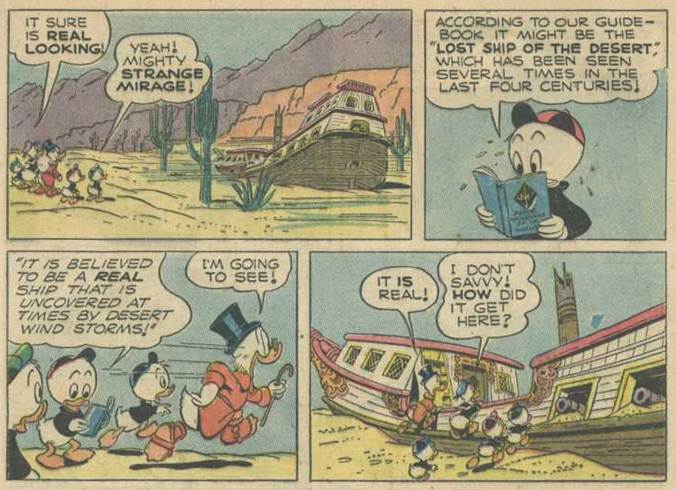
(GeoX) [T]here are three clear Barks call-outs [in the episode]: the ship stranded in the desert
recalls "The Seven Cities of Cibola"; [El Capitan], as he's taking
Scrooge's gold captain's hat, refers to it as a "golden helmet;" and
then at the end... Glomgold has to eat his
hat (okay, so it was Scrooge's hat that he ate in "The Money Champ," but still).
I think that there's a case to be made for all of these references being intentional, but I'm
most certain about the connection between the treasure ship and Captain Ulloa's "desert-ed" ship in "Seven Cities of Cibola." For one thing, there's that pesky
Celestial Arts connection to consider: "Cibola" was reprinted in that volume. For another, the visuals are just too similar, though the treasure ship appears to be in surprisingly good shape for a wreck that has been alternately baked and inundated by water for X hundred years.
The golden helmet (
"Check!") that Scrooge sports and El Capitan later reclaims might well be a reference to the miter that gives its wearer ownership of North America, but it could also be... just a plain, ordinary conquistador's helmet that happens to be made of gold. This particular Barks story, and this particular Barksian artifact, are well enough known to Duck fans such as Jymn Magon that I'm willing to grant Jymn the benefit of the doubt in this case.
The hat-chewing connection is probably the weakest of the three. Flinty's tam-o-shanter is so garish that the idea to make its consumption the forfeit to be paid by the loser of the bet might simply have occurred by chance. An intended reference to "The Money Champ," however, certainly isn't impossible.

(Greg) So we begin this episode back outside
the oozing chocolate candy factory as the woman news reporter
continues to talk and police continue to surround the place. The news
reporter says nothing of note as we head inside and we basically get
new footage of the finish from the last episode of the Beagle Boys
Chocolate Statues being carried out by two officers as one white
haired dogsperson officer proclaims that the bonbon is going to
Sing-Sing. Okay; this makes sort of sense from a storyline point of
view, but it's a waste of time. Why not show this at the end of the
first episode and show El Captain's saying beware from the start? Not
a big deal; just an observation. Then logic break #1 for the episode
rears it's ugly head as [Burger]'s head gets un-cracked on
site with a mallet and chisel as he pops up and eats chocolate. Cute
spot though; but all three Beagle Boys were carried out still
completely covered with chocolate in the previous episode! We cut to the female reporter as she
continues to fill in the details about the objet d'art that the
Beagle Boys were after as the police continue to secure the area and
clear out the Beagle Boys. And then more logic is broken as Scrooge
takes the ship away from the chocolate wave and he walks off on his
own even though we clearly saw him talking to his nephews during that
sequence in the previous episode! Now I see why Disney started doing
PREVIEWS for syndication episodes?! It was to KILL CONTINUITY ERRORS
like this.
This was rather peculiar, insofar as Disney, to the best of my memory, never tried to do anything like this in any other "recap" in a multi-part story. Generally, the next part of the tale either struck off in a new direction, assuming that everyone remembered what had happened at the end of the previous episode, or used episode clips to get everyone up to speed. (In a later series, of course, "Previously on Gargoyles..." became an expected part of EVERY episode.) Perhaps it was felt that the retrofit was necessary in order to provide a fitting lead-in for the introduction of Glomgold. It would have seemed rather strange if we'd gotten our first glimpse of Flinty reacting to something that had already happened in the previous ep.
(Greg) And of course the plane goes into a nosedive as Louie has to
go into the Junior Woodchuck Guidebook. If Kit [Cloudkicker] was here; this scene
would be over in 15 seconds as this would be his wet dream realized.
Besides; Kit doesn't need a book anymore he seems to have this down
pat... Sadly; the
guide book has nothing about flying an airplane. HAHA! About damn
time those nephews got licked; not let's see how well they do without
that damn book...or why Kit is so much better you you three combined.
And so the surprising fallibility of the DuckTales Junior Woodchuck Guidebook is revealed for the first (in "real" continuity) time.
(Greg) So now Flint throws the dynamite
down the hill as he want to bury Scrooge good... El Captain tells him to forget him because it's all about
the gold see... Flint wants to be [better] safe than sorry;
but El Captain doesn't want to wait as Flint and El Capitan turn
around and they are SHOCKED and APPALLED (in that order) as their
jackass is EATING THE MAP on the rock! Wait a minute?! Wasn't it in
the pouch?! That's logic break #3 for the episode.
As this screen shot reveals, the map had indeed been taken out of the ice cream cart (by Flinty) before Flinty and El Capitan's mule started noshing on it. You can see it here lying on the rock in the foreground, with the mule already eying it hungrily. Nice foreshadowing there.

(Greg) All hands on deck as the nephews get on board as the sail is
also made of gold. Okay that makes even less sense along with the
floor repairs. Seriously; and some question Plunder and Lightning's
breaks in logic. Why? Because they are Cartoon Ducks and when you see
Cartoon Ducks; you accept them without. Since bears are Russian and
Russians are EVIL Communists (which is so absurd no one should be
caught dead...oh never mind); they are booed. Now you understand the
psychology of why people thought Ducktales and Darkwing Duck was
better than TaleSpin; even if the quality would prove otherwise in
hindsight (not to see the two duck cartoon sucked in any way; but
still). It's the “American” way see. Then again; I'm
Canadian; and that's why I'm so biased the other way.
"Sorry, lads, I dinna understand that either."
Next: Episode 26, "Treasure of the Golden Suns, Part Three: Three Ducks of the Condor."