Showing posts with label Hanna-Barbera. Show all posts

Thursday, August 21, 2014

DUCKTALES RETROSPECTIVE: Episode 94, "The Duck Who Knew Too Much"

If I had to hazard a guess, I'd say that, prior to preparing these RETROSPECTIVES, I'd watched "The Duck Who Knew Too Much" fewer times than any other DuckTales episode.  (That, or "A DuckTales Valentine"; it's hard to say for absolute certain.)  There's no particular reason for this; circumstances just seemed to work out that way.  What is relevant to the present review is that any prior speculation as to the quality of the ep was based on comparatively sketchy personal recollections and/or what Joe Torcivia wrote in our DUCKTALES INDEX.  I was therefore sticking my long, scrawny Duck neck out just a bit during my review of "Ducky Mountain High" when I fingered "Knew Too Much" as "probably the most uniformly satisfying" of the three second-season episodes that were held over for the first season of The Disney Afternoon.  Having now gone over "Knew Too Much" with a finer-tooth comb... well, I would now like to qualify that statement a bit.  The ep's superiority to both "Mountain" and "Scrooge's Last Adventure" is no longer quite so clear in my mind.

Don't get me wrong... "Knew Too Much," like the other two components of "The Tardy Trio," is centered on a first-rate thematic conceit -- in this case, chivvying a bumbling Fenton through a scenario that wouldn't be out of place in an Alfred Hitchcock movie.  Despite the title, the ep probably more closely resembles North by Northwest (1959) than The Man Who Knew Too Much (1956), if only because a good deal of the early action takes place on board a train.  However, despite the slinky spy Goldfeather's claim at one point that Fenton "knows too much," one shouldn't push any Hitchcockian analogy too far.  In both of the Hitchcock movies, the protagonists are thrust into intrigue through no fault of their own.  Fenton, by contrast, sets himself up for trouble by using chicanery (to wit: a phony case of "the dreaded purple-blotch beak pox") to sneak off on his ski vacation.  Once the initial dirty deed is done, the plot slips into a more familiar Hitchcockian groove, but, thanks to Fenton's original dishonesty, we have slightly less of an emotional investment in seeing him triumph in the end... at least, until the second half of the episode swings our sympathies in his direction and he receives due punishment for his "original sin" in the end.  The universe's balance is thereby restored, though Fenton might not appreciate the fact at the moment.

In three of Fenton's last four appearances of the series (counting "Knew Too Much"), he either doesn't use the Gizmoduck suit at all or has only a tangential relationship with its ultimate use. This strikes me as the DuckTales' writers' tacit admission that, when all is said and done, Fenton is truly more interesting than his Gizmoduck alter ego.  (One has to wonder how many more Fenton-only eps we would have gotten had the series extended beyond 100 episodes.)  Writer Doug Hutchinson (whose last animated episode of any kind this was, thereby concluding a brief, but highly fruitful, career with WDTVA) certainly takes full advantage of the opportunity; Fenton is in excellent form throughout, spouting quips, donning disguises, and acting the harried victim to a T.  The fact that we also get to enjoy Gandra Dee's most multifaceted and enjoyable role (just in time, too; it's also her last) is merely a bonus.  Not only that, the episode is surprisingly mature, touching on sexual themes more than any other ep outside the overheated "Metal Attraction," and perhaps deserving some extra credit in that human beings (or the Duckburgian equivalent thereof) are driving the "steamy engine," as opposed to a lecherous, crazed robot.  So, there is quite a lot to like here.

Unfortunately, we can't leave things at that...

... because this episode also features some of THE worst transition sequences the series has ever seen.  Greg brought a lot of these up in his review, but the "sitch" is, if anything, worse than he describes.  Throughout the first act and into the second, we are fed a constant stream of "WTF??  I thought that...??" moments that test, and ultimately break, our patience.  At the same time, the episode is acutely aware of itself, sometimes almost to excess, and the constant "nudge-winks" to the audience as we are trying to figure out "how we got from scene A to scene B" ultimately become a bit grating.  Thankfully, things get straightened out as Act Two progresses, and we get a thoroughly first-class conclusion in Act Three, but there is no way that we can entirely forget what has gone before.  Entertaining, to be sure, but unquestionably frustrating.

I'm not sure whether to blame Hutchinson or story editors Ken Koonce and David Weimers for "making the mess" (green jello and swizzle stick not included) here.  Actually, that's not strictly true. Since the final version of the episode is already packed full of incident to begin with, it is possible that Hutchinson originally included even more material, and, when K&W trimmed the ep down to a 22-minute length, they excised scenes that "seemed" unnecessary but actually provided for better transitions.  Or, perhaps Hutchinson wrote the script that we saw on TV, and K&W simply didn't bother to ask Hutchinson to tighten those transitions up.  (I prefer the former theory, for a reason I'll describe below.)  Other theories are possible, but I'm sensing that K&W may have been the ones who really fell down on the job (or into the jello-filled kiddie pool) in this case.

Despite the silliness of the whole Let's Make a Mess scenario, we get an early indication of the "mature matter" to come when the tackily triumphant Fenton "detumesces" in response to a kiss from the gleeful Gandra Dee.  The fairly hot "demo-babe" who suggestively swizzles her stick for the camera doesn't detract from the mood, either.  I do wonder, though: Since Mrs. Crackshell was watching the broadcast, shouldn't she have heard Fenton ask Gandra to "come ski with me"?  Wouldn't that have dissuaded her from automatically assuming that she would be going to Swizzleland with Fenton?

After Scrooge (who swings between grumpiness and cluelessness throughout before one final, glorious moment of redemption) violently rejects Fenton's request for vacation time, Fenton channels... well, Donald, Fred Flintstone, take your pick of any number of sitcom stars... and pulls what Major Courage would term "the old sickness ploy."  To his credit, Hutchinson handles the other characters' reactions to Fenton's invalid indisposition well.  Mrs. Crackshell warns Fenton of possible consequences (how responsible of her! -- though she will ultimately backslide a bit later in the ep), while Scrooge initially balks before being convinced of Fenton's illness for economic reasons (the possibility that Fenton might infect all of Scrooge's other employees, or at least those at the Money Bin).  Nicely played, Mr. Hutchinson...

... alas, now we get:

Bad Transition 1:  We jump from the Crackshells' trailer to the airport with NO explanation as to how (a) Fenton convinced his "M'Ma" to stand down; (b) Fenton managed to convince the jealous Gandra Dee that there was no "other woman" involved.  Leave aside for the moment the question of why the normally placid Gandra is suddenly so quick to don the green eyeglasses.  Presumably, Fenton had to go to or call Gandra just to convince her to get on the plane with him.  Here, though, Fenton is proclaiming his love for Gandra as they are sitting down in their seats.  Is this supposed to explain why Gandra looks so pissed off?  But then, why did she consent to board the plane in the first place?

Scrooge's presence on the plane is the first of many "near misses" that Fenton will have before the two finally meet again at the close of Act Two.  This would be more contrived if it weren't quickly made clear that Swizzleland is so tiny (with all the main settings of the drama located so close together) that the two characters NOT crossing paths would be less likely than them actually doing so!  Of course, some awkward contrivance will be involved, as well...

Bad Transition 2:  We jump from Fenton and Gandra getting ready to take off from Duckburg right to the train station in Swizzleland... or is it ACTUALLY Switzerland?...

... with no intervening scenes.  So how did Fenton and Scrooge miss each other during the flight and its aftermath?  One of them would have had to have gone to the "little Duck's room" at some point, no?  Or go to baggage claim?  Or go to currency exchange?  Or meet during the trip from the airport to the train station?  Or meet after Scrooge saw Gandra at some point?  After all, the two have met before, in "Metal Attraction," and Scrooge does know about Fenton and Gandra's relationship.

I'm willing to give Fenton a bit of a pass on making a pass at Goldfeather, because he was hit on the head by some luggage a moment before, and so his brains might still have been a bit croggled.  If this is an indication of the hidden depths of Fenton's subconscious mind, though, then perhaps Gandra has a reason for her "jealous-o-meter" to be set at "10".  (BTW, Susan Blu's "French" accent for Goldfeather has GOT to be the worst stab [no pun intended] at such an accent that I have EVER heard, even including Ruth Buzzi's horrific performance as Miss Ma'amselle Hepzibah in I Go Pogo: Pogo for President [1980]).  I honestly have no idea why Blu was allowed to get away with it.  Perhaps they thought they were trying to be funny, or ironic, or something, but it really is a distraction.)

The subsequent near-misses, hesitations, threats, and goof-ups on the train do have a number of bright moments, for example, Fenton pretending to be "suggestive" when he closes the curtains in his and Gandra's compartment, and a curiously dyslexic Scrooge continually misinterpreting the warning notes that a furtive Fenton tries to send him...

... but they also provide us with:

Bad Transition 3:  The frantic Fenton hides on a luggage rack in Goldfeather's compartment and then immediately hears and sees her below, talking to Agent X (the swizzle-stick magnate Von Doghousen).  Greg pointed out that Goldfeather would have no reason NOT to see Fenton when she went into the compartment.  I suppose it's possible that she sat down without noticing that Fenton was in the luggage rack above her, but then, you have to account for the fact that, when the rack breaks, Fenton falls down directly in front of Goldfeather, suggesting that he was on the opposite rack.  (Also note that Fenton appears to be looking forward when he listens to Goldfeather's conversation.) Questionable logistics, no matter how you slice things.

Bad Transition 4:  Fenton's notorious jump from the foreground of the picture inside the train onto the outside undercarriage of the train.  "Kids, don't bother trying this at home -- it can't be done, except by a trained Toon professional!"

Bad Transition 5:  Fenton and Gandra arriving at "Gducks" together at the start of Act Two, though we never saw how they made up after Gandra caught Fenton in Goldfeather's compartment and ran away in tears.  This is even worse than Bad Transition 1, or, for that matter, the scene at the train station.  Gandra actually saw the two characters together in what could easily be described as an intimate ("suggestive"?) setting, and Gandra had already been made suspicious of Goldfeather, thanks to the train-station incident.  Gandra's offhanded comment about Fenton "acting weird" doesn't even BEGIN to paper over the chasm here.

This is a LOT of oversights to forgive.  It's fine for an episode to have (in GeoX's terms) a "manic" pace, but there's "manic," and then there's just plain SLOPPY.  Unfortunately, we're not quite done yet:

Bad Transition 6:  Fenton knows enough (and why not -- he already supposedly knows "too much"?) to go to the Whizzle Swizzle Stick Factory to intercept Goldfeather and Von Doghousen, despite the fact that neither Goldfeather nor Von Doghousen ever mentioned the factory during their conversation on the train.  Nor does Goldfeather mention it when she asks the desk clerk for a taxi to go to "ze very important meet-ING."  This is the best evidence of all that some material had to have been cut or removed from the initial script.  It strikes me as highly unlikely that Hutchinson would have completely neglected such an important plot point.  Scrooge just happening to own the factory -- and, rather improbably, taking time out from supervising his gold shipment to do "surprise inspections" of "all [his] Swiz properties" -- is a mere "hop of logic" compared to this mighty leap across a canyon of unexplained deduction.

Thankfully, once we hit the factory, the episode FINALLY finds its webs and proceeds to deliver the intrigue and excitement we have been hoping for.  Fenton gets a chance to strut his stuff in several on-the-spot disguises and manages to remain undetected until the unfortunate incident with the sloppily slipshod swizzle-stick stomper.  (I'd ask you to "say that three times fast," but that joke, which isn't all that funny to begin with, is all but used to death during this sequence.  The earlier self-referential moments -- the real-life "idea bulb"; "Don't try this at home"; Fenton's warning to the audience that he does, too, have wits; the Alan Oppenheimer-voiced Von Doghousen dissing the code word "Oppenheimer" -- were cute, fairly clever, and generally isolated; here, the ep tries too hard to punch a gag over, in a textbook example of unnecessary "jackhammering.")

Once Fenton manages to explain things to Gandra, the pair turn out to make a pretty good team, so much so that I'd like to have seen them have at least one additional dual starring role before the series closed up shop.  Gandra gets most of the priceless moments; even her momentary lapse into inappropriate Spanish is made up for by the quick recovery into French.  Then, of course, she gets to show those hard-won "night school" skills by manipulating the giant robot mantis with ease.  Her ultimate ejection certainly isn't her fault, due to Goldfeather's possession of the remote control.  Gandra probably had as many "hidden talents" as Mrs. Beakley; too bad we never got to see more of them.

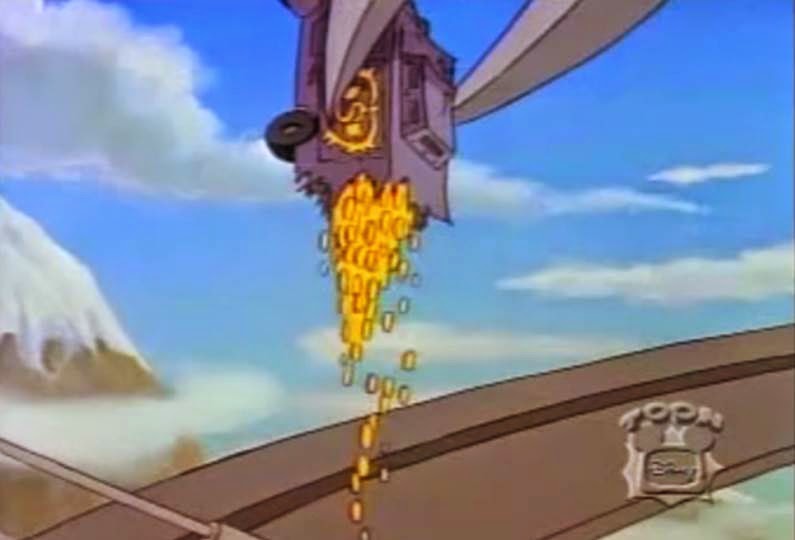
With the late-arriving Scrooge now a part of the good guys' team -- and "Gizmomamma" finally making up for her previous lack of attention to the ringing phone by bringing the Gizmosuit on-site -- Act Three whizzes by in a riot of laughs and generally impressive action, some of which is legitimately perilous.  The robot mantis legitimately does seem unstoppable as it "taps" the gold out of Scrooge's gold trucks...

... and Fenton earns some "gonad points" for daring to use the telephone workers' equipment to attempt to electrocute the mantis, putting himself in quite a bit of danger in the process.

Then, of course, "Gizmomamma" pushes all of the Gizmosuit's buttons (the last time we will see that particular shtick) and destroys the mantis, in perhaps the ultimate display of the adage that "motherhood is all about suffering."  In the end, though, you REALLY have to give it up to Scrooge for "getting dangerous," at least where the WDTVA censors are concerned:

Oddly enough, you could argue that Scrooge might have gotten the idea for the fake-gun trick from a notoriously feeble-souled comic-book story published during Western Publishing's terminal decline phase.  "The Jack-in-the-Box Plots" (UNCLE $CROOGE #193, February 1982, written by Vic Lockman, art by Pete Alvarado) found The Beagle Boys reduced to intimidating Scrooge into giving up his money by literally pointing fingers at him in unlikely places.  At one point, Scrooge moans that he can't tell the world about the Beagles' crimes because he would be too embarrassed to do so, and you can hardly blame him.

The late-episode rush is strong enough to make this episode a good one... but, as should be more than obvious by now, not as good as it could have been with a little additional care and thought.  The immediately subsequent "Scrooge's Last Adventure," like "Knew Too Much" and "Ducky Mountain High," will be a similar combination of conceptual gold and tactical dross.  Whichever episode contains the highest gold-to-dross ratio... well, that's up to every viewer to decide for himself or herself.  Myself, I think that it's a three-way tossup.

.

.

.

"DuckBlurbs"

(GeoX) For this one, the seminal wikipedia article "List of DuckTales Episodes" claims that "Fenton uncovers an international conspiracy to steal Scrooge's gold overseas while supposedly on vacation." I defy you to tell me, based on that description, who is overseas, who is on vacation, and whether or not these two things are one and the same.

Hey, at least the description isn't factually wrong.  I wish I could say as much for the "official" DuckTales episode capsules that were published in Gladstone's DUCKTALES title.

(GeoX) The only real weakness is the ending, in which, [with Hutchinson] apparently unable to come up with anything really satisfying in the limited space remaining, Fenton comes down with the illness ("the purple-blotch beak-pox") that he was feigning before.

The ending may have been just a bit rushed, but Fenton did get his just deserts.  So there's that.

(GeoX) Fenton and Gandra have separate hotel rooms, I note. Yeah, it's a kids' show, I know, but still…could this have some relationship to the fact that he's so intensely--uncharacteristically, I would have thought--lecherous upon meeting the enemy femme fatale?

See above for my argument as to the possible source of Fenton's sudden bout of "lecherousness."  As to Fenton and Gandra's separate rooms... well, there's always the possibility that the two rooms are part of, you know, a duplex...

(Greg) This episode is written by Doug Hutchinson and the story [sic] is done by Ken Koonce and David Weimers. 

K&W are the story editors, actually... and here, it's a distinction with a real difference.


(Greg) So Goldfeather sticks the pistol in Fenton's face (WARNING! Toon Disney cut might be commencing here) and Fenton does the Peter Piper tongue twister to confuse her and he tries to bail stage left. But Goldfeather teleports in front of him and sticks the pistol in his face. I'm almost happy if Toon Disney cuts this scene actually. Almost.

It didn't.  To review: Waving blunderbusses about to no apparent purpose = OK.  Having a character meet a gun beak-to-barrel = No problem-o.

(Greg) So we finally head to the Swizzle Stick Factory of Doom which is on a snowy hill in Swizzleland. And there is a huge door below the mountain by the way which will probably be used by the end of this episode.

Curiously, though it would have seemed natural to have included a shot of the robot mantis walking through the door, we never actually get such a scene.  Instead, we see the mantis "emerging" from the shadow of the Swizzle Stick Factory hill and advancing on the surrounding countryside.  Apparently we were meant to infer that the creature exited via the door.

 
(Greg)  We see the stamping machine in a far view as Worker Fenton fiddles with swizzle sticks and then in comes a [pig] tour guide with some tourists which includes Gandra Dee who comes in last... The pig fur[r]y (who looks like that furry from somewhere I cannot remember at the moment) wants Worker Fenton to demonstrate since he's behind the control panel now trying to escape. 

It's Sevenchins Snootsbury from "The Land of Trala La."  Earlier, the Quack Maison waiter from "Down and Out in Duckburg" made an appearance as Scrooge's waiter on the train.  And, lest we forget...


Au revoir, Vacation van Honk, we hardly knew ye.  (Literally.)  And Quax is probably grateful that Gloria Swansong allowed him to go out on his own for once.

(Greg)  Fenton whisper yells that he's going to explain why he is here; but grabs Gandra and they run into the storage room with a No Swizzle sign on it. Why is there a sign? I don't know; I don't they will ever explain it.

I think it's meant to be a "Do Not Enter" sign.  The interdicted hand appears to be reaching for a door knob.

(Greg) So Fenton dials the phone and we discover that the motel desk man is known as the Italian Sn[o]b (6.5% of the people in Switzerland speak Italian so there better be someone German and Romanian or I am going to be disappointed.) as Fenton informs the guy that he has an important message to Scrooge that the Swizzle Stick Factory is a cover for a plot to steal his gold signed a friend.

The desk clerk isn't "The Italian Snob"; he is referring to the lodge as "Hotel de Snob."  (Funny, I thought the place was called "Gducks."  Maybe that's the name of the village in which it is located.)  And I think you mean Romansh, rather than Romanian. 

Next: Episode 95, "Scrooge's Last [sic!] Adventure."

Monday, May 19, 2014

DUCKTALES RETROSPECTIVE: Episode 79, "Bubbeo and Juliet"


There's an amusing consistency in many of the parodies of Shakespeare's ROMEO AND JULIET.  What we often end up remembering about them is not the "star-crossed" love affair of the two titular teenagers, but rather, the "family feud" that sets the stage for the tragedy.  This is, of course, in direct contrast to the play itself, in which the origins of the Montague-Capulet misunderstanding are never explained and most of the attention goes to the growth of the relationship between the two lovers.  West Side Story, perhaps the best-known of all R&J homages, treated theater and movie audiences to all manner of memorable moments of song, speech, and dance, but I'd venture to say that most of us, when asked to bring an image of the show to mind, would probably light upon the quarrel between the Sharks and the Jets.  For sure, MAD magazine's famous "East Side Story" spoof, with its transformation of the Cold War rivalry between the U.S. and the U.S.S.R. into a turf war between rival gangs, seemed to regard the conflict as the natural jumping-off point for its parody.

Flintstones fans are no doubt aware that the series essayed not one, but two, knockoffs of R&J: "The Most Beautiful Baby in Bedrock" and "Dino and Juliet."  In a display of chutzpah that puts Ken Koonce and David Wiemers' recycling of the plot of "Allowance Day" to shame, these two episodes aired on back-to-back weeks in November of 1964.  Both also stuck to the parodic template of paying relatively little attention to the supposedly central romantic (or, in the case of Pebbles and Bamm-Bamm, child-friendly) relationship.  Instead, we're treated to Fred and Barney's escalating bouts of "one-up-yours-caveman-ship" on behalf of Pebbles and Bamm-Bamm in the former and the feud between Fred and the frog-mouthed Mr. Loudrock in the latter.  Given the success ratio of past parodies of the famed "balcony scene" (read: pretty low), I honestly can't blame the writers for wanting to emphasize comedic conflict over eloquent affectations of affection, especially at a time when The Flintstones was morphing into a show meant primarily for children.


"Bubbeo and Juliet" does little to disturb the established order of ROMEO AND JULIET parodies.  Indeed, given the history of the Carl Barks Duck comics, it could hardly have been otherwise.  The nature of the background feud must have practically written itself, combining the nastiness and childishness of the long-running battle between Donald Duck and Neighbor Jones with the big-bucks-powered can-you-top-this? splashiness of the statue-building contest between Scrooge and the Maharajah of Howduyustan in "Statuesque Spendthrifts" (WALT DISNEY'S COMICS AND STORIES #138, March 1952).  The use of redneck lottery winners Tiny and Cookie Blurf as the antagonists (and they are clearly presented as the bad guys in this scenario, damn the sociological implications that seem to have bothered GeoX) was a legitimately risky departure for WDTVA, but, in a series the arc of which has been bending in a decidedly humorous direction ever since the beginning of the second season, a plot like this must have seemed quite natural.

But what about the romantic angle?  Does Bubba, in his first starring role since "Time is Money," hold up his end of the bargain and perform well enough to make his burgeoning relationship with little Julie Blurf seem at least reasonably believable under the circs?  Well... upon my initial viewing of the episode, I was inclined to say no.  For sure, slotting Bubba into the "prefab role" of Romeo did not suggest that writers Evelyn Gabai and Doug Hutchinson had all that much faith in Bubba's ability to carry a protagonist's load on his own merits.  In our DUCKTALES INDEX comments on the ep, Joe Torcivia and I scoffed at the idea that Bubba could pass as a "jilted lover" and argued that viewers would probably "spend more time laughing at [Bubba's] inept attempts to impress Julie than sorrowing at his thwarted love."  In hindsight, I'm willing to admit that that judgment may have been overly harsh.  The use of an existing role as a half-hour starring vehicle for Bubba does point up his inherent limits as a character, but, within those limits, he gives a reasonably effective performance here.  His attempts to woo Julie crash and burn for the most part, but, in his own "primitive" way, he is trying his best to make friends with her, and Julie ultimately comes to appreciate his efforts as the indicator of a good heart.  Ultimately, the battle between Scrooge and Blurf gulps up so much of the oxygen that the Bubba-Julie relationship doesn't get a chance to develop beyond a fairly superficial level, but what we do get does have its share of cute moments. 

Based on the ep's opening "first day of school" setup, I guess that we're meant to regard the Nephews bringing Bubba to class during "Bubba Trubba" as some sort of glorified "Show and Tell" project gone bad.  Scrooge's gracelessly ironic farewell speech to Bubba about school being an opportunity to get to appreciate and respect "people different from yourself" sends the immediate message that subtlety is not going to be this script's strong suit... and, sure enough, the Blurfs come on strong from the opening tree-fall and wall-smash.  With Disney long since having acclimatized itself to many of the "Lower Slobbovian" aspects of American culture, I need to emphasize just how shocking a departure the portrayal of the Blurfs was in 1989.  Rarely before had the company presented such an unattractive picture of "plain folks."  (I guess that the human hunter character of The Fox and the Hound [1981] was pretty much of a redneck, but he was a loner.  Seeing a family of this type was a Denny's Grand Slam compared to that bunt single.)  In retrospect, the Blurfs clearly planted the seed for such future developments as Darkwing Duck's Muddlefoot family and the gleeful portrayal of Goofy in A Goofy Movie (1995) as a devotee of Middle-American lumpenproletariat culture.

I'm not as taken aback as GeoX was by Scrooge's reaction to the Blurfs.  There is ample precedent (read: Gladstone Gander) for Scrooge expressing resentment of someone who relies on pure luck, as opposed to a trust fund, a stock-market deal, or some other non-laborious means, to strike it rich.  Then, too, it is clear from the start that the Blurfs provide most of the fuel for the feud, and not simply because their taste is hopelessly tacky.  How else would one expect Scrooge to react when the "new neighbors" blithely destroy part of a wall and pollute the air, just for starters?  Scrooge's revulsion at the hideous "weather vane" (which, given the fact that it is mounted on the ground, as opposed to the Blurfs' roof, suggests to me that it is actually intended to be some sort of sculpture) does have more of an elitist edge.  By that time, though, Scrooge has already been pushed to the limits of his patience and can perhaps be forgiven a bit of overreaction.  The fact that Scrooge snaps after he has learned that the Blurfs' "home improvements" have reduced the value of Scrooge's property by $1 million also makes perfect sense in view of what we know about Scrooge.  Sure, blame Scrooge all you want for allowing Blurf to get to him and deciding to show the Blurfs "the underside of the welcome wagon," but don't say that he wasn't legitimately provoked.  In an ep filled with more than its share of verbal bluff and guff, Tiny Blurf's claim that "I didn't start this, McDuck..." may be the biggest whopper of them all.

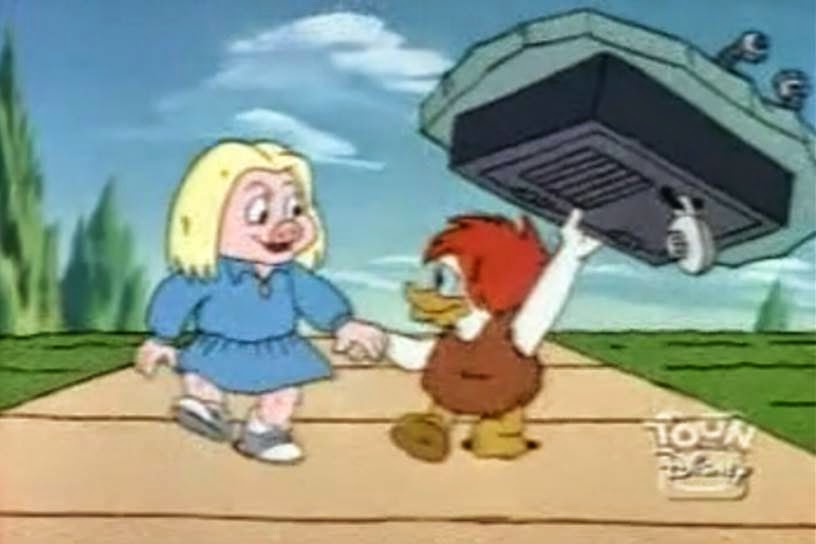
At the "TARDIS schoolhouse" (yes, really -- the kids' one-room temple of learning seems to possess the capability of expanding just enough to display corridors, lunchrooms, and all the other attributes of a normal-sized school building), Bubba meets Julie and stumbles his way through what could generously be called a courtship.  The uses of the familiar "how cavemen get their girlfriends" trope here are legitimately funny, though one could question how Bubba even knows about such rituals, given that he was the only inhabitant of Duckbill Island back in the prehistoric day.  Webby, enjoying her first extended interactions with Bubba after barely appearing in "Time is Money," is believably eager to push Bubba's love life along, but she gets a faceful of flora for her trouble.  Ultimately, Bubba just "being himself" in the best sense -- bumbling, but open and sincere -- is enough to get Julie to forgive all the oopsies and gaucheries and give Bubba the chance to win her over.  It's still something of a stretch to buy the implicit contention that the relationship between Julie and Bubba went from wary acceptance to close friendship in the time that it took for Bubba to tear down Julie's locker and carry her books home.  Perhaps Julie prefers the strong, monosyllabic type.

Alas for Julie and Bubba, by the time they reach home, the McDuck-Blurf entente has well and truly broken down, forcing the two would-be lovers apart.  The most surprising thing about the fast-escalating feud is how eager all of the members of Scrooge's household (except Bubba, of course) seem to be to stoke the burners.  Duckworth and Mrs. Beakley probably "go with the flow" primarily because of their overarching loyalty to Mr. McDuck, but for HD&L to be willing participants... that takes some getting used to, especially for those viewers who are familiar with the Donald-Neighbor Jones stories, in which the boys consistently frowned upon Donald's dispute with Jones and did what they could to discourage Donald from engaging in the fight.  I would imagine that "truly" Barksian Nephews would probably have cast a similarly jaundiced eye upon their uncle engaging in such childish back-and-forth with the Blurfs.  But seeing is believing.  Evidently the sneaky, prank-playing "bug" that bit HD&L before the events of "Allowance Day" has yet to be eradicated from the boys' systems.

Gabai and Hutchinson demonstrate that they paid attention to the details of the original ROMEO AND JULIET by having Bubba and Julie reunite "under cover" at the masquerade ball.  (In Shakespeare, the two teens met and fell in love at a Capulet shindig.)  Bubba definitely seems to be getting into the spirit of his role in the cast by using the proverbial "cheesy disguise" to fool Tiny into thinking that he's a "long-lost relative."  I suppose that we actually have Webby to thank for putting the masquerade idea in Bubba's noggin, but give him credit: he still had to pull the role off.

Angered beyond reason by the Blurfs' loud party (and once again, can you REALLY blame Scrooge for being pissed off here?), Scrooge engages Tiny in a "noise duel" that, if it does not quite rival Barks' take on the notion in WALT DISNEY'S COMICS AND STORIES #178 (July 1955), comes reasonably close.  It's not often that the combined effects of bagpipes and accordions include broken windows and what appear to be actual Earth tremors.  The end result of the acoustic altercation is nothing if not historically significant: for the first time (in America, at least), we see Scrooge thrown in jail for a legitimate reason.  Now I understand why Scrooge was railroaded in "Duckman of Aquatraz," "Ducks on the Lam," and "The Billionaire Beagle Boys Club" -- those incidents were meant to soften us up for this shocking occurrence.  It's SO shocking, in fact, that we never actually get to see Scrooge in jail; we only see him coming home.

Julie has the last word in Act Two, which concludes with Scrooge and Blurf being hauled away by the cops.  It's a good thing, too, for Act Three will be almost completely dominated by the "Scrooge vs. Maharajah" stage of the feud, in which Scrooge and Blurf (well, Blurf, anyway, unless that killer whale that Scrooge puts in Blurf's pool wasn't simply rented from the aquarium or something) spend freely to spite one another.  The sequence, which is funny enough but probably goes on a bit too long, concludes with yet another trip to jail -- and a strange visual gag in which a trio of undersized cops join forces to deposit Blurf in the paddy wagon.  That's the sort of unexpected throwaway gag you'd expect in a Barks story, but DuckTales has rarely essayed such bits until now.  Another sign that the show, like Blurf's belly-strained belt buckle, has loosened up considerably.

And here, as Greg correctly observes, is where the episode comes a bit unstuck.  I'm not as bent out of shape by the fact that Bubba drops his club (during the scene in which he and Julie are making plans to run away) as much as I am by the fact that the duo, as Webby herself announces when she tells the others, run straight into the carnival and therefore would not appear to have had the chance to leave farewell notes at both houses.  I suppose that Julie and Bubba could have dropped a note off at the Blurfs' place, circled back to drop a letter off at McDuck Mansion, and then run off to hide, but the episode, as written, doesn't really provide that "out."  It also seems a little peculiar that the kids would hide in the nearby carnival to begin with.  Even Pebbles and Bamm-Bamm knew enough to leave the immediate neighborhood when they got tired of their families' feud.

Evidently, Scrooge, in addition to being fluent in cormorant language, Sowbuggian, and any number of additional tongues, is also able to read Prehistoric Rebus.

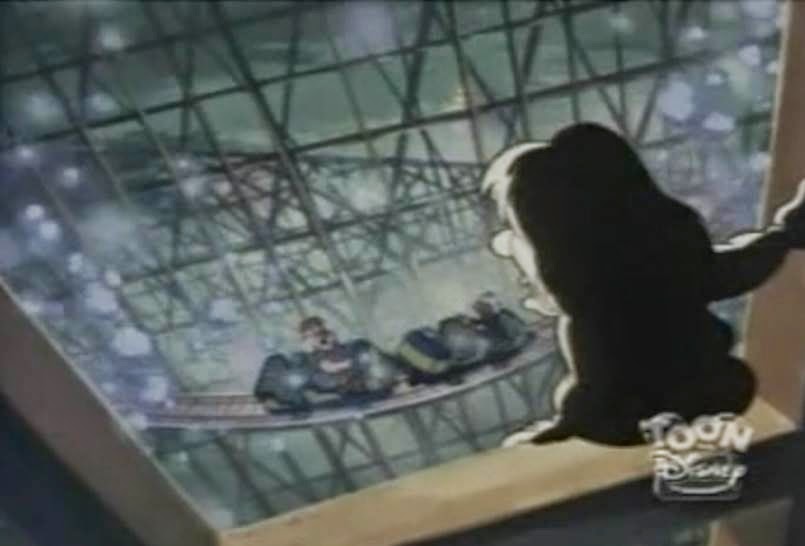
The climactic action is also pretty contrived.  I agree with Greg that Scrooge should certainly have seen that the kids had ditched the roller-coaster wagon before he jumped into it, but that's not the real problem.  The problem is that the action is taking place on a roller coaster at all.  I don't honestly see what this unnecessary action sequence achieved that made the basic moral and the ultimate reconciliation between Scrooge and Blurf any more resonant. I think that Julie's cutting response to her daddy's complaint that running away from home was "very childish" provided more than enough zing to get the point across; we didn't need to have the lead-in of Scrooge and Blurf narrowly averting a head-on collision.

Ending with the status quo ante (the Blurfs being forced to move away because they've spent too much money) is, of course, the only possible way to conclude matters, and I don't really mind the pressing of the reset button.  Barks, after all, was famous for the concluding comment, "And things are again as they were."  Actually, the Blurfs' final fate is positively benign compared to the ending of "Statuesque Spendthrifts," in which the Maharajah of Howduyustan is reduced to barrel-wearing poverty, while Scrooge has barely made a dent in his petty cash safe.  There's no indication that the Blurfs have been completely cleaned out; they simply can't afford to maintain their luxurious lifestyle.  (The guys carrying the Blurfs' possessions to the truck are movers, not auctioneers.)  Since HD&L and Webby pretty clearly go to public school, it's also possible that Julie may, in fact, continue to see Bubba on a regular basis.  We just won't be favored with those future meetups.

So, definitely not anything close to a classic episode, but certainly a watchable one, particularly since this is arguably Bubba's finest hour outside the "Time is Money" serial.  In future Bubba appearances, the caveduck will either be reduced to the role of a "fifth Nephew" (Webby being the fourth) or will have his personality completely altered in order to justify a starring role (do I even need to mention which ep I'm thinking of?).  Admittedly, Bubba doesn't fit the role of a Romeo, either, but "Bubbeo and Juliet" is an instance in which that hoary animated trope -- "Just be yourself!" -- turned out to be pretty sage advice.

.

.

.

Bumper #14: "Boombox"

.

.

.

"DuckBlurbs"

(GeoX) So some white-trash lottery winners move in next to Scrooge, provoking an amazingly élitist reaction on Scrooge's part--natural, perhaps--and, it seems to me, also on the writers' part: although it's true that their feud is laid bare as childish and pointless at the end, the fact remains that we are pretty clearly meant to see the new neighbors' behavior as, at best, tasteless, and the restoration of the status quo (inevitable in a show like this, of course, but doesn't that in itself represent an embedded tendency towards a particular politics?) as the natural order re-asserting itself. 

You say that like it's a bad thing.  Up until the Blurfs' party, there was still a chance, albeit a thin one, that Scrooge could have learned to live with the Blurfs, provided that the contractor could have built that wall ten feet taller and performed all the other necessary tweaks (odor-proofing the Mansion, and so on).  Scrooge may have been fantasizing about getting revenge on the Blurfs, but he didn't actually turn his fantasies into actions until the party started to roll.  In that respect, the Blurfs really WERE to blame for things getting out of hand the way they did. 

(GeoX) "Wow! What a fastball! Nobody's ever gotten a strike against Bruiser before!" As in "Time Teasers," the show evinces a certain ignorance of how percentages work in baseball. 

True enough.  Speaking of ignorance, how the heck OLD is Bruiser?  He looks and sounds as though he's of driving and/or drinking age.  Evidently, while Duckburg's legal system is a shambles, its education system is pretty serious about leaving recalcitrant students back if they're not up to snuff.  (Also notice here that Bruiser sneeringly refers to Bubba as a "prehistoric hotshot."  With Bubba having become a part of the McDuck household, it's easy to forget that, to a good portion of the rest of Duckburg, Bubba's still an exotic outsider.  The series simply won't make that big of a deal of it from this point forward.)
(GeoX) "It cost me two hundred fifty dollars to get out of jail this time!" …and also, an ignorance of how bail works.

I'm guessing that the penalty for disturbing the peace is simply paying a fine, and that, given that Scrooge's first arrest was his first real arrest, the initial fine was relatively low.

(Greg) Scrooge and Mrs. Beakly get together thinking that they will have peace and quiet all day...and then a tree gets floored and destroys part of the gate. Scrooge is not happy to see that as he walks over and we discover that another mansion has been built OUT OF NOWHERE. Strange since we didn't see it on the first shot where Scrooge was talking to Webby and Bubba, since he walked in the same direction as he looked.

The "next-door mansion" is one of those details created for the explicit purposes of a particular episode.  I normally don't like such sudden inventions; they're the physical equivalent of a character suddenly developing an obsession or fetish to carry a single plot along. It is, however, stated in the episode that the encroaching estate existed before now, since Scrooge makes a comment about how handsome the property looked before the Blurfs got their hands on it.  A bit of a stretch, given Scrooge's proclivities for occasional paranoia, but I can live with it for one ep.

(Greg) The hubby is also a pig who uses a snork[e]ling mask as safety goggles wearing a purple flower shirt, cheese pants and brown leather shoes. Think Herb Muddlefoot with an even more annoying voice... He sounds like Wendell; so I'm guessing Frank Welker here.

It's actually Chuck McCann doing his best to provide a redneck accent. Chuck and Russi Taylor (as Julie) get gold stars for effort, but probably only deserve silver ones for execution.

(Greg) We return to the mansion as Mrs. Beakley places Scrooge on the front lawn and waves a dollar bill like smelling salts. Okay; that is different at least.

And funny! It's almost like a gag cover to UNCLE $CROOGE come to life. I also appreciated the subtle Wizard of Oz reference ("There's no home like theirs"). And to think, Koonce and Weimers weren't even involved here.


(Greg) Scrooge calls [having the Blurfs as neighbors] worse than having the Beagle Boys over.

You might want to reconsider, Scroogie. Remember how the Beagles behaved when they came into (your) money in Barks' "The Case of the Sticky Money":


(Greg) So we head back to the nephews at the cafeteria outside looking at the windows. We zoom in and Webby notices [Julie] despite the fact that she is nowhere in that shot of the tables. That's logic break #2 for the episode and the first one I don't accept eight and a half minutes in.

Oh, she's there, all right:
(Greg) Bubba looks around [at the party] as everyone is in costume including Usagi Yojimbo, a TMNT (sans mask), and a brown Spiderman.

And just different enough from the originals to be non-actionable... imagine that. The partially obscured critter at the far left of the screenshot below is also a reference, to the Martian invaders in Paramount's adaptation of War of the Worlds (1953).


(Greg) Scrooge and Tiny blow each other [sic] and threaten to get them removed from the neighborhood. 

I would remove them, too, if they tried that in MY neighborhood!

(Greg) So we head inside Tiny's living room as he is on the phone as he yells that he will spend to make sure Scrooge gets spitled. Sorry; I don't speak redneck sir.


He actually said that he would spend whatever it took to "spite ol' McDuck."

Next: Episode 80, "The Good Muddahs."