Showing posts with label Don Rosa. Show all posts

Thursday, January 15, 2015

DUCKTALES Fanfic Review: "The Sincere Fraud" by "Commander"

Home is the place where, when you have to go there, they have to take you in. -- Robert Frost

Of course, what happens AFTER they take you in is often the most interesting part...

I'm back with another DuckTales fanfic focus... and the angst is STRONG with this one!  Thankfully, DuckTales doesn't appear to have inspired nearly as many of these soul-sucking fics as, let's say, Chip and Dale's Rescue Rangers (does anyone remember the concept of "Gadget-gouging"?  If not, then be thankful) or Darkwing Duck (the Gosalyn-Drake relationship was always rife with potential for emotional exploitation, and numerous writers have taken advantage).  The TV series simply didn't provide sufficient raw material for the introduction of soap-opera elements.  With THE LIFE AND TIMES OF $CROOGE McDUCK still well in the future, the show's explorations of Scrooge's past were comparatively straightforward, and they focused almost entirely on his individual exploits.  The Nephews and Webby were too young to enter "the dating zone" and similar locales where adolescent Weltschmerz might have a chance to get its hooks into them.  As for Launchpad, he was primarily concerned with where his next crash was coming from.

Of the main cast of DuckTales, Fenton Crackshell came the closest to experiencing some legitimate angst, thanks to his occasionally rocky relationship with Gandra Dee, the demands of his "M'Ma," and his struggles to reconcile his "normal" and superheroic identities.  However, these experiences  were generally played for laughs.  The mere fact that such stories were attempted with Fenton indicates just how promising a character he was... and what a shame it was that he was left abandoned on a metaphorical siding following the TV series' shutdown, with no further opportunities to build upon the ideas that had already been introduced.

The prolific fanfic writer "Commander" appears to have reasoned, logically enough, that, in order to introduce any heavy-duty emotional dynamics into the world of DuckTales as a whole, the characters would have to be pushed forward in time.  OK, I know what many of you must already be thinking...

... and, yes, HD&L are thrust into middle school in the epic under discussion here, but there's little indication that "Commander" was influenced in any meaningful way by Quack Pack.  During the traumatizing events of "The Sincere Fraud, " the boys are anything but ironically detached snark-dealers. 

"Commander" apparently planned to write a whole series of fics set in his personal version of the DT "universe" -- which turns out to be a mixture of the world of the TV series and his own take on Don Rosa's LATO$M timeline -- but "The Sincere Fraud" turned out to be the only major product that survived the vagaries of time and the demands of "real life."  He did, however, manage to set the table for the story in the reminiscence tale "Sepia Tone," which basically consists of the seven-year-old Louie finding an old family album and asking Scrooge to tell him about some of his and his brothers' "foreducks."  It's a pretty quick read, and I encourage you to give it a look if you get the chance, but here's a summary of the significant takeaways.  Some of them will be quite familiar, some not so much.

(1)  The McDuck siblings, in order of age: Scrooge, Matilda, Hortense (as per Rosa).

(2) Matilda married Ludwig Von Drake (as per the Rosa Family Tree) and died young.  Scratch "A Letter from Home" (preferably, while shedding a silent tear or two).

(3) Hortense married Quackmore, and they had Donald and Della two years apart.  That is, Donald and Della were not twins.  This fact actually turns out to be rather significant.

(4)  Quackmore joined the Navy during World War II and died in action when Donald was nine years old.  Since Donald was a "Mama's boy" and never really that close to his Dad, that was what really motivated him to join the Navy... AND, more than that, to make the service an actual career.

(5)  Della was the proverbial "bad seed," getting into repeated, and increasingly serious, trouble as a youngster and developing a knack for conning people into making them do what she wanted them to do.  In the process, she also developed a bad feud with her older brother Donald.  Don's original intention, to keep her from running completely off the "road of life," was actually a good one, but he ultimately got so angry at her that he came to believe that he had always hated her.  For her part, Della resented Donald trying to butt into her life, and he similarly assumed the role of a monster in her own troubled mind. Della ultimately got knocked up by someone or other -- I'm guessing that the picture of Della's anonymous mate on the Rosa Family Tree is meant to be a generic composite; if so, then it's probably an overly flattering one -- and had her triplets, Huey, Dewey, and Louie.
 Idealized portrayal of Duck relationship #1

(6) Incapable of supporting herself, yet desperate to provide for her kids, Della tried to rob a bank and was arrested and sentenced to 15 years in prison.  The Nephews, who by that time were three years old, were subsequently transferred over to Donald's care.  The famous 1938 DONALD DUCK Sunday strip that introduced HD&L is therefore in error in at least one respect: The document that was sent to Donald to inform him of the transfer was probably a lot more formal than a simple handwritten note.

(7)  At the age of five -- yes, you read that right -- Donald joined the Navy, and HD&L came to live with their next closest relative, Scrooge.  Commence the events of DuckTales.  IF you can buy the idea of the Nephews being that young at the start of "Don't Give Up the Ship," then this actually explains a lot about why the characters act the way they do during the "dock scene."  As I noted in my review of that episode, it is quite clear that the Ducks of "Ship" do not know one another all that well, and it is therefore next to impossible to imagine them sharing any joint adventures between the time Donald assumed charge of the Nephews and the time he left to go to sea.  Heck, even if they had wanted to have an adventure, there was hardly enough time for them to do so!

Take a moment to consider the consequences of this setup.  "Commander"'s interpretation takes the events of "Don't Give Up the Ship," and subsequently of DuckTales, as being the TRUE Duck "canon," at least in an adventurous sense.  Any previous tales told by Barks (basically, the only Duck-bard who was relevant at the time of DT's debut) are hereby rendered null and void... EVEN THE ONES in which Donald and HD&L went on adventures all by themselves!  We're dealing with the cleanest of whiteboards here!

(8)  Webby was three years old when she and her "grammy" came to live with Scrooge and HD&L.  Despite Webby's occasionally "childish" behavior, that age also seems a little low.  Perhaps young Ducks mature at a quicker rate than humans of a similar age.  (If nothing else, then their memories improve quickly; HD&L do not have any clear memories of their mother, but, in the span of two years, their memories are suddenly working on roughly the same level as a typical adult's.)

Flash forward a decade or so.  Scrooge is older and creakier, and he now allows himself the luxury of a day off every week (gasp!), but he remains feisty and driven.  HD&L are now 14, are in eighth grade, and have developed very distinct personalities.  Webby is 12, is in sixth grade, is about to start dating, and may also harbor a secret crush on Dewey.  Mrs. Beakley, sad to say, is in a nursing home with Alzheimer's disease, and Scrooge has become Webby's legal guardian.  Donald is still in the Navy, albeit on leave, and Daisy is pushing him to finally "pop the question" (about time, don'tcha think?). 

** MAJOR SPOILERS **

THE STORY:  Having secured an early release from prison for good behavior -- or what would pass as such for a character with a temperament that's just as explosive as Donald's -- Della comes to McDuck Mansion in search of a fresh start... and, perhaps, some assistance from Scrooge to help her get her life back on track.  The Nephews have very different reactions to her.  "Troubled kid" Huey is suspicious of her motives, partially because he sees himself in her but doesn't want to end up like her. "Intellectual" Dewey tries to weigh the available evidence and maintain some objectivity.  "Optimistic, sensitive, and creative" Louie, meanwhile, embraces the idea that his Mom has returned and accepts her wholeheartedly.  When Donald proposes to Daisy and is turned down (for a presumed "lack of sincerity" -- sheesh, even Barks' Daisy never came close to being THAT fickle!), Donald has a mental breakdown that requires him to be cared for by Scrooge.  With Donald and Della now forced to be in close proximity, their long-standing feud flares up, in the manner of a particularly wince-inducing hemorrhoid.  When Ludwig von Drake calls from Europe to check in with Scrooge, the increasingly stressed tycoon jumps at the chance to invite Ludwig to his mansion, where the prof will be able to provide some much-needed therapy for Donald and Della.  Alas, Huey chooses this moment to explode in frustration at his role as the "put-upon," least favored Duck triplet, and he chooses his "cousin by adoption," the "perfect porcelain doll" Webby, as his primary target.  Events finally come to a head when Donald and Della get into an ugly fight at a restaurant at the same time that Scrooge, beset by familial dysfunction, finds himself at the mental -- and, more importantly, the physical -- breaking point.  Can this family be saved?...

PLOT:  The unraveling and subsequent reraveling of the Duck family.  That's pretty much all that happens.  (*** out of *****)

One of the problems with "angstfics" is that there is usually quite a lot going on -- of the emotional variety, anyway -- but nothing is actually happening.  To his credit, "Commander" doesn't completely succumb to this trap.  We only hear about Donald's post-turndown breakdown at second hand, from the policemen who come to tell Scrooge about the incident, but the restaurant ruckus is "on screen" and is appropriately nasty, complete with cursing and knives wielded with deadly intent.  Adding to the noxious atmosphere is the fact that Donald had been on a blind date and had been confronted and dressed down by an angry Daisy before Della even got there, making Don's reaction to Della's subsequent arrival all the more malicious.  (You may wonder why Daisy should even care that Donald has plunged back into the dating whirl, given that she had turned down Don's proposal.  Sorry, I got nothin'.)  Apart from this one ugly scene, "Commander" basically sticks to dialogue scenes (frequently involving arguments) and uses very little action. 

I know that there are those who love this sort of thing.  I typically don't count myself among their ranks.  At least "Commander"'s dialogue scenes are usually well-written and, given the characterizations that he has chosen to use here, generally believable.  They're just somewhat painful to read through at times.

CHARACTERIZATION:  "All over the map" doesn't begin to cover it.  (***1/2 out of *****)

There's no denying it... some of "Commander"'s decisions on characterization here are a little tough to stomach.  Take Huey, now... he's basically a complete asshole.  He "acts out" in school, breaks curfew, bullies the more passive Louie into spying on Scrooge and "his mysterious visitor" (Della), and pelts Webby with crudely sexist insults even before he verbally attacks her (and is apparently also ready to SLUG her!!) for being the cute little "favored child."  He's like the egocentric Huey of Quack Pack with the amp set at "11."  It's hard for me to believe, as "Commander" suggests (through the medium of Huey's thoughts), that Huey got to be this way because of some school pranks that just got out of hand.  There's a definite suggestion of something uglier having been there under the surface all along.  That thought kind of disturbs me.

Donald and Della, whose feud is sufficiently nasty to render them both as contemptible as Huey from the start, nonetheless wind up faring a bit better in the long run.  We all know about Donald's legendary (and supposedly "hilarious") temper, and Don did have a few minor blowups during his infrequent appearances on DT, but his outbursts here seem uncomfortably... realistic.  We are led to believe that the authorities may have had a point in examining Don at the psychiatric hospital before releasing him into the care of Scrooge.   To his credit, though, Donald rallies after Scrooge's cardiac event, pulls himself together, and even manages to make up with and become engaged to Daisy before the end.  (Daisy... fickle.  Just saying.  Actually, the reconciliation is handled very well, with both characters admitting that they will inevitably have arguments as husband and wife, yet deciding to get married anyway.  That's what makes a marriage work... the partners recognizing and accepting one another's flaws while, at the same time, cherishing the more meaningful feelings that drew them together in the first place.)

"Commander," of course, has more direct control over the characterization of Della, and he basically opts for the "female version of Donald" notion... the difference being that Della's temper has tended to have much more serious consequences in her life than Donald's has had in his.  This is why Della suffers through such despair after her fight with Donald at the restaurant gets them both tossed in jail.  She had been making some progress with Ludwig's help and now appears to have tossed it all away.  This was the first moment at which I legitimately felt bad for Della and hoped that she would, indeed, get control of herself and reform.  She subsequently earns additional points by deciding to leave Scrooge's mansion, move into a homeless shelter, and pick up the pieces of her life without being a burden on others.  (In response, Scrooge allows her to keep her job as a janitor at the Money Bin, despite all the problems she's caused.)  The change of heart comes very late in the game, and after Della had amassed a pretty sizable likability deficit, but at least she winds up making some progress, and I do appreciate that.

Idealized portrayal of Duck relationship #2

The rest of the gang is characterized fairly well.  Scrooge is Scrooge, albeit with a few thousand miles extra on him, and Webby is a reasonable advancement of the DT character to the lip of adolescence.  (Webby's "desperate" desire to be accepted at her new school does strike me as a little extreme, though.  Why haven't all of those adventures with Scrooge and the boys given her more self-confidence?)  Ludwig von Drake's bubbly enthusiasm provides a nice counterweight to all of the troubles swirling around him.  He can't completely escape the imperatives of an angstfic -- he is still clearly affected by Matilda's early death -- but he serves as a welcome voice of reason, and his psychiatric dissection of Donald and Della is far more adept than, say, his semi-comical analysis of Launchpad in the DT version of "The Golden Fleecing."  In a sidebar, "Commander" says that Ludwig is one of his favorite Duck characters, and his affection for the loquacious polymath is on clear display.

I also admit to being quite taken with the characterizations of Dewey and Louie.  Dewey is an intellectual with a heart; he wants to be supportive of others but prefers to get as many facts as he can about the case before committing himself.  Thus, he learns that Webby's "big first date" was a disappointment and immediately moves to comfort and counsel her, but he reserves passing final judgment on Della until he becomes more familiar with her.  Louie, meanwhile, is akin to the sensitive-souled kid of Quack Pack who wanted to protect "pugduddies" and such.  The difference is that he is even more trusting and optimistic.

HOMEWORK:   Only relevant when it comes to Duck Family Tree material. (N/A out of *****)

These are basically "Commander"'s own future versions of the characters, so it's not all that surprising that he does not refer to any of the TV episodes.

WRITING AND HUMOR:  The story is very well-written.  The humor is... well, quirky, for lack of a better word.  (***1/2 out of *****)

"Commander" has an odd way of slipping humor into unlikely places in the narrative.  When two policemen come to inform Scrooge of Donald's breakdown, one of them inexplicably starts acting like a character in a goofy cop comedy:

"Can I tell the story, officer?" asked the other policeman, younger and more hyper than his supervisor.

The older one sighed.  "Go ahead, Korwitz..."

Korwitz spread his arms out dramatically, as if about to begin an epic tale.  "Dateline, Duckburg, eight o'clock last night!  Location, the Dragon's Head restaurant, 825 L Street!  Incident, a broken-hearted Duck goes crazy, overturning tables and eating napkins!  Cloth napkins, not the paper kind!"

Considering that Scrooge, because of the return of Della, is already on edge as this scene begins, this strikes me as not exactly the most opportune time to shoehorn in some (rather forced) comedy relief.  Later, when HD&L and Webby visit Scrooge at the hospital, we get an awkward exchange that I think was supposed to pass for some manner of humor, in which Scrooge teases the youngsters' assuming responsibility for his hospital bill... or, barring that, his insurance premiums. Unnecessary cheapness gags during a family-wide crisis?  Not a smart editorial move.

QUESTIONABLE MATERIAL:  Occasional curse words, though none of the REALLY bad ones, and argument scenes that are sometimes difficult to endure.  Plus, one fairly nasty fight scene.

OVERALL:  ***1/2 out of *****.  RECOMMENDED, BUT WITH RESERVATIONS.

This one is definitely a matter of taste.  If you don't like watching the Ducks -- even slightly altered versions of same -- bickering like a hypercaffeinated version of The Fantastic Four, then I would suggest that you avoid.  If you're curious, or if you're indifferent to the notion of mutual Duck-breaking, then you're extremely unlikely to find a better version of the DuckTales angstfic anywhere in Googleworld captivity, so have a look.

NEXT FANFIC UP: Time for the Big Kahuna, the Top Boss, the Meat Grinder.  "DuckTales: 20 Years Later."  You'll definitely have to be patient with me on this one.  It's 125,000 words long, it features multiple crossovers, and a WHOLE honkin' load of stuff -- some of it quite untidy -- comes down in the process.  I may even have to break the review into several parts: one setting the stage by describing the world in which the story takes place, the other examining the story itself.  So as not to tease my reading public unnecessarily, I will not announce the review's impending arrival(s?) until I am just about finished with the project.

Sunday, December 28, 2014

Seems Like Old "Life and Times"... Except It's Not.

IDW's first Disney comics release was solicited in last week's PREVIEWS: an oversized "Artist's Edition" of the first six chapters of Don Rosa's LIFE AND TIMES OF $CROOGE McDUCK.  The price is listed as "$ Please Inquire."  I know that something is probably out of my price range when it is priced in the same manner as freshly-caught fish at a fine restaurant.

Still no word on when "regular" IDW Disney offerings might be arriving.

Monday, November 24, 2014

DUCKTALES Fanfic Review: "The Reunion at Duckburg" by "Sosa Lola"

At long (and seemingly interminable) last, it's time to begin examining some of the very best Duckfic fantales!... Er, DuckTales fanfics!

Before I begin, I'd like to acknowledge my good friend Mark Lungo for his useful advice concerning these reviews should be organized.  In the Disney Afternoon apa WTFB, Mark developed something of a specialization in the assessment of fan-created prose works.  The "star" rating system for various features of the story is entirely my own.

You can find "Sosa Lola"'s "The Reunion at Duckburg" here on fanfiction.net.

.

** WATCH FOR FALLING (AND YAHOOHOOEEING, GOOFY-STYLE) SPOILERS FROM THIS POINT FORWARD -- OR DOWN, IF YOU PREFER **

.

THE STORY:  It's Spring Break time, and Goofy and a reluctant Max travel to McDuck Mansion for one of Goofy's periodic reunions with his old pals Donald and Mickey.  There are several reasons for Max' reticence: he's reluctant to get reacquainted with Donald's Nephews, who tormented him with pranks at the last reunion at Donald's house some four years ago; Uncle Scrooge, whom Max has never met, sounds like a grouchy old miser; Goofy's enthusiasm for the get-together just doesn't seem... cool.  (In case you're wondering: HD&L appear to be their DuckTales selves here, as opposed to the teenaged Quack Pack versions, while Max likewise seems to be in his Goof Troop form, rather than his older A Goofy Movie manifestation.)  Not wanting to be victimized yet again, and somewhat alienated by Huey and Dewey's slightly snarky attitudes towards him, Max tries to get "cold-served" revenge on the triplets with a prank of his own.  The gag winds up putting Dewey in bed with an injured ankle.  An angry Goofy grounds Max for the first time ever, meaning that he's left behind while the others go out to dinner.  Scrooge, who's been busy and absent up until this time, returns home to find the unfamiliar Goof kid.  The duo hit it off reasonably well -- so much so, in fact, that Scrooge brings Max with him to the Money Bin.  Scrooge has been fretting over a threatened attack on the Bin by the Beagle Boys, who are working for Magica de Spell.  Scrooge temporarily leaves his Old #1 Dime in Max' possession while he's investigating a suspicious noise inside the Bin, and Max is promptly knocked out.  He awakes to find himself in Magica's lair on Mount Vesuvius, where Magica is preparing to finish what she started in "Send in the Clones" and create an amulet out of the cherished coin.  One hitch, however: she needs some frogs' legs to complete the recipe.  (Um, since when?)  With a heavy load of guilt sitting on his shoulders due to his failure to protect Old #1 at the Bin -- not to mention his previous misbehavior -- Max must help the Duck, Mouse, and Goof rescue party set things right, a task that becomes all the more difficult when his beloved Dad gets turned into a frog by Magica...

Well, I certainly wasn't going to pick a dog (heh) of a story with which to start my review series.  This is a fine effort, a fanfic that both reflects the familiar and expected in a (mostly) accurate fashion and goes in several new, intriguing, and entirely believable directions.

Here are my evaluations of the individual components of the tale:

PLOT:  Just fine in Chapter 1 (which ends with Scrooge taking Max to the Bin), but gets a tad "overly convenient" in a couple of spots in Chapter 2, and goes completely haywire in one particular instance.  (***1/2 out of *****) 

"Sosa Lola" him/herself seems to have been uncomfortable about the notion of the Beagle Boys bringing the unconscious Max back to Magica's lair with them when there was no need for them to do so.  How can I tell?  Because Max HIMSELF wonders why they did it. Since Magica needs frogs' legs to complete the amulet spell (again, you tell me why) and later proves to have no compunction over turning both adults and kids into frogs and threatening to rip off their legs, you would think that this would be the main reason for going to the trouble of bringing Max along, but it turns out that Magica expected the Beagles to get real frogs instead.  What makes this all the stranger is that the Beagles don't even bother to capture Scrooge; Max is the only one that enjoys the privilege of being carted away.

The good-guy cavalry arrives at Mount Vesuvius very soon after Max does -- the others actually arrive in stages, with Minnie and Daisy (who, thankfully, are not on hand just to serve as eye candy; the same goes for Webby, BTW) flying in helicopters as backup.  I don't have a problem with this, given that Scrooge was left behind to raise the alarm.  But Louie insisting on parachuting out of Launchpad's plane beforehand, under the premise that a little kid like him would be able to infiltrate Magica's place more easily?  It rings true in a character-based sense -- at least in the context of this story, as we'll soon see -- but no way can I imagine Scrooge letting Louie do that on his own recognizance.

Which would be more likely to parachute solo into a dangerous situation?

Where I really must part company with "SL" is with his decision to set Max up to be the "fall Goof" by having Scrooge give Max Old #1 for temporary safekeeping.  Mind you, Scrooge had already taken a special precaution to protect the dime by removing it from its normal storage case and sticking it inside a "pencil box" filled with loose change.  It would make all the sense in the world to simply leave it in that atypical location, as opposed to putting it in the hands of a young kid whom Scrooge has just met.  Yes, Scrooge does treat Max with respect from the start.  Even given that fact, there's no bleeding way I can see him taking such a chance.

I can't even imagine Little Scroogie doing it.

CHARACTERIZATIONS:  The best part of the story, in both a good sense and a bad sense... if you can believe it.   (***** out of *****)

Apparently, "Sosa Lola" has written several other Goof Troop fanfics in addition to this one, so I would hope that he would have a handle on what makes Max Goof tick.  He turns out to possess rather more than that.  The Max that we see here is poised somewhere between the Max of Goof Troop and the Max of A Goofy Movie.  He's still the "polite kid" who desires to be "cool," is a mean foot (feet?) with a skateboard, and easily gets embarrassed at his Dad's pratfalls, but there are more than a few hints that Max' attitude towards his own "Goofitude" and his tendency to screw things up is beginning to sour into something rather more unpleasant.  "SL" ramps up Max' feelings of inadequacy as the story progresses -- making him feel bad over his prank going wrong, making him feel ashamed of embarrassing his Dad, giving him the guilt trip over "losing" Scrooge's dime, etc.  It gets to the point where Max is so filled with "guilt and self-loathing" that he even offers to sacrifice his life so that other characters won't be harmed for Magica's benefit.  Louie is so horrified at what Max had planned to do that he literally slaps Max in the face.  Even Goofy is tempted to do the same, except that he "doesn't believe in hitting children."  Now you see why I described Max as standing between two "poles."  If one wants to take this story as belonging to "Spoonerville canon," then this might be the very moment at which "Glad Max" morphed into "Sad Max."  It makes the "happy ending" seem just a bit hollow.

Louie's reaction to Max' intended self-sacrifice resonates all the more because Louie had previously treated the visiting Goof kid with far more thoughtfulness and kindness than either of his brothers.  When you realize that the Nephews are still their DuckTales selves, this is quite something.  Numerous other fanfics that I've examined, especially those set in the indeterminate future, have taken pains to give the boys distinct characterizations.  It's as if these writers wanted to go the Quack Pack route but didn't necessarily want to use the Quack Pack versions of HD&L.  This is the first fic I've seen in which such a distinction was applied to the DuckTales versions of the boys.  Louie's slapping of Max is all the more significant because Louie appears to be disappointed with Max for even contemplating such a thing.  Evidently, Louie had been determined to befriend Max from the start.

If you're wondering why Huey and Dewey had so much more of a negative reaction than Louie did to Max' presence... well, "SL" helpfully provides us with an explanation, straight from the Ducks' (in this case, Huey's) beak.  Apparently, HD&L had always been jealous of the fact that Max lived with and was cared for by his Dad, in part because of a guilt trip carried over from their own hell-raising days.  Add to this the fact that the boys were upset that Donald (who's still in the Navy) had been unable to get away for the reunion... The unanswered question here is, what caused Louie, in particular, to have a different attitude from his brothers'?  Was "SL" consciously or unconsciously drawing on the "big-hearted" Louie of Quack Pack, the kid who protected endangered "pugduddies" and so forth? 

You have NO idea, Donald...

HOMEWORK:  To be a really good fanfic, "attention must be paid" at some point(s) to what has gone before, even if only tangentially.  "Sosa Losa" is right "on point" in this area.  (***** out of *****)

There are many, many references here to "Send in the Clones."  In fact, the first part of the showdown at Magica's lair is close to a clone (heh) of what we saw in that first syndicated ep, right down to Huey giving Magica the most trouble.  Huey and Magica each make clear references to their previous encounter.  Some lines from "Don't Give Up the Ship" are shoehorned in, as well, and Dewey (who has to sit out the battle back in Duckburg because of his injury) is referred to by Louie as "always com[ing] up with great plans."

"SL" also makes references to several Goof Troop episodes, such as "Slightly Dinghy."  Goofy's "lucky horseshoe," which enters into the denouement, first appeared in An Extremely Goofy Movie, but it's easy to imagine Goofy having that object during the Goof Troop era, so I'll let the apparent anachronism slide.

Thankfully, "Sosa" didn't add "disco references" to his story. 

WRITING AND HUMOR:  The writing's serviceable, and, given that half of the tale is an adventure and some genuinely sober subthemes are present, there are some really funny lines.  It helps that "Sosa Lola" understands how these characters should sound.  (**** out of *****)

There's one really annoying misspelling -- "stake" for "steak" -- that should really have been corrected, especially since it appeared multiple times during the course of a couple of pages.  It's also difficult at times to identify who exactly is speaking; this is a particular issue during the character-choked finale.  Other than those nits, there are few problems here.

Launchpad doesn't have a whole lot to do, but, true to form, he does get the funniest line of the story.  Some of the banter between Max and Scrooge is  quite amusing, and it was easy for me to imagine the characters exchanging the dialogue in their "animated voices."

There is one peculiar moment at the very end of the story that I frankly don't quite understand.  Peg appears on the scene, and she and Scrooge appear to engage in a bit of.... innuendo??  Was this titillation really necessary?  I did get a chuckle about the plans that Scrooge has for Peg, though.  (They're NOT WHAT YOU THINK.  Remember, Goldie could always be lurking around the next corner inside a giant cake.)


OVERALL:  ****1/2 out of *****.  N&V RECOMMENDED.

This story is definitely worth DuckTales' fans' time.  "Sosa Lola" clearly put a good deal of thought into it, and the problems with the plot don't detract from the simple fact that it's an enjoyable read, albeit one with a slightly darker underside than you might expect.

.

.

.


Please feel free to send feedback on how I handled this first review.  Did I give away too much of the plot?  Do you approve of the categories I used?  Did you actually go and READ the darned story, and, if so, how did your reactions differ from mine?  I'd love to know.

Monday, November 3, 2014

Book Review: WALT DISNEY'S UNCLE $CROOGE AND DONALD DUCK: THE DON ROSA LIBRARY, VOL. 1 by Don Rosa (Fantagraphics, 2014)

Quick turnaround time, indeed: Volume 2 of this collection just landed at my comics dealer's this past week.  (Volume 3, by contrast, isn't slated to be released until next June.)  Since a good deal of the matter in these initial tomes has been reprinted several times in the past -- by Gladstone and Boom!, to be more specific -- and can easily be found to pristine-or-close-to-it condition, I'm not all that surprised that Fantagraphics got this new reprint project off to a fast start.

I was an anomaly among the many unsuspecting readers who bought Gladstone's UNCLE $CROOGE #219 (July 1987) and were hit square in the face with a brand-new $CROOGE adventure story, crafted by an American, no less.  Thanks to an article in COMICS INTERVIEW magazine, I knew who Don Rosa was, how much he admired Carl Barks, and even something about THE PERTWILLABY PAPERS, the fan project that provided the template for the plot of "Son of the Sun."  I even recognized Rosa's nascent art style -- which one of the very few negative letter-writers to the U$ lettercol criticized as "nervous and scuzzy-looking" -- as an extension of sorts of the style he had previously used for his personal comics.  (I was not aware of the fact that Rosa basically cribbed virtually all of the Duck-poses in "Sun" from Barks drawings... though, now that Rosa has made me aware of the fact, said fact seems pretty obvious in retrospect.)

You'll pardon me if I classify the appearance of Rosa in general and "Sun" in particular as one of TWO great "booster shots" that Scrooge's career received in '87, the other, of course, being DuckTales.  At the time, I was unaware that DT was on its way -- the good thing AND the bad thing about today's instant-gratification world is that very few such pop-culture bombshells still catch us by surprise -- but the arrival of a new and promising American Duck creator clearly presaged a future for American Disney comics that went above and beyond "simply" reprinting Barks classics and serving up treats from abroad.  And so it proved to be.

In the COMICS INTERVIEW piece, Rosa said that Barks' anonymity during his working career could be considered an advantage of sorts, because it gave Barks the freedom "to just try and please himself."  And that is precisely what the Rosa adventures, short stories, and gag pages of 1987-88 reflect: an inexperienced, but talented and enthusiastic, creator, who was simply trying to craft the best Duck tales he possibly could.  Yes, a lot of the artwork is crude and clunky by Rosa's standards of the 90s and the aughts, but it's not REALLY that terrible -- William Van Horn's early gag pages for Gladstone got more catcalls -- and the writing is good from the off.  Rosa's bold willingness to put his pen to the service of eye-popping, oversized individual panels (the explosion that hurled the Temple of Manco Capac into the empyrean in "Son of the Sun" was the first and, arguably, the most famous example) indicates a creator who is willing to punch above what would seem to be his artistic weight, at least at this time, and such risk-taking would serve Rosa well as his sense of finesse improved.  Most importantly, the pretension and "weight-of-the-worldishness" that beleadened numerous Rosa projects during and after THE LIFE AND TIMES OF $CROOGE McDUCK is almost entirely absent.  In "Last Sled to Dawson" (UNCLE $CROOGE ADVENTURES #5, June 1988), Rosa's first stab at Glittering Goldie, the sentiment underlying the entire story is only revealed at the very end and is kept quite low-key, Rosa's spangled and flashy "staring into my memories" final panel notwithstanding.

Most indicative of the fact that Rosa was still taking these early jobs with the lightheartedness that they reflect is the observation that he was perfectly willing to do "ten-pager"-style domestic stories during this period.  In his "Behind the Scenes" story notes, Rosa has some fun with the idea that he doesn't have much to say about the content of these stories, but, then again, there wasn't a lot of content in most of Barks' "ten-pagers," either.  (There were exceptions, of course, but a lot of fans tend to remember those "sports" and then make mistaken generalizations as to the quality of the lot.)  A couple of these efforts -- "Mythological Menagerie" (WALT DISNEY'S COMICS AND STORIES #523, October 1987), in which Rosa wears his considerable research into obscure mythological creatures rather lightly, and "Metaphorically Spanking" (WDC&S #531, August 1988), in which Rosa delightfully subverts his soon-to-be-ironclad rule that Donald, and NOT HD&L, should always be the member of the Duck clan to take the major abuse -- stand out as legitimately superb.  Even in these tales, though, I get the sense that Rosa was straining at the leash, unsatisfied with painting on such a relatively small canvas.  By the time he got to the "operatic" part of his career, such "minor" creations would, for the most part, be set aside.  When you're comparing Rosa to someone like Barks in terms of being a "complete" creator, that does have to count as a debit.


"The Rosa Archives," presented at the back of the volume, appears to be Rosa's version of a biography of sorts.  If so, then he's booking through it at double time, since part one takes us from his birth up until "The Son of the Sun."  Oh, please tell me that I'm wrong... does this mean that part two is going to be one gigantic rant about how that evil Disney corporation (does any "artistic type" believe in a GOOD corporation anymore?) refused to give him back his original artwork to help him make a living?  I haven't opened Volume 2 yet -- a few other items on my current "pile" are on top of it -- but I'm hoping that Rosa exercises good judgment on that score.  (BTW, there's a funny photo in this section of a teenaged Rosa smiling like a split cantaloupe over a pile of comics that he's just recently acquired.  He looks for all the world like a maniacal teenaged Bobby Fischer with glasses.  I kid you not.)

Wednesday, October 15, 2014

Disney Comics: NEXT PUBLISHER UP!

While he was attending the New York Comic Con, Joe Torcivia passed word along to me that "classic" American Disney comics are finally on their way back.  So, did Disney finally grow a brain and realize that, hey, it now owns one of the world's biggest comics outfits (Marvel), so Disney should oblige it to get cracking?  Well, um, no.  The publisher is actually going to be IDW.  Surprise, surprise!

Let's look at IDW's official announcement of what it terms "a monumental collaboration" and see what we can glean from it:

This monumental collaboration kicks off with multiple monthly series featuring some of the most iconic characters of all time: Mickey Mouse, Donald Duck, Pluto, Minnie Mouse, Goofy, and many more! Re-presenting acclaimed comics from the past and today, these series will highlight the best and brightest of Disney’s impressive comic catalogue.

Looks as if the old standby titles -- MICKEY MOUSE, DONALD DUCK, UNCLE $CROOGE, and WALT DISNEY'S COMICS AND STORIES -- have some life left in them yet.  Hopefully, IDW will know who to consult regarding identification of the "best and brightest," starting with those people who made the final few months of Boom!'s Disney comics line so enjoyable.  Given IDW's interest in publishing adaptations of animated series (MY LITTLE PONY, ROCKY AND BULLWINKLE, and various CARTOON NETWORK series, just to name a few), could some Disney Afternoon-related titles also be in our future? 

The award-winning Artist’s Edition line, pioneered by IDW, that showcases original artwork, will feature collections from the immense talents who have contributed to many beloved Disney comics over the years. Artist’s Editions featuring the legendary Carl Barks and Don Rosa will receive the spotlight in these gorgeous over-sized collections of original art reproduced at full size.

Sounds good, too.  Given the collector-focused nature of the Artist's Edition line, it is likely that the regular comics will be pitched at both collectors and new readers.  American Disney comics MUST do something to increase the pool of potential patrons, or we all are simply going to die out! 

Launched in 2014, Micro Comic Fun Packs have enjoyed immense success with highly recognizable franchises, and will expand its line with multiple Disney properties. Packed with a mini-comic, stickers, posters, and more, the Micro-Comic Fun Pack has been captivating new comic audiences on a mass-market scale.

OK, as long as IDW doesn't try to stuff comics material into boxes of ice-cream treats.  (A few of you will know what I am referring to there.) 

Celebrating the rich history of the many facets of comics, the Library of American Comics offers detailed and insightful looks at specific comics and creators. Beginning in 2015, the LOAC will begin collecting the various newspaper strips that have featured iconic Disney characters.

Given that Fantagraphics is releasing the Barks and Gottfredson collections even as we read, what could IDW have planned here?  Collections of the SILLY SYMPHONIES strips, perhaps?  I can't see them simply taking over from Fantagraphics.

.

.

.

Back to personal musings... If IDW's handling of the MY LITTLE PONY franchise is any indication of how the Disney characters will fare in the company's hands, then there is every reason to believe that IDW will be good stewards.  Management of American Disney comics has been so erratic, whimsical, and downright perverse over the decades that I, for one, could stand for a spell of honest, reliable craftsmanship.  One open question at the moment is how "hands-on" Disney will be with IDW.  Actually, I'm inclined to believe at this point that Disney couldn't care less.  If Disney found it easy enough to ignore its alliance with Marvel, then Disney clearly saying that it's perfectly willing to let IDW take the comics off its hands (or somewhere near there), just as long as they don't have to deal with the issue any longer.  "Ignorance is bliss," Disney style?  It might actually be a blessing.

Thursday, October 9, 2014

A POST "DUCKTALES RETROSPECTIVE" PERSPECTIVE: "The City Under the Ice" (Gladstone DUCKTALES #12, March 1990)

There's a good deal of irony packed into that William Van Horn cover image.  Those of us who remember the original DUCKTALES comics line -- the one that Disney more or less forced upon a reluctant Gladstone Comics in 1988 as a way of promoting the red-hot TV series -- mentally divide the 13 issues that followed into two groups:

(1)  The Disney Studio stories, some of which directly adapted episodes of the series, such as "Armstrong" (DT #1) and "Jungle Duck" (DT #2).

While the adaptations may not have been top-notch, they were pure genius compared to the original Studio stories that followed -- stories that were notorious for gaffes in characterization (e.g., Webby calling her grammy "Mrs. Beakley" in "The Crown Jewels Affair" [DT #4]) and an UTTER, as opposed to a partial, lack of inspiration.  Just about the only things that these issues had going for them were the lively and detailed covers by Daan Jippes.  It certainly wasn't Daan's fault that these eye-catching covers promised adventure and excitement that the stories inside so miserably failed at delivering.

(2) In the back of DT #6, backing up yet another blah Studio lead, was an intriguing bauble that pointed directly to DUCKTALES Mark 2.0: "Coin of the Realm," a ten-page tale written and drawn by Bill Van Horn.  Recall that, up to this point, Van Horn was known to Gladstone readers primarily as "the guy who does the fillers and gag pages."  The former included a couple of humorous GYRO AND LAUNCHPAD four-page stories in DT #4 and 5.  "Realm" was of an entirely different scope and immediately seemed more entertaining than any of the mush and dribble that had been regularly doled out to us.

And so, beginning with DT #7, Van Horn -- with occasional assistance from John Lustig -- began to produce lead stories for the title.  These quickly became so popular that, when Gladstone temporarily reverted to Studio fodder with DT #9's "The Oil Pirates," the dropoff in quality was almost jarringly noticeable.  Van Horn was back on the job in DT #10, producing "The Whistling Ghost," a 16-page feature story that brought back Baron Itzy Bitzy, the whistling flea character that Bill had introduced in one of his non-DUCKTALES efforts.

Van Horn would likewise provide the lead stories for issues #11 and #13, the last of which, "The Billion-Bean Stampede," may well be the most memorable of all of these highly quirky efforts.  For sure, it had the zaniest cover.

These romps are warmly remembered, not least because they cemented the bond of fondness between American Disney comics fans and Van Horn, who, unlike Don Rosa, didn't make a splashy debut, but patiently worked his way up the ladder and amassed good will a bit at a time.  (Somehow, I think that Scrooge would approve.)  And yet... and yet... as enjoyable as these stories were, I think that fan-friend Pete Fernbaugh was correct when he said that they came across as VAN HORN stories more than they did DUCKTALES stories.  Van Horn seemed uninterested in using any original DuckTales creations other than Launchpad.  While Bill handled LP quite well, his approach seemed uncomfortably close to the lazy Studio practice of creating a DT story simply by plugging LP into the Donald slot in an otherwise conventional "Scrooge and the Ducks" narrative.  (The GYRO AND LAUNCHPAD stories, by contrast, didn't seem quite so atypical, primarily because Van Horn knew how to take advantage of Launchpad's nature and abilities in such a specialized setting.) Needless to say, there was never anything conventional about Bill's approach, but, the more he tried to "wacky" things up by dropping in zany rock concert promoters, lively legumes, and so forth, the more his tales got pulled away from anything resembling what DuckTales had given us during its wide-ranging first season.

The bottom line is that neither of the aforementioned groups contain what one might characterize as a legitimately authentic, high-quality comic-book adaptation of the TV series.  Pretty unfortunate for a title that was supposed to be providing readers with the equivalent of the DuckTales animated experience, only on the printed page.  But then, we get to issue #12, which... stands apart.  Boy, does it ever.

During the last several months in which it held the Disney comics license, Gladstone had converted its titles into a double-sized format, the better to pump out as much "classic" material and heretofore unseen overseas delights as possible before the "window of opportunity" closed and the Disney Company took over.  (These included lengthy stories by the Italian great Romano Scarpa, who was a complete revelation to us notoriously insular Americans at the time.)  In DT #12, Gladstone finally took full advantage of the extra space to showcase "The City Under the Ice," a 39-page French story.  I wonder how many folks saw the Van Horn cover, immediately began thinking of the crazy scenarios and gags that "Silly Billy" might be able to stage in that gelid setting, and then really froze up when the first page of "City" displayed "something completely different."

According to Inducks, "City" is the second longest standalone DUCKTALES comic-book story ever produced, trailing only "The Curse of Flabberge," which David Gerstein so memorably "reimagined" for Boom!'s UNCLE $CROOGE during its DuckTales phase.  The creation of the story was very much an international affair. It was written by Frenchman Patrick "Zack" Galliano, whose previous authorial credits included PIF LE CHIEN, a creation of the French Communist paper L'HUMANITE; penciled by the Spanish artist Maximino, who did quite a bit of work for Mondadori, the Italian Disney comics publisher at the time; and inked by the staff of the Barcelona-based Comicup Studio.  Oddly enough, a similar combination of French, Spanish, and Catalan talents worked on "The Curse of Flabberge."  The artwork for "City" is a little rougher and livelier, all things considered.

The "Americanization" of the story was done by Gladstone and Disney Comics stalwart Dwight Decker.  During the Gemstone and Boom! Comics years, we got used to imaginative, reference-packed transformations of the utilitarian English dialogue that was normally provided to scripters.  Even the more sedate efforts along these lines had a touch of class.  (At least, I like to think that I provided one.)  Decker's translation, while sturdy enough, is more of the vanilla variety, though he does throw in a contemporary reference to some briefly famous pop star whom I don't have the time to research right now.  I wonder whatever happened to the guy.

While it certainly doesn't have the sheer scope of "The Gold Odyssey," or even the more modest "Scrooge's Quest," neither is "City" a sprawling, shambolic wreck on the order of "Rightful Owners."  The best praise that I can offer to it -- praise that will seem more meaningful when you consider when this tale was produced -- is that it gets the DuckTales aspects right.  It has a few quirks of its own, but the plot is easily recognizable as one that might have sprung up in an episode of the TV show, the characters involved are bang-on in character, there is a splendid reference to an infamous event that occurred on screen, and there's a pleasing mix of action and humor.  For that reason, I consider "City" to be the first TRULY successful DUCKTALES comic-book story to appear in America, at least when "successful" is interpreted in a strictly DuckTales-oriented context.

** SPOILERS **

We start with that classic McGuffin: a long-lost, well-hidden treasure map.  During the skateboard mishap pictured above, the ambulating Eskimo drops a bone that proves to be hollow.  The map inside points the way to a stark Arctic peak on Chilblain Island where (according to... no, not the Junior Woodchuck Guidebook, but a convenient Arctic exhibit at the Duckburg Museum) a legendary "sun of gold" once fell and is now buried beneath the ice, along with the artifacts of a "mysterious civilization."  (Hey, if Golden Sun worship can occur on one peak, then it certainly can on another.)  Unfortunately, the Beagle Boys get wind of the find, as well, thanks to their capture of the unfortunate Eskimo.

Yup, them's the DuckTales Beagles, all right. And they're all in character, too, suggesting that Decker must have been paying attention when he viewed whatever episodes he viewed in order to prepare for this gig.  This should NOT be passed over lightly.  Not after a later story like "The Great Chase" (Disney Comics DT #16, September 1991, written by Frank Ridgeway of "Bermuda Triangle Tangle" fame) gave us the memorable sight of a kick-ass, take-charge Burger and a whimpering Big Time and Bankjob deferring to him. As things turn out, the Beagles of "City" will have far more to offer to the discriminating fan than simply looking and acting as they ought to.

Up in Canada's Northwest Territories, a somewhat headstrong Launchpad gets involved in a fracas at a honkytonk -- it isn't explicity referenced as such, but I think we all know better -- and is bailed out by Walking Mountain, a giant, stone-faced, and inscrutable Native American.  The grateful Ducks invite WM to accompany them to the treasure site... which, when you come to think of it, is rather peculiar.  He turns out to be helpful at various times and utters some (yep) appropriately inscrutable remarks, but welcoming the assistance of a complete stranger was, shall we say, not S.O.P. in the TV adventures... or in Carl Barks' adventures, for that matter.

The heart of the story features the Ducks' journey to the legendary Bear's Tooth peak and the Beagles' various efforts to stop them.  We start with a pretty bog-standard version of the "paper-thin disguise" routine...

 Well, their number plates aren't visible, at least.

... which leads to sabotage, a crash, and an unpleasantly close encounter with a polar bear.  The Ducks get out of the fix when Scrooge resorts to the somewhat extreme tactic of lighting the crashed plane on fire "to scare the bear away."  The Ducks' on-board flares subsequently go off, alerting a passing ship to their presence.  As solutions to dilemmas go, this is closely allied to suicide.  But then, the "Type A" Scrooge of this story would probably be tunnel-visioned enough to try it.  We soon see more evidence of Scrooge's mental state when Scrooge poor-mouths in dramatic style in order to rent a snowmobile at a lower-than-rock-bottom price.  A bit over the top, perhaps, for the Alan Young DuckTales Scrooge, but, hey... it's in character.

Upping the ante, the Beagles track the Ducks' snowmobile with one of their own... armed with a gun, no less.  Chisel McSue would be proud, fellas.  Walking Mountain displays some fancy driving in order to get the gang out of harm's way, but the Ducks soon discover that the Beagles had sabotaged their gas cans back at the Eskimo town.  Left to starve and/or die of cold on the Arctic ice, Walking Mountain suggests a rather unusual tactic to attract animals that could (per the JW Guidebook, which HD&L belatedly consult here) be used for food:

Another in-character moment.  It's easy to imagine Launchpad getting into the spirit of things that way.  Alas, the ululations only serve to "attract" the Beagles' ice-breaking submarine. (Did the Beagles have their working boots on in this story, or what?  Makes some of their feebler second-season efforts seem all the more annoying, doesn't it?)  Thrown into the sub's brig along with the Eskimo, the Ducks have little to do but wait out the ride to the Bear's Tooth.

As the Beagles prep for treasure-hunting, Walking Mountain gets his funniest moment of the adventure:

Thanks to a conveniently placed thin crust of ice, our heroes are sent hurtling down, down... to this:


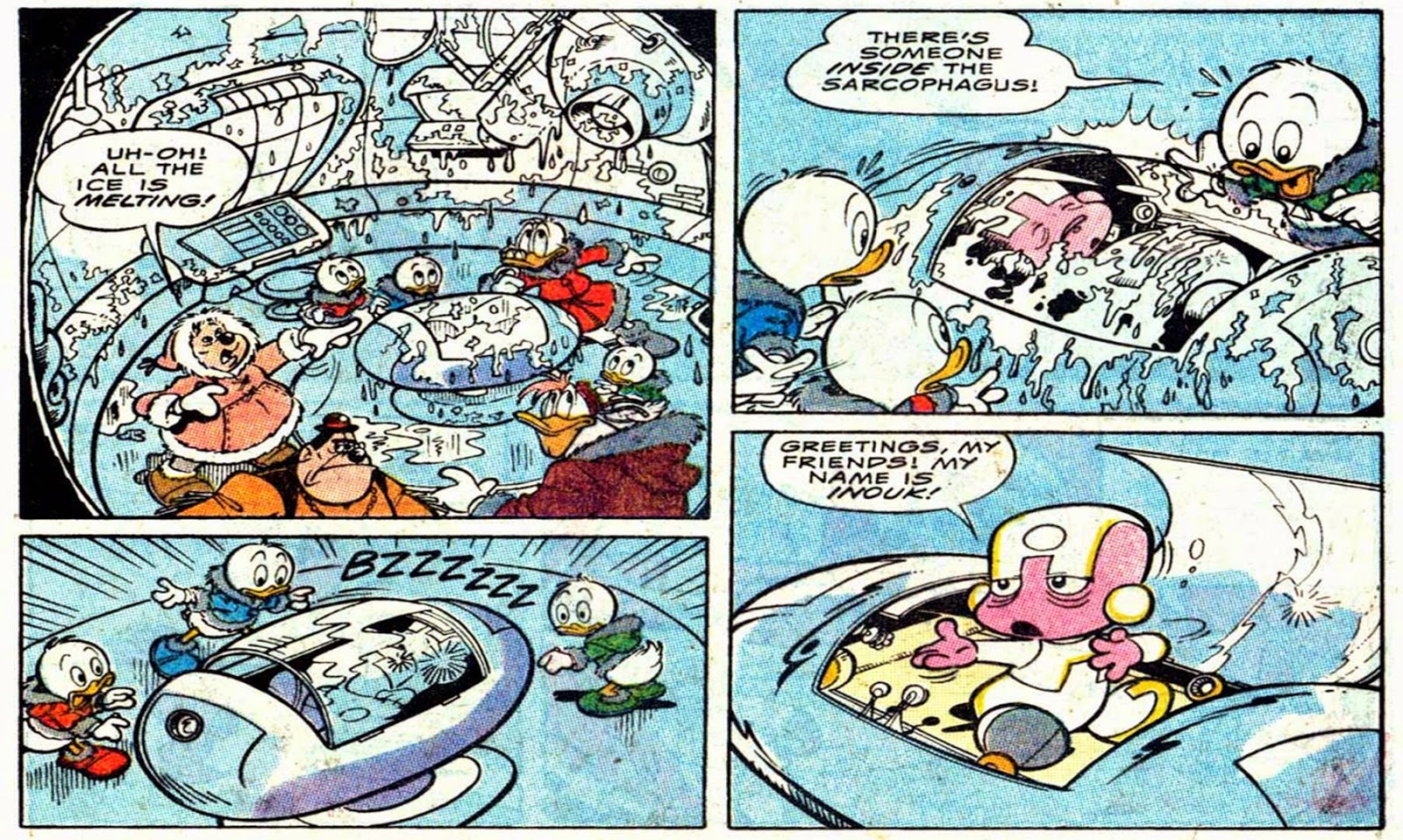
So, where's the gold?  The Ducks find out when they discover a hidden laboratory, a high-tech sarcophagus, and its completely unexpected owner:

Yes, folks, it's an alien, a Thulian (clever reference, that) who was left behind by an exploration party that had to retreat because of the cold weather.  Inouk was put into the deep freeze with the understanding that his friends would ultimately come back to get him.  The "sun of gold" turns out to have been the golden spaceship that brought Inouk and his people to Earth.  You realize what that means, Scroogie: these guys live on a planet where gold is so common that it can be used to build spaceships -- not the "structural metal" of first choice for me, but to each his (or its) own -- and therefore...

And Scrooge didn't even go through the intermediate stage of hiccuping: he went right to a dead faint.  Any direct reference to "Too Much of a Gold Thing" can't get enough praise from me.  This was the point at which I knew that Dwight Decker had REALLY, REALLY taken his responsibilities seriously. Bless him.

At this point, you're probably wondering whether the story is going to end in the cataclysmic manner of "Gold Thing."  Well, the Beagle Boys are tooling around while operating heavy machinery.  What do YOU think?  

The Ducks' plight isn't as desperate as it was in "Gold Thing," but it comes pretty close.  As if to make up for the shortfall, the mode of the Ducks' salvation is a bit more esoteric than Launchpad flying in the transport plane just in the nick of time.  Here, Inouk flies the gang out of danger using his "golden egg" sarcophagus (which turns out to be a small spacecraft, as well) as the City of Gold, in the manner of its namesake in a Kimba the White Lion episode, collapses into oblivion.  Scrooge takes this development with considerably less grace than he did at the end of "Gold Thing."  Perhaps writer Galliano was letting his inner "L'HUMANITE contributor" out for a little holiday here.


The story's final two pages are a bit displeasing, if only because:

(1) The Beagles are allowed to scuttle away, more or less scot-free.  After that performance, they deserved the dignity of a stay in a luxury high-security prison, at the very least.

(2) Inouk's "rescue ship" just happens to have been located on the Moon all along -- a fact of which Inouk himself appears to have been completely unaware when he went into hibernation mode.  What the heck, was this supposed to be a "monolith test," or something?  Why would Inouk even need one, since his civilization is capable of space travel?

Yeah, I'm just as confused as you are, buddy.

The fact that I have to pick such a tiny nit in order to give "The City Under the Ice" anything less than unqualified praise indicates just how strong this story really is.  It's easy to understand why it sort of flew beneath the radar at the time of its release: Van Horn's multiple stabs at the DUCKTALES lead story naturally left more of an impression than this one-shot, and Gladstone Comics itself was just about to go into its own form of "prolonged hibernation."  But let's give credit where credit is due.  Speaking strictly of DUCKTALES comic-book stories that appeared in America, "City" is one of the very few that can be said to have done full justice to the TV series.

"Golden Sun."  I like the sound of that...

.

.

.

My apologies for making you wait so long to see this.  Hopefully, you'll find the wait to have been worth it.  In my next comics review, we'll catch Disney Comics' DUCKTALES title on a similar back end, so to speak, and look at how the book's 18-issue run ended with Bob Langhans' post-"Gold Odyssey" offering, "A Dime in Time."  Is there any way that Langhans could have lived up to the standard set by "Odyssey"?  We shall see.