Showing posts with label Harveyville Fun Times. Show all posts

Saturday, August 24, 2013

A Fanboy Looks at Fifty... From BOTH Sides

Three situations came together to inspire the following exercise in ramblage:

(1)  My DUCKTALES RETROSPECTIVE series reaching entry #50 (duh).

(2)  Some comments posted by Joe Torcivia in response to my review of "The Right Duck."

(3)  My growing interest in My Little Pony: Friendship is Magic -- the TV series itself, that is, as opposed to the comic-book title.  (You can tell the difference because I typically use italics for TV series, capital letters for comic-book series.)

Joe started the ball rolling in his response to "kenisu" regarding the subjective nature of fans' reviews of their favorite works:

Chris is one of the best reviewers I’ve ever been associated with – and together we go back just about as far as DuckTales itself. He does a magnificent job reviewing this series in retrospect – as he (and I) did back when it was “current”. But, I don’t always agree with him – and that doesn’t make his views any less valid than my own. I find that I am far more critical of DT now, than I was then. A combination of no longer being enthralled with the “mere notion” of such a series after too many years of “bad animated programming”, Disney-decision-making vs. Barks’ original visions, and the fact that other series (mostly from Warner / DC) have surpassed it in overall quality.  The great DT eps are still great – but the flaws of the lesser ones have become far more glaring (fairly or unfairly) due to the reasons cited above.

I've gradually come around to the same conclusion as Joe -- that DuckTales, for all its many virtues, has in fact been "passed" by several newer series (I won't be specific).  The thing is, it took me a very long while to admit that he was right.  You see, my experience with DuckTales mirrors how most people become fans (short for "fanatics," let's not forget) of entertainment products.  You start with an emotional commitment to the product.  Why did Star Trek become the first and foremost of all "cult TV shows"?  Because, at that turbulent time, people desperately wanted to believe that the idealized, cooperative future pictured on the show was possible.  The intellectual rationalization for the emotional interest -- all those Klingon vocabularies, character backstories, specs of Starfleet vehicles, and so forth -- followed soon after.  In the case of DuckTales, while I had already begun reading Duck comics at the time the show debuted, the TV show was a product that I could literally experience from Day One.  I still recall how excited I was when "Treasure of the Golden Suns" aired in its two-hour format, and I still do feel those reverberations.  That excitement led to my work with Joe on the DUCKTALES INDEX, and I hope that that same sense of commitment has been visible in the various RETROSPECTIVES columns.  I had a similar sort of emotional investment in RICHIE RICH comics, which were the only comics I collected for quite some time.  By the time I got to write for Mark Arnold's HARVEYVILLE FUN TIMES!, I was ready to subject those comics to an intellectual (well, quasi-intellectual) examination, writing about the different genres of RICHIE adventure stories and so forth.  One of the reasons why I decided to do my Kimba the White Lion columns starting in 2009 was to perform a similar dissection of a TV series for which I had always had a very powerful emotional attachment and had "rediscovered" as an adult.

The problem with the emotional/intellectual paradigm is that, depending upon how emotionally flexible you are, you may have trouble accepting that the thing that you love so much doesn't look quite so good in retrospect.  Emotionally and temperamentally, I am much more conservative than the vast majority of my friends and acquaintances, so shoving DT several paces back in the queue was not so easy a task.  Depending upon how invested you are in the product, this process can be extremely disconcerting.  Reading through all those "great" RICHIE RICH adventure stories and having to pick out all the inconsistencies and logical absurdities was annoying enough, but taking DT down a peg or two was considerably harder.

A while back, I mentioned a piece I wrote for THFT! a few years ago entitled "Free DuckTales!" in which I bemoaned the loss of status that the series had (at least in my eyes) endured among animation fans in general.  I tried to walk through it in an even-tempered a manner as possible, and I think that I did a good job, keeping the whining (as opposed to the garden-variety complaining) to a minimum.  In retrospect, I see what I was trying to do there: come to intellectual terms with the idea of knocking DT off its pedestal.  Emotionally, however, I hadn't quite "bought in" yet.

After reading Joe's comments and mulling them over, I was at long last able to come to terms with the reality of the situation.  DuckTales will never lose its status as the "Arnold Palmer" of modern-day TV animation, the trailblazing monster hit that showed the industry that high-quality, intelligent TV Toons could be done on a reasonable budget and cross age and gender lines to be popular with a mass audience.  I'm still absolutely convinced that post-1987 TV animation of ALL sorts owes a massive debt to DT that ought never to be forgotten.  But I'm fine now with the whole notion of other animated series being better.

Needless to say, when I attended the recent BronyCon, I saw plenty of evidence that the people in attendance had made intense emotional commitments to the series, with the intellectual activity trailing in its wake.  The emotional stakes appear to be far higher now than they were to me in 1987, though.  Even I never considered writing about "100 Years of Narrative Art" (the title of one of the Con panels) and treating DuckTales as the panel blurb seemed to treat MLP: FIM:

Come on a 100-year journey [through] the history of modern culture from the publication of PETER PAN to the one-year anniversary of MY LITTLE PONY.  We'll look at CITIZEN KANE, WATCHMEN, DUBLINERS, and CLANNAD and show how it all leads up to MY LITTLE PONY.  (Boldface mine)

Of course, the Internet, social media, Youtube fan reviews, and other technological advances (not to mention Hasbro's very active encouragement of the MLP: FIM fandom) have everything to do with this.  This is light-years removed from the days of taking handwritten notes and reading the DT credits realfast because I didn't have a VCR.  It's enough to cause a new, middle-aged fan of the thing to throw up his hands in despair, as I seemed to do during my review of the first four issues of the comic-book series when I said, "there's no way that I'm ever going to be anything more than a 'fellow galloper' in their bubbly little world."  What I'm discovering -- actually, it's more like relearning -- is that there is another way to become a fan of something, one that reverses the emotional/intellectual paradigm.

Unlike most of my Duck fan-friends, I did not read the Duck comics while growing up, apart from brief exposure to one WALT DISNEY'S COMICS DIGEST.  I did, however, learn something about the works of Carl Barks from other sources.  In 1985, with RICHIE RICH comics having for all intents and purposes "gone away," my curiosity finally got the better of me, and I bought two sets of the Another Rainbow CARL BARKS LIBRARY.  This was first and foremost an intellectual decision; I wanted to examine these works, see what made them tick, and see why they were so popular with so many highly intelligent people.  Of course, I found them even better than I had supposed.  The emotional "buy-in" came soon thereafter, helped in no small measure by the return of American Disney newsstand comics.  At the same time, the manner in which I entered Disney comics fandom made it somewhat easier to "accept" the many changes that were made to the Duck "universe" in DuckTales.  I wasn't protecting any sort of primal emotional commitment.

Of course, if you enter a fandom through the intellectual "door," then it's more likely that your interest in the product will not be sustained, since the fandom wasn't, in a sense, "part of you."  I was curious about superhero comics in the 90s and started to buy several of the DC titles, later augmenting them with titles from America's Best and the like.  My interest started to peter out soon after 2000, however, simply because the emotional commitment was just not forthcoming.  The fact that DC was at a creative peak in the 90s, only to slip a few years later, certainly didn't help matters.  But part of the reason for the change of feeling was the "gut sense" that superheroes simply aren't my "bag" in the way that humorous comics and TV series and classic comic strips are.  In the same manner, I greatly enjoyed Warners' Batman and Superman animated series of the 90s and still respect the hell out of them, but that's pretty much as far as it has gone; I feel no compelling "push" to seriously seek out any of the more recent series and am content to let others show me episodes that they think I might enjoy seeing.


Regarding MLP: FIM, as I wend my way through the old episodes, I think that I'm traveling the same route that brought me to my interest in Duck comics, starting with an intellectual curiosity about the product (Adults and teens getting into a new version of that crappy series from the pre-DuckTales 80s about cute ponies?  What is UP with that?).  Unlike what happened with superhero comics and animation, however, I've definitely started the process of the emotional "buyin."  I can tell because (*gasp!*) I'm now willing to admit that the show is actually better than Kimba.  It's more consistent and just as "Heart"-filled without the irritating continuity lapses and occasionally jarring animation.  For me to admit this would have been absolutely unthinkable just a couple of months ago.  It's "demotion of DuckTales" syndrome all over again.  The difference this time is that I've been down this road before, and so the process is somewhat easier.  By this point, I'm also more at peace with myself about what I truly enjoy and don't really care as much about the sort of impression it makes on others.  I'm not going to try to justify my liking of MLP: FIM in the same elaborate manner that I've done for the likes of RICHIE RICH, Kimba, and DuckTales.  I'll leave that to the show's original, first-and-foremost emotionally committed fans.  If it's good, it's good, "intended demographic" be damned. 


I'd be interested to hear your thoughts on my emotional/intellectual theory of fandom.  Does it make sense from your perspective?  (And I didn't even use the phrase "playfully transgressing normative coding."  Yes, that appeared in the blurb for a BronyCon panel, too.)

Sunday, September 23, 2012

Wing Doesn't Need a Prayer

So, have you had the opportunity to read Eric Wing's fine article commemorating DuckTales' 25th birthday?  If not, go ahead.  I can wait.

Let me take on a few of Eric's points:

(1)  To be completely fair, Eric, some DuckTales merchandise DID manage to get into the stores.  It even merited several TV commercials.  Artful, however, the spots generally weren't, even when measured by the modest standards of the medium.


Quack-quack.  Right. To make matters worse, the narrator seems to assume that the term "DuckTales" referred to the group of characters featured on the show.  (More painful even than this was the fact that the misbegotten Marvel-Disney DISNEY AFTERNOON comic-book title once used the phrase "DuckTales in..." to introduce a DT story.)

Several items produced during the original run of the series -- the Panini sticker album, a number of the figurines, and particularly the well-received video games -- have achieved semi-legendary status.  Unfortunately, there weren't enough of these to sustain the long-term interest of the "civilian" population as the 1990s wore on.  It would have helped, I think, if the DT-based comic books had been regularly plugged during broadcasts of the show.  But then, you can say exactly the same thing about all of the other series produced during the "Golden Age" of WDTVA.  Next to the video division's ham-fisted, unimaginative handling of the DVD releases, the refusal to partake of what would seem to be a straightforward opportunity to exploit "synergy" is the most infuriatingly puzzling aspect of Disney's superintendence of this marvelous product. 


(2)  As for the troubling question of why DT has not sustained more of a legacy, over and above the "mere" lack of enough store-buyable baubles, I addressed this question at some length a couple of years ago in "Free DuckTales!", a piece I wrote as part of my RICHVILLE RUMINATIONS column in Mark Arnold's THE HARVEYVILLE FUN TIMES!.  I identified the following potential reasons:
  • Duck fans were divided on the question of the series' viability from the very beginning, and so the show lacked the solid phalanx of fans that helped perpetuate interest in, say, Chip and Dale's Rescue Rangers.
  • The comic books were of uneven, aesthetically confused quality, which made it easier for some to write off the DT concept as inferior.
  • A number of the new characters had as many detractors as they had boosters -- and some had more of the former than the latter (see Duck, Bubba).
  • The series lived a more or less "natural" lifespan of 100 episodes, and it was easy for Duck fans to go back to reading the "standard" comics after it was all over.  Rescue Rangers and TaleSpin, by contrast, gained a second wind because they were taken out of production "before their time."
  • The era of TV animation that DT ignited has ended, and we're living in a different aesthetic world today.
To this list, I'd now add:
  • Disney DVD's treatment of the DVD releases as throwaway product has helped to obscure the true historical and aesthetic significance of the series.
(3)  If I were as comprehensive an authority on DT as Eric seems to think me to be, then I'd certainly know a lot more behind-the-scenes information about the series' production history.  I do know that the show was officially put into development in 1985, as indicated in the copyright notice below:

Also, episode voice tracks were being recorded as early as the Spring of 1986.  I have a news article noting the recording of the track for "Micro Ducks from Outer Space" as taking place during April of that year.  The production order of the eps as a whole, I've gleaned from a couple of sources.  But "inside infor"?  I wish.

Wednesday, March 21, 2012

RIP Sid Couchey

I really should have checked in a little sooner with my reaction to Mark Arnold's report of Sid Couchey's death. Blame the travails of real life. I was fortunate enough to get to speak with the old LITTLE DOT and LITTLE LOTTA master (well, if anyone was indelibly associated with those gals, then Sid certainly qualifies, the relative paucity of Couchey stories in Dark Horse's HARVEY GIRLS collection notwithstanding) and am glad that he finally began to get some recognition for his long service to Harvey Comics towards the end of his life. Of course, befitting the long history of screwups and gaffes that seem to plague all "official" Harvey projects, the professional bouquets didn't come without their share of thorns. Witness Ape's butchering of Sid's last name and inexplicable confusion of his art style with that of Ernie Colon in the recent VALENTINE'S SPECIAL! issue.

I only occasionally wrote about Couchey's work in my RICHVILLE RUMINATIONS column for THE HARVEYVILLE FUN TIMES!; he did a fair number of RICHIE RICH stories, but not a lot of adventure tales, which tended to be my focus. But one of his rare long RICHIE stories made such a marked impression on me that it was one of the first adventures I discussed in considerable detail. I already mentioned it in my previous Couchey-related blog entry, but, in tribute to Sid, here's my complete writeup on "Crash Landing" (RICHIE RICH #43, March 1966), freely adapted from my original article in THFT! #15 (Summer 1994). After reading my piece, I think you'll appreciate my observation that this tale "seems to inspire a weird fascination in those who learn about it." The specific feelings of fascination that are felt will be, of course, up to the nature and beliefs of the reader.


When Richie's new "atomic jet" crashes on poor, desolate, Communist-bossed Port Atlantic Island, Richie and his crew (faithful butler Cadbury, tough-guy pilot Bull Dolan, Chef Pierre, and a few Rich Aviation grunts) are taken prisoner by "the people," a.k.a. a wild-haired, nasty, Moscow-trained ideologue named Quagmire, who has the "Republic"'s ineffectual President Belden under his thumb. Richie and friends seem up against it, but, at a show trial, they quickly win the hearts of the people by proudly describing their lives in America. Richie's employees boast of the possessions and rights that "working men" can have in America, while Richie praises his great, "far from rich" friends Gloria, Freckles, and Pee-Wee. Not satisfied with merely justifying the capitalist lifestyle, Richie proposes that the islanders build a dam to catch rainwater for their crops, using the gunpowder that Moscow had sent the island to protect it from "imperialists." In the course of the dam-building, Richie shows his character by (1) saving a young man from a fall off a cliff and (2) cheerfully dancing with a peasant girl, who is amazed that someone so rich would do such a thing. The fulminating Quagmire determines to foil the dam plans, using characteristically Orwellian phrasing to justify the deed.

The bad guys are caught and thwarted and are sentenced to be shot as traitors, but Richie pleads for clemency, drawing a remarkable confession of guilt out of Quagmire -- which leads to the ultimate establishment of a newly democratic country:

"Simplistic and cliched!" Of course. But I think that this tale shows exactly why Richie is such an appealing hero in his adventures. Throughout, he displays courage, compassion for others, and quick thinking and helps the Port Atlantic Islanders penetrate the cliches of propaganda by demonstrating that capitalism doesn't inhibit the growth of character. Notably, he does not even mention his own vast wealth during the court-trial scene; his main concern is how Communism affects others.

The pilot Bull Dolan provides a humorous counterpoint to Richie's earnestness by displaying a "hit 'em in the gut" approach to confronting the Reds. Not that Bull actually does any real fighting; his "combat" is pretty much confined to verbally sticking up for his boss Richie and his fellow crew members. In the funniest scene of what is a pretty poker-faced story, Bull slaps down the well-meaning, but weak-kneed, Belden's claim that "you have given the lie to Red propaganda... yet the idea of Communism still sounds good to us" with a sarcastic "Born losers, eh, Mr. President?" Even Richie calls Bull out for that crack, but it's hard not to chuckle at its comical straightforwardness. Couchey's RICHIE, DOT, and LOTTA tales very rarely included memorable one-shot characters, but Bull is one of the very best.

The weirdest thing about "Crash Landing" may simply be the bare fact that Couchey drew it. His minimalist, stylized artwork, which works just fine for five-page gag stories, would seem to be out of its element in the service of a tale like this, yet Sid somehow manages to pull it off. The simplicity of the artwork seems to complement the earnestness of the story line in a most unique manner. Anonymous and frequently patronized Couchey and his fellow Harvey artists may have been during their primes, but the "classic" Harvey titles are chock-full of intriguing little gems like these.

Thanks, Sid, for all the memories.

Saturday, June 4, 2011

THFT!'s All, Folks!

THE HARVEYVILLE FUN TIMES! #75, containing my final RICHVILLE RUMINATIONS column, is now available from Mark Arnold. Mark is stepping down as editor and turning the reins over to Ben Samuels. I'm pretty much "tapped out" in terms of talking at length about "classic" RICHIE RICH and figured that this was as good a time as any to close up shop. I will, of course, continue to comment on matters Harvey in N&V.

It occurs to me that RICHVILLE RUMINATIONS, lasting as it did from 1993 to 2011, represents the single longest lasting non-familial commitment of my life. During the time that I produced the column, I changed jobs once, moved twice, got married, cycled through several dogs... the list goes on. I've been writing about Disney comics and sundry other matters since the late 80s, but those efforts were spread over several venues, both print and electronic. Writing for THFT! for 18 years... who'da thunk? Thanks for giving me the opportunity, Mark.

Tuesday, December 14, 2010

"Reimagining" RICHIE RICH... Is "Imaging" Everything, or Nothing?

Thanks to Mark Arnold for alerting us to Ape Entertainment's announcement of plans to publish a comics title starring what the independent company terms a "reimagined" version of Richie Rich. Or perhaps Ape's mixing up its buzzwords a bit; one of the press releases that I saw online described the planned version of Richie as "a new incarnation imaged (sic) for modern audiences." Actually, Ape may be splitting semantic hairs over nothing. Despite the anime-flavored look of the redesigned characters -- a makeover not unlike those given to Casper, Wendy, and Hot Stuff in Ardden Entertainment's CASPER AND THE SPECTRALS title -- the much-trumpeted thematic changes to the character and his world do not represent a drastic departure from what has gone before. Provided that you are aware of what has gone before, of course.


Here's a portion of Ape's press release about the retrofitted Richie:

Part James Bond, Jr., and part Indiana Jones with Donald Trump's bank account, Richie Rich is an altruistic adventurer who travels the world helping the less fortunate. With his close-knit team of friends, including an updated iRona (sic) and a butt-kicking Cadbury, Richie is a hero for a new generation, acting as the voice for the underprivileged while putting his wallet and exceptional character to good use, spending some, but helping many.

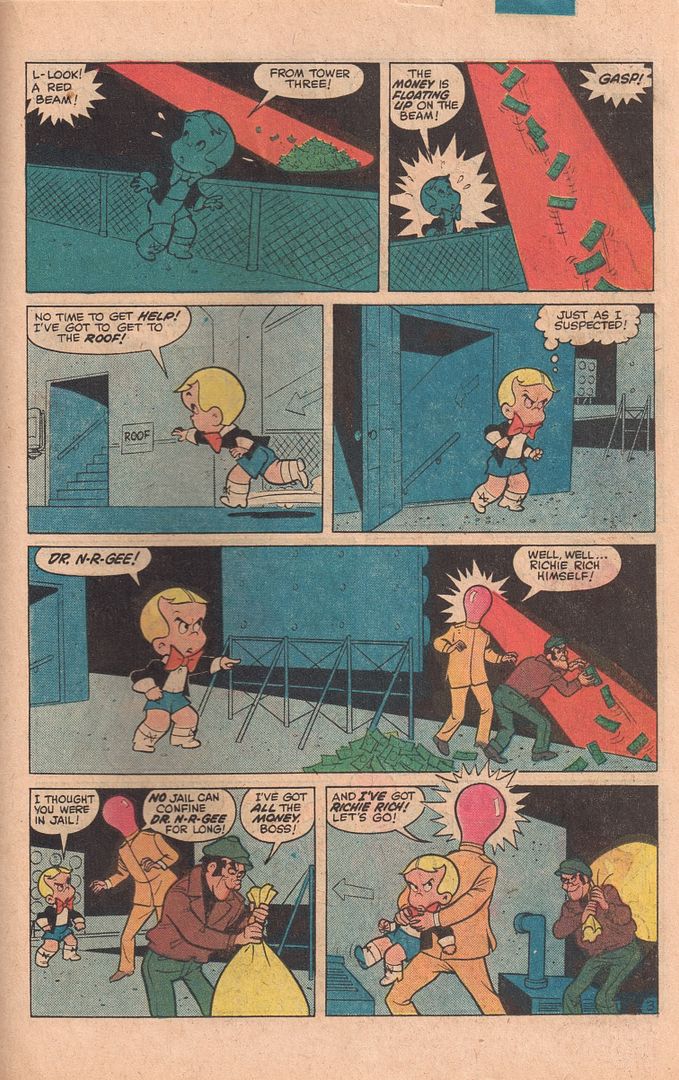
Er... "spending some" of his character? Money? Wallet collection? Proofreaders to the front of the store! But I digress. Aside from the overtly "socially conscious" tone suggested here -- which could be effective if handled correctly, but, especially in the wake of the financial crisis and recession, could just be an excuse for crude capitalist-bashing of one sort or another -- the notion of Richie as a globe-trotting adventurer is certainly nothing new. Thanks to my long-running RICHVILLE RUMINATIONS column in THE HARVEYVILLE FUN TIMES!, I suppose that I have written more about Richie for public consumption than just about anyone in existence. My first series of RUMINATIONS columns for THFT!, back in the early- to mid-90s, covered the many, many ways in which Richie led an adventurous existence in the Harvey Comics of the 60s, 70s, and early 80s. The sight of the (bulked-up) Cadbury packing heat on the cover of Ape's first RICHIE release doesn't faze me; Richie himself was known to handle firearms to good effect on many different occasions. As for faceless minions ganging up on Richie's gang, we have seen that too, thanks to such "classic" adversaries as The Condor and Dr. N-R-Gee. Those baddies don't really qualify as "hip," "cool," or "cutting-edge," though, which is probably not going to be an issue here (despite the reported contributions of old Harvey hands Sid Jacobson and Ernie Colon to an early Ape issue). The question is, will political correctness trump the simple desire to tell a good, rousing adventure tale?

The appearances of the characters aside, the cast also reflects treatments seen in past RICHIE stories. Cadbury was always a remarkable athlete and "Renaissance man" -- heck, Dos Equis' spokesman could have taken a few lessons from the Riches' butler -- so the acquisition of a lantern jaw and a few more layers of muscle (along with, strangely, a pair of Mickey Mouse-style gloves?) won't be too much of a stretch to imagine. I gather than iRona (I hope that that name doesn't get Ape in copyright trouble) is simply a sleeker version of the Riches' robot maid, with up-to-date computer technology added to augment her already superhuman strength (and, if the Hanna-Barbera cartoon version of RICHIE RICH is to be believed, Transformers-style body-modification abilities that predated the original TV version of Transformers itself). iRona bears a certain unsettling resemblance to the tit(t)ular star of a Phil Foglio XXXENOPHILE story, "I Swing the Body Electric," but I am confident that Ape won't go THAT far in the course of its "reimagining" activities. Richie's girlfriend Gloria's role isn't described above, but "tomboyish ass-kicker" is a pretty good guess as to her personality -- and, wouldn't you know, even that idea has some precedent (cf. the Gloria of the live-action Richie Rich movie from 1994 starring Macaulay Culkin). As for Dollar the dog, well, as long as Ape can stay an arm's length (or ten) away from the Frank Welker-voiced "comic relief" character of H-B days... To paraphrase Sigmund Freud, sometimes a dog should just be a dog.

The previous observations should serve to convince you that Ape's new version of the RICHIE RICH "universe" is built on a sturdier foundation that you might guess. What is yet to be determined is the attitude that the creators, and particularly the writers, will take. A lot of comics fans have admitted to disliking the Harvey Comics version of Richie because of the (mistaken) perception that the flaunting and/or abuse of vast wealth was all that Richie brought to the table. In its zeal to attract a "new generation," will Ape go too far in the other direction and turn Richie into a smug, preachy character who pays obeisance to all the appropriate secular "gods"? (Dr. N-R-Gee and The Iceman in a global warming story, anyone?) I really do hope that Ape does this project right. Richie is too enjoyable a character to simply be left on the "diamond heap" of comics history.

Sunday, September 26, 2010

Zine Review: THE HARVEYVILLE FUN TIMES! #74 (Summer 2010)


Conflict of interest? Yup, and who cares? I've been a contributor to Mark Arnold's "Harvey-themed" zine since 1993. This is the next-to-last issue before Mark hands over the reins to another individual... and it features the next-to-last RICHVILLE RUMINATIONS column that I plan to produce, though I'll certainly continue to post Harvey-related matter on this blog. The luscious "Queen of the In-Crowd," Bunny Ball, is this issue's featured cover girl. Jerry Boyd interviews BUNNY artist Hy Eisman and also provides an article on the BUNNY title, illustrated with enough eye-crossing late-60s psychedelic imagery to satiate even the "Deadest" of "Heads." Boyd throws in a nice reminiscence of the old Palisades Park theme park in New Jersey, where "Casper's Ghostland" was once one of the attractions. Throw in Mark Arnold's interview with SABRINA THE TEENAGE WITCH creator George Gladir, Joe Torcivia's penultimate "dead-tree" version of "The Issue at Hand", Milton Knight's memories of a brief sojourn at Harvey in the late 70s, and more reprints of Harvey-related ephemera than you can shake a Good Little Witch's wand at, and this is a bargain at $10.95 for 60 jam-packed pages. Even the formatting of the issue will surprise you (though not those who remember the earliest issues of SIMPSONS COMICS). Buy it, already!

Friday, January 1, 2010

Comics Review: STAR COMICS ALL-STAR COLLECTION, Volume 1 (Marvel Comics, 2009)

My "Silver Age of Comics Collecting" (not to be confused with the "Golden Age" of 1975-1982, during which I concentrated solely on RICHIE RICH) began in a peculiar way that sort of typifies my decidedly atypical comics-collecting experience. Here's how I described it in a piece I wrote for THE HARVEYVILLE FUN TIMES! (issue #41):

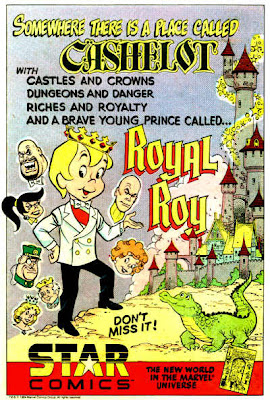
In the Spring of 1985, in a last, defiant gasp of my overweening interest in "classic" Harvey comics, I buy a small number of Marvel's late and decidedly unlamented Star Comics when they start appearing on the sparsely populated magazine racks of a small food store located down the street from the Brown [University] Graduate Center. In this year of CRISIS ON INFINITE EARTHS, I derive considerable pleasure from the likes of TOP DOG, PLANET TERRY, and EWOKS. Don't get me wrong -- even I can see that the Star offerings are, by and large, pale imitations of Harvey comics (especially the notorious ROYAL ROY, which pisses me off... uh, royally). What excites me the most is the presence of creator credits. At long last, I have incontestable proof that the artist who I always thought was Warren Kremer was, in reality, Warren Kremer! I'm so happy to be proved right that I compose a personal letter to Mr. Kremer on my manual typewriter (yep, this WAS a while ago...) and send it to the Marvel offices.

If it sounds like I'm setting up the duckpins for a revisionist bowl-a-rama, you're correct... up to a point. Marvel's recent out-of-nowhere release of the first of a planned series of volumes reprinting the (short-lived) exploits of Star Comics' original creations was a pleasant surprise, given the generally low esteem in which these comics are held. I couldn't help but snap the book up, and I'm delighted to say that these works hold up much better than I'd recalled -- with one big, gold-plated, starts-with-Rs exception. It's no Dark Horse LITTLE LULU line, for sure, but you could certainly do worse than purchase this collection with an eye towards getting a young child interested in comics. If you really want to go "above and beyond," you might also get a couple of the Dark Horse HARVEY COMICS CLASSICS volumes and do a direct "compare-and-contrast," so as to fully understand the tangled Star-Harvey relationship.


Star Comics came into existence because the notoriously deal-happy Harvey family couldn't make a deal. The original Harvey Comics line, unable to cope with the "brave new world" of the direct-market distribution system, ceased publication in 1982. Over the next several years, Marvel, seeing an opening in the kids' comics market -- an opening that would become a gaping maw once Western Publishing finally gave up the ghost in '84 -- dickered with Harvey over the rights to print Harvey comics. When the two parties couldn't come to terms, Marvel hired away some of Harvey's idled personnel and set up shop for itself, giving the line a new title in order to establish a cordon sanitaire between the newbies and the superhero-dominated Marvel Universe. Featuring a mixture of licensed properties and original creations, Star sputtered along for a couple of years before the new line was jettisoned and the few ongoing titles (ALF and BARBIE, most notably) were gathered under the Marvel banner. While no original title lasted longer than TOP DOG's 14 issues, it is these titles that have come to symbolize what minimal profile Star has retained among comics fans -- and it is these titles that are at the center of the controversy over whether Star really was just a bald-faced Harvey knockoff.


ROYAL ROY is the one title reprinted in this collection that truly deserves all the scorn heaped upon it. Roy was a Richie Rich ripoff -- nothing more, nothing less -- and the cast of supporting characters have direct parallels to Richie's cast in a manner not seen again in popular culture until The Lion King's "borrowings" from Kimba the White Lion. Reportedly, young prince Roy's facial features had to be changed at the last minute to make the resemblance to Richie less grindingly obvious. The change in setting from Richville to the kingdom of Cashalot didn't fool anyone -- in fact, the decision to make Cashalot a rich kingdom seemed calculated to twist a painful knuckle into RICHIE fans' spines -- and, I would argue, gave what was already an idea doomed to failure even less of a chance to succeed. For all of his immense wealth, Richie remained, at heart, a fairly typical American kid who could "connect" with readers in a manner that the regal Roy never could, not even when he took a "commoner" girl friend, Crystal Clear (read: Gloria Glad), in ROYAL ROY #2. The cynicism of the whole enterprise almost beggars (heh) belief. Marvel's decision to cancel the title after six issues (in, I might add, the face of the Harvey family's most justified lawsuit ever) didn't remove the bad taste from people's mouths. Indeed, the whole affair wound up curdling Star's overarching reputation for good. More's the pity, as the other, legitimately original Star creations ranged from good to excellent.


While less ambitious than PLANET TERRY (the first "children's comic" of my acquaintance to essay a continuing story line) and less artfully produced than WALLY THE WIZARD (to my mind, the real revelation of this collection), Top Dog was at the beginning, and probably always will be, my favorite Star character. The concept is simple enough -- "typical kid" Joey Jordan meets and adopts (in a manner of speaking) an opinionated talking dog who's something of a "Renaissance mutt" -- but the execution is charming. Kremer, inked by Harvey associate Jacqueline Roettcher in a manner that will be instantly familiar to anyone who's read Kremer's work on RICHIE RICH AND CASPER in the 1970s, makes TD, Joey, and the supporting players very appealing. Lennie Herman's scripts for TD #1-#3 are also excellent, though the Cold War-flavored "Spies" (TOP DOG #2) has aged a bit. (The prolific Herman actually died before the first Star comics appeared on the shelves; it'll be interesting to see how the stories' quality will hold up once other hands take the controls.) If I have any modern complaints with these engaging stories, they lie in (1) the use of a wealthy snob, Mervin Megabucks, as Joey and TD's main antagonist -- he's much too reminiscent of Richie's "mean" Cousin Reggie van Dough for my taste -- and (2) the fact that TD, wisecracker though he may be, isn't as big of a smart-aleck as he probably ought to have been. He's a Bugs Bunny type, but rendered in pale pastels. If Herman had combined the likability of Richie Rich with the sassiness of, say, a Hot Stuff or a Little Audrey, then we would really have had something.


PLANET TERRY looks a lot like a conventional Harvey comic -- same page layout, same division into "chapters" with different titles, etc. -- but just look at the characters once and the novelty is obvious. Terry, an (extremely) prematurely graying teenager, is on a galaxy-spanning quest to find his lost parents. Along the way, he acquires a comely female robot and a scaly green muscle-monster as allies. The temptation to link Terry to Timmy Time -- the young, white-haired time-traveler (created by one of Alfred Harvey's sons, BTW) who appeared in a single issue of Harvey's RICHIE RICH AND TIMMY TIME (1977) -- is as strong with me as "The Force" was with young Luke Skywalker, but I don't honestly think that Terry was a ripoff. Star had already tweaked the Harvey family's nose once with Royal Roy, so what could have been gained by antagonizing them again? Terry's adventures (which ceased prematurely when the comic was cancelled with issue #12) are good, solid "space opera" with definite Star Wars overtones. Even though the story arc was never resolved, I only read a couple of issues of the comic, so a lot of the future goings-on will be entirely new to me.


Speaking of new experiences, I had never read WALLY THE WIZARD before sampling issues #1-#2 in this collection. Perhaps I've been softened up by a combination of the HARRY POTTER novels and the ongoing Wizards of Mickey story line in MICKEY MOUSE AND FRIENDS, but I found these adventures of an apprentice wizard in a vaguely defined medieval setting to be utterly winning. For all of Wally's boss Marlin's muttering "To think that I had my pick of apprentices!", Wally's mastery (or lack thereof) of magic isn't really germane to his success; he relies more on a combination of quick-wittedness and thoughtfulness to get his ju-ju jobs done. In "A Plague of Locust" (WW #1), Wally's willingness to help a dragon's offspring turns the dragon into an ally in a battle against a metal locust (Duke Igthorn is probably feverishly taking notes even now) that is threatening the royal family. Wally then wins "The Magic-a-Thon" (WW #2) through what Marlin, somewhat patronizingly, describes as "sheer intelligence." Wally's creator, Bob Bolling of LITTLE ARCHIE fame, peppers "Locust" with sight gags and verbal jokes while also breaking the "Harvey boundaries" by using multiple splash panels and three-tiered pages. Howie Post (with inker Jon D'Agostino) takes up the drawing reins from Bolling in #2 and gives all of the characters that goofy Post "spin" so familiar to Harvey Comics readers, while Sid Jacobson's plot is every bit as good as Bolling's. WALLY, like PLANET TERRY, lasted 12 issues even though, unlike the other titles mentioned above, it did not lean on Harvey (in the time-honored manner of the drunk leaning on the lamp post: "for support, not illumination") as a clear aesthetic inspiration. Too bad: this is one comic that could (and probably should) have survived Star's later "engulfment" by Marvel.

Kudos to Marvel for finally making this material available again. These characters, for the most part, deserve a chance to gain the attention of a new comics-reading generation.

Friday, October 23, 2009

What Was That "Mask" Manhandling?

Over the last several months, I've enjoyed reading and commenting on Gregory Weagle's "rants" (read: reviews, but of a very unique type) on episodes of DuckTales. Greg has previously done the other "Golden Age" DTVA series, so I was familiar with his style, and, by and large, I tend to agree with his assessments of individual episodes. This past week, however, we finally "crossed swords" over the episode "Duck in the Iron Mask." "Mask" has always been one of my favorites, but Greg heartily disliked it.

This happenstance dovetailed ("ducktailed"?) with a suggestion by my good friend and fellow DuckTales devotee Joe Torcivia -- with whom I wrote an index to the series back in the day -- that I use my blog to "revisit" the series. With DT's silver anniversary a mere three years away, why not look at the episodes afresh and see whether my opinion of them has changed (and, if so, why). Thanks to the Internet and other resources that were not available at the time we did our index, there should be something meaningful to add to the commentaries on most, if not all, of the episodes. Work-related time constraints preclude my starting this work until at least the beginning of 2010 -- and, with Boom! Comics having restarted the American Disney comics "engine," I may be even more hard pressed to get the work done than I'd originally anticipated. Greg's review of "Mask," however, provides me with the perfect opportunity to do a "dry run" of sorts, in the guise of defending my particular view of this ep. I will split my response into several parts, all of which I hope to complete over the next couple of days.

A while back, I wrote a rather heartfelt piece for THE HARVEYVILLE FUN TIMES! in which I decried the lack of respect and recognition given to DuckTales these days. The specific context was Gemstone Comics' decision to reprint Marv Wolfman's lackluster multi-part serial "Scrooge's Quest" over Bob Langhans' far superior -- and far truer to the spirit of the TV series -- "The Gold Odyssey." Justice was eventually done, as "Odyssey" got a trade paperback of its own, but the larger point still holds. This terrific series -- the trigger for the TV-animation boom of the late 1980s and early 1990s -- needs to be celebrated whenever possible. Hopefully, you'll enjoy the "revised standard version" of my "take" on what I consider to be one of the show's most imaginative and entertaining episodes.

Friday, August 7, 2009

Book Review: CREATED AND PRODUCED BY TOTAL TELEVISION PRODUCTIONS by Mark Arnold (Bear Manor Media, 2009)

Over the past two decades, Mark Arnold has done yeomanlike work in preserving memories of various pieces of fondly recalled pop culture that have, for one reason or another, fallen by the wayside (though fond memories of them may linger on). Most of his efforts have gone towards commemorating the legacy of Harvey Comics in his fine fanzine, THE HARVEYVILLE FUN TIMES!. For more than 15 years, I've written the RICHVILLE RUMINATIONS column for that magazine and therefore can testify directly to Mark's love for the subject matter. Now, Mark has favored us with a book on the unjustly overlooked output of Total TeleVision productions, a cartoon producer in the paradoxical position of having created several of the best-loved animated TV series of the 1960s, yet currently languishing in such obscurity that (gasp!) no one has even bothered to create a Wikipedia page wholly devoted to the company. Though Mark's book isn't as tightly organized as I might have liked, he presents by far the most detailed and enlightening history of TTV that has appeared to date.

Past reference works that have touched upon TTV's output have tended to be condescending at best and disdainful at worst, often making disparaging remarks that compare the company's work unfavorably to that of the Jay Ward Studios. This is an understandable parallel to draw, given that (1) both the Ward shows and the TTV efforts were sponsored by General Mills; (2) both groups of shows were animated by the same limited-animation factory in Mexico; (3) a number of network and syndicated "compilation series," such as The Dudley Do-Right Show and Go-Go Gophers, indiscriminately mixed Ward and TTV product together, virtually forcing viewers to do comparisons; (4) to be perfectly frank, Ward's shows (especially those starring Rocky and Bullwinkle) were legitimately funnier that TTV's. Arnold, however, provides some helpful information as to WHY such TTV series as Underdog, Tennessee Tuxedo and His Tales, and King Leonardo and His Short Subjects took a different tack.

When Buck Biggers, Chet Stover, Treadwell Covington, and artist Joe Harris formed TTV in the late 50s, the goal was to follow Ward's lead and produce shows sponsored by General Mills (for whose advertising agency Biggers, Stover, and Harris all worked at the time). The focus of TTV's output, however, was intended to be different from the outset. Wary of Ward's prickly reputation and penchant for firing jokes that sailed over the heads of (most of) his audience, GM wanted shows that, while still watchable by sophisticated audiences, were a bit more "kid-friendly." TTV shows, as a result, emphasized characterization and narrative over "boffo yuks." This approach sometimes puts these shows in the awkward position of "falling between two stools" -- not being funny enough for the wiseacre crowd that loved Ward's material, yet being too funny to be taken entirely seriously. (This was especially true of Underdog, which spent its active life in perpetual tension between authentic, cliffhanger-ridden superheroics and outright parody.) It did, however, have the advantage that when such a "halfway-house" methodology was appropriate to get a specific point across, TTV's work could be very effective indeed. This is why, after considerable reflection, I've come to regard Tennessee Tuxedo, rather than Underdog, as being the best TTV series. Tuxedo was one of several "educational" cartoons that popped up in the early 60s in response to complaints (most famously by FCC Chairman Newton Minow) that animated TV fare didn't teach kids anything useful. Similar beefs have been registered in the intervening decades, resulting in occasional classics (Schoolhouse Rock) and a whole lot of schlock (Histeria!, Cro, most "green-themed" cartoons). Tuxedo was the best of that first generation of "edu-toons," which also included The Funny Company and The Big World of Little Adam. Unlike those series, which leaned heavily on live-action documentary footage, Tuxedo wrapped its soft-pedaled nuggets of info in the appealing package of wise-guy penguin Tennessee Tuxedo (would you believe, voiced by Don Adams?) and dimwitted walrus Chumley getting required data from Phineas J. Whoopee, the genial "man with all the answers." The fact that Tuxedo was 100% animated (with assistance from Whoopee's "three-dimensional blackboard") permitted the educational material to slide smoothly down the throats of the youngsters for which it was intended. As Arnold points out, while some of the technology described in Tuxedo has dated, the method of delivery displayed in the cartoon remains highly effective.

Tuxedo and Underdog, like most of the other TTV features, relied upon repetition of catchphrases and the like as a means of ramming their points home. This has the advantage of rendering the shows difficult (if not impossible) to forget, yet, when taken to extremes, it can become irritating. Arnold notes the major repetitive features of these shows and additional TTV products such as The World of Commander McBragg, The Hunter, Klondike Kat, Go-Go Gophers, and Tooter Turtle, yet does not "string the thread through the popcorn" and discuss TTV's output as a complete entity. Instead, we get series-by-series recaps, some of which are better than others. Another structural flaw in the book is the heavy emphasis upon lengthy quotations from Biggers, Stover, Covington, Harris, Bradley Bolke (the voice of Chumley), and others. Aside from not being adequately edited for clarity, these quotes should have been set off in paragraphs by themselves, allowing Arnold to fill in the gaps with more writing of his own. As it is, I had to read the book several times before the narrative really started to "flow" and make coherent sense.

Despite the aforementioned problems, Arnold's book, along with Biggers' and Stover's own book of reminiscences (also available from Bear Manor Media), will be the standard reference work on TTV into the foreseeable future. Arnold is especially good when describing TTV's demise in the late 1960s and the story behind the company's last, unproduced series, The Colossal Show. This series, which was intended to star a Sergeant Bilko-style character in ancient Rome, "lives on" to this day in the peculiar form of a one-shot comic book commissioned from Gold Key after TTV had reached a "handshake deal" with NBC to produce the show (General Mills had dropped out of the picture several years before, and TTV's actual last series, The Beagles, was sponsored by a toy company). NBC eventually backed out of its commitment, but the comic book remains, preserving what The Colossal Show might have looked like, in the manner of prehistoric tree sap preserving an ancient insect. The failure to produce this series -- which would undoubtedly have been far, far better than Hanna-Barbera's later The Roman Holidays -- is probably the one "pseudo-tragedy" in TTV's relatively short, but genuinely distinguished, history. Thanks, Mark, for finally doing TTV some justice.

Sunday, February 8, 2009

Retrospective: A Crash Course in Panelology at MoCCA

This past Jan. 15, thanks to a generous offer from longtime friend and HARVEYVILLE FUN TIMES! head honcho Mark Arnold, I made my debut as a comics panelist at a get-together feting the ongoing (through Mar. 15) Harvey Comics Art Show at NYC's Museum of Comic and Cartoon Art. While I was disappointed that the surviving "Harvey Legends" invited to the panel weren't able to make it, a few of the "young Turks" who worked for Harvey during the final years of its original 1940-1982 incarnation were among the 20-25 or so on hand, and an enjoyable and informative time was had by all. Hopefully, I contributed something of merit to the festivities.


(L-R) Paul Maringelli, CEB, Mark Arnold, Jim Salicrup, Rick Parker, Angelo DeCesare

Jan. 15 was a bitterly-cold, zero-bright day up and down the East Coast. After I fulfilled my teaching duties (8-10 a.m. Stats class), Nicky and I, suitably bundled up, caught a midday train from Baltimore's Penn Station and trekked up to NYC's version of same. We ate lunch with Nicky's older sister Lisa and her little nanny-charge at an Irish-style "oyster pub" across from Lincoln Center and whiled away some time at the giant Barnes & Noble bookstore nearby before heading downtown to MoCCA's unpretentious office-building location on Lower Broadway. There, I found Mark and the MoCCA employees setting up for the panel. While waiting for others to arrive, I had a chance to look around the exhibit, which had enjoyed its original exposure at the Cartoon Art Museum in San Francisco. Items on display included original art from Harvey vets Ernie Colon, Sid Couchey, Howie Post, and Warren Kremer, various sorts of character merchandise (including some of the very nice Harvey maquettes produced by Electric Tiki), Harvey calendars distributed to store owners who handled the comics back in the day, and a monitor showing Famous Studios cartoons. I was pleased to see a big stack of Mark's compendium of THFT! columns and features on prominent display at the front desk. But who would be coming to (possibly) make purchases of same? Nicky and I had debated on the way down as to the type of crowd the panel would get. I knew that Mark had e-mailed many folks with the news, but, between the vagaries of the work week, the frigid weather, and the fact that the panel was being held after normal MoCCA operating hours, I didn't figure that the attendance would be that high. To my dismay, I learned soon after arriving that Colon, Post, and former Harvey art director Ken Selig had all had to beg off for various reasons. I knew that Couchey was already a "scratch" because he was visiting his son in (I believe) North Carolina. As things turned out, most of the attendees appeared to be MoCCA "regulars" -- not that there was anything wrong with that, but the general public so badly in need of Harvey "enlightenment" was conspicuous by its absence. Perhaps a sandwich-board sign posted outside the building announcing the panel would have helped?


Mark, Joe Torcivia, and I ducked out for a quick bite before going back upstairs. As the "crowd" trickled in, I got a rare change to have my ego massaged when I signed a copy of Mark's book. Then MoCCA's Jim Salicrup called the panel to order. Two former Harvey staffers -- Paul Maringelli and Angelo DeCesare -- were invited to "come on up" and join me, Mark, Jim, and Rick Parker. This made for a tight squeeze, as Paul was forced to sidle in next to me on the far left of the panel table. (My friend Mark Lungo later commented to me that it was rare for me to be on the far left of anything.) Nicky, who was sitting in back and taking occasional pictures, later told me that the guys filming the panel had a difficult time getting Paul in the frame with the rest of the panelists; usually, all that showed up were his waving hands. Those hands ending up waving quite a bit, as Paul turned out to be the most talkative of the "Harvey hands" regarding the old days at the company. Mark provided the "global" Harvey perspective, while I weighed in with observations from a fan's point of view. That is, when I got chances to speak. I've never been keen about interrupting other people's conversations, so that kind of inhibited me when it came to "breaking in" with a comment. It was all good, though, as I figured the audience would be better served hearing from people who worked for Harvey, as opposed to a guy who'd "merely" been a RICHIE RICH fan since 1975 and a columnist for THFT! since the early 90s. I did manage to point out that the RICHIE stories, in particular, contained more daring material (especially during the "James Bond" era of the 60s) than one might think feasible for a "children's comic." Witness a story like "The Fantastic Weapon," in which a kindly scientist is shot to death and dies on panel. If only Ernie Colon had been there to address the issue.


Yours truly, Mark Arnold, and Joe Torcivia

The panel lasted about 90 minutes. Afterwards, there was a reception, but Nicky and I had to catch a late train so that I could get back for Friday's classes. Joe also had to hit the road and accompanied us on the trip back to Penn.

It was a fun experience. Let's do it again sometime! (Or, at least, put out a sequel to the THFT! compendium volume. Eh, Mark?)

Sunday, September 7, 2008

A Call from Sid Couchey

I'm temporarily postponing my review of the June issue of WALT DISNEY'S COMICS AND STORIES, and for a darn good reason. This past Thursday afternoon, I received one of the biggest surprises of my 30-plus years as a card-carrying comic-book fan when I got a phone call from former Harvey Comics artist Sid Couchey. Sid -- the definitive artist for LITTLE DOT and LITTLE LOTTA comics in the 50s, 60s, and 70s, and a regular delineator of RICHIE RICH stories during those years as well -- certainly wasn't the first pro with whom I'd ever exchanged words, nor even the first Harvey creator; I'd both spoken with and written to RICHIE RICH comics great Ernie Colon back in the early 80s. What made this contact unique was that I'd never had any dealings with Couchey whatsoever.

Sid was responding to my most recent RICHVILLE RUMINATIONS column in issue #70 of Mark Arnold's fanzine THE HARVEYVILLE FUN TIMES!. In that piece, I corrected an error made by Jerry Beck in the introduction to the RICHIE RICH volume of Dark Horse's ongoing HARVEY COMICS CLASSICS series. Jerry had claimed that "Couchy" (sic) drew the first RICHIE story in RICHIE RICH #1 (December 1960), when, in fact, Ken Selig did the honors. The goof struck me as especially peculiar because, as I noted, "Couchey's artwork is so distinctive that it's practically impossible to misidentify, even if one tries." Here's a sample of Sid's angular, uniquely stylized -- er, stylings -- from the 60s RICHIE tale "It's a Wild Idea":

In an earlier THFT! column, I'd labeled Couchey "the Grandma Moses of comics," and hopefully you can see why. Sid brought that comment up, by the way, but not to criticize me for it... simply to note that his home in upstate New York is not that far from the real Grandma Moses homestead.
Sid is pushing 90 but is still quite active locally and is preparing to celebrate his 50th wedding anniversary. (If you can believe it, he actually proposed to his wife Ruth through the medium of a LITTLE LOTTA story in a 1960 issue of LITTLE DOT.) I'm glad that he has gotten some attention for his work in these latter days, especially since most of his comic-book labors were devoted to characters who were, shall we say, not among the most inspired creations Harvey ever midwifed. As a loyal RICHIE RICH reader, I certainly saw plenty of the dot-loving Little Dot and the food-guzzling, super-strong Little Lotta, but only as five-page backup features in the RICHIE books. Couchey hardly got to do any 10- or 15-page adventure tales with these characters; one of the very few exceptions was a clever DOT story produced during the heyday of The Beatles, entitled (logically enough) "Dot's Rock 'n Roll Adventure":

Most of Sid's RICHIE RICH efforts were five-page quickies as well, but occasionally he'd be called upon to pen a longer story, and he did produce some excellent ones. At the top of this list is "Crash Landing" (RICHIE RICH #43, March 1966), a frankly weird, yet unsettlingly memorable, tale in which Richie and some companions crash on a Communist-run island. Without tearing down a single wall -- or even rhetorically urging the Commie leaders to do the same -- Richie and friends convince the government to reform itself. Don't laugh; Sid and his writer somehow made it all work. (How else were they supposed to pull it off -- by liberal use of radioactive cigars and poisoned beard trimmers?)

During our brief chat, Sid came across as a thoroughly nice man. I am flattered and grateful that he was moved to contact me, and I do intend to keep in touch with him. I've said it before in other venues, and I'll say it again: "My life as a fan" has led to some of my most cherished friendships and some amazing encounters. This one, though, truly knocked me for a loop.

Monday, August 25, 2008

Welcome to my Brand Spanking New Blog!

Thanks, Joe Torcivia, for inspiring me to finally do this!

I first started NEWS AND VIEWS as a column in issue #2 of the Disney TV animation APA WTFB in 1992. I stuck with it until the mag's demise in 2003 but continued to keep my hand in with a regular column for Mark Arnold's Harvey fanzine THE HARVEYVILLE FUN TIMES!. When my wonderful wife Nicky inaugurated The BaratCave, our Barat family home page, in 2005, I started posting reviews there. All my reviews from 2005 to August 2008 are archived there in perpetuity. Starting NOW, however, they'll be posted right here!

What can you expect to find here? Reviews of Disney comics, first and foremost. I used to write regular letters of comment to the Disney comics letter columns but ultimately chafed at the space limitations. In this format, I can let myself go (um, did that come out right?). I'll also post reviews of books I've recently read (both related to comics and otherwise) and DVDs I've recently perused (I generally do the latter while walking on the treadmill, so it takes me a good while to slog through a multi-disc set). Any other posts related to sports, politics, work, etc. I will keep to a minimum, but I'll include appropriate links where appropriate. Outright ranting and conspiracy theorizing will be conspicuous by their absence. I am, however, generally at odds with the sociopolitical views of most of my colleagues in academia and fandom, so expect the occasional shot across the bow.

My teaching schedule this semester (which includes mentoring a pair of students doing independent research projects) is rough, but I hope to post on at least a weekly basis. Please be patient, especially during the early shakedown portion of the school year. Comments are welcome at any time.

Thanks for visiting!