Showing posts with label Giorgio Cavazzano. Show all posts

Thursday, July 11, 2013

DUCKTALES RETROSPECTIVE: Episode 44, "Raiders of the Lost Harp"


"Raiders of the Lost Harp" was one of only two DuckTales episodes released in VHS format to be granted the honor of titling and illustrating a two-episode collection.  The choice, along with that of "Duck to the Future," no doubt relates to the fact that the title parodies that of a wildly successful movie, so "Duck newbies" deciding upon a video purchase would be more likely to gravitate to it on the store shelves.  There is a difference, though: "Raiders" deserved to be showcased.  Not that "Duck to the Future" was terrible, but everyone -- and I mean EVERYONE -- familiar with DuckTales and the wonderful "comics culture" that birthed it seems to adore the "decidedly Barksian feel" (cf. GeoX) of Scrooge and HD&L's Trojan trek.  "Home Sweet Homer" may have probed more deeply into the world of Greek mythology, but for the object of the quest in "Raiders" to be a lost treasure -- now, that's something all Duck fans can readily sink their bills into.

Remarkably, "Raiders" manages to maintain a Barksian flavor throughout, even though the structure of Cherie Dee Wilkerson's story is rather different from that of a "typical" Barks treasure hunt -- and that very much includes the Trojan-themed "Horsing Around with History" (UNCLE $CROOGE ADVENTURES #33, July 1995, art by William Van Horn), the then-nonagenarian Barks' last original Duck script.  Scrooge's snaffling of the headlined singing harp is described with crisp dispatch in the first half of Act One; for the rest of the episode, we are treated to character interactions, Magica De Spell's machinations, and, most memorably, the stone Minotaur guardian's relentless quest to recover the purloined object of its ages-long vigilance.  (In that last respect, the use of "Raiders" in the ep's title acquires an extra level of irony; the Ducks really are "raiding" the treasure here, which makes the fearsome Minotaur something of a good guy.)  Admittedly, this authorial feat isn't as groundbreaking as the development of Launchpad's character seen in "Hero for Hire," "Top Duck," and "Where No Duck Has Gone Before," the exploration of Gyro's psyche in "Sir Gyro de Gearloose," or such off-the-reservation late-first-season offerings as "The Uncrashable Hindentanic" and "Double-O-Duck."  But, when it comes to a race between the best DT eps, "Raiders" is hot on the heels of this peerless peloton, pursuing it with the dogged determination of... well, a Minotaur scorned.

"Raiders" is one DT ep for which I would dearly like to know the specific contributions of story editors Tedd Anasti and Patsy Cameron.  Not that I don't think that Cherie Wilkerson was capable of creating this gem all by herself; her list of animation credits includes the "G1" My Little Pony, the original Transformers, and Batman: The Animated Series, among others.  It's just that her other work for Disney, most of which appeared in DISNEY ADVENTURES DIGEST in the early 90s, could best be described as... erratic.  Her two DuckTales efforts, "The Disappearin' Bullion Blues" and "The Power of the Pyramids," aren't bad, on balance, but the frantic pacing seen in these stories is a very far cry from the smooth development on display in "Raiders."  Magica co-stars in "Pyramids" but speaks standard English dialogue, in contrast to the extremely broken English she uses in "Raiders."  Wilkerson's Tale Spin stories are even more problematic.  We know that Wildcat is meant to be a loopy "Reverend Jim" type, but, in "Congratulations, You Have Just Won...," he talks like an actual hippie, calling Rebecca Cunningham a "capitalist business pig."  Don Karnage is similarly out of character in "Mission Maybe Sort of a Little Impossible," the first TS comic story published in America, probably best known for artist Giorgio Cavazzano's mistaken use of *gulp* human supporting players.  "Shine a Little Light," the "This-Is-A-Hanukkah-Story-But-We're-Not-About-to-Admit-It" offering in Disney Comics HOLIDAY PARADE (1990), completes a dubious sort of trifecta by sanding away Colonel Spigot's notorious Thembrian lisp and making him a more-or-less-standard ranting blowhard.  Tack on the presence of "time-share condos" in putatively-1930s Usland, and you'll understand why I'm so curious about the true genesis of the "practically perfect" "Raiders."  Perhaps Wilkerson was simply more motivated when writing the episode script than she was when hacking out the comic-book stories, but that explanation seems overly pat to me.

I've never watched The Exorcist (I have precious little stomach for horror movies of any stripe), so naturally I was unaware that the opening scene of "Raiders" was parodying that film's "archaeological dig" sequence.  The weird little song sung by Scrooge's workers is so distinctive that I can't help but feel that it's a parody of something, as well.  As opening gambits go, this is definitely one of DuckTales' best.


Right at the start, we get an intriguing indication as to the level of care taken with this episode.  As the Ducks break into the "lost city of Troy," note how Huey is consistently depicted as being somewhat nervous about what lies ahead.  He lets his brothers go in front of him when the Ducks climb up the stairs to the wall...

... hesitates just a bit before following Scrooge, Dewey, and Louie down the tunnel...

... and, of course, is the first duckling to go all "Frenchified" on us and offer to "give up" when the helmeted and sword-swinging HD&L encounter the Minotaur statue.  Perhaps Huey was simply having a bad day, or perhaps he had some strange early inkling that the discovery of the lie-detecting harp was going to cause problems for all concerned.

It has always struck me as rather "conveeeeeenient" that all of the treasures of ancient Troy just happen to be located in one place, and in near-pristine, well-organized fashion, to boot.  In "Horsing Around with History," Barks followed a more conventional approach and spent the majority of the adventure detailing the Ducks' maritime investigation, culminating in their discovery of ruins (including the well-preserved Trojan Horse) in caves on a sunken island.  The reason for "Raiders"' relative short-shrifting of the treasure find is, of course, that the real point of the story is the manner in which the characters tangle over the episode's magical McGuffin, the singing harp.  All else is basically window dressing, albeit very classy window dressing.  The treasures of Troy might just as well have been lined up like tenpins through some sort of magical intervention... which, come to think of it, may serve to explain why the torch in the tunnel spontaneously ignited just as the Ducks happened by.

Speaking of magic, another nice serving of subtlety is baked into Scrooge's comments regarding his feelings about the validity of magic and superstition.  Scrooge's claim that "mindless superstition" has no place in exploration and treasure-hunting seems to be contradicted by his later declaration that he's seen many things that "only magic" could explain.  In fact, Greg seemed surprised that the harp didn't call him out for speaking a falsehood in that latter comment.  However, it doesn't take a lot of thought to recognize that there's no conflict here.  In the former case, Scrooge is trying to say that superstition will not dissuade him from seeking out treasures, while in the latter, he is affirming that he realizes that magical powers do exist (how could it be otherwise when one of his most persistent foes is a witch?) and that he does respect them.  Ironically, Scrooge gets into trouble in this ep by overlooking the possibility that some magical force may be guarding the carefully hidden harp.  One would think that this might affect his attitude in the future.  Not hardly; in the very next episode, "Luck O' the Ducks," he's once again mucking around with a "magic-tinged" treasure without giving it a second thought.

This is arguably the closest that Magica De Spell has ever come to being depicted as something of a supervillain.  We know from way back, of course, that she's capable of changing her appearance, and she adopts several memorable guises here, including what seems to be a tribute to an old Carol Burnett sketch character...
... but she also augments her arsenal with goons (only one, true, but that's a necessary step towards having a whole gang of them, Batman-TV-series style) and a "themed" mode of transportation that even outdoes the "Satan 666 Jet of Death" seen in "Send in the Clones." 
Of course, she's not averse to old-school methods of villainy, such as applying indiscriminate force and hiding out in more-or-less-likely places.

This diversity of approaches and accouterments seems apropos in view of the fact that Magica's scheme here goes well beyond her standard pursuit of Scrooge's Old #1 Dime.  We never learn anything about what specific plans Magica has for the harp, apart from her egotistical claim that, if the "inferior" Helen of Troy achieved greatness with its help, then there's no limit to what Magica can accomplish.  But, in a sense, it doesn't really matter.  Supervillains, after all, tend to be interested in acquiring sources of boundless power simply because, well, that's what they DO.  The details can be ironed out later.

Fittingly, given the episode's depiction of Magica, the conflict between Scrooge and the notorious necromancess has something of the flavor of a hero vs. villain battle that you'd see in a superhero comic, complete with multiple action scenes.  In the process, Scrooge's work rate comes close to matching that seen in "Merit-Time Adventure."  Right at the start, Scrooge gave a hint that he was "up" for the tussle to come by climbing the Minotaur statue and moving the stone lid to reveal the harp without any outside aid whatsoever.  He subsequently performs a "car-to-car transfer" that is all the more impressive in view of his, er, somewhat advanced chronological state...

... rides the harp-holding desk through the streets of Duckburg, performing several vaults and an X-Games-fashion "flip stunt" along the way...

... and finishes with a flourish by hitching a ride on the escaping Magica's claw-copter, grabbing the harp, and free-falling into the bubble-gum-covered street.  OK, the plunge isn't on the order of Kit Cloudkicker's various "dives to doom," or even the semi-comical free fall in "Working for Scales," but it shouldn't be lightly dismissed.  Scrooge deserves some additional bonus points for enduring chokeholds, airplane spins, and the like while being Duck-handled by "wrestler Magica."  Heck, he even evinces a high level of testosterone when he invites "Magica-Helen" into his office without a second thought!  How can one fail to be impressed by all of this?

Of course, the Scrooge/Magica faceoff is far from being the only harp-centric conflict that manifests itself once Scrooge and HD&L get back to Duckburg.  The dialogues between Scrooge and Duckworth are brief but take full advantage of such established character tropes as Duckworth's polished bemusement and Scrooge's cheapness.  Duckworth doesn't make as big a deal of the matter as do HD&L, but the viewer gets the definite impression that he views a future in which the harp interferes with life in McDuck Mansion as something less than ideal.

The Nephews, of course, have the most to "lose" from Scrooge's possession of a "little golden tattletale"... which, by the bye, strikes me as a slightly ungenerous bit of characterization on Wilkerson's part.  Are the boys in the habit of lying to Scrooge?  I hardly think so, and the only "fiblet" they tell here doesn't mean anything at all in the "big picture" scheme of things.  They've cleaned up their room as they were asked, and there's no indication that Scrooge explicitly told them NOT to put their junk in the closet.  Where else could they be expected to put it, anyway?

I think that Wilkerson's peculiar treatment of HD&L here was a manifestation of something that occasionally pops up in both printed and animated depictions of the boys; namely, the desire to present them as "regular guys."  It isn't "cool," after all, for HD&L to excel in school, which Wilkerson clearly hints that they are not doing here.  However, it is "cool" to skate on down to a video arcade (or whatever has taken its place in the ensuing quarter-century) or make incongruously sly remarks while decked out in tuxes.  Taken to an extreme, this sort of approach results in Quack Pack.  Even in its mildest form, I do find it slightly annoying.  I think the Nephews are plenty "cool" just as they are.

The character that looms over all else in "Raiders" is, of course, the Minotaur, and the stone statue's slow-motion invasion of Duckburg is one of the show's great set pieces.  The only negative aspect of the Minotaur's performance is the "gleeful gurgling" that Frank Welker performs when Scrooge finally yields to the inevitable and returns the harp.  A simple "snort of recognition" would have been more in character than this momentary slide back into Scooby-Doo territory.


I would argue that one additional character needs to be considered in this mix -- namely, the harp itself.  The "bitchy, bitchy, bitchy" voice used by Russi Taylor may drive Greg and other people up the wall, but, in a sense, its irritating inflections are fitting.  Most people, after all, don't WANT their lies to be called out, and so it makes perfect sense for "the voice of the truth" to grate on one's nerves.  Note that, in the scene with Scrooge and "Magica-Helen," the voice becomes more annoying the more whoppers "M-H" tells.  If consciences used Taylor's voice here as a template, then a more honest world would almost inevitably result.

"Raiders" is one of those DuckTales eps that no one gets tired of watching... and, more to the point, that no one should get tired of watching.  In no other made-for-TV episode is the "feel of Barks" more palpable, or more authentically sustained -- albeit with a few clever twists.

And convincing HD&L to wear formal gear isn't the least of them.

.

.

.

"DuckBlurbs"

(GeoX)  This is a pretty classy episode, I've gotta tell you. It's packed full of incident--maybe slightly too much so; I can easily see this working as a two-part episode...

There are a couple of indications that the episode had to be trimmed in order to meet the 22-minute running-time limit.  The jump from Scrooge finding the harp to the Ducks carting their Trojan treasures away seems a bit abrupt, likewise the quick cut from the contents of the boys' closet burying the Ducks to Scrooge cackling with the harp in his hands.  I noted above that Wilkerson's comic-book scripts have a "frantic" pace, and one of the reasons is that she literally tries to cram too much action and dialogue into each panel.  Here, however, the "overbooking" seems to have been kept reasonably under control. 

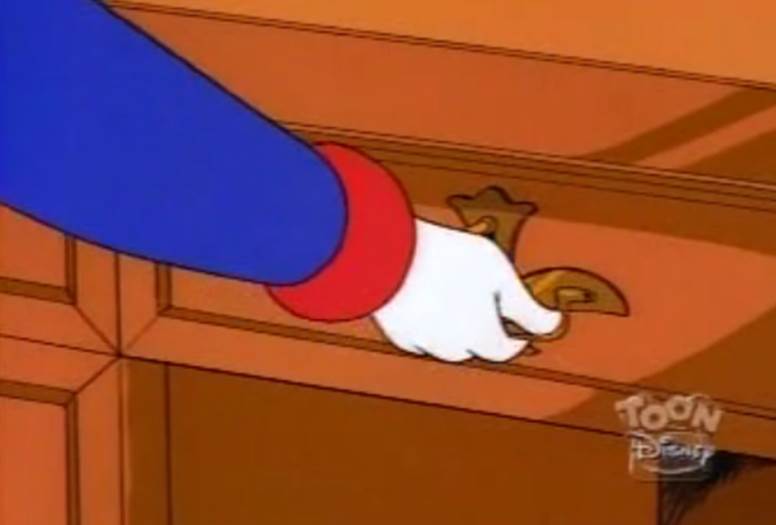
(GeoX) There is one thing that doesn't make sense: Scrooge locks the harp in his desk and tosses the key in his vault for safekeeping, but…for some reason he can open it just as easily with HDL's "skate key?" Wuh? We're supposed to believe that Scrooge is so cavalier about security that he'd have a desk that any key fits?
(Greg) After the commercial break [at the end of Act Two]; we get a shot of the bay as the desk floats up (HA!) and Scrooge pops up coughing and gasping for air. Scrooge gets on the desk and tries to open it because he wants the harp. Umm; check your internal logic there guys. The harp is in the right drawer; not the central drawer. Then again; Scrooge might be going insane after the salt water has infected him; so I'm going to not call it a logic break. The nephews call it a solution to their harp problems. The nephews then recoil because they don't want to suffer the insanity of Scrooge McDuck as Huey throws the skate key over to Scrooge and he almost lets it drop into the ocean. Scrooge takes the key and opens the central drawer and takes out the harp. It's the top right one you idiot! Logic break #1 for the episode 17 and a half minutes in which is a new record for Ducktales thus far. And as he cheers for victory; the desk sinks into the ocean again. HAHA! See; I'm always right about these certain things in the end. 

I figured I'd tackle both of these at once for obvious reasons.  HD&L's "skate key" is probably a Junior Woodchucks-sanctioned key, which means that it has drawer-opening powers far beyond those granted to standard skeletons... and, since JWs wouldn't think of breaking into other people's property without permission, that takes care of the security issue right there.  As for which drawer Scrooge used to hide the harp... well, it's pretty clearly the center drawer, since that's the only one with a keyhole.  While it looks as though Scrooge pulled the upper-right drawer in the shot immediately following the one below, that's simply because he happens to be standing on the right side of the desk to begin with.  That's more of an "inaccurate positioning" than an outright logic break.
(Greg) We get a shot of the city [of Troy] which looks like a golden stone lost city as the nephews aren't too keen about this discovery.

And they suddenly revert to their old habit of "completing a sentence together": "Yeah, Unca Scrooge... sure is... exciting!"  This was probably Wilkerson's doing, since the boys did this on several occasions in her comics scripts.  Unfortunately, it comes off as a bit awkward on screen, mainly because there are noticeable pauses between the phrases.  When Clarence "Ducky" Nash did it in the old cartoon shorts, HD&L typically fired off the sentence in machine-gun fashion. 

(Greg) Magica grabs the scroll from her stone safe (I guess considering how it crumbles) and we see some information on the magic harp in Greek symbols (delta, pi, omega. I don't know what it means and I don't think the writers do either) along with a picture of the harp.

There's actually a Delta Pi Omega sorority, but it appears to be a local organization, as opposed to a national one. 

(Greg) The nephews still haven't decided on getting rid of that tattletale bitchy harp yet. Dewey suggests talking to Scrooge about his side of the story and speaking of the rich devil himself; Scrooge rides down the street on his desk which makes the nephews panic. They race down to help which the [Quack Pack] nephews would never do for their uncle. Because they would blow off Scrooge as an old fuddy duddy and then go home and fling forks in the ceiling whining about having nothing to do. Now THERE'S a good home for that annoying harp: In Quack Pack; inside the new nephews room; just to piss them off.

*Applause for a brilliant idea*

(Greg) Huey jumps in off-screen and grabs Scrooge who nearly drowns...

... which is rather interesting, given that the Scrooge of "Merit-Time Adventure" demonstrated considerable proficiency at swimming and scuba-diving.

(Greg) So we go to a city roof top shot AFTER HAPPY HOUR as the helicopters are spotlighting the entire city. We then go to a ground shot of the police chief (in a green uniform; I guess he's part of the army of Duckb[u]rg) with the MEGAPHONE OF JIMMY HARTS (Chuck McCann) ordering everyone to leave and not panic. That face and white beard looks familiar to an early Ducktales episode where Scrooge was framed for stealing something.   

"Duckman of Aquatraz" -- the warden.  I guess that he pulled the duty when the Chief O'Hara clone (see "Robot Robbers") went on vacation. 

Next: Episode 45, "Luck O' the Ducks." 

Friday, June 29, 2012

Here's Looking at You, Min

A neat collectible, created by Italian Disney comics legend Giorgio Cavazzano:


See Papersera.net -- in my links list at right -- for more information (if you can read Italian, that is).

Pete as "The Fat Man"... Goofy as the police chief, perhaps played as the bumbling Inspector Goofeau from Disney Comics' MICKEY MOUSE ADVENTURES story "The Case of the Foxy Felon"... Might do!

Saturday, June 4, 2011

Comics Review: UNCLE $CROOGE #404 (June 2011, kaboom!)

The earliest versions of the cover to U$ #404 all featured the garish green background seen above. The actual cover has a far more muted, "steel and light" tone. Don't know why this should be... in light of the fact that this may be "the last new issue of U$ for a while," the bright green associated with jealousy (of fans of other, more stable comics lines, that is) would seem to be as appropriate as any hue.

If this is in fact fated to be Boom!'s last swipe at UNCLE $CROOGE, then at least we went out with a literal BANG: Scrooge's last explicit physical act has him blowing up a Money Bin. Don't be alarmed, there are plenty more where that came from -- at least, there are in this far-fetched but entertaining Italian story from 1966, "The Fifty Money Bins Caper." Romano Scarpa, assisted by Giorgio Cavazzano, draws the story in his "inflated-lower-torso" style of the period, while David Gerstein translates Michele Gazzari's "with-a-grain-of-salt" script. Donald, trying to get back in Scrooge's good graces following a standard-issue mental screw-up, steals an idea from HD&L and suggests that Scrooge build a bunch of fake Money Bins to keep crooks (read: The Beagle Boys) guessing as to where the miser's money is stored. Aside from the colossal expense that Scrooge would incur just to set the scheme up, the obvious flaw in the outlandish plan is that robbers could search all of the Bins at one time easily enough if they simply had enough manpower. In other words, if "Beagles International" existed in the world of Italian Disney comics, then Don's design would fall apart like a cheap suit. These Italian Beagles being only three in number, and pretty scrawny at that (at least, the way Scarpa draws them), the plan actually works for a while -- until The Beagles kidnap in-the-know Donald and Scrooge accidentally drinks an amnesia potion he'd meant for his "gossipy" Nephew...

This story shouldn't work, but it does. Gerstein's as-ever clever scripting is a major reason why, but the schizophrenic characterization of Scrooge -- a characterization that is also sometimes seen in American comics, but rarely to such an extreme extent as it is in Italian comics -- turns out to be amusingly refreshing, almost turning Scrooge into the "true" villain of the piece. Scrooge completely blows his top not once but several times, reaming out a hapless employee over the phone, thwacking Donald with a cane, and nearly wringing Donald's neck in addition to frantically dynamiting one of his Bins (which turns out to solve his problems for him). Scrooge's constitution is so fragile here that petty thefts by The Beagles make him (1) force Donald to pedal-power electrical devices, (2) succumb to a case of the vapors, and (3) leap at Donald's loony multi-Bin idea like a thirsty desert traveler lunging at a mirage. By contrast, we end up feeling sorry for the perpetually bungling but well-meaning Donald, despite the fact that it was his plan that triggered Scrooge's woes. Even the version of "torture" that The Beagles inflict on Don places us squarely on the incompetent duck's side, involving as it does the (gulp!) IRS. (Actually, the Beagles ought to keep that same scheme in mind the next time they kidnap Scrooge.) Had Don Rosa written this story, suffice it to say that Scrooge's tantrums and meanness would have been muted, Donald would have been inept without engendering as much audience sympathy, and HD&L would have played an even larger part in foiling The Beagles' scheme.

Boom!/kaboom!'s run on $CROOGE ends (only temporarily, let us hope) with a real mixed record. The early serialized material ("The Hunt for Old Number One," "Around the World in 80 Bucks") seemed even weaker than it actually was, due to the fact it was the only Boom! offering being presented in a "traditional Duck comics" format at the time. The DuckTales-themed issues provided both inspired highs ("The Curse of Flabberge/Fall of Brutopia," "The Arcadian Urn," "The Last Auction Hero") and space-filling lows (four-color grout culled from DISNEY ADVENTURES and DUCKTALES ACTIVITY MAGAZINE). The Boom! 2.0 era (remember when that actually meant something?), with its mixture of curio stories ("The Man Who Drew Ducks"), reprints from American and Italian Masters, and new takes on traditional tropes ("Obsession"), was unquestionably "the best of times," but it will probably only be remembered for its brevity. In retrospect, trying to get away with a "cheap" approach to U$ out of the gate at the same time that the other Boom! Duck and Mouse titles were being radically revamped may have had the unfortunate effect of alienating some of the very longtime fans whose support was still badly needed at a time when Boom! was hoping that the new approaches would catch on with younger readers. To their credit, the Boom! editors recognized their error and made a serious attempt to rectify matters later on. Whether they will get a chance to continue to apply their hard-earned lessons is very much an open question.

Sunday, May 8, 2011

Comics Review: UNCLE $CROOGE #403 (May 2011, kaboom!)

It's a genuine shame that kaboom! fumbled the scripting credits on this issue's featured story, the 1968 Romano Scarpa/Giorgio Cavazzano Disney Studios romp "The Pelican Thief." As he loudly laments (with Donald's howling help) here, Joe Torcivia was responsible for the job... and, since this ranks as one of his best efforts on that score, I'm happy to draw my readers' attention to the "facts in the air." The plot line is pretty elementary -- a villainous master of impersonation (who is so good at what he does that he's forgotten HIS OWN name by this time) and The Beagle Boys commandeer a pack of trained pelicans to fly into Scrooge's Money Bin and remove the coins and bills, er, bill by bill. The birds just happen to be the stars of Scrooge's favorite TV show, Tex Aviary and his Pelican Prodigies (and, yes, Joe slips in a few references to the great cartoon director and his creations along the way). Aviary's original Italian name was Captain Feathers, which sounds like the name of a kiddie-show TV host of the era... could it be that Scrooge's second childhood is at hand? With the help of some Junior Woodchuck know-how and some timely villain-baiting, the bad guys' scheme nets only a few handfuls of cash before it is shut down. Not that it would have made much difference, as I calculate that it would have taken roughly 4,526 years for the pelicans to have removed all of Scrooge's money. Even the incredibly prolific Beagle line might have died out before the end of this caper.

Unlike last week's "To the Moon by Noon," there's nothing firmly tying this story to the era in which it was produced, so Joe quite properly feels free to indulge in a bunch of present-day pop-culture references. Indeed, he feels so liberated that he tosses in some political digs, as well. The "guy of many guises" originally introduces himself as "Alvin Greenspin" of the treasury department, come bearing a governmental gift for Scrooge in the form of TARP (Tangible Asset Repainting Program) funding. The Beagles (natch) turn out to be the "reformed government hirelings" assigned to repainting Scrooge's Money Bin. There's also some nice continuity with DuckTales in that blue-capped Dewey turns out to be the Nephew who comes up with the scheme to have the villains literally knock one another out. See "Duck in the Iron Mask," wherein Dewey is fingered as the Nephew who's "the best at coming up with escape plans." This bit doesn't exactly qualify as an escape, but it'll do in a pinch.

Daan Jippes provides a quick, refreshing "issue-cap" with the four-page story "Scrappy Mettle." This could be considered a "revisitation" of sorts of the central scenario of Carl Barks' "Back to the Klondike," "North of the Yukon," and "The Golden Nugget Boat", with Scrooge traveling back to the old Klondike boom town of Whitehorse to relive old memories (with or without medicinal assistance). Here, however, he literally explodes into action once he gets the idea that life in Whitehorse is getting "soft." Simply to prove that "I still have 'it'!" (and, come to think of it, he probably did meet Clara Bow at one point or another), Scrooge returns to the now-civilized city, determined to hit the wilderness and trap a bear for old clime's sake. The specimen of bearhood that greets him, however, exudes more of the hankering after creature comforts of Yogi than the menace of Glittering Goldie's Blackjack. This story's extreme shortness definitely works against it to a certain extent; Barks took his sweet time developing back stories and motivations for his brace of Yukon yarns, while Jippes has Scrooge transition to the trip in the span of five panels. This lends Scrooge's decision an air of desperate hysteria that makes for a funny sight gag (Scrooge jumping up from his desk and hitting a pillow nailed to the ceiling, a gag which first appeared in Barks' "The Strange Shipwrecks") but seems a little, well, over the top for him. It's not like a sea monster ate his ice cream, or anything like that. The final-panel payoff, however, is priceless, right down to Jippes' reuse of bit characters and Whitehorse settings that had appeared in an earlier panel. U$ #403 winds up as another "Boom! 2.0" issue with that old Gemstone feel... which I'm trying very hard not to mistake for impending Death's clammy grip.

Tuesday, February 8, 2011

Comics Review: UNCLE $CROOGE #400 (February 2011, Boom! Kids)

On the happy occasion of U$' milestone 400th issue, I'm feeling so generous that I'm giving pride of visual place to Don Rosa's "Busy, Busy World of Scrooge McDuck" cover, even though I actually purchased the old-school Deluxe Edition with Carl Barks' painted version of the cover to FOUR COLOR #386. (The "logos-in-the-back" business was a bit creepy, but still... why would you want to muck up a classic image like that?) The good vibes are warranted: this is easily the best ish of U$ that Boom! has given us, a welcome return to the glory days of Gemstone, when we were regularly treated to new stories in the old tradition. The two featured items here are (with apologies to Keno Don) "a little something special" in terms of thematic approach, but not so much so as to seem out of place.

No less a personage than Carl Barks himself (Dog-Nosed Version, Patent Pending) is the center of attention in the 1992 Italian story "Uncle $crooge and the Man who Drew Ducks." When I first heard about this tale, I thought that it might have been a tribute created after Carl's death in 2000. The fact that it was produced a number of years before Barks' passing gives the idyllic portrait of a reporter's genial visit to Carl and Gare's home in Grants Pass, OR something of a bittersweet tinge. The "Carl Barks Studio" fiasco which made Carl's last years less pleasant than they ought to have been was still over the horizon. Writer Rudy Salvagnini (with David Gerstein doing what, for him, seems to be some fairly unadorned translation duty) appears to have taken inspiration from the German DONALDist claim that Barks' stories were "reports" of actual happenings in Duckburg -- that is, that Barks was serving as "journalist of record" for the Ducks. Barks' first original ten-pager in WDC&S (#32, May 1943) is presented as a "reenactment," while Carl describes himself as "living through" Scrooge's various travels to exotic destinations. Turning Barks' comics adventures into something like shorthand transcriptions should leach some of the magic away from the stories, but it honestly doesn't, largely because Barks did, in a real sense, create a unique, believable (albeit often fantastical) "universe" and "inhabit" it as he was spinning his stories, to a greater extent than most any other comics creator. This is a charming tribute, and a worthy lead-off to such a significant issue.

Byron Erickson and Daan Jippes' "Obsession" can't hope to match the unique nature of "The Man Who Drew Ducks," but it comes amazingly close, given that it's based on the familiar conflict between Scrooge and Magica De Spell. As he notes in his comments in "Musings from the Money Bin," a three-page text feature at the back of the book, Erickson went back to basics -- in this case, Magica's debut story, "The Midas Touch" (UNCLE $CROOGE #36, December 1961) -- and exhumed the easily-overlooked fact that Magica originally didn't care whether or not she got Scrooge's Old #1 Dime. She simply wanted any coin that Scrooge had touched and only became fixated on Old #1 after she realized that its "potential energy" would make her planned "Golden Touch amulet" all the more powerful. What would happen if someone -- in this case, Magica's feathered pal Ratface -- realized that Magica could create her amulet and gain riches without relying on Old #1? Answer: Magica would realize a "triumph" that would turn out to be hollow at its core. This splendid story is as much a comment on our own expectations about Scrooge-Magica stories as it is an exploration of the relationship between Scrooge and Magica. Recall that DuckTales, when it used Magica for the first time in "Send in the Clones," cut straight to the chase and introduced her as being obsessed with Old #1 from the start. It's funny how quickly we forget how it all started. (In a similar fashion, the many modern stories about an "evil" Flintheart Glomgold have tended to make us forget that Glomgold was originally conceived by Barks as basically just a South African clone of Scrooge, right down to the money bin full of Rands.) Jippes complements Erickson's clever writing with some supremely crafted depictions of Magica in all her guises, from sultry temptress (when she's posing as a filthy-rich "mystery heiress") to raving madwoman (when she turns on the baffled Ratface, casts "foof bombs" left and right, and destroys her non-Old-#1-powered amulet as "the only way to beat McDuck!"). I do wish, though, that Jippes had kept straight the physical details of how Magica's amulet works. Magica claims that she only needs to have the amulet on to turn things to gold, but, early in the story, she is always holding or touching the amulet during "gilding operations." We also see her holding or touching various inanimate objects (trays, pages in a book) while wearing the amulet but not turning said objects to gold. In a showdown with Scrooge, however, she turns Old #1 and the walls of the Money Bin to gold while wearing but not touching the amulet. I know magic is tricky, but Arrrgggghhh! Can we have a little consistency here, please?

Three Barks gags -- including the Genuine Old Original "Free Cup of Coffee Gag" -- and the aforementioned "Musings from the Money Bin," which include comments by William Van Horn, Giorgio Cavazzano (artist for "The Man Who Drew Ducks"), and other notables in addition to Erickson, fill out a superb package that keeps Boom!'s "2.0 winning streak" alive.  Between the newly "classicized" titles and the enjoyable Disney Afternoon material, this is as close as we've gotten in years to the days of Disney Comics circa 1990-91. Let us devoutly hope that "history repeats itself" only up to a point.

Saturday, December 4, 2010

Comics Review: MICKEY MOUSE AND FRIENDS #302 (November 2010, Boom! Studios)

Sergio Badino and Giorgio Cavazzano's "Legend of the Robo-Presidents" turns out to have been a more substantial epic than I'd thought. I was expecting another "half-and-half" deal here, with one story closing and another opening; instead, "Robo-Presidents" takes up all the space. In said space, we learn that The Phantom Blot has retrofitted the giant robot Presidents that inventor Borzon Gutglum had been commissioned to build to complement the newly-sculpted Mount Rushmore attraction (make sure to read that again, slowly) with the help of software designed by Gutglum's slightly wayward grandson. For all of The Blot's pleonastic, pompous pedantry (at least translator Saida Temafonte is consistent on this score; s/he used the same characterization for vastly different versions of The Blot in the ULTRAHEROES and WIZARDS OF MICKEY tales), the villain's plot is what he himself might call a "dreadfully banal" strike at the gold in Fort Knox. This comes, it should be noted, on the heels of The Blot's channeling of Hugo Drax in Casty's "Mickey Mouse and the Orbiting Nightmare." Honestly, if The Blot's new image as an intellectual is to be taken entirely seriously, then he really should be above ripping off schemes by James Bond villains, much less relying on the help of goons with names like "Billy Bob." The Blot, in the tradition of Pinky and the Brain, seems not to realize that the flying Robo-Presidents couldn't possibly get off the ground if they were truly "stuffed" with gold, but at least he has writer Badino to blame for that little oversight. Morty and Ferdie get a rare chance to fill the HD&L hero role, and, as you might guess, the "Nintenduck" obsession that they displayed in #301 winds up being a key to the good guys finally winning. An absurd story, to be sure, but oddly engaging, with Cavazzano's energetic art, as always, a point in its favor.

In the wake of The Blot's appearing without his black hood and cloak throughout the WIZARDS OF MICKEY sequence and in civvies in part two of "Mickey Mouse and the Orbiting Nightmare," his partially-unmasked status here is notable. Once he captures Mickey, Minnie, Morty, and Ferdie, he pulls off his hood and spends the rest of the story with his head showing above the cloak. I suppose that this is an "Italian thing," and, after mulling over the events of both this story and "Orbiting Nightmare," it's a "thing" that I actually do understand. The Blot can't pretend that absolutely no one knows what he looks like anymore (otherwise, why use a disguise to infiltrate Space Hotel Olympus in the first place?) and, while he can still rely on the "full effect" of his costume to produce some "fright value," there is no real reason why his face can't be regularly shown. This, of course, provides the writers with a challenge, to make The Blot's schemes really imaginative so as to compensate for the "loss of mystery." If The Blot's next caper involves "toppling" Mousetonian rockets or swallowing up Duckburgian space capsules, then he has every right to lodge a protest.

Sunday, October 31, 2010

Comics Review: MICKEY MOUSE AND FRIENDS #301 (October 2010, Boom! Kids*)

The conclusion of "300 Mickeys" -- the "Clone Saga" that should, by all rights, have been devoured in one gulp in MM&F #300 -- is served up "cold pizza" style in this issue. The "Mickey-Me's" created by Eega Beeva's "Pduplication Ray" do their expected slapstick "thang," including putting the real Mouse and Eega on trial for "[planning] to unmake us!". There's actually something of an edge to this silly business, in that Mickey and Eega realize that eliminating clones would be akin to murder (or, in Stefan Petrucha's slightly more decorous phrase, "taking lives"). Fortunately, Eega has access to all manner of convenient technological problem-solvers, and one of them saves the day, giving the multitude of Mickeys their own "space" while ridding Mouseton of a grave threat. Left unexplored is the question of how an entire planet of cocky, strong-willed Mice will manage to govern itself. Petrucha and Cesar Ferioli make the most of this one-joke idea, but I still shake my head at Boom!'s decision to serialize this tale.

The back side of the book is given over to the opening stanza of yet another serialized scenario, Sergio Badino and Giorgio Cavazzano's 2007 Italian story "Legend of the Robo-Presidents." We come to issue's end just as the vacationing Morty, Ferdie, Mickey, and Minnie have tumbled into the bowels of Mount Rushmore (think I'm kidding? One of Mickey's nephews wonders whether M&F have found "some President's small intestine") and discovered a clutch of mechanical gear. I sure as shootin' hope that we aren't headed for something as silly as that KIM POSSIBLE digest story set in Washington DC which climaxed with several national monuments coming to life and fighting. Given that M&F are depicted as video-game-obsessed, however, I fear that joystick manipulation of a "National Treasure" may be in our immediate future. BTW, you can tell that this story is a foreign import even if you aren't hep to the Italian drawing style; several panels are devoted to an explanation of who's depicted on the monument. Oddly enough, the "rock-star Presidents" are depicted in humanoid form. Considering that DuckTales showed duck-billed Presidents on Mount Rushmore in the episode "Ali Bubba's Cave," this comes as something of a surprise. Though Barks did depict a human "Senator Snoggin" monument in one of his 50s "ten-pagers," so perhaps the DuckTales "Mount Rushmore" ISN'T the Duck-and-Mouse-world equivalent of Mount Rushmore after all, but a duck-centric facsimile... uh, my head hurts.

* For some reason, the cover logo is that of Boom! Studios proper, as opposed to Boom! Kids. I don't know what to make of this; it may be an oversight, or something more.

Sunday, August 15, 2010

Comics Review: UNCLE $CROOGE #394 (Boom! Kids, August 2010)


After all my grousing about Boom!'s seemingly overwhelming desire to serialize everything -- including short gag stories that were always meant to be downed in one "5-Hour Energy"-style gulp -- I'm happy to say that the two-part "The Curse of Flabberge" is the best thing that could have possibly happened to UNCLE $CROOGE's flagging DuckTales experiment at this particular moment. The cliffhanger at the end of this issue's Part One doesn't truly compare with most of the crag-clingers Bob Langhans served up during "The Gold Odyssey," but it almost doesn't matter; the story's satisfying succession of locales (the Chickaboom country, Duckburg, Paris) and element of mystery (the whereabouts of the missing Flabberge Egg of Brutland) provide the epic "feel" that was lacking in #392 and #393's adequate, but generally uninspired, lead stories. Thankfully, the broader scope of the tale isn't accompanied by a backsliding in the area of characterization; everyone acts just as they should. Writer David Gerstein takes French author Regis Maine's original script and packs it full of clever references to DT episodes, Alfred Hitchcock films, more-or-less-obscure French roundelays, and even Boom!'s ongoing DARKWING DUCK title. We even get a fillip of sex appeal in the form of a comely "cat burglar" in a skin-tight black outfit. Add some nice artwork by Jose Cardona Blasi and you get a very appealing package that easily beats anything that Boom! has served up in U$ to date.

Scrooge's wild tirade following the failure of the Chickaboom Diamond expedition is a perfect example of a bit that would have rung false in a Barks-, Rosa-, or Van Horn-based Duck story but makes perfect sense in a DT context. (Launchpad provides the necessary frame of reference by referring back to the legendary "A sea monster ATE MY ICE CREAM!!!" scene from the episode "A Whale of a Bad Time.") Likewise, when Scrooge, LP, and the Nephews infiltrate the Palais Garnier opera house to obtain more info on the mysterious "Miss Mitzi," they dress in outlandish, quasi-Elizabethan costumes, even getting to do a quick "shuffle off to St. Lo" in them. The "cheesy disguise" routine may cause groans from the Duck-comics purists, but it certainly won't bother fans of DT, where such "stage business" was par for the course. It's nice to see a clear recognition that DT isn't simply "Barks lite sans Donald," but, rather, frequently follows its own (charming) approach to telling stories.

Giorgio Cavazzano's cover deserves more than the usual amount of interest apart from its inherent quality -- it's this issue's only cover. That's right, no cover variants this time! Boom! is apparently edging away from the "Cover A"/"Cover B" gimmick, and, IMHO, not a moment too soon. If the intent was to "goose" sales by encouraging readers to purchase multiple copies of each issue, then the strategy obviously hasn't worked.

Friday, July 23, 2010

Comics Review: DONALD DUCK AND FRIENDS #356 (Boom! Kids, July 2010)

Scratch one reformation -- maybe. The fag-end of "Souvenir de Paris", and especially the first page of DD&F's final (for now, anyway) DOUBLE DUCK story, "Total Reset Button", throw us yet another curve ball regarding Kay K's true loyalties. Was she simply "using" Donald, and the cover of the fake kidnapping of Daisy in #355, to rifle The Organization's coffers? Is she, in fact, the mysterious individual who's targeted Don based on the results of his "first mission" for The Agency -- the one the details of which he so conveniently can't remember? Is ANY person or event in these DOUBLE DUCK stories what he/she/it appears to be at first glance? I'm going to wind up hoping that the emergency "TRB" that Don has been instructed to apply to the backsliding ex-Agency director Felino Felinys can be applied to this entire collection of story arcs. It's all getting so difficult to keep straight. Even if you can, there's Giorgio Cavazzano's bizarre cover to this issue to consider. What symbolism could be inherent in agent Don's brandishing of a banana, I don't like to think... and who is the "Double-O-Duck" extra pushing a button in the corner, there? Is he auditioning for Minion status?

A good portion of the opening action of "Total Reset Button" is simply a rehash of the beginning of "Before the Premiere", with the opera changed to Aida, the setting switched to Cairo, and Gladstone Gander serving as the cocklebur in Don's cummerbund. (For some reason, I think even Gladstone will be less irritating than Daisy has generally been during these stories -- though the preoccupied Donald's blowoff of his bragging cousin at the start of "TRB" suggests that he might be able to handle the situation.) While trying to keep Felinys in "ignorance-is-bliss" mode, Donald is evincing a growing interest in exactly what happened during that nebulous "first mission," the one that's got that supposed assassin in such a snit. Don even goes so far as to attempt to do some espionage work at The Agency itself. If the "first mission" subplot is wrapped up at the end of "TRB," as I suspect it probably will, then that will indeed be an ideal time for the DOUBLE DUCK tales to go bye-bye for a spell.

Sunday, April 25, 2010

Comics Review: DONALD DUCK AND FRIENDS #353 (Boom! Kids, April 2010)


Evidently, the identity of The Agency's "Big Boss" is, like the Sherlock Holmes story of the Giant Rat of Sumatra, "a tale for which the world is not yet prepared." "Before the Premiere," the new "Double Duck" story arc, instead throws us straight into a new adventure introducing The Organization, which apparently will serve as FOWL to The Agency's SHUSH. Here, Donald is being asked to keep tabs on a former Agency bigwig, orchestra conductor Felino Felinys (who is, against all probability, a bird rather than a cat), whom The Org is apparently interested in nabbing and "reactivating" from his mind-zapped forgetitude. The song-slinging ex-"spook" is presently engaged in preparing the premiere of a forbidding new opera at Milan's La Scala Opera House. Strange doings are afoot, however: there's Bondian tech aplenty in the basement of the grand structure, while Felinys seems oddly insistent (even for a conductor) that "triangle-player" Donald not be "one nanosecond late" to play his one note of the piece, which occurs at the climax of the concluding crescendo. This, combined with occasional slips of the tongue, suggests strongly to me that Felinys has already been "turned" to the side of bad and that we're in for a "sound assault" on someone or something. Could it have something to do with the seemingly irrelevant "Clippedonia election results" reported in the newscast on page one? Perhaps The Org plans to monkey with the results by means of musical malfeasance? It won't take us long to find out, as this story is much shorter than the recently-concluded origin epic. The tale won't be short enough, though, to dispense with the "mundane irritant" subplot. Taking the place of the unpaid parking ticket this time around is Donald's rash promise to give the ever-demanding Daisy a surprise birthday party. Oddly, Donald's frequent lies here trigger mishaps for others, a tic that didn't turn up in the origin story.

Giorgio Cavazzano, the prime influence on modern Italian Duck artists, draws this first segment of the story (and, if Inducks is right, will at least pencil the rest). His loose artwork is an acquired taste for us Statesiders, though WORLD OF THE DRAGONLORDS softened me up to a considerable extent. However, the cohort of Cavazzano-wannabes who drew the earlier chapters of "Double Duck," as well as WIZARDS OF MICKEY, would probably have been hard-pressed to pen the striking reproduction of La Scala seen here (as well as on the cover of TOPOLINO #2767 (December 9, 2008), which I've reproduced above).

As someone who's long had to hear from others about mathematics' inherent power to bore, I couldn't help but chuckle at the implication in the first few pages of this story that classical music bores ALL "normal" males (the poor schlub sitting behind Don and Daisy at the Canasta Club concert is just as anxious to get away as Don is). Part of the chuckle was due to the fact that the opening newscast presents the Milan opera premiere as a news story. If classical music is so irrelevant, then why is such attention being paid to it? Is that news network run exclusively by females?

Tuesday, November 18, 2008

Comics Review: UNCLE $CROOGE #381 ("September" 2008, Gemstone Publishing)

Happy 80th, Mickey!

.

.

.

Alas, poor Donald -- even when he succeeds by failing, he winds up... well, failing. Such is the intriguing premise of this issue's main story, the ingenious Italian effort "Breakfast of Champions" by Bruno Concina, David Gerstein, and artist Lara Molinari. Desperate to counteract John D. Rockerduck's aggressive marketing of his marmalade Vita-Jam, Scrooge strikes out in his efforts to purchase celebrity talent to hawk McDuck Marmalade, mostly because he's unwilling to pay the going price. Scrooge settles for the inevitable LCD (that's "least common denominator" for the layperson) in the ever-indebted Donald, who proves to be a surprise success by -- surprise -- totally fouling up a variety of attention-grabbing "extreme" stunts. Finally admitting, "I should really let you stay you!", Scrooge lets his bumbling nephew have his own fallible head. "Failure is victory! Black is white!" smiles Donald as his popularity soars... but then comes the inevitable crash. Don't worry, I won't spoil the surprise for you, but Donald is tangentially responsible for his own demise, though it comes as the result of another character's actions. Molinari's lively artwork channels that of Giorgio Cavazzano without being overly derivative, and Gerstein packs in references to Barack Obama, Al Pacino, Vic and Sade, and The Simpsons' Comic Book Guy in the course of his merry labors.

"Half-Baked Bakers," a brief four-page story by Frank Jonker, Mau Heymans, and John Clark, returns us to something resembling familiar ground as Scrooge challenges Donald and Gladstone to show their business mettle by operating competing pastry shops. Don's performance, of course, founders on the reefs of Gladstone's luck, and Gladstone winds up outperforming Tim Hortons -- to his ultimate dismay. With the 1952 Carl Barks classic "Spending Money," we're back to the theme of an improbable Donald crash-and-burn. Scrooge is rapidly running out of room to store his money, so the troubled tycoon engages Donald to spend some of it for a wage of 30 cents a week. Unfortunately, the ensuing uber-splurge winds up enriching, you guessed it, a bunch of businesses controlled by Scrooge. Donald really deserved a "thank you" for a good try, as opposed to the caning he's about to receive at story's end. If this is unfair, then Don's fate in Jens Hansegard, John Clark, and Tino Santanach's "Cleaned and Intervened" is enough to make you cry. A doctor orders Scrooge, who's "never taken a day off" (I suppose all those treasure hunts counted as business trips, then?), to spend a day at a health spa or be forcibly hospitalized, and casually fingers Donald as the "aggressive young man" to take over for the duration. Scrooge, who's nothing if not obsessively hands-on, disguises himself as a cleaning woman, sneaks away and spies on his nephew, and sabotages what looks like an attempt to con Donald into a bad investment. Don turns out to be right about the proposition after all, leaving Scrooge a babbling wreck. No, I don't feel sorry for Scrooge here -- I feel sorry for Donald, who misses out on a chance to make far more money for Scrooge than he would have at any old pastry shop.

The book closes with "Homeward Hound," an "origin story" for Bolivar, Donald and HD&L's lumbering St. Bernard. We learn that "Bolly" hails from the Heather Hill Kennel (do I detect a spoof of Snoopy's Daisy Hill Puppy Farm?) and comes from a whole family of famous rescue dogs (with names of famous South American heroes, natch). Don and HD&L return to the scene of the whelping in the course of trying to locate Bolly after the depressed dog has run away. Until the very end of the story, it appears that Bolly got shortchanged in terms of inheriting noble qualities (unless a bottomless appetite counts as one), but we finally learn that he has one very large asset that even his brothers do not possess. (The ultimate reason why Bolly displays such a trait is one of the funniest things in the story.) Fine dialogue by David Gerstein and lively artwork by Maria Nunez (normally a Beagle Boys specialist) nicely complement Kari Korhonen's solid, and generally believable, story.