I think that we can safely say that the vast majority of DT fandom is pretty much of one mind about the high quality of this climactic chapter of "Treasure of the Golden Suns." Back in September of 1987, who WASN'T imitating the gold-hungry Scrooge by the end and shouting, "More, more, I want to see MORE!"? The visual gloss of and excitement level engendered by the episode haven't dated one bit, with memorable sequence succeeding memorable sequence and the whole kit (not Cloudkicker) and kaboodle (not Kitten) ramping up to a third act that completely blew away anything on offer from any animated series of the first 40 years of television. The levels of sophistication of such later series curtain-lifters as "Last Son of Krypton" and "Awakening" -- and, yes, Greg, I'm willing to throw in "Plunder and Lightning," at least when considered as a single, sustained narrative -- may have been somewhat higher, and I enjoyed all of these (and others) to one extent or another, but, as they famously say about sex, there can be only one "first time." When it came to TV animation, "Golden Suns," with "Gold Thing" as its gilt-edged centerpiece, was the ultimate "first time."

*Phew* Cigarette, darling?
(Or should I also say, "Here we go again!"?)
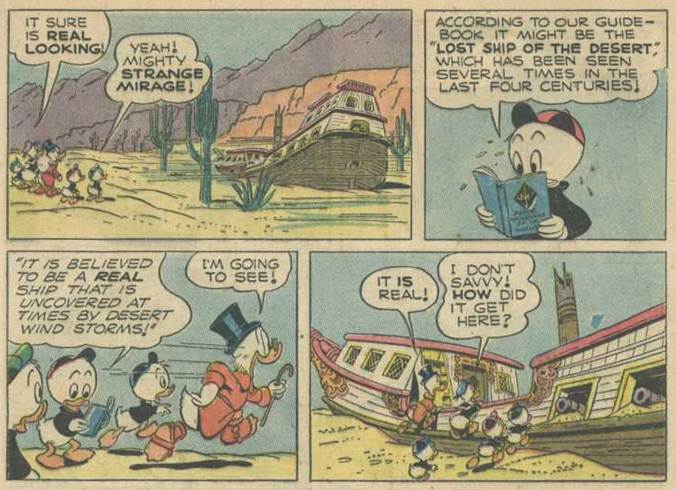
As spine-shakingly original as "Gold Thing" was in an animated sense, I think that a case can be made that Jymn Magon, Bruce Talkington, and Mark Zaslove had a particular template in mind when crafting their climactic narrative... namely, Carl Barks' "The Seven Cities of Cibola." In my discussion of "Wrongway in Ronguay," I agreed with GeoX's argument that the "treasure ship" that Scrooge and HD&L find in the Ronguayian wastes may have been inspired by Captain Ulloa's ship in the Barks adventure. This got me to thinking, and other similarities between the two tales soon began to suggest themselves to me. It's a little surprising that these didn't originally attract my attention back in 1987; Gladstone had, after all, reprinted the story in UNCLE $CROOGE #217 in February of that year, complete with one of Daan Jippes' fine covers. I hadn't yet gotten the set of the CARL BARKS LIBRARY containing "Cibola," and I do remember reading over the "new" story multiple times. For some reason, I didn't pick up on the parallels when I first watched "Golden Suns" in the two-hour format. But when you consider that "Cibola" was included in that handy-dandy, putative DuckTales reference source, the Celestial Arts UNCLE $CROOGE collection... well, as I said, there just may be a case to be made here.

(1) The "conquistador connection." Why El Capitan, anyway, as opposed to Le Colonel or der Admiral? Who knows but that reading "Cibola" triggered the creation of an adversary with a direct link to the conquistadors who, unlike Captain Ulloa and his men, had managed to survive the centuries, thanks to his obsession with the legendary Treasure of the Golden Suns? The physiological likelihood of such a thing happening is, of course, remote, but the psychological understanding of what drove the ruthless Spaniards is accurate enough.

(2) The dramatic ways in which the final destination is first revealed to the reader/viewer. In Barks' story, the Ducks' climb up the cleft leading to Cibola is followed by one of the artist's great splash panels (or polygons, if you want to get geometrically technical).


(3) The "mounting tension" built into the plots. Barks takes a fair number of pages to get the Ducks (and, tagging along behind, the Beagle Boys) to Cibola, just as "Golden Suns" takes its sweet time giving Scrooge his crack at the "ultimate treasure." Once there, the various treasures that the Ducks find get more and more impressive, though we more or less have to take Barks' word on this (the artist shows us a few small-panel shots of various impressive treasures and otherwise assures us in a sidebar that "each 'city' is richer than the one before"). "Gold Thing," with a TV screen to play with, is far freer to sightsee on the trip up the "pecuniary curve."

(4) The presence of the "ultimate booby trap." Barks, of course, lets the Ducks (specifically, Huey) dope out the danger in time to avoid causing catastrophe and gives the cluelessly greedy Beagle Boys the "dishonor" of activating the trap instead. In "Gold Thing," with Jymn et al. having committed to plugging the infamous "Scrooge gets gold fever" angle from the get-go, it's only logical that Scrooge and the equally lucre-addled HD&L wind up tripping the... big sun clock-gear... uh, thing. I wonder: had Barks thought up the idea for "Cibola" about five years earlier, when Scrooge was a somewhat more villainous character, might he have been tempted to teach the old miser a similar "lesson"?


"Gold Thing," however, has the artistic freedom to stack the Ducks up against peril after peril, starting with dangers that are more or less self-imposed by an increasingly demanding and desperate Scrooge...

... and then, once inside the Valley, using various improbable means to keep the pressure on...

... leading to the unforgettable scene at the end of act two which -- and I give GeoX full marks for recognizing this -- is unquestionably the psychological climax of the story. Here is how Geo describes it:
And here, we see what I would call a genuinely great moment; certainly
the best in the series so far: [El Capitan] overtakes [the Ducks] and
lowers them into a pit of lava to do away with them; as they get to the
bottom, it becomes clear that it's actually a pit of molten gold,
and in Scrooge's ecstasy at this revelation, we see that the ultimate
satisfaction of his lust would be to immolate himself therein. It's
really just a momentary thing, but it is authentically frightening.

I'd add to this the comment that Scrooge is so far gone with "gold fever" by this time that he mindlessly puts his frightened companions in peril at the start of act three by twirling the basket around like some sort of demented ballet dancer. Even when Scrooge punctured the raft to get away from the caymans, you got the sense that he knew what he was doing (well, sort of) and didn't intend to see the other Ducks get hurt. Here, he doesn't seem to give a damn about anything but the improbable natural resource boiling away a few feet below. In completely neglecting the immediate welfare of the other Ducks, Scrooge really does seem to have gone "mad for gold" here, just like El Capitan. It takes the jealous El Capitan's decision to pull the Ducks back up in order to keep them from "tainting his gold" to finally restore some tiny bit of lucidity to Scrooge, even though it is entirely focused on "getting rid of" the rival to his treasure.


As things literally begin to fall apart, Mrs. Beakley finally gets through to Scrooge by... reminding him that he'll die if he doesn't think of saving his own tailfeathers first. Unlike GeoX, I don't really see a problem here. This restoration of the "life wish" to Scrooge seems a fitting response to the "death wish" that he displayed during the scene in the pit. Once Scrooge decides that staying alive is the first priority, all else follows naturally: his ultimate compassion for the hopelessly insane El Capitan, his apology to Mrs. Beakley. In other words, Scrooge was "back" well before the young Ducks "officially" welcomed him back. (Incidentally, no explanation is ever given as to how the Nephews shook off their case of "gold fever." Perhaps HD&L simply didn't have enough experience with treasure-hunting to be profoundly affected by the "disease" and thus found it easier to purge it from their systems.)


The final rescue sequence, of course, can hardly be faulted on any level, with Launchpad finally slipping out of his episode-long role of interstitial comedy relief and making the ultimate save -- and quite slickly, too. (It probably helped that, by that time, there was no hard surface left in the Valley for him to crash into.) The draft version of the script that I own, BTW, would have added to the degringolade by showing scenes of temple gargoyles spitting molten gold and melting away from the intense heat. Apart from offending Gargoyles partisans, I don't think that this would have added much to the legitimate creepiness of the pre-pickup scenes that did make it to the screen. These scenes were pretty darn chilling a quarter-century ago and retain their effectiveness today.


Needless to say, I don't think that there was any way that DuckTales would have killed off El Capitan, especially given the dreadful options that were available for his demise. There is something truly troubling, though, about El Cap's ultimate fate. Just imagining him willingly scraping and scrabbling through that dirt and rubble for another few centuries gives me pause, try as Scrooge might to make his own comment on the matter sound a bit light. El Cap had the "sheer willpower" to live this long already, so one can easily imagine him continuing this pseudo-existence for an indefinite period of time. Images of the eternal trials and tribulations of some of the "damned" characters in Dante's Inferno immediately come to mind.

As we prepare to fade out, one rather annoying false note clouds the sunset: Scrooge's claim that he can't be bothered to go on any more treasure hunts, since "there'll never be another prize this big again." This was too obviously a contrived way to set up the final gag of Scrooge teasing the return of "gold fever." As such, its logic is about as dubious as that of the whole notion of "gold fever" itself (which I'll address in "DuckBlurbs," in response to GeoX's comments on the issue). As we all know, Scrooge will NEVER be too complacent, or too crotchety, or too miserly, or too... whatever, to take on a treasure hunt wherever it presents itself. Indeed, such will be the theme of the remainder of the DuckTales series, just as it is in stories by Barks, Rosa, and other "Duck Masters." It is the ability to bring the spirit of a Scrooge fortune-seeking adventure to life -- and to do so with style, grace, and visual splendor -- that gives "Golden Suns" its deservedly iconic status as a landmark in TV-animation history.

.
.
.
"DuckBlurbs"
Look what I found! An image of the original title card from the two-hour version of "Golden Suns." It's a bit blurry, but still. I had forgotten that the title lettering was colored gold (seems fitting, don't you think?). A leading "The" also seems to be canonical. I think I'll stick with "Treasure of the Golden Suns" anyway; it seems snappier and more dramatic, somehow.

(GeoX) The episode creates a parallel between Scrooge's lust for gold and that
of Sinister Foreigner (yeah, I know he has a name, but it pleases me to
just refer to him as Sinister Foreigner all the time)--fairly
sophisticated, you might think, but, well, not really; what this amounts
to is that Mrs Beakley ceaselessly and melodramatically maunders about
how Scrooge is in the throes of the TERRIBLE GOLD FEVER. Subtle it
ain't. I thought the show might make a connection with "The Fabulous
Philosopher's Stone" and suggest that he might turn into gold if
he keeps this up, but it never goes there. Nor is it at all clear why
this particular quest rather than any other should trigger this TERRIBLE
GOLD FEVER. Hey, I admire the effort, but I have to say the execution
is kind of on the lackluster side.
The original script actually hit the theme considerably harder, especially in the early stages of the episode. For example, in the first scene on the plane where the scratching and snarling Scrooge has begun his initial descent into "madness," we were originally supposed to get the following highly disquieting exchange:
Mrs. Beakley: Mr. McDuck, can't we please take the children home before you continue this treasure hunt?
Scrooge: NO! (whacking a crate with his cane) I want that gold NOW!
Mrs. Beakley: But it may be dangerous...
Scrooge (swinging his cane like a saber and cutting off Mrs. B. in mid-sentence): That's too bad, Beakley! I didn't ask any of you to come along, did I? So you'll just have to take your chances!
There follows Huey's suddenly-far-more-significant comment, "I've never seen [Unca Scrooge] like this before!" As harsh as Scrooge's words may sound, I'm somewhat sorry that they weren't included in the final version of the script. They would have given extra gravitas to Mrs. Beakley's comment that "gold fever" "makes you itch for wealth so much, you forget what's important," and infused the relationship between Scrooge and his companions with that much more tension. (Imagine the extra edge it would have given the cayman-escape scene, for example.) If you're going to give Scrooge a contrived malady like "gold fever" at all, then you might as well extract the maximum amount of conflict and turmoil out of it.
 I've come to think of "gold fever" as just another example of "80s cartoon ethics" influencing DuckTales in a tangential manner. It is noteworthy that the series' concluding adventure, "The Golden Goose," which also involved a battle over an "ultimate treasure," used the same theme of Scrooge turning away from his preoccupation with wealth (i.e., trying to save the petrified HD&L by recovering the goose and returning it to its rightful owners) but didn't feel the need to explain Scrooge's gold-lust by appealing to some dubious affliction. The Scrooge of "Goose" acted much more like the Scrooge of "Cibola": he came close to tipping over the edge when he started turning various objects in and around his Mansion to gold, but he never quite did so. The Scrooge of "Gold Thing" didn't have to suffer from "gold fever" in order for the adventure to work. These days, the addition of the theme seems like a bit of moralistic overkill that wasn't really required.
The original script actually hit the theme considerably harder, especially in the early stages of the episode. For example, in the first scene on the plane where the scratching and snarling Scrooge has begun his initial descent into "madness," we were originally supposed to get the following highly disquieting exchange:
Mrs. Beakley: Mr. McDuck, can't we please take the children home before you continue this treasure hunt?
Scrooge: NO! (whacking a crate with his cane) I want that gold NOW!
Mrs. Beakley: But it may be dangerous...
Scrooge (swinging his cane like a saber and cutting off Mrs. B. in mid-sentence): That's too bad, Beakley! I didn't ask any of you to come along, did I? So you'll just have to take your chances!
There follows Huey's suddenly-far-more-significant comment, "I've never seen [Unca Scrooge] like this before!" As harsh as Scrooge's words may sound, I'm somewhat sorry that they weren't included in the final version of the script. They would have given extra gravitas to Mrs. Beakley's comment that "gold fever" "makes you itch for wealth so much, you forget what's important," and infused the relationship between Scrooge and his companions with that much more tension. (Imagine the extra edge it would have given the cayman-escape scene, for example.) If you're going to give Scrooge a contrived malady like "gold fever" at all, then you might as well extract the maximum amount of conflict and turmoil out of it.

So where did Mrs. Beakley learn all about "gold fever"? Short answer: She was the only other adult present (El Capitan doesn't count, for obvious reasons). Longer, "what-if-fier" answer: during one of her previous periods of presumably exotic employment (her years "in the service of Sir Ruddy Blighter," for all of you RICHIE RICH fans in the audience), she participated in some other treasure hunt and learned about the affliction first-hand.
(Greg) We begin this one in a bay with a
rowboat as El Captain is wheezing about gold again. He also has the
telescope which is awesome in one sense; but it's fashioned in banana
yellow. El Captain decides that Scrooge is at the Valley of the
Golden Suns by now and that he'll just follow him and grab the
treasure. And then he'll MURDER Scrooge with his Gedo-laced telescope
complete with evil laughter. Ooooo....that would be deadly to both
Scrooge's head and his fashion sense if that thing connects. Sadly;
he whacked his hand on the miscue and he sells it like a madman.
HAHA! Well; with him that is completely apporos.
Actually, El Capitan seems to miss his hand, which makes his reaction seem all the funnier (or crazier). The original script contained a fairly large bit of additional pre-Valley business involving El Cap jumping up and down for joy when Scrooge's plane arrives, getting knocked into the drink, vowing revenge as a result, etc. Even the small bits that we ultimately did get were trimmed out of the two-hour version: Who can forget E.C. suddenly appearing from OUT OF NOWHERE on the ancient pathway and following Scrooge and company? I rather wish that the latter had been preserved in the long version of the story. The more screen time El Capitan gets at the beginning of the episode, the more time we have to wonder (1) how on Earth he managed to pick up Scrooge's trail again in the first place, (2) why he doesn't seem capable of locating the Valley without Scrooge's assistance now that he's so close to it, especially given that he can literally "feel" the gold's presence. You would think that after 400 years of searching, having gotten thisclose to his goal, El Cap would have been just a wee bit more proactive.
Actually, El Capitan seems to miss his hand, which makes his reaction seem all the funnier (or crazier). The original script contained a fairly large bit of additional pre-Valley business involving El Cap jumping up and down for joy when Scrooge's plane arrives, getting knocked into the drink, vowing revenge as a result, etc. Even the small bits that we ultimately did get were trimmed out of the two-hour version: Who can forget E.C. suddenly appearing from OUT OF NOWHERE on the ancient pathway and following Scrooge and company? I rather wish that the latter had been preserved in the long version of the story. The more screen time El Capitan gets at the beginning of the episode, the more time we have to wonder (1) how on Earth he managed to pick up Scrooge's trail again in the first place, (2) why he doesn't seem capable of locating the Valley without Scrooge's assistance now that he's so close to it, especially given that he can literally "feel" the gold's presence. You would think that after 400 years of searching, having gotten thisclose to his goal, El Cap would have been just a wee bit more proactive.

Nowadays, I can't watch this scene without immediately thinking of the first panel of Barks' "Gall of the Wild":

It's all in the delivery, I guess. The Nephews of "Gold Thing" sound like regular kids, the HD&L of "Gall" like... well, their Quack Pack selves.
(Greg) And so we get an awesome running sequence which ends with Beakly and
the children getting to the ledge on the sides and then we see the
awesome running sequence of Scrooge and El Captain from the opening
sequence. Oh; and the temple crumbles into the molten gold of course.
Scrooge and El Captain make the leap of faith and manage to grab onto
the ledge as the gold bricks fall into the molten gold.
Just so we can end on a really high note... Sing along, everybody!


What to do? Just grab onto some... ledges!
Next: Episode 29, "Duckman of Aquatraz."