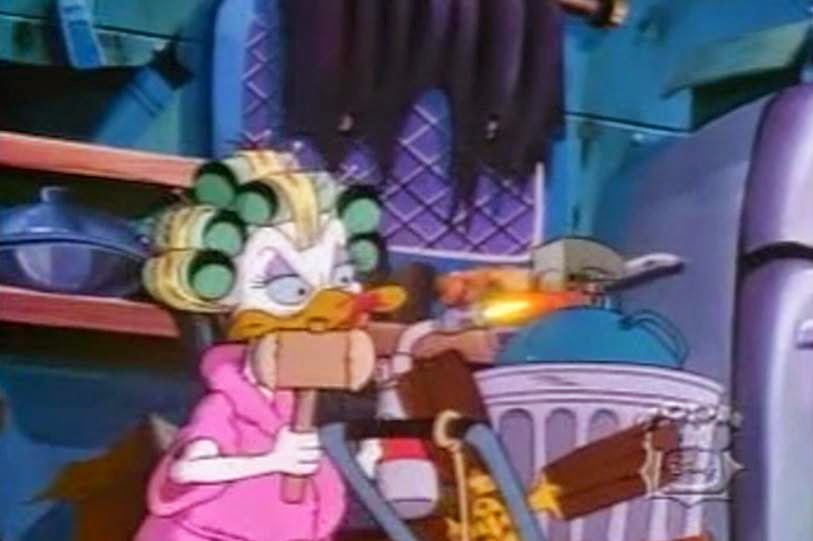
Thursday, September 4, 2014

DUCKTALES RETROSPECTIVE: Episode 99, "The Golden Goose, Part 1"

A few words before we figuratively "kick for home" in a cloud of goose feathers and gold dust... 

I greatly appreciate all of the comments and suggestions I've received while I've been working on what has turned out to be a two-years-plus (the latter, just barely) project.  It's been quite an experience, and, as I've said before, I've been continually amazed at how much MORE I've been able to say about the DuckTales episodes than what Joe and I included in our original DUCKTALES INDEX.  After we've taken a fresh gander at "The Golden Goose," I plan to do a wrap-up post, similar to the one I wrote at the conclusion of the Kimba reviews, and then... quien sabe?  I definitely intend to review the cutscenes of the DuckTales Remastered video game, since (as I can now personally aver) the scenario does resemble a 101st episode of sorts, provided that you squint hard enough and aren't distracted by all the bleeping and blooping.  I'm also thinking about reviewing some of the DUCKTALES comic-book stories -- not the ones I've already discussed, such as "The Gold Odyssey" and the various stories that appeared in kaboom!'s UNCLE $CROOGE during its DT phase, but stuff from the early-90s DISNEY ADVENTURES, the "non-serialized" era of the Disney comics DUCKTALES title, and other sources, most of which I've never had a chance to put under the critical microscope before.  (In certain instances, that might actually be a good thing!)  I'm also seeking out whatever interesting DuckTales fan fiction might be lurking out there on the Internet.  There isn't much of it -- or, should I say, much that is legitimately worth reading -- but I have unearthed a bit of promising material thus far.  Do you, my humble and lovable readers, have any further suggestions as to DT-related matter that you might want to see me dissect on this blog?  If so, then please let me know.

According to GeoX's diligent correspondent "Christopher," "The Golden Goose" wasn't actually meant to be DuckTales' farewell adventure.  The creative staff supposedly believed that there would be more episodes to come, perhaps even another feature film or two.  Granted that "Christopher" might have access to some "inside infor" that I don't possess, something about this theory doesn't ring right to me.  DuckTales: The Movie was animated by Disney MovieToon Studios (now DisneyToon Studios) and Walt Disney Animation France, neither of which had anything to do with the production of DT half-hours.  Therefore, delays caused by animation studios being busy with other projects (as, for example, Hasbro Studios releasing only 13 new half-hours of My Little Pony: Friendship is Magic during the 2012-13 season, due to the Summer 2012 release of the Equestria Girls movie) ought not to have been an issue.  The absolute best possible time to have produced a substantial number of new eps would have been the 1990-91 TV season, the first season of The Disney Afternoon and the first season following the release of the theatrical feature.  The decision to make only four 1990-copyright episodes and stop at a total of 100 eps (a strip-show-friendly number, since it is divisible by five) seems suspiciously convenient.  In the end, perhaps the best argument in favor of "Goose" being an appropriate end of the road is, in essence, a psychological one.  Its narrative may be "lean and lively" rather than "sweeping and epic," and it plays out on a relatively bare stage, but it simply feels like a finale, blending elements from all "eras" of the series -- action, moral seriousness, slapstick, verbal humor, great character dynamics -- into a satisfying whole.  Add the fact that the storyline, for all of its sideline silliness, features the most apocalyptic vision EVER put forth in a story about talking ducks, and you've got the ideal way to wrap up modern TV animation's most groundbreaking single series.

Our quartet of creative contributors (Ken Koonce, David Weimers, and Alan Burnett on story; Jeffrey Scott on script) waste zero time cutting to the wild goose chase (Burger's favorite, in case you weren't aware), putting all of our major players into Barkladesh right away.  (That initial pan shot of people shopping in the marketplace must have blown the budget for extras for the entire adventure; a "cast of thousands" will be conspicuous by its absence the rest of the way.)  As will be confirmed in Part 2, this country (which ought to have been named "Barksladesh," but you can't have everything) is tucked away somewhere on the Indian subcontinent.  The appearance of a snake charmer and a merchant's reference to "rupees" further hammer home the point.  This inevitably leads to speculation as to whether Dijon and his brother Poupon, anchorite-in-chief of the Brotherhood of the Goose, are Barkladeshian.  I have no real problem with the notion.  It's easy to imagine Dijon, the kleptomaniacal "black sheep" of the 'on family, literally being forced to strike out on his own as a lackey-for-hire and winding up somewhere in the Middle East (with dress to match the location) just in time for the events of DuckTales: The Movie.  Funny how he seems to regard morphing into a "professional beggar" as a step up in class from that.

The explosive meeting of Scrooge and Dijon in the marketplace, as I confessed in my review of "Attack of the Metal Mites," really SHOULD have been the characters' first get-together since the final scene of DT:TM.  They quickly recognize each other and display entirely appropriate reactions.  It might have been nice to have had one additional reference to the events of the movie -- perhaps Scrooge making note of Dijon's takeover of the Money Bin while Dijon had control of the magic lamp and its Genie -- but what we got was perfectly adequate.  Given Dijon's subsequent character arc in the story, it's for the best that we start back at "ground zero," with Dijon occupying the same moral position that he did when he escaped with that pantload of "loose change" in the movie's final scene.  It also makes sense for HD&L to suggest that Scrooge immediately let bygones be bygones by giving Dijon a quarter (which, when you come to think about it, makes about as much sense as that legendary Scottish ditchdigger giving "young Scroogie" an American dime).  That turns out as well as you might expect.

After Dijon swipes the robe (yes, I know it looks like he paid the merchant, but watch carefully; he actually paid with money cadged from the guy's own pocket) and "joins" the Brotherhood, we segue to Glomgold and the Beagle Boys on the balcony, with Flinty making with the exposition about the Golden Goose.  Get comfortable with this, because there are several additional info-dumps to follow.  There was no real way to avoid this, of course, since we only have 45 minutes or so in which to develop and wrap up the entire storyline.  One noteworthy aspect of this scene goes unmentioned but deserves comment: This is the only time in the series when Glomgold actually steals a march (an appropriate phrase, methinks) on Scrooge when it comes to seeking out a treasure.  Flinty has aggressively taken the initiative in the past, of course, but such proactiveness involved duplicitous behavior (framing Scrooge in "Duckman of Aquatraz"), a new business venture (commissioning the giant robots in "Robot Robbers"), or a challenge to a contest (coming to Duckburg to literally throw down the gauntlet to Scrooge in Carl Barks' "The Money Champ").  In "Wrongway in Ronguay," "Master of the Djinni," and throughout "Time is Money," Flinty gets involved in a treasure tussle in response to various actions by Scrooge.  Here, Glomgold is boldly treading on turf that should, by all existing precedent, be Scrooge's.  I wonder where Flinty got his original "infor"... or do I want to know? 

Greg is right -- that is Flinty's arm when it should be Scrooge's.
You can tell by the red cuff.

The relationship between Dijon and Poupon will, of course, be of key importance throughout the remainder of the tale. Poupon's obvious decency and willingness to forgive his wayward brother are unquestionably admirable, but his inclination to give Dijon such an important responsibility (that of guarding the Goose on its fountain) right away could be flagged as a bit... naive.  Even real-world monastic orders, after all, don't give their novices major duties right off the bat.  Rather, the novice must typically demonstrate fidelity to the order through acts of humility and selflessness.  Since Poupon offhandedly disses Dijon in the fountain scene ("Have you anything worthless... besides yourself, of course?"), he pretty clearly thinks that Dijon has a ways to go before fully meriting the good opinions of others... and Dijon quickly backs him up on that by casting a covetous glimpse at the Goose the moment after Poupon has left the fountain room.  Poupon can't even be sure that the two big monks at the door will provide a fail-safe, since Dijon is well-known for his slipperiness.  Dijon, Scrooge, Glomgold, and the Beagle Boys all share some responsibility for the metastatization of the "Goose crisis," but Poupon's contribution shouldn't be neglected just because his actions were the result of kindness.

The Beagles provide the main levity of Part 1 when they don the inevitable "cheesy disguises" to try to sneak into the fountain room.  I'm in agreement with GeoX that the Beagles are a bit on the irritating side here -- Burger makes one or two too many food references, and the absence of Bouncer deprives the Beagles' performance of some needed gravitas (did I ACTUALLY JUST WRITE THAT?!) -- but the "tacky tourist" garb the B-Boys employ here is simply too funny for words.  Dijon is quick to get with the program, embracing his inner Toon and materializing an impromptu disguise of his own that fools the monks into giving him the (literal) boot.

Commence Moral Dilemma Number 1!  Dijon shows off his shiny new conscience by talking through his options on the mountainside.  I think that Scott made the right decision by having Dijon's final remark (the one before the Beagles accost him) suggest that he might have voluntarily returned the Goose.  It's our first real indication that this seemingly hopeless case might be salvageable, after all... and it makes Poupon's angry "supposed final break" with Dijon during Part 2 have even more of an impact.

Scrooge finally becomes involved in the adventure through no effort of his own, thanks to the proverbial "conveniently placed box."  (In case you're wondering where the "fifty rusty door chimes" are, Greg, they're obviously under the packing material on which the Goose lands.)  Scrooge's relative passivity here contrasts, in a certain sense, with what most of us would like to think about the character, just as Glomgold's aggressive treasure-seeking is something out of the norm for him.  The dissonance is especially true of the classic "old sourdough" version of Scrooge who dug his fortune out of the frozen ground of the Klondike, "outsmarted the smarties," and so forth.  However, there are more than enough UNCLE $CROOGE adventures in existence into which Scrooge gets sucked by one means or another, so I have no real problem with his portrayal here.

After Poupon collars Dijon and teases what we will learn about the Goose's powers in Part 2, we shift back to Duckburg, where Scrooge begins to get an inkling as to the true worth of the "ugly" Goose after Burger tries to steal it (Big Time would have been my first option for that job, but that's just me) and Glomgold attempts to bargain for it.  I'm not sure why Greg was so negative about the "sale negotiation" scene.  Scrooge knows enough about Glomgold's capacity for do-badding that he should naturally be suspicious at any interest Flinty might show in a seemingly "worthless" item, especially after one attempt to steal it (and by a figure who has worked with Glomgold in the past, no less) has already been made.  Flinty's comment to Scrooge back in Barkladesh that he had "more important things to do" than search out bargains may also have popped back into Scrooge's mind here at just the right moment.  Scrooge keeps raising the price only because Glomgold is able to match several of the lower offers for the Goose.  That's not being "a jealous old jackass," that's elementary CYA in the ongoing conflict between this pair.

A bit more contrivance ensues back at the Mansion as Scrooge more or less stumbles upon the secret of the Goose (interestingly, much as he did in Barks' "The Fabulous Philosopher's Stone" [UNCLE $CROOGE #10, June 1955])... and then, "away he golds," with Moral Dilemma Number 2 trailing in his wake!  Though the true consequences of this dilemma will not kick into full gear until Part 2, we get ample foreshadowing of it here, with Scrooge gradually turning more and more things in the Mansion to gold, even as his family members warn him that he's endangering the Ducks' "happy home."  The obvious question here is why no reference to the "gold fever" of "Too Much of a Gold Thing" was made.  Upon further review, I honestly don't think that the two situations are all that comparable.  In "Gold Thing," Scrooge was literally overwhelmed by the discovery and massive physical presence of gold, to a degree unlike anything he had ever experienced before.  Here, Scrooge is actively creating gold and therefore has more inherent "control" (a word he himself uses at one point) over the process of acquisition.  If Scrooge were as gold-crazed as he was in "Gold Thing," or even in "Philosopher's Stone," he would not have stopped to go to bed; he would have continued turning things to gold until the cows came home.  (In "Philosopher's Stone," Scrooge's gold-making had a built-in time limit, in that the "radiation" from the Stone would have turned him to gold before long.  Absent that limiting factor, he would unquestionably have gone on indefinitely, as well.)  Part of the intrigue of this story lies in the fact that we never do get to find out whether Scrooge would have been able to control himself once the initial excitement had died down.  Would he have had a moment of "Dough Ray Me"-inspired epiphany and realized that turning every single thing in his house into gold would ultimately be counterproductive?  Would the pleas of Mrs. Beakley, HD&L, and Webby have finally gotten through to him after a good night's rest?  As with Dijon's ultimate "Beagle-free" decision on the mountainside, the "what-if" helps give this tale an extra, and welcome, layer of complexity.

The genetic source of Huey's fantastic leaping ability in "Send in the Clones" REVEALED.
We end, of course, on the cliffhanger that sent many viewers into a tizzy back in the day, HD&L's being turned into gold statues by the Beagles.  This easily trumps even Bob Langhans' array of narrative minefields in "The Gold Odyssey," which is the highest possible complement where DT is concerned.  What we do not know as of yet, of course, is that the Nephews will literally have no further part to play in the story, in terms of active participation.  This, I think, is why Scrooge's grief and distress in Part 2 wind up having the impact that they do.  Scrooge will have to try and atone for his spasm of greed by dedicating the rest of his efforts to the Nephews, but he will also ultimately be forced to choose between acting on behalf of the boys and acting on behalf of the entire world.

A few coloring and animation mistakes from Wang Films aside, this table-setting chapter of the saga of the Goose delivers ALL the goods... and, just think, we haven't even gotten to that whole "fate of the world" business yet.

.

.

.

Specially requested by GeoX... not.

.

.

.

"DuckBlurbs" 

(GeoX) The idea is that Scrooge and HDL are in Arabland (sic) to collect old junk to pawn off as antiques (um…didn't "Much Ado about Scrooge" establish that this is considered immoral by the show's metric?)
("Christopher")  I think that when you take actual old items from halfway around the world, it's fair to describe them as exotic antiques, because curios that are made in far away places with strange sounding names always have some level of value in the U.S. It's only when you try to pass off mass-produced cheap junk from Hong Kong factories as antiques that you're stepping over the ethical line.

I'm inclined to side with Christopher on this one.  The lost Drakespearian play in "Much Ado" would certainly be of interest to the entire world, and its ultimate worth, no matter what the quality of the play might be, would be greatly influenced by that fact.  Selling Barkladeshian merchandise as "exotic antiques" is much more of a one-on-one transaction involving the seller and the buyer, and the buyer would always have the option of refusing to buy.

I will say that for Scrooge to be micromanaging the stocking, opening, and operation of a department store -- right down to using HD&L as security personnel! -- does seem a little "off."  Surely, Scrooge would ride herd on the individuals who did operate such a store on his behalf, but going to the trouble of traveling to Barkladesh for merchandise and then manning the store himself?  That's much more of a stretch.  All a matter of plot convenience, you understand...

(GeoX) Yadda yadda, [the Goose] accidentally gets stowed in Scrooge's luggage and towed back to the States, and it's quite weird how the show emphasizes how completely worthless he thinks it looks. Dude--it's a gold statue. He would be all over that shit, whether or not he knew its secret.

And, knowing the properties of gold and other precious metals as well as he presumably does, he would probably be suspicious of the authenticity of the "gold" statue, based on the physical evidence alone.

(GeoX) Back in Arabland [sic], Poupon is insistent that they go recover the goose--otherwise, for unspecified reasons, the END OF THE WORLD may occur, as it's been known to do. But back, again, in Duckburg, the Beagles succeed in stealing the statue from Scrooge, and TURN[S] THE NEPHEWS TO GOLD OH NO and to be continued and I can't help pointing out that if you can turn people into gold, there is really no chance that Scrooge wouldn't have accidentally done it to himself in his transmutation binge.

Even while he is in the throes of his initial binge, Scrooge clearly demonstrates that he realizes that the Goose's beak is the source of its gold-granting powers.  Poupon makes the fact explicit in Part 2, but Scrooge definitely got the message fairly quickly.

(Greg)  Dijon sadly doesn't get the remove the damn cowl put and just goes to the eating part. HA! So the monks remove his cowl and they are not impressed because Dijon is not a monk. Dijon claims that this is not the YMCA. Oh god Jeffrey Scott; what would Dijon KNOW about the YMCA?! It should be "So this is not the Friars League?!". That makes a lot more sense than this.

Change "Friars' League" to "Friars' Club," and I'm with you.  That would have been a first-rate "in-joke," especially considering the nature of the real-world organization.

(Greg) The big ass guard grabs [Dijon] by the nose and throws him back into the fountain because they are there to make sure Dijon keeps his word. Which begs the question; if they are there then why would you need Dijon to guard the goose? Probably punishment for being a thief and a liar I guess.

Dijon's task is to keep the Goose on the fountain; the big monks' task is to (as I said before) serve as a fail-safe.

(Greg) So the nephews grab their whistles, and police caps with night sticks and run out of the security room. Yes; we are supposed to believe that a bunch of ten year olds are Scrooge's Rent-A-Cops. Kit Cloudkicker might be able to get away with this; but not a bunch of crybaby nephews. They chase Burger in the store as Burger realizes that he blew his cover; he collides very poorly into a model of a lady posing right next to a dognose (dogperson; same difference) and the bag goes flying and so does the golden goose. Then we jump cut to Burger leaving the store and getting into the heels' van. Huh?! So how did Burger get out of the store?

I guess he must have simply slipped (sound familiar?) past everyone as they were distracted by the sliding Goose.  Also, Burger's mannequin fail = obvious outtake from "New Gizmo-Kids on the Block."  Just saying.
(Greg) Scrooge touches the scale with the [Goose's] beak claiming that it[s] weight is worth in gold and the scale turns into gold. Obvious logic break: After the nephews are surprised that the scale turned to gold, Scrooge then taps the green book; but nothing. The reason I mention this is because before he turned the scales into the gold; both the green book and desk lamp were ALREADY gold colored. And the desk lamp is red shade with a blue base. So the original scene was to have the SCALE turned last and the green book and lamp first according to Wang's line of thinking. Really bad form there Wang Films.

Yup.  There's a coloring mistake earlier in the ep, in which the shirt color of the dognosed Barkladeshian towing Glomgold around in a rickshaw (or whatever the local equivalent with the bicycle is called) switches between blue and tan.  Since Dijon's vest was blue, did some animator mistakenly think that this guy was supposed to be Dijon??  Given Wang's decidedly spotty track record during the series' final dozen or so episodes, I'm almost inclined to believe it.

Before and after, the Wang way!
(Greg)  Mrs. Beakly comes in and blows of[f] Scrooge for letting the golden touch get out of hand here. Scrooge ribs her and tells her to relax [and] he goes to the golden waste paper basket and gets golden garbage since they can buy a new home from it. Which is silly since in Dough Ray Me; this would devalue gold big time.

Not if Scrooge had the sense to use the gold to buy things a little bit at a time.  The open question we are left with is: Would he ultimately have had the sense, had Glomgold and the Beagles not intervened? 

(Greg) Still; a pretty nasty scene as the heels leave while Big Time proclaims that the Scrooge will like the nephews now because they are priceless. Problem with that line is; Big Time never heard Scrooge say that.

I don't think he was ever meant to.  Scrooge's earlier praise of the Nephews as "priceless" and Big Time's use of the word here could easily have been thought up independently. 

Next: Episode 100, "The Golden Goose, Part 2."

Wednesday, September 3, 2014

Comics Review: MY LITTLE PONY: FRIENDS FOREVER #7 (July 2014, IDW Publishing)

I'm still in something of a catchup mode with these: FF #7 was released during the week of my kidney surgery.

** SPOILERS **

Princess Luna and Pinkie Pie -- with a modest assist from Twilight Sparkle -- are this issue's "Duo of Doom," and they make a remarkably good team, as Jeremy Whitley's plot veers in an unexpectedly sober direction about two-thirds of the way through.  A highly improbable, hitherto non-canonical (and I rather think it's going to stay that way) "Canterlot royal tradition" sets the whole shebang up.  Still concerned that the denizens of Equestria aren't comfortable with her because of her "thousand-year bitch" as the evil Nightmare Moon, Luna gets the idea of participating in "Chuckle-lot," a ceremony initiated by Princess Celestia to figuratively "let down her mane" (even more than it already is, I should say) and show her subjects what a salt-of-Equestria, regular-pony clown she can be.  (This includes smashing a watermelon with a mallet.)  After Twilight fails in literally teaching Luna all there is to know about comedy, Pinkie steps in with a more... applied approach.  The problem is that the somewhat haughty Luna can't actually stand the idea of other ponies laughing at her and wants whatever material she can work up to be performed by Celestia.  In a shockingly mature moment, Pinkie slaps Luna down hard for this, insisting that Luna should be the performer, and the two actually have an argument.  THIS is what I have been hoping to see in these FRIENDS FOREVER teamups -- previously-unseen pairings that explore the differences, as well as the similarities, between the characters involved.  We haven't really gotten this before apart from some occasional slight bickering.  Here, with Pinkie having walked out on her, Luna is forced to figure things out for herself, and she manages to show that she's learned her lesson... though the actual execution of the proof contains a twist or two, including a bit of belated revenge (if that's the word) on Pinkie.

Whitley writes Luna and Pinkie extremely well and has a lot of fun displaying the obvious contrasts between them.  In an amusing moment, Pinkie even proves to have her own version of Luna's forbidding "Royal Canterlot Voice."  I don't know whether I should be pleased or worried by the return of the slightly-insane Pinkie's "imaginary friends" from the first-season episode "Party of One."  The idea behind their original appearance was that Pinkie was pretending that they were substituting for the rest of the "Mane 6," who had supposedly "abandoned" her.  Ergo, they were a product of a mental delusion and shouldn't have been employed by a "normal" Pinkie.  Perhaps Pinkie has a different idea of "nostalgia" than I do.  For her part, Whitley's Luna is a little less volatile and loopy than she was in, say, MICRO-SERIES #10, but a sterner approach is certainly in character as well.  (As I've said before, Luna has a habit of acting a bit different in every appearance that she makes, which can be a good, as well as a bad, thing.)  Tony Fleecs' artwork continues to improve in terms of both smoothness and figure drawing, and this is easily his best work to date, with Luna, Pinkie, and Twilight all very attractively rendered. 

With seven issues of FRIENDS FOREVER now in the books, I think we can safely say that the overall quality of this title is outstripping that of the defunct MLP micro-series.  Now, can they keep the roll going?

Book Review: THE PRESIDENTS' WAR by Chris DeRose (Lyons Press, 2014)

When Abraham Lincoln was elected President in 1860, five of his predecessors were still alive and active, a record that still stands.  As author DeRose reveals in this unusual look at the antebellum and Civil War eras, this was a decidedly mixed blessing.  Martin Van Buren, John Tyler, Millard Fillmore, Franklin Pierce, and James Buchanan had all governed in the great Era of Compromise, in which effort after effort was made to hold the Union together in the face of the growing controversies over slavery.  Each had to make his own version of a "deal with the devil" to preserve the status quo.  The Lincoln years split the ex-Presidents asunder, just as the Civil War split the country as a whole.  Tyler joined the Confederate cause wholeheartedly, working to take Virginia out of the Union and serving in the Confederate congress for a time before his death.  Pierce became a Copperhead, or Peace Democrat.  The much-maligned Buchanan turned most of his attention to various attempts to salvage what remained of his reputation after his one disastrous term, which had ended with a number of states seceding.  Even Fillmore, who (at least in DeRose's telling) comes off better than any of his Democratic peers in terms of energy and ambition, broke angrily with Lincoln after the latter announced the Emancipation Proclamation and broadened the war's moral scope.  Perhaps symbolically, Van Buren, the oldest of the five and the one whose lifetime stretched back to the difficult Revolutionary War era, seems to have been the most uniformly supportive of Lincoln's policies, though he died before Emancipation became an issue.

DeRose does a decent job of weaving the actions and reactions of the ex-Presidents in and out of his narrative.  The main problem here is that the wartime narrative, in particular, gets too much attention.  The time spent reiterating the well-known results of various battles could have been better spent expanding upon the ex-Presidents' views.  The book also ends rather abruptly, at the end of the war, with three of the five exes still alive.  I would have liked to have seen an epilogue that discussed how their feelings towards Lincoln and the war effort may have changed (if, in fact, they did) and how they may have felt about the war's impact on their legacies.  I could also have done without some of DeRose's clunky grammar and troubles with dates (he has an annoying tendency to record days absent years).  Still, I appreciate his efforts here.  These may not have been America's best and/or brightest leaders, but it is useful to know what they thought and said about Lincoln and the war that forever sundered their time from the very different future that was to come.

Tuesday, September 2, 2014

DUCKTALES RETROSPECTIVE: Episode 98, "New Gizmo-Kids on the Block"

The last unequivocally BAD episode of DuckTales... and we're going out in a particularly noxious blaze of gory in this case.  "New Gizmo-Kids on the Block" isn't the single worst episode of the series, as I previously argued here, but I think that it can fairly be described as having one of the very worst PLOTS of the series, if not THE worst.  The setup here is so transparently laughable and ill-conceived that the ep starts out in a hole that it wouldn't have a chance in a hundred of escaping under the best of conditions... and the inclusion of a thoroughly out-of-date subplot (HD&L dissing Webby's ability to be a hero for gender-based reasons) and a distressing number of silly animation goofs don't exactly qualify as the "best of conditions."  In his final appearance of the series, poor Fenton -- or, at the very least, his Gizmoduck alter ego -- is well and truly "buried" (as Greg pungently put it), to the extent that one is actually relieved that both he and Gizmoduck were resurrected for somewhat more gainful employment in Darkwing Duck.  Even the BEST things about the episode -- Webby's trumping of the bungling HD&L with the display of her heroic capabilities in the guise of the "Gizmo-Kid," and one of Mrs. Crackshell's liveliest and most interesting roles of the series -- come with barbs in their tails.  Granted, we don't get a completely ludicrous denouement a la "Yuppy Ducks" or a thoroughly butchered moral a la "Bubba's Big Brainstorm," but precious little else of substance can be salvaged from this wreckage.  "Gallopin' Garbage!"?  My "scentiments" exactly.

Putting the treatment of Fenton aside for the moment, is there any way that DT could have crafted a scenario in which the kids bicker over the right to use the Gizmosuit (or a version thereof) that would hold the expected cliches to a minimum?  Sure, there is.  In fact, it appeared barely a month after "Gizmo-Kids" first aired, albeit in a comics (for lack of a better term) magazine.  "The Littlest Gizmoduck" (DISNEY ADVENTURES #2, 12/10/90, script by Karen Willson and Chris Weber, art by Roberto Santillo) beats Jeffrey Scott's version six ways to Sunday and eight ways to every other day of the week.  The very first panel of the eight-page digest tale represents an improvement on "Gizmo-Kids," as HD&L and Webby are cooperating to construct a Gizmo-like suit to present at the school crime fair.  The obvious implication is that HD&L and Webby are equally competent, at least in this particular endeavor.  The dispute comes when the kids debate who will get to ride the contraption.  And, yes, the kerfuffle is gender-based, but Webby gives as good as she gets from the very outset, responding to HD&L's claim that "girls aren't crimefighters!" by commandeering the suit when the boys aren't paying attention and then charging into battle against the Beagle Boys at the Duckburg art museum (!).  In "Gizmo-Kids," before Webby finally gets her shot at the shrunken (more about that later) Gizmosuit, we have to endure repeated whining and pleading from her as the lads pass the suit back and forth amongst themselves, which tends to dilute her final triumph a bit.  The Webby of "Littlest Gizmoduck" is a far stronger and far less compromised character.

Even Gizmoduck (whose first of very, VERY few comics appearances this was) is treated with respect in "Littlest Gizmoduck," coming to save the kidnapped Nephews from the Beagles, with Webby continuing to lend a hand along the way.  Given their helpless state throughout the latter portion of the story, the HD&L of "Littlest Gizmoduck" might be considered fall-guys of sorts, but, unlike in "Gizmo-Kids," they do not end up the butt of the gender-joke.

"Littlest Gizmoduck" is too slight of a story to have made for a 22-minute episode, but its superior character dynamics and greater sense of believability are easily apparent.  Even the inexplicable re-dialoguing of the story for its reprinting in UNCLE $CROOGE #392 doesn't mar the essential strength of the work.  The approach taken in "Gizmo-Kids," by contrast, doesn't begin to make up for the fatal plot-related errors committed in the episode's first act -- surely, among the most painful 10 minutes of the entire series.

The ep actually begins fairly promisingly.  The dueling "Mother of the Year" campaigns by Mrs. Crackshell and Ma Beagle hold out promise for some decent funny business, and Mrs. Crackshell certainly delivers some yuks; her mantra about wanting to win the "50inchcablereadywidescreenTV" rivals some of the repetitive phrases in "Nothing to Fear" for sheer catchiness.  Ma Beagle's participation is a bit more problematic.  Her efforts to show "what a good mother she is" (breaking her boys out of the slammer and leading them on thieving expeditions to art museums and clothing stores) seem like, well, things she would encourage her boys to do under normal circumstances.  For what should be obvious reasons, Mrs. Crackshell's efforts, whatever their "true motivation" might be, represent a bigger stretch out of her thimble-sized "comfort zone."  Even so, pairing Ma up with "M'Ma" does make good psychological sense, in that both maternal ancestors are trying to make up for a legacy of neglect of their children (or, in the case of Ma Beagle, outright betrayal, e.g., in "Robot Robbers" and "Hero for Hire").  We see a similar twist on what has come to be expected when the guard at the prison finally sees a sufficient amount of light to inspect Ma's Hickleberry Hiccup Surprise Cake for hidden escape tools.  Too bad that, on this one occasion, the "escape tool" turns out to be Burger himself.  It makes sense, in a perverse way, that this is the final "Beagle escape scene" of the series.  I mean, how could the Beagles be expected to top THIS? (Whether that should be taken as a positive or a negative, I leave as an exercise to the blog-reader.)

And THAT, dear friends, is quite literally as good as it gets.  Perhaps as a symbol of what's to come, in the scene that introduces the young Ducks' recycling campaign, the dollar sign on Scrooge's Money Bin
appears in reverse.  Hang on, Wang Films has more such baubles in store for us.

Do I even have to explain why the whole notion of "shrinking the Gizmosuit in the wash" makes no sense whatsoever, even in a "Toony" context?  Even if one posits that the "polyester-aluminum blend" suit was created by Gyro as a replacement suit following the events of "Attack of the Metal Mites" -- and, in all honesty, it is easy to imagine Scrooge demanding that a "Gizmosuit 2.0" be made less susceptible to consumption by whatever other metal-eating critters might be lurking out there -- polyester doesn't shrink in the wash anyway.  The idea that the new suit is foldable, and therefore can now be carried in a cardboard box, is killed before it even makes its formal debut, since the suit is clearly made of solid material when Mrs. C. lifts it up to look at the label.  (Fenton's washing of the suit near the end of the ep abruptly revives the "foldable" theme.)  Let's not even talk about the change in the computerized code word.  This is a classic example of what the popular Youtube and Deviantart animation reviewer The Mysterious Mr. Enter calls, "I'm going to have this thing happen, because I WANT this thing to happen."  In the rush to get the Gizmosuit down to kid size, Jeffrey Scott tramples logic and reason into the turf.  Why couldn't his story editor have warned him... oh, that's right, we're in the same "flying solo" mode here that we were during "Metal Mites."  There's a lot more turbulence in evidence this time around, though.

 
Mrs. C. does deserve some props for her impromptu handicraft in putting together the Garbageduck suit.  I fail to see what was accomplished, however, by the tedious "teasing" of the "final reveal" of the woebegone wardrobe until the scene at the art museum.  Thanks to the swan-dive into the box full of cans, Fenton is already well on his way to humiliation before the full splendor of the Garbagesuit is vouchsafed us.  (Wang can't even get the hidden transition right here; Mrs. C. gives the Garbagesuit to Fenton in a box, and the entire suit appears to encase Fenton when he first utters the new code phrase, but Fenton then needs to push the garbage can to the museum by hand in order to perform his transformation there.)

As poor Fenton sinks slowly in the webs, HD&L cover themselves with similar glory, discovering the shrunken Gizmosuit and taking turns botching their tenancies thereof.  Interesting dichotomy here: all three of the Nephews appear to know exactly where certain features of the suit can be accessed, yet they prove to be inept at using them.  (I guess that their founding of the "Gizmoduck Fan Club" in "Full Metal Duck" wasn't for naught, at least in terms of gaining a knowledge of Gizmo-anatomy.)  To be fair, the boys do have one or two little moments of glory...

... but we tend to remember the less successful moments, now, don't we?

That's supposed to be Huey in the suit, BTW.  Thanks, Wang!
Pwned by Baggy, no less! 
And, of course, the sudden amplification of the Nephews' egos makes these goofs seem all the worse, even before they drop that "Super stuff is for boys!" load on Webby's wee head.  Thankfully, when Webby finally takes control in the clothing store, some sense of order is restored.  Even her brief effusion of self-congratulation ("Gizmoooo WEBBY!... to you") is relatively restrained, given what had gone before.  It's unfortunate that this otherwise satisfying ending became so nakedly obvious the moment that HD&L started acting like jerks.  It's also unfortunate that Webby's previous puling about the boys being unfair and not letting her use the suit undercuts the (already thumpingly obvious) moral that Scott was attempting to deliver about girls being the equal of boys.

As for poor Fenton... poor, poor Fenton... he goes from one humiliation to another as he literally attempts to salvage what shreds of respectability still accrue to his secret ID.  His involuntary "dumpster dive" makes Launchpad's two visits to the junkpile in "Hero for Hire" seem dignified by comparison.  Fenton and Mrs. C.'s "ride through the countryside" looks even worse in light of Webby's subsequent competence in battling the Beagles.  "Garbageduck"'s final "wheel-on" may be said to complete the character's abasement, as it makes Fenton's secret identity even clearer than Scott had done in "Metal Mites."  Fenton speaking in his own voice, wearing a Gizmoduck-like suit, accompanied by Mrs. Crackshell... it's like putting ONE and ONE together, fer cryin' out loud.

Even the last couple of scenes don't leave us unscathed.  Having gained back some respect thanks to the wits of that one cake-examining guard, the Duckburg penal system fails even harder than normal when the Beagles and Ma Beagle are put in the same cell.  To say the least, this is far more dubious than Scrooge and Mrs. Beakley sharing occupancy of a cell in "The Billionaire Beagle Boys Club."  Mrs. Crackshell then partially gives back some of the newfound approbation we have for her by evincing more glee over winning the "Mechanic of the Year Award" than over exchanging a loving gesture with her son.  This leaves it a very open question as to whether Mrs. C. will retain any portion of the lesson she ought to have learned here.  Off her po-faced performance in "Dangerous Currency," in which she forgets that her son is Gizmoduck, I'm inclined to say... um, not.

This little journey may have been rough as the proverbial cob, but cheer up -- this wonderful series ain't going down without a fight.  Just the opposite, in fact.

.

.

.

"DuckBlurbs"

(GeoX) BOY does that title ever instantly date the hell out of this episode.

At least Harvey Comics didn't try to turn this title into another NKOTB comic-book title.  We got more than enough of those back in the day, thank you.

(GeoX) Fenton gets the suit back to normal size by means that weren't totally clear to me...

He makes a comment that he may have to "lose some weight" to fit into the suit, so it's not even clear that the suit has been restored to normal size.

(GeoX) Scrooge has a bronze statue of himself? As is often the case, I Have My Doubts.

Well, he did have a small statue of himself in Barks' "The Lemming with the Locket."  I will admit that Scrooge having a LARGE statue of himself seems a bit far-fetched.

(GeoX) "A good mother would help her son; therefore, I, being a good mother, will help you."

There's something amusingly... mechanical about this sentiment, or at least the way in which it is expressed.  Mrs. Crackshell IS trying to show that she's a good mother, but she's obviously new at this particular game.

(GeoX) I never got the impression that the [G]izmosuit would just switch around to different users like that. Is there anywhere else where its behavior in that regard is established? Seems like a potentially fatal flaw.

Well, simply using the phrase "Blabberin' blatherskite!" was enough to get Mrs. Crackshell into the suit in "Full Metal Duck"...

... and Launchpad into the suit in "A Case of Mistaken Secret Identity"...
... so it's definitely a design flaw, at least in the suit's current incarnation.  (BTW, at some point, the Wang animators evidently got tired of showing all the details of the suit switching from Nephew to Nephew.  When HD&L do the round-robin thing in the clothing store, the suit simply jumps on top of them, and Bingo!  They're encased.)

(Greg) We begin this one at the trailer park as Mrs. Crackshell is watching another soap on television again. And the Duchess of Swansylvania is back with a blond haired duck wearing a green shirt and brown pants. 

The latter appears to be Count Roy of Monte Dumas ("Duck in the Iron Mask") with his mustache shaved off.  In a later scene, the toy salesman from "Allowance Day" makes a comeback as the manager of Crooks Brothers.  With DT drawing to a close, I suppose that it was as good a time as any to start freshening up those resumes.


(Greg) So the guards cannot believe this as the heels drop down and then dig their way through... Then we clearly jump cut to the BB getting up and running out of the prison in front of the sidewalk. Judging by the hearing of a gunshot sound; there was a scene cut for shooting, around 15 seconds or so. Finally! A gun edit in an episode other than TaleSpin that Toon Disney cut out. It also is clear [since] there are bullets spraying around the area as they hop into Ma's jeep. The cut is made even stupider by the fact that on the next shot where Ma declares that she broke them out of prison because she's a good mother; you can clearly see the police guards pointing their rifles for all to see. Too obvious of a cut; and another reason why Toon Disney was so laughable in those days. 

Yep.  We see the bullets whizzing from off-screen as the Beagles exit the escape hole, and again when Ma's jalopy makes the getaway.  We also see the guards shooting at unseen, off-screen targets.  But implying that the bullets from off-screen are coming FROM the guards and are being aimed AT the Beagles?  Nope, can't have that, even though it is cringingly obvious what is happening here.

(Greg) Yeah; they are officially burying Fenton here; although this was the last Gizmo Duck episode in production so it was kind of expected (and then regretted when Stones starting having him do cameos in DARKWING....DUCK!) even though it probably aired before Scrooge's Last Adventure.

It did: "Gizmo-Kids" first aired on November 5, 1990, and "Last Adventure" aired 12 days later.  So I suppose you could say that Fenton, qua Fenton, was rehabilitated to a certain extent by that long-delayed episode.  That's ONLY if you give "Last Adventure" credit as a 1990 episode, however.

(Greg) So [Mrs. Crackshell] hears the phone ring in the garbage and answers it. It is for Fenton; and it's Scrooge as he is in front of the vault and he informs Fenton that the heels are heading for the museum and he wants him there as Gizmo Duck. Fenton is hot under the collar hearing that one.

He should be, considering that Scrooge didn't identify WHAT museum was meant.  Duckburg has an art museum (confirmed by "Rightful Owners," for what that is worth) and a natural history museum ("Bubba Trubba"), among others that have been in various venues seen over the years.

(Greg) Ma and three of the boys (BT, BR and BG) walk in[to the museum] leaving Bouncer to watch the jeep.

Whereupon Bouncer suddenly teleports into the museum to join the other Beagles as they approach the Mona Duck.  Another "Wang moment" for your delectation!

(Greg) Question: How did Gizmo Dewey get in[to the museum] without anyone noticing? The writers didn't seem to bother adding that one little detail. Meaning that Jeffrey Scott doesn't care today which is a BAD sign...

Dewey must have emulated Fenton and rolled there on his Gizmo-wheel, given that Huey, Louie, and Webby show up at just about the same time.  I can certainly understand why, given the mess Dewey made of the Mansion while flying. 

(Greg) The police take the heels away with the coat rack as Gizmo Webby wheels over to Scrooge and Scrooge thinks it's one of the nephews in the suit despite the fact that we NEVER see Scrooge see the Gizmo Kids at all. Stupid, stupid, STUPID! Did I mention dumb?

Scott evidently sensed that Scrooge's initial reaction was a problem, since Scrooge subsequently expresses surprise at the existence of a small Gizmosuit.  That doesn't make up for his original assumption that one of the "lads" was in there, though.

Next: Episode 99, "The Golden Goose, Part 1."

Monday, September 1, 2014

Comics Review: MY LITTLE PONY: FRIENDSHIP IS MAGIC #21-22 (July-August 2014, IDW Publishing)

** SPOILERS **

"Manehattan Mysteries" finds Applejack, Apple Bloom, Rarity, and Fluttershy visiting the great Equestrian "mare-tropolis," where they encounter "The No Longer So Great but Still Relatively Powerful" Trixie attempting to make a living as a stage performer... and, as we quickly learn, an ally of the local police in their attempts to catch a jewel thief.  Trixie's somewhat soiled reputation comes back to bite her in the plot when a valuable jewel is found in her possession.  Can our friends -- aided by Apple Bloom's cousin, Babs Seed -- clear Trixie's mane, er, name and solve the mystery?

I really liked the way in which writer Ted Anderson worked Babs, making her first appearance in comics here, into the story.  A reformed bully thanks to the events of the TV episode "One Bad Apple," Babs has received surprisingly little attention since then in any medium, a rather peculiar thing, given that (1) Babs would seem to be an ideal appendage to the Cutie Mark Crusaders, and (2) her residence in Manehattan provides a good jumping-off point for any number of future stories set in the big city.  Anderson almost overcompensates for this lack of love by using Babs as the catalyst who turns "similarly reformed villain" Trixie to the side of good AND the smartyhooves who solves the mystery.  I suppose that Babs could be considered hard-boiled enough by nature to qualify as a gimlet-eyed junior detective, but her sudden emergence as a comprehensive problem-solver here still strikes me as a bit overly convenient, though nowhere near as "WTF??"-worthy as Webby's mutation into a self-righteous scold in "Rightful Owners."  It's also hard to say how any future appearances of Trixie on the TV show are going to be made to square with the sorceress' apparently complete turn to the side of good here.  (And, yes, I do take consistency of continuity between the TV series and the official comics line seriously... the more so after seeing such continuity treated far more roughly by various iterations of Disney Afternoon-based comics.) Even so, this is a well-constructed story and a generally fun read.

I've had something of an issue with Agnes Garbowska's artwork ever since she appeared on the MLP comics scene.  Her latest effort here can fairly be said to have tested my patience.  The chunky, storybook-style artwork has not changed much.  What bothered me about this particular production was the huge, even excessive, number of panels in which characters directly face the (supposed) audience.  I've been in Greek Orthodox cathedrals that had far fewer icons.  Admittedly, the face-on frenzy is consistent with Garbowska's book-illo-flavored overall approach.  The problem is that getting the same point of view, over and over again, in a two-part story hammers home the theme of LAZINESS far more than it does artistic integrity.  I'll give Agnes the benefit of the doubt on this latter contention, but here's some friendly advice: Evidence of a bit more ambition in your next story would be welcome.