Tuesday, November 5, 2013

DUCKTALES RETROSPECTIVE: Episode 62, "Once Upon a Dime"

Play along with me for a moment: Think of "biographies" of Scrooge McDuck as the equivalents of term papers.  In December 1987, at the time "Once Upon a Dime" first aired, the existing Scrooge bios -- Jack L. Chalker's AN INFORMAL BIOGRAPHY OF SCROOGE McDUCK (1974), Robert Weinberg's article "In the Days of My Youth" (FANZATION 5 [1970]) -- were what one might call "rough drafts" of Scrooge's past.  They chained together nuggets of information from Barks and non-Barks comic-book sources, attempting to link them into something remotely resembling a coherent narrative, but without adding much, if any, original interstitial material.  In that respect, they resembled papers from students who've clearly done their share of research but have ultimately contented themselves with stringing together a bunch of quotes from their various sources.

Half a decade on from DuckTales' stab (ouch!!) at biography, we got that peerless exemplar of four-color OCD, Don Rosa's LIFE AND TIMES OF $CROOGE McDUCK (UNCLE $CROOGE #285-296, April 1994-February 1996).  Sticking (for the most part) to Barksian "facts," Rosa went above and beyond a merely sequential approach.  He carefully filled in the cracks between Barksian adventures, fleshed out the personalities of Scrooge's previously shadowy relatives, and posited various encounters between the young (or, more precisely, the pre-"Christmas on Bear Mountain") Scrooge with future friends, future foes, and various historical figures.  One can certainly flyspeck some aspects of Rosa's flights of fancy, but one can't deny that, like the driven "A student" who wants to make his or her term paper something REALLY special, he put his all into this monumental effort.

By contrast, "Once Upon a Dime" resembles nothing so much as... well, as a well-meaning, but lazy and sloppy, effort by a "borderline" student who has at least a nodding acquaintance with some of the necessary source material (or at least a dubious, Wikipedia-flavored summation of same) but wound up cobbling everything together at the last minute, much like Charlie Brown notoriously finishing his book report on GULLIVER'S TRAVELS "at 2 o'clock in the morning" on the last day of holiday vacation.  The resulting product is a mishmash of interesting detail, frustrating anachronisms, and indescribable muddle, sort of the literary equivalent of... hmm, how should I put this?...

Thank you, Hortense.  Remarkably, "Dime" ultimately subsumes into a pile of incoherent goo despite a good deal of evidence that writers Ken Koonce, David Weimers, and Richard Esckilsen (more specifically, the mysterious Esckilsen, who provided the "story" and has no other credit listed on IMDB; K&W wrote the teleplay) performed at least some degree of moderately heavy lifting, to the extent that they consulted and used "facts" from not one but several stories that were not written by Barks.  Since they took the trouble to do that extra work, you would think that the end product would reflect a fair bit of care and thought.  No such luck.

Even at the time of the episode's original release, Joe Torcivia and I recognized that "Dime" was a rather poor excuse for a Scrooge biography, and we bombed on it rather savagely in our DUCKTALES INDEX.  I certainly don't want to retract that negative review, BUT... I will qualify it, just a bit, by specifying that the ep's most egregious sins are committed at the beginning and at the end.  The middle, including most of Act Two, actually isn't so bad (or, at least, is measurably less dreadful).  The "middle game" features a reasonably good, though rushed, take on the Barks story "The Great Steamboat Race" (UNCLE $CROOGE #11, Sept.-Nov. 1955), throwing in some amusingly cynical touches to match Barks' own.  Chapter two of Rosa's LATO$M, "The Master of the Mississippi," which relates the story of the original "steamboat race" of 1880 that formed the backdrop for the Ducks' 1955 adventure, is certainly more ambitious and detailed than "Dime"'s take on the competition, but at least the DT version of the tale, which supposedly takes place in the same time frame as Rosa's, can stand next to "Master" without looking completely ridiculous.

The heart of the episode also features a clever take on the notion of America as a "melting pot" (the kilted teenage Scrooge arriving in New Yolk [well, what else would it be?] and getting arrested by a vaguely homophobic and nativist cop, only to be bailed out by the equally kilted Judge Scotty McGillicuddy); a quick, but nonetheless appreciated, glimpse of Scrooge's Klondike mining days; and several encounters with the 19th century "cowboy-esque" version of the Beagle Boys.  OK, there are a few too many silly "kilt/skirt" gags thrown in here -- though I must admit to chuckling when Scrooge "showed some leg" to attract the attention of the female carriage driver and hitch a ride -- but most of this material is, at the very least, acceptable in context, provided that you check any residual memories of Rosa's stories at the door.

Unfortunately, the episode starts and finishes so poorly that even the better parts of the production can't come close to saving the day.  The first few minutes are horrific; even Scrooge's seemingly innocent desk calendar lets us down right off the bat:

As Duckworth notes, it's "Dime-Polishing Day," not "Kilt Day," and it appears as though an entire day in the last week of July has been skipped.  I guess that Huey, Dewey, and Louie must be angling for an extra allowance before their appointed time.  HD&L then pull the rock of all rocks with their lame excuse as to why they replaced the Old #1 Dime with their "lucky quarter."  Even in a strictly DT context, this makes absolutely no sense, and both GeoX and Greg rightly jumped on it with both (non-webbed) feet.  Having worked on one of the first episodes to feature Magica De Spell's quest to snare Old #1, Koonce and Wiemers should never have let this misguided idea get beyond the first draft.  Then again, the entire episode ignores previous DT "facts" about Scrooge's early life and emigration as revealed in "The Curse of Castle McDuck," and why should only one previous episode have the honor of being ignored?

Our first glimpse of Young Scrooge quickly slaps us upside the head with another of the episode's overarching problems: its inability to establish a precise time frame for the events of Scrooge's story.  Greg guessed that the initial scenes in Scotland took place in the 1920s, but the presence of the Klondike gold rush as a featured part of the narrative, Scrooge's use of a high-wheeled bicycle (velocipede) to get to his Uncle Catfish's dock, and the "Wild Western" appearance of Scrooge's forlorn "Oklahoma timberland" all indicate that most of the events of Scrooge's story (at least, up until the time he "goes international" in Act Three) must be taking place during the 19th century.  Which means, of course, that Young Scrooge's "newly-invented electric bagpipes" are a flat impossibility.  You tell me how the isolated Cottage McDuck is getting its electricity.

In chronological terms, the biggest difference between the Young Scrooge of "Dime" and the Scrooge of the first two chapters of Rosa's LATO$M (whom I'll call "Laddie Scrooge") is that the former emigrated to America at a somewhat older age.  The Pat Fraley-voiced Young Scrooge is certainly far more naive than his Rosa-crucian counterpart, who, even before he arrived in America, had already shown a hint of his inner steel by fighting off the Whiskervilles in "The Last of the Clan McDuck."  Young Scrooge's mindset may reflect the influence of an upbringing in the country, as opposed to the Glasgow cityscape in which Laddie Scrooge lived and labored.  Woefully ignorant of the way the business world really works, Young Scrooge comports himself in the insouciant-yet-secretly-insecure manner of Fenton Crackshell as he attempts to secure that elusive first job.  Even in the pre-LATO$M days of 1987, Young Scrooge's breezy attitude (not to mention his rather too modern concern with various fringe benefits) didn't quite jibe with what we felt to be true about the character -- that he started at the very bottom and made his way to the top by dint of dogged, old-fashioned effort.  It wouldn't surprise me, however, if the later characterization of Fenton Crackshell were influenced to some degree by this admittedly amusing portrayal.

In both "Dime" and LATO$M, Scrooge's shining of a ditchdigger's mud-caked boots to earn Old #1 is adapted directly from an incident in "Getting That Healthy, Wealthy Feeling" (UNCLE $CROOGE #50, July 1964, written by Carl Fallberg, drawn by Tony Strobl).  Rosa famously "rehabilitated" this non-Barksian factoid to use in his epic because the task "seemed completely appropriate for a young Glasgow lad," but let the record show that DuckTales got there first.  I wonder how Esckilsen came to know of this story.  Could it be because it was published in an early-80s issue of the Whitman UNCLE $CROOGE, a pile of which the DT crew might well have had lying around for browsing purposes (perhaps right next to that well-thumbed copy of the Celestial Arts $CROOGE volume)?  "Dime"'s take isn't precisely that of "Feeling" or Rosa -- the mud has clustered about the ditchdigger's boots in a suspiciously regular rectangular-box shape, because that was easier for the animators to draw, no doubt -- but there can be no question but that the Fallberg-Strobl story was consulted at some point here.

Young Scrooge's use of a "shoe-shining conveyor-belt system" to earn money for his passage to America is also drawn from a rather obscure Duck story, in this case "The Invisible Intruder" (UNCLE $CROOGE #44, August 1963, written by Vic Lockman, drawn by Barks).  This story was reprinted by Gold Key in 1978, so it might also have been part of that purported pile of comics references mentioned above.  I think you'd have to agree that the rationale for Scrooge's inventiveness presented in "Dime" is rather more convincing than the one given by Lockman.

For all of that effort in research, I emulate Vic Lockman and say, "Yay for you, Mr. Esckilsen!"... And then I have to yank the "Yay!" right back.  One of the important points about Laddie Scrooge's earning of the dime in "Clan McDuck" is that the fact that it is a "worthless" American dime teaches the youngster that he will need to be wary of "sharpies" in the future, which leads directly to his first verbal formulation of his famed "tougher than the toughies and smarter than the smarties" mantra.  "Dime" also plays with the implications of different media of exchange, but blows any chance of mining something meaningful out of them by using the idea as a source of cheap humor.  Scrooge's McMomma and McPoppa (is Scrooge's home country Scotland or McDonaldland?) do point out that Old #1 "isn't worth ten cents here in Scotland," and Young Scrooge does ultimately choose to regard the acquisition of the dime as a "sign" that his fortune is awaiting him across the sea.  Later, however, we are apparently expected to laugh when the successful Scrooge sends his McParents "worthless" American dollars.  Maybe they can exchange the dollars for British currency at the local branch of the "national bank" with the dollar signs prominently featured in its window.  $... £...  So what part of this didn't Esckilsen, Koonce, and Weimers understand?

The steamboat race pitting Scrooge and his scabrous Uncle Catfish (who, in a nice twist, had sent stereotypical reports of gold-paved American streets back to Scotland) against Old Man Ribbit dispenses with the "reclamation section" of Barks' story, in which Scrooge and "Horseshoe" Hogg must first pry their uncles' sunken boats out of the "Big Muddy" muck and get them river-worthy again before resuming the disrupted 1880 race.  Here, as is the case with Rosa's "Master of the Mississippi," we cut straight to the original chase for Cornpone Gables.  It's a shame that the faintly ridiculous "Beaver Boys," rather than the 19th century Beagles themselves, are used as Ribbit's helpers, but at least Ribbit is sufficiently conniving all on his own to be considered a "Beagle by proxy."

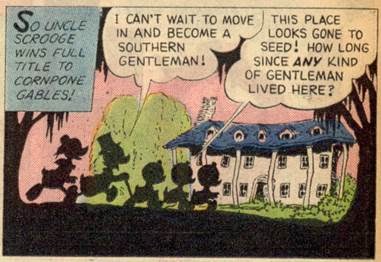
Despite the large differences between the events of "Master" and the truncated race in "Dime," there is at least one instance in which there might have been some cross-pollination.  Yes, I know that Rosa denied any swiping from "Time Teasers" when creating "On Stolen Time," and I'll grant him the benefit of the doubt again in this instance, but let's just say that I find the juxtaposition of the following images to be mighty... suggestive.

There's a barb in the tail of the seemingly "cute" and simplified DT version of the race.  True, the "fully functioning" Cornpone Gables of "Dime" appears to be a stereotypically great prize, whereas Barks' long-abandoned mansion turns out to be hardly worth the trouble that Scrooge and co. went through to secure it:

At the same time, Uncle Catfish proves to be a TRUE McDuck by paying Young Scrooge a paltry wage for his help (I think it worked out to about 30 cents an hour).  Not even Rosa's Uncle Pothole McDuck, who sold Scrooge the deed to his boat at precisely the time when riverboats were being phased out in favor of rail travel, can rival Catfish for classic skinflintery.

Following Young Scrooge's truncated traipse through the Klondike (Goldie?  Never heard of her), "Dime" provides us with a few final memorable moments after the lad is bilked out of his gold stash by the "Oklahoma timberland" salesman.  Given that the Scrooge of DT's "Back to the Klondike" was already as "tough as the wolves" and had arguably enjoyed a romantic relationship with the sexiest gal in the region, it requires some mental gymnastics to accept the idea that the post-Klondike Scrooge could be cheated so easily, but at least the sequence is consistent with the portrait of Young Scrooge presented earlier in this particular story.  There follows the Beagles' train hold-up, Scrooge's "having a blast" (and temporarily losing Old #1, not to mention his plaid wardrobe), and Scrooge's use of "Scottish warfare" to bring the Beagles low.  We'll also see bagpipes used as weapons in the second season's "Full Metal Duck," though the effects of the pipes are played more for laughs there.  Here, given that one of the Beagles admitted earlier that Ma Beagle (who, let us be clear, is NOT the same as the Ma Beagle who appears in contemporary Duckburg) had committed murder to obtain clothes, I think it is entirely appropriate that the Beagles have a much harder time dealing with the squealing squash-machine.

Sadly, once Scrooge hits the timber-less-land, the episode (to use a bagpipe-friendly metaphor) goes straight down the pipe.  Scrooge striking oil (and thereby reestablishing his fortune -- for good, as it turns out) while trying to hide Old #1 from the wage-demanding workers truly is, in GeoX's words, "the most egregious example of the 'lucky dime' heresy we've seen yet."  Heck, the doggoned Magic Hourglass didn't have as direct an influence on Scrooge's fortune as the dime does here -- and all due to sheer, dumb luck!

And then, with all of those wonderful Barksian examples of "Scrooge the clever businessman" to draw upon, we get the stupid-beyond-words "coal patch stomp."  I can't help but regard that scene in "Marking Time" in which Louie blows off "dummy" Dewey for thinking that the coal in Bubba Duck's cave should already have formed into diamonds as an indirect apology for this ridiculous scene.  As if to twist the knife, Scrooge subsequently shoves his dubious diamonds into his giant mattress in what may be another reference to "The Invisible Intruder," in which Scrooge's ambition is to have a huge bed.  Leave it to this episode to display its not-inconsiderable level of comics-derived detail as a tag end of one of the series' lamest incidents.

"The greatest treasure is family"?  Who didn't see that closing line coming?  Admittedly, the presentation isn't quite as "goopily saccharine" as GeoX suggests; the Nephews do attempt to exploit the "family bonding" moment to get a raise in their allowance.  (The gambit, of course, fails.)

So, overall, this "term paper" gets a failing grade, albeit one that is given with at least a twinge or two of regret.  It's tempting to think that all would have been well had the series followed Greg's advice and turned "Dime" into a two-part story.  Based on the available evidence, though, I'm not sure that Esckilsen, Koonce, and Weimers would have known how best to fill the extra space.  30 additional kilt and bagpipe jokes wouldn't have cut it, but I'm afraid that that would have been the most likely scenario.

.

.

.

"DuckBlurbs"

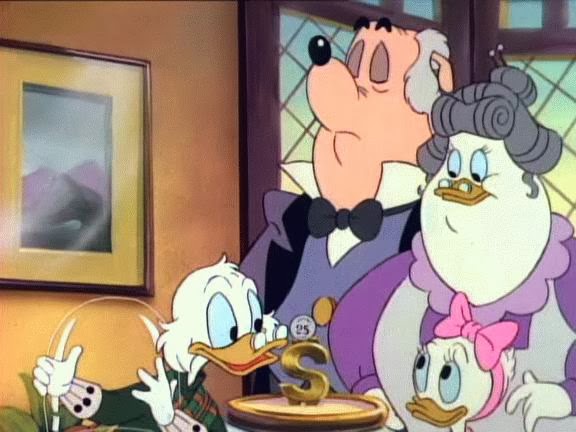
(Greg) Scrooge storms off as he tells Duckworth to begin the yearly polish as we cut to the downstairs drawing room as Mrs. Beakly and Webby ha[ve] joined in for fun. They gather around the room complete with dime on glass which I guess Scrooge moved from the Money Bin after Dime Enough For Luck which is quite smart methinks.

Based on "Magica's Shadow War," "Magica's Magic Mirror," and "Send in the Clones," the Money Bin location of "Dime Enough for Luck" was the exception, rather than the rule.

(Greg) Scrooge wants it all as the bank manage is hardly amused as Scrooge claims that he was the 8th grade treasurer and that's enough for him to get thrown out of the bank with a wussy bump.

Another unwarranted Americanism creeps into Scrooge's Scotland.  I think that they call grades "forms" in the British system.


(Greg) Another scene changer as Scrooge is riding a bicycle towards the ruined river boat as Scrooge narrates that he hoped that Catfish's skills would rub off of him. Scrooge does an excellent chin up on the door entrance and crashes the bicycle off-screen inside since it had no brakes during the time period see. 

A nice detail!

(Greg) [Uncle Catfish] used to haul freight for Colonel Cornpone. And so did a big, fat frog furry in weird clothes as he hops in and he's Old Man Ribbit (William Callaway) and he's French see. Hew sounds like he's talking African American for some reason and faking the French. Somehow; I do not like where this is going. 

As is stated later, Ribbit's accent is actually a Cajun accent.  Actually, the strange thing about Ribbit is not his accent; it's the fact that he's a man-sized frog in the DuckTales "universe"!  Doesn't it seem as though TaleSpin would be a more "natural" place to see a character like that?

 (Greg) So we get the scene changer as the [Cotton] Queen starts up again as we cut to inside as Scrooge was shoveling coal like a bicycle on his makeshift bicycle because working smarter is more effective than just working harder. It's what McPoppa would always say. 

Forget coal, elephants, and diamonds: Scrooge's "coal slapper" is what I choose to regard as Scrooge's finest "business moment" in "Dime."

(Greg) We continue [the railroad building] for a while and then the workers stop dead in their tracks as Scrooge would say (and Disney Captions would not) in the narration as Ma Beagle and the Cowboy Beagle Boys stop them and it's stick up time... Scrooge calls [them] either robbers or the ugliest welcome wagon in history. 

The "forced" way in which Alan Young reads this joke is actually funnier than the joke itself.  It's as if Scrooge, in an indirect "fourth wall" reference, is daring us not to laugh. 

Next: Episode 63, "All Ducks on Deck."

Tuesday, October 29, 2013

Wilkes 21, Stevenson 17

While Nicky and I were away for the weekend -- visiting Nicky's sister and hospitalized brother-in-law in NYC and meeting up with David Gerstein and Joe Torcivia -- Stevenson was, in all likelihood, kicking away any chance of its first .500 season, thanks to a dreadful fourth-quarter meltdown at Wilkes.  For three quarters, the Mustangs had things their own way against the Colonels, building a 17-0 lead.  Wilkes finally managed to score on a gadget play early in the fourth.  An SU fumble and a subsequent personal foul penalty helped the Colonels narrow the margin to 17-14 with about 1 1/2 minutes left.  The Mustangs needed only one first down to ice the game but couldn't get it.  Working with no timeouts, Wilkes connected on two long pass plays to get down to the SU 1, then scored on another pass to take the lead with :24 remaining.  A desperation pass by the Mustangs was intercepted as time ran out.

The Mustangs' mental mindset will be key as they host winless Misericordia this weekend.  This should be win number four at long last, but who knows how long that Wilkes wilt will linger.

Wednesday, October 23, 2013

DUCKTALES RETROSPECTIVE: Episode 61, "Dr. Jekyll & Mr. McDuck"

Uh, oh, a DuckTales story set in a hitherto-unexploited region of those rainy little islands in the North Sea.  Where have I heard that notion before?  As I recall, the last such effort left a whole lot to be desired.  Thankfully, "Dr. Jekyll & Mr. McDuck," though shot through with flaws, does considerably better by London (or a heavily Disneyfied version of same) than "Luck O' The Ducks" did by "The Emerald Isle."

The London of Shedlock Jones and Dr. Jekyll (pinfeathered version) is a decidedly odd mixture of old and new, factual and fanciful.  For whatever reason, writers Michael Keyes and Margaret Osborne (the latter yet another of those mysterious "one [credit] and done" DT contributors in the noble/vague tradition of James A. Markovich and Judy Zook) couldn't seem to come to a consensus regarding how to handle place names and landmarks.  Thus, Dr. J.'s abandoned mansion is located in "Hyde Park" and the crazed "Uncle Moneybags" version of Scrooge is domiciled at "Scotland Yard," but the Queen lives at "Duckingham Palace," the resident genius detective is "Shedlock Jones," Jones' evil archrival is "Professor Moodydoody," and Scrooge is corralled by bobbies at "Tra La La Square."  (I suspect a possible Barksian shout-out in the latter.)  The last-named euphemism is particularly peculiar because the background artists appear to have made a concerted effort to at least approximate the look of the REAL Trafalgar Square:

The iconic dome of St. Paul's Cathedral isn't directly referenced in the episode, but here, too, the background crew appears to have been paying reasonably close attention to the real thing:

Unfortunately, things break down when it comes to simple geography.  The shot below suggests that Big Ben and Dr. Jekyll's mansion are very close together...

... but the clock tower and Hyde Park are actually separated by three or so miles.  Apart from making no geographical sense, this scene makes a hash of the idea that Jekyll's estate is stone broke and that Jekyll's effects had to be auctioned off to pay "outstanding debts and taxes."  There's no way in the world that a prime piece of real estate like that would have been permitted to go to seed to such an extent.

Aside from the hit-or-miss use of and/or references to real landmarks, the DT London reminds me of nothing so much as... St. Canard!  Aside from the sighting of one limousine at the start of Act 2, the streets, fog-bound or otherwise, are utterly deserted.  In a Darkwing Duck episode, this would mean that the field was clear for hero-on-villain violence.  Here, it gives the animators a chance to fancy up their visuals by showing characters moving towards the camera from a distance.  The trick was executed quite well in the top scene below, less well in the scene at bottom (at one point, the oncoming bobby noticeably lunges forward a few paces).  I agree with GeoX that the animators do manage to capture a certain "late-Victorian-style fog-and-gaslight ambience" in a number of their scenes, particularly Jack the Tripper's nocturnal assaults on the banker at the beginning of Act 1 and on "Lord and Lady Somebody-or-Other" at the start of Act 2.  The problem is that even the London of the late Victorian era would have had people and conveyances on the streets at pretty much all hours of the day and night, so the empty London seen here gives one a decidedly uneasy feeling, as if one is reading a Conan Doyle story in which a neutron bomb has suddenly been set off.

Following the introduction of Jack the Tripper and his self-explanatory way of doing criminal business, with a potted summary of the key facts about the life and fate of the late Dr. Jekyll being thrown in for good measure, the plot proper gets off to something of a ragged start.  GeoX correctly notes that both Scrooge and HD&L are a little out of character in the auction scene, the former in his heckling of the auctioneer and the latter in their atypical concern over the possible loss of their "inheritance."  The welcome appearance of Gladstone balances things out a bit, with the gander making a classic killing on the contents of the McDuck-mocked coffer.

Scrooge's subsequent decision to bid on the next trunk isn't as badly out of character as GeoX makes it seem.  His interest having been piqued by Gladstone's success, he is merely rising to the challenge of Jack the Tripper bidding on the item, and you know how much Scrooge relishes a challenge.  After Scrooge makes the ill-advised decision to test the "cologne," the REAL out-of-character madness ensues.  This scene also launches the running "funny hat" gag, which, sad to say, isn't a patch on the repeated phraseology in the previous episode.  It doesn't help that the gag forces credulity to be stretched when the auctioneer calls Scrooge "the man in the funnier hat" rather than recognizing him as Scrooge, as he surely ought to have done (thanks to Greg for noticing this).

Literally tearing Dewey's cheek away from his beak?!  That's gotta hurt...

Greg seemed to have some issues with the logic behind "the madness of kinked Scrooge" -- specifically, the mechanics of how the "Moneybags mania" is triggered and then halted.  It doesn't seem that complicated to me... at least, not up to a certain point.  It's tolerably clear that:

(1)  The initial spray with the "Jekyll formula" brings on the first episode of madness.  "Lord and Lady S.O.O." experienced the same effect at the start of Act 2.

(2)  Being doused with a liquid causes the madness to abate, but the "Jekyll formula" remains in the victim's system until the next contact with money.

(3)  After each subsequent contact with money, the madness returns and can only be halted by another splash of liquid.

(4)  (Here, there be speculation)  After a certain point, the "Jekyll formula" completely compromises one's system.  Scrooge's rapid-fire transformations at Tra La La Square were an indication that he was about to permanently switch into "Moneybags mode."  Once in jail (or, should I say, "gaol") at Scotland Yard, Scrooge would have become permanently mad had HD&L and Shedlock Jones not brought him the antidote in time.

The difficulty that I can't adequately resolve is this: When Dr. Jekyll created the antidote, he was presumably in the "final phase" of the madness, at least according to the note in his journal ("it's too late for me").  So how could he have gotten his increasingly erratic actions under sufficient control to cook up the stuff?  And how would he have known about the "48-hour rule" (the fact that the antidote will fail if not used within 48 hours of the initial spraying) without having tested the antidote on someone other than himself?  Admittedly, the use of "the six-hour time difference between London and Duckburg" (yet another indication that Duckburg is on the East Coast of the U.S., by the way) to buy HD&L and Jones some extra time is undoubtedly the cleverest aspect of the episode.  It does lose some of its effectiveness, however, if the absence of a good explanation for the "48-hour rule" makes it seem more like a haphazard contrivance.  I almost hate to say it, but, had all references to the "48-hour rule" been dropped in favor of a more logically coherent explanation of the antidote's existence -- say, that Jekyll had created the antidote at the same time that he created the "Jekyll formula," but had overdosed himself with the "Jekyll formula" and thus gone mad before having had the chance to use the antidote -- I wouldn't have minded at all.  We might even have gotten a good anti-drug message out of the ep as a result.

Happily, Shedlock Jones, like his real-life... er... literary equivalent, is not presented as a perfect savior with all the answers.  In our first few moments with him, he actually comes across more like a cross between Darkwing Duck and the bumbling detective Goosely Clueless from "The Great Paint Robbery."  Jones' use of a huge signboard to advertise his existence to all and sundry, criminals included, surely indicates a Darkwing-sized ego...

... and, of course, Jones haughtily blows off HD&L's entreaties to help with their "little" problem before belatedly realizing that his "honor as a Junior Woodchuck" is at stake.  There is an interesting foreshadowing of Chip and Dale's Rescue Rangers in the whole idea of "big crook" Professor Moodydoody trying to cover his trail by disguising himself as a "little crook."  The contrast would have been more satisfying had Moodydoody been pulling his various crimes as a precursor to executing a much BIGGER plot.  Given Moodydoody's intense interest in the "Jekyll formula," perhaps he could have been presented as a master chemist who plans to plant the stuff in London's water supply and reap massive rewards from the crazed citizenry as a result.  (He could even have been ingeniously renamed Professor Molarity for the purpose, which would certainly have made more sense than the where-the-heck-did-THAT-come-from "Moodydoody.")  Now that would be a sinister scheme fully worthy of Shedlock Jones' chief antagonist.  I simply refuse to believe that all of Moodydoody's efforts were geared towards the "mere" theft of the Crown Jewels.

After a few too many additional "tripping" gags, Jack/Moodydoody takes his final tumble, and we close with the funny sequence in which HD&L are sorely tempted to let "Uncle Moneybags" shower them with mail-order gifts.  (If you like, you can regard the boys' self-sacrificial decision to cure Scrooge as a tacit admission that their earlier "inheritance" comment was out of order.)  Scrooge's parting blowoff of Jones both reestablishes his ultra-thrifty bona fides and provides the perfect capper to his money-flinging actions throughout most of the episode.  The neatness and tidiness of these concluding scenes make the confusion of some of the ep's earlier parts all the more frustrating.

"Dr. Jekyll" may be a middle-ranking DT ep, but it's a veritable masterpiece compared to the Ducks' previous jaunt to Ireland... not to mention the return to bonny Scotland that's right around the corner (and the oncoming presence of which is duly signaled by the piercing sound of "electric bagpipe" music).  I'm looking forward to the latter in the same manner that I would relish a hot, steaming haggis... which is to say, not a-TALL. 

.

.

.

"DuckBlurbs"

(Greg) The bobbies go to the iron gate as the tall bobby tries to get the lock open but the short one tells him to let it go. The tall one is addressed as Chucky as he explains that no one would ever hide in Doctor Jekyll's old mansion; not even Jack the Tripper. Well; he just did you idiots! Then again; I'm not surprised. In DTVA; the police are even dumber than the heels sometimes. 

Actually, it's fairly clear that Jack slipped over the gate and into the shadows of the Jekyll estate far enough in advance of the bobbies that they might legitimately have missed him.


Why, Chucky, how transparently phallic of you!

(Greg) The auctioneer starts with fifty dollars and Scrooge gleefully blows him off. Then we go [to] $40 and Scrooge blows him off on that one because he's not called Shirley see. Now here's an obvious logic break: Don't all auctions in real life starts with a low bid and then the bids INCREASE as they go on? Doesn't this auctioneer realize that he's LOSING that MONEY, MONEY, YEAH, YEAH?

My understanding always has been that the increasing of bids only begins after the first (minimum) bid has been received, and the auctioneer has the option of lowering the proposed minimum bid if the original minimum bid is not given.

(Greg) So we go back to the auctioneer again as there are items recently received from London. We cut to see a black trunk on the pillar and the auctioneer asks for $100, and Jack's voice beckons as Scrooge cannot put his bid in. The auctioneer proclaims that Jack is “the man in the funny hat”. Big logic break #2: Why didn't Jack just STEAL the trunk from the house from the start? Unless the writers are implying that the stuff was already in Duckb[u]rg beforehand... And why would he be stupid enough to appear in an auction without a proper disguise so he doesn't obviously look like Jack the Tripper? 

I'm assuming that everything of importance in Jekyll's mansion (with one or two highly notable exceptions) was carted over to Duckburg for the auction.  As for the lack of a disguise, people in Duckburg (as opposed to people in London) naturally have no clue as to who Jack the Tripper is.

(Greg) And so we cut to inside Scrooge's room as Scrooge (in red pjs) walks to the picture of Goldie with her blunderbuss and opens the frame as it is a hidden safe.

We'll be seeing that portrait of Goldie again -- in a different, and more prominent, location in the McDuck Mansion -- in "Till Nephews Do Us Part."  I wonder who painted it?  Images of an itinerant, starving artist wandering the Klondike for random commissions come to mind.

(Greg) Dewey asks what will happen if there is no antidote; and Scrooge proclaims that he can never touch money again. He goes to the closet and then it open and a wave of dollar bills and some coins entomb Scrooge. Oh; that wasn't contrived in the very least no siree. 

Yeah, as if every (visible) closet and room wouldn't have been thoroughly vetted for valuables long before this.

(Greg) Shedlock Jones is voiced by Clive Revill... 

You can't possibly list Revill's credits without including Matilda (1978), the notorious -- or it would be, if anyone remembered it -- "family-friendly" movie about a boxing kangaroo that was supposed to be a monster Summertime hit and the source of a major crossover promotion with McDonalds (at a time when such tie-ins were still relatively new).  Instead, the finished product turned out to be so hideously awful that the movie barely made it to any theaters at all.  Revill, who plays Matilda's trainer, can be seen in the video's opening scene.

 
(Greg) Interesting Moment #1: And then history is made as Shedlock Jones is actually SMOKING HIS PIPE and there's smoke coming out of it! And Disney DVD doesn't censor it at all! I don't know if Toon Disney cut the scene out; but Disney is one of those companies that has been painstaking[ly] strict when it comes to smoking to please anti-smoking groups for years now. Huey does blow him off with a health promo; but so what?!... Shedlock claims that he doesn't smoke the pipe; even though he clearly DOES in that scene. He's not fooling anyone. 

Early version of an e-cigarette, anyone?  It would have been so much easier if they'd simply nixed the Meerschaum and showed Shedlock engaging in one of his other pastimes, such as shooting cocaine into his... um, er, such as playing his violin!  Yes, that's the ticket.  We've had enough drug references in this episode already.
(Greg)  Shedlock leans on the fireplace and asks the boys to study the painting and ask what is wrong with this picture. Huey claims it's ugly. Shouldn't LOUIE be cracking that joke? Then they get the LIGHTBULB OF BLOODY CLARITY and see that there is a green door in the painting even though there is none. 

Actually, Dewey is the one with the brainstorm, a very fitting choice given past practice (cf. "Duck in the Iron Mask").


.

.

.

The immeasurable coolness of the following two "mash-up" videos (made by two completely different people, as far as I can tell) goes without saying.


Next: Episode 62, "Once Upon a Dime."

Monday, October 21, 2013

Fanfic Review: THE VINYL SCRATCH TAPES by Corey W. Williams

When I started to become interested in My Little Pony: Friendship is Magic, I always had one overriding principle in the back of my mind:  DON'T get into MLP:FIM fanfic!  There is simply too much of the stuff to keep track of unless you're a "round the bend" brony.  However, Mark Lungo suggested that I look at "The Vinyl Scratch Tapes," arguing that its quality was very much in the tradition of the Disney Afternoon fanfics we enjoyed in the APA WTFB.  I couldn't pass up that recommendation, now, could I?  Nor could I ignore his request that I review the work in this space.


"Tapes" isn't for the MLP newcomer, as Twilight Sparkle is the only member of the "Mane 6" to "appear" (she speaks one line).  The main players here are a couple of "background ponies" who, as has been the case with more than a few spear-carriers, have been given character development, backstories, and more by MLP fans.  Prim 'n proper cellist Octavia and self-consciously "radical" disk jockey (isn't that an ironic job description for an equine?) DJ Pon-3, aka Vinyl Scratch, start their own radio talk show, leading to embarrassing moments aplenty and predictable but amusing oil-and-water gaggery... that is, until the duo are forced to cooperate to thwart the evil designs of the comically conceited (yet, thankfully, only marginally ept) Prince Blueblood, aided and abetted (in a manner of speaking) by the equally egotistical magician, "The Great and Powerful" Trixie.  The entire fanfic is presented as a series of transcripts of tapes of Octavia and Vinyl's show and Blueblood's fumbling attempts to compete with it.


The best thing about "Tapes" is the way in which it believably develops the relationship between these characters, all of whom (with the exception of Trixie, who has had major roles in two TV episodes) are essentially tabulae rasae that author Williams has free rein (see what I did there?) to present as he likes.  In the hands of less circumspect writers, this can sometimes lead to trouble, but Williams keeps things under control and clearly understands that, in a show like MLP:FIM, no character, no matter how unlikable, is entirely beyond redemption.  The only caveat is that one really needs to have some prior exposure to the series in order to fully comprehend all the "in-jokes" and offhand references in the scripts.  If you are willing to do the necessary spadework, though, there's a lot to enjoy here.

King's (Pa.) 31, Stevenson 24

This one really stung, not least because it came before a packed Homecoming crowd.  The game could not have started worse for the Mustangs as their starting quarterback was sacked and knocked out of the game on the second offensive series.  On came the backup QB, the same guy who was responsible for dropping a couple of field-goal snaps in the game against Widener.  First play: sack, fumble, which King's returned for a touchdown to take a 14-0 lead.  SU pulled it together, though, and rallied back to take a 17-14 halftime lead.  Tit then repaid tat as the Mustangs intercepted the Monarchs on the first series of the second half and returned the pick for six.  And then... the offense simply stopped, as King's ground out a couple of lengthy drives for touchdowns.  SU had one final chance to tie on the last series and tried the "Cal Play," which failed and led to a game-ending brawl for good measure.  Had an SU player not socked a King's player during the melee, the Mustangs might have gotten one final chance at a "Hail Mary."

So now, the Mustangs are 3-3 and the chances of that first .500 season are suddenly looking a bit slimmer.  A lot will depend on next week's game at 2-4 Wilkes.  Win that game, then beat winless Misericordia at home on November 2, and a .500 record will be assured.  SU will not be favored in the last two games at Lebanon Valley and at home against Lycoming.