If any first-season episode of
DuckTales could be categorized as a "problem episode," then "
Dime Enough for Luck" is unquestionably the one. When I say "problem episode," I'm referring to a production that, based on the circumstances and/or the characters involved, in some sense defies being rated objectively. Joe Torcivia and I
tried doing so in our DUCKTALES INDEX, but now I realize that that was something of a fool's errand. When all is "done und said," one's opinion of "Dime Enough" will depend to an extremely large degree upon one's previous experiences with the Barks character who makes his formal series debut (which will turn out to be his
only real starring, or even
co-starring, role) here: Donald's extravagantly lucky cousin,
Gladstone Gander.
I've no doubt that
the folks behind
DT wanted to do right by Gladstone really, really badly. His introduction is far more elaborate than the ones provided for, say, Gyro Gearloose and the Beagle Boys in "
Treasure of the Golden Suns," and there are only two principals (Scrooge and Magica de Spell) in the cast besides him, giving him a clear field on which to make that all-important "first impression." Some major talents were involved in crafting the episode: no less than
Jymn Magon,
Mark Zaslove, and
Bruce Talkington hammered out the story line, while veteran TV and fiction writer
Diane Duane did the teleplay. At the time that "Dime Enough" was produced, Gladstone and Magica had never met in American Duck comics, which would have made the ep special enough even if it
weren't Gladstone's featured bow. All the pieces seem to be in place for one of the series' best episodes... and,
if you know nothing about Gladstone beforehand, then I can easily see you mining a lot of enjoyment out of this adventure. For those of us
with that prior knowledge, though, things seem... well, a bit out of focus. The ep does have some logical problems independent of the characterization of Gladstone, but the
real issue, at least for Duck comics fans, is the fact that the "decaffeinated" Gladstone we see here isn't "really" the Gladstone who was so obnoxious that Barks himself didn't particularly care for the character and dreaded the prospect of doing a full-length GLADSTONE GANDER comic book (which, fortunately, he never actually had to do) as "a real grind."
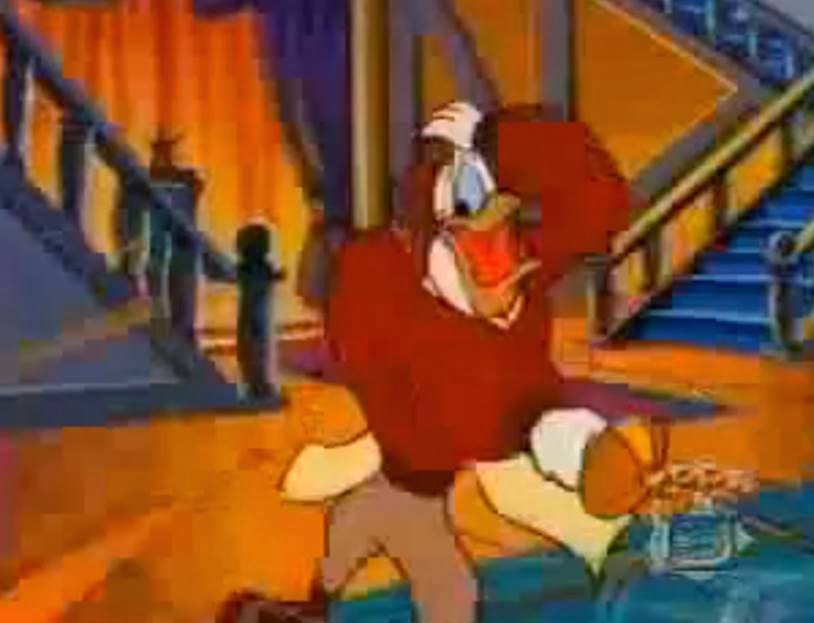
The divergence of opinion makes its presence felt in, quite literally, the opening seconds of the episode, in which Gladstone calls on Scrooge to take him to breakfast. This seems innocuous enough...
... but a quick look back at how Gladstone was handled in Barks stories reveals just how amazingly
atypical this mundane meetup is. The other Ducks were, shall we say, not overly enthused about encountering Gladstone in casual social situations. When they weren't simply trying to avoid him...
... they were spying on him in order to dope out the secret of his fabulous luck...
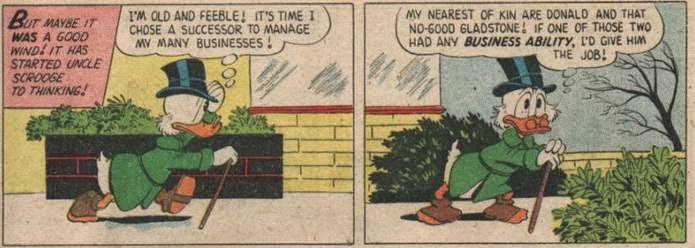
... or, as was often the case with Scrooge, they were sizing Gladstone up in order to determine whether he was worthy of inheriting some or all of Scrooge's fortune, or just simply trying to jerk the arrogant lout's chain and get him to show some initiative for once.


This "arms-length" treatment of Gladstone stemmed, of course, from the gander's toxic combination of infuriating luck and insufferable arrogance. Suffice it to say that the softening of Gladstone's character in "Dime Enough" casts that of Scrooge in the series as a whole into the shade. The worst sin that Gladstone can reasonably be accused of here is that of complacency, taking his luck in stride. Scrooge's reaction -- mild irritation and bemusement -- could be considered an appropriate one under the circumstances, but Gladstone's luck is supposed to be more than just a simple personality quirk, akin to Gyro's urge to invent or Launchpad's crash-resistant insouciance; the character is supposed to be a living "poke in the eye" to Scrooge's whole worldview, and, indeed, to pretty much everyone else's devotion to the work ethic.

Even if the writers
had tried to depict Gladstone in a harsher manner, the choice of
Rob Paulsen as the character's voice would probably have sabotaged their efforts.
GeoX described Paulsen's effort as
"an enthusiastically youthful, slightly smarmy-sounding voice that makes [Gladstone] sound like a guy in a beer commercial or something," which gets it about right. The "studied casualness" in the voice is also somewhat reminiscent of Paulsen's voice performance in another type of commercial:
I think it is fair to say that the "real" Gladstone should
NOT have a voice that makes it sound as if it might be a cool thing to hang out with the guy. Paulsen can do
sarcastic, smart-ass voices as well, of course, but my own vision ("audion"?) of the character would be something close to
Charlie Adler's voice for Filler Brushbill in "
Much Ado About Scrooge." (Refer to that earlier entry for an argument that Gladstone might in fact have originally been slated for the Brushbill role.)
Having already compromised Gladstone's character to a great extent -- at least, in the minds of those who would know -- the episode now commits the first of a couple of "luck-gical faux pas" that betray a certain amount of misunderstanding as to how, exactly, Gladstone's luck works. Why should Gladstone need to ask Scrooge to buy the money clip from him so that the gander can pay his rent? Shouldn't Gladstone, you know, trust to luck to get his rent money? The gaffe is especially irritating because Gladstone immediately turns around and says that he WILL rely on his luck to get money to pay for his and Scrooge's breakfast (which leads to the "millionth customer" bit). To top it all off, Gladstone then offers to TRADE the clip to Scrooge in exchange for a look at the Old #1 Dime, and Gladstone's need to pay rent is never mentioned again. This whole sequence is butchered about as badly as such a thing can be, which is remarkable considering the talents who labored over this episode.

The ep's plot finally kicks into gear, more or less, as we hear Magica talk about her plans to use "Meester Lucky"'s unique gifts to break through Scrooge's new Money Bin traps and snare Old #1, which has been conveniently relocated to the Bin for the purpose. "Talk about" is a key phrase in this instance, because this ep, even more so than "
Magica's Shadow War," is literally "talked to death," or at least into a stupor. Nowhere is this more apparent than during Scrooge and Gladstone's trip to see Old #1, as the duo literally gab their way past each of the snares. Since Magica will later have the hypnotized Gladstone do the same thing, and the lucky gander would have been able to get past the traps
without any prior knowledge of what they were, the ep is literally spinning its wheels here. I would much rather have had these redundant scenes be trimmed in favor of some additional activity at Magica's lair.
Armed with his lucky horseshoe (since when does Gladstone need tangible symbols of luck to help him out?!), Gladstone goes to what he thinks is the game-show audition and gets hypnotized by Magica. We've reached faux pas #2, although the extent of the goof won't become clear until Gladstone has recovered his luck later in the ep. Since the "newly fortunate" Gladstone proves able to stave off a magical bolt with no trouble, shouldn't his luck have protected him from being hypnotized in the first place? Or are we supposed to intuit that mental spells and physical attack spells have different effects on him? If so, why?


The game-show parody is moderately amusing, piling together riffs on
The Price is Right (emcee Bill Barker),
Wheel of Fortune (Vanna Black/"spin to win"), and
Truth or Consequences (the fake show's name -- I would call this reference an anachronism except that the last version of the long-running stunt show was syndicated in
DT's first season, 1987-88). Gladstone's ability to get through the "laser limbo" trap even though it makes contact with him on several occasions can be put down to the effects of his luck, or at least the "I can't be harmed by physical attacks" version of same. I actually have much more of a problem with Gladstone dodging the last trap by throwing his horseshoe and hitting the control panel. His luck shouldn't
NEED no stinkin' props!
Once Magica has used Gladstone to get inside Scrooge's vault and grabbed Old #1, we are swatted across the face with
faux pas #3, the one that I suspect most longtime comics readers had the most trouble accepting: Gladstone's loss of his luck due to "using his good luck for a wicked purpose." I
suppose that Magica might possess enough general magical knowledge to know of such a caveat, but the more obvious problem is that Gladstone did not
WILLINGLY use his luck for evil; he was under mind control at the time. Indeed, the number of times that Gladstone was called upon to consciously use his luck for
ANY purpose, either good or evil, in Barks' stories was extremely small. The one that immediately comes to my mind is Gladstone helping Donald out by finding a wallet filled with money in "
A Christmas for Shacktown" (FOUR COLOR #367, 1951). Most of the time, the gander's luck manifested itself in strictly amoral fashion, with the sole concern being that it benefited Gladstone in some way. (This included situations in which Gladstone temporarily experienced a supposed skein of bad luck, the better to make his final triumph all the more aggravating.) The decision to cancel out Gladstone's luck here was obviously intended to help the audience to sympathize with the character and root for him as he tries to reverse the
karma-cide. Since the character had been softened to begin with, however, the bad-luck gags that follow aren't as funny as they should be, with the one arguable exception being Gladstone's panicked shout, "I'll have to get a job like
normal people!"
Gladstone ultimately heads to Scrooge's mansion to fess up, and... we suddenly take a sharp left exit and a trip into Toontown. I'm not referring to the fact that Scrooge begins to lose money once Magica has taken his dime; after all, even Barks couldn't keep the extent to which Old #1 was literally "lucky" straight in his own mind, and the later episode "
Once Upon a Dime" uses the "lucky dime" idea in a far more dubious manner than it is used here. What I literally mean is that we suddenly start getting a string of gags that would seem more appropriate in a Warner Bros. cartoon. I wouldn't have minded this as much had the rest of the episode not been
FREE of such logic-defying gags. Even the "nasty" triphammers that could have crushed an unwary passerby in the Money Bin are at least semi-canonical, given that Scrooge has used things like cannons, land mines, and pools of sulfuric acid as traps in the past. I wonder why the writers didn't recognize the abrupt shift in tone here and didn't try to make the ep's overall tone a bit more uniform.
The inevitable showdown with Magica features one off-the-wall idea of its own -- the "fire-breathing bunny" -- but I can't really complain too much about this sequence as a whole. The money clip makes a clever comeback at the climax (those "
smallll details" again), Scrooge makes ingenious use of Gladstone's bum luck to help the two of them, and we learn that Magica may be suffering from a case of "trap envy," given that she throws her own series of physical perils at the Ducks' webbed feet. (Since Magica has magical powers, this reliance on physical traps might seem a little strange, but she
does mix in a few supernatural stingers, such as the rock-crushing gambit.) Only three things mar the finale: too much talkiness (especially when Magica tells Scrooge at length how poor her amulet is going to make him, even as he plans to "flash" her with the money clip), the aforementioned "Gladstone's restored luck blocks Magica's attack" bit, and the indecent haste with which the villains
give up. I think that
Greg was picking up on the last-mentioned point when he commented that the ending "buried" Magica as a serious threat (though, IMHO, her appearances in "
Nothing to Fear" and "
The Unbreakable Bin" were certainly threatening enough). First, the "doused" giant rabbit meekly allows Scrooge and Gladstone to escape, even though it could easily have pursued them and tried to crush them; then, a bitching, clumsy Magica lets Scrooge and Gladstone literally walk away from the scene of battle. Even
IF you can't zap Gladstone, Magica, what's to prevent you from renewing your attack on
Scrooge? The warranty may have run out on your wand, but what became of all those potions, elixirs, and such that were used as weapons in "
Send in the Clones"? Did Poe claim possession of them when he took his leave of you, never to appear again, apart from his cameo in
that episode in which
everyone and his grandmother made a cameo?
I can't honestly regard "Dime Enough" as "just one of those episodes," as GeoX apparently does. Unlike Gladstone's luck, this
IS something that can reasonably be interpreted as either "good" or "evil." It all depends on what your definitions of those terms are in context.
.
.
.
"DuckBlurbs"
(GeoX) A Ducktales episode named after a novel in which a guy has sex with his clone? I'd buy that for a dollar!
(GeoX) "It [Scrooge's dime] will control all other dimes in the world, not to
mention dollars!" Not totally sure what this means, but it's the
clearest--only, as far as I can recall--statement from Magica about what
she actually expects to accomplish with the dime.
In "Send in the Clones," Magica claimed that, thanks to her possession of Old #1, "the world" would be hers. Here, she seems to have upped (or broadened) the ante to "wealth and power." Of course, if Magica literally controls all the money in the world, then wouldn't the money automatically become... well, worthless? And how would that help her to maintain power? The series never seems to have digested these ideas completely.
(GeoX) And the idea that the dime could just disappear from [Scrooge's] bin, and he wouldn't even notice until Gladstone fessed up? I do not think so.
Scrooge must have been unnaturally complacent about the efficacy of those new traps! He evidently learned his lesson, though; by the time of "Nothing to Fear," he will have a Money Bin alarm installed in his Mansion office.
(Greg) Gladstone pours hot
tea (or water; it's hard to tell) into the white/blue stripe tea cups
as Scrooge explains that Magica Despell is in town and she wants to
break into his vault. In town? I thought her mountain was PART of
Duckb[u]rg? I don't get it.
"
Raiders of the Lost Harp" aside,
DT is pretty consistent in its depiction of Magica's lair as a free-standing island at some distance from Duckburg.
(Greg) Scrooge pops the hat and tells [Gladstone] that Magica is a
tricky witch. I agree; I mean she could just use magic to disable the
traps easily. They make it to the office and the vault door as
Gladstone states that even if they get lucky they still would have to
know the combination. But Magica is a tricky witch; she could use
magic to blast down the vault door. See how easy it is to figure this
out?!
To be fair, Barks tended to overlook this fact as well. Even when a Barks story featured an all-out, balls-to-the-wall frontal assault on the Money Bin (e.g., "
For Old Dime's Sake" [UNCLE $CROOGE #43, 1963]), Magica used magically generated physical phenomena, rather than "pure magic," to attack the structure
.
(Greg) We then cut near a sidewalk as Gladstone is all right
without any injuries whatsoever. I'm still wondering how Gladstone
got out of the Money Bin without Scrooge NOTICING?!
I assume that he just went out of the doors that had been opened during the phony "game show." (His bad luck wouldn't have been an issue, since the traps had already been sprung.)
Next: Episode 58 (or should I say, Episode 58 revisited?), "Duck in the Iron Mask."