Friday, January 18, 2013

DUCKTALES RETROSPECTIVE: Episode 23, "Launchpad's Civil War"

Twenty days since my last retro-post... NOT good.  I hope to get back into rhythm now that the Spring term has begun and resume a once-a-week posting schedule.

I think that it goes without saying that "Launchpad's Civil War" couldn't possibly have been made in the modern era.  Perhaps Seth Macfarlane or Trey & Matt might have been able to avoid the slings and arrows of politically correct censors by crafting "Civil War-themed episodes" that succeeded in offending ALL points of view regarding the conflict.  But an ep that, while comedic, invites us to consider such heavy matters as reconciliation and restoration of honor and treats both sides with a reasonable amount of respect?  Just no way.  "Civil War" can be said to have slipped through a crack in time -- a period during which Civil War symbols could still be shown without the heavens falling in, and an animated series that thought highly enough of the intelligence of its audience to be able to present such an episode without a surfeit of dumbed-down explanation.

For those who, like GeoX, have a problem with the whole notion of an ideology-free presentation of the war, I think that I have a solution to your dilemma.  Remember the "Parachute Postulate" of TaleSpin, in which every pilot of every doomed plane had a parachute at the ready?  Or the "Animal Apothegm" of Rescue Rangers, which posited an elaborate animal "subsociety" mimicking the activities of the human society?  For your kind consideration, may I present the "Taxes and Tariffs Tenet": in the Ducks' world (called "Quackeria" by Greg Weagle and simply the "Mouse and Duck 'universe'" by other, somewhat less imaginative souls), the Civil War arose solely as a dispute over tariff policy!  No pesky "involuntary servitude" involved whatsoever!  Given the huge number of pig villains known to infest the Ducks' world -- very much including 19th century representatives -- it's not hard to imagine the country being led to sectional blows thanks to the machinations of porcine economic malefactors.  So GeoX gets his capitalist villains without having to concern himself with slavery.  What's not to like?

The low-tariff version of "Don't Tread on Me"?

By coming up with the "Taxes and Tariffs Tenet," I've already done better than "LCW" writers Pamela Hickey and Dennys McCoy at addressing some of the more annoying logical inconsistencies in the Duck Ridge reenactment saga.  Admittedly, some of these loopholes have only become visible with time.  Take, for example, the fundamental notion that Launchpad accepts the invitation to role-play his "heroic" ancestor General Rhubarb McQuack without knowing that Rhubarb's blundering helped give the Confederates, er, "Low-Tariff Guys" the victory.  Remarkably, it would seem that the organizers of the celebration sent the invitation to Launchpad without checking on his familiarity with the true story of the Battle of Duck Ridge.  Why else would Mayor Rufus B. Pinfeathers and Col. Beauregard DuBarque act so surprised when LP declares that it would be an "honor" to play the Rhubarb role?  It evidently didn't occur to them that, if LP had known the truth, then he could just as easily have refused to cooperate and stayed home to clean the Joyrider.  These issues didn't much bother me when I first encountered this episode 25 years ago, but they seem a little more irritating now.  For consistency's sake, Hickey and McCoy really should have recognized a small problem here.

Once LP is safely in Duck Ridge, you'd think that Pinfeathers and DuBarque would strive to keep the truth from him until literally the very last minute.  Instead, as Pinfeathers might put it, they seem bound and determined to "upset the applecart" after the apples have already been taken off the trees.  Case in point: as LP struggles to extract himself from a car door, Pinfeathers reminds him that "you don't have to act like General Rhubarb McQuack until tomorrow."  Way to almost louse up your elaborate scheme, Genius.  Later, DuBarque imperils the whole operation by insulting Launchpad to his face (you know, the face only DuBarque "can't wait to see") during the "I'll stupidly repeat everything you say" sequence.

Pinfeathers and DuBarque manage to pull their scheme off because, as noted by GeoX, Launchpad is mind-numbingly dumb-de-dumb-DUMB in this episode.  The opening scene at the hangar quickly sets the tone: Launchpad undergoes a silly, self-inflicted pratfall (pumping the tire too full of air, hopping around on the air pump, etc.) and then pulls a mental rock (evincing surprise that he "missed" the Civil War and then suddenly remembering that Rhubarb was a hero in said war).  Launchpad is nothing if not fallible, of course, but many of his mishaps in other episodes occur during "the flow of the action."  Here, no matter what he tries to do, he literally seems to be operating under some sort of a curse.  He doesn't even get the satisfaction of "saving the day" through direct action, as was the case in "Hero for Hire."  Instead, he inadvertently starts the old Union, er, "High-Tariff Guys" soldiers' decisive "second charge" by accidentally falling onto and dislodging the brake on the Merriquack.  As if to drive home the point that Launchpad is operating a few struts short of a functioning wing here, other characters' comments to and about LP tend to be cutting, if not outright crude. Even Doofus (whose personality, like his voice, seems to be tuned about a half-pitch too "shrill" in this ep) damns his idol with faint praise when he complains about having to always remind people that Launchpad's not ignorant.  Incompetence is a part of Launchpad's persona, but here, Hickey and McCoy slide over the "tipping point," and incompetence becomes entirely too dominant a part of LP's makeup.
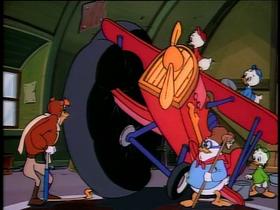
How does Launchpad shame thee?  Let me count the WHOOPS!

Contra Greg, if you're willing to accept the idea of a 400-year-old Spanish sea captain keeping himself alive through "sheer willpower,"  then swallowing the notion of 150-year-old Union soldiers staying alive to redeem a long-ago humiliation should be, as the saying goes, "cake."  In fact, I'm even more impressed at the old soldiers' resilience than I am at El Capitan's, since the "no-longer-boys in blue" don't have the potential for substantial material gain egging them on.  The Duck Ridge reenactors don't bother to get the details of "McQuack's Marauders"' defeat right -- the pretend soldiers "flee," as opposed to silently slipping away -- so can you really blame the old guys for wanting to set things right?  The old soldiers' sense of despair is probably the most affecting part of the episode, though their comically repeated lament about "that lousy, rotten, bunglin' polecat McQuack" puts something of a humorous spin on the situation.
After two extremely talky opening segments, Act Three of the episode gives us the "big action payoff" that we've been waiting for, and it delivers the goods.  Not even Launchpad's fatalistic imitation of Rhubarb's unfortunate mishap -- a moment that, ironically enough, is one of LP's better moments of the episode, since he's not simply acting like a clueless stumblebum but instead has gotten caught up in the excitement and simply wants to help "his men" -- can flatten the taste of the old soldiers' sweet vindication.  (Not that Hickey and McCoy were about to let the episode end with the "Confederates" maintaining the upper hand.  Political correctness of a sort did exist in 1987, after all.) 


While not quite as good as I remember it being back in the day -- largely because of the occasionally squirrelly logic and the one-sided characterization of Launchpad -- "Launchpad's Civil War" still entertains, amuses, and instructs.  Modern-day cartoon-makers should ponder on the basic level of sophistication displayed in this storyline and use it for inspiration, as opposed to "running away from" the episode's supposed ideological implications.  After all, we wouldn't want to have to wait 150 years for eps like this to be permitted to grace our TV screens again.

.

.

.

"DuckBlurbs" 

(GeoX)  Huey, upon learning that Launchpad's been invited to be in this thing: "Wow! The Civil War happened a long long time ago!" That's a rather bizarre non-sequitur.

Thankfully, this rather unimaginative line doesn't turn out to be a harbinger for the intellectual content of the rest of the episode; the Civil War ambiance (small-town parades, reenactments, souvenir shops, observation balloons, etc.) is generally treated quite well.  The line does, however, foreshadow the contribution that HD&L make to the episode, which is basically nil.  They're just kinda-sorta there.  At least Doofus gets to show off his photography skills.  Given the minor roles played by the boys, "Launchpad's Civil War" seems just the right title for the episode.  "A DuckTales Civil War" would have made much less sense (not to mention given viewers a false idea of the series as a whole!).

(Greg)  The kids try to help [Launchpad] from the carnage as we cut to the entrance to see a dogperson wearing blue; a helmet and glasses with pants, a white scarf and a red bicycle. He rings the bell and proclaims that he has a Quack-a-Gram... Launchpad is tied up by the tires and tries to grab it from the boy; but he's basically a rocking tire chair. HAHA! He does have enough to pay the boy and the boy thanks him as Doofus grabs the Quack-A-Gram.

Hard to believe, but the "Quack-a-Gram delivered by messenger boy" bit now seems almost as dated as the Civil War itself! 

(Greg)  So we cut to Launchpad talking to the Larry, Curley and Moe of Civil War Re-enactments as LP gives the pep talk about recreating a great battle in the Civil War. The three stooges giggle with their backs turned of course as LP is so dense that it's funny. This will be their finest hour. For Launchpad's it's already happened as they must work as one to win the battle. Launchpad's pep talk is so hilarious given the context that this is an re-enactment and LP's treating it as if the civil war is happening RIGHT NOW! The Three Stooges laugh their asses off on THAT one. 

Again, I can't be too hard on Launchpad here, since he is only trying to get into the spirit of his role.  It's the incidental stupidity that hurts LP more in this episode. 

(Greg)  After the commercial break; we see Grace and Launchpad huddled together in mortal fear of being MURDERED by ghost soldiers. The soldiers proclaim that the horse and LP look awfully familiar as the kids arrive and swear in DUBBED DUCK STYLE (Holy Quackamole!). The soldiers think Launchpad is Rhubarb McQuack and that he has aged well. Now if they are truly real; then we have a logic break since the Civil War took place about 100+ years ago. LP gets off a religious reference (heavens to helicopters!) as they are the lost soldiers of General Rhubarb McQuack as they get flashed by Doofus and the guns go off. Okay; the joke is seriously overplayed now Doofus. Their guns go away as they huddle and surrender. 
The "guns firing accidentally" bit was cut by Toon Disney at some point.  Hey, I'm grateful that TD at least left in the scenes of the old soldiers training their guns on people.  Scrooge and Fenton Crackshell should have been so fortunate during "Liquid Assets."

Next:  It's "Back to the Beginning" at last!  Episode 24, "Treasure of the Golden Suns, Part One: Don't Give Up the Ship." 

Thursday, January 17, 2013

Book(s) Review: THE "RAGGED DICK" SERIES by Horatio Alger, Jr., edited by Charles Carter (Amazon Digital Services)

During my recent bout of "whatever-it-was-but-it-wasn't-quite-the-flu," I felt badly in need of some "comfort reading."  I found it in the unexpected form of the first six novels written by Horatio Alger, Jr., part of a recent slew of Kindle books that I downloaded using a couple of gift cards.  I was not unacquainted with the works of the famed author of "Rags to Riches" stories, having been gifted with a volume collecting RAGGED DICK and MARK, THE MATCH BOY at some point during my early teenage years.  The intervening volume, FAME AND FORTUNE, had been referenced at several points in MARK, THE MATCH BOY, but I had never read it until now, much less known that there were three additional volumes in the "series."  Calling this a "series," by the way, is severely pushing it; there is only the thinnest of connective tissue between the first three novels and the second three novels in this sextet.  A couple of minor characters from the earlier books make very brief appearances in the later books, and Ragged Dick, aka Richard Hunter, is mentioned once during the last three volumes.  That's it.

These stories, published between 1867 and 1870, were the tomes that cemented Alger's reputation and established the "formula" that would inform most of his later works: the poor boy who "struggles upward" to achieve ultimate success.  Is it really surprising that a fan of Scrooge McDuck would find such a narrative attractive?  At this early stage of his career, though, Alger had not yet settled into assembly-line production; in particular, he was paying careful attention to characterization, especially in the works featuring the wise-cracking bootblack Ragged Dick.  Wikipedia's claim that the typical Alger novel "featured a cast of stock characters: the valiant hard-working, honest youth (who knew more Latin than the villain), the noble, mysterious stranger (whom the poor boy rescued and by whom he got rewarded), the snobbish youth (cousin), and the evil squire (uncle)" isn't remotely close to the truth at this point.  Ragged Dick knows no Latin (at the start, he can barely write or read English) and needs to be weaned off of such bad habits as smoking and squandering what few cents he has on amusements; the "noble strangers" who encourage him to seek a better life are a middle-class uncle and nephew whose wishes for the bootblack are quite modest; and Dick's antagonists range from an arrogant, would-be "young gentleman" (well, even a blind Wikipedia-rootling pig finds an acorn on occasion) to a plug-ugly rival bootblack.  In positing the existence of good, bad, and indifferent characters on all socioeconomic levels, Alger's "simplistic" worldview is well in advance of a typical Hollywood movie in the age of Obama (when was the last time a businessperson was presented in a good light in a movie you saw?).  And, with repetition not yet having dulled his enthusiasm, Alger appears to take great pleasure in introducing colorful and interesting supporting players.  RAGGED DICK, FAME AND FORTUNE, and MARK, THE MATCH BOY are filled with memorable incidents and snapshots of pre-Civil War New York and the wide variety of characters who peopled its streets.  The middle-class Richard Hunter's care of the impoverished Mark, the Match Boy -- who, as you might guess, doesn't finish the story in nearly as bad a way -- brings the trilogy full circle in a satisfying manner.

With the introduction of newspaper hawker Rough and Ready (all sorts of rhymes are coming to my mind just now), we begin to see Alger's creative genius becoming a bit lazy... just a bit.  R&R comes off as basically a pale carbon copy of Ragged Dick, though his circumstances are somewhat different (he has a younger sister to care for and an evil, drunken stepfather to avoid), and Alger's pedestrian writing style seems a bit more labored in this second group of three books.  The story of BEN, THE LUGGAGE BOY seems to be dropped into the Rough and Ready saga from a parallel universe; indeed, it's almost a typical Alger story in reverse, with young Ben, alienated from his father, going to Gotham to seek his fortune, only to wind up poor, guilt-ridden, and penitent.  It's a mystery to me why Alger didn't simply present this cautionary tale as a stand-alone.

Because of his profound influence on a whole generation of upwardly mobile strivers and captains of industry, Alger deserves to be read today, and these six novels -- the first three, in particular -- are as good a place as any to direct one's attention.  Great art, they're not, but they still contain plenty of entertainment value, and not a few useful reminders of common-sense values, too.

Tuesday, January 15, 2013

Those Darn Real-Life Situations Always Keep Gettin' in the Way!

Between the start of spring classes and my recent bout with the runs (of the nose, that is), I won't be able to post my review of "Launchpad's Civil War" until this weekend.  Don't despair and slink away like Rhubarb McQuack's humiliated Union troops; succor and solace is on the way!

Thursday, January 10, 2013

Book Review: THE COMPLETE DICK TRACY, VOL. 14: 1951-53 by Chester Gould (IDW Publishing, 2012)

2013 smacked me in the face upon arrival with some kind of nasal malady, which explains why I haven't posted more during the latter part of the holiday break.  It's not the full-fledged flu, thank goodness, and I should be ready to go when classes begin on Monday.


*SPOILERS*

During this period of the 1950s, DICK TRACY underwent something of a paradigm shift.  After wowing his fans with that long string of famous "grotesque" villains, Chester Gould set aside the pop-art approach for a while and began to "paint" his stories with a more finely bristled brush.  As he did during the "Tommy Guns and G-Men" period of the early-to-mid-30s, Gould paid particular attention to real problems encountered by law enforcement at this time:  juvenile delinquency, cops on the take, the growth of organized crime.  At the same time, he used the opportunity to move one of his major characters forward on the maturity scale, with Junior Tracy suddenly graduating into young adulthood.  These two elements memorably intersect in the short but powerful Model Jones continuity, the best story in this volume, hands down.

This volume begins with the completion of the lengthy Crewy Lou continuity.  Now that Lou's crazy, out-of-left-field brother Brainerd is safely out of the way, the storyline gets back on track, more or less, with Tracy trying to track down the fleeing babe in the deep woods and also ascertain the whereabouts of baby daughter Bonnie Braids.  Gould really twists the screws with his melodramatic portrayal of the perils of little Bonnie; as noted by Max Allan Collins in the Introduction, the suspense is heightened by the reader's recognition that Gould is perfectly capable of bumping off any sympathetic character.  Due to the ill-considered Brainerd business, I still can't rank this story as Gould's very best, but the powerful ending at least partially redeems it.

No sooner has Tracy recovered Bonnie than his integrity is called into question.  Actually, the comic strip was catching up with real-world queries in this case.  Tracy's super-duper, ultra-modern house, introduced in 1950, had to have been paid for by someone, and inquiring readers and columnists had openly wondered at the time how Tracy could possibly have managed to scrape together the cash to purchase it on a police detective's salary.  After giving verbal excuses that are more or less convincing -- I'm inclined to choose the latter -- Tracy lets his deductive actions do the real talking, uncovering a conspiracy and clearing his name.  Gould had noticed the intense interest paid to the Kefauver Hearings on organized crime and jumped at the chance to both craft a comic-strip equivalent of a corruption investigation and tie up an annoying loose thread.

Organized crime is at the heart of this book's other major continuity, the 1952 tale of Tonsils and Mr. Crime, and Gould might also be said to have anticipated a pop phenomenon of the succeeding decade in this story.  The pop-eyed "singer" Tonsils is one of Gould's "tragic" villains -- a small-timer with flexible morals who just happens to get mixed up with worse and worse company and winds up paying the ultimate price.  The ultra-smooth "big boss" Mr. Crime, with his hidden lair and man-eating barracudas and Muerte vines (no, he doesn't have a cat, in case you're wondering), is definitely a Blofeld prototype, though the exact nature of his (presumably vast) criminal activities is left unexplained.  The irony here is that Tracy's later activities as a "space cop" in the late 60s and early 70s would include an encounter with a real supervillain, Mr. Intro.


In terms of criminal activity, the story of Model Jones, Junior Tracy's first true love, involves the smallest of small potatoes -- the thefts of parking meters by a band of JD's led by Model's brother Larry.  This, however, merely provides the backdrop for a thought-provoking examination of the eternal "nature vs. nurture" question.  Lovely Model's parents are drunks and terrible role models, and Gould clearly indicates that we are to regard them as responsible for Larry's turning to the dark side.  This is rather atypical for the cartoonist, who usually portrayed his bad guys as agents of their own fates.  At the same time, however, Model is a dutiful, honest youngster who has been raised by the same parents.  The "liberal" message of the story is thereby subverted, at least in part, and we are left to consider the role of personal responsibility in one's development.  I've just been reading (or, in several cases, rereading) Horatio Alger's cycle of RAGGED DICK novels, and that author makes the same point, that one's forebears can, but do not have to, determine the manner in which one will behave; individuals do indeed have an innate free will to choose the course that they will take.  Not that making the right choices does Model any good in the end.  The conclusion of this story hits you with the force of a baseball bat to the gut; just imagine how it must have felt for those readers who, like Max Collins, first encountered this story in serialized form in Harvey Comics' TRACY reprint title.  You still have to be able to buy Junior Tracy's sudden leap from callow boyhood to passionate young manhood -- for someone so inexperienced in matters of the heart, he's mighty quick on the draw with that offer of marriage! -- but the transition had to happen sometime, and it's just as well that it occurred in the context of a classic melodrama such as this.

To be sure, more "grotesques" are on the way, but Gould's successful exploitation of less eye-catching themes in this volume helps to explain why many TRACY fans regard the early 50s as one of the most fertile periods of the strip.

.

.

.

BONUS TIME!  Here's Chester Gould's appearance on What's My Line? (the original, classy CBS version, not the somewhat more loosely-wound syndicated one with Soupy Sales that some of you may remember) in 1956.
 

Friday, January 4, 2013

Movie Review: LINCOLN (Touchstone/DreamWorks/20th Century Fox, 2012)


Do we really need a talky, 2 1/2 hour drama about Abraham Lincoln in this day and age?  Yes, apparently we do, and quite desperately, it would seem.  Between some moviegoers reportedly being shocked -- shocked! -- at the (unseen) assassination that concludes Steven Spielberg's film and Internet Movie Database posters asking such questions as, "Why didn't they show Oswald?" and "Where's the scene in which Lincoln cut down the cherry tree?", I can't quarrel with any attempt to reacquaint some of the more benighted members of our society with the words and deeds of the Great Emancipator.  The shame is that many of the very folks who would legitimately benefit from a viewing of this slow-paced, but frequently moving, film would probably have opted for the axe-swinging, ass-kicking version of Lincoln that appeared in another film released earlier in 2012.

It is rather misleading to say that Lincoln is "based on" Doris Kearns Goodwin's bestseller TEAM OF RIVALS.  Actually, Tony Kushner's screenplay covers only a small portion of Lincoln's Presidency, namely, the first few months of 1865.  The focus here is on the reelected Lincoln's simultaneous efforts to bring the Civil War to a conclusion and ram the 13th Amendment abolishing slavery through a divided House of Representatives.  While the film has its hagiographical aspects, the most striking thing about it is the matter-of-fact way in which it depicts the horse-trading, vote-buying, and occasional dishonesty in which Lincoln and his subordinates had to engage in order to ensure passage of the Amendment.  I'm glad that Spielberg refused to go the "Saint Abraham" route and instead depicted Lincoln as a practical politician who was not above using patronage and similar tactics to achieve a grander goal.

The acting in Lincoln can hardly be faulted.  Daniel Day-Lewis has received all sorts of praise for his portrayal of Lincoln, and rightfully so, but David Straithairn as Secretary of State William Seward and Tommy Lee Jones as misanthropic Radical Republican firebrand Thaddeus Stevens are equally fine.  James Spader provides a welcome touch of comic relief as one of the vaguely shady politicoes employed by Seward and, later, Lincoln to arm-twist recalcitrant Democrats into supporting the Amendment.  Sally Field is vaguely irritating as the impossible Mary Lincoln, but I suppose that that was the whole point.

Lincoln isn't exactly a lighthearted night at the movies, but it tells a compelling story that all Americans need to hear.

An Expensive Counter-Argument

From the Disney Comics Mailing List comes mention of the following limited-press item currently offered on eBay:


As knowledgeable Disney comics fans will probably gather from the subtitle, this is meant to be a rebuttal of sorts of HOW TO READ DONALD DUCK, the notorious Marxist critique of Carl Barks' DONALD DUCK and UNCLE $CROOGE stories.  All well and good -- a valuable contribution to a long-standing debate over the Duck comics' influence on American pop culture.  And when I say "valuable," I'm not just talking through Scrooge's top hat.  The 12-page, stapled, black-and-white booklet was initially offered on eBay for... wait for it...

NINE HUNDRED AND SEVENTY-FIVE DOLLARS!!

At last check, the price was down to $653.75... plus $12 shipping and handling. (Yeah, better handle it very carefully.)  Talk about giving the profit motive a bad name.