Sunday, December 19, 2010

Comics Review: DARKWING DUCK #7 (December 2010, Boom! Studios)

Part three of "Crisis on Infinite Darkwings", not unlike part two, rolls along in relatively straightforward fashion... but a surprise revelation at the end justifies some

S
P
O
I
L
E
R

S
P
A
C
E

As promised in #6, Gosmoduck (assisted by Honker) and the reformed "Crimebots" do indeed join Darkwing, Morgana, and, in a manner of speaking, Launchpad (who gets one grand two-page splash panel's worth of combat against some of the "infinite Darkwings" and virtually no other exposure) in their fight against Negaduck and Magica. Good guys and bad guys finally square off in the villains' subterranean lair, and the expected magical fireworks and exaggerated punch-ups ensue. I'm not normally a fan of overheated superhero battles, but here is a case where a few additional pages might actually have improved matters. Magica "neutralizes" Morgana with surprising ease -- in view of how many times Morgue has been battered, brainwashed, and the like in this story, can we infer that writer Ian Brill has something against DW's girlfriend? -- and thus, a magical showdown that Darkwing Duck and DuckTales fans had literally anticipated for years doesn't deliver on its promise. Likewise, the ruse that DW uses to counteract Negs' assault a la chainsaw, mace, etc. is almost childishly simple. Gosmoduck makes up for some of the letdown when she receives a near-deadly blow from a "Wolfman DW," but, after 20 years of waiting, I could have hoped for a little more of an epic "feel" to this battle. (DW's entrance line, "I am the TV crossover that doesn't live up to the hype!", turned out to be truer than Brill probably intended.) All current antagonisms will probably have to be shoved to the rear in part four, when everyone will be forced to deal with the "sinister force" behind St. Canard's misbehaving water... which turns out to be Paddywhack, the frankly unsettling force (the word "villain" seems a bit inappropriate for such a creepy being) who made such a memorable impression in the TV episode "The Haunting of Mr. Banana Brain".  Paddy was reportedly supposed to get a second TV appearance in the fourth DW season that never came to pass, so I'm happy to see Brill bring him back, but tossing Paddy into a narrative that already seems so overstuffed may not be the most effective use of the character. Paddy is a strong enough adversary to merit a story in which he is the principal antagonist from start to finish. 

In the course of his fight with DW, Negs reveals his ulterior motive in dumping the "infinite DWs" into St. Canard. After the unwelcome visitors "exterminate" the "Regularverse" DW -- and I'm hard-pressed to see why simply causing mass chaos in the streets and skies of St. Canard would help to accomplish that task, but whatever; perhaps Negs is simply letting them run riot on general principle before directing them to their main task -- Negs will turn around and destroy them, thus eliminating all DW simulacra apart from himself. This is definitely a believably grandiose (and ego-driven) scheme for Negs, next to which he must regard Magica's desire for the Old #1 Dime as the equivalent of Oliver Twist's request for an extra helping of gruel. It's hard to see how Paddywhack relates to Negs' game plan, though.

As things stand right now, unless Brill really outdoes himself in part four, "Crisis on Infinite Darkwings" is not quite measuring up to "The Duck Knight Returns." The plot is a little easier to follow, but the appearance of the "kitchen-sink DW" in DARKWING #6 reflects Brill's "throw-in-everything-you-possibly-can" approach to this storyline, and some of the parts are fitting together better than others. I can't quibble too much, though; this continues to be a first-rate read.

Saturday, December 18, 2010

Belated RIP Billie Mae "Rudolph" Richards


I've had more than the usual amount of time to Web-surf this week while recovering from surgery. Thus it was that I learned, only a couple of days ago, of the death of Billie Mae Richards, the Canadian actress who voiced Rudolph the Red-Nosed Reindeer on three extremely memorable occasions, this past September 10. She was 88 and had suffered several strokes. Rudolph the Red-Nosed Reindeer (1964) remains my favorite of all the perennial Christmas specials -- yes, even over A Charlie Brown Christmas (1965) -- and Richards' winning, boyish portrayal of Rudolph, so similar in so many ways to Billie Lou Watt's portrayals of Astro Boy and Kimba the White Lion, is a VERY big reason why. Rudolph's Shiny New Year (1976) was a popular (and still, to my mind, highly underappreciated) sort-of-sequel, with Richards in fine form after a decade away from the character, and even the maddeningly slow-tempo'ed feature film Rudolph and Frosty's Christmas in July (1979) had its good points (plus a solo song by Richards, "No Bed of Roses," which, quite honestly, wasn't one of them). Younger (in a comparative sense) folks probably best "know" Richards as the voice of Tender Heart Bear, one of the Care Bears.

In tribute to Richards, here's "No Bed of Roses."


DVD Review: REAP THE WILD WIND (Paramount, 1942)

Mix together the historical ambience and romantic histrionics of Gone with the Wind, the maritime perils of 20,000 Leagues under the Sea, and the bizarre sight of Ray Milland performing "dog ventriloquism" and decking John Wayne with one punch in the same movie, and you wind up with the fizzing, fuming, infuriating, yet endearingly watchable bowl of "flip" that is Reap the Wild Wind. Cecil B. DeMille's second color film was a big hit upon its release in early 1942, at a moment when a nation recently rocked by Pearl Harbor and gearing up for total war was particularly amenable to a slice of pure escapism. The movie, despite garnering comparisons with GWTW at the time, hasn't sustained much of a reputation, and not simply because the giant squid that horns in on the final action sequence (and helped the movie win an Oscar for Special Effects) now looks so transparently phony. Several of the actors are either miscast or allowed to get away with two-dimensional portrayals of their roles, the dialogue veers from serviceable to (charitably) hokey, and there are numerous incidents of racial stereotyping that seem rather gratuitous, even for the era. If you stick with the film past its sketchy first half-hour or so, however, you'll find yourself becoming involved in the story almost despite yourself -- and the climactic events beneath the waves of the Caribbean are legitimately exciting, the sight of the pseudo-squid notwithstanding.

Set against a background of cutthroat salvage operations in the Florida Keys circa 1840, Reap the Wild Wind centers around a classic love triangle, with two-fisted sea captain Jack Stuart (Wayne) and well-coiffed, lapdog-canoodling Charleston maritime lawyer Stephen Tolliver (Milland) locking horns over feisty salvage-company president Loxi Claiborne (Paulette Goddard as an odd sort of cross between Scarlett O'Hara and Rebecca Cunningham). Having fallen for Stuart following the latter's wreck at the hands of the unscrupulous salvage-pirate King Cutler (Raymond Massey), Loxi plays up to Tolliver during a jaunt to Charleston, hoping to help Stuart get a gig as captain of a steamship belonging to Tolliver's company. Loxi does her job too well, causing Tolliver to fall for her, and the obligatory "complications" ensue. (To make matters worse, or at least more complicated, Loxi's Cousin Drusilla [Susan Hayward] has fallen for King Cutler's brother Dan [Robert Preston], the slimy King's partner in crime.) Stuart, convinced that Tolliver is actually trying to keep him from getting his new command, agrees to cooperate with the King in staging another wreck, but the treacherous deed has deadly consequences, with the result being that Tolliver and Stuart must both dive to the wreck to recover evidence needed in a trial. Cue the squid, which breaks up the love triangle for good but also ties up all the other plot threads to boot (you see, sometimes it helps to have eight arms).

Admittedly, there are a lot of things in this movie that will make the viewer uneasy, not the least of which are that (1) we are asked to buy John Wayne as a bad guy -- or a sort-of-good guy gone bad -- and (2) we are asked to believe that Tolliver can stand toe to toe with Wayne and fight him to a draw. DeMille reportedly had to do some serious lobbying to convince Wayne, whose breakthrough moment in Stagecoach (1939) was still recent enough to allow for some fears of backsliding, to play the role of Milland's foil. Massey is a solid villain, but so clearly a villain that it's a wonder he wasn't taken into custody long ago, much less taken out and keelhauled in such a wide-open milieu as the antebellum Keys. The character parts range from funny and enjoyable (Lynne Overman as a colorful "Yankee cracker-barrel Skipper" type who is Loxi's right-hand man in the salvage biz) to squirm-inducing (Louise Beavers as the Claibornes' maid, a likable enough version of a "Mammy" who nonetheless is afraid of the dark, references voodoo, and is made a fool of by Stuart's pet monkey). As for the dialogue, Stuart's patter contains about 50 too many strained sea-related metaphors, Milland's pathetic attempts to wring humor out of manipulating a dog's jaws are usually painful (and not just for the dog), and the romantic-clinch exchanges are at best banal. Given the technical limitations of the time, however, the scenes at sea are good, even the ones that obviously feature models in tubs, and the crowd scenes (on the docks, in a proper Charleston drawing room, and in a courtroom) are, as always in DeMille movies, first-rate. Even the squid would have worked had it not been for the sight of the creature's eyes, which look and move like the eyes on one of those "goo-goo" dolls.

The DVD version of Reap is the cut-rate variety, with extras limited to still menus describing cast and crew, plus the original theatrical trailer (introduced and narrated, of course, by DeMille himself). Perhaps, at some point in the future, an upgraded edition can be issued with commentary by someone like Scott Eyman, additional details on the technical aspects of the production, etc. Reap isn't a great movie, but it is interesting enough to merit a slightly more elaborate video treatment.

Finally, for those of you who refuse to believe that Ray Milland could EVER be passed off as a "he-man"...

Thursday, December 16, 2010

Ripping Me a New/Old One

I had surgery Wednesday morning to repair my umbilical hernia, so I'm in a fair bit of pain at the moment. Not enough to require the use of heavy-duty pain medication, but enough to make getting up from a sitting or lying position something of a chore. The stitches are right over my belly button (or what is left of it), and if I'm not careful getting up, it can feel as though my abdomen is tearing open. Nicky is staying close to minister to my needs, but hopefully the worst of the pain will subside by this weekend. A follow-up visit is slated for the 22nd.

Tuesday, December 14, 2010

Book Review: BLOODY CRIMES: THE CHASE FOR JEFFERSON DAVIS AND THE DEATH PAGEANT FOR LINCOLN'S CORPSE by James L. Swanson (William Morrow, 2010)

Swanson's sequel-of-sorts to the enjoyable MANHUNT intertwines two stories: Confederate President Jefferson Davis' flight from the doomed capital of Richmond and his eventual capture by Federal troops, and the organization and progress of the funeral ceremonies for Abraham Lincoln, climaxing with the legendary train journey that took Lincoln back to Springfield for burial. Of necessity, Davis gets the lion's share of the back of the book, as Swanson also tells the story of his imprisonment, release, and gradual semi-rehabilitation (at least in the South). In death, Davis even got a funeral journey to match Lincoln's own, though that trip is much less celebrated. The "Meanwhile..." problems inherent in switching back and forth between two narratives are a bit more acute here than in MANHUNT, in part because the stories really do have relatively little to connect them (apart from the North's brief "certainty" that the fleeing Davis must have been involved in Lincoln's assassination -- a theory that was quashed relatively quickly, though Davis lingered in stir for several years while the government tried to decide what to do with him). There is also a fair amount of repetition from MANHUNT early in the book regarding the circumstances of Lincoln's death. You don't have to read both books, but I found following up MANHUNT with BLOODY CRIMES to be a pretty seamless reading experience. Another excellent effort from Swanson.

"Reimagining" RICHIE RICH... Is "Imaging" Everything, or Nothing?

Thanks to Mark Arnold for alerting us to Ape Entertainment's announcement of plans to publish a comics title starring what the independent company terms a "reimagined" version of Richie Rich. Or perhaps Ape's mixing up its buzzwords a bit; one of the press releases that I saw online described the planned version of Richie as "a new incarnation imaged (sic) for modern audiences." Actually, Ape may be splitting semantic hairs over nothing. Despite the anime-flavored look of the redesigned characters -- a makeover not unlike those given to Casper, Wendy, and Hot Stuff in Ardden Entertainment's CASPER AND THE SPECTRALS title -- the much-trumpeted thematic changes to the character and his world do not represent a drastic departure from what has gone before. Provided that you are aware of what has gone before, of course.


Here's a portion of Ape's press release about the retrofitted Richie:

Part James Bond, Jr., and part Indiana Jones with Donald Trump's bank account, Richie Rich is an altruistic adventurer who travels the world helping the less fortunate. With his close-knit team of friends, including an updated iRona (sic) and a butt-kicking Cadbury, Richie is a hero for a new generation, acting as the voice for the underprivileged while putting his wallet and exceptional character to good use, spending some, but helping many.

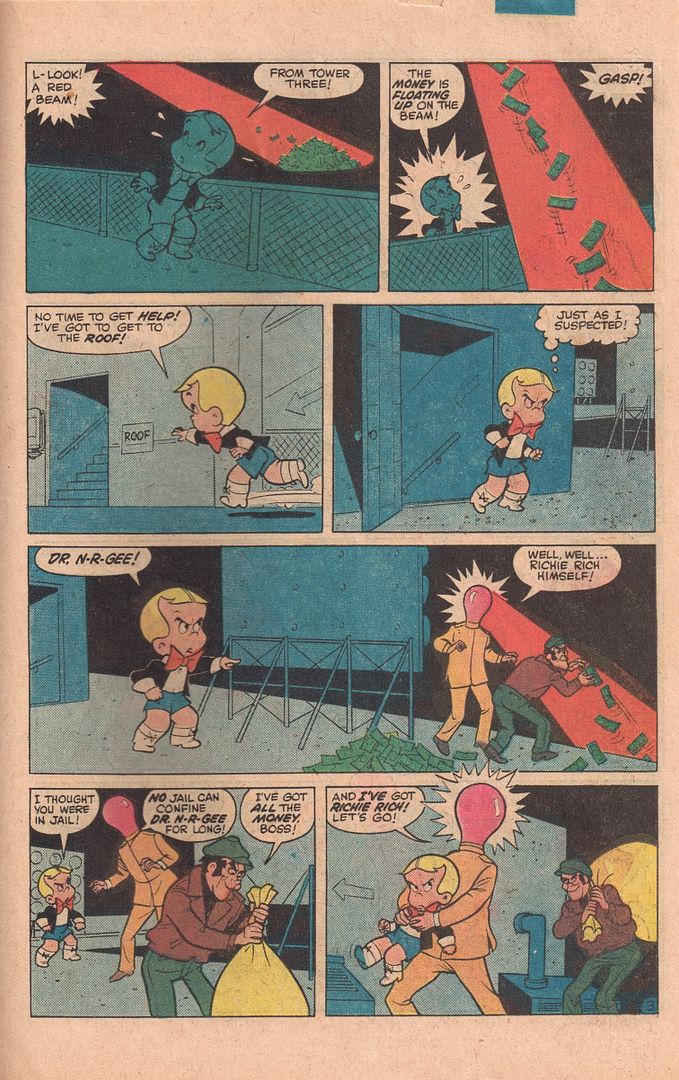
Er... "spending some" of his character? Money? Wallet collection? Proofreaders to the front of the store! But I digress. Aside from the overtly "socially conscious" tone suggested here -- which could be effective if handled correctly, but, especially in the wake of the financial crisis and recession, could just be an excuse for crude capitalist-bashing of one sort or another -- the notion of Richie as a globe-trotting adventurer is certainly nothing new. Thanks to my long-running RICHVILLE RUMINATIONS column in THE HARVEYVILLE FUN TIMES!, I suppose that I have written more about Richie for public consumption than just about anyone in existence. My first series of RUMINATIONS columns for THFT!, back in the early- to mid-90s, covered the many, many ways in which Richie led an adventurous existence in the Harvey Comics of the 60s, 70s, and early 80s. The sight of the (bulked-up) Cadbury packing heat on the cover of Ape's first RICHIE release doesn't faze me; Richie himself was known to handle firearms to good effect on many different occasions. As for faceless minions ganging up on Richie's gang, we have seen that too, thanks to such "classic" adversaries as The Condor and Dr. N-R-Gee. Those baddies don't really qualify as "hip," "cool," or "cutting-edge," though, which is probably not going to be an issue here (despite the reported contributions of old Harvey hands Sid Jacobson and Ernie Colon to an early Ape issue). The question is, will political correctness trump the simple desire to tell a good, rousing adventure tale?

The appearances of the characters aside, the cast also reflects treatments seen in past RICHIE stories. Cadbury was always a remarkable athlete and "Renaissance man" -- heck, Dos Equis' spokesman could have taken a few lessons from the Riches' butler -- so the acquisition of a lantern jaw and a few more layers of muscle (along with, strangely, a pair of Mickey Mouse-style gloves?) won't be too much of a stretch to imagine. I gather than iRona (I hope that that name doesn't get Ape in copyright trouble) is simply a sleeker version of the Riches' robot maid, with up-to-date computer technology added to augment her already superhuman strength (and, if the Hanna-Barbera cartoon version of RICHIE RICH is to be believed, Transformers-style body-modification abilities that predated the original TV version of Transformers itself). iRona bears a certain unsettling resemblance to the tit(t)ular star of a Phil Foglio XXXENOPHILE story, "I Swing the Body Electric," but I am confident that Ape won't go THAT far in the course of its "reimagining" activities. Richie's girlfriend Gloria's role isn't described above, but "tomboyish ass-kicker" is a pretty good guess as to her personality -- and, wouldn't you know, even that idea has some precedent (cf. the Gloria of the live-action Richie Rich movie from 1994 starring Macaulay Culkin). As for Dollar the dog, well, as long as Ape can stay an arm's length (or ten) away from the Frank Welker-voiced "comic relief" character of H-B days... To paraphrase Sigmund Freud, sometimes a dog should just be a dog.

The previous observations should serve to convince you that Ape's new version of the RICHIE RICH "universe" is built on a sturdier foundation that you might guess. What is yet to be determined is the attitude that the creators, and particularly the writers, will take. A lot of comics fans have admitted to disliking the Harvey Comics version of Richie because of the (mistaken) perception that the flaunting and/or abuse of vast wealth was all that Richie brought to the table. In its zeal to attract a "new generation," will Ape go too far in the other direction and turn Richie into a smug, preachy character who pays obeisance to all the appropriate secular "gods"? (Dr. N-R-Gee and The Iceman in a global warming story, anyone?) I really do hope that Ape does this project right. Richie is too enjoyable a character to simply be left on the "diamond heap" of comics history.