Showing posts with label Romano Scarpa. Show all posts

Thursday, October 9, 2014

A POST "DUCKTALES RETROSPECTIVE" PERSPECTIVE: "The City Under the Ice" (Gladstone DUCKTALES #12, March 1990)

There's a good deal of irony packed into that William Van Horn cover image.  Those of us who remember the original DUCKTALES comics line -- the one that Disney more or less forced upon a reluctant Gladstone Comics in 1988 as a way of promoting the red-hot TV series -- mentally divide the 13 issues that followed into two groups:

(1)  The Disney Studio stories, some of which directly adapted episodes of the series, such as "Armstrong" (DT #1) and "Jungle Duck" (DT #2).

While the adaptations may not have been top-notch, they were pure genius compared to the original Studio stories that followed -- stories that were notorious for gaffes in characterization (e.g., Webby calling her grammy "Mrs. Beakley" in "The Crown Jewels Affair" [DT #4]) and an UTTER, as opposed to a partial, lack of inspiration.  Just about the only things that these issues had going for them were the lively and detailed covers by Daan Jippes.  It certainly wasn't Daan's fault that these eye-catching covers promised adventure and excitement that the stories inside so miserably failed at delivering.

(2) In the back of DT #6, backing up yet another blah Studio lead, was an intriguing bauble that pointed directly to DUCKTALES Mark 2.0: "Coin of the Realm," a ten-page tale written and drawn by Bill Van Horn.  Recall that, up to this point, Van Horn was known to Gladstone readers primarily as "the guy who does the fillers and gag pages."  The former included a couple of humorous GYRO AND LAUNCHPAD four-page stories in DT #4 and 5.  "Realm" was of an entirely different scope and immediately seemed more entertaining than any of the mush and dribble that had been regularly doled out to us.

And so, beginning with DT #7, Van Horn -- with occasional assistance from John Lustig -- began to produce lead stories for the title.  These quickly became so popular that, when Gladstone temporarily reverted to Studio fodder with DT #9's "The Oil Pirates," the dropoff in quality was almost jarringly noticeable.  Van Horn was back on the job in DT #10, producing "The Whistling Ghost," a 16-page feature story that brought back Baron Itzy Bitzy, the whistling flea character that Bill had introduced in one of his non-DUCKTALES efforts.

Van Horn would likewise provide the lead stories for issues #11 and #13, the last of which, "The Billion-Bean Stampede," may well be the most memorable of all of these highly quirky efforts.  For sure, it had the zaniest cover.

These romps are warmly remembered, not least because they cemented the bond of fondness between American Disney comics fans and Van Horn, who, unlike Don Rosa, didn't make a splashy debut, but patiently worked his way up the ladder and amassed good will a bit at a time.  (Somehow, I think that Scrooge would approve.)  And yet... and yet... as enjoyable as these stories were, I think that fan-friend Pete Fernbaugh was correct when he said that they came across as VAN HORN stories more than they did DUCKTALES stories.  Van Horn seemed uninterested in using any original DuckTales creations other than Launchpad.  While Bill handled LP quite well, his approach seemed uncomfortably close to the lazy Studio practice of creating a DT story simply by plugging LP into the Donald slot in an otherwise conventional "Scrooge and the Ducks" narrative.  (The GYRO AND LAUNCHPAD stories, by contrast, didn't seem quite so atypical, primarily because Van Horn knew how to take advantage of Launchpad's nature and abilities in such a specialized setting.) Needless to say, there was never anything conventional about Bill's approach, but, the more he tried to "wacky" things up by dropping in zany rock concert promoters, lively legumes, and so forth, the more his tales got pulled away from anything resembling what DuckTales had given us during its wide-ranging first season.

The bottom line is that neither of the aforementioned groups contain what one might characterize as a legitimately authentic, high-quality comic-book adaptation of the TV series.  Pretty unfortunate for a title that was supposed to be providing readers with the equivalent of the DuckTales animated experience, only on the printed page.  But then, we get to issue #12, which... stands apart.  Boy, does it ever.

During the last several months in which it held the Disney comics license, Gladstone had converted its titles into a double-sized format, the better to pump out as much "classic" material and heretofore unseen overseas delights as possible before the "window of opportunity" closed and the Disney Company took over.  (These included lengthy stories by the Italian great Romano Scarpa, who was a complete revelation to us notoriously insular Americans at the time.)  In DT #12, Gladstone finally took full advantage of the extra space to showcase "The City Under the Ice," a 39-page French story.  I wonder how many folks saw the Van Horn cover, immediately began thinking of the crazy scenarios and gags that "Silly Billy" might be able to stage in that gelid setting, and then really froze up when the first page of "City" displayed "something completely different."

According to Inducks, "City" is the second longest standalone DUCKTALES comic-book story ever produced, trailing only "The Curse of Flabberge," which David Gerstein so memorably "reimagined" for Boom!'s UNCLE $CROOGE during its DuckTales phase.  The creation of the story was very much an international affair. It was written by Frenchman Patrick "Zack" Galliano, whose previous authorial credits included PIF LE CHIEN, a creation of the French Communist paper L'HUMANITE; penciled by the Spanish artist Maximino, who did quite a bit of work for Mondadori, the Italian Disney comics publisher at the time; and inked by the staff of the Barcelona-based Comicup Studio.  Oddly enough, a similar combination of French, Spanish, and Catalan talents worked on "The Curse of Flabberge."  The artwork for "City" is a little rougher and livelier, all things considered.

The "Americanization" of the story was done by Gladstone and Disney Comics stalwart Dwight Decker.  During the Gemstone and Boom! Comics years, we got used to imaginative, reference-packed transformations of the utilitarian English dialogue that was normally provided to scripters.  Even the more sedate efforts along these lines had a touch of class.  (At least, I like to think that I provided one.)  Decker's translation, while sturdy enough, is more of the vanilla variety, though he does throw in a contemporary reference to some briefly famous pop star whom I don't have the time to research right now.  I wonder whatever happened to the guy.

While it certainly doesn't have the sheer scope of "The Gold Odyssey," or even the more modest "Scrooge's Quest," neither is "City" a sprawling, shambolic wreck on the order of "Rightful Owners."  The best praise that I can offer to it -- praise that will seem more meaningful when you consider when this tale was produced -- is that it gets the DuckTales aspects right.  It has a few quirks of its own, but the plot is easily recognizable as one that might have sprung up in an episode of the TV show, the characters involved are bang-on in character, there is a splendid reference to an infamous event that occurred on screen, and there's a pleasing mix of action and humor.  For that reason, I consider "City" to be the first TRULY successful DUCKTALES comic-book story to appear in America, at least when "successful" is interpreted in a strictly DuckTales-oriented context.

** SPOILERS **

We start with that classic McGuffin: a long-lost, well-hidden treasure map.  During the skateboard mishap pictured above, the ambulating Eskimo drops a bone that proves to be hollow.  The map inside points the way to a stark Arctic peak on Chilblain Island where (according to... no, not the Junior Woodchuck Guidebook, but a convenient Arctic exhibit at the Duckburg Museum) a legendary "sun of gold" once fell and is now buried beneath the ice, along with the artifacts of a "mysterious civilization."  (Hey, if Golden Sun worship can occur on one peak, then it certainly can on another.)  Unfortunately, the Beagle Boys get wind of the find, as well, thanks to their capture of the unfortunate Eskimo.

Yup, them's the DuckTales Beagles, all right. And they're all in character, too, suggesting that Decker must have been paying attention when he viewed whatever episodes he viewed in order to prepare for this gig.  This should NOT be passed over lightly.  Not after a later story like "The Great Chase" (Disney Comics DT #16, September 1991, written by Frank Ridgeway of "Bermuda Triangle Tangle" fame) gave us the memorable sight of a kick-ass, take-charge Burger and a whimpering Big Time and Bankjob deferring to him. As things turn out, the Beagles of "City" will have far more to offer to the discriminating fan than simply looking and acting as they ought to.

Up in Canada's Northwest Territories, a somewhat headstrong Launchpad gets involved in a fracas at a honkytonk -- it isn't explicity referenced as such, but I think we all know better -- and is bailed out by Walking Mountain, a giant, stone-faced, and inscrutable Native American.  The grateful Ducks invite WM to accompany them to the treasure site... which, when you come to think of it, is rather peculiar.  He turns out to be helpful at various times and utters some (yep) appropriately inscrutable remarks, but welcoming the assistance of a complete stranger was, shall we say, not S.O.P. in the TV adventures... or in Carl Barks' adventures, for that matter.

The heart of the story features the Ducks' journey to the legendary Bear's Tooth peak and the Beagles' various efforts to stop them.  We start with a pretty bog-standard version of the "paper-thin disguise" routine...

 Well, their number plates aren't visible, at least.

... which leads to sabotage, a crash, and an unpleasantly close encounter with a polar bear.  The Ducks get out of the fix when Scrooge resorts to the somewhat extreme tactic of lighting the crashed plane on fire "to scare the bear away."  The Ducks' on-board flares subsequently go off, alerting a passing ship to their presence.  As solutions to dilemmas go, this is closely allied to suicide.  But then, the "Type A" Scrooge of this story would probably be tunnel-visioned enough to try it.  We soon see more evidence of Scrooge's mental state when Scrooge poor-mouths in dramatic style in order to rent a snowmobile at a lower-than-rock-bottom price.  A bit over the top, perhaps, for the Alan Young DuckTales Scrooge, but, hey... it's in character.

Upping the ante, the Beagles track the Ducks' snowmobile with one of their own... armed with a gun, no less.  Chisel McSue would be proud, fellas.  Walking Mountain displays some fancy driving in order to get the gang out of harm's way, but the Ducks soon discover that the Beagles had sabotaged their gas cans back at the Eskimo town.  Left to starve and/or die of cold on the Arctic ice, Walking Mountain suggests a rather unusual tactic to attract animals that could (per the JW Guidebook, which HD&L belatedly consult here) be used for food:

Another in-character moment.  It's easy to imagine Launchpad getting into the spirit of things that way.  Alas, the ululations only serve to "attract" the Beagles' ice-breaking submarine. (Did the Beagles have their working boots on in this story, or what?  Makes some of their feebler second-season efforts seem all the more annoying, doesn't it?)  Thrown into the sub's brig along with the Eskimo, the Ducks have little to do but wait out the ride to the Bear's Tooth.

As the Beagles prep for treasure-hunting, Walking Mountain gets his funniest moment of the adventure:

Thanks to a conveniently placed thin crust of ice, our heroes are sent hurtling down, down... to this:


So, where's the gold?  The Ducks find out when they discover a hidden laboratory, a high-tech sarcophagus, and its completely unexpected owner:
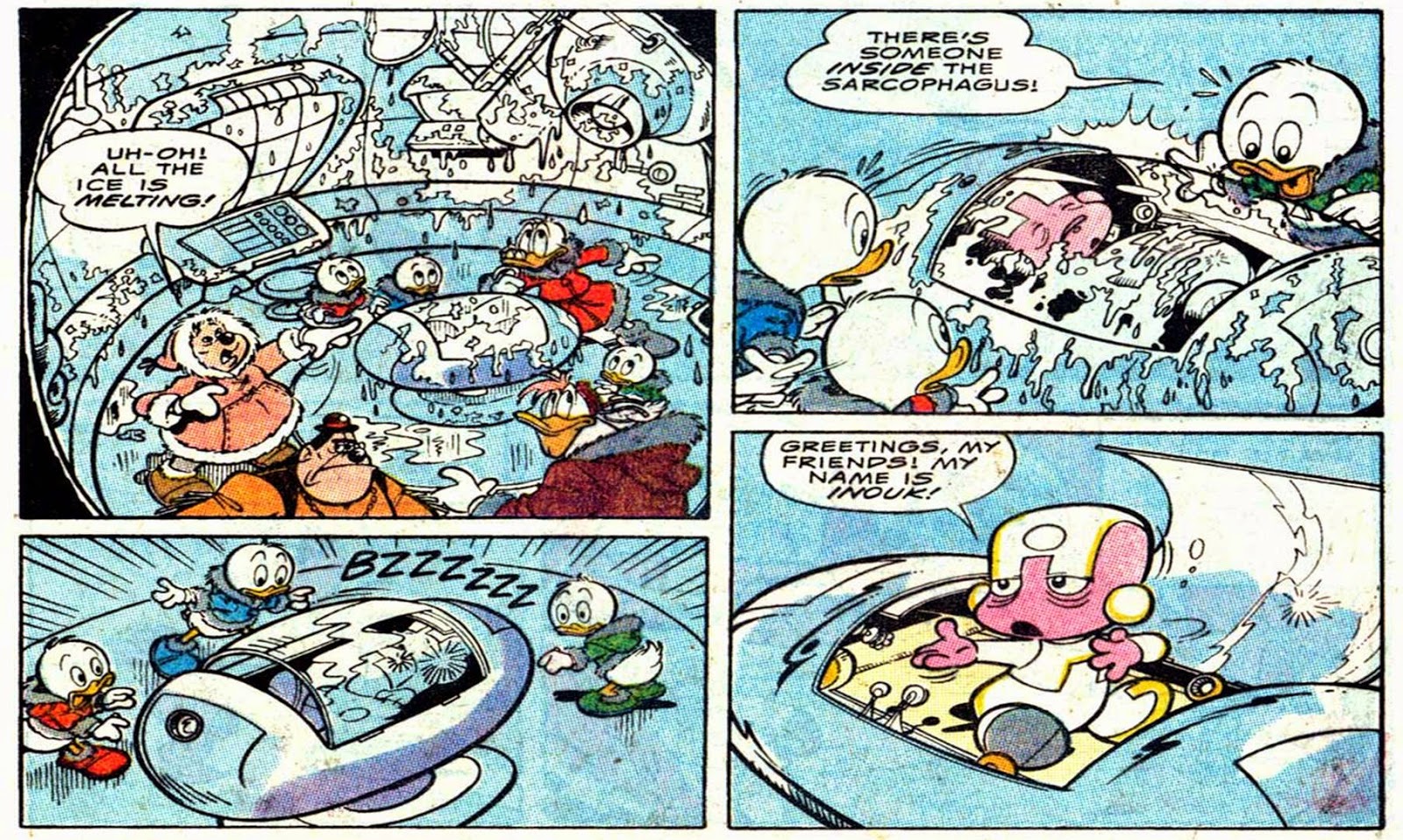
Yes, folks, it's an alien, a Thulian (clever reference, that) who was left behind by an exploration party that had to retreat because of the cold weather.  Inouk was put into the deep freeze with the understanding that his friends would ultimately come back to get him.  The "sun of gold" turns out to have been the golden spaceship that brought Inouk and his people to Earth.  You realize what that means, Scroogie: these guys live on a planet where gold is so common that it can be used to build spaceships -- not the "structural metal" of first choice for me, but to each his (or its) own -- and therefore...

And Scrooge didn't even go through the intermediate stage of hiccuping: he went right to a dead faint.  Any direct reference to "Too Much of a Gold Thing" can't get enough praise from me.  This was the point at which I knew that Dwight Decker had REALLY, REALLY taken his responsibilities seriously. Bless him.

At this point, you're probably wondering whether the story is going to end in the cataclysmic manner of "Gold Thing."  Well, the Beagle Boys are tooling around while operating heavy machinery.  What do YOU think?  

The Ducks' plight isn't as desperate as it was in "Gold Thing," but it comes pretty close.  As if to make up for the shortfall, the mode of the Ducks' salvation is a bit more esoteric than Launchpad flying in the transport plane just in the nick of time.  Here, Inouk flies the gang out of danger using his "golden egg" sarcophagus (which turns out to be a small spacecraft, as well) as the City of Gold, in the manner of its namesake in a Kimba the White Lion episode, collapses into oblivion.  Scrooge takes this development with considerably less grace than he did at the end of "Gold Thing."  Perhaps writer Galliano was letting his inner "L'HUMANITE contributor" out for a little holiday here.


The story's final two pages are a bit displeasing, if only because:

(1) The Beagles are allowed to scuttle away, more or less scot-free.  After that performance, they deserved the dignity of a stay in a luxury high-security prison, at the very least.

(2) Inouk's "rescue ship" just happens to have been located on the Moon all along -- a fact of which Inouk himself appears to have been completely unaware when he went into hibernation mode.  What the heck, was this supposed to be a "monolith test," or something?  Why would Inouk even need one, since his civilization is capable of space travel?

Yeah, I'm just as confused as you are, buddy.

The fact that I have to pick such a tiny nit in order to give "The City Under the Ice" anything less than unqualified praise indicates just how strong this story really is.  It's easy to understand why it sort of flew beneath the radar at the time of its release: Van Horn's multiple stabs at the DUCKTALES lead story naturally left more of an impression than this one-shot, and Gladstone Comics itself was just about to go into its own form of "prolonged hibernation."  But let's give credit where credit is due.  Speaking strictly of DUCKTALES comic-book stories that appeared in America, "City" is one of the very few that can be said to have done full justice to the TV series.

"Golden Sun."  I like the sound of that...

.

.

.

My apologies for making you wait so long to see this.  Hopefully, you'll find the wait to have been worth it.  In my next comics review, we'll catch Disney Comics' DUCKTALES title on a similar back end, so to speak, and look at how the book's 18-issue run ended with Bob Langhans' post-"Gold Odyssey" offering, "A Dime in Time."  Is there any way that Langhans could have lived up to the standard set by "Odyssey"?  We shall see.

Sunday, July 6, 2014

DUCKTALES RETROSPECTIVE: Episode 86, "Beaglemania"

True confessions time:  Boy, did I HATE this episode when it first aired.  As I've mentioned before, given the atypical manner in which I'd entered Duck fandom, I was generally in a more forgiving mood towards the non-canonical nature of many aspects of DuckTales from the get-go.  But this... THIS definitely seemed a (non-musical) bridge too far.  Too many references to contemporary mass-market musical culture, all of the Ducks being reduced to playing minor supporting roles for the first time, and, of course, the whole absurd, laughable notion of the Beagle Boys becoming rock stars.  It took a while, and a few additional viewings, before I could accept "Beaglemania" for exactly what it was -- no more and no less than the Fenton-Bubba era's version of "Scroogerello," with all the positives and negatives attendant upon that description.  Once I was able to get over that hurdle and revel in all the gleefully silly fun, I found myself greatly enjoying this ultimate example of departure from the objections of "old sourdoughs."

If I were re-rating the DT episodes today, I'd probably rank "Beaglemania" a little below "Scroogerello," primarily because writer Mark Seidenberg doesn't take quite as much care in setting up and tearing down his audacious premise as he does in exploiting it.  The idea of Duckburg hipster impresario Screamin' Sky McFly (who is finally seen in the diminutive flesh here after we heard his lip-burbling audio act in "Marking Time") running a contest to find the hottest new singing group is a perfectly fine one, as we ourselves certainly know, having been force-fed modern-day televised versions of pretty much the same concept for a decade or more.  Nor is there anything wrong with casting Duckburgified versions of popular real-world pop acts as the competition.  Even in the context of an exaggerated satire, however, it was bad form to have McFly declare the Beagles the winners of the contest without any other acts having been performed.  "The gig is up," you say, Big Time?  More like "the fix is in."  It wouldn't have taken that much for this problem to have been rectified -- perhaps a 10- or 15-second sequence in which the Beagles alternately wait for the show to finish, comment about their performance, and grouse about not having swiped the guitar full of money when they had the chance to do so.  Leaving the bridge out seems "but awfully" contrived at this remove.

Don't tell ME this guy can't be bought.

On the back end of the episode, we get what must be one of the ultimate tests of the Barksian dictum that, no matter what trials and tribulations the characters may endure during a story, things must always conclude "as they were."  The vengeful Ma Beagle's audience-aggravating anthem causes the Beagles to "bomb" for good and all... but there's still that small matter of the fortune that the Beagles had accumulated in the interim, sitting there in yet another version of a Beagle Money Bin.  And this fortune is not likely to explode, implode, or otherwise dissipateSo how to get the Beagles back to "Square Want" (as in, "We want Scrooge's money")?  The episode doesn't know and, apparently, doesn't care.  My best guess is that Scrooge, as the Beagles' employer (!!), used some legal muscle to get the Beagles' betrayal of their fans interpreted as some sort of "breach of contract" and was able to take the Beagles' boodle away from them.  That seems rather cold-blooded, but, let's remember, the Scrooge of "Beaglemania" is willing to go beyond mere "cooperation for convenience's sake," a la the arrangements with Glomgold in "Robot Robbers" and Magica in "Magica's Shadow War," and exploit the Beagles in a mutually beneficial money-spinning enterprise.  This doesn't take Scrooge as far down the path of ethically dubious doings as have some Italian adventures of Paperone di Paperone, wherein Scrooge is known to have committed actual crimes, but there's something unnerving about it, nonetheless.  A Scrooge who is willing to cut deals with his most persistent foes would probably be capable of commandeering the Beagles' profits through clever legal means.

"Beaglemania" also suffers from some irritating production problems.  Some are of the cheese-paring variety, such as the three identical crowd-pan shots we see during the Beagles' performance of "Boogie Beagle Blues."  To be fair, many of the same characters that we see in the pans can also be seen ripping up seats and rioting during the Beagles' final, fatal gig (a sequence that seems to have been cut from the episode at some point, given the visual evidence I've been able to dig up on YouTube).  So I'll give the Wang animators the benefit of the doubt, for consistency, if nothing else. 

Rally, rinse, repeat.
On second thought, scratch that...

It's a bit harder to overlook the opening of the scene at the Dukka Records recording studio.  Before the Frank Welker-voiced engineer gives the corpulent Melvis Pigsley the go-ahead, we hear the muffled word "Take" in a voice that DOESN'T sound like Welker's.  Evidently, one of voice director David Weimers' cast instructions got onto the master tape, and no one caught the error or bothered to edit it out.  This goof is particularly troublesome in light of the fact that, while the quality of the animation in DuckTales isn't always consistent, the audio production has hitherto been impeccable.  (I'm also aware that some of the YouTube posts of this ep have sound out of sync with picture in Act Three.  I don't recall this problem during the initial episode airings, so I'm figuring that this was some sort of transfer problem.)
Sloppy framing and teetering production values aside, the remainder of the episode can best be described as one continuous laugh riot.  Not all of the jokes hit home, but most of them do, including the easily overlooked, yet nonetheless amusing, scene at the Mothers of Criminals meeting.  Here, we see a side of Ma Beagle that we've never before been privy to, namely, her twisted "pride" in her family's criminal accomplishments (which was earlier lampshaded in the "Duckburg's Most Wanted" TV-watching scene).  Ma's proclamation in "Take Me Out of the Ballgame" that "Cheating is a family tradition!" is something of a precursor of this, but her admission of shame that "four of my boys have... gone legit" adds an extra dose of irony or three to the mix.  Ma's later desire to be "Bramble Soups' Mother of the Year" in "New Gizmo-Kids on the Block" is but a pale echo of this "bad is good" theme, which wouldn't have been out of place in one of Barks' sourer stories.

We also learn here -- though the lesson won't really be rammed home until "The Bride Wore Stripes" -- that Ma might suffer a tad from OCS.  It isn't enough for her that the Beagles have become rock stars; instead, she pushes them and pushes them to "suffer for [their] art" until they finally snap and throw her out.  And it isn't just verbal nagging, either, as her threatening of Big Time with those "little piggies" makes clear.  Perhaps we can formulate a new theory as to why Ma has "as many boys as a toad has warts."  She just can't HELP herself.

Of course, the juxtaposition of the Ducks' world with that of popular music isn't exactly new.  As one might expect, the Nephews were the first of the clan to express any sort of appreciation of rock and roll, starting with a dogface simulacrum of the original rock star ("Mutilated Music," DONALD DUCK #53, May 1957, drawn by Tony Strobl and John Liggera):
I like that "weeks ago."  Yes, there once was a time when people thought that rock and roll, like mambo and other briefly trendy musical forms, would eventually fade away...

HD&L were back in fanboy mode several years after this in "The Paper Route Panic" (DONALD DUCK #66, July 1959, written by Bob Gregory, drawn by Strobl and Liggera).  This time, they were the fans (literally -- the ONLY fans) of a cowboy-hatted crooner named Paisley Mantee.  I suppose that you could drape the mantle of rock over this obsession by calling Mantee a practitioner of rockabilly.  HD&L must have really had it bad if they were willing to spend a $50 newspaper delivery prize on Mantee's records.  That's $50 in 1959 money, folks.

Carl Barks, however reluctantly, dipped a toe into the "pop pool" with his late Scrooge adventure "Queen of the Wild Dog Pack" (UNCLE $CROOGE #62, March 1966), which finds the boys enamored with the music of Tweedy Teentwirp.  Oddly enough, when Scrooge confronts the kids over the noise from their TV set in "Beaglemania," Huey holds a "boomlet box" in a manner that is disquietingly similar to the ways in which various characters in "Dog Pack" zone out while listening to Tweedy on transistors.


Perhaps more relevant to the current discussion is Barks' invocation of The Beatles in "The Great Wig Mystery" (UNCLE $CROOGE #52, September 1964), both in general theme (Duckburg having gone wiggy for moptop wigs) and in explicit mention.  If you're perturbed at the idea of "Beaglemania" showing direct parodies of Bruce Springsteen, Madonna, Elton John, and Michael Jackson, consider that Barks was striking while the iron was red-hot in his own way; he composed "Wig Mystery" in the early months of 1964, when America was enduring the virulent early stage of Beatlemania.  Barks may not have shown a version of the moptops, but he wasn't above invoking their actual names for the purposes of a gag.

He could be diddling MUCH WORSE things, believe me...
During "Time is Money," the series had prepared the groundwork for the kids' immense enthusiasm over the Sky McFly show.  Indeed, Bubba's immediate commandeering of McFly phrases like "Get rude, dude!" and "Bop till you drop!" was supposed to help define his personality (more's the pity, but I digress).  That being said, I find the depiction of the kids' love of McFly in "Beaglemania" to be a whole lot cuter, primarily due to the inclusion of Webby.  After so many instances of the boys blowing Webby off for her choices of favored pastimes "just because she's a girl," it's refreshing to see her fully accepted as part of a fan-group.  And not simply accepted; Dewey even dances with her!  I wonder why Webby didn't do the "change partners" routine at some point and dance with Huey or Louie.  Perhaps Dewey's being the cleverest of the Nephews (cf. "Duck in the Iron Mask") held some sort of cachet for her.
The Beagles' performance of "Boogie Beagle Blues" is... well, unlike Babyface, Bankjob, and Bebop/Bugle's harmonizing in "Time Teasers," it'd be a stretch to call it an actual song.  In the original performance, Welker and McCann only sing the actual phrase "... and sing the Boogie Beagle Blues," "talking" through everything else.  It's easy to overlook this because of the flashy accompanying visuals, which include Burger biting through his guitar neck, the drum set being blown up, and Bouncer firing pistols directly into the camera.  In case you're wondering, no, that last bit has never been censored to my knowledge.  Presumably, the blue-pencil people would have been more offended had Bouncer fired the pistols up in the air, or, heaven forbid, twirled them around in his hands, the way Fenton did during the scene on the dam in "Liquid Assets."  The version of "Blues" that you're more likely to be familiar with, the one on the 1990 Disney Afternoon Songbook CD, has somewhat smoother production values, and Welker and Chuck McCann sing just a little bit more, but basically, it's six of one, six and a quarter (Scrooge: "Not one of mine... but I can give it a good home!") of the other.

It goes without saying that this performance would have been a perfect time to bring Bebop/Bugle back as a supporting player.  Heck, in one of that character's several incarnations (the "Scroogerello" one), he even talks in rhythm!  Tell me that that wouldn't have been a useful contribution to the production.  By this time, unfortunately, the DT writers have settled upon Big Time, Bouncer, Burger, and Baggy as THE de facto Beagle Boys, and over-familiarity has long since started to breed contempt (not that some didn't possess such an attitude about the DT Beagles from the beginning).  The constant post-season-one use of the "Feckless Four" can usually be put down to laziness.  Here is one instance in which the lassitude made the ep something distinctly less than it could have been.


Through the mysterious alchemy of instant stardom, the Beagles' song is soon "#1 with a bullet... and I'm not kidding" (my choice for the single cleverest gag of the episode).  I suppose that I should be surprised that the strongarm tactics that the Beagles use to crash the music biz -- first forcing Dukka Records to sign them to a contract by threatening to torch the recording studio, then putting the gun on the KDUK DJ to get him to play their platter -- didn't get them into legal trouble before they got involved in contract disputes with Scrooge.  It's long been crystal-clear, however, that the denizens of Duckburg (the DuckTales version, at least) can be conned or browbeaten into doing just about anything.

Ma soon takes full charge of her boys' affairs, making demands on Scrooge and hounding the Beagles into all manner of fan-propitiating activities.  We're invited to blame her for the costume changes that turn the new pop stars into what can only be called "The Village Beagles," since Big Time is heard protesting the wardrobe choice at the record store.  The truth might be a little more complicated, though; the Beagles had already been seen wearing the garish gear on the cover of ROLLING DUCK, presumably before Ma had muscled her way into the Brian Epstein role, and they don't seem to be having any problem with it there.  Actually, Big Time has much less reason to be unnerved by his costume than does Bouncer.  Somewhere, Gyro's Helper is shuddering silently, and the members of Electric Light Orchestra are fuming that they didn't think of this first.

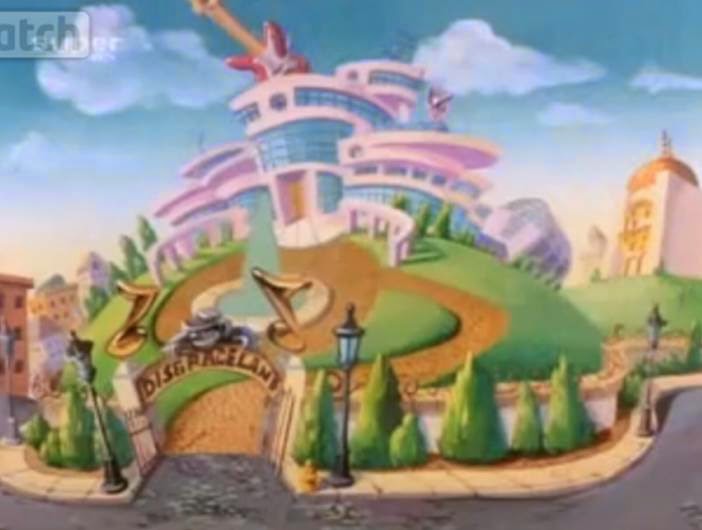
Most of the subsequent gags, like that of the Beagles' sartorial invocations of various genres of rock music, are pretty broad in nature -- a fact that GeoX brings up as one of the ep's negative aspects.  In truth, I think that GeoX missed the point here.  The fact that the gags are broad and silly pales in comparison to the overwhelmingly bizarre nature of the episode's context in and of itself.  It's shocking enough that we got an episode in which the Beagles become rock stars and move into a mansion called Disgraceland; let's not quibble too much about authentically subversive rock-industry-satire tropes.

After being given the heave-ho by her rebellious brood, Ma resorts to the time-tested approach of a cheesy disguise, posing as ROLLING DUCK reporter Nina Quackwell in order to frame the Beagles for a robbery.  In a further indication that she's playing for keeps, Ma goes beyond the earlier fistic threat she'd made to Big Time and actually mugs the real Nina on camera in order to steal Nina's clothes.  OK, it isn't as bad as killing someone to get a dress, as the 1800s Ma of "Once Upon a Dime" did, but it's bad enough.  Ma evidently has come a ways from the days of "Robot Robbers" when she merely evaded the security guard at Glomgold's construction site.

Ma benefits from the wonders of Spandex.

The "robbery" itself has two interesting features: the victimized bank is our familiar four-walled friend, the "First Interfeather Bank," and one of the cops who arrest the Beagles is female.  The Duckburg legal system may be terminally inept, but you can't say that the city's law enforcement operatives don't practice progressive hiring methods.

Of course, in the manner of tone-deaf celebrity worshippers everywhere, the Beagles' fans aren't bothered by their arrest, and thus Scrooge and Ma must join forces in order to burst the band's balloon.  I do wish that Seidenberg had avoided the obvious trap and had had the desperate Scrooge say something less drastic than "I don't think that my bank account can take this much punishment!".  Scrooge's "entire fortune" doesn't always have to be at putative stake in order for the consequences of an episode to be meaningful.  Any reasonable loss should be enough to pitch Scrooge into panic mode, since he values a portion of his fortune just as much as he values the whole.  The oversight is less fatal here than in "Yuppy Ducks," but it's still annoying.

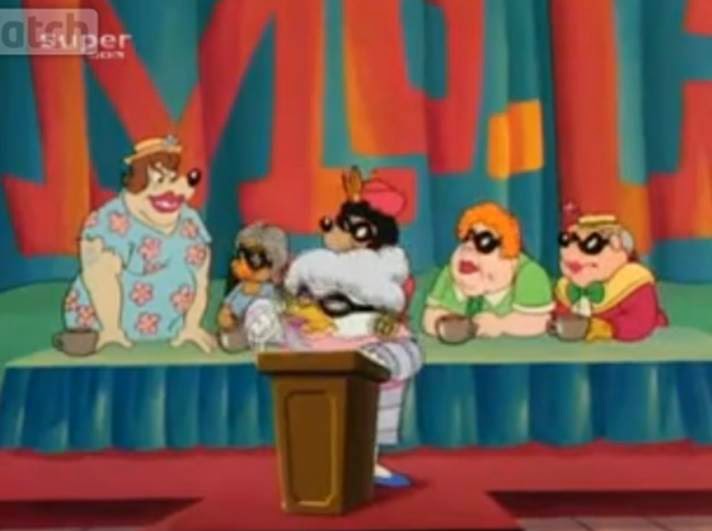
The Beagles' final scene with McFly is arguably the sharpest jab of all at the hypocrisies of the rock business, as McFly's cheerful attitude quickly sours and is replaced with a threatening one once it becomes clear that the boys don't have a new song ready to perform.  Ma then pounces and extracts a promise to be good in exchange for a "new" (lyrically, at least) ditty.  A rain of refuse from the indignant audience subsequently renders the Beagles "multiply-hit one-hit wonders."  They're left to lick their wounds and, presumably, to find access to their accumulated wealth barred for some vaguely plausible reason that we're apparently expected to work out ourselves.

I perfectly understand why certain folks might hate "Beaglemania."  I prefer to regard it as one of the series' boldest ventures, and, therefore, am willing to cut it a little slack on the small stuff.  Perhaps it's the sheer, unapologetic chutzpah with which the idea is punched over, but, after that initial period of fear and loathing, I came to accept the episode on its own terms... not unlike the manner in which a fair number of folks grew to tolerate, and then perhaps even enjoy, rock music when it first burst on the scene. 

.

.

.

Bumper #21: "Quadricycle"
.

.

.

"DuckBlurbs"

Terry Talks:  I've long wondered whether Terry McGovern based the persona of Screamin' Sky McFly on his own persona as a DJ in the San Francisco Bay area.  I couldn't find a recording of his dating that far back, but I was able to find a clip from one of his shows on the Internet oldies station, Boss Boss Radio.  (Insert blibbering lips where desired.)


In addition, here's an interview with McGovern conducted for the California Historical Radio Society.  The revelation that Terry was responsible for one of the many iconic lines from the original (and I do mean ORIGINAL) Star Wars movie will be a great "I did not know that" moment for many of you.


Dickie Bird is the Word:  Italian comics maestro Romano Scarpa plunged more deeply than Barks would ever have dared to into the pop-music waters with his original character Paperetta Ye-Ye, aka Dickie Duck, who first appeared in TOPOLINO #577 (December 18, 1966).  Like most Americans, I haven't had that much exposure to Dickie, but, judging from the fact that she's seen wearing (and grooving to) a transistor radio ring in that initial appearance, I gather that "musical fangirl" was one of her defining traits, at least during the late 60s.

(Greg) We begin this one with the STOCK FOOTAGE OF DOOM and down in the basement as Scrooge is giving the dollar bills a bubble bath and drying them on clotheslines. Duckworth just stands there; probably wondering about Scrooge's sanity at this point. Scrooge puts the dollar bill through the ringer and Duckworth pins the bills on the clothesline. Apparently; in Duckberg, Scrooge can launder money and get away with it.

At least, he has been able to since UNCLE $CROOGE #6 (June-August 1954), when Carl Barks drew him doing the same thing for the issue's cover.
(Greg) Duckworth even references Frank Sinatra and some other guy which earns a blow off from the nephews as they call Scrooge a fuddy duddy. Well screw you nephews! Frank Sinatra is awesome! Rock and roll is great; but that doesn't mean Frank Sinatra automatically sucks because he doesn't do rock and roll.

"Some other guy" wasn't too bad, either.  I might even have voted for him over Frank as "the winner of the hog-calling contest."

(Greg) Scrooge blows it off because he has work to do and the kids walk upstairs calling Scrooge more ancient than Bubba. Bubba is as confused as I am.
"My God!  I'm either a gimmick character or an unnecessary
extra Nephew.  Rock, hard place."

(Greg) So we head to KDUK radio studio (with big ass D on top of the building) and then pan down to floor level and then go inside the studio as a pig Elvis [sings] so badly that he has to mangle the words to avoid infringement.

The building is actually the Dukka Records building; the Beagles don't infiltrate KDUK until they threaten the DJ (which makes more sense, given that they'd have to sign a record contract before a record actually existed).

Is the Elvis parody here cruel, or what?  I know that the "fat-farm" and "overdressed" tropes have long since been beaten to death -- or, given that we're talking about Elvis in the context of death, maybe they haven't been -- but Melvis Pigsley doesn't catch anything resembling a break here.  You almost find yourself feeling embarrassed that Scrooge winds up hiring Melvis to replace the Beagles.

(Greg) Mrs. Featherby goes to the door and she gets MURDERED by the Beagle Boys and Ma who are running away from their fans... [Later] the fanboys and fangirls break down the door and use it as a bridge to squash Mrs. Featherby (Again; what is this no male on female contact rule again?) and head to the window. 

Remember Fenton and HD&L asking for "hazard pay" and "hazard allowances" in "The Land of Trala La"?  Poor Mrs. F. ought to consider putting in for similar compensation here.  OUCH!!


(Greg) Ma gives Scrooge a list of demands which Scrooge blows off because it will cost a fortune. Ma blows it off because it's in their contract and if Scrooge violates the deal, they split. There's one problem to this: Scrooge can simply end the deal now and the episodes ends in less than a minute.

Scrooge probably was scared to death of what he might have to pay in legal costs if the Beagles took him to court over the matter.  Considering that it's the Duckburg legal system we're talking about here, and considering that the Beagles once succeeded in taking said legal system over, I can forgive Scrooge for eschewing a separation, at least until the odds are clearly on his side.

(Greg) After the commercial break; we head to the Money Bin Desolate version as we go to the vault and the Beagle Boys dive into the money and the law of heavy metals has forsaken us.
(GeoX) And from there [the Beagles] become big stars with their own money bin.  Which they're able to swim in, contradicting previous episodes.

Well, they were seen swimming and playing in Scrooge's Bin in "Bubba Trubba."  Plus, they're not swimming in their own Bin so much as they're sort of wallowing in it.  No biggie, I deem.

Next: Episode 87, "The Big Flub."