In
my comments on "Liquid Assets," I identified three key moments that I consider to be the three biggest events in the history of
DuckTales. There should be little debate, however, as to the single most
shocking moment in the annals of the series. Sorry, Joe, but it's not the appearance of The Phantom Blot in "
All Ducks on Deck," as thoroughly unexpected as that was. For sheer, jaw-dropping improbability, the blue ribbon simply
has to go to the
Disney Afternoon closing credits for Monday, September 17, 1990. In that era, you may recall, all four shows in the block ran their credits at the end of the two hours, together with "teasers" for the episodes to be run on the next edition of
DAft. Wonder of wonders, the "teaser" for
DuckTales' 9/18/90 offering showed material that was clearly from an episode that
had not previously been known to exist. Even what little we knew about "
The Duck Who Knew Too Much" and "
Scrooge's Last Adventure," the two 1989-copyright episodes that had yet to be broadcast, did not match up with the stuff we were seeing on that tiny inset screen. This was mind-blowing enough, but then, guess who favored us with his out-of-left-field presence -- ironically, falling
OUT of the audience's view when he first appeared on screen:
Dijon: "Oh noooooooo!!"
Audience: "No wayyyyy!!"
The appearance of "
Attack of the Metal Mites" led to immediate, and highly understandable, speculation as to how many additional "completely new" eps the 1990-91 season was going to deliver. Little did we know at the time that WDTVA had contracted to produce just enough material (namely, four half-hours) to bring the total number of
DT eps to 100. Perhaps, we should have gotten the hint when "
The Golden Goose" gave us its "climactic" end-of-the-world scenario, but I recall waiting and hoping for a little while longer that more new eps might, just might, come our way. Of course, this kind of thing was S.O.P. for the era before the existence of social media and the Internet.
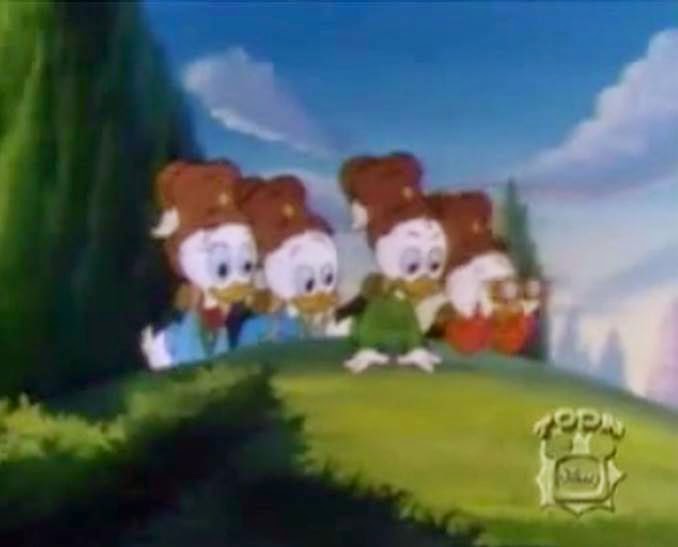
WDTVA might have exhibited tidy-mindedness in its decision to wrap up its DT manifest on a nice, round number, but it also evidently did not want to put any more resources into the 1990 DT eps than it absolutely had to. Nothing in the DT "Final Four" looked as horribly sloppy as, let's say, some of the 1990-copyright episodes of Gummi Bears, but some penny-pinching is nonetheless noticeable. Some of it is disquietingly blatant, e.g., the sequence outside the First Interfeather Bank in "Mites" in which Dijon lets Glomgold's metal-eating bugs loose to devour an armored car. In the first scene below, the screen freezes as we hear the bugs chomping away. In the second, the car literally vanishes in a cloud of dust before our eyes, with no transition scene whatsoever. And, yes, the whole thing REALLY looks that bad in "real time."
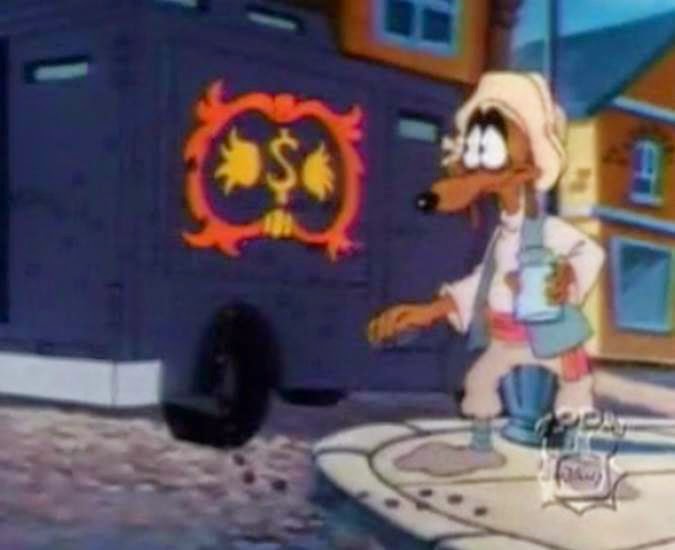

Dijon subsequently appears in a sewer as the bugs go marching by, with his muzzle conveniently placed so that the animators don't have to show his mouth moving as he speaks some dialogue. Shades of UPA's
Dick Tracy Show showing Dick holding the Two-Way Wrist
Radio over his mouth as he talked to his "field agents."
These mingy moments tend to stand out in the mind's eye, precisely because they are so at variance with even some of the weaker examples of animation from the series' first two seasons. A closer look, however, reveals an even
more troubling trait: a tendency to mount "normal" scenes with as small a number of background characters and other extraneous details as possible. Consider:
(1) Dijon is generally seen sneaking around in deserted or near-deserted streets.
"Is that my cue I am hearing?"
(2) Scrooge calls for the National Guard, and
ONE tank shows up. (I'd like to think that the
Goose Guard from "
Attack of the Fifty-Foot Webby" would have provided a more effective response.)
(3) For a bunch of pests who are supposedly "multiplying" -- exactly how this parthenogenetic phenomenon is being accomplished, we are never told -- the mites remain relatively few in number throughout. A single bubble from Gyro's bubble-gum-blowing robot is apparently sufficient to trap
ALL of them at once, despite what the earlier consumption of the tank and the missile might have led us to believe.
(4) The massive media coverage of the mites' attack on Scrooge's Money Bin is handled by Walter Kronduck and a pair of cameramen and draws a vast throng of... um...
ten denizens, in addition to Scrooge, HD&L, Webby, and Fenton. And Scrooge shouldn't even
BE there, because, in the immediately previous scene, we saw him fondling some of his "precious friends" inside the vault.
The simplicity of
Jeffrey Scott's central plot, and the slightly shopworn nature of the subplot (Fenton reacting to the mites' destruction of the Gizmosuit by losing confidence in himself, only to come through in the end, as in "
Money to Burn" and "
A Case of Mistaken Secret Identity"), further add to the impression of straitedness. It must be admitted, however, that the effects of the "stripdown" aren't quite as deleterious here as they are in "The Golden Goose," which marries an adventure tale that
SHOULD have been a true epic to a razor-thin cast and sparsely populated settings. It speaks to the overall excellence of "Goose" that the two-part finale managed to get away with it and be a big success
despite the self-imposed limitations, largely due to a stimulating injection of some real "Heart." The effects of cheapness on a modest effort like "Mites," by contrast, only serve to make the episode seem... well, a bit
more modest.
GeoX observed that "Mites"
"very much feels like your average early first-season episode" -- decent plot and characterizations, reasonably good action -- and that's pretty much correct, I think, even given that the visual accompaniment is a bit more poverty-stricken than we have grown accustomed to.
Glomgold's determination to
destroy Scrooge's money, rather than to simply try to outearn him or thwart one of his financial deals, goes well beyond anything Carl Barks tried to do with the character in terms of its potential direct impact on the McDuck quadzillions. Yes, even including Flinty's attempt to shrink Scrooge's money pile with the "Jivaro Juice" in "
The Money Champ." Reduction in size is not obliteration, and the Glomgold of "Money Champ" worried about what his "dear mother" would think of him for stooping so low, even as he dealt with the witch doctor out of sheer desperation. By contrast,
Greg's invocation of Duke Igthorn's use of the wood-devouring bug Big Tooth in "
King Igthorn," the
Gummi Bears two-part finale, may give Glomgold too
much credit, since the physical destruction triggered by Big Tooth's arrival ultimately had an impact on the
entire kingdom of Dunwyn. (Of course, you could always argue that the ingestion of Scrooge's fortune would have had just as great of a long-term
economic impact on Duckburg, but that depends upon how seriously you take some of the claims that have gone before in
DT.)
The use of bugs as a menace has some precedent in such Barks stories as "
Donald Duck and the Titanic Ants" (DONALD DUCK #60, July 1958) and "
Billions in the Hole" (UNCLE $CROOGE #33, March 1961). For a more exact analogy, however, you have to turn to "
The March of the Giant Termants" (DONALD DUCK #133, September 1970, drawn by
Tony Strobl and
Steve Steere). In this story, the Beagle Boys, with the unwilling help of a kidnapped bugologist, breed bugs that can chew through metal. Using commands from a fife, they march the bugs to the Bin and swipe some loot, only for Dewey to steal a march on
them and use his Junior Woodchuck Fife and Drum Corps training to foil the plot. The JW-inspired efforts to thwart the metal mites, we should remember, are actually every bit as successful as they were in "Termants"; it certainly wasn't the JWs fault that Dijon just happened to stumble onto the scene at the wrong time.
At the time "Mites" first aired, I was quite pleased and surprised to see Dijon reappear as a "special guest lackey" a mere month after he had been introduced to the public in
DuckTales: The Movie. Glomgold reaps the full harvest of his complaint in "
Master of the Djinni" that "you just can't get good lackeys these days," with Dijon's overcooked obsequiousness and perpetual surname-strangling driving Flinty increasingly mad. Upon further review, however, I am no longer quite so certain that Dijon should have been reintroduced in
THIS particular episode. In a sense, he actually
isn't reintroduced at all, as no character except Glomgold
seems to take the slightest notice of his presence, let alone recognize who he is (as, surely, Scrooge, HD&L, and Webby should). Scrooge obliviously running over the "Dijon bridge" after the mites is only the most obvious example of this peculiar case of localized astigmatism.


A far more troublesome example of this almost willful ignorance, at least to my mind, comes when Dijon is trying to lure the mites away from the ruins of the Duckburg Bean Factory and back towards the Bin with some metal scrap. In a sequence that lasts about 35 seconds but seems to take two or three times that long, Dijon runs out of scrap, plops the empty bag on his head, cowers for a moment in the finest "Cringing Ay-rab" style, pauses, exits stage left, returns with a new bag of metal, and leads the mites back across the screen, all in plain sight of Scrooge and Gizmoduck. It makes sense that Gizmoduck wouldn't recognize Dijon, but Scrooge??? What is the purpose of using Dijon in this role if the past relationship between Dijon and other cast members isn't going to be addressed?


In retrospect, it probably would have been a better idea for DT to have held off on reintroducing Dijon until "The Golden Goose." In that story, his past reputation IS a key plot point, and Scrooge's initial reaction to his presence in Barkladesh DOES take Dijon's reputation for thievery (which was, let us remember, amplified by his getaway with a pantload of Scrooge's money in DT:TM's very last scene) into account. Dijon's soul-searching and partial rehabilitation in "Goose" would then have seemed even more meaningful than they ultimately were. Using Dijon just to USE him... well, it was certainly nice and all, but it's hard to see what it accomplished.
Fenton's emotional travails here, as I mentioned above, should be more than familiar to the attentive longtime viewer. What's particularly noteworthy is how
quickly Fenton despairs after his Gizmosuit is gulped. It's the Crackshell equivalent of Scrooge's passive acceptance of his fate in "
The Money Vanishes" and much of the first act of "
Scrooge's Last Adventure." Fenton's meltdown is so complete that he describes his role as Scrooge's accountant as "worthless" and intends to quit McDuck Enterprises entirely. More dubiously, he's
STILL ready to resign even after he has cleverly used his Gizmo-call to attract the mites to himself and trap them with the convenient giant magnet. Not until he captures the one missing mite "with no super-stuff" does he (rather abruptly) return to his normal self. The character changes here are not exactly subtle, or anything close to it.


A good deal of the Fenton-Gizmo action here, of course, takes place in full view and/or earshot of the public (or what little of it could be troubled enough to be on set). After the following concatenation of events, how could ANYONE in Duckburg, including the supposedly still-ignorant members of the main cast, possibly NOT be aware that Fenton and Gizmoduck are one and the same:
(1) Fenton and Scrooge have their amusing little conversation about Fenton turning to Gizmoduck to save the Bean Factory right in front of Walter Cronduck and a cameraman. Their attempts at "whispering" here can only be described as pathetic.
(2) Fenton screams his code phrase in the Bean Factory, and the Gizmosuit comes flying in from several miles away to encase him (nice trick if you can do it!).
(3) Fenton becomes "unsuited" right in front of a TV news crew, which is then seen running towards him.
(4) Fenton yells for the mites from outside the Bin in such a manner that Scrooge, HD&L, Webby, and Gyro can clearly hear him and can subsequently clearly see the visual consequences (the mites encasing Fenton in a Gizmosuit-like manner).
(5) HD&L compliment Fenton for his quick thinking
without making any mention of the fact that Fenton has just revealed that he is Gizmoduck.
My best guess, if you want to know the truth, is that Jeffrey Scott, who wrote the scripts for all four of the
DT eps of the
Disney Afternoon era -- another sign of corporate cheapskatery, if you ask me -- was simply
NEVER TOLD about the whole secret-identity issue. The fact that we will see similar evidence in "
New Gizmo-Kids on the Block" of Fenton's secret ID being accepted as a given lends some additional support to my theory, I think. I'm not sure whether we should blame Scott so much as we should the uncredited story editor(s), who should have done a better job of making sure that Scott was up to date on the particulars of the series. Of course, that's assuming that Scott even
had a story editor. No such credit is given, nor will it be for any of the remaining new episodes. The phrase "we don't want it good so much as we want it
Thursday" comes to mind.
I don't want to be too harsh on Scott. Giving him the benefit of the doubt on the matter of adequate advance preparation and the unnecessary inclusion of Dijon -- which, for all we know, may have been
mandated to WDTVA by Disney higher-ups in order to take advantage of the publicity surrounding the movie -- he turns in an honest, workmanlike effort here, though one that does raise a number of questions about basic biology, physics, and such (as if those issues have never come to the fore before during
DT!). All the cast members who appear get meaningful things to do, and Scott gives us one of the finest Warner Bros.-style sight gags of the entire series when the mites cross the street and discomfit the decidedly atypical Walk/Don't Walk sign:
Then, too, Act Three makes up for the rather sedately paced Acts One and Two by building up some legitimate suspense as the mites get nearer and nearer to Scrooge's vault. I haven't a clue how the mites managed to get into the vault through the security camera, but there can be no complaints about the effectiveness of the "last-minute cavalry call," with Fenton pulling the mites away
just as they are about to nosh on the top layer of coins.
For a supposed "hands-off," minimalist production, "Metal Mites" isn't half-bad. Unfortunately, Scott would not be fortunate enough to get away with it the next time.
.
.
.
"DuckBlurbs"
(GeoX) I knew from the Wikipedia episode list that [Dijon] was going to reappear in the final two-parter, but seeing him here was an unwelcome surprise. My mind just reels that someone somewhere at some point announced "a cringing, sycophantic, avaricious A-rab stereotype? Boys, we've got ourselves a winner!" Jeez. Though I suppose if it's between him and the Ducktales Beagles, there isn't much to choose.
Assuming that WDTVA was bound and determined (or were bound and directed
by someone) to use a character from the movie, Dijon was the only logical choice. Merlock was presumably destroyed due to his talisman-less fall from the heavens, while Gene, the "boy-version" of the transformed Genie, doesn't seem to add much to the table that HD&L don't already possess. Even
Bubba is a more distinctive character than Gene. Whether Dijon should have been introduced
here, as opposed to "The Golden Goose," is another question.
(GeoX) I like the idea that Fenton can count all of Scrooge's money at a rapid rate while frantically tunneling through the piles of cash.
Fenton gets more chances to display his amazing counting abilities here than at any time outside of the "
Super DuckTales" serial.
Strange; that shtick could probably have made for a number of funny side gags along the way.
(GeoX) Gizmoduck, on deploying his head-copter to save a worker from a mite-eaten catwalk: "And you thought my head was only full of brains!" "No! I'd never think that!"
I like this exchange, because it's fun to hear a Duckburgian evince a highly negative, even cynical, attitude towards Gizmoduck's doings. In the past, Gizmoduck has been feted, celebrated, been subjected to intense media examination, and so forth. Evidently, the novelty of having a (somewhat fallible) superhero in town is beginning to wear off, and more quickly with some of the denizens than with others.
(GeoX) Webby as a Junior Woodchuck, recalling "Merit-Time Adventure." I'm down with that.
Ditto, and I think it says something about the Junior Woodchucks' willingness to make its distaff members feel welcomed that Webby is allowed to wear blue here after sporting pink in "Merit-Time." Too bad that Scott fumbled the ball a bit by mistakenly calling the JW Guidebook the JW
Manual (which was, I believe, Barks' original name for the tome).
Additional evidence that Scott was flying at least partially blind here?
(Greg) So we head to Flint's mansion and into Flint's office as Flint is talking to Dijon. That's right; they introduced this guy without any build up at all. Although to be fair; this is not his first appearance as that was the Ducktales Movie a few months earlier. However; the problem is that most fans of the series probably never got to watch the movie and thus didn't see Dijon's first appearance or origin story.
I think that it was reasonable for WDTVA to assume that
most (at the very least) of the regular
DT watchers had gone to see the movie. I agree, though, that it would have made more sense to have provided a
bit more background justifying Dijon's presence. (Not that anyone ultimately
noticed his presence, anyway...)
(Greg) Sadly; since Wang Films cannot animate a collapsing factory properly we quickly scene change to the sidewalk in front of Scrooge's mansion at the gate. We see Webby and the nephews (Louie) with a lemonade like stand as we discover that they are giving away free soda crackers and some of the denizens start taking them. Then we pan over to a real lemonade stand as Huey and Dewey are selling lemonade for a dollar (still better than the $2.25 lemonade in a bottle that the businesses sell; so I cannot complain) as everyone mobs the two nephews and Dewey has to tell them to relax. Huey then sees Scrooge in the window and asks how they are doing and Scrooge calls it better than expected. Then Fenton arrives with Scrooge at the window as Scrooge has the Gruffi pose and wants to do a cracker/lemonade franchise. You would think that after what happened in Duck To The Future and Yuppy Ducks that Scrooge would take the hint and NOT be trying to leech ideas off of his nephews. They are hardly shrew[d] Scroogie.
The obvious question here is: How can we square the actions and attitudes of the kids and Scrooge with the events of "Duck to the Future," in particular? Actually, it's not
that hard, though the manner in which the actions and attitudes are
portrayed isn't particularly helpful. In "Future," as the Nephews ran the second (post-Scrooge's-advice) version of their lemonade stand, they actively trying to cheat people by selling lemonade as water
and were cheating their employee, Doofus, besides. Even Gosalyn Mallard's selling of hose water as "bottled water" in a parched St. Canard in the
Darkwing Duck episode "
Dry Hard" didn't sink as low as this. HD&L and Webby's saltine-cracker-and-lemonade emporium, by contrast, is... well, let's call it an example of "sharp practice," as opposed to outright dishonesty. Scrooge's reaction to the initiative suggests that he thinks of the gambit as an example of being "smarter than the smarties." The problem is that the characters' reactions seem to be hinting that we should put a more negative spin on things. Scrooge rubs his hands in a conniving way when he praises the "shrewdness" of his "wee Nephews," while the kids take rather too much... well, pleasure a bit later in talking about their chili-peppers-and-water idea. More matter-of-fact reactions by Scrooge and the kids would have cleared up the contradiction a bit.
(Greg) Then in one of those moments that annoys me; we see Louie and Webby with the water hose. Wait; we clearly didn't see Webby run in so how did she teleport over to here now?!
I simply assumed that she got a late start for some reason (perhaps she was gathering up some supplies) and ran over to join HD&L a bit later.
(Greg) Webby proclaims that the bugs will be here any minute and Huey points out that the door is made of metal and it will turn to Swiss cheese. Scrooge runs into the storage office and returns with...cement? Yeah; we are suppose[d] to buy that Scrooge had wet cement prepared beforehand just for such a moment.
It came from the same mysterious location where Dijon got the extra bag of metal scrap, Walter Cronduck's cameramen got their spare cameras, and... you get the picture.
(Greg) So we head to Flint's mansion as Flint is checking his gold coins and then out of nowhere; Dijon appears from the open window. Even Flint demands to know about this outrage as Dijon has some news to share with him. The bad news is that Scrooge is making billions with the wrecking business which makes Flint groan in pain.
Vic Lockman would be proud of this ending... just as the late
Hal Smith should be proud of that fadeout shriek. That would have been a fitting note on which to end Glomgold's animated career, though I'm certainly not going to carp about his appearance in "The Golden Goose."
Next: Episode 98, "New Gizmo-Kids on the Block."