What Michael Barrier did for the history of classic Hollywood studio animation in HOLLYWOOD CARTOONS, he does here for the golden years of Dell Comics and its most accomplished and historically significant creators -- Walt Kelly, John Stanley, and, above all, Carl Barks. While devoting most of his critical attention to this trio of greats and the ways in which they helped shape the development of the American comic book into an art form with its own distinct verbal and visual language, Barrier also unearths facts and highlights overlooked personalities in a manner that is sure to surprise and delight even the most knowledgeable Dell/Western Publishing fan.
As was the case with HOLLYWOOD CARTOONS, FUNNYBOOKS had an extremely long gestation period, with Barrier using interview material from as far back as the 1960s to help craft his narrative. Barrier also draws upon material used in his 1981 book-length study of Carl Barks, but he expands greatly upon that earlier work. Perhaps his most important critical achievement here is his in-depth illumination of exactly how Barks, who famously worked in isolation and with minimal (at first) editorial interference, became one of the very first comics creators to "crack the code" and essentially discover how to tell effective stories in comic-book form. Barks fans have always known of the Old Duck Man's mastery of narrative, but they will come away from this discussion with a newfound appreciation of the wider importance of his work.
Barrier pretty clearly considers Barks to be primus inter pares even among the "really good ones," but Kelly and Stanley get their due and then some. Kelly's creation and development of the POGO characters is covered in detail, as is Stanley's work on LITTLE LULU, but Barrier brings their other notable comic-book works (e.g., Kelly's stories for OUR GANG and his fairy-tale and Christmas comics, Stanley's honing of his craft in NEW FUNNIES) under similar critical scrutiny. As was made quite clear in HOLLYWOOD CARTOONS, Barrier is a very astringent analyst, and it takes quite a lot for a story to wring praise out of him. Everyone who knows these creators will probably disagree with Barrier's assessments at some point -- for example, I think that he is much too harsh on Barks' more loosely-wound, but still immensely entertaining, UNCLE $CROOGE stories from the 1960s -- but he always has a well-considered reason for his opinions.
The "extra material" here is what really lifts FUNNYBOOKS to "instant classic" status. Anyone who has ever wondered about the precise relationships between the various corporate subsidiaries and allies grouped under the spreadeagled "Western Publishing" umbrella -- Whitman, K.K. Publications, Dell, Gold Key -- will have any and all questions answered to their satisfaction here. Interested in the early history of LOONEY TUNES AND MERRIE MELODIES, the Warner Bros. "answer" to WALT DISNEY'S COMICS AND STORIES, or in how Dell handled such significant "non-funny-animal" licensed properties as TARZAN and various movie cowboy heroes? You'll learn about some of these comics' most accomplished writers and artists here. Perhaps the biggest surprise is a brief discussion of "the Jim Davis shop," an association of artists who produced "funny-animal" challenges, of a sort, to Dell's humorous hegemony for the notorious comics entrepreneur Benjamin Sangor. It's nice to see the exquisitely obscure characters that came out of this outfit get some recognition, even if Barrier's primary purpose for bringing them up is to demonstrate how their comics failed while the best of Dell's succeeded.
If I have a small nitpick here, it is with Barrier's comparatively brusque brushing-aside of the Gold Key era. Yes, that era did see ill-considered format and price changes and increasing editorial restrictions, but there was a whole lot of high-quality material being produced at that time, as well. (See Joe Torcivia's 50th Anniversary tribute for numerous examples.) I fully realize that Barrier's intention was always to focus on the years before the Dell/Western split, but a few extra pages discussing some of the GK highlights couldn't have hurt. Anyone want to pick up the bracketed torch (as opposed to fallen; it's not as if Barrier failed, after all) and try writing a sequel?
So, what are you waiting for? If you care at all about the Dell Comics that truly WERE "Good Comics," or simply about the history of quality comics in general, FUNNYBOOKS virtually defines the term "MUST-GET."
Comics, book, and DVD reviews (and occasional eruptions of other kinds)
Showing posts with label Pogo. Show all posts
Saturday, December 27, 2014
Monday, November 17, 2014
Comics Review: MY LITTLE PONY: FRIENDS FOREVER #11 (IDW Publishing, November 2014)
FRIENDS FOREVER gets back on the beam with issue #11, doing what I always hope that this title will do... namely, use a limited cast of MLP characters to allow for a focus on certain aspects of a character that have never been examined, or perhaps even clearly defined, before. The task is trickier here than it might appear at first glance, certainly more so than when Katie Cook and Andy Price cast the hitherto characterization-challenged Princess Cadance and Prince Shining Armor as refugees from a John Hughes movie. Spitfire, the Captain of the Wonderbolts and thus something of an "aspirational peer" for the gung-ho Rainbow Dash, has a problem opposite to that of the Princess and her hubby; she has literally gotten a different characterization every time she has appeared on the show, and most of those did not exactly put her in the best of lights. Somehow, writer Ted Anderson manages to cut through the muck and give us a new take on the character that feels believable and does not entirely abandon what has gone before. It helps that Rainbow Dash, whose various foibles have been the subject of televised dissection more than once, gets one of her best "supportive adult" moments in any medium here.
** SPOILERS **
Think I'm kidding re: Spitfire? Glad-hoofing celebrity and partygoer ("The Best Night Ever"), bumbling co-conspirator in a surprisingly incompetent group of supposedly heroic pegasi ("Sonic Rainboom" and "Secret of My Excess"), bland sideline-watching executive ("Hurricane Fluttershy"), hardass drill instructor ("Wonderbolts Academy"), conniving bitch and colleague-betrayer ("Rainbow Falls")... Baskin-Robbins would be hard put to top the variety in that list. My hopes here were that Anderson would (1) not add to the damage caused by the character derailment in "Rainbow Falls," (2) bring Spitfire back to something resembling the "authority figure" setting of "Wonderbolts Academy," where I think she works the best, and (3) give her some relatable foibles without making her an overt figure of fun. All three missions accomplished!
Spitfire invites Dash to be an instructor at a "Junior Flyers Summer Camp" because... she simply isn't good at dealing with kids (beg pardon, fillies and foals). It seems that she doesn't know how to temper down her "mean" behavior as a Wonderbolt D.I. (I'd call it "demanding" rather than outright "mean," but potato, potahto...) and thus lets the littl'uns walk all over her. Dash suggests being "tougher" with the kids, but Spitfire promptly overdoes it, treating them just like adult recruits. Spitfire, however, does have a legitimate, inherent ability to motivate others -- though, as we are told in a flashback, it took a while for her to assert herself when she was a new recruit -- and Dash cunningly gives Spitfire a chance to literally show the little(r) ponies how it's done by whipping up a tornado for the Wonderbolt Captain to disperse before their eyes. (The meteorological danger is perhaps a bit extreme for the purpose, but, then again, this is Rainbow Dash we're talking about.) The "practical lessons" finally take, and Dash reminds Spitfire that the latter can always get better at working with kids by herself, yet still ask for a helping hoof when needed.
The plot is handled spot-on perfect. We get a look at what makes Spitfire the entire character, as opposed to Spitfire the icon/buffoon/meanie/bitch, tick. Anyone who has ever had to wield authority that they have earned, as opposed to authority that they have been awarded, will be able to both understand Spitfire's pride in her capabilities and recognize that any leader must be willing to keep learning, just as Spitfire does here. And all credit to Dash for being so understanding, thoughtful, and (what else?) friendly while playing a lower-key role than the "cheekily bombastic" one at which she normally excels.
The plot is strong enough by itself, but the artwork, by a newcomer named Jay P. Fosgitt (henceforth to be referred to "Fearless" for blog-obvious reasons), is really something special. It is at utter variance with any visual depictions of the MLP:FIM characters that we have been given in any of IDW's MLP titles, or on the TV show, for that matter: cartoonier, sweeter, softer-edged. I would even go so far as to call it "POGO-esque," but that may be setting the bar just a tad high, and, in any event, Fosgitt uses more exaggerated facial expressions and poses than Walt Kelly ever did. Having seen a preview page or two, I wasn't sure how this style was going to wear in a book-length tale, but it didn't take long for Fosgitt to win me over. It helped that the story, with its mix of slapstick, reminiscence, and sentiment, seemed to be complemented quite well by Fosgitt's approach. I don't think that the somewhat stiffer "official" visual versions of the characters would have carried the plot off with such panache.
You can get an idea of the amount of "cartoonification" involved here by looking at the cover at the top of this blog entry and comparing it to the Fosgitt cover. I hope we see more of Fosgitt in the future; I would be particularly intrigued to see how he would handle a more "action/adventure"-oriented story.
This title continues to mix gems with relative clinkers. Perhaps I should do some research and try to come up with a numerically-based reason for the inconsistency... you know, like the thing about "original Star Trek movies" only being good if they're even-numbered.
** SPOILERS **
Think I'm kidding re: Spitfire? Glad-hoofing celebrity and partygoer ("The Best Night Ever"), bumbling co-conspirator in a surprisingly incompetent group of supposedly heroic pegasi ("Sonic Rainboom" and "Secret of My Excess"), bland sideline-watching executive ("Hurricane Fluttershy"), hardass drill instructor ("Wonderbolts Academy"), conniving bitch and colleague-betrayer ("Rainbow Falls")... Baskin-Robbins would be hard put to top the variety in that list. My hopes here were that Anderson would (1) not add to the damage caused by the character derailment in "Rainbow Falls," (2) bring Spitfire back to something resembling the "authority figure" setting of "Wonderbolts Academy," where I think she works the best, and (3) give her some relatable foibles without making her an overt figure of fun. All three missions accomplished!
Spitfire invites Dash to be an instructor at a "Junior Flyers Summer Camp" because... she simply isn't good at dealing with kids (beg pardon, fillies and foals). It seems that she doesn't know how to temper down her "mean" behavior as a Wonderbolt D.I. (I'd call it "demanding" rather than outright "mean," but potato, potahto...) and thus lets the littl'uns walk all over her. Dash suggests being "tougher" with the kids, but Spitfire promptly overdoes it, treating them just like adult recruits. Spitfire, however, does have a legitimate, inherent ability to motivate others -- though, as we are told in a flashback, it took a while for her to assert herself when she was a new recruit -- and Dash cunningly gives Spitfire a chance to literally show the little(r) ponies how it's done by whipping up a tornado for the Wonderbolt Captain to disperse before their eyes. (The meteorological danger is perhaps a bit extreme for the purpose, but, then again, this is Rainbow Dash we're talking about.) The "practical lessons" finally take, and Dash reminds Spitfire that the latter can always get better at working with kids by herself, yet still ask for a helping hoof when needed.
The plot is handled spot-on perfect. We get a look at what makes Spitfire the entire character, as opposed to Spitfire the icon/buffoon/meanie/bitch, tick. Anyone who has ever had to wield authority that they have earned, as opposed to authority that they have been awarded, will be able to both understand Spitfire's pride in her capabilities and recognize that any leader must be willing to keep learning, just as Spitfire does here. And all credit to Dash for being so understanding, thoughtful, and (what else?) friendly while playing a lower-key role than the "cheekily bombastic" one at which she normally excels.
The plot is strong enough by itself, but the artwork, by a newcomer named Jay P. Fosgitt (henceforth to be referred to "Fearless" for blog-obvious reasons), is really something special. It is at utter variance with any visual depictions of the MLP:FIM characters that we have been given in any of IDW's MLP titles, or on the TV show, for that matter: cartoonier, sweeter, softer-edged. I would even go so far as to call it "POGO-esque," but that may be setting the bar just a tad high, and, in any event, Fosgitt uses more exaggerated facial expressions and poses than Walt Kelly ever did. Having seen a preview page or two, I wasn't sure how this style was going to wear in a book-length tale, but it didn't take long for Fosgitt to win me over. It helped that the story, with its mix of slapstick, reminiscence, and sentiment, seemed to be complemented quite well by Fosgitt's approach. I don't think that the somewhat stiffer "official" visual versions of the characters would have carried the plot off with such panache.
You can get an idea of the amount of "cartoonification" involved here by looking at the cover at the top of this blog entry and comparing it to the Fosgitt cover. I hope we see more of Fosgitt in the future; I would be particularly intrigued to see how he would handle a more "action/adventure"-oriented story.
This title continues to mix gems with relative clinkers. Perhaps I should do some research and try to come up with a numerically-based reason for the inconsistency... you know, like the thing about "original Star Trek movies" only being good if they're even-numbered.
Labels:
Comic Strips,
Dick Tracy,
General Comics,
Li'l Abner,
MLP:FIM,
Movies,
Pogo,
Star Trek
Thursday, August 21, 2014
DUCKTALES RETROSPECTIVE: Episode 94, "The Duck Who Knew Too Much"
If I had to hazard a guess, I'd say that, prior to preparing these RETROSPECTIVES, I'd watched "The Duck Who Knew Too Much" fewer times than any other DuckTales episode. (That, or "A DuckTales Valentine"; it's hard to say for absolute certain.) There's no particular reason for this; circumstances just seemed to work out that way. What is relevant to the present review is that any prior speculation as to the quality of the ep was based on comparatively sketchy personal recollections and/or what Joe Torcivia wrote in our DUCKTALES INDEX. I was therefore sticking my long, scrawny Duck neck out just a bit during my review of "Ducky Mountain High" when I fingered "Knew Too Much" as "probably the most uniformly satisfying" of the three second-season episodes that were held over for the first season of The Disney Afternoon. Having now gone over "Knew Too Much" with a finer-tooth comb... well, I would now like to qualify that statement a bit. The ep's superiority to both "Mountain" and "Scrooge's Last Adventure" is no longer quite so clear in my mind.
Don't get me wrong... "Knew Too Much," like the other two components of "The Tardy Trio," is centered on a first-rate thematic conceit -- in this case, chivvying a bumbling Fenton through a scenario that wouldn't be out of place in an Alfred Hitchcock movie. Despite the title, the ep probably more closely resembles North by Northwest (1959) than The Man Who Knew Too Much (1956), if only because a good deal of the early action takes place on board a train. However, despite the slinky spy Goldfeather's claim at one point that Fenton "knows too much," one shouldn't push any Hitchcockian analogy too far. In both of the Hitchcock movies, the protagonists are thrust into intrigue through no fault of their own. Fenton, by contrast, sets himself up for trouble by using chicanery (to wit: a phony case of "the dreaded purple-blotch beak pox") to sneak off on his ski vacation. Once the initial dirty deed is done, the plot slips into a more familiar Hitchcockian groove, but, thanks to Fenton's original dishonesty, we have slightly less of an emotional investment in seeing him triumph in the end... at least, until the second half of the episode swings our sympathies in his direction and he receives due punishment for his "original sin" in the end. The universe's balance is thereby restored, though Fenton might not appreciate the fact at the moment.
In three of Fenton's last four appearances of the series (counting "Knew Too Much"), he either doesn't use the Gizmoduck suit at all or has only a tangential relationship with its ultimate use. This strikes me as the DuckTales' writers' tacit admission that, when all is said and done, Fenton is truly more interesting than his Gizmoduck alter ego. (One has to wonder how many more Fenton-only eps we would have gotten had the series extended beyond 100 episodes.) Writer Doug Hutchinson (whose last animated episode of any kind this was, thereby concluding a brief, but highly fruitful, career with WDTVA) certainly takes full advantage of the opportunity; Fenton is in excellent form throughout, spouting quips, donning disguises, and acting the harried victim to a T. The fact that we also get to enjoy Gandra Dee's most multifaceted and enjoyable role (just in time, too; it's also her last) is merely a bonus. Not only that, the episode is surprisingly mature, touching on sexual themes more than any other ep outside the overheated "Metal Attraction," and perhaps deserving some extra credit in that human beings (or the Duckburgian equivalent thereof) are driving the "steamy engine," as opposed to a lecherous, crazed robot. So, there is quite a lot to like here.
Unfortunately, we can't leave things at that...
... because this episode also features some of THE worst transition sequences the series has ever seen. Greg brought a lot of these up in his review, but the "sitch" is, if anything, worse than he describes. Throughout the first act and into the second, we are fed a constant stream of "WTF?? I thought that...??" moments that test, and ultimately break, our patience. At the same time, the episode is acutely aware of itself, sometimes almost to excess, and the constant "nudge-winks" to the audience as we are trying to figure out "how we got from scene A to scene B" ultimately become a bit grating. Thankfully, things get straightened out as Act Two progresses, and we get a thoroughly first-class conclusion in Act Three, but there is no way that we can entirely forget what has gone before. Entertaining, to be sure, but unquestionably frustrating.
I'm not sure whether to blame Hutchinson or story editors Ken Koonce and David Weimers for "making the mess" (green jello and swizzle stick not included) here. Actually, that's not strictly true. Since the final version of the episode is already packed full of incident to begin with, it is possible that Hutchinson originally included even more material, and, when K&W trimmed the ep down to a 22-minute length, they excised scenes that "seemed" unnecessary but actually provided for better transitions. Or, perhaps Hutchinson wrote the script that we saw on TV, and K&W simply didn't bother to ask Hutchinson to tighten those transitions up. (I prefer the former theory, for a reason I'll describe below.) Other theories are possible, but I'm sensing that K&W may have been the ones who really fell down on the job (or into the jello-filled kiddie pool) in this case.
Despite the silliness of the whole Let's Make a Mess scenario, we get an early indication of the "mature matter" to come when the tackily triumphant Fenton "detumesces" in response to a kiss from the gleeful Gandra Dee. The fairly hot "demo-babe" who suggestively swizzles her stick for the camera doesn't detract from the mood, either. I do wonder, though: Since Mrs. Crackshell was watching the broadcast, shouldn't she have heard Fenton ask Gandra to "come ski with me"? Wouldn't that have dissuaded her from automatically assuming that she would be going to Swizzleland with Fenton?
After Scrooge (who swings between grumpiness and cluelessness throughout before one final, glorious moment of redemption) violently rejects Fenton's request for vacation time, Fenton channels... well, Donald, Fred Flintstone, take your pick of any number of sitcom stars... and pulls what Major Courage would term "the old sickness ploy." To his credit, Hutchinson handles the other characters' reactions to Fenton's invalid indisposition well. Mrs. Crackshell warns Fenton of possible consequences (how responsible of her! -- though she will ultimately backslide a bit later in the ep), while Scrooge initially balks before being convinced of Fenton's illness for economic reasons (the possibility that Fenton might infect all of Scrooge's other employees, or at least those at the Money Bin). Nicely played, Mr. Hutchinson...
... alas, now we get:
Bad Transition 1: We jump from the Crackshells' trailer to the airport with NO explanation as to how (a) Fenton convinced his "M'Ma" to stand down; (b) Fenton managed to convince the jealous Gandra Dee that there was no "other woman" involved. Leave aside for the moment the question of why the normally placid Gandra is suddenly so quick to don the green eyeglasses. Presumably, Fenton had to go to or call Gandra just to convince her to get on the plane with him. Here, though, Fenton is proclaiming his love for Gandra as they are sitting down in their seats. Is this supposed to explain why Gandra looks so pissed off? But then, why did she consent to board the plane in the first place?
Scrooge's presence on the plane is the first of many "near misses" that Fenton will have before the two finally meet again at the close of Act Two. This would be more contrived if it weren't quickly made clear that Swizzleland is so tiny (with all the main settings of the drama located so close together) that the two characters NOT crossing paths would be less likely than them actually doing so! Of course, some awkward contrivance will be involved, as well...
Bad Transition 2: We jump from Fenton and Gandra getting ready to take off from Duckburg right to the train station in Swizzleland... or is it ACTUALLY Switzerland?...
... with no intervening scenes. So how did Fenton and Scrooge miss each other during the flight and its aftermath? One of them would have had to have gone to the "little Duck's room" at some point, no? Or go to baggage claim? Or go to currency exchange? Or meet during the trip from the airport to the train station? Or meet after Scrooge saw Gandra at some point? After all, the two have met before, in "Metal Attraction," and Scrooge does know about Fenton and Gandra's relationship.
I'm willing to give Fenton a bit of a pass on making a pass at Goldfeather, because he was hit on the head by some luggage a moment before, and so his brains might still have been a bit croggled. If this is an indication of the hidden depths of Fenton's subconscious mind, though, then perhaps Gandra has a reason for her "jealous-o-meter" to be set at "10". (BTW, Susan Blu's "French" accent for Goldfeather has GOT to be the worst stab [no pun intended] at such an accent that I have EVER heard, even including Ruth Buzzi's horrific performance as Miss Ma'amselle Hepzibah in I Go Pogo: Pogo for President [1980]). I honestly have no idea why Blu was allowed to get away with it. Perhaps they thought they were trying to be funny, or ironic, or something, but it really is a distraction.)
The subsequent near-misses, hesitations, threats, and goof-ups on the train do have a number of bright moments, for example, Fenton pretending to be "suggestive" when he closes the curtains in his and Gandra's compartment, and a curiously dyslexic Scrooge continually misinterpreting the warning notes that a furtive Fenton tries to send him...
... but they also provide us with:
Bad Transition 3: The frantic Fenton hides on a luggage rack in Goldfeather's compartment and then immediately hears and sees her below, talking to Agent X (the swizzle-stick magnate Von Doghousen). Greg pointed out that Goldfeather would have no reason NOT to see Fenton when she went into the compartment. I suppose it's possible that she sat down without noticing that Fenton was in the luggage rack above her, but then, you have to account for the fact that, when the rack breaks, Fenton falls down directly in front of Goldfeather, suggesting that he was on the opposite rack. (Also note that Fenton appears to be looking forward when he listens to Goldfeather's conversation.) Questionable logistics, no matter how you slice things.
Bad Transition 5: Fenton and Gandra arriving at "Gducks" together at the start of Act Two, though we never saw how they made up after Gandra caught Fenton in Goldfeather's compartment and ran away in tears. This is even worse than Bad Transition 1, or, for that matter, the scene at the train station. Gandra actually saw the two characters together in what could easily be described as an intimate ("suggestive"?) setting, and Gandra had already been made suspicious of Goldfeather, thanks to the train-station incident. Gandra's offhanded comment about Fenton "acting weird" doesn't even BEGIN to paper over the chasm here.
This is a LOT of oversights to forgive. It's fine for an episode to have (in GeoX's terms) a "manic" pace, but there's "manic," and then there's just plain SLOPPY. Unfortunately, we're not quite done yet:
Bad Transition 6: Fenton knows enough (and why not -- he already supposedly knows "too much"?) to go to the Whizzle Swizzle Stick Factory to intercept Goldfeather and Von Doghousen, despite the fact that neither Goldfeather nor Von Doghousen ever mentioned the factory during their conversation on the train. Nor does Goldfeather mention it when she asks the desk clerk for a taxi to go to "ze very important meet-ING." This is the best evidence of all that some material had to have been cut or removed from the initial script. It strikes me as highly unlikely that Hutchinson would have completely neglected such an important plot point. Scrooge just happening to own the factory -- and, rather improbably, taking time out from supervising his gold shipment to do "surprise inspections" of "all [his] Swiz properties" -- is a mere "hop of logic" compared to this mighty leap across a canyon of unexplained deduction.
Thankfully, once we hit the factory, the episode FINALLY finds its webs and proceeds to deliver the intrigue and excitement we have been hoping for. Fenton gets a chance to strut his stuff in several on-the-spot disguises and manages to remain undetected until the unfortunate incident with the sloppily slipshod swizzle-stick stomper. (I'd ask you to "say that three times fast," but that joke, which isn't all that funny to begin with, is all but used to death during this sequence. The earlier self-referential moments -- the real-life "idea bulb"; "Don't try this at home"; Fenton's warning to the audience that he does, too, have wits; the Alan Oppenheimer-voiced Von Doghousen dissing the code word "Oppenheimer" -- were cute, fairly clever, and generally isolated; here, the ep tries too hard to punch a gag over, in a textbook example of unnecessary "jackhammering.")
Once Fenton manages to explain things to Gandra, the pair turn out to make a pretty good team, so much so that I'd like to have seen them have at least one additional dual starring role before the series closed up shop. Gandra gets most of the priceless moments; even her momentary lapse into inappropriate Spanish is made up for by the quick recovery into French. Then, of course, she gets to show those hard-won "night school" skills by manipulating the giant robot mantis with ease. Her ultimate ejection certainly isn't her fault, due to Goldfeather's possession of the remote control. Gandra probably had as many "hidden talents" as Mrs. Beakley; too bad we never got to see more of them.
With the late-arriving Scrooge now a part of the good guys' team -- and "Gizmomamma" finally making up for her previous lack of attention to the ringing phone by bringing the Gizmosuit on-site -- Act Three whizzes by in a riot of laughs and generally impressive action, some of which is legitimately perilous. The robot mantis legitimately does seem unstoppable as it "taps" the gold out of Scrooge's gold trucks...
... and Fenton earns some "gonad points" for daring to use the telephone workers' equipment to attempt to electrocute the mantis, putting himself in quite a bit of danger in the process.
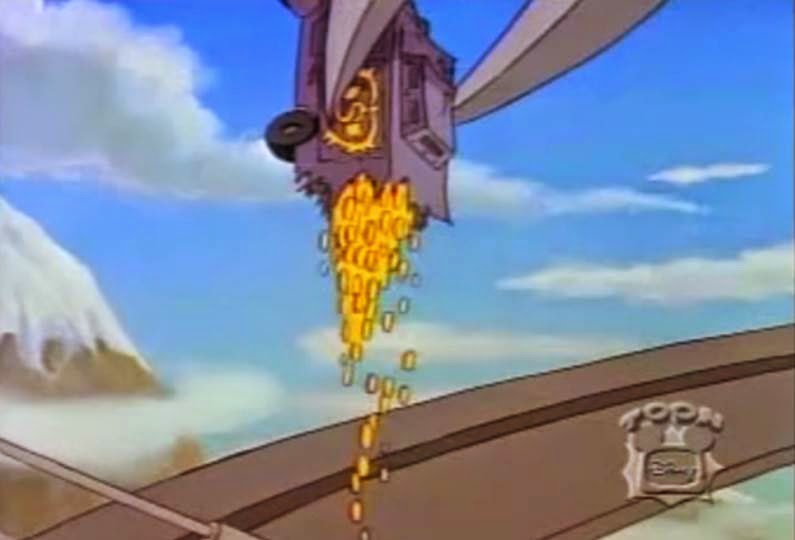
Then, of course, "Gizmomamma" pushes all of the Gizmosuit's buttons (the last time we will see that particular shtick) and destroys the mantis, in perhaps the ultimate display of the adage that "motherhood is all about suffering." In the end, though, you REALLY have to give it up to Scrooge for "getting dangerous," at least where the WDTVA censors are concerned:
Oddly enough, you could argue that Scrooge might have gotten the idea for the fake-gun trick from a notoriously feeble-souled comic-book story published during Western Publishing's terminal decline phase. "The Jack-in-the-Box Plots" (UNCLE $CROOGE #193, February 1982, written by Vic Lockman, art by Pete Alvarado) found The Beagle Boys reduced to intimidating Scrooge into giving up his money by literally pointing fingers at him in unlikely places. At one point, Scrooge moans that he can't tell the world about the Beagles' crimes because he would be too embarrassed to do so, and you can hardly blame him.
The late-episode rush is strong enough to make this episode a good one... but, as should be more than obvious by now, not as good as it could have been with a little additional care and thought. The immediately subsequent "Scrooge's Last Adventure," like "Knew Too Much" and "Ducky Mountain High," will be a similar combination of conceptual gold and tactical dross. Whichever episode contains the highest gold-to-dross ratio... well, that's up to every viewer to decide for himself or herself. Myself, I think that it's a three-way tossup.
.
.
.
"DuckBlurbs"
(GeoX) For this one, the seminal wikipedia article "List of DuckTales Episodes" claims that "Fenton uncovers an international conspiracy to steal Scrooge's gold overseas while supposedly on vacation." I defy you to tell me, based on that description, who is overseas, who is on vacation, and whether or not these two things are one and the same.
Hey, at least the description isn't factually wrong. I wish I could say as much for the "official" DuckTales episode capsules that were published in Gladstone's DUCKTALES title.
(GeoX) The only real weakness is the ending, in which, [with Hutchinson] apparently unable to come up with anything really satisfying in the limited space remaining, Fenton comes down with the illness ("the purple-blotch beak-pox") that he was feigning before.
The ending may have been just a bit rushed, but Fenton did get his just deserts. So there's that.
(GeoX) Fenton and Gandra have separate hotel rooms, I note. Yeah, it's a kids' show, I know, but still…could this have some relationship to the fact that he's so intensely--uncharacteristically, I would have thought--lecherous upon meeting the enemy femme fatale?
See above for my argument as to the possible source of Fenton's sudden bout of "lecherousness." As to Fenton and Gandra's separate rooms... well, there's always the possibility that the two rooms are part of, you know, a duplex...
(Greg) This episode is written by Doug Hutchinson and the story [sic] is done by Ken Koonce and David Weimers.
K&W are the story editors, actually... and here, it's a distinction with a real difference.
(Greg) So Goldfeather sticks the pistol in Fenton's face (WARNING! Toon Disney cut might be commencing here) and Fenton does the Peter Piper tongue twister to confuse her and he tries to bail stage left. But Goldfeather teleports in front of him and sticks the pistol in his face. I'm almost happy if Toon Disney cuts this scene actually. Almost.
It didn't. To review: Waving blunderbusses about to no apparent purpose = OK. Having a character meet a gun beak-to-barrel = No problem-o.
(Greg) So we finally head to the Swizzle Stick Factory of Doom which is on a snowy hill in Swizzleland. And there is a huge door below the mountain by the way which will probably be used by the end of this episode.
Curiously, though it would have seemed natural to have included a shot of the robot mantis walking through the door, we never actually get such a scene. Instead, we see the mantis "emerging" from the shadow of the Swizzle Stick Factory hill and advancing on the surrounding countryside. Apparently we were meant to infer that the creature exited via the door.
(Greg) We see the stamping machine in a far view as Worker Fenton fiddles with swizzle sticks and then in comes a [pig] tour guide with some tourists which includes Gandra Dee who comes in last... The pig fur[r]y (who looks like that furry from somewhere I cannot remember at the moment) wants Worker Fenton to demonstrate since he's behind the control panel now trying to escape.
It's Sevenchins Snootsbury from "The Land of Trala La." Earlier, the Quack Maison waiter from "Down and Out in Duckburg" made an appearance as Scrooge's waiter on the train. And, lest we forget...
Au revoir, Vacation van Honk, we hardly knew ye. (Literally.) And Quax is probably grateful that Gloria Swansong allowed him to go out on his own for once.
(Greg) Fenton whisper yells that he's going to explain why he is here; but grabs Gandra and they run into the storage room with a No Swizzle sign on it. Why is there a sign? I don't know; I don't they will ever explain it.
I think it's meant to be a "Do Not Enter" sign. The interdicted hand appears to be reaching for a door knob.
(Greg) So Fenton dials the phone and we discover that the motel desk man is known as the Italian Sn[o]b (6.5% of the people in Switzerland speak Italian so there better be someone German and Romanian or I am going to be disappointed.) as Fenton informs the guy that he has an important message to Scrooge that the Swizzle Stick Factory is a cover for a plot to steal his gold signed a friend.
The desk clerk isn't "The Italian Snob"; he is referring to the lodge as "Hotel de Snob." (Funny, I thought the place was called "Gducks." Maybe that's the name of the village in which it is located.) And I think you mean Romansh, rather than Romanian.
Next: Episode 95, "Scrooge's Last [sic!] Adventure."
Don't get me wrong... "Knew Too Much," like the other two components of "The Tardy Trio," is centered on a first-rate thematic conceit -- in this case, chivvying a bumbling Fenton through a scenario that wouldn't be out of place in an Alfred Hitchcock movie. Despite the title, the ep probably more closely resembles North by Northwest (1959) than The Man Who Knew Too Much (1956), if only because a good deal of the early action takes place on board a train. However, despite the slinky spy Goldfeather's claim at one point that Fenton "knows too much," one shouldn't push any Hitchcockian analogy too far. In both of the Hitchcock movies, the protagonists are thrust into intrigue through no fault of their own. Fenton, by contrast, sets himself up for trouble by using chicanery (to wit: a phony case of "the dreaded purple-blotch beak pox") to sneak off on his ski vacation. Once the initial dirty deed is done, the plot slips into a more familiar Hitchcockian groove, but, thanks to Fenton's original dishonesty, we have slightly less of an emotional investment in seeing him triumph in the end... at least, until the second half of the episode swings our sympathies in his direction and he receives due punishment for his "original sin" in the end. The universe's balance is thereby restored, though Fenton might not appreciate the fact at the moment.
In three of Fenton's last four appearances of the series (counting "Knew Too Much"), he either doesn't use the Gizmoduck suit at all or has only a tangential relationship with its ultimate use. This strikes me as the DuckTales' writers' tacit admission that, when all is said and done, Fenton is truly more interesting than his Gizmoduck alter ego. (One has to wonder how many more Fenton-only eps we would have gotten had the series extended beyond 100 episodes.) Writer Doug Hutchinson (whose last animated episode of any kind this was, thereby concluding a brief, but highly fruitful, career with WDTVA) certainly takes full advantage of the opportunity; Fenton is in excellent form throughout, spouting quips, donning disguises, and acting the harried victim to a T. The fact that we also get to enjoy Gandra Dee's most multifaceted and enjoyable role (just in time, too; it's also her last) is merely a bonus. Not only that, the episode is surprisingly mature, touching on sexual themes more than any other ep outside the overheated "Metal Attraction," and perhaps deserving some extra credit in that human beings (or the Duckburgian equivalent thereof) are driving the "steamy engine," as opposed to a lecherous, crazed robot. So, there is quite a lot to like here.
Unfortunately, we can't leave things at that...
... because this episode also features some of THE worst transition sequences the series has ever seen. Greg brought a lot of these up in his review, but the "sitch" is, if anything, worse than he describes. Throughout the first act and into the second, we are fed a constant stream of "WTF?? I thought that...??" moments that test, and ultimately break, our patience. At the same time, the episode is acutely aware of itself, sometimes almost to excess, and the constant "nudge-winks" to the audience as we are trying to figure out "how we got from scene A to scene B" ultimately become a bit grating. Thankfully, things get straightened out as Act Two progresses, and we get a thoroughly first-class conclusion in Act Three, but there is no way that we can entirely forget what has gone before. Entertaining, to be sure, but unquestionably frustrating.
I'm not sure whether to blame Hutchinson or story editors Ken Koonce and David Weimers for "making the mess" (green jello and swizzle stick not included) here. Actually, that's not strictly true. Since the final version of the episode is already packed full of incident to begin with, it is possible that Hutchinson originally included even more material, and, when K&W trimmed the ep down to a 22-minute length, they excised scenes that "seemed" unnecessary but actually provided for better transitions. Or, perhaps Hutchinson wrote the script that we saw on TV, and K&W simply didn't bother to ask Hutchinson to tighten those transitions up. (I prefer the former theory, for a reason I'll describe below.) Other theories are possible, but I'm sensing that K&W may have been the ones who really fell down on the job (or into the jello-filled kiddie pool) in this case.
Despite the silliness of the whole Let's Make a Mess scenario, we get an early indication of the "mature matter" to come when the tackily triumphant Fenton "detumesces" in response to a kiss from the gleeful Gandra Dee. The fairly hot "demo-babe" who suggestively swizzles her stick for the camera doesn't detract from the mood, either. I do wonder, though: Since Mrs. Crackshell was watching the broadcast, shouldn't she have heard Fenton ask Gandra to "come ski with me"? Wouldn't that have dissuaded her from automatically assuming that she would be going to Swizzleland with Fenton?
After Scrooge (who swings between grumpiness and cluelessness throughout before one final, glorious moment of redemption) violently rejects Fenton's request for vacation time, Fenton channels... well, Donald, Fred Flintstone, take your pick of any number of sitcom stars... and pulls what Major Courage would term "the old sickness ploy." To his credit, Hutchinson handles the other characters' reactions to Fenton's invalid indisposition well. Mrs. Crackshell warns Fenton of possible consequences (how responsible of her! -- though she will ultimately backslide a bit later in the ep), while Scrooge initially balks before being convinced of Fenton's illness for economic reasons (the possibility that Fenton might infect all of Scrooge's other employees, or at least those at the Money Bin). Nicely played, Mr. Hutchinson...
... alas, now we get:
Bad Transition 1: We jump from the Crackshells' trailer to the airport with NO explanation as to how (a) Fenton convinced his "M'Ma" to stand down; (b) Fenton managed to convince the jealous Gandra Dee that there was no "other woman" involved. Leave aside for the moment the question of why the normally placid Gandra is suddenly so quick to don the green eyeglasses. Presumably, Fenton had to go to or call Gandra just to convince her to get on the plane with him. Here, though, Fenton is proclaiming his love for Gandra as they are sitting down in their seats. Is this supposed to explain why Gandra looks so pissed off? But then, why did she consent to board the plane in the first place?
Scrooge's presence on the plane is the first of many "near misses" that Fenton will have before the two finally meet again at the close of Act Two. This would be more contrived if it weren't quickly made clear that Swizzleland is so tiny (with all the main settings of the drama located so close together) that the two characters NOT crossing paths would be less likely than them actually doing so! Of course, some awkward contrivance will be involved, as well...
Bad Transition 2: We jump from Fenton and Gandra getting ready to take off from Duckburg right to the train station in Swizzleland... or is it ACTUALLY Switzerland?...
... with no intervening scenes. So how did Fenton and Scrooge miss each other during the flight and its aftermath? One of them would have had to have gone to the "little Duck's room" at some point, no? Or go to baggage claim? Or go to currency exchange? Or meet during the trip from the airport to the train station? Or meet after Scrooge saw Gandra at some point? After all, the two have met before, in "Metal Attraction," and Scrooge does know about Fenton and Gandra's relationship.
I'm willing to give Fenton a bit of a pass on making a pass at Goldfeather, because he was hit on the head by some luggage a moment before, and so his brains might still have been a bit croggled. If this is an indication of the hidden depths of Fenton's subconscious mind, though, then perhaps Gandra has a reason for her "jealous-o-meter" to be set at "10". (BTW, Susan Blu's "French" accent for Goldfeather has GOT to be the worst stab [no pun intended] at such an accent that I have EVER heard, even including Ruth Buzzi's horrific performance as Miss Ma'amselle Hepzibah in I Go Pogo: Pogo for President [1980]). I honestly have no idea why Blu was allowed to get away with it. Perhaps they thought they were trying to be funny, or ironic, or something, but it really is a distraction.)
The subsequent near-misses, hesitations, threats, and goof-ups on the train do have a number of bright moments, for example, Fenton pretending to be "suggestive" when he closes the curtains in his and Gandra's compartment, and a curiously dyslexic Scrooge continually misinterpreting the warning notes that a furtive Fenton tries to send him...
... but they also provide us with:
Bad Transition 3: The frantic Fenton hides on a luggage rack in Goldfeather's compartment and then immediately hears and sees her below, talking to Agent X (the swizzle-stick magnate Von Doghousen). Greg pointed out that Goldfeather would have no reason NOT to see Fenton when she went into the compartment. I suppose it's possible that she sat down without noticing that Fenton was in the luggage rack above her, but then, you have to account for the fact that, when the rack breaks, Fenton falls down directly in front of Goldfeather, suggesting that he was on the opposite rack. (Also note that Fenton appears to be looking forward when he listens to Goldfeather's conversation.) Questionable logistics, no matter how you slice things.
Bad Transition 4: Fenton's notorious jump from the foreground of the picture inside the train onto the outside undercarriage of the train. "Kids, don't bother trying this at home -- it can't be done, except by a trained Toon professional!"
This is a LOT of oversights to forgive. It's fine for an episode to have (in GeoX's terms) a "manic" pace, but there's "manic," and then there's just plain SLOPPY. Unfortunately, we're not quite done yet:
Bad Transition 6: Fenton knows enough (and why not -- he already supposedly knows "too much"?) to go to the Whizzle Swizzle Stick Factory to intercept Goldfeather and Von Doghousen, despite the fact that neither Goldfeather nor Von Doghousen ever mentioned the factory during their conversation on the train. Nor does Goldfeather mention it when she asks the desk clerk for a taxi to go to "ze very important meet-ING." This is the best evidence of all that some material had to have been cut or removed from the initial script. It strikes me as highly unlikely that Hutchinson would have completely neglected such an important plot point. Scrooge just happening to own the factory -- and, rather improbably, taking time out from supervising his gold shipment to do "surprise inspections" of "all [his] Swiz properties" -- is a mere "hop of logic" compared to this mighty leap across a canyon of unexplained deduction.
Thankfully, once we hit the factory, the episode FINALLY finds its webs and proceeds to deliver the intrigue and excitement we have been hoping for. Fenton gets a chance to strut his stuff in several on-the-spot disguises and manages to remain undetected until the unfortunate incident with the sloppily slipshod swizzle-stick stomper. (I'd ask you to "say that three times fast," but that joke, which isn't all that funny to begin with, is all but used to death during this sequence. The earlier self-referential moments -- the real-life "idea bulb"; "Don't try this at home"; Fenton's warning to the audience that he does, too, have wits; the Alan Oppenheimer-voiced Von Doghousen dissing the code word "Oppenheimer" -- were cute, fairly clever, and generally isolated; here, the ep tries too hard to punch a gag over, in a textbook example of unnecessary "jackhammering.")
Once Fenton manages to explain things to Gandra, the pair turn out to make a pretty good team, so much so that I'd like to have seen them have at least one additional dual starring role before the series closed up shop. Gandra gets most of the priceless moments; even her momentary lapse into inappropriate Spanish is made up for by the quick recovery into French. Then, of course, she gets to show those hard-won "night school" skills by manipulating the giant robot mantis with ease. Her ultimate ejection certainly isn't her fault, due to Goldfeather's possession of the remote control. Gandra probably had as many "hidden talents" as Mrs. Beakley; too bad we never got to see more of them.
With the late-arriving Scrooge now a part of the good guys' team -- and "Gizmomamma" finally making up for her previous lack of attention to the ringing phone by bringing the Gizmosuit on-site -- Act Three whizzes by in a riot of laughs and generally impressive action, some of which is legitimately perilous. The robot mantis legitimately does seem unstoppable as it "taps" the gold out of Scrooge's gold trucks...
... and Fenton earns some "gonad points" for daring to use the telephone workers' equipment to attempt to electrocute the mantis, putting himself in quite a bit of danger in the process.
Then, of course, "Gizmomamma" pushes all of the Gizmosuit's buttons (the last time we will see that particular shtick) and destroys the mantis, in perhaps the ultimate display of the adage that "motherhood is all about suffering." In the end, though, you REALLY have to give it up to Scrooge for "getting dangerous," at least where the WDTVA censors are concerned:
Oddly enough, you could argue that Scrooge might have gotten the idea for the fake-gun trick from a notoriously feeble-souled comic-book story published during Western Publishing's terminal decline phase. "The Jack-in-the-Box Plots" (UNCLE $CROOGE #193, February 1982, written by Vic Lockman, art by Pete Alvarado) found The Beagle Boys reduced to intimidating Scrooge into giving up his money by literally pointing fingers at him in unlikely places. At one point, Scrooge moans that he can't tell the world about the Beagles' crimes because he would be too embarrassed to do so, and you can hardly blame him.
The late-episode rush is strong enough to make this episode a good one... but, as should be more than obvious by now, not as good as it could have been with a little additional care and thought. The immediately subsequent "Scrooge's Last Adventure," like "Knew Too Much" and "Ducky Mountain High," will be a similar combination of conceptual gold and tactical dross. Whichever episode contains the highest gold-to-dross ratio... well, that's up to every viewer to decide for himself or herself. Myself, I think that it's a three-way tossup.
.
.
.
"DuckBlurbs"
(GeoX) For this one, the seminal wikipedia article "List of DuckTales Episodes" claims that "Fenton uncovers an international conspiracy to steal Scrooge's gold overseas while supposedly on vacation." I defy you to tell me, based on that description, who is overseas, who is on vacation, and whether or not these two things are one and the same.
Hey, at least the description isn't factually wrong. I wish I could say as much for the "official" DuckTales episode capsules that were published in Gladstone's DUCKTALES title.
(GeoX) The only real weakness is the ending, in which, [with Hutchinson] apparently unable to come up with anything really satisfying in the limited space remaining, Fenton comes down with the illness ("the purple-blotch beak-pox") that he was feigning before.
The ending may have been just a bit rushed, but Fenton did get his just deserts. So there's that.
(GeoX) Fenton and Gandra have separate hotel rooms, I note. Yeah, it's a kids' show, I know, but still…could this have some relationship to the fact that he's so intensely--uncharacteristically, I would have thought--lecherous upon meeting the enemy femme fatale?
See above for my argument as to the possible source of Fenton's sudden bout of "lecherousness." As to Fenton and Gandra's separate rooms... well, there's always the possibility that the two rooms are part of, you know, a duplex...
(Greg) This episode is written by Doug Hutchinson and the story [sic] is done by Ken Koonce and David Weimers.
K&W are the story editors, actually... and here, it's a distinction with a real difference.
(Greg) So Goldfeather sticks the pistol in Fenton's face (WARNING! Toon Disney cut might be commencing here) and Fenton does the Peter Piper tongue twister to confuse her and he tries to bail stage left. But Goldfeather teleports in front of him and sticks the pistol in his face. I'm almost happy if Toon Disney cuts this scene actually. Almost.
It didn't. To review: Waving blunderbusses about to no apparent purpose = OK. Having a character meet a gun beak-to-barrel = No problem-o.
(Greg) So we finally head to the Swizzle Stick Factory of Doom which is on a snowy hill in Swizzleland. And there is a huge door below the mountain by the way which will probably be used by the end of this episode.
Curiously, though it would have seemed natural to have included a shot of the robot mantis walking through the door, we never actually get such a scene. Instead, we see the mantis "emerging" from the shadow of the Swizzle Stick Factory hill and advancing on the surrounding countryside. Apparently we were meant to infer that the creature exited via the door.
(Greg) We see the stamping machine in a far view as Worker Fenton fiddles with swizzle sticks and then in comes a [pig] tour guide with some tourists which includes Gandra Dee who comes in last... The pig fur[r]y (who looks like that furry from somewhere I cannot remember at the moment) wants Worker Fenton to demonstrate since he's behind the control panel now trying to escape.
It's Sevenchins Snootsbury from "The Land of Trala La." Earlier, the Quack Maison waiter from "Down and Out in Duckburg" made an appearance as Scrooge's waiter on the train. And, lest we forget...
Au revoir, Vacation van Honk, we hardly knew ye. (Literally.) And Quax is probably grateful that Gloria Swansong allowed him to go out on his own for once.
(Greg) Fenton whisper yells that he's going to explain why he is here; but grabs Gandra and they run into the storage room with a No Swizzle sign on it. Why is there a sign? I don't know; I don't they will ever explain it.
I think it's meant to be a "Do Not Enter" sign. The interdicted hand appears to be reaching for a door knob.
(Greg) So Fenton dials the phone and we discover that the motel desk man is known as the Italian Sn[o]b (6.5% of the people in Switzerland speak Italian so there better be someone German and Romanian or I am going to be disappointed.) as Fenton informs the guy that he has an important message to Scrooge that the Swizzle Stick Factory is a cover for a plot to steal his gold signed a friend.
The desk clerk isn't "The Italian Snob"; he is referring to the lodge as "Hotel de Snob." (Funny, I thought the place was called "Gducks." Maybe that's the name of the village in which it is located.) And I think you mean Romansh, rather than Romanian.
Next: Episode 95, "Scrooge's Last [sic!] Adventure."
Tuesday, February 11, 2014
Mid-winter Clearance
We're presently hunkering down for another wintry blast, but a few interesting items have beaten the rush and blown into my figurative in-box:
(1) Disney is apparently developing a Chip and Dale's Rescue Rangers CGI/live-action movie. I'm not sure whether to cheer or weep. IF the development team is smart enough to bring a Ranger-knowledgeable writer aboard -- someone who knows the types of stories that this series was able to tell effectively -- and IF they resist the all-too-obvious temptation to lard this puppy up with annoying pop-culture references and gross jokes, then we might have something worthwhile here. I do think, however, that Disney should reconsider the decision to place the CGI Rangers in a "real" human world. When the animated series tried to depict humans in a quasi-realistic manner -- the humans in "Flash the Wonder Dog" are a good example -- the results were less than optimal. The series fared better when the humans were designed in a slightly exaggerated fashion. Putting the Rangers in a starkly realistic world would be like remaking Bolt but only animating the animal characters. Stylization is visually appealing for a reason.
A lot of good could come from this project -- the reunion of the original voice actors, the completion of the Rescue Rangers (and other Disney Afternoon) DVD releases -- but the Disney of 2014 is a very different animal (pun very much intended) than the Disney of 1989. So I'll give this news an "amber," as in "proceed with caution."
(2) Disney Afternoon book project in the works? Well, I'm intrigued enough to at least try to contact the guy and find out what sorts of information would be of use to him.
(3) Last weekend's My Little Pony episode, "Simple Ways," was... well, beyond belief. It seemed to split Bronydom bang down the middle, with people either loving it or hating it. I fell on the "love" side of the fence for two major reasons: it co-starred Rarity -- and not just Rarity, but a Rarity the likes of which we've never seen before -- and it bore a positively numbing resemblance to a rather notorious DuckTales episode.
** SPOILERS **
True to her persona as a romanticist and all-around enthusiast, Rarity has a from-afar crush on Trenderhoof, a pony "travel writer" who's coming to Ponyville to cover the Ponyville Days festival, which our fave fashionista just happens to be organizing. Trend, however, blows right past Rarity's attempts to impress him and falls hard for the hard-working, "authentic" Earth pony Applejack. Rarity ultimately decides that she needs to fight "fahr" with "fahr" and... well, goes "full hillbilly" on us. Not to be outdone, Applejack decides to ape Rarity's normal concern with all things fashionable. The results are side-splitting.
Another reason why, as much as I love POGO's Miss Ma'amselle Hepzibah, Rarity has become my favorite female Toon: she can be "funnayyy" in a way that Hepzibah never could be.
Anyway, you can probably guess what I started to think of when Tabitha St. Germain began doing that... whatEVER the heck it was. In case you didn't, here are a few more hints, centering on the way "Simple Ways" could have gone (but thankfully did not).
(1) Disney is apparently developing a Chip and Dale's Rescue Rangers CGI/live-action movie. I'm not sure whether to cheer or weep. IF the development team is smart enough to bring a Ranger-knowledgeable writer aboard -- someone who knows the types of stories that this series was able to tell effectively -- and IF they resist the all-too-obvious temptation to lard this puppy up with annoying pop-culture references and gross jokes, then we might have something worthwhile here. I do think, however, that Disney should reconsider the decision to place the CGI Rangers in a "real" human world. When the animated series tried to depict humans in a quasi-realistic manner -- the humans in "Flash the Wonder Dog" are a good example -- the results were less than optimal. The series fared better when the humans were designed in a slightly exaggerated fashion. Putting the Rangers in a starkly realistic world would be like remaking Bolt but only animating the animal characters. Stylization is visually appealing for a reason.
A lot of good could come from this project -- the reunion of the original voice actors, the completion of the Rescue Rangers (and other Disney Afternoon) DVD releases -- but the Disney of 2014 is a very different animal (pun very much intended) than the Disney of 1989. So I'll give this news an "amber," as in "proceed with caution."
(2) Disney Afternoon book project in the works? Well, I'm intrigued enough to at least try to contact the guy and find out what sorts of information would be of use to him.
(3) Last weekend's My Little Pony episode, "Simple Ways," was... well, beyond belief. It seemed to split Bronydom bang down the middle, with people either loving it or hating it. I fell on the "love" side of the fence for two major reasons: it co-starred Rarity -- and not just Rarity, but a Rarity the likes of which we've never seen before -- and it bore a positively numbing resemblance to a rather notorious DuckTales episode.
** SPOILERS **
True to her persona as a romanticist and all-around enthusiast, Rarity has a from-afar crush on Trenderhoof, a pony "travel writer" who's coming to Ponyville to cover the Ponyville Days festival, which our fave fashionista just happens to be organizing. Trend, however, blows right past Rarity's attempts to impress him and falls hard for the hard-working, "authentic" Earth pony Applejack. Rarity ultimately decides that she needs to fight "fahr" with "fahr" and... well, goes "full hillbilly" on us. Not to be outdone, Applejack decides to ape Rarity's normal concern with all things fashionable. The results are side-splitting.
Another reason why, as much as I love POGO's Miss Ma'amselle Hepzibah, Rarity has become my favorite female Toon: she can be "funnayyy" in a way that Hepzibah never could be.
Anyway, you can probably guess what I started to think of when Tabitha St. Germain began doing that... whatEVER the heck it was. In case you didn't, here are a few more hints, centering on the way "Simple Ways" could have gone (but thankfully did not).
Applejack: Then it's agreed. I bet Sweet Apple Acres against your boutique in a contest to see who's the better farm pony. 'Less'n you're... chicken!
Rarity (as hillbilly): NevAIR! Ya got yerself a DAYEAL! A farm pony contest it AYAIS!
Applejack wins the plowing contest...
... and the apple-bucking contest.
Rarity's final fate in the contest.
Applejack: Too bad but you lost, city slicker unicorn Rarity! I now own your whole boutique, and you don't even have a home in Ponyville!
Rarity (back to normal): Great Celestia! Now I'm in a real mess. But before I try to get my boutique back, I'd better see if I can find my missing dresses!
Applejack: I decided to give y'all back your boutique. Y'all proved yourself to be a true farm pony. Besides which... I cain't sew.
At least "Simple Ways" turned out to be more satisfying than... well... that other thing.
Labels:
Animation,
Books,
Disney Afternoon,
DuckTales,
MLP:FIM,
Movies,
Pogo,
Rescue Rangers
Subscribe to:
Posts (Atom)


