FRIENDS FOREVER gets back on the beam with issue #11, doing what I always hope that this title will do... namely, use a limited cast of MLP characters to allow for a focus on certain aspects of a character that have never been examined, or perhaps even clearly defined, before. The task is trickier here than it might appear at first glance, certainly more so than when Katie Cook and Andy Price cast the hitherto characterization-challenged Princess Cadance and Prince Shining Armor as refugees from a John Hughes movie. Spitfire, the Captain of the Wonderbolts and thus something of an "aspirational peer" for the gung-ho Rainbow Dash, has a problem opposite to that of the Princess and her hubby; she has literally gotten a different characterization every time she has appeared on the show, and most of those did not exactly put her in the best of lights. Somehow, writer Ted Anderson manages to cut through the muck and give us a new take on the character that feels believable and does not entirely abandon what has gone before. It helps that Rainbow Dash, whose various foibles have been the subject of televised dissection more than once, gets one of her best "supportive adult" moments in any medium here.
** SPOILERS **
Think I'm kidding re: Spitfire? Glad-hoofing celebrity and partygoer ("The Best Night Ever"), bumbling co-conspirator in a surprisingly incompetent group of supposedly heroic pegasi ("Sonic Rainboom" and "Secret of My Excess"), bland sideline-watching executive ("Hurricane Fluttershy"), hardass drill instructor ("Wonderbolts Academy"), conniving bitch and colleague-betrayer ("Rainbow Falls")... Baskin-Robbins would be hard put to top the variety in that list. My hopes here were that Anderson would (1) not add to the damage caused by the character derailment in "Rainbow Falls," (2) bring Spitfire back to something resembling the "authority figure" setting of "Wonderbolts Academy," where I think she works the best, and (3) give her some relatable foibles without making her an overt figure of fun. All three missions accomplished!
Spitfire invites Dash to be an instructor at a "Junior Flyers Summer Camp" because... she simply isn't good at dealing with kids (beg pardon, fillies and foals). It seems that she doesn't know how to temper down her "mean" behavior as a Wonderbolt D.I. (I'd call it "demanding" rather than outright "mean," but potato, potahto...) and thus lets the littl'uns walk all over her. Dash suggests being "tougher" with the kids, but Spitfire promptly overdoes it, treating them just like adult recruits. Spitfire, however, does have a legitimate, inherent ability to motivate others -- though, as we are told in a flashback, it took a while for her to assert herself when she was a new recruit -- and Dash cunningly gives Spitfire a chance to literally show the little(r) ponies how it's done by whipping up a tornado for the Wonderbolt Captain to disperse before their eyes. (The meteorological danger is perhaps a bit extreme for the purpose, but, then again, this is Rainbow Dash we're talking about.) The "practical lessons" finally take, and Dash reminds Spitfire that the latter can always get better at working with kids by herself, yet still ask for a helping hoof when needed.
The plot is handled spot-on perfect. We get a look at what makes Spitfire the entire character, as opposed to Spitfire the icon/buffoon/meanie/bitch, tick. Anyone who has ever had to wield authority that they have earned, as opposed to authority that they have been awarded, will be able to both understand Spitfire's pride in her capabilities and recognize that any leader must be willing to keep learning, just as Spitfire does here. And all credit to Dash for being so understanding, thoughtful, and (what else?) friendly while playing a lower-key role than the "cheekily bombastic" one at which she normally excels.
The plot is strong enough by itself, but the artwork, by a newcomer named Jay P. Fosgitt (henceforth to be referred to "Fearless" for blog-obvious reasons), is really something special. It is at utter variance with any visual depictions of the MLP:FIM characters that we have been given in any of IDW's MLP titles, or on the TV show, for that matter: cartoonier, sweeter, softer-edged. I would even go so far as to call it "POGO-esque," but that may be setting the bar just a tad high, and, in any event, Fosgitt uses more exaggerated facial expressions and poses than Walt Kelly ever did. Having seen a preview page or two, I wasn't sure how this style was going to wear in a book-length tale, but it didn't take long for Fosgitt to win me over. It helped that the story, with its mix of slapstick, reminiscence, and sentiment, seemed to be complemented quite well by Fosgitt's approach. I don't think that the somewhat stiffer "official" visual versions of the characters would have carried the plot off with such panache.
You can get an idea of the amount of "cartoonification" involved here by looking at the cover at the top of this blog entry and comparing it to the Fosgitt cover. I hope we see more of Fosgitt in the future; I would be particularly intrigued to see how he would handle a more "action/adventure"-oriented story.
This title continues to mix gems with relative clinkers. Perhaps I should do some research and try to come up with a numerically-based reason for the inconsistency... you know, like the thing about "original Star Trek movies" only being good if they're even-numbered.
Comics, book, and DVD reviews (and occasional eruptions of other kinds)
Showing posts with label Li'l Abner. Show all posts
Monday, November 17, 2014
Saturday, August 10, 2013
Book Review: THE COMPLETE LITTLE ORPHAN ANNIE, VOL. 9: 1940-41 by Harold Gray (IDW/Library of American Comics, 2013)
As was the case with the latest DICK TRACY volume, unwelcome signs of editorial corner-cutting can be seen in the ninth ORPHAN ANNIE collection. Jeet Heer's introductory essay is the only substantial "extra" we get here, apart from a couple of Al Capp parody strips on the inside back cover. More significantly, the "My Most Recent Adventures" feature has been eliminated. Given the meticulousness with which Harold Gray typically crafted his continuities, this represents a major omission. It took me a short while before I could get back up to speed with the ongoing "Nick Gatt/Axel" story. IDW really ought to consider restoring the "Last time..." features in future ANNIE and TRACY collections.
* SPOILERS *
Gray seems to be repeating himself just a tad as the 1940s begin and the world lurches into war. Our "bullseye boy" for this volume's cover, the arrogant bandleader and movie star Pete La Plata (nee Bill Slagg), undergoes a thorough rehabilitation, just as Rose Chance's estranged husband Ace did during the "Shanghai Peg" storyline. There is a moral catch, however; the change takes place as the result of a brain operation that clears up the aftereffects of a long-ago injury. Therefore, Slagg's redemption cannot be considered to be a change of character so much as a change of a physical affliction affecting character. In much the same manner, the surprisingly likable gangster Nick Gatt does good "by accident" when he determines to smash Axel's band of would-be revolutionaries. Given that Gray generally takes a rather dim view of what one might call "professional" do-gooders, his inclusion of "goodness by stealth or accident" in the Gatt/Axel tale reflects a much more nuanced vision of good and evil than he is typically given credit for. Matters moral are further muddled by Gray's introduction of the character of Sam the pants-presser, who is pretty clearly meant to be a Jewish refugee from Hitler's Europe -- and, Jeet Heer convincingly argues, is treated as something of a Christ-figure. Sam even "sacrifices himself" by going back to Europe at the end of the Gatt/Axel story, presumably to help his people. Given Gray's somewhat unorthodox religious views -- Heer describes him as a "deist" who was strongly affected by his membership in the Masonic order -- I probably shouldn't be surprised that his handling of moral issues here takes so many different forms.
I'd rate Nick Gatt as one of the most memorable figures in comic-strip history. Significantly, Gray can't bear to show his eventual death on screen; his death during a gunfight with the police and would-be mob usurper Byron Bolo (who, ironically, is hailed as just the man to clean up the crooked Gatt operation by the usual "do-gooder" suspects) takes place between the end of a Sunday strip and the beginning of the following Monday strip. Gray depicts numerous deaths and "disappearances" in this volume, so his decision not to show how Gatt died speaks volumes about his undeniable feelings for the character.
"Daddy" Warbucks returns from a tortuous stay in a foreign concentration camp (run by either the Germans or the Soviets -- at this time, remember, they were in cahoots) and immediately lives (back) up to his name by devoting his factories to military production in the name of "preparedness." In doing this, Gray was obviously flying in the face of the isolationist sentiments trumpeted by his flagship paper, the CHICAGO TRIBUNE, but he also tweaked the New Dealers by having Warbucks ostentatiously refuse to profit from his work. Warbucks must dodge several attempts at industrial sabotage, including one engineered by the bitter Pete La Plata, who nearly gets himself and "Daddy" killed before finally coming right, thanks to the wonders of medical science. With remarkable speed, Warbucks proceeds to make the rechristened Bill Slagg his right-hand man. The volume closes with another rerun of sorts, this one of the "I'm trapped and I can't get out" variety, as Warbucks, Annie, and Punjab (disguised as an Indian guide) investigate strange goings-on at a Warbucks mine, only to be imprisoned in the mine's depths -- a scenario very similar to one seen early in the "Axel" story. Gray's "Injuns" mimic most of his "ethnic" characters in that they are presented in a stereotyped manner (1941 natives with medicine men, tepees, the whole bit), yet are characterized with respect. At one point, Warbucks comments that Indians, unlike white men, are almost always trustworthy. If this is "condescension to the savages," then, by all means, let's have more of it.
There are surprisingly few direct references to the war in this collection, but that will change soon as Annie becomes involved with the Junior Woodchucks, er, Commandos. (I wonder whether Carl Barks' choice of a name for the Nephews' scouting organization was affected by Gray in some manner.) The strip remains a bulwark of solid storytelling and is well worth diving into even if you haven't sampled any of the earlier volumes.
* SPOILERS *
Gray seems to be repeating himself just a tad as the 1940s begin and the world lurches into war. Our "bullseye boy" for this volume's cover, the arrogant bandleader and movie star Pete La Plata (nee Bill Slagg), undergoes a thorough rehabilitation, just as Rose Chance's estranged husband Ace did during the "Shanghai Peg" storyline. There is a moral catch, however; the change takes place as the result of a brain operation that clears up the aftereffects of a long-ago injury. Therefore, Slagg's redemption cannot be considered to be a change of character so much as a change of a physical affliction affecting character. In much the same manner, the surprisingly likable gangster Nick Gatt does good "by accident" when he determines to smash Axel's band of would-be revolutionaries. Given that Gray generally takes a rather dim view of what one might call "professional" do-gooders, his inclusion of "goodness by stealth or accident" in the Gatt/Axel tale reflects a much more nuanced vision of good and evil than he is typically given credit for. Matters moral are further muddled by Gray's introduction of the character of Sam the pants-presser, who is pretty clearly meant to be a Jewish refugee from Hitler's Europe -- and, Jeet Heer convincingly argues, is treated as something of a Christ-figure. Sam even "sacrifices himself" by going back to Europe at the end of the Gatt/Axel story, presumably to help his people. Given Gray's somewhat unorthodox religious views -- Heer describes him as a "deist" who was strongly affected by his membership in the Masonic order -- I probably shouldn't be surprised that his handling of moral issues here takes so many different forms.
I'd rate Nick Gatt as one of the most memorable figures in comic-strip history. Significantly, Gray can't bear to show his eventual death on screen; his death during a gunfight with the police and would-be mob usurper Byron Bolo (who, ironically, is hailed as just the man to clean up the crooked Gatt operation by the usual "do-gooder" suspects) takes place between the end of a Sunday strip and the beginning of the following Monday strip. Gray depicts numerous deaths and "disappearances" in this volume, so his decision not to show how Gatt died speaks volumes about his undeniable feelings for the character.
"Daddy" Warbucks returns from a tortuous stay in a foreign concentration camp (run by either the Germans or the Soviets -- at this time, remember, they were in cahoots) and immediately lives (back) up to his name by devoting his factories to military production in the name of "preparedness." In doing this, Gray was obviously flying in the face of the isolationist sentiments trumpeted by his flagship paper, the CHICAGO TRIBUNE, but he also tweaked the New Dealers by having Warbucks ostentatiously refuse to profit from his work. Warbucks must dodge several attempts at industrial sabotage, including one engineered by the bitter Pete La Plata, who nearly gets himself and "Daddy" killed before finally coming right, thanks to the wonders of medical science. With remarkable speed, Warbucks proceeds to make the rechristened Bill Slagg his right-hand man. The volume closes with another rerun of sorts, this one of the "I'm trapped and I can't get out" variety, as Warbucks, Annie, and Punjab (disguised as an Indian guide) investigate strange goings-on at a Warbucks mine, only to be imprisoned in the mine's depths -- a scenario very similar to one seen early in the "Axel" story. Gray's "Injuns" mimic most of his "ethnic" characters in that they are presented in a stereotyped manner (1941 natives with medicine men, tepees, the whole bit), yet are characterized with respect. At one point, Warbucks comments that Indians, unlike white men, are almost always trustworthy. If this is "condescension to the savages," then, by all means, let's have more of it.
There are surprisingly few direct references to the war in this collection, but that will change soon as Annie becomes involved with the Junior Woodchucks, er, Commandos. (I wonder whether Carl Barks' choice of a name for the Nephews' scouting organization was affected by Gray in some manner.) The strip remains a bulwark of solid storytelling and is well worth diving into even if you haven't sampled any of the earlier volumes.
Thursday, August 8, 2013
DUCKTALES RETROSPECTIVE: Episode 47, "Down and Out in Duckburg"
I've been given the medical "green light" to resume normal blogging activities -- and, like the old swamp dweller in "Sweet Duck of Youth," I've got a lot of catching up to do. Unlike him, I'm not planning on delaying a reentry into the worldly fray by taking a trip to Tahiti. It will, however, take a while to clean up all those loose ends, so please be patient with me.
It's crystal clear now that my stated ambition to get through season one of DuckTales by the end of the Summer was laughably overoptimistic. My new goal is to finish the initial set of 65 eps by the end of the Fall semester. This estimate is based on my maintaining a one-ep-per-week posting schedule once school begins in the last week of August, which I should be able to do. I've already written my infamous "notes" and clipped the images for the two episodes immediately following "Down and Out in Duckburg," so I should be able to pop those out in short order before the "time-vise" really begins to bite down on me.
While I certainly respect Greg's stated desire to interpret DuckTales' Carl Barks adaptations independent of any acquaintance with the original stories, "Down and Out" is arguably the textbook case of how familiarity with a Barks tale -- in this case, the early $CROOGE adventure "Trouble from Long Ago," more popularly known as "The Horseradish Story" -- is absolutely ESSENTIAL in order to fairly assess the TV version of the story. Ken Koonce and David Weimers turn what was, in its original incarnation, a pretty straightforward "race against time" story into an unwieldy combination of a now-dated media parody and a none-too-subtle morality play in which a hard-hearted Scrooge is pauperized and made to learn the meaning of the "Golden Rule." This might have played better had it been produced during the Obama era, in which the mere possession of wealth is all too often taken as prima facie evidence of questionable character. In light of the manner in which Scrooge's character had been developed during the course of the series, though, it seemed at the time like a tremendous step backwards into the mindset of far inferior "moralizing" cartoons of the 80s.
Taking the ep at face value, Greg described it as "awesome and depressing at the same time." The thing is, even if one is not familiar with "Trouble from Long Ago," the K&W version of the story has more than enough of its own share of problems. Logical lapses and inappropriate slapstick abound, and even the draftsmanship lets the ep down in several instances. Most frustrating of all is the fact that "Trouble from Long Ago" presented Scrooge with a real "moral dilemma" that was far more believable than any of the chump-change-chiseling in which he indulged on screen. Had K&W showed more faith in the simple power of the Barks narrative, they could have had their "moral moment" and some legitimately exciting undersea action as well. It was all right there, laid out for them in the persistently perused pages of UNCLE $CROOGE McDUCK: HIS LIFE AND TIMES. Given such a beautiful canvas to copy, why settle for primary colors and finger-painting?
K&W's opening gambit of Scrooge sowing discontent and confusion amongst a trio of "regular Duckburgian folks" immediately brings to mind the opening scenes of "Don't Give Up the Ship." The Scrooge featured at the start of "Treasure of the Golden Suns" was purportedly an isolated, grumpy guy who hadn't yet softened up and returned to an "active lifestyle" with the Nephews. I'd argue, though, that the supposedly more "civilized" Scrooge who raises Mr. O'Flannel's rent, avoids giving boat-repair money to Captain Jack, and dodges donating to Salvation Mary comes across as a far more questionable, if not downright sinister, character. These three one-shot characters were obviously created to put a "human face" on the monetary misery that Scrooge causes others (never mind that the "real" Scrooge would probably have dealt with these folks through intermediaries), and the twisted logic that Scrooge employs during these confrontations (especially the one with Jack) winds up seeming more like a personal insult than the standard "sorry, it's just business" behavior in which you might expect a mogul to indulge.
Just so we fully realize how eminently despicable Scrooge is supposed to be here, we soon learn that Scrooge's favorite TV show is... Lifestyles of the Filthy Rich. Moreover, Scrooge is going to be a special guest on an upcoming episode. This is highly problematic, to say the least. If anything, Scrooge has traditionally resented any prying into his personal life; in Barks' "North of the Yukon," to take just one example, he had to be arm-twisted into giving an interview and his picture to a magazine (and was subsequently proven prescient when the unwanted media exposure caused him some major difficulties). Nor has Scrooge ever expressed any interest in how any other rich person lives, except insofar as it directly infringes upon his personal space and/or property values (e.g., his resentment of the lottery-winning Blurfs' nouveau riche crudeness in "Bubbeo and Juliet"). K&W must have found the temptation to satirize Lifestyles of the Rich and Famous (and, by extension, the self-indulgence of the boom-time 80s) too much to resist. Never mind that the Scrooge I know and love would probably have run screaming from any intrusion by anyone remotely resembling "Robin Lurch."
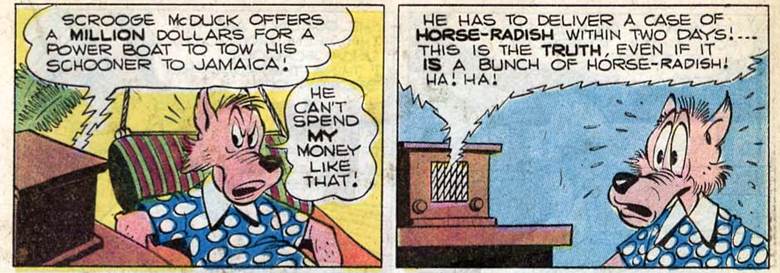
The substitution of the free-spending Fritter O'Way for Barks' Chisel McSue is, of course, another sledgehammer blow to our collective moral sense (Hey, this guy is the exact opposite of the chintzy-cheap Scrooge! How ironic is it that HE'S claiming Scrooge's fortune??). While K&W at least try to give Barks his due by basing Fritter's claim on Scrooge's riches on a long-ago delivery disaster, they don't seem to realize that their version of the story's antagonist makes far less logical sense. Because of the stipulation (not used by K&W) that McSue can't take possession of Scrooge's money for 30 days -- strangely enough, McSue's ancestor also seems to forget about this, demanding the unfortunate Seafoam McDuck's gold teeth immediately after the sinking of the Golden Goose -- McSue has a vested interest in Scrooge not spending any money in the interim. This is most clearly seen when McSue learns of Scrooge's attempt to salvage the horseradish:
By contrast, with Fritter gleefully spending money right and left as Scrooge festers in his "palatial underpass" and later goes on a desperate search for the marbles, it is clear that Scrooge is going to take a major financial hit even if he does manage to deliver the lost cargo. Why, he might even cede the title of "world's richest duck" to Glomgold as a consequence. The later "Yuppy Ducks" got slammed big-time for the whole idea of HD&L's deals getting cancelled and Scrooge not losing a penny of his fortune as a result. It seems to me that "Down and Out" is equally vulnerable to criticism for failing to follow through on the consequences of Fritter's many (supposedly) legitimate deals.
I still have no clue as to why K&W saw fit to change the shipment of horseradish to a barrel of marbles. Were they afraid that viewers wouldn't know what horseradish is? (Talk about showing contempt for your audience...) Did they want the freedom to employ the tiresome "He's lost his marbles!" pun at any time they chose? My guess is that, during their radical simplification (and that's a kind way of putting it) of the original salvage sequence, in which the "power" of horseradish played a key role in helping the Ducks locate the Golden Goose, K&W realized that they simply didn't need such a "complicated" McGuffin and jettisoned it. Besides, shortening the salvage action would free up more time for the middle-game parody of Lifestyles of the Rich and Famous around which the entire adaptation was presumably built.
(Greg) He is Fritter O'Way who is voiced by Aron Kincaid (according to the USIMDB; so take that one with a grain of salt) who started on the television show This Is The Life in 1952; then Fall of Nineveh (which he wrote, directed and produced along with acted in it!), and as a beekeeper in The Wasp Woman. He went on to do mostly movies such as Spartacus, The Girls On The Beach, Ski Party, Beach Ball, Dr. Goldfoot & The Bikini Machine, The Ghost In The Invisible Bikini, The Secret Sharer, The Happiest Millionaire, and the New Wife. He didn't land much in terms of roles on television until he got into animation as The Iron Sheik in Rock'N'Wrestling in 1985. He then became Sky Lynx in Transformers and Killer Croc in Batman: The Animated Series.
Maybe Fritter should have thrown a big rock at Scrooge. :-) Kincaid passed away in 2011, BTW. I recall having all sorts of trouble matching names and voices in this episode for much the same reason that I had trouble in "Sphinx for the Memories." All those one-shotters.
Next: Episode 48, "The Right Duck."
It's crystal clear now that my stated ambition to get through season one of DuckTales by the end of the Summer was laughably overoptimistic. My new goal is to finish the initial set of 65 eps by the end of the Fall semester. This estimate is based on my maintaining a one-ep-per-week posting schedule once school begins in the last week of August, which I should be able to do. I've already written my infamous "notes" and clipped the images for the two episodes immediately following "Down and Out in Duckburg," so I should be able to pop those out in short order before the "time-vise" really begins to bite down on me.
While I certainly respect Greg's stated desire to interpret DuckTales' Carl Barks adaptations independent of any acquaintance with the original stories, "Down and Out" is arguably the textbook case of how familiarity with a Barks tale -- in this case, the early $CROOGE adventure "Trouble from Long Ago," more popularly known as "The Horseradish Story" -- is absolutely ESSENTIAL in order to fairly assess the TV version of the story. Ken Koonce and David Weimers turn what was, in its original incarnation, a pretty straightforward "race against time" story into an unwieldy combination of a now-dated media parody and a none-too-subtle morality play in which a hard-hearted Scrooge is pauperized and made to learn the meaning of the "Golden Rule." This might have played better had it been produced during the Obama era, in which the mere possession of wealth is all too often taken as prima facie evidence of questionable character. In light of the manner in which Scrooge's character had been developed during the course of the series, though, it seemed at the time like a tremendous step backwards into the mindset of far inferior "moralizing" cartoons of the 80s.
Taking the ep at face value, Greg described it as "awesome and depressing at the same time." The thing is, even if one is not familiar with "Trouble from Long Ago," the K&W version of the story has more than enough of its own share of problems. Logical lapses and inappropriate slapstick abound, and even the draftsmanship lets the ep down in several instances. Most frustrating of all is the fact that "Trouble from Long Ago" presented Scrooge with a real "moral dilemma" that was far more believable than any of the chump-change-chiseling in which he indulged on screen. Had K&W showed more faith in the simple power of the Barks narrative, they could have had their "moral moment" and some legitimately exciting undersea action as well. It was all right there, laid out for them in the persistently perused pages of UNCLE $CROOGE McDUCK: HIS LIFE AND TIMES. Given such a beautiful canvas to copy, why settle for primary colors and finger-painting?
K&W's opening gambit of Scrooge sowing discontent and confusion amongst a trio of "regular Duckburgian folks" immediately brings to mind the opening scenes of "Don't Give Up the Ship." The Scrooge featured at the start of "Treasure of the Golden Suns" was purportedly an isolated, grumpy guy who hadn't yet softened up and returned to an "active lifestyle" with the Nephews. I'd argue, though, that the supposedly more "civilized" Scrooge who raises Mr. O'Flannel's rent, avoids giving boat-repair money to Captain Jack, and dodges donating to Salvation Mary comes across as a far more questionable, if not downright sinister, character. These three one-shot characters were obviously created to put a "human face" on the monetary misery that Scrooge causes others (never mind that the "real" Scrooge would probably have dealt with these folks through intermediaries), and the twisted logic that Scrooge employs during these confrontations (especially the one with Jack) winds up seeming more like a personal insult than the standard "sorry, it's just business" behavior in which you might expect a mogul to indulge.
Just so we fully realize how eminently despicable Scrooge is supposed to be here, we soon learn that Scrooge's favorite TV show is... Lifestyles of the Filthy Rich. Moreover, Scrooge is going to be a special guest on an upcoming episode. This is highly problematic, to say the least. If anything, Scrooge has traditionally resented any prying into his personal life; in Barks' "North of the Yukon," to take just one example, he had to be arm-twisted into giving an interview and his picture to a magazine (and was subsequently proven prescient when the unwanted media exposure caused him some major difficulties). Nor has Scrooge ever expressed any interest in how any other rich person lives, except insofar as it directly infringes upon his personal space and/or property values (e.g., his resentment of the lottery-winning Blurfs' nouveau riche crudeness in "Bubbeo and Juliet"). K&W must have found the temptation to satirize Lifestyles of the Rich and Famous (and, by extension, the self-indulgence of the boom-time 80s) too much to resist. Never mind that the Scrooge I know and love would probably have run screaming from any intrusion by anyone remotely resembling "Robin Lurch."
By contrast, with Fritter gleefully spending money right and left as Scrooge festers in his "palatial underpass" and later goes on a desperate search for the marbles, it is clear that Scrooge is going to take a major financial hit even if he does manage to deliver the lost cargo. Why, he might even cede the title of "world's richest duck" to Glomgold as a consequence. The later "Yuppy Ducks" got slammed big-time for the whole idea of HD&L's deals getting cancelled and Scrooge not losing a penny of his fortune as a result. It seems to me that "Down and Out" is equally vulnerable to criticism for failing to follow through on the consequences of Fritter's many (supposedly) legitimate deals.
What's the matter, Scrooge? Feeling a bit low today?
I still have no clue as to why K&W saw fit to change the shipment of horseradish to a barrel of marbles. Were they afraid that viewers wouldn't know what horseradish is? (Talk about showing contempt for your audience...) Did they want the freedom to employ the tiresome "He's lost his marbles!" pun at any time they chose? My guess is that, during their radical simplification (and that's a kind way of putting it) of the original salvage sequence, in which the "power" of horseradish played a key role in helping the Ducks locate the Golden Goose, K&W realized that they simply didn't need such a "complicated" McGuffin and jettisoned it. Besides, shortening the salvage action would free up more time for the middle-game parody of Lifestyles of the Rich and Famous around which the entire adaptation was presumably built.
The use of marbles is actually only a mild irritant compared to the clumsy manner in which K&W handle the circumstances surrounding the sinking of the Golden Goose. Barks makes it very clear that McSue's ancestor set up poor Seafoam for a fall...
... whereas Diddle O'Way's entire "plot" against Seafoam McDuck rested on the assumption that the Golden Goose was fated to sink. That's on the order of planning to pay for your child's education by investing in "sure-to-be-valuable-someday" comic books. Bag those suckers and hope for the best, that's the surefire way to proceed!
There's a reason why several of his fingers are crossed.
I'm going to have Diddle pick my Powerball numbers next time.
Frankly, it's somewhat surprising that Scrooge and his family hung around McDuck Mansion and "worked for" Fritter as long as they did. One would think that simple pride, if nothing else, would have driven them out to seek a solution to their dilemma almost immediately. What was to prevent them from asking their old friends Launchpad or Gyro to put them up... oh, that's right, the only characters who can possibly help Scrooge in this episode are the ones whom he dissed in the opening scenes. That looks even sillier in retrospective than it did in 1987. Scrooge needs a job, so his first application goes to... Mr. O'Flannel? That has got to end well, right?
After they (apparently) blow off the silly notion of calling upon legal assistance and experience the remarkably rapid deterioration of their collective raiment, it's time for the Ducks to get the ironic "Robin Lurch" treatment. Actually, even if you don't remember Lifestyles of the Rich and Famous, this dream sequence (BTW, GeoX, that clears up the question of "why would Robin Lurch still want to do this") features some decent gags, most of them courtesy of Duckworth. "Ba-roke" and "This is the best cardboard money can't buy" still work for me, as does the brief scene in which Scrooge wrestles the Pluto-wannabe for the bone. I will admit, however, that Greg has a point when he remarks that, the longer this business goes on, the more depressing it gets. (Even Robin Lurch appears to realize this; witness his reaction after he sees HD&L burning newspapers to keep warm.) Surely, Scrooge's subsequent spell of temporary insanity (there is no other word for it) leaves a bad taste in the beak, not least because it seems to undercut the whole notion of Scrooge personally learning a meaningful lesson from his spell of poverty. As it stands, Scrooge doesn't really get the message until Duckworth challenges him to recover the marbles and Captain Jack shows him some unmerited kindness by lending the Ducks his leaky boat.
"Down and Out" might still have been salvaged (pun intended) had K&W maintained the adventurous, detection-oriented tone of the search for the horseradish in Barks' story. No such luck. After chucking the Ducks' detailed doping-out of the horseradish's location in favor of Captain Jack's dubious use of maritime charts to determine where "the ocean currents" must have dragged the wreck of the Golden Goose in the course of the past century, K&W abruptly decide that laughs have been lacking and turn the salvage operation into a series of goofy gags. Needless to say, semi-comical sharks are involved and diving suits are overinflated along the way. At least Mrs. Beakley gets one of her very rare moments to shine as a (sort of) action heroine.
Just as Scrooge and co. have succeeded in bagging the marbles, Fritter shows up on Scrooge's unrecognizable yacht (how'd Fritter get to the Cape of No Hope so fast? At least Chisel McSue was already in Havana when he heard of Scrooge's "sitch" on the radio), and we seem to get back on track with Barks' original. Seem, I said. Here is where Barks gives his story an extra-cruel edge, depicting McSue as cold-blooded enough to follow up on his destruction of Scrooge's vessel (using a machine gun, mind you, rather than a "mere" blunderbuss) with an attempt to "silence" the henchman who has been helping him...
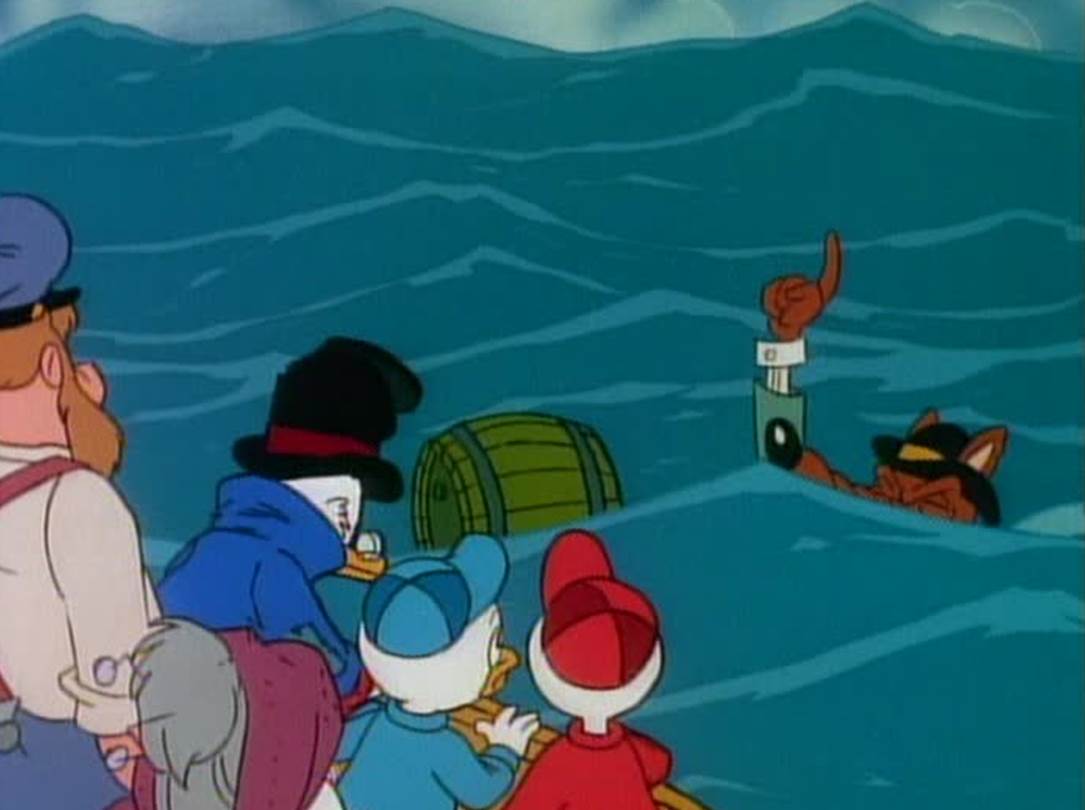
... and then giving Scrooge an opportunity to do exactly the same sort of thing after McSue falls out of his boat and is in danger of drowning:
So why couldn't THIS have been the "moral dilemma" that K&W used to test Scrooge's character? Kimba the White Lion faced challenges like this on a fairly regular basis (to take just one example, consider Kimba's reluctance to kill "The Gigantic Grasshopper"), so surely Scrooge was capable of handling a similar situation? K&W did tease the notion of "going there," at least for a moment, but unfortunately, they had already sabotaged their opportunity to do so in any sort of effective manner. The fact that Fritter had already taken over Scrooge's fortune pretty effectively neutralized any temptation on Scrooge's part to "let the rat drown." Had Fritter refused to sign the delivery paper and Scrooge then followed through by refusing to take him on board the lifeboat -- an action that would have come across as far more cold-hearted than anything Scrooge did to Mr. O'Flannel et al.-- then, at least according to the terminally screwed-up Duckburg legal system, Fritter's fortune would probably have passed into legal limbo, as opposed to reverting back to Scrooge. Thus we see the domino effect in action: decisions made early in the episode undercutting the effectiveness of later scenes.
Of course, we have to conclude the episode with scenes of Scrooge making up for his past sins by showing generosity to all the folks he'd dissed earlier. It doesn't appear to have occurred to K&W that they were undercutting their own parody of Lifestyles of the Rich and Famous here by positing an entire episode of Lifestyle of the Filthy Rich centered around how generous a rich person could be to others. (Or perhaps Rich and Famous actually DID this on occasion? I never watched the show, so I can't be sure.)
"Down and Out" isn't a total loss, quite. As I noted above, some of the Filthy non-Rich gags are OK, as are some of Fritter's more... um, inspired redecoration schemes. This episode must also be regarded as one of Duckworth's more memorable performances. In addition to the butler providing Robin Lurch with the memorable tour of the "palatial underpass," the byplay between Scrooge and his butler here is rivaled only by the Senor Wences-esque "closet gags" during "Nothing to Fear." One's memory immediately leaps to the "You mean like..." "Yesss..." routine quoted by Greg, but I actually find the dialogue at the start of the episode, as Duckworth is ferrying Scrooge around Duckburg to sow financial tares, to be much funnier (not to mention much less preachy). Then, too, Duckworth is the character who shakes Scrooge out of terminal decline by reminding him of his adventurous past and challenging him to retrieve the marbles.
It'd be difficult not to rank "Down and Out" at the bottom of the list of DuckTales' "full" (as opposed to semi-) adaptations of Barks stories. Early episodes like "Micro Ducks from Outer Space" and "Earth Quack," while disappointing, at least tried to stick to the Barks template for the most part, even if their departures from "book" were generally found to be wanting. Koonce and Weimers commit a far more serious error: they fail to trust the template of "Trouble from Long Ago" and, in their insistence upon turning the story into a moral lesson, fatally compromise what was already a perfectly solid storyline that already contained a number of the thematic elements that they wanted to include. The phrase "shooting yourself in the foot" comes to mind.
.
.
.
"DuckBlurbs"
(GeoX) Has anyone ever actually been required to wash dishes to pay for a
restaurant bill? Regardless, for some reason I find the trope far more
hilarious than I think it really is.
The classic example of this in comics is probably the early sequence in LI'L ABNER in which Abner, freshly arrived in New York, gets himself trapped in a vicious circle by going to a restaurant and eating a big meal without having the money to pay for it. By the time he finishes his kitchen penance, he's hungry again, so he orders another big meal, and... you take it from there.
(Greg) Scrooge wonders if that came out right as he
catches himself...and then here comes the nastiest brown weasel with
a black umbrella and green suit with tie; and black hat out of the
closet!
Actually, he's supposed to be a fox. Of course, given the average level of craft displayed by the animators in this episode, it's easy to see how you could make such a mistake.
It's Polygonal Scrooge!
(Greg) He is Fritter O'Way who is voiced by Aron Kincaid (according to the USIMDB; so take that one with a grain of salt) who started on the television show This Is The Life in 1952; then Fall of Nineveh (which he wrote, directed and produced along with acted in it!), and as a beekeeper in The Wasp Woman. He went on to do mostly movies such as Spartacus, The Girls On The Beach, Ski Party, Beach Ball, Dr. Goldfoot & The Bikini Machine, The Ghost In The Invisible Bikini, The Secret Sharer, The Happiest Millionaire, and the New Wife. He didn't land much in terms of roles on television until he got into animation as The Iron Sheik in Rock'N'Wrestling in 1985. He then became Sky Lynx in Transformers and Killer Croc in Batman: The Animated Series.
Maybe Fritter should have thrown a big rock at Scrooge. :-) Kincaid passed away in 2011, BTW. I recall having all sorts of trouble matching names and voices in this episode for much the same reason that I had trouble in "Sphinx for the Memories." All those one-shotters.
(Greg) So we head to the flashback as we go
to the docks as we see the Golden Goose as Fritter explains that it's
owned and sailed by his ancestor. We then see cargo being put into
the hull as we see a duck with white shin guard and a sailor uniform
which Fritter address as Seafoam McDuck. See Seafoam was charged with
making a delivery for his ancestor Diddle O'Way (who happens to be
like Fritter; only with a mustache and wearing brown and green
striped pants). He is carrying a barrel that isn't so funny. Diddle
(Aron Kincaid again through Fritter's narration) asks how much will
it be to deliver the barrel of marbles to the Cape of No Hope.
Seafoam proclaims that it's two schilling; or be gone. Diddle agrees;
but he wants insurance so he gives him a paper and Seafoam signs it
which is clearly the deed and then proclaims that they leave with the
tide. However; we head to sea and it's stormy and the sails are
tattered now. The ship sank and the marbles with it; but everyone was
able to make it to the rowboats safely back to shore. So we head back
to the docks as we see Seafoam explain to Diddle on the docks about
the storm; but there are no excuses and according to the fine print;
he now owns everything. Seafoam states that everything he owned went
to sea; except for the golden pocket watch. Diddle wants that; but
Seafoam runs away with it stage left. Diddle tries to get it; but
gets MURDERED by the net filled with cargo and falls into the sea. I
guess he died or something.
Probably not, else how could Fritter have gotten the contract? BTW, note how the size of the contract changes dramatically in the two scenes below. I do give K&W credit for including a version of the Barks hypothesis that Scrooge used his "golden inheritance" (watch on TV, gold teeth in the comics) to set himself up as a prospector. For sure, it's a heck of a lot more palatable than the manner in which the situation would later be presented in "Once Upon a Dime."
Next: Episode 48, "The Right Duck."
Thursday, April 25, 2013
Book Review: AL CAPP, A LIFE TO THE CONTRARY by Michael Schumacher and Denis Kitchen (Bloomsbury, 2013)
The contentious, cantankerous creator of LI'L ABNER has deserved a major biography for quite some time. Alexander Theroux' glorified term paper THE ENIGMA OF AL CAPP (1999) could best be described as "an outline of a rough draft of a synopsis" and was marred by obvious political partisanship besides. Though Schumacher and Kitchen indulge in their own share of tsk-tsking at Capp's abrupt swerve to the right late in his life, they do a far better -- and, no surprise, much more thorough -- job of placing Capp in the context of his time and explaining why his cartoon brainchild became such a massive hit in the mid-20th century. Even so, there is quite a bit left unsaid here, and I can easily imagine a more comprehensive biography emerging at some point in the future.
LI'L ABNER is fondly remembered as one of the first comic strips to specialize in social satire. It's not hard to understand why Capp should have gone that route; starting with the famous childhood accident in which he lost a leg, his rise to fame and fortune was anything but smooth and untroubled. At a time of socially sanctioned anti-Semitism, his Jewish roots also cast him in the role of an outsider. The result was a man with many rough edges. Capp, for all of his surface geniality, was not a nice person, as Schumacher and Kitchen display in ample detail. Capp's lengthy, nasty feud with his ex-boss Ham Fisher brings to mind Henry Kissinger's comment about the Iran-Iraq War, that it was too bad that both parties couldn't lose. Fisher paid the ultimate price, losing all of his friends and committing suicide, but Capp's reputation also took a major hit as a result of the decades-long disagreement. Arguments with family over LI'L ABNER marketing initiatives (Capp was also a pioneer in the public exploitation of his strip), serial infidelity, and the like paint a grim picture, culminating in several sex scandals in the early 1970s that wrecked Capp's reputation for good and all. Even Capp's frequent parodies of other creators' comic strips, the most famous example of which is the DICK TRACY parody FEARLESS FOSDICK, could be considered a passive-aggressive form of fighting back against perceived rivals, however much Capp might have argued that he admired the original creations.
The major failing here is Schumacher and Kitchen's inability to articulate why, exactly, Capp took such a dramatic turn to conservatism during the 1960s, going on campus to hector students and such. One comics encyclopedia of note trotted out the cliched rationale that Capp turned conservative after he had gotten rich. This conveniently ignores the fact that Capp stayed a flaming liberal for a good while after LI'L ABNER's highest circulation figures and most lucrative licensing deals had been achieved. The "he was a nasty guy" argument doesn't work either, since Capp was what he was for many years before the 60s. My own opinion is that Capp, like a fair number of old-fashioned New Deal-style liberals, was genuinely appalled by what was going on during that giddy time and determined to attack and parody it, but that his satirical skills had gone off the boil since the salad days of the 40s and early 50s. (Charles Schulz always argued that Capp's decision to let Abner and his perpetual romantic pursuer Daisy Mae get married in 1952 knocked the bottom out of the strip; Capp was not pleased and did a rather cruel parody of PEANUTS some years later, leading the mild-mannered Schulz to demand that Capp cease and desist.) Capp had always sought publicity for himself and his strip, but, in the late 60s, the somewhat cruder execution of the LI'L ABNER storylines was mirrored in Capp's partaking of such harebrained stunts as confronting John Lennon and Yoko Ono during their "bed-in for peace." Creatively, Capp had simply lost it, and the over-the-top insults and radical-baiting made it all too easy for the intelligentsia to write him off as a lost cause. Had Capp been, say, twenty years younger, his assault on the left might have been more successful.
A fuller treatment of Capp's life and art must wait for the future, but Schumacher and Kitchen's book is a good place to start learning about both.
LI'L ABNER is fondly remembered as one of the first comic strips to specialize in social satire. It's not hard to understand why Capp should have gone that route; starting with the famous childhood accident in which he lost a leg, his rise to fame and fortune was anything but smooth and untroubled. At a time of socially sanctioned anti-Semitism, his Jewish roots also cast him in the role of an outsider. The result was a man with many rough edges. Capp, for all of his surface geniality, was not a nice person, as Schumacher and Kitchen display in ample detail. Capp's lengthy, nasty feud with his ex-boss Ham Fisher brings to mind Henry Kissinger's comment about the Iran-Iraq War, that it was too bad that both parties couldn't lose. Fisher paid the ultimate price, losing all of his friends and committing suicide, but Capp's reputation also took a major hit as a result of the decades-long disagreement. Arguments with family over LI'L ABNER marketing initiatives (Capp was also a pioneer in the public exploitation of his strip), serial infidelity, and the like paint a grim picture, culminating in several sex scandals in the early 1970s that wrecked Capp's reputation for good and all. Even Capp's frequent parodies of other creators' comic strips, the most famous example of which is the DICK TRACY parody FEARLESS FOSDICK, could be considered a passive-aggressive form of fighting back against perceived rivals, however much Capp might have argued that he admired the original creations.
The major failing here is Schumacher and Kitchen's inability to articulate why, exactly, Capp took such a dramatic turn to conservatism during the 1960s, going on campus to hector students and such. One comics encyclopedia of note trotted out the cliched rationale that Capp turned conservative after he had gotten rich. This conveniently ignores the fact that Capp stayed a flaming liberal for a good while after LI'L ABNER's highest circulation figures and most lucrative licensing deals had been achieved. The "he was a nasty guy" argument doesn't work either, since Capp was what he was for many years before the 60s. My own opinion is that Capp, like a fair number of old-fashioned New Deal-style liberals, was genuinely appalled by what was going on during that giddy time and determined to attack and parody it, but that his satirical skills had gone off the boil since the salad days of the 40s and early 50s. (Charles Schulz always argued that Capp's decision to let Abner and his perpetual romantic pursuer Daisy Mae get married in 1952 knocked the bottom out of the strip; Capp was not pleased and did a rather cruel parody of PEANUTS some years later, leading the mild-mannered Schulz to demand that Capp cease and desist.) Capp had always sought publicity for himself and his strip, but, in the late 60s, the somewhat cruder execution of the LI'L ABNER storylines was mirrored in Capp's partaking of such harebrained stunts as confronting John Lennon and Yoko Ono during their "bed-in for peace." Creatively, Capp had simply lost it, and the over-the-top insults and radical-baiting made it all too easy for the intelligentsia to write him off as a lost cause. Had Capp been, say, twenty years younger, his assault on the left might have been more successful.
A fuller treatment of Capp's life and art must wait for the future, but Schumacher and Kitchen's book is a good place to start learning about both.
Labels:
Biography,
Books,
Conservatism,
Dick Tracy,
Li'l Abner,
Peanuts
Friday, October 21, 2011
Book Review: THE COMPLETE DICK TRACY, VOLUME 12: 1948-1950 by Chester Gould (IDW/Library of American Comics, 2011)
"Characters count" and "the family is the focus" as Chester Gould brings his prime creative decade to a close. The villains in this latest volume will be unfamiliar to most -- Sketch Paree, the nutso wardrobe designer, is only remembered because he was one of those picked as a goofy bad-guy spear-carrier in UPA's Dick Tracy Show -- but they're a solid enough crew, all things considered. The big events here, though, are the introduction of one major new character, the shocking departure of another, and the (seemingly?) out-of-nowhere permanent "joining" of the strip's two original principals.S
P
O
I
L
E
R
S
P
A
C
E
As Max Allan Collins notes in his introduction, the replacement of Pat Patton with Sam Catchem as Tracy's partner does indeed give DICK TRACY an important shot of adrenaline -- not to mention an authentic tang of ethnicity. I always got the impression that Sam's "Jewishness" was gradually sanded off over time, but, in his earliest appearances, the wise-cracking, freckled, knobby-nosed cop is like nothing the strip has seen before (on the side of the law, at least). Patton is not forsaken, becoming police chief after a crushed Chief Brandon "retires himself" due to guilt over feeling responsible for the murder of the blind young inventor Brilliant. Having never seen this "transition sequence" before, I was amused to see how quickly the long-time bungler Patton evolved into a "senior officer" type. It's not a matter of weeks, as Jay Maeder claimed in his strip history; it's literally a matter of days. When he introduces Catchem to Tracy, Patton is already passing himself off as a personnel expert in knowing just the sort of sidekick Tracy now needs. This from a guy who started his career peering into a keyhole with a known murderer on the other side of the door...
The death of Brilliant at the hands of the ruthless gang boss Big Frost is one of the most shocking examples of Gould's creative profligacy. Having created one of those "accommodating sources of miracles" who could have served the strip for decades, in the manner of Gyro Gearloose or Hedgerow Huppy, Gould jettisons Brilliant without an apparent second thought. In an era that emphasized relationships, however, this was admittedly a very effective way to demonstrate the frailty of the "social compact" and the family unit at the hands of crime. The after-the-fact revelation that Brilliant was Diet Smith's son only adds to the sense of real tragedy. Something of the same sort of fragility is on display when B.O. Plenty exiles himself for a while in the mistaken conviction that he has committed murder, leaving Gravel Gertie and little Sparkle behind to (rather ineffectively) fend for themselves. At least B.O. was allowed to return in one piece.
There is less reliance on "grotesques" here, apart from Wormy Marrons (of the striated kisser seen above) and the comically obese diet-racket fraud Pear-Shape, a Gould caricature. More believable heavies such as Big Frost, the hard-boiled shop thief Mousey, and the haughty femme fatale Sleet reflect the brassier, less sentimental tenor of the late 40s that was reflected elsewhere in phenomena like film noir. Sketch Paree turns out to be something of a pathetic figure, the rare case of a TRACY villain who is certifiably insane; with his "dry-land-drowning" water mask apparatus, he comes off as a sort of French version of the early Joker. As the "modernized" rogue's gallery indicates, Gould is perfectly comfortable with his place in the wider culture at this time, seamlessly integrating parodies of such celebrities as Spike Jones and Arthur Godfrey into his narratives, and giving "Spike Dyke" and "Ted Tellum" meaty, multi-faceted roles to boot. After the decade of success that Gould had just enjoyed, he was certainly entitled to feel confident that he had the pulse of the public.
The 1940s draw to a close with Tracy's long-delayed (to the point of parody, yet!) wedding to Tess Trueheart. In view of Gould's working methods, this may well have been an off-the-cuff decision, but I find it suspiciously convenient that the wedding takes place as, quite literally, the LAST major "action" of the 40s. Was Gould doing it to "reshuffle the deck" for the upcoming decade? Whatever the reason, it did no real "damage" to the strip, as Li'l Abner's wedding to Daisy Mae did to LI'L ABNER, mostly because Tracy and Tess had always been an "item." It also, of course, reinforced the "family bond" theme that so dominated this period.
Onward to the 50s with this outstanding reprint series!
Monday, August 30, 2010
Baltimore Comic-Con Report
After 19 years of contact, I finally got to meet Mark Lungo when he came to stay at our house this past weekend for the Baltimore Comic-Con. Another old friend, Chuck Munson, arrived on Saturday and also spent the night at our place. We were sorry other "regulars" weren't able to make it, but "real life" has that annoying habit of sometimes intervening.
The Con was, as ever, a refreshing reminder of the ways comic-cons used to be. No hoo-hah about upcoming blockbuster films or cult TV shows -- just a plain ol' dealer's room and a slate of panels devoted, first and foremost, to comics and comics creators. Publishers were well represented, with the shocking exceptions of DC and Marvel (which, to be fair, did spoon out some "dish" at panels dedicated to the companies' upcoming projects). Boom!'s personnel were friendly and helpful and smiled "stay tuned" in response to our questions about future DISNEY CLASSICS hardback editions and additional titles based on Disney Afternoon series. As things turned out, there was some late-breaking news on the latter front that will surely have made a certain segment of DAFTies "nuts" by now. More below...
Saturday's itinerary included a side trip to Geppi's Entertainment Museum, which
was offering half-price admission to all Con-goers who brought their ticket stubs
with them. It didn't take long for me to notice that some of the artwork that had been on hand when GEM opened had disappeared. Half of the display cases in the 19th-century exhibit were empty for reasons of "renovation" (which, in Baltimore parlance, usually means that you've got a long wait ahead of you before things get fixed). But it was nice to see "all that cool stuff" again, and the gift shop is extremely well appointed, with a nice selection of books, plushies, and chatchkas.
From Geppi's, we met Nicky and proceeded to M&T Bank Stadium to watch the preseason game between the Ravens and the Giants. Nicky was able to get cheap tix via StubHub, and, trio of Con-going fanboys though we were, we weren't going to pass up the chance to see an NFL game, albeit a meaningless one. Unfortunately, we got stuck right in front of an obnoxious, drunken loudmouth fan who divided his time between yelling inane comments about how "great" preseason was and flirting with a girl in the row in front of us. (The girl's boyfriend was present, and we learned after we left that there had been a fight in our premises after halftime... Coincidence??) We were planning to leave early in any event, but the noisy nuisance and his neighboring enablers made it easier to depart. By the time we got home, we were pretty much pooped...
...On second thought, scratch the "pretty much."
Sunday morning saw Chuck take off to visit his mom in New Jersey and Mark and I essay another run at the Con. We saw a good panel, a "Spotlight on Sergio Aragones" in which the MAD cartoonist and creator of Groo dispensed with the usual interlocutors and worked the room while wielding a handheld microphone. He's funny, but not quite as wacky as I would have imagined him being. The ingenuous, "Spanglish"-speaking naif who occasionally pops up as "Sergio" in Aragones' works is evidently a fanciful creation. Aragones dropped the interesting news that he is working on another GROO miniseries that will feature Groo vs. ... Conan! So what do you do when two such towering titans meet? Doesn't one of them have to lose? All I'll say here is that Sergio appears to have come up with a good solution to that particular dilemma. Earlier in the Con, we also saw the tail end of a panel spotlighting Denis Kitchen (who's apparently preparing a biography of Al Capp -- no surprise there, given Kitchen Sink Press' series of LI'L ABNER reprints) and a panel starring Mike Allred, creator of MADMAN. Attendance could have been better at all three events, but no one was trying to "spin" anything, create "synergy," or establish "buzz"... just impart some interesting "inside infor" about comics.
Purchases? Yes, we made some purchases. I got about a dozen RICHIE RICH comics from the 1960s, continuing my tortuous crawl towards the glittering goal of a complete RICHIE collection... a goal I'm certainly never going to achieve. Chuck got Don Rosa (who originally wasn't on the list of attendees... but c'mon, those piles of Golden Age and Silver Age cover parodies aren't going to sell themselves!) to sign a print of Scrooge, Magica, and Glomgold for Chuck's daughter Kathryn. Mark got a 60s BUGS BUNNY comic "introducing" a female bunny character that I'm sure even the hardiest of die-hard Warner Bros. fans have forgotten about. The best news from the Con, however, was (as the ads have it) ABSOLUTELY FREE...
... Boom! will publish a CHIP AND DALE'S RESCUE RANGERS title starting in December. No doubt we have the surprising success of the DARKWING DUCK title to thank for this; I seriously doubt that the DuckTales material running in UNCLE $CROOGE had much to do with it. Boom!'s confidence is reflected by the fact that it's giving the Rangers a continuing title right off the bat, with no intervening mini-series to test the waters. Ian Brill, the writer of the DARKWING title, will also handle the writing chores for the Rangers, with Leonel Castellani doing the artwork. Nothing against Brill's involvement, but I'm kind of nervous about these original DAFT creations being assigned to a single writer; I'd feel a bit better if Boom! tried to find a C&DRR "specialist" at some point. The stakes are somewhat higher for a RANGERS book, as well; the well-organized and vocal C&DRR fandom, with its fond memories of Disney Comics' impressive RANGERS effort, will no doubt be a tougher crowd to please than the fans of Darkwing who'd never seen DW in a continuing title with original material (the four issues published by Disney in 1991-92 were simply an adaptation of "Darkly Dawns the Duck"). Give Boom! credit, though, for seeing an opening and attempting to "run to daylight."
Saturday's itinerary included a side trip to Geppi's Entertainment Museum, which

was offering half-price admission to all Con-goers who brought their ticket stubs
with them. It didn't take long for me to notice that some of the artwork that had been on hand when GEM opened had disappeared. Half of the display cases in the 19th-century exhibit were empty for reasons of "renovation" (which, in Baltimore parlance, usually means that you've got a long wait ahead of you before things get fixed). But it was nice to see "all that cool stuff" again, and the gift shop is extremely well appointed, with a nice selection of books, plushies, and chatchkas.
From Geppi's, we met Nicky and proceeded to M&T Bank Stadium to watch the preseason game between the Ravens and the Giants. Nicky was able to get cheap tix via StubHub, and, trio of Con-going fanboys though we were, we weren't going to pass up the chance to see an NFL game, albeit a meaningless one. Unfortunately, we got stuck right in front of an obnoxious, drunken loudmouth fan who divided his time between yelling inane comments about how "great" preseason was and flirting with a girl in the row in front of us. (The girl's boyfriend was present, and we learned after we left that there had been a fight in our premises after halftime... Coincidence??) We were planning to leave early in any event, but the noisy nuisance and his neighboring enablers made it easier to depart. By the time we got home, we were pretty much pooped...
Sunday morning saw Chuck take off to visit his mom in New Jersey and Mark and I essay another run at the Con. We saw a good panel, a "Spotlight on Sergio Aragones" in which the MAD cartoonist and creator of Groo dispensed with the usual interlocutors and worked the room while wielding a handheld microphone. He's funny, but not quite as wacky as I would have imagined him being. The ingenuous, "Spanglish"-speaking naif who occasionally pops up as "Sergio" in Aragones' works is evidently a fanciful creation. Aragones dropped the interesting news that he is working on another GROO miniseries that will feature Groo vs. ... Conan! So what do you do when two such towering titans meet? Doesn't one of them have to lose? All I'll say here is that Sergio appears to have come up with a good solution to that particular dilemma. Earlier in the Con, we also saw the tail end of a panel spotlighting Denis Kitchen (who's apparently preparing a biography of Al Capp -- no surprise there, given Kitchen Sink Press' series of LI'L ABNER reprints) and a panel starring Mike Allred, creator of MADMAN. Attendance could have been better at all three events, but no one was trying to "spin" anything, create "synergy," or establish "buzz"... just impart some interesting "inside infor" about comics.
Purchases? Yes, we made some purchases. I got about a dozen RICHIE RICH comics from the 1960s, continuing my tortuous crawl towards the glittering goal of a complete RICHIE collection... a goal I'm certainly never going to achieve. Chuck got Don Rosa (who originally wasn't on the list of attendees... but c'mon, those piles of Golden Age and Silver Age cover parodies aren't going to sell themselves!) to sign a print of Scrooge, Magica, and Glomgold for Chuck's daughter Kathryn. Mark got a 60s BUGS BUNNY comic "introducing" a female bunny character that I'm sure even the hardiest of die-hard Warner Bros. fans have forgotten about. The best news from the Con, however, was (as the ads have it) ABSOLUTELY FREE...
... Boom! will publish a CHIP AND DALE'S RESCUE RANGERS title starting in December. No doubt we have the surprising success of the DARKWING DUCK title to thank for this; I seriously doubt that the DuckTales material running in UNCLE $CROOGE had much to do with it. Boom!'s confidence is reflected by the fact that it's giving the Rangers a continuing title right off the bat, with no intervening mini-series to test the waters. Ian Brill, the writer of the DARKWING title, will also handle the writing chores for the Rangers, with Leonel Castellani doing the artwork. Nothing against Brill's involvement, but I'm kind of nervous about these original DAFT creations being assigned to a single writer; I'd feel a bit better if Boom! tried to find a C&DRR "specialist" at some point. The stakes are somewhat higher for a RANGERS book, as well; the well-organized and vocal C&DRR fandom, with its fond memories of Disney Comics' impressive RANGERS effort, will no doubt be a tougher crowd to please than the fans of Darkwing who'd never seen DW in a continuing title with original material (the four issues published by Disney in 1991-92 were simply an adaptation of "Darkly Dawns the Duck"). Give Boom! credit, though, for seeing an opening and attempting to "run to daylight."
Wednesday, August 25, 2010
DVD Review: SERGEANT YORK (Warner Bros., 1941)
Here's a comparison for you: Sergeant York and Patton. Not so much the movies themselves -- they have very different feels, even taking the differences between World War I and World War II into account -- as the fact that how you're "programmed" will probably determine how you react to the story being told. During the Vietnam era, a divided nation watched Patton and saw the general as either a no-guff, victory-minded patriot or a noxious jerk, depending upon individual political preferences. Sergeant York, which was universally praised during its initial run, earned Gary Cooper an Academy Award, and played no small part in drumming up support for the military during the run-up to Pearl Harbor, now seems to split opinions in a similar manner. The critical comments on IMDb bifurcate neatly into either uncomplicated admiration or snarky dismissal. Alvin York's choice between either obeying the dictates of his pacifist interpretation of Christianity and coming to his country's aid in time of war is either applauded as a "deep theme" to be considered at length or waved aside with a smirk as just another example of hypocrisy in an American "hero." The cosmetic aspects of the movie -- particularly the patently artificial feel of the "hillbilly" section describing Alvin's wild youth and his "getting religion" -- have dated badly, making one's personal commitment to the tale seem all the more significant. Quite frankly, how you view Sergeant York's dilemma probably says more about you than it does about the Sergeant.
In all honesty, I found the first half of the film rather tedious, save for Walter Brennan's great turn as the folksy, pulpit-pounding Pastor Pile. The obvious soundstage settings and the frequently labored attempts to do LI'L ABNER shtick are definite turnoffs; Cooper's careful pronunciation of such backwoodsisms as "hyar" and "air" is actually comical at times. York's "conversion by lightning bolt" flies in the face of the actual facts about the man and seems more suited for a Cecil B. DeMille costume epic. The second half makes up for all this, however. Director Howard Hawks is on familiar territory when he places the diffident, self-conscious York in a diverse company of doughboys, and the "guys training and bonding" material comes off well. York's soul-searching is presented in melodramatic fashion, complete with a wind-riffled Bible opening to just the right page to break York's mental deadlock, but the legitimate clash of basic moral values still rings true. The battle scene in which York earns his honors, while also confined to an artificial set and relatively bloodless, packs a surprising wallop for all that, especially when York makes up for the killing of a buddy by quickly dispatching the German prisoner who had done the surreptitious deed.
We only got one disc from Netflix, with only a handful of extras -- but interesting extras they are. There's a running critical commentary on the movie, as you might expect, but a couple of Warners shorts, including Porky's Preview, attempt to give the viewer the "feel" of a night at the local Warners theater in 1941. It would have been even more authentic had you been obliged to watch the shorts prior to the main feature, but I'm not complaining.
In all honesty, I found the first half of the film rather tedious, save for Walter Brennan's great turn as the folksy, pulpit-pounding Pastor Pile. The obvious soundstage settings and the frequently labored attempts to do LI'L ABNER shtick are definite turnoffs; Cooper's careful pronunciation of such backwoodsisms as "hyar" and "air" is actually comical at times. York's "conversion by lightning bolt" flies in the face of the actual facts about the man and seems more suited for a Cecil B. DeMille costume epic. The second half makes up for all this, however. Director Howard Hawks is on familiar territory when he places the diffident, self-conscious York in a diverse company of doughboys, and the "guys training and bonding" material comes off well. York's soul-searching is presented in melodramatic fashion, complete with a wind-riffled Bible opening to just the right page to break York's mental deadlock, but the legitimate clash of basic moral values still rings true. The battle scene in which York earns his honors, while also confined to an artificial set and relatively bloodless, packs a surprising wallop for all that, especially when York makes up for the killing of a buddy by quickly dispatching the German prisoner who had done the surreptitious deed.We only got one disc from Netflix, with only a handful of extras -- but interesting extras they are. There's a running critical commentary on the movie, as you might expect, but a couple of Warners shorts, including Porky's Preview, attempt to give the viewer the "feel" of a night at the local Warners theater in 1941. It would have been even more authentic had you been obliged to watch the shorts prior to the main feature, but I'm not complaining.
Sunday, April 26, 2009
Book Review: BOODY: THE BIZARRE COMICS OF "BOODY" ROGERS by Gordon "Boody" Rogers, edited by Craig Yoe (Fantagraphics Press, 2009)
The roiling, anything-goes "Golden Age of Comics" is best known for introducing and developing the superhero genre, but the medium was so fluid at that time that literally any sort of subject matter was fair game, provided that audiences liked it. Humor comics flourished in the years after World War II, and, in their zeal to get readers' attention, publishers weren't averse to taking walks on the weird, wild side and employing stylists whose over-the-top gags and broad drawing styles would probably not have passed muster in the more cautious post-Comics Code days. Basil Wolverton (POWERHOUSE PEPPER) is probably the best known of these genial nutcases. This volume introduces modern readers to a second likable loony: Gordon "Boody" Rogers. Of this gentleman, I previously knew only that he created Sparky Watts, the first true parody of Superman, and was the leading assistant to Zack Mosely on the comic strip SMILIN' JACK. After digesting this brief collection of examples of each of Rogers' major features -- and "major" is stretching things some, given that even Sparky Watts had a career that lasted less than a decade and was interrupted due to Rogers' service in World War II -- a few additional questions have been answered, at least... but not enough to give this volume the high rating it otherwise might have merited.One reviewer of BOODY strafed editor Craig Yoe for a fanboyishly dizzy introduction that gave Rogers' biography short shrift -- a bit of a surprise considering Yoe's obvious enthusiasm for Rogers' work and self-proclaimed diligence at digging up data. (I myself picked up at least one error of fact: Carl Ed was the creator of HAROLD TEEN, not SMITTY, which was drawn by Walter Berndt.) At the very least, we should have been provided with a basic bibliography of Rogers' comic-book work. Unfortunately, sloppy, breathless writing is the least of Yoe's sins here. Take Sparky Watts, the bespectacled, casually dressed mock superhero... who is featured in several stories herein but does not get a chance to perform any superheroics. I'd call that a major omission, wouldn't you? Instead, we get to see him lose his mysterious powers and shrink (!) due to the wearing-off of the "cosmic rays" that are the source of whatever abilities he may happen to possess. The resulting antics are funny -- ant-sized Sparky survives encounters with some truly bizarre insect life and barely avoids getting married to a two-headed, half-bug-half-babe (would I make this up?) -- but c'mon, Craig, surely we could have been treated to at least one little fantastic feat, in order to give the un-powered Sparky's adventures in bug-land a little more context? The last SPARKY story, a two-parter, features Sparky and his pal Slap Happy in a supporting role to two pairs of animate legs and feet who fall in love and get married. Sparky and Slap might just as well have been Sam and Silo (cf. my previous review) for all they contributed to this story. If Fantagraphics wants to follow up this collection with another bundle of "Boody" boodle, I have a mild suggestion: publish a volume devoted entirely to Sparky, so that we can actually see what makes him tick, as opposed to getting ticked off at not finding out more about the character.
The volume does a little better by BABE, "The Amazon of the Ozarks," whose origin story and its follow-up appear herein. Unfortunately, the two stories are split up at opposite ends of the book and really should have been printed back-to-back. The influence of LI'L ABNER on this fanciful scenario of a female hillbilly who's part super-athlete and part "eternal innocent" is obvious, but Rogers' Ozark setting is far weirder than Al Capp's ever was, including, among other things, a "table mountain" that's home to a group of male centaurs who get their kicks by racing comely females as if they were horses. This scenario is disturbing enough, but just as skin-crawling is the brief tale in which Babe performs as a female wrestler and has her neck broken. She spends the last page or so of the story with her head canted back at an impossible angle -- and no, there's no deus ex machina to make it all better at story's end. The reader apparently had to assume that Babe's neck would heal up by the time the next issue appeared (and since this only appeared in issue #4 of an 11-issue run, at least she got the chance to recover!).
A few additional stories from a teenage comic, DUDLEY, are thrown in to help the volume make weight, though additional SPARKY WATTS stories would probably have been a better choice. The DUDLEY story, chock full of antiquated "hepcat" slang, is pretty lively and amusing, though nowhere is it made clear exactly which of the characters is Dudley. It's reasonably easy to figure it out in context, but, to me, it's another example of careless editing. JASPER FUDD, a "filler" story about a clod-hopper country boy who doubles as an inexplicably fast cross-country runner, is the most "normal" story in the issue, and, as such, is the story that should probably have been chucked in favor of more zany fare.
Rogers left comics after 1950, and probably just in time; though there's nothing truly offensive herein, his extreme caricatures, "scary" creatures, and occasional forays into realms of "iffy" taste (cf. the BABE story in which a famous actor cross-dresses and escapes to Babe's town to dodge his adoring fans) would have been a much harder sell after the Comics Code crackdown. I liked this material enough to want to see more of it -- and, apparently, a few of Rogers' others stories have been posted on the Web, so I may go hunting for them -- but the next Rogers collection should receive somewhat soberer treatment, at least when it comes to ancillary material.
Labels:
Books,
Comic Strips,
General Comics,
Li'l Abner
Subscribe to:
Posts (Atom)