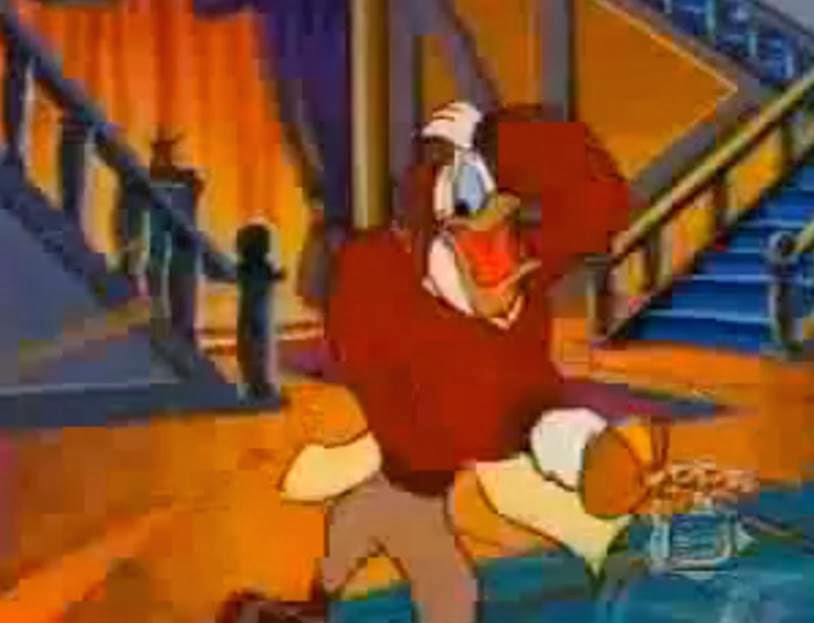
So why would Scrooge, that notorious miser who's been known to blow off magazine interviews and such, suddenly develop a desire to join society (or at least a portion of same)? In all honesty, Magon does a better job of setting up the story's premise than does Barks. Barks starts us off at the status seekers' party, with Scrooge having decided to attend for a utilitarian reason: he owns the hotel and is "just checking the lights." How convenient. Presumably, if the hotel had used LEDs, then Scrooge never would have been persuaded to seek higher status. Magon, by contrast, takes his time shepherding us to the snobby soiree, first establishing that the somewhat rough-and-tumble duck who once mined for (presumably muddy) gold in the Klondike still likes to get down and dirty on occasion. Unfortunately, this places him at odds with the sterile aesthetic of the image-conscious status seekers and, it would seem, has cut him off from a pool of potential investors. Barks never mentions any financial motivation for Scrooge's actions, a somewhat remarkable oversight. I think that Magon recognized something here that Barks either missed or chose to ignore: Scrooge may not always make decisions based solely on money, but a monetary motivation should never be that far from his mind.


No, you're not seeing things: the "background snobs" really ARE frozen in place.
He also includes the bum who gets an invite by virtue of owning the "Pink Fakasso," even including the bit about the bum having to sell his mother's gold teeth in order to be able to afford the painting. However, Magon's mendicant actually carries the painting WITH him, which would seem to be a security risk but otherwise makes a good deal of sense; otherwise, the bum's presence would probably be questioned by someone every time the raggedy guy decided to show up.


Ultimately, Scrooge lets it slip that he once owned the world's greatest status symbol -- and a word of explanation is needed here regarding the TV adaptation's change of that particular McGuffin. One of the reasons why Barks used the Candy-Striped Ruby was that it allowed him to make an atypical continuity reference to his earlier story "All at Sea," in which Scrooge hid a shipment of gold from the Beagle Boys by disguising it to look like corn. Barks evidently had great confidence in the faithfulness of his readership, for he revisited "the scene of the attempt to prevent a crime" three years later.

Since Scrooge had brought along the peppermint candy to use as trade goods and Chief Fulla Cola of Rippon Taro had accepted the pounds-producing candy in exchange for the Ruby, this subterfuge makes perfect sense in the context of the story at hand. Though Magon could probably have presented the candy caper as an entirely new plan and gotten away with it, he evidently decided against it, so how best to handle the new situation? Magon's solution, while a bit jerry-rigged, turns out to be very ingenious. The use of the Mask of Kuthu-Lulu (thanks to GeoX for enlightening me as to the connection to the Cthulhu mythos) gives Magon the opportunity to slip in a priceless explanation as to why such an ugly item could be the world's "ultimate" status symbol: because the owner could have afforded to buy the best but has instead purchased the worst. That's such a cynical sentiment that I'm surprised Barks didn't come up with the idea first.

In lieu of peppermint candy as a lure for Chief Fulla Cola, Magon does a very Barksian thing and plants the notion of Scrooge liking peanut butter sandwiches and cracker treats early in the episode, hauling it out after HD&L learn the meaning of status on Rippon Taro (in a dialogue with the Chief that is copied from Barks almost word for word). The use of peanut butter both burnishes Scrooge's "salt of the Earth" credentials and proves to be a crucial factor in resolving problems that crop up during the episode (much as the "football" references get a callback when Scrooge and his gang foil the villains' attempt to steal the Mask at the end). It also gives Mrs. Beakley her excuse to go along for the ride, which isn't a bad thing, I suppose.


The seams begin to show when Magon constructs his version of how the Ducks' submarine escapes the giant jellyfish. The use of Charles Upstuck III and the Blueblood Beagle Boys' homing device as a lure for the creature is an improvement on the Barks original, in which the Ducks just basically run into the jellyfish by accident. But HD&L getting the idea of spooking the jellyfish with a load of spices that... just happen to be on board the submarine for no apparent reason? That's a bit more of a stretch. (I don't think that Mrs. Beakley could have fit all those spices into her picnic basket.) At least Magon completes the circle by allowing the airborne, stunned jellyfish to literally "drop back into the picture" at a crucial moment and save the Ducks' tailfeathers. Sure, the action may be scientifically dubious -- among many other objections, wouldn't the jellyfish have dried up and died after being out of the water for so long? -- but its karma-content is massive. Magon may have monkeyed with some of Barks' specific story elements, but he definitely appreciates the Duck Master's gifts for inserting telling details and "never throwing anything away" where storytelling is concerned.


 Magon also compares favorably vis-a-vis Barks when it comes to characterization. The main bad guy in Barks' "Status Seeker" is the standard "pig villain" used in many $CROOGE stories of the early-to-mid-60s, here called Porkman De Lardo (a name which Magon appropriated and gave to A.S.S. member Lady De Lardo). Magon evidently decided that a more pointed symbol of the snobbish nature of the A.S.S. was appropriate, the better to make Scrooge's renunciation carry more weight at story's end, and thus replaced ol' pigface with Charles Upstuck III, who is, as Greg noted, "pretty smart for a heel" and an above-average one-shot menace. He further upped the social ante by replacing the usual "A-list" trio of Beagle Boys (Big Time, Burger, and Bouncer) with their slightly more sophisticated, and competent, "Blueblood" equivalents (Bonaparte, Bearnaise, and Bicep). These characters give Magon a chance to get in a few extra digs at the pretensions of the upper crust, and he delivers big time (or, should I say, in a Bonaparte-like fashion), both on the macro scale (the hilarious "Club Fed" scene) and the micro scale (the Bluebloods' number plates being sewed on the breasts of their polo shirts like designer symbols). Admittedly, Magon probably didn't come by the idea of using "sophisticated" villains entirely on his own; in the Barks story, hiring the unionized (but otherwise typical) Beagle Boys is suggested to Porkman De Lardo as a way of giving his caper some status. But it would be difficult to argue that Magon didn't take fuller comedic advantage of the situation.


 As for the Ducks themselves, HD&L have a bit less to do in the DuckTales version of the story than in the Barks version. The lads' most notable additional contribution in "The Status Seeker" is their suggestion that Scrooge use a submarine to get to Rippon Taro, thereby avoiding the prying eyes of the other status seekers. Granted, in the Barks story, we don't see the crowd of snobs pursuing Scrooge in Duckburg Harbor that we do on screen -- Scrooge and company, in fact, advertise their impending departure in one of Barks' panels -- but the advantage of submarine travel is nonetheless obvious, and it's unfortunate that Magon didn't give the boys their chance to claim the credit that was due them.

 Barks' version of the adventure, of course, doesn't have Launchpad, and Magon once again makes the most of the cast change, with LP providing us with such laugh-lines as "Opportunity knocks only skin deep!", "Ten more crashes [on my crash chart] and I get a toaster!", "Happy scales to you!" (to the peanut-butter noshing Chief), and, weirdest (and funniest) of all, "At times like these, I remember the words of the immortal Socrates... YOWWWCHH!" (That must have been a "post-hemlock" quote.) Not that Donald did anything wrong in "The Status Seeker," but he can't hope to compete with Launchpad in the area of (intelligible) one-liners.
The dockside wrap-up is the most contentious part of the episode, but, granted that you accept the change in the ep's focus from the get-go, it's the most logical way to end Magon's rendition of the story. Scrooge, an isolated figure at the start of the series, is believably tempted by the prospect of becoming "one of" the status seekers, but his new-found appreciation for the importance of family allows him to perceive just how cold-blooded his A.S.S. associates are, and he winds up making the right call. Trust me, this scene could have been much more treacly and sentiment-stuffed than it turned out to be.
 The second season's "The Land of Trala La" and "The Unbreakable Bin" are, in my opinion, equally as ingenious and enjoyable as "The Status Seekers" when it comes to clever and imaginative adaptations of Barks stories. Any one of these three eps could reasonably be fingered as THE single best Barks adaptation of the series. If pressed to choose one, I'd probably opt for "Seekers," simply because it seems a bit more polished than either of the later efforts: a superb combination of intelligent writing, humorous dialogue, good pacing, clever characterization, and excellent animation. I'd like to think that Barks himself would have been pleased, or at least content, with the effort made here.
.
.
.
"DuckBlurbs"
(Greg) A woman gasps in horror (I['m] guessing Joan Gerber here since she sounds like a snobbish Mrs. Beakly) and orders Vincent to stop the limo. The female gives the football back to Scrooge who is muddy all over (and even wears a dollar sign football uniform) and tells Scrooge to get the football game off his property before Scrooge arrests himself. HAHA! Scrooge pleads with her that he is Scrooge McDuck and the female snob blows it off as nonsense because the richest duck in the world would NEVER find time to play around.
I'm of two minds about this head-scratching ignorance as to the appearance of the world's richest Duck. It does seem to be a stretch that Lady De Lardo would not know Scrooge by sight, but Magon is simply following the lead of Barks, who made it equally clear that the status seekers neither know nor care about Scrooge's identity (that is, until he gets hold of a status symbol).
(Greg) So we head to the recycled background (in this case; the restaurant from Dime Enough For Luck)...
And also "Down and Out in Duckburg," I do believe.
(Greg) We get some shots of a blond haired dogsperson in a pink dress who looks more like a cross dressing man and two business men who look like oversized chipmunks in business suits with one on the Paul E. Dangerously cellphone and the other [checking] the paper ticker. Oh; and they all are drinking the WE KNOW IT'S RED WINE ALCOHOL BUT WE'RE NOT TELLING ANYONE.
I just HAVE to show a still of this scene so that the younger readers of my blog will know what a 1987-vintage cell phone looked like. (Actually, wouldn't a stock ticker be just as dated as a 1980s cell phone by this time?)
 (Greg) Scrooge is dumbfounded on who is following them as we head to the
black ship as we see the sonic radar in front as Charles laughs with
the Beagle Boys behind him. HAHA! And damn; I'm good as he hid the
sub-sonic beeper inside McDuck's cargo crates. Okay; how did they do
that?
(Greg) Scrooge is dumbfounded on who is following them as we head to the
black ship as we see the sonic radar in front as Charles laughs with
the Beagle Boys behind him. HAHA! And damn; I'm good as he hid the
sub-sonic beeper inside McDuck's cargo crates. Okay; how did they do
that?
Actually, as we see later, the beeper is attached to the side of one of the crates. It still doesn't explain how Upstuck put the thing there, though.
(Greg) The jellyfish is annoyed and then inflates into a balloon and the submarine pops from the water into the air. Bicep calls it the Goodyear blimp eating a submarine sandwich. HAHA! And man; that's ANOTHER real life company brand reference...
... Along with the Astrodome and Socrates. At the same time, Magon makes reference to "Gadillacs," "Fakasso," and "Van Goat." Evidently, he couldn't make up his mind as to whether or not real-world references were acceptable.
(Greg) And then the red Beagle blows his cover and calls him old bean as it's Charles in a convincing Beagle Boy disguise. So he's Upstuck Beagle all along. And he had me fooled too.
 This is quite literally the only moment in the episode at which Upstuck's intelligence might be questioned. And even then, his "cheesy disguise" appears to have fooled some people.
Next: Episode 60, "Nothing to Fear."


The dockside wrap-up is the most contentious part of the episode, but, granted that you accept the change in the ep's focus from the get-go, it's the most logical way to end Magon's rendition of the story. Scrooge, an isolated figure at the start of the series, is believably tempted by the prospect of becoming "one of" the status seekers, but his new-found appreciation for the importance of family allows him to perceive just how cold-blooded his A.S.S. associates are, and he winds up making the right call. Trust me, this scene could have been much more treacly and sentiment-stuffed than it turned out to be.

.
.
.
"DuckBlurbs"
(Greg) A woman gasps in horror (I['m] guessing Joan Gerber here since she sounds like a snobbish Mrs. Beakly) and orders Vincent to stop the limo. The female gives the football back to Scrooge who is muddy all over (and even wears a dollar sign football uniform) and tells Scrooge to get the football game off his property before Scrooge arrests himself. HAHA! Scrooge pleads with her that he is Scrooge McDuck and the female snob blows it off as nonsense because the richest duck in the world would NEVER find time to play around.
I'm of two minds about this head-scratching ignorance as to the appearance of the world's richest Duck. It does seem to be a stretch that Lady De Lardo would not know Scrooge by sight, but Magon is simply following the lead of Barks, who made it equally clear that the status seekers neither know nor care about Scrooge's identity (that is, until he gets hold of a status symbol).
(Greg) So we head to the recycled background (in this case; the restaurant from Dime Enough For Luck)...
And also "Down and Out in Duckburg," I do believe.
(Greg) We get some shots of a blond haired dogsperson in a pink dress who looks more like a cross dressing man and two business men who look like oversized chipmunks in business suits with one on the Paul E. Dangerously cellphone and the other [checking] the paper ticker. Oh; and they all are drinking the WE KNOW IT'S RED WINE ALCOHOL BUT WE'RE NOT TELLING ANYONE.
I just HAVE to show a still of this scene so that the younger readers of my blog will know what a 1987-vintage cell phone looked like. (Actually, wouldn't a stock ticker be just as dated as a 1980s cell phone by this time?)

Actually, as we see later, the beeper is attached to the side of one of the crates. It still doesn't explain how Upstuck put the thing there, though.
(Greg) The jellyfish is annoyed and then inflates into a balloon and the submarine pops from the water into the air. Bicep calls it the Goodyear blimp eating a submarine sandwich. HAHA! And man; that's ANOTHER real life company brand reference...
... Along with the Astrodome and Socrates. At the same time, Magon makes reference to "Gadillacs," "Fakasso," and "Van Goat." Evidently, he couldn't make up his mind as to whether or not real-world references were acceptable.
(Greg) And then the red Beagle blows his cover and calls him old bean as it's Charles in a convincing Beagle Boy disguise. So he's Upstuck Beagle all along. And he had me fooled too.

Next: Episode 60, "Nothing to Fear."