Saturday, June 8, 2013

It's No Longer a "Duck Blur"...

... it actually DOES look like an episode!  Well, episodes, actually.


A reader was kind enough to send along a link to some additional information about the remastered DuckTales video game, including a couple of videos showing game sequences.  Never having been a game-player, I'm unfamiliar with a lot of the details of the original, but you'd better believe that I was excited to hear the voices of many of the surviving voice actors in what will almost certainly be their last joint performance.  (That is, unless the Disney Movie Club decides to round them all up for extra features in a putative DuckTales: Volume 4 release.  Yeah, as if.)  For a nonagenarian, Alan Young sounds very good indeed.

Since DuckTales: Remastered will be available in a PC format, I just might break down and get this!

Thursday, June 6, 2013

Comics Reviews: MY LITTLE PONY: FRIENDSHIP IS MAGIC #1-#4 (IDW, November 2012-February 2013)

It took a while, but I've finally managed to read the first four-issue story arc of IDW's MLP:FIM comic. Long story short: while the animated series (or, should I say, the ten or so episodes that I've watched thus far) is very good, the comic is very, VERY good.  The hardcore MLP:FIM fans have a good three years' head start on me, so there's no way that I'm ever going to be anything more than a "fellow galloper" in their bubbly little world.  But concentrating on the comic series appears to be a reasonable option, primarily because the creative team is wisely targeting the book to as wide an audience as it can manage.  If the IDW title stays on its present course, then I don't think that I'll need to master X-MEN-style deluges of detail in order to get the gist of what is going on.

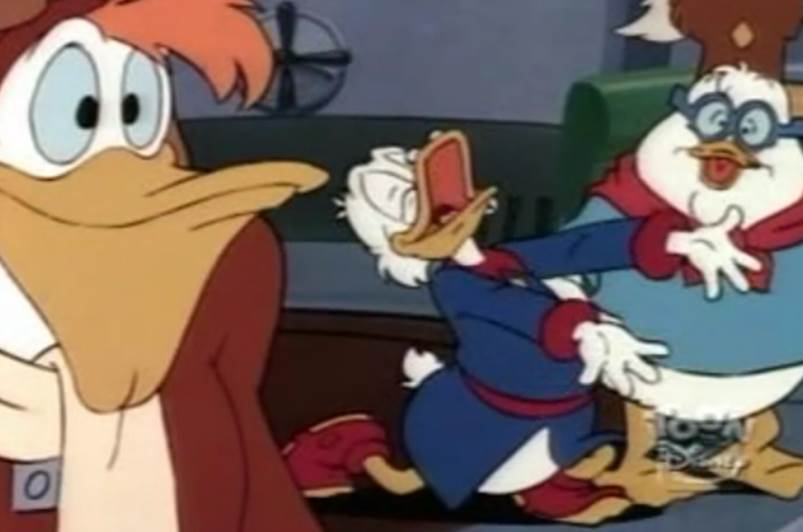
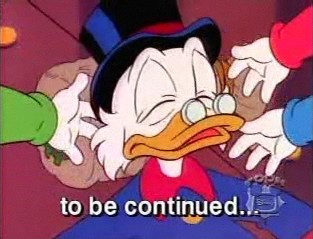
Artistically speaking, the MLP:FIM title works because the artists (Andy Price, in this first story arc) have found a successful "middle ground" between the flat, stylized, two-dimensional look of the TV show and the solider, more three-dimensional look that is required in order to make the characters seem more "real" on paper.  Now, admittedly, the Colorforms aesthetic has some distinct advantages, especially when the characters are as well designed as these.  If you're clever enough and your animators and designers are skilled enough, then the stylized approach can make for some arresting visuals.  For example, which of the following images is more effective at getting across the onset of an outburst of insanity?

Sorry, Scrooge, but Twilight Sparkle has you beaten here.  However, as funny as the poses in the animated MLP:FIM can be, I don't think that they would transfer all that well to a comic-book story, in which (and note that this is a personal preference -- YMMV) I have to be given some sort of aesthetic reason to believe in the reality of the characters.  The creators at Bongo Comics managed to turn the difficult trick of rendering Matt Groening's semi-abstract characters into acceptable comic-book form, but the MLP:FIM characters and settings are far more elaborate; simply replicating the look of the series would give the comic book the appearance of fancy wallpaper.  Price and the other artists working on the title solved the dilemma by altering the templates of the characters just enough to allow for more flexibility of expression (in terms of the eyes and mouth, mostly) and to make three-dimensional renditions of the characters possible without lunging way off model.  For all the attractiveness of the series, I actually prefer the comic-book appearances of the characters; I only wish that the kaboom! versions of the Disney TV characters had been this consistently good.

Katie Cook's script for the first story arc mirrors the artwork; in terms of wit and cleverness, it's a step up from the already-impressive writing for the TV series.  The ongoing byplay among the "mane 6" pony heroines is the highlight, of course, but Cook adds significantly to the fun by giving the villainess of the piece, the evil Changeling Queen Chrysalis, a bit more of a humorous edge.  There is a certain danger in this, of course, in that a wisecracking villain can quickly lose credibility if there is insufficient menace to balance the equation, and I think that Cook gets close to crossing the line on a couple of occasions here.  The comic script also resembles a number of the animated stories I've viewed in that, for all the bells and whistles, the underlying plot is really rather elementary.  But, on balance, these first four issues were truly a pleasure to read.

On to the individual issues...

S
P
O
I
L
E
R

S
P
A
C
E

Did you realize that MLP:FIM #1 was published under NINETEEN (!!) different covers?  Yes, I still have issues with the whole multiple-cover scheme, and I would have even if the six "pony solo" covers had been the only ones issued.  The book is already selling incredibly well, and artificially goosing the sales with gimmicks like this seems like opportunism of the highest order.

Anyway... Queen Chrysalis' Changelings are back after their defeat in the TV two-parter "A Canterlot Wedding," once again seeking to suck souls and leech off of others' happiness.  But wait, there's more... Chrysalis has an even more devious plan in mind and intends to use the three "Cutie Mark Crusaders" as bait to lure the six major heroines to her lair.  For the uninitiated, the "Crusaders" are three little ponies who have yet to determine their passions in life and thereby earn their "Cutie Marks."  You can imagine how such youthful sincerity might turn an evil queen's stomach... and, in fact, Chrysalis' increasing impatience with the girls is one of the arc's comedic highlights.

In #2, the "mane 6" go all "There and Back Again" on us as they embark on a quest to Queen Chrysalis' realm.  We even get some possible shoutouts to Gummi Bears in the form of a cave troll with a fetish for ponies and some decidedly goofy-looking arachnids.  Changelings try to sow confusion by disguising themselves as members of the "mane 6" and trying to turn our heroines against one another... and, completely forgetting that the Changelings had done just that in their first encounter, the "mane 6" fall for it hook, line, and sinker.  Given the series' constant harping on the importance of sticking together in friendship, you'll forgive me if I didn't find this contrived conflict to be all that convincing.  Surely one of our heroines should have tumbled to the possibility that such out-of-character behavior was a hoax?

#3 starts with some jet-black humor as we learn in flashback what happened to Chrysalis and her Changelings after they were literally blown out of Equestria: they landed in "Wuvy-Duvy Smoochy Land," inhabited by mindlessly loving little cats.  The place, of course, became the Changeling Kingdom in short order.  Chrysalis later ups the ante by smooshing one of the poor kitties right in front of the horrified "Cutie Mark Crusaders."  And Darkwing Duck fans thought that the "Cute Little Lost Bunnies" were a harsh dig at the Care Bears.  The "mane 6" spend most of the issue making up with one another, that is, when they're not fighting carnivorous jackalopes and petunias.  It reads better than it sounds.  An amusing framing sequence features Spike, the ponies' baby dragon friend and helper, hyping the action in the manner of a carnival barker.


The "Power of Friendship" conquers all!  Queen Chrysalis plans to drain Twilight Sparkle of her magic with the help of a celestial conjunction caused by the "Secretariat Comet."  (Insert "it's not Saturday, it's Friday") joke here.  Better yet, she'll drain Twilight of her love for her friends and then have her destroy them.  Twilight fights back and batters Chrysalis into submission, monologuing all the while about how the selfish Chrysalis can't possibly understand the power of friendship and love, etc.  Yes, we're quite familiar with such an approach from the toy-commercials-with-morals-tacked-on era of TV animation, but very rarely has the sentiment been ladled on with such slick efficiency.  The defeated Chrysalis gets the ultimate punishment: having the irritating Pinkie Pie serve as her jailer.

I think that this one's a keeper.  Who knows, I might even be able to attend the upcoming BronyCon in Baltimore and not embarrass myself.

Wednesday, June 5, 2013

DUCKTALES RETROSPECTIVE: Episode 38, "Catch as Cash Can, Part Three: Aqua Ducks"

My revisiting of what I've always considered to be the weakest chapter of the "firefly fruit" saga turned out to be a more pleasant sojourn than I'd expected.  I'd now rank it ahead of "A Drain on the Economy" on the quality scale, though still safely behind both "A Whale of a Bad Time" and the climactic "Working for Scales."  Part of the reason why is a belated attempt to be fair to Michael Keyes' teleplay, specifically, its similarity to that of "Cold Ducks" in "Treasure of the Golden Suns" (which, ironically, occupies the same penultimate position in the narrative).  Keyes introduces various details at the start of "Aqua Ducks" and cleverly kneads all of them together as the plot progresses. Accepting Gyro, Launchpad, and Doofus' successful "raising of Atlantis" and its centuries-old layer of "air-breather" trash may still require a certain suspension of logic in the viewer's mind, but I give Keyes credit for trying to make the narrative cohere in a satisfactory fashion.  I have also uncovered some overt evidence that Keyes (or the guiding trio of Magon, Talkington, and Zaslove) was, in fact, influenced by Barks' "The Secret of Atlantis" here, and that's certainly worth a few bonus points.

Of course, I don't want to go too far in rehabbing this ep.  Dan Neyer has done a good job of reminding me and all other partakers of this blog of Scrooge's lengthy history of (momentary) hysteria, but the old miser's ceaseless verbal battering of his "partners in dive" has ALWAYS irritated the living hell out of me, and it still does today.  Nor have I ever understood why Scrooge would sign off on allowing Doofus to provide the "youth interest" on this trip, especially since Scrooge (as Greg correctly noted) has had virtually no interaction whatsoever with the Nephews' portly pal up until this point in the production order of the series.  The on-edge Scrooge who had two mini-fits in "Economy" and pitched the funniest tantrum in the history of TV animation in "Whale" should have known that changing the usual cast of adventuring characters in this manner was asking for trouble.  Add on the expected moments of bumbledom from LP, Gyro, and Doofus to set Scrooge off and the insertion of a not-so-very-subtle environmental message, and you have an episode that, while it has its share of strong points, still has a distinct tendency to grate on one's sensibilities like sand in one's beachwear.

Recall that the original script for "Three Ducks of the Condor" originally presented Scrooge in a far harsher light, playing up his tendency to boss others around so as to provide a better contrast to the imperious Joaquin Slolee.  I think that some of the excess bile that was ultimately drawn out of that ep must have trickled its way into this one.  Scrooge's second line of dialogue (which ironically follows words of praise for Gyro's quick construction of the Gold Digger) is already of the "snarky dig" variety, and we're off to the (verbal) razes.  The worst part of Scrooge's opening salvo of spleen sploodge is his immediate bashing of Doofus, starting with the implied claim that Doofus' approval of Gyro's "Super Fizz" drink means that the kid isn't human (or avian, or whatever).  Scrooge hadn't seen ANY real evidence of Doofus' fallibility in "Merit-Time Adventure," "Hero for Hire," or "Where No Duck Has Gone Before."  Nor had Doofus yet done anything to tick Scrooge off in this episode.  Heck, even Launchpad hadn't really screwed anything up at this point, since the initial 'copter crash occurred because of a mechanical problem.  Scrooge's behavior in these early scenes seems like an incredibly crude way of setting up the subsequent conflicts between him and the "morons" on his team.  Keyes would have been much better off letting Scrooge's anger build as the episode progressed.  

Gyro seems to need another type of "Super Fizz" here!

Of the three "morons," Gyro arguably is the least deserving of Scrooge's abuse; the stuck valve that caused the premature inflation of the balloon inside the Gold Digger is, like the 'copter crash, a mechanical malfunction, and Scrooge should have known that bugs might develop in the Gold Digger due to the lack of beta-testing.  (Oddly enough, after the gang plugs the leaks that develop in the Marinara Trench, the seaworthiness of the Digger is never an issue again.)  Where Scrooge might have found additional fault with the inventor was the method Gyro created to get Scrooge's money off the ocean bottom: using balloons to float it to the surface in bags.  Rather small bags.  If you accept the premise of "A Christmas for Shacktown" regarding how long it would take Scrooge to haul his money out of the quicksand pit by toy train...

... then how long would Gyro's method take?  Half as long, perhaps?  That would still be well over a century.  There would also be more potential for loss, especially since we never see who, if anyone, was tasked with the job of fishing the bags off the surface of the ocean.  The bags could very easily drift away from their surfacing points as well.  I suspect some sort of magical intervention would have to be involved here.  Is Calisota next door to Equestria, perchance?

Doofus' main contribution to raising Scrooge's blood pressure is, of course, his using a balloon to squeak -- er, speak -- er, both -- to dolphins.  I think that Keyes missed a chance here to at least partially justify Doofus' presence in the episode by making more of Doofus' Junior Woodchuck ties.  Doofus' eager participation in the JWs is, after all, one of the major things (besides the physically obvious, of course) that defines the character.  But after allowing Doofus to use his "Junior Woodchuck Toothpick" to pop the out-of-control balloon, Keyes simply has Doofus stumble onto his dolphin communication system (which, of course, will play a major role in helping the captured Ducks to escape the Fish Folk) through dumb luck.  Unless the Junior Woodchuck Guidebook has explicit instructions regarding bringing peanut butter and sardines on underwater expeditions, this sort of convenient revelation could have been vouchsafed to anyone -- even a Littlest Chickadee.

Launchpad, of course, doesn't need to be laden with any additional burdens of dubious competence; all that he has to do to arouse Scrooge's ire is simply to be himself.

The most impressive sequence of "Aqua" is probably the stretch between the Ducks' dive into the Marinara Trench and their capture by the Fish Folk.  The Trench visuals provide us with our first tantalizing hint that "The Secret of Atlantis" may have been mined for source material: the appearance of weird, luminescent fish.  Granted, Barks takes fuller advantage of the situation by using the fish to explain why Atlantis can enjoy daylight, but "Aqua" makes up for shedding less (natural) light on its subjects by including a neat "passage of time" scene in which the Gold Digger switches on its lights in dramatic fashion.  Remarkably enough, the figure of "5000 fathoms" (9140 feet) reported by Launchpad during the Ducks' descent is pretty close to the actual record dive depth in the real-world Marianas Trench, the mark of 10,916 feet at the so-called Challenger Deep.  Since the Digger still had a ways to go before touching bottom at the time LP issued that statement, the actual depth of the Marinara Trench must have been even closer to the real-world figure.  I suspect that Barks would heartily approve of such accuracy.

After dropping what GeoX reported as "an Are You Being Served?" reference -- personally, I was thinking of elevator operator Bugs' announcement to the Great Gildersleeve character in Hare Conditioned (1945) -- we get one of the series' most eye-popping pop-culture references, Scrooge's brief "Mammy" call-back.  Would this has slipped through today?  I highly doubt it.  Even Doofus seems somewhat taken aback by Scrooge's Jolson take, and we've had 25 years to sharpen our "sensitivities" since then.  Soon thereafter follows another classic movie reference, with Scrooge lamenting the "morons on [his] team" in the manner of the Strother Martin character in Butch Cassidy and the Sundance Kid (1969).  Might this be considered a call-ahead to a future Don Rosa story featuring those raffish title characters?

The first encounter with the Fish Folk also goes rather well, with the Gold Digger following in the noble tradition of the Golden Condor and the Construction Robots by acquiring distinctly sentient characteristics.  The "humanoid" way in which the Digger attempts to squiggle away from the Ducks' would-be captors is very nicely done.

With the introduction of the Fish Folk's environmentally-mandated mad-on against the "air breathers," the tale bogs down somewhat.  The price we have to pay for Master Malek's lengthy video-enhanced diatribe against the polluting "purple traitors" (thanks for trying to lighten up this scene, LP) and the subsequent sentencing of our gang to 400 years of hard labor in the junkyard is that, in contrast to Barks' quick yet careful sketch of Atlantean civilization, we never get a real sense of who the Fish Folk are, or from whence they originated.  GeoX described the Folk as "charmless," which is accurate enough, but the reason why they are such is that we only basically see them browbeating, slave-driving, or pursuing the Ducks.  Barks' Atlanteans, by contrast, are much more sympathetic; even though they effectively imprison Scrooge, Donald, Huey, and Dewey, they have a convincing reason for doing so (wanting to avoid discovery and exploitation at the hands of the "greedy" surface dwellers), and they are even willing to allow the Ducks to learn the story and secrets of their civilization.  (Of course, had Barks conceived the Atlantis story during the time he wrote his JUNIOR WOODCHUCKS scripts, he might well have opted for the more simplistic anti-pollution approach.)  If Keyes, Magon, Talkington, and Zaslove did take inspiration from "The Secret of Atlantis," then they seem to have missed the point -- and, yes, I'm now inclined to believe that they did.  The overarching reason?  Pants.  Yes, really!

Horizontally striped red and blue pants in both cases!  Fashion faux pas such as these don't occur simultaneously due to mere chance.  As to the simpler designs (carp-ish and frog-like) of the Fish Folk, I suspect that that was done for the obvious reason, to make the Folk appear "Toonier" and, therefore, more in line with the designs of the Duck characters.  Barks' "men turned fish" design may have struck the DT character designers as a bit too realistic.

Visually, the design and setting of the sunken "junkyard" of Atlantis -- complete with upside-down ship where the imprisoned Ducks can survive, Poseidon-style -- are most impressive.  How unfortunate, therefore, that the animators couldn't keep the appearance of the place straight.  The sunken Atlantis, with its coral-encrusted towers and temples, looks like an underwater Bedrock; the newly raised city, by contrast, loses its calcium carbonate coating almost immediately.  By the time "Working for Scales" opens, the place looks like a brand-new Las Vegas resort (and with Scrooge's fortune now arranged into a tidy pile, to boot).  I'll have more to say about the decidedly jagged join between "Aqua" and "Working for Scales" in my next entry, but, for now, I'll just let the contradictory pictures speak for themselves.

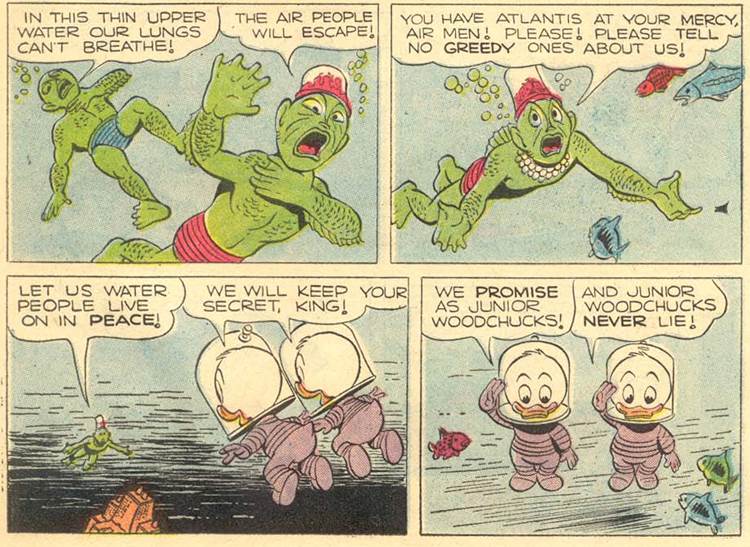
The "revenge of the morons" neatly incorporates a whole honkin' load of artfully planted story elements: the calcium carbonate, "Super Fizz," the vulcanized rubber, even Doofus' cherished peanut butter and sardines (though I must confess that I don't recall Gyro making a big deal of needing a vegetable oil to create his home brew).  The rescue would have been dramatic enough without the superfluous added peril of a sudden leak that imperils Scrooge in "solitary confinement"; the contrived nature of this business reminded me of the melting snow suddenly threatening The Mole's hideout in DICK TRACY.  The chase sequence featuring Launchpad, Squeaker, the Fish Folk guards, and the monster Glubzilla is a sort of reprise of the air battle at the climax of "Three Ducks of the Condor," albeit a mellower one, due to the nature of underwater travel.  It's not entirely surprising that the Fish Folk ultimately flub their pursuit, given that they had inexplicably parked the Gold Digger right next to the junkyard before Scrooge's earlier, abortive escape attempt.  LP's ultimate resort to that old Disney Afternoon standby of tickle-torture to convince Glubby to release the rising Atlantis somehow seems fitting.  Barks' parallel "Going Up!" scene in "The Secret of Atlantis" is fittingly more sober-sided, with Huey and Dewey promising never to reveal the existence of the underwater city.


"Aqua Ducks" is in no sense a classic or anything close to it, but I'm willing to give it its fair share of props and acknowledge what it does do well.  I just wish that Keyes' "snarling Scrooge" and "morons save the day" approach had been tempered a bit.  To be fair, the single most inappropriate moment of harshness on the part of Scrooge in this serial is still ahead of us.

.

.

.

"DuckBlurbs"

(GeoX)  Doofus refers to "my mom," the only piece of evidence so far that would contradict my theory that he's an insane vagrant. Still not entirely convinced, though.

Well, I am.  Why else do you think that Doofus disappears after this chapter?  Someone back home must have insisted that Doofus stay behind when the gang returned to Duckburg for final preparations to travel to Macaroon.  And there's absolutely no doubt that they did so, as I'll argue when discussing "Working for Scales."

(GeoX)  "Thanks to Flintheart Glomgold, my fortune is sitting on the bottom of the ocean!''--Well, as noted in the entry for the previous episode, you've gotta take a lot of the blame for that yourself.

I suppose that in a certain sense, Glomgold was to blame for Scrooge's money winding up there... but it's true, Scrooge did make the fateful decision to pull THE... SWITCH, um, I mean, the eject lever.

(Greg) [Gyro] gives the beaker to Launchpad and the glass to Scrooge and neither one seems terribly excited about it. They drink it and they all gag and spit on cue...  Launchpad proclaims that it tastes like an old tire and Gyro responds by saying that vulcanized rubber is one of the main ingredients. You know what is even funnier: fake rubber is the main ingredient in bubble gum. So it's not the rubber's fault; it's GYRO forgetting to add flavoring to MASK the rubber.

I wish I knew WHY Gyro added vulcanized rubber in the first place.  Practical uses of vulcanized rubber that I dredged up using Google include tires, hockey pucks, shoes, and hoses -- nothing liquid there.  (Evidently, I haven't watched enough episodes of How It's Made.)  At least Keyes tried to bring in the rubber angle later in the story to give Squeaker and his pals a way to help the Ducks by fetching the old tires. 

(Greg)  Doofus is blowing up Gedo balloons with the mini air pump just to annoy me...  He then rubs the balloon casually as that annoys Scrooge to no end...  Scrooge... pops the balloon with his cane (BOO HISS!) and threatens to make him tread water the hard way. 

Threatening to drown a child for a petty cause... ugh.  Scrooge's subsequent reference to Doofus as "a pea brain" is practically a complement next to this.

(Greg)  So we see the Gold Digger swim in an easterly direction as Scrooge asks if they are at the money and Launchpad checks his coordinates and proclaims that it should be over the ridge... I predict that we see the bottom and there is no gold to be found. I check the DVD... Damn; I'm good as there is only a penny left as Doofus asks if he had a lot more money than that. HAHA!... Gyro calls this impossible because no craft could dive this deep and you cannot move three acres of gold that fast.  

There is an obvious logic break here that Greg missed: since the money is not where it is supposed to be, the Fish Folk must have moved it, so how did they move it?  Master Malek calls the arrival of Scrooge's fortune on the sea bed "littering" and we later see pictures of the Fish Folk dumping some money into the junkyard, so the money can't simply have fallen en masse into the junkyard to begin with.  Glubzilla must have really "earned his kelp" on this little job.

(Greg)  [W]e see a huge clam being placed on a podium and then some electric eels go into it and it opens to create a television screen. 

Leaving aside the obvious question of who the heck TOOK the pictures of the Fish Folk being inundated with trash over the centuries, this scene may provide additional evidence that the writers consulted "The Secret of Atlantis."  Barks gave the Atlanteans an "all-fish lighting system" that provided illumination for street signs and street lamps.  (Since the "layer of glowing fish" was already present to give Atlantis a source of light, these technological innovations seem a bit redundant, but that's another story.)

(Greg)  [T]he City of Atlantis rises from the ocean slowly to the surface and I see Logic Break #10 because there's no F'N way the city could FIT through the deep trench. 

Agreed; this is as bad as the coral cover suddenly vamoosing on the surface.

(Greg) So the water drains from the smoke stack and Scrooge is screwed because he free falls and slides down the smoke stack and lands with a wussy bump onto the ground...  Gyro and Doofus meet with him and Scrooge is in SHOCK. Gyro thanks LP and the dolphins along and Doofus thanks Gyro for the fizzy drink. I would thank Doofus for getting the dolphins to help of course; but it's ignored. 

Actually, Gyro does mention both Launchpad and Doofus here, so Doofus does get his due(fus) before all is said and done.

Next: Episode 39, "Catch as Cash Can, Part Four: Working for Scales." 

Friday, May 31, 2013

DUCKTALES RETROSPECTIVE: Episode 37, "Catch as Cash Can, Part Two: A Whale of a Bad Time"

Before we start, let's pause for a momentary look back.  I got quite a number of challenges to my assessment of "A Drain on the Economy," mostly concerning the believability of Scrooge's mental meltdown.  I'm happy to concede the point that there were several other significant instances in which Scrooge showed similar vulnerability, including one that DuckTales would later mold into one of the series' better Barks adaptations.  Dan Neyer fingered "The Menehune Mystery" as another example of Scrooge going "nutsoid," but Scrooge's panic attacks there, IMHO, don't quite rise to the level of the "round-the-bendedness" he displays in "Drain" and "Tralla La."  My reaction to Scrooge's behavior in "Drain" was probably partly due to the amount of exposure that I had had to Barks' UNCLE $CROOGE stories at the time I first watched the episode.  I simply hadn't SEEN that many $CROOGE stories at that point.  Moreover, I still feel that something a bit more than a Beagle Boy raid, however massive, would be required in order to tip Scrooge completely over the edge.  The deluge of panhandlers, tax collectors, etc. in "Tralla La" -- which seemed even more overwhelming when depicted in animated form -- I could buy as a believable trigger, but not an occurrence that Scrooge should more or less be used to by now.

There seems to be little debate about the high quality of "A Whale of a Bad Time."  The episode overcomes a bit of a stuttering start to deliver a highly effective mix of comedy and suspense.  Donald gets one of his few chances to feature in an episode in which he is not being victimized or manipulated by outside forces, and, by and large, he makes the most of it.  In his first substantial series role, Admiral Grimitz manages the tricky feat of seeming funny while eschewing the somewhat forced "kablooey!"-centered humor that would be overstressed in future Navy-focused eps.  More impressively, he actually comes across as at least a semi-competent commander; in no other episode will the cry "The Navy to the rescue!" engender such a feeling of reassurance.  One-shot villain Dr. Horatio Bluebottle encapsulates the virtues of the ep in miniature, being both a giggling jokester and a legitimate threat to the well-being of our heroes and half of Scrooge's fortune; in that respect, he's an interesting dogface precursor of Chip and Dale's Rescue Rangers' Professor Norton Nimnul.  Then, of course, there's that little spot of bother involving a "sea monster" and "ice cream."

The "shipping money disguised as ice cream" business that dominates the opening minutes really does require a substantial suspension of disbelief (which includes a suspension of the idea that HD&L really should have gotten extremely suspicious of the entire setup from the start).  Between the expenses he incurred during the course of "A Drain on the Economy" and the amount of money required to build the fake factory, hire grouchy guards, and outfit robot-driven trucks, Scrooge must have employed the "Bill Me Later" gambit to the absolute hilt in order to avoid fatally falling behind Glomgold in the money-weighing contest. 

Perhaps it was the sultry weather, but the Nephews seem awfully cranky early on; even their voices seem a bit higher-pitched than normal.  The air conditioning must not have been repaired by the time the boys returned home, as Mrs. Beakly harshly tells the boys not to bother Scrooge and Webby suddenly turns into a whiny little greedy-guts.  The latter may be the single most pointless one-off character quirk of the series; it is never referenced again outside of the dining-table and breakfast-nook scenes in this episode and doesn't seem to serve any larger purpose.  Anthony Adams, who wrote this episode's teleplay, wrote a number of other eps involving Webby ("Lost Crown of Genghis Khan," "The Curse of Castle McDuck," "Maid of the Myth") and didn't refer to this character trait in any of them.  Why did he feel the need to toss it in here?  And why didn't Magon, Zaslove, and Talkington call him on it and ask him to cycle Webby back to something resembling her normal personality in these scenes?

Unlike Webby, HD&L get a quick opportunity to atone for their earlier splenetic spasms when the "ice cream" trucks decide to take a night detour right past the McDuck Mansion.  (If I were Scrooge, I'd probably have chosen a more landmark-shy route.)  The boys perform their subsequent detective duties quite admirably, though their method of entry into one of the trucks would probably not pass BS&P muster today.  This is as close as the lads will ever get to sky-surfing a la Kit Cloudkicker.  The "reveal" of Scrooge as the money-moving mastermind is also well done, though Louie appears to have lost his neck somewhere along the way.  The "Transparent-Necked" Scrooge in kaboom! DUCKTALES #3 at least had something connecting his noggin to his shoulders!

"Keep your heads up, lads... those of you who can, that is."

The kitchen breakfast nook makes its first appearance in... well, in THAT scene, and will become a familiar gathering place over time, in such episodes as "Till Nephews Do Us Part" and "Scrooge's Last Adventure."  Along with the front gate and Scrooge's home office (the one with the rolltop desk), the nook will become one of the signature features of McDuck Mansion, one that I actually wish could have been carried over into future comic-book stories.  Aside from being cozier than the dining-room setting, the nook makes sense in context, as it probably cost much less than the table, chairs, and other paraphernalia in the dining room.  Scrooge would probably want me to add that, since it is closer to the kitchen, the nook allows the McDuck household to save on gas and electricity used in preparing food, since the food comes to the table hotter to begin with.

The nook has one additional advantage in the context of this episode: it provides a more informal, and hence more appropriate, setting for you-know-what than the formal dining area would have.  Rave on, McDuck!  And don't fret about breaking any of the good china.


And there's your most famous scene of the series right there.  I don't know which is more improbable: Scrooge's head-bouncing or his ability to pull a tablecloth out from under Huey and Louie's legs without knocking them over.  

Oddly enough, Scrooge's fit proves to be the turning point of "Whale" in terms of quality.  Everything hereafter is first-rate, though one or two logical hiccups still intrude.  GeoX points out a clear contradiction in that Scrooge denies the existence of sea monsters after having encountered the "seaweed monster" in "Bermuda Triangle Tangle" (I'm willing to give Scrooge a pass on "Home Sweet Homer" because Scrooge may have rationalized away the reality of that time-trip in some manner by now).  The gaffe is actually worse than GeoX described, as the Nephews also appear to have forgotten about their previous monster-meeting moments.  I suspect a lack of communication between Adams and the other writers on this matter.  As for the slightly phony appearance of Bluebottle's "S.S. Moby," I rather doubt that the Ducks had the luxury of examining it thoroughly during that initial encounter, seeing as how they were being shaken nearly to death and all.  Still, it would have been nice had the rivets, seams, and doors been a tad more inconspicuous.  My guess is that it was feared that an overly realistic Orca attacking the Ducks at the commercial break would have seemed too frightening, and thus the visual evidence of fakery was added.  If the intent was to make the scene more reassuring, then the gambit failed; this remains one of the more intense action sequences of the series, intervening commercial break notwithstanding.  As Scrooge might put it, there are additional such fireworks a-comin'.

Before the first pseduo-Orca encounter, we get a couple of equally fine sequences: Scrooge and HD&L's underwater exploration (in which they fittingly wear diving gear that may very well have been lifted from one of Barks' best seafaring stories) and the introduction of Donald and Admiral Grimitz.  The Ducks' use of a giant turtle to sneak up on the wrecked ship is one of those clever throwaway bits of Junior Woodchuck lore that the show honestly should have used more often (as opposed to showing us how fallible the Guidebook could sometimes be).  The encounters with the Navy guards pack more punch than all of the series' "Scrooge in jail" scenes combined.  Grimitz keeps the semi-serious beat going when he calmly refuses to rise to the bait of Scrooge's insults and threats.  This was the ideal situation in which to introduce what would become Grimitz' permanent voice, namely, Peter Cullen's riff on John Wayne (Cullen had used a more generic "authority figure" voice for the Admiral in "Home Sweet Homer").  I don't think that even Optimus Prime could have provided a better template for Grimitz' voice, mainly because Cullen was able to leaven the impression with a healthy hint of humor.  Unfortunately, later appearances by Grimitz failed to maintain the same balance of humor and seriousness in the character, opting for the "lunkheaded jingo" characterization.

This episode affords us our only real chance of the series to see Scrooge and Donald operating as a team, with no other characters present.  Happily, Adams seems to recognize the basic differences between the two while downplaying the "clumsiness" gags that clutter up many of Don's other DuckTales appearances.  The mere fact that Grimitz decides to entrust Donald with the task of keeping an eye on Scrooge (with surreptitious electronic assistance, of course) gives Don's role here a certain basic level of gravitas that the bumbling deckhand of other episodes simply can't conjure up.  Appropriately, Scrooge's attitude towards Donald is refreshingly free from extreme condescension; at worst, he seems mildly bemused by his nephew's actions and words.  The one glaring exception, of course, is the hoary "use your head" routine in which Donald smashes the sub's control panel.  I really think that Adams could have come up with a cleverer way than this to show Donald's... well, Donaldishness.  Also, I have to agree with Greg that Scrooge's reaction to Donald's threat to use what both Ducks believe to be the "self-destruct lever" seems too casual. (By contrast, Scrooge's reaction after he learns that the lever controls the dumping of his money is entirely in character.)  One must admit, however, that this is a pretty badass moment for Donald, and he's not even under the spell of an evil king at the time.

Concerning the not-so-good Dr. Bluebottle, I'll agree with GeoX on one point: Horatio does seem more like a Mickey Mouse villain than a Duck dastard, and not simply because he's the same size as Scrooge and Donald.  Along with Professor Nimnul, he reminds me a bit of Emil Eagle, Gyro Gearloose's evil rival, who later became a quasi-regular foe of Mickey and others in the comics. Both Bluebottle and Emil have permanent mad-ons because they feel unfairly put-upon by fate: Emil because he is jealous of Gyro (in addition to desiring the usual "power and money"), Bluebottle because his Navy work makes him ineligible for the "No-Bill Prize."  (The specific prize for which Horatio would be eligible is unclear; perhaps it's for "Research with a Sense of Hyyyumor.")  The implied conflict between "research for its own sake" and "research related to warfare" is intriguing, though Adams does nothing of substance with it, preferring instead to display such improbable features of the sub as a hose, a giant umbrella, and a missile-deflecting tennis racket.

The intensity ratchets up again when the Navy starts dropping the depth charges, and yet again when it seems to those on the surface that one of those charges has met its mark.  Thankfully, the overplayed bawling (which, in all honesty, is still much better than a number of the crying jags we had to endure in Kimba the White Lion) is kept to a relative minimum in the latter scene, with HD&L seeming to be more in shock than anything else.  Check out Dewey's facial expression, in particular; it's as if he's still processing the reality of what he believes the situation to be.

Scrooge's decision to jettison the money into the Marinara Trench doesn't bother me as much as it did GeoX.  It may not strike one as a typical "tougher than the toughies" moment, but for Scrooge to show that kind of faith in Gyro (or in his ability to compel Gyro to come up with a method of salvaging the money) required jumbo-sized cojones.  Even so, this sequence could probably have been written more artfully.  Bluebottle's comment that "a normal sub can't dive this deep" seems to have little to do with his subsequent claim that only he can raise the Orca; after all, he had little to do with the sub falling into the trench in the first place.  Adams might have been better advised to have set things up so that Bluebottle's claims were actually in the nature of a bluff and that Horatio was trying to preserve the status quo so as to fulfill his deal with Glomgold and get his reward.  The final showdown between Scrooge and Horatio would then have become a TRUE battle of wills.

"Whale" ends with a nice verbal lead-in into part three of the serial, and Donald even gets a medal that wasn't manufactured by the Nephews.  (I guess that Don had to give it back before the events of "All Ducks on Deck.")   Flawless it certainly isn't, but this whale-tale gets the job done: it is entertaining in and of itself, gives everyone involved something to do (even if it's somewhat out of character!), and, of course, gives us the one single DuckTales moment that will "live in infamy," techno-mixed or otherwise.

.

.

.

"DuckBlurbs"

(Greg)  Apparently; there are 131 flavors of ice cream [at Scrooge's factory] which is BS since most ice cream factories churn out about half that in real life. 

Tell that to the folks in Merida, Venezuela.  This shop makes Scrooge, not to mention Baskin-Robbins, look like an unambitious piker.

(Greg)  We see various ice cream trucks in the background and one being driven as the nephews follow it out back. And then we see a pig security guard (voiced by Hal Smith) telling them to scram as the nephews try to introduce themselves as friends of Scrooge McDuck...  No dice as he blows them off and pushes them out because he doesn't care if they are Frosty's sister and that Scrooge left instructions for no one to be let in. Which includes nobodies like them.

Adams is more likely than most DuckTales writers to throw real-world references into his scripts, but, beginning with the shout-out to "Frosty the Snowman's sister," we get a positive torrent of them here: Jonah, Martina Navratilova, Albert Einstein, Enrico Fermi (or, as Bluebottle calls him, "Foimie"), Charlie Tuna, and any number of well-known magazines.  I guess he was trying to make the point that "Quackeria" (which appears to be Greg's own term for the Ducks' version of America) really and truly is just like our own world, apart from those annoying duckbills, pig snouts, and dog ears and noses.   

(Greg)  Grimtiz thanks [Donald] for his heroism and he'll award Donald with the silver star (which Disney Caption calls a silver tar. Seriously; what are these guys thinking?!) as Donald just blushes.

I think that you may have to blush next, Greg... Grimitz clearly says "silver tar" here.  I imagine that this was a simple play on words, referring to an actual military decoration and the fact that Donald is literally a "tar" (seaman).  Given Adams' predilections in the episode, I'm somewhat surprised that he didn't refer to the real Silver Star.  Then again, the real Navy may not have been amused.

Next: Episode 38, "Catch as Cash Can, Part Three:  Aqua Ducks."

Tuesday, May 28, 2013

National Champs! Stevenson 16, RIT 14

From near Ground Zero to the pinnacle in nine years.  When I joined the faculty at Stevenson, the lacrosse team, along with most other teams, played on the "front field" on the original Greenspring campus before standing-only "crowds" that could typically be counted in the teens.  Even for a Division III school, the program was small-time.  This past Sunday in Philadelphia, Nicky and I watched the Mustangs win a wild 16-14 game against RIT and claim the school's first national title in any sport.


We were up in the club level at Lincoln Financial Field, rather at a distance from the main clutch of SU supporters.  This was because we'd purchased our tickets early, right after Stevenson beat Salisbury in the semifinals.  It took the school a while to get up to speed and organize mass bus transportation for the 400-odd additional people who came up from Baltimore.  Happily, we were able to mingle with the others at a local watering hole before the game.  We also really liked the club level, which featured padded seats and separate facilities for food and drink and provided an excellent view of the action.

You can watch highlights of the game below.  The full video is available at the NCAA Web site.

Monday, May 27, 2013

DUCKTALES RETROSPECTIVE: Episode 36, "Catch as Cash Can, Part One: A Drain on the Economy"

OK, about this "Catch as Cash Can" business... Not until very recently did I know that the four-part serial that Joe Torcivia and I had originally called "The Firefly Fruit Contest" (catchy, eh?) even had an "official" name.  And to what purpose, might I ask?  The phrase "Catch as Cash Can" doesn't seem to have any relevance whatsoever to the overarching plot of Scrooge and Glomgold having a money-weighing contest.  By contrast, when Carl Barks wrote "The Money Champ," it was plain as day from the get-go what was at stake.  However, I will admit that "Catch as Cash Can" does fit this story in a technical sense.  The MERRIAM-WEBSTER DICTIONARY's list of synonyms for the phrase "catch as catch can" includes such terms as "erratic," "slapdash," and "hit-or-miss," and the firefly-fruit serial definitely qualifies as any or all of these.  Parts one and three are arguably weaker than parts two and four, but all four segments have both "up" and "down" moments, making for a real toboggan ride of a story.

A lot of elements in "Catch" -- character reactions, character conflicts, gags -- seem to be pitched an octave or so higher than they normally should be for a DuckTales epic.  The infamous juxtaposition of Scrooge, a "sea monster," and "ice cream" in "A Whale of a Bad Time" is only the most noteworthy example of this tendency.  Right out of the gate, in "A Drain on the Economy," we get more exaggerated, cartoony gags and situations in 22 minutes than we did in ALL of "Treasure of the Golden Suns."  It almost seems as if writers Jymn Magon, Bruce Talkington, and Mark Zaslove wanted to unburden themselves of all the expected cartoon tropes that they had purposely suppressed in the action-dominated pilot story.  When they tapped Len Uhley, late of "Where No Duck Has Gone Before," to do the teleplay of "Drain," they must have known what they were getting themselves into, but Len really went over the top here, giving us a Scrooge who suffers not one but two near-nervous breakdowns, a veritable plague of Beagle Boys attacking the Money Bin, HD&L sustaining a physical battering in the sewers of Duckburg, and enough leaps of logic to sustain an entire Triple Jump competition.  It's enough to tucker out even the most dedicated of elderly multiquadzillionaires.

It's certainly possible that the creative team consciously borrowed the plot of "The Money Champ" to serve as the serial's throughline.  If they did so, then they missed a golden opportunity to shore up some of the Barks tale's questionable logistics.  In fact, as GeoX correctly pointed out in his reply to a comment on his review of the episode, "Drain"'s money-matching match actually makes LESS sense than did Barks' version of the same scenario.  Barks, after all, had Glomgold propose that Flinty and Scrooge convert all their holdings to silver dollars in order for there to be a "like vs. like" comparison:

Needless to say, with Scrooge and Flinty both in charge of global business empires, neither could ever pin down exactly how much he was worth at any given time.  But even Barks' modest attempt at applying some logic to the situation is missing in the DuckTales version.  Instead, the Grand Kishki of Macaroon simply asks the Ducks to "weigh [their] money" -- no conditions whatsoever.  What if Scrooge brought coins and bills to the weigh-in, while Glomgold brought gold bars?  Scrooge might still have more actual wealth, but Flinty might win the contest anyway.  (As it happens, Flinty ultimately does try to use metal bars of a different sort to cheat his way to victory.)

Early in "Drain," we are constantly reminded of the importance of Scrooge bringing "every penny" of the money in his Bin to Macaroon.  HD&L, in particular, seem to be tasked with verbally hammering this point home to the audience.  Oddly, this doesn't seem to be an issue in "The Money Champ"; the boys' sole concern during the money-transport process is that the trucks carrying Flinty's wealth are larger, roll faster, and have louder horns.  "Drain" is slightly more realistic, I suppose, in showing just how difficult it actually would BE to move all of one's wealth to a remote location, especially if one of the competitors is trying to actively sabotage the other (as opposed to getting an early jump, as a "thinly disguised" Glomgold did when he messed up some of Scrooge's business ventures in Barks' story).  Given Scrooge's headlined need to keep his fortune "all present and accounted for" (and with no Fenton Crackshell around to help!), it's hard not to notice just how damn near impossible it would be for Scrooge to do so as his money drains out of the Bin, goes into the sewers, is strewn hither and thither, etc.  With the Bin's floor having been cracked by the explosion of "Bertha," I even found myself wondering where Scrooge stored his money after he got it out of the penthouse and before he unleashed his "ice cream gambit" at the start of "A Whale of a Bad Time."  That's what happens when you leave too many holes in your plot and give the viewers the freedom to fill them in as they see fit.

The alliance between Glomgold and the Beagle Boys (which will be resumed in "Working for Scales") is a precursor of a number of similar cooperative ventures to come, especially in the second and third seasons.  Interestingly, Big Time doesn't show the same initial hostility to the idea here that he did when Magica asked for the B-Boys' help in "Send in the Clones." Once the ice is broken, however, the Beagles become "thugs for hire" to an extent they rarely were in the comics.

Given the Beagles' later success in commandeering/stealing the Money Bin in the "Time is Money" and "Super DuckTales" serials, the "ultimate Beagle Boy raid" that dominates the latter part of Act One might be considered a case of severe overkill.  Of course, the Beagles used a frontal assault here, rather than chicanery, and any Barks fan will tell you that those seemingly silly signs posted on Killmotor Hill are there for a reason.  The armor-suited Big Time's appeal to standard Toon operating procedure -- producing an oversized can opener from OUT OF NOWHERE to carve open the vault door -- isn't nearly enough to counteract the hailstorm of Warners-style pratfalls that rain upon the heads of his brothers, cousins, and such.  Though some of the gags push the bounds of believability (for the quasi-realistic realm of DuckTales, that is), this is one instance in which the somewhat more exaggerated approach of "Catch as Cash Can" actually matches what we might expect (hope?) to "really" happen if the Beagles were to train all their forces on Scrooge's property.

Greg questioned the presence of a tank in the Money Bin.  Frankly, I'd have been surprised if Scrooge hadn't had some kind of last-ditch defensive device stashed away in a corner somewhere, just as he had a Boer War cannon primed to fire in the 1951 Barks story that introduced the Beagle Boys.  The later presence of "Bertha" is more problematic, given that HD&L, at the very least, would have had to have seen the giant gun brought from Scrooge's "warehouse" and assembled on the premises, and thus their "surprise" at its sudden presence rang false.  The only reason that I can think of for the ordnance overkill is to make the ensuing "shell mishap" that cracks open the Bin a bit more "visually dramatic."  Not that Barks' original depiction of the exact same scene was anything to scoff at, but it's easier to imagine a huge gun like "Bertha" causing such massive damage.  (BTW, I don't recall this scene being cut in the aftermath of 9/11.  Given that it would have been near-impossible to have explained the explosion of "Bertha" without showing the shell's progress, WDTVA would probably have had to deep-six the entire episode, an unlikely occurrence in a multi-part story.)


The "Bertha blast" is one of the first examples of a "grafting" of an incident or a device from a Barks story into an unrelated TV story line.  "Time and Money" and "Super DuckTales" would later take this notion and run (if not sprint headlong) with it.  Seeing as how the essential backstories of the two scenes are basically the same, the selective swiping works quite well here.  Scrooge's comparative demeanor during the two scenes, on the other hand...

I have to say, I have always found Scrooge's quick descent into a crazed state in "Drain" to be highly questionable.  Of course, I'm looking at matters from the perspective of a Duck comics reader; a viewer who had had little exposure to Scrooge outside of the TV series wouldn't have been as likely to have picked up on the oddity of this transformation.  But even in 1987, at a time when I hadn't read most of Barks' stories, something about Scrooge's "nutsoid" fit rubbed me the wrong way.  It just didn't seem a likely thing for the Scrooge I knew at that time to do.  I had somewhat less of a problem with Scrooge's penthouse panic attack near the end of the episode, because at that point, Scrooge really had been through the wringer (an apt metaphor, given the importance of water in the sewer scenes), and he was probably far more tired and stressed out than he had been when he was drooling over "Bertha."  The "sea monster"/"ice cream" fit likewise didn't bother me as much because it was so ridiculously over the top that it possessed more "camp" than shock value.  But if just one big Beagle threat was enough to tip Scrooge over the mental edge, then why hadn't it ever happened before?  Scrooge's reactions here aren't even internally consistent when it comes to DuckTales itself; just look at the passive manner in which Scrooge reacted to the Beagles zapping his fortune away in "The Money Vanishes."  

The "A Christmas for Shacktown" scenario of Scrooge's money caving in the Bin floor and falling "down, down" into a pit over a swamp of quicksand was positively... well, believable compared to what happens to the money after "Bertha"'s big blowup creates the floor fissure.  Due to the nature of the disaster caused by Scrooge's addition of that "one coin too many" to the Bin in "Shacktown," it was easy to keep track of where "every penny" of Scrooge's fortune was ; the fortune's physical form (coins vs. bills vs. gold bars, etc.) made no difference.  When Scrooge's money falls into the sewers, logic would seem to dictate that the bags full of greenbacks would float away, while the coins and similar heavy objects would sink to the bottom.  (Indeed, the latter is exactly what Scrooge, Flinty, and HD&L assumed was the fate of the ship's treasure in "Wrongway in Ronguay.")  Instead, the physical rule followed by the laundered loot here seems to be, "whatever makes for a good visual."  Thus, for instance, there's no logical contradiction between money bags and piles of golden coins being piled up in various locations, despite the fact that it's easier to imagine the bags (if they're filled with banknotes, anyway) amassing in a pile.  It's a short step from here to the risible scene of ice makers and ovens spitting out cash in the penthouse.

For Scrooge's sake, I hope that the utility companies in Duckburg are as forgiving as they presumably must be in St. Canard.  After playing havoc with electricity in "Robot Robbers" and "Magica's Shadow War," Scrooge (with the assistance of the Beagle Boys) causes a water pumping station to blow up here, inadvertently mauling HD&L in the process.  (Lucky for the boys that their trip through the pipes was taken in accompaniment with only a dozen or so moneybags; otherwise the weight of Scrooge's fortune would have crushed and/or asphyxiated them.)  Add payment for the damages to the station and the penthouse to the bills for buying the penthouse and fixing the Money Bin's floor, and it's a wonder that Scrooge didn't quit the contest by episode's end.

"Drain" hasn't aged that well.  The Beagle raid, for all its goofiness, is admittedly amusing, but the balance of the rest of the episode is either overexaggerated to little purpose or reflective of various misunderstandings of what makes the main characters drip, er, tick.  Happily, the framework on which the "silly skin" will be stretched in part two will be much stronger, and the firefly-fruit narrative will get back on track.  Only for a while, though.  In this serial, momentary impressions typically prove to be as ephemeral as water flowing off a duck's back.   

.

.

.

DuckBlurbs

(GeoX) The central plot is painfully contrived: there's an India-ish country called "Macaroon" that has a magic kind of fruit that can provide illumination to replace lightbulbs and whatnot. But, according to the country's risibly accented ruler, "the only person qualified to market our fruit is the richest man in the world," which is about as flawed as premises get. But alas, it turns out that Scrooge and Glomgold are, as far as anyone can tell, equally rich, so the only way to tell which of them is "the only person qualified" is to lug all that cash down and weigh it. 'Cause it stands to reason that the one who has .001 milligrams more money is going to be qualified, whereas the other one would fatally botch the operation, right? Of course.

Actually, the charming naivete reflected in the Grand Kishki's assumption here matches up quite well with the attitude he'll display at greater length in "Working for Scales."  Risible it may be, but at least it's consistent

(GeoX)  In the sewers, the kids are easily scared away by Beagle Boys in a really fake-looking alligator suit. Just an example of poor characterization; the Junior Woodchucks I know would never be fooled so easily.

Agreed.  At least they balance out the moment of weakness by building a raft on short notice using a penknife and the Guidebook.


(GeoX) "Boy, the Department of Water and Power's gonna hear from me!" "Yeah! First fluoridation, now alligators!" Um…what? I know it's at least meant to be joke-y, but I feel about the same about this as I would if the show just casually stuck in a reference to the fakeness of the moon landings. 

Strangely enough, this joke is arguably less dated NOW than it was in 1987, given the current anti-vaccination movement.  I wonder why HD&L would be so concerned about fluoridation in the first place, given that they don't have teeth.  (At least, most of the time.  I remember the German "Donaldist" who crafted an elaborate theory as to where the Ducks' occasionally-seen teeth were "stored" when not in use.  Among his arguments was the contention that the Ducks could only develop tooth decay if they ate sweets while they were "angry or stressed," since that was the only time that their teeth would be visible.)

(Greg)  So we logically go to a look out tower in a prison as three dogsperson guards in brown security uniforms are guarding with billy clubs and the binoculars. We pan south east as Bouncer Beagle (Chuck McCann) is telling Bigtime that they need to get out of jail again as we see the Beagle Boys...  walking around in a circle as Bigtime blows Bouncer off because they are watching them like buzzards. Geez; I wonder why.

Stop the presses!  The Duckburg police department finally shows some intelligence by keeping a special eye on the B-Boys.  The extra vigilance doesn't prevent the Beagles from escaping, but, hey, you have to start somewhere.

(Greg)  So we head to a red fox (!!!) wearing a red suit with a pencil in his blue cap throwing a ball and jacks on the desk. Then he hears a weird bong and in through the door runs Scrooge demanding to know if this is the department of water. The fox blows him off as this is an oak counter top and asks how he might serve him. Scrooge wants the blueprints to the water systems or he's ruined. You know; telling someone they might be ruined isn't a good way to get something Scrooge McDuck. You sound like your panicking as the fox asks if he's kidding and Scrooge blows him off because he never kids about MONEY, MONEY, YEAH, YEAH. The fox gets upset over Scrooge's treatment of him as he has another set of blueprints as Scrooge demands answers on that while holding the fox's ears. The fox (Frank Welker) tells him some guys were in there asking for the same thing. Scrooge asks if they look weird and the fox answers that he did notice that they were wearing black masks which brings out the LIGHTBULB OF BLOODY CLARITY from Scrooge. Scrooge takes the blueprints and storms out as the fox drops on his ass with a wussy bump welcoming him despite getting no thank you from Scrooge. How nice of him....

This scene works rather well, starting with the Barksian bit of the bored fox playing jacks (wouldn't YOU find your work tedious if YOU worked for the Department of Water and Power?).  It could just as easily have been a throwaway bit to help Scrooge get from Point A to Point B, but I appreciated the attempt to inject humor into the situation.  The use of a fox as a one-shot character is also intriguing, and rare for the Duck "universe"; in the later "Down and Out in Duckburg," of course, Fritter O'Way (nee Chisel McSue) will simply be carried over from the Barks original.


Next: Episode 37, "Catch as Cash Can, Part Two: A Whale of a Bad Time."