Let's clear up one contention about this episode right off the bat. Yes, the notion of honest-to-goodness Vikings invading Duckburg
does possess a distinct element of the "utterly cockamamie" (
cf. GeoX). This is especially true when no explanation is given (much less asked for) as to why these exotic outlanders have abruptly decided to pillage a large city, and with a mere
three ships full of invaders at that. But let's be honest, now: how much more fanciful is
writer Anthony Adams' confection than Carl Barks'
own "take" on Viking lore?

Eschewing anything like Barks' somewhat heavy-handed satire, Adams turns this Viking DuckTale into more or less of a conventional action-thriller, with meaty supporting roles for Launchpad and the hitherto underused Mrs. Beakley and one absolute champion of a one-shot player in the comely chariot-driver Swanwhite (
Tress MacNeille, who begins to cement her legend here as
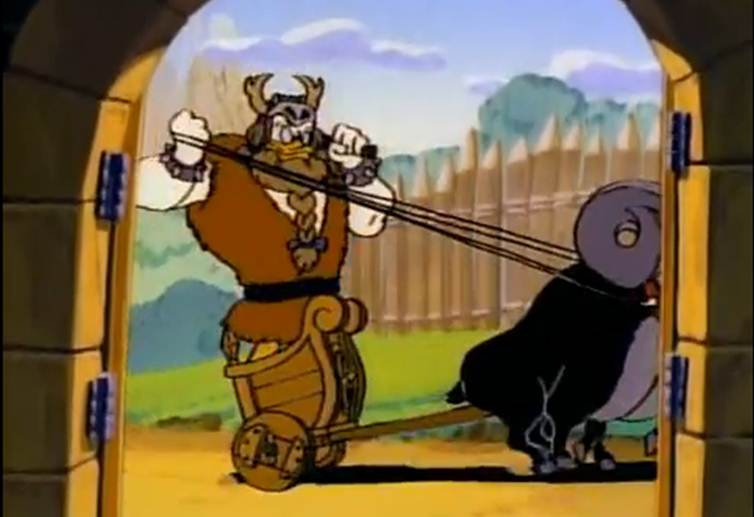
DuckTales' "go-to gal" for incidental female character voices). Following an exciting and well-animated chariot race between Mrs.B. and the Viking champion, Thor (and yes, Adams
did do his homework when choosing that name -- see below), the episode just sort of trails off; there's some mutual mumbling about the Vikings of the hidden island of Valhalla "learning to live in peace with the Outsiders," but you never get the impression that such promises will ever come to anything. (Perhaps the ties would have seemed stronger if Scrooge had taken in a wild young Viking child and decided to raise him along with HD&L and Webby... On second thought, let's not go there.) We also must tiptoe past a fair number of logical lapses on the way to the finish. Despite all this, "Maid" remains a highly enjoyable entry on the distinguished roll of "myth-and-legend-based"
DuckTales episodes.
GeoX complained about the use of the "
operas are long and boring!" trope, but the ep actually gets off to a worse start than that. Why are Scrooge and HD&L acting like such insensitive assholes, considering that Mrs. Beakley is performing on stage for a charitable cause? They practically make a
scene of being ostentatiously indifferent to the proceedings. I mean, surely they could have
gotten better seats simply by
asking for them. Perhaps they found it difficult to take seriously what appears to be a glorified "community theater" event, in which Gyro, Quacky McSlant, and Vacation van Honk are being pressed into service as unlikely Vikings.
But wait, it gets worse. Mrs. B., gallantly trying to make several bars from
The Ride of the Valkyries stand in for
ALL of the collected works of opera, has a mishap with a prop tree, and Scrooge and the boys join the rest of the audience in laughing themselves silly. Where's the
empathy, fellas?!
So on come the Vikings, who cut legitimately menacing figures as they ransack the docks, grab some plunder, and... find the contents of fizzing cans of soda disquietingly entertaining. The soda gag is rerun several additional times during the episode, almost as if it's destined to play some sort of role at the climax... but, nope, it's just a throwaway (or should I say, recyclable) gag. Had Barks thought up something as weird as this to use as a running joke, I suspect that he would probably have found a somewhat cleverer alternative use for it.


There is some legitimately wonderful animation in this opening sequence -- the Vikings walking onto the deck of Auric's ship with their plunder, Auric sweeping through the air to shanghai Mrs. Beakley. Logic, however, hits the banana peel as the Ducks take to a
speedboat to pursue the Vikings to Greenland. I can understand the use of a watercraft to trail the Vikes' ships, but wouldn't a submarine have provided better protection against the Ducks' being spotted? And why is Scrooge so slapdash in getting this little expedition outfitted? No winter coats or (as
Greg pointed out) life jackets for the Nephews, no apparent room on the speedboat for the necessary provisions...
and no Webby, at least not until the Ducks get to Valhalla and she suddenly reappears on the scene. No wonder the departing Nephews don't seem to like the direction in which this adventure is heading.

Speaking of directions, GeoX goes through all sorts of contortions trying to get the Vikings' trek to Duckburg to make some geographical sense:
Calisota, as we know, is on the west coast. So the Vikings either
sailed all the way through Nunavut and the Northwest Territories (okay,
it was just the Northwest Territories at the time), around Alaska, and
all the way down the west coast of Canada; or all the way south past
Tierra del Fuego and up the other side. Though granted, they could have
cut that second route down substantially had they been able to get
permission to use the Panama Canal. Or they could have gone aaaall the
way over Asia and crossed the Pacific, but gimme a break--that would
just be silly!
All of this speculation, of course, flows from the premise that Calisota is on the West Coast. But here's the thing: several
DuckTales eps provide explicit evidence that the
DT version of Duckburg is on the
EAST Coast
. In "
Double-O-Duck," we even get some
cartographical evidence:
Um, guys, seeing as how Duckburg is clearly situated on a body of water, I think that you might want to move that Duckburg dot at lower left a wee bit more to the right. That would plant the
DT Duckburg in the vicinity of "real-world"
Norfolk and
Hampton Roads, VA. Several eps after "Double-O-Duck," in "
Dr. Jekyll and Mr. McDuck," detective Shedlock Jones refers to the "six-hour time difference" between London and Duckburg. So, you see, it
would be possible for the Vikings to reach
this version of Duckburg... though I'm surprised that they went to the trouble of going that far, as opposed to invading the more easily reachable New York. (Or would that be St. Canard?)
UPDATE (10/1/12): I just remembered another episode that provides evidence of the Eastern location of Duckburg. In "Top Duck," while recounting the story of his sad exile from The Flying McQuacks, Launchpad notes that the aerial acrobats had been doing a show "out on the coast" when LP screwed up his part of the "cattle rustle hustle." Now, the phrase "out on the coast" may be used on the West Coast to refer to those of us back East, but it's generally taken to mean "out West." Ergo, Duckburg must be in the East.
Joe and I have speculated in the past that the hot-spring-heated island setting of Valhalla may have been inspired by the live-action Disney movie
Island at the Top of the World (1974). Other points of similarity include the plot being motivated by a search for a missing person and an "Outsider" enjoying a romance with a Viking maiden. Of course, it is also possible that Adams was simply inspired by his love of myth and legend, as displayed in his fanciful rock opera
An Eye in Each Head and, just perhaps, by his boyhood experiences of reading Barks stories. In any event, I would certainly like to know a bit more about the genesis of this episode.
Adams may have done a bit of a "rethink" regarding the romantic self-confidence that Launchpad displayed in "
Lost Crown of Genghis Khan." Launchpad seems somewhat more competent than usual here -- he ultimately learns how to drive the ram-chariot, after all -- but he's clearly flustered by Swanwhite's considerable charms. Of course, his romantic cause isn't helped by his attempt to maintain his disguise as a Viking. (Given that Valhalla is such a closed community, I'm actually surprised that Swanwhite didn't realize that Launchpad wasn't a real Viking right off the bat. Perhaps she lives apart from the rest of the clan; she certainly has much better "manners" and "tenderness" than they do.) This is among the first of what will become numerous "costumed" roles for Launchpad, and it's actually one of the better, albeit lower-key, ones.

For whatever reason, during my early viewings of "Maid," I had all sorts of problems picking up on the names of the Vikings. It took me a long while to recognize "Swanwhite" because her name was only mentioned once, and Launchpad was hoarse when he mentioned it. It was so bad that I originally thought that the name of Thor's partner in sabotage Snagnar was supposed to be the parodic "Snacbar." Thor, of course, was no problem to pick up, and Adams isn't simply going for a cliched name in this case: the
legendary Norse god is famous for traveling a chariot pulled by a pair of goats (not rams), and the
DT Thor even mentions one of their names: Toothgnasher ("
Tanngnjostr" in the Norse language). Thankfully,
DT saw fit not to recreate the part of the Thor legend in which Thor eats his rams and then resurrects them. That would have gotten uncomfortably messy, I think.

The two main strands of the Valhalla plot -- Auric's queen Griselda's jealousy of Mrs. "Brunhilde" Beakley and the chariot race between the Duckburgian and Valhallian champions -- dovetail neatly when Griselda's potion causes Launchpad to lose his voice, obliging Mrs. Beakley to fill in for LP and thereby forcing the redoubtable nanny to brave Thor's attempted sabotage. Scrooge, who plays a surprisingly minor role in the ep apart from challenging Auric to the "man-to-man" contest to decide the Ducks' fate, finally gets in his ration of work as he and Swanwhite try to stop Thor's henchVikes from collapsing the bridge. Since Scrooge's interference caused the
premature destruction of the bridge, giving Mrs. Beakly a chance to make everything turn out well in the end, I'd say that Scrooge made the most of his brief opportunity. I'd certainly like to know where Mrs. B. learned how to drive a chariot -- this must be one of those "hidden talents" that she allows to escape from hiding on special occasions, the best-known occasion of which is "
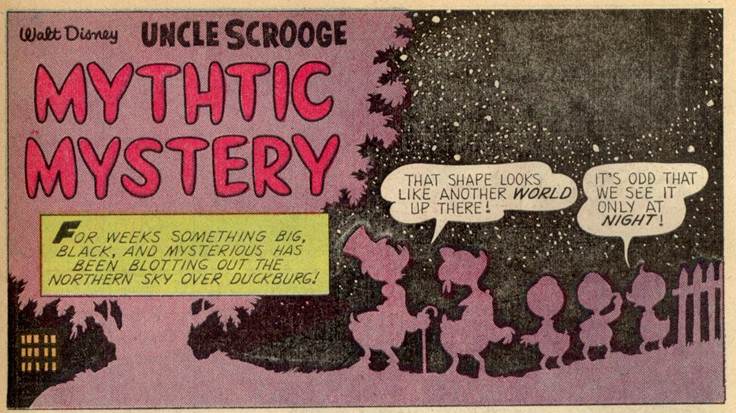
Jungle Duck" -- but there's very little to dislike about this well-mounted sequence. I find this action-oriented approach far more enjoyable than Barks' rather sour and cynical use of similar material in "Mythtic Mystery."

As noted above, the ending of the episode is rather flabby. Apart from the mushy nature of the promise of future "peaceful" contacts, the ep doesn't even handle Mrs. Beakley's final flight of song properly. Imagine if Mrs. B.'s climactic trill had caused, not a small shower of falling ice, but a semi-catastrophic landslide that accidentally sealed Valhalla off from the outside world? After all, as we've just seen, her "C above high C" packs quite a destructive, ice-shattering punch. How ironic would that ending have been? And dark, as well, which is probably why DT wouldn't have dared to touch it. Ah, well, what we did get was plenty good enough for my tastes.
.
.
.
"DuckBlurbs"
(GeoX) Didn't even mention the good viking shepherdess or the bad viking
queen--the latter especially makes essentially no impression; her
purpose is questionable, aside from screwing up Launchpad's voice and
requiring Beakley to race.
If Griselda made any impression at all -- and I think that she did, though not as large a one as did Swanwhite -- it was entirely due to Tress MacNeille's voicing. Oddly enough, Tress seemed to have some trouble nailing the voice down. In Griselda's first scene, the Viking queen's voice is somewhat huskier than in the scene in which she plots to ruin Mrs. Beakley's voice
. That latter effort sounds more like the "all-purpose villainous female" voice that MacNeille will later give to one-shot distaff players like
Circe,
Millionaira Vanderbucks, and Feathers Galore. Had
DT decided
not to use June Foray's Natasha voice for Magica De Spell, it would have made a good voice for Magica, as well.
(Greg) Louie notices that those [Viking] ships
are real as we see the viking running down the street. I don't want
to be the spoilsport around here; but doesn't someone notice that THE
DOCKS ARE [ON] FIRE?!
Seeing as how the shot of the harbor area taken on the following morning doesn't show much, if any, damage
, that couldn't have been
TOO serious of a blaze. TMS just animated it so well that it seemed more ferocious than it truly was.
(Greg) We then see Thor and his Wingammo Toothgnashers rams whip
from the west and stop near the short viking (Wait; shouldn't he be
AT the feast? Logic break #2 for the episode.) as he is addressed as
Ragoth... Apparently; the
viking near the tree is addressed as Snagnar (...he I think should be at the feast too at this time for logic
break #3).
I suspect that "Economical Character Design Syndrome" was at play here. There were certainly several "short Vikings" around, but it would have been tempting for TMS to cut a few corners and make them all look alike.
(Greg) Mrs.
Beakly as an opera star is funny and the Viking[s] I found really good
although I didn't find Launchpad's lady man routine as funny as it
was in Lost Crown Of Genghis Khan; although I did like Swanwhite and
her sonic goats. And I would have liked them better if they dropped
the ja like speech that they annoyed me with.
So, you have a problem with "ja," eh? Well, here bane my answer to
that -- even though it involves the wrong kind of Scandinavian:
Next: Episode 13, "Hero for Hire."