Thursday, November 3, 2011

Book Review: DESTINY OF THE REPUBLIC by Candice Millard (Doubleday, 2011)

Following up on THE PRESIDENT IS A SICK MAN and THE PRESIDENT AND THE ASSASSIN, we plunge back into the 19th century for another little-told tale of what used to be called the "Chief Magistracy." This one covers arguably the most pointless Presidential assassination in history, Charles Guiteau's 1881 shooting of James Garfield just a few months into the latter's term in office. The standard historical outlay for this affair concerns the unique fact that Garfield lingered on for several months after the shooting before finally succumbing. But, as Millard makes clear in her absorbing book, Garfield's death was anything but inevitable -- and the country may have lost a potentially outstanding President as a result.

With the exception of several digressions into the career and life of Alexander Graham Bell, who used a mechanism called an "induction balance" to try to locate the bullet that had lodged behind Garfield's pancreas, Millard gives us a straightforward narrative. The Garfield she describes was a self-made man who rose from grinding poverty through education and hard work, a classic American tale. But there also seemed to be a touch of genius about the man; what other prominent American politician can claim an original proof of the Pythagorean Theorem, for example? A Civil War general and a strong advocate of equal rights for freed slaves, the well-liked Garfield might have made a more effective fight against the late-19th-century "Jim Crow" clampdown in the South had he been permitted to live out his three-score-and-ten. Unfortunately, no sooner had Garfield braved the demands of waves of office seekers (this was still the era of the spoils system) and batted down some strong-arm tactics by a would-be power behind the throne -- Senator Roscoe Conkling of New York, the patron of Garfield's Vice President, Chester Arthur -- than Guiteau's bullet cut him down.

Garfield's major wound was not actually life-threatening -- and the sad fact is, as Millard relates in sometimes sickening detail, that his doctors were more the cause of his demise than the bullet itself. The American medical establishment of the day scorned the theory of "antiseptic surgery" practiced and promoted by Britain's Dr. Joseph Lister, relying instead on such "heroic" measures as sticking unsterilized fingers and other objects into the wound. Even had Bell succeeded in locating the bullet, Garfield would still probably have died of septic poisoning. The stubborn unwillingness of American doctors to adopt Lister's theories seems rather strange to me; after all, aren't we the "innovator nation"? (Lister himself, in a fruitless attempt to convert skeptics during a lecture at the 1876 Centennial Exposition, pointed out that America had given the medical world anesthesia.) The problem seems to have been the overwhelming importance of seniority (and, hence, a certain hideboundedness) in the medical pecking order at the time. The incompetence of senior medical officers was a problem during the early days of the Civil War, giving rise to the creation of the U.S. Sanitary Commission, but evidently the problem also extended into the civilian sphere.

Guiteau gets plenty of attention here as well. He appears to have been the ultimate example of "the lights being on but nobody being home" -- a seemingly rational individual who was nonetheless the prisoner of all sorts of delusions, the most infamous of which was that he had helped Garfield win the Presidency and therefore "deserved" a government sinecure. Sadly, "watch lists" were not a common security practice in 1881 -- nor, in fact, was any sort of formal protection for the President, since John Wilkes Booth's killing of Abraham Lincoln was thought to have been a one-shot (no pun intended) affair stemming from the Civil War atmosphere -- and Guiteau was given the opening he needed to gain infamy. Guiteau's execution is a matter of some controversy due to his apparent insanity (the "insanity plea" was new at the time, but it did exist); my own opinion is that anyone who skipped out of paying hotel, boarding house, and restaurant bills as often as Guiteau did must have had some rudimentary notion of the difference between right and wrong. He just chose not to act on the impulse.

A quick and enjoyable read -- apart from the frequent incidents involving oozing pus, that is -- DESTINY OF THE REPUBLIC is another excellent example of a recent book shedding new light on an obscure but significant incident in American history.

Tuesday, November 1, 2011

Book Review: THE BIG ROADS by Earl Swift (Houghton Mifflin Harcourt, 2011)

You may have noticed that I have links to Web pages on the histories of the U.S. and Interstate Highway systems in my "Miscellaneous" section. It won't come as a surprise, therefore, that this well-written, even-handed book tracing the development of the modern American roadway grid was an easy sell for me. Swift gives space to both the architects and the critics of the Interstate network and clears up some misconceptions concerning the development of the Interstate system along the way. One such mistaken belief is the idea that the Interstates were originally supposed to be rural highways and were only diverted into and through big cities -- often to the cities' detriment -- because of greed and political maneuvering. Swift makes it clear that, from the time the Interstates were conceived, urban routes were part of the plan, on the theory that the highways would make it easier to ship goods to and from population centers and could be used as an excuse to wipe out unsightly "slums." Only gradually did local activists begin to push back against the incursion of the I-behemoth. One of the bitterest battles, which Swift discusses in detail, took place here in Baltimore, where a diverse group of neighborhood residents resisted plans to send I-70 through the downtown area, within a stone's throw of what is now the Inner Harbor. The challenges lasted well over a decade before the would-be highway-builders finally conceded defeat. Swift concludes with a review of the challenges faced by the Interstate system today, the largest of which is a rapidly deteriorating infrastructure under the pressure of ever-increasing traffic. We can debate all we want to about the proper role of government in our lives, but I think we can all agree that the maintenance of the transportation grid is something on which we don't want to skimp.

Sunday, October 30, 2011

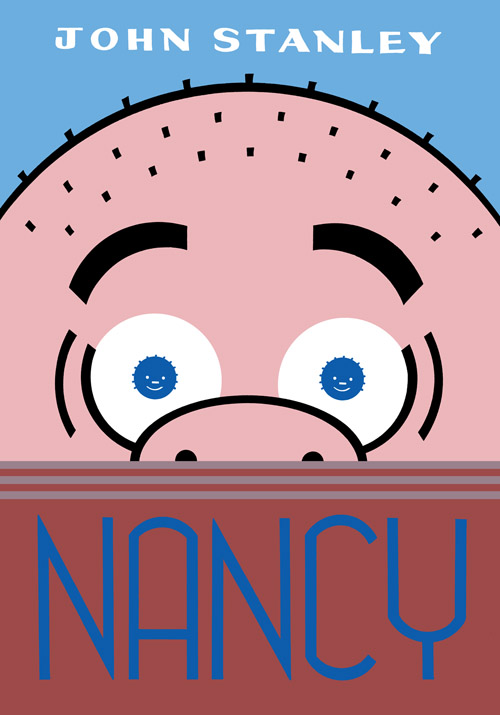
Book Review: THE JOHN STANLEY LIBRARY: NANCY, VOLUME 3 by John Stanley and Dan Gormley (Drawn & Quarterly, 2011)

John Stanley continues to exude a sense of "liberation" in these stories from Dell NANCY #170-173. Evidently attempting to make a point, he leads off each issue with a wildly fanciful story in which Nancy, despite her own best efforts, is forced to brave bizarre perils in her friend Wednesday Addams', um, Oona Goosepimple's creepy mansion. This is the sort of stuff that Stanley had previously been obliged to run only in the backs of his issues of LITTLE LULU, plus a handful of issues of the TUBBY title. The weirdness seems to leach into other stories, as well; Nancy and Sluggo play ring-toss with hula hoops and a flag pole in #171's "The Hulahoops," Nancy's cat and bully Spike's dog converse with each other (in thought balloons, to be sure) in #173's "The Kitty's Collar," and a teeth-grindingly self-pitying Nancy literally clads herself in "sackcloth and ashes" in an effort to move an unyielding Aunt Fritzi in #170's "Nancy and the Cold Dinner." There is a zaniness here that many of the later issues of LITTLE LULU conspicuously lacked. Great fun, especially for those who've ever nodded their way through a series of Ernie Bushmiller's stultifying comic-strip gags.

THE BEST (AND REST) OF KIMBA, Episode 36: "Monster of Petrified Valley"

This episode has gradually grown on me over time. Watching it cold, you're likely to find special guest star Colosso the Brodo Bird (Ray Owens) more than a little irritating, rather like an oversized Bubba Duck without the latter's childish charm (or all those pop-culture references). Despite the effort to put something of a "smiley spin" on it, the ep's ending is definitely a downer. With repeated viewings, however, you'll begin to notice, and appreciate, some good voice-acting performances and to become intrigued by the ep's slightly different "take" on the overarching theme of Kimba's introduction of "civilization" to the jungle. Kimba has nothing but good intentions here, to be sure, but Colosso might legitimately be considered one of the "victims" of the the former's determined push for a "new jungle order." If you squinch up your eyes long enough to "see red," you might even catch a glimpse of an inherent critique of cultural imperialism, of the nasty fallout that often results from a "clash of cultures," especially when one side holds all the important cultural advantages. "Petrified Valley" isn't a classic, but there's more substance than one would expect in what basically amounts to a series of (theoretically) comical misunderstandings.


In eps like "Petrified Valley," "City of Gold," and "Legend of Hippo Valley," Kimba appears to be completely unaware of certain "local myths and legends." You'd hope that it would take something less than a crisis (the danger to peril-braving Charley [Ray Owens] and Harley [Gilbert Mack] Cheetah, who appear to be "splitting the difference" of the standard "Cheetah" character between them) to get Kimba up to speed on what are, after all, potential sources of trouble and rancor in and around his kingdom.

Kimba's typical reactions to stories of monsters, spooks, and legends are relentlessly rational. It's amusing to note, though, that he's at least willing to accept the possibility that a monster of some sort might be menacing Charley and Harley. Dan'l, by contrast, immediately ridicules the notion -- a rather amusing face-turn coming from a character who was so quick to attribute earthquakes to the Devil in "The Gigantic Grasshopper."

So who told Kimba how to get to Petrified Valley, anyway? Did Pauley impart the info between sneezes but we somehow missed it?

The voice of Harvey Hedgehog (Billie Lou Watt) seems a little different here, a little higher-pitched than normal, though it's pretty much of a "tomato"/"tomahto" distinction. This will be one of little Harvey's biggest roles, so it makes sense to bring him on stage early in the proceedings, even if it's just for a "Chinese restaurant menu" gag.

Keep those rumbling rocks at the entrance to Petrified Valley in mind; you're seeing them for a reason. The Narrator helpfully tells us what anyone can plainly see, namely, that some sort of gas is responsible for the paralyzed state of the other animals in the Valley (who include among their number "dead ringers" for Cassius and Gargoyle G. Warthog). This makes Kimba's realization of the danger less impressive than it should have been. Perhaps the Narrator's spiel should have been replaced by Kimba doing some verbal, off-camera detective work to figure out what is going on. Not that Kimba himself seems to have much to worry about from the gas -- he does fall down for a moment, only to just as quickly right himself. Do I sense a cut here?

Colosso's sudden, and suitably dramatic, appearance on the scene begs a thunderingly obvious question -- why isn't HE affected by the gas? We learn in just a little while that he lives in a cave, but even that location wouldn't be safe, since the gas issues forth from "cracks and crevices" in the Earth, presumably including subterranean ones. It seems irritatingly convenient that the only two critters who don't seem to mind the miasma are precisely the ones we need to get the main plot moving.

Kimba's brief laughing jag is a wonderful "humanizing" moment for our jungle prince. He's flashed a good sense of humor in past episodes, to be sure, but that was always tempered by the essential seriousness of his character and the burden of his civilizing task. Here, we're suddenly reminded that he is just a kid, or at most an adolescent, and therefore prone to laugh at silly sights despite himself. (Billie Lou's performance of the laughter is great, too.) Kimba then frees the trapped, and extremely embarrassed, Colosso by nearly killing him with a giant boulder. Too funny.

Could it be that Colosso isn't aware of the effects of the gas, despite having lived in Petrified Valley for so many years? "I guess I just paralyzed [Charley and Harley] with fear"... so how does he explain all those other animals lying around? As we'll see, obliviousness is probably Colosso's most distinctive character trait. Scrooge should have saved his irritated comment re Bubba: "I know, I know -- he does'nae understand!" for the Brodo Bird.

So what sort of critter is Colosso, anyway? We get a hint when Dan'l tells the story of the Brodo Birds and their forced exile from Madagascar. The Brodos developed in isolation, so it is quite possible that they are direct descendants of some sort of prehistoric creature. My best guess is that the Brodos are an evolved form of Archaeopteryx, the "missing link" between reptiles and birds. The episode confuses the issue a bit by showing Colosso slavering over flowers and a would-be meaty tidbit (Harvey Hedgehog), leaving open the question of whether he is a plant-eater or a meat-eater.

I am extremely grateful that the Titan crew did not try to "sing over" the chorus of children's voices during the singing sequence. In this case, it made sense to preserve the original Japanese background chorus of "Sing a Human Song" from "A Human Friend." The downside is that we get an additional earful of Colosso's maddening "Lo-Lo-Lo" song. I believe that the term "earworm" was invented for just such situations as this.

Kimba's generous but misguided attempts to "enable" Colosso's, er, eccentricities begin to backfire in a major way just as "the rainy season" kicks in. In truth, it's rather tough to assess the amount of "blame" that Kimba deserves for bringing Colosso back to the jungle with him. The problem is that we never actually saw the conversation in which Kimba made, and Colosso presumably accepted, the offer of jungle citizenship. Did Kimba, remembering Colosso's earlier lament that he "[wished he] had some friends," mistakenly take Colosso's benign (read: oblivious) indifference for acceptance of the offer? Or did Colosso leap at the chance to leave? For this to be a tragedy -- and it ultimately turns out to be one -- we really need to see the moment in which the fatal mistake was made. Barring that, Kimba's efforts to make Colosso feel at home seem like thoughtful gestures that simply don't work out the way they ought to.

Ironic, isn't it, that a representative of the very species that "felled"... er, "got rid of"... er, "took care of"... the Brodos comes to Colosso's defense when everyone else is ready to run the clueless creature out of Dodge without a second thought. Extra points go to Harvey for being so forgiving, but wouldn't landslides in the Valley in past "rainy seasons" have been an issue long before this? This reminds me of the DICK TRACY villain The Mole, who suddenly began having trouble with melting snow flooding his hideout at the exact moment when Tracy was trying to track him down.

Once you get another glimpse of the wabbly rocks in Petrified Valley, you just know what the denouement is going to be. Dan'l can "Monday-morning QB" all he wants about his belief that Colosso "would have wanted" to be "felled" on his doorstep, but Kimba's yell of despair at Colosso's fate is the true end of the ep. There's no question that Kimba feels some share of responsibility for what happened to the Brodo, that he regards the incident as one of his few outright failures. The fact that Kimba probably can't put his paw on exactly why he should feel at fault for what is basically an unfortunate accident makes his "roar of regret" all the more painful. It's another great example of how this "kids' cartoon," despite all the editorial attempts to soften the blows, was able to tackle big ideas and powerful emotions with remarkable thoughtfulness and subtlety.

Up next: Episode 37, "Legend of Hippo Valley."

Sunday, October 23, 2011

THE BEST (AND REST) OF KIMBA, Episode 35: "The Pretenders"

Refer to last week's entry to get caught up to speed on the first chunk of this wildly uneven two-episode tale.


After we learn of Kimba's near-fatal accident at the end of the extended flashback, everyone seems to remain in a bit of a daze for a while. Kimba's lair is suddenly perched on the edge of a precipice, presumably to lend the long, slow tracking sequence even more drama and pathos than one would expect it to have under the circumstances. For purposes of security and safety, I can think of a whole lot of reasons not to have Kimba's home in such a place.

In all honesty, despite his shaky opening response to the faithful Kitty, Kimba doesn't seem all that badly injured. We see a bandage on his leg, a few dirt streaks, and that's about it. For sure, it won't take him very long to snap back to full strength. In their brief (and utterly pointless) dialogue following the lair scene, Bucky, Dan'l, and Pauley actually come across as far more somnolent and mind-croggled than our wounded jungle prince. C'mon, Gil, "I'm afraid he's plotting some kind of revenge" shouldn't sound so, well, wistful.

Kimba's "He must really have changed... but completely!" is a fascinating line to me. Out of nowhere, Billie Lou Watt suddenly tosses off a bit of slang that was 20 years out of date at the time this was recorded. It's like a character in a WWII-era movie suddenly breaking into a chorus of "Vo-do-de-oh-do," or a "contemporary urban dancer" abruptly adopting trash-bag pants and an open vest. (Magic shoes optional.) Then, when you factor in the odds that a lion in the middle of Africa, even one with an ultra-rare gift of speech, would come up with such a phrase independently... But if you think this was anachronistic, well, just wait until the curtain goes up on Tom and Tab.

OK, I'd almost be willing to accept T&T magically producing hats and canes out of nowhere, since they are arguably the most consistently "Toony" characters on the show. In their effort to convince the jungle youngsters that "the bad guys have all the fun," it would have been perfectly fine for T&T to have play-acted in exaggerated fashion, perhaps mutating themselves into "international objects" along the way. But I defy even the staunchest proponents of the "anything goes in Toontown" theme to explain how the hyenas managed to stage THESE "antihero animal antics" in the manner depicted.

The Wild West and Kimba do NOT mix! 'Nuff said.

Well, this sequence actually did work for me, at least a bit. I like the character design on Captain Kidd's cat a great deal; this character might even have worked as a legitimate "furry" somewhere else.  Perhaps he could have done a walk-on on some series like Cats & Company.  But, still, we are supposed to believe that the boys were somehow able to stage a SEA battle on a stage in the middle of the jungle... and how did T&T learn of all these characters, anyway? Did they visit the Jungle Library where Roger Ranger got his reference materials?

All of a sudden, I'm nostalgic for the Al Vermin era of Bonkers.

One unfortunate side effect of this entirely-too-long side trip to Toontown is that we never actually get to see how Cassius, T&T, and Claw managed to lure all of Kimba's subjects into being captured. Distracting the children, I can see the logic of that, but where were all the adults while this was going on? And how did Claw et Cie. instantly manage to construct a massive rocky barricade, complete with sturdy wooden gate, around the amusement park? After this cascade of improbabilities, I can almost understand Kimba's seemingly foolish decision to try and smash the gate down himself. In such a seemingly random "universe," why couldn't Kimba pull off such a feat? Perhaps if he hadn't been so *ahem* "badly hurt," he might have done it.

In his dialogue with the wrathful-turned-tearful Kimba, Claw drops the pretense that he wants to "rule" the jungle in a manner even remotely close to Kimba's. Earlier, Dan'l reported overhearing Claw say that, with the other animals imprisoned, he "[wouldn't] have to hunt for his food." Now, every animal for roughly 75 miles around must have heard Claw threaten to "destroy" the others unless Kimba abdicates. Strangely, however, Claw will soon be trying to arm-twist Kitty into becoming the "queen" of a presumably functioning kingdom. So what would Claw and Kitty be ruling, exactly? Maybe he needed to consult with Big-O on that matter before proclaiming his enmity to the assembled masses.

Kimba's breakdown and sad, silent retreat are the first truly powerful scenes in what has, up to now, been a crazy quilt of an ep. In "Running Wild," just three episodes down the line, Kimba will suffer an out-of-nowhere emotional collapse that is so over-the-top and improbable, it's actually half-comical. Here, Kimba isn't bawling, he's legitimately weeping for what he clearly believes is the death of his dream. Also, there's a real sense of finality to Kimba's gradual, self-sacrificial disappearance into the wilderness. Not until "Destroyers from the Desert" will Kimba appear to be so thoroughly vanquished.

So, we're now officially in "action drama" mode, right? Wrong. We still have to endure one final gag-stuffed sequence in which Claw piddles away virtually all of the dignity that he had managed to earn through his fearsome performances during "Jungle Fun" and the park-gate scene. If anything, Kitty doesn't slap him down hard enough for making such an ass of himself.

And I thought tigers... I mean, Tiggers... didn't live in Africa.

If you have good eyesight, then you may have seen The Black 4 snatch Kitty and haul her under the gate and inside the park. Like their sudden appearance at the end of "Jungle Fun," what they were doing there wasn't explained. Now, following up on Cassius' whistle, we should have gotten our formal introduction, or a reasonable facsimile, to the conniving quartet. The lyrics (translated below the Youtube of the deleted scene) don't explain why the B4 are specifically working for Claw, much less what they expect to get out of the deal, but they do clearly establishes the leopards' freelance brand of villainy.


Living in the dark, we are the Black Four. Come to us and tell us what you want. We specialize in... Doin' dirty business in style! The infamous shadow of evil. Yes, we are the Black Four. Excuse us, but we have to go. We're off to do another job... We'll get it done... Piece of cake!

Or not. The B4 give a much better account of themselves in battle during "The Day the Sun Went Out," and one reason may be that they are working for themselves in that situation. Amazing how self-interest focuses the mind and toughens the sinews... just as the threat of being eaten galvanizes Kimba's subjects into putting up a much stiffer fight against Claw and his minions here than they did in "Gypsy's Purple Potion." Kitty leads the charge, flashing her most ferocious fighting skills of the series. Next in line for awards are, if you can believe it, Dot, Dash, and Dinky, who alternate stomping on Tom and Tab with treating the hapless hyenas as literal punching bags -- a little less impressive than the brave attack at the start of "Jungle Fun," perhaps, but impressive nonetheless. I only wish that more animals had been given a chance to visibly pitch in, as opposed to fighting in the "FCC-friendly dustcloud of doom" (thanks, Greg).


Characters seem to be able to "teleport" to where they need to be with shocking ease in this ep. How did the B4 track down Kimba so fast? How did Dan'l manage to find Kimba equally fast? Above all, how did Kimba locate that "weak spot in the wall" so effortlessly, after spending several minutes beating his brains out in a frontal assault? The fight between Kimba and Claw is the most vicious one of the series -- check out the bit in which Claw grabs Kimba in his maw and worries him like a Jack Russell terrier manhandling a chew toy -- but, even here, Kimba doesn't really maul Claw as much as out-wrestle him. The beaten Claw's tottering rise to his paws, however, underscores this as being the evil lion's "ultimate defeat." He would indeed appear again, but never again would he pose such a dire threat to the peace and safety of Kimba's jungle. We may also safely assume that the amusement center would endure for the duration, thereby cutting off Claw's source of food and, presumably, forcing him to ultimately "abandon the field" for purposes of survival.

Dan'l and Kimba provide a fitting end to a schizophrenic story by, respectively, spouting off a Revolutionary War-era non sequitur and channeling "Fair Catch Corby" for no apparent reason. Surely, the most "epic" story of the series -- in structure, if not in content -- deserved a better wrap-up than this rather lame coda. Or, perhaps the very pointlessness of the ending makes a point. All that Kimba wanted to do with his amusement park project, after all, was to allow the animals to enjoy a little harmless and, yes, pointless fun while engaged in the arduous task of building a civilization. Not every vestige of "human civilization" worth imitating has to possess gravitas, after all.


Up next: Episode 36, "Monster of Petrified Valley."

Friday, October 21, 2011

Comics Review: DARKWING DUCK #17 (October 2011, kaboom!)

Reading DARKWING #17 is like watching a baseball player hitting a dramatic homer... only to trip and fall on third base. For two-thirds of its length, part two of "Dangerous Currency" is a delight, giving us the inter-character byplay that was so conspicuous by its absence in DT #5 -- and it's high-quality banter, to boot. Then we get, in rapid succession: (1) a truly bizarre out-of-character comment from Darkwing (granted, it's delivered under some duress, but still); (2) the admittedly hilarious, but logically off-the-wall, "drop-in" of a nearly forgotten DuckTales cast member; (3) a factual goof to rival DT #5's "revelation" that Drake and Fenton don't know each other. I still give the ish a "thumbs up" on balance, but the overall arc to date a grade of "Marginal"... mainly because I don't know whether the good points or the factual flubs will wind up tipping the scales.

S
P
O
I
L
E
R

S
P
A
C
E

The kids' dialogue in the early stages is GREAT. I've always wondered how Gosalyn and HD&L, those two (or, technically, four) wonderful exemplars of youthful proactivity, would react to one another if they ever got together. As impressive as the Nephews' track record is, Gos is a phenomenon, to quote (with a wince) Gil Mack in "Jungle Fun," "like which they never have heard." Huey's reaction, "Never seen a girl do something like that before. I... liked it!" was a true spit-take moment, not least because it was so believable. It also stands to reason that Gos would know something about HD&L's adventures thanks to her friendship with Launchpad, so her baiting the boys into trying to get a sample of The Phantom Blot's "evil ink/slime" wasn't simply a shot in the dark. Webby then gets a shining moment when she calls Gos out on not helping HD&L ("You seem to like getting your hands dirty...") and implicitly defends the Nephews for at least trying to get the sample. Add on Honker's obligatory creation of a "miracle" (a high-tech dowsing rod made from scrap? Has he been channeling Gadget?), which produces a near-swoon from Webby and legit admiration from the other kids, and you have a superb example of what this storyline ought to be emphasizing... wild action as rendered by James Silvani, yes, but with ample helpings of "Heart" and character.

The adults' palaver -- at least most of it -- ain't bad either. Scrooge reacts in humorously deadpan fashion to his immersion in the wild world of St. Canard ("Oh, good... I was worried when something weird didn't happen for a couple of seconds"). Launchpad realizes that he may have to choose between past and former "masters." The villains get some brief but effective verbal "love," as Bushroot asks the obvious question -- what does The Blot want with St. Canard, anyway? -- and the "Fearsome Five-minus-The-Most-Important-One" and the "League of Eve-il" begin to craft their own shadowy agendas. Best of all, DW is far more in imperious character than he ever was in DT #5... at least, until Fenton/Gizmoduck appears (OUT OF NOWHERE, but I've come to expect that in this title), the "slime" turns Gizmo into a monster, and DW is on the verge of being choked by the ravening "roboccountant." What the frag is DW talking about when he says that Fenton/Gizmo "seemed to have it all, yet always acted so humbly"?! Even worse, that DW wishes he could be the same way?! It's bad enough that St. Canard has been turned into a monster citadel, now pod creatures are invading as well...

The emergency airlift of Mrs. Crackshell was such a funny "you gotta be kidding me!" moment that I originally didn't fully process Mrs. C.'s comment to Fenton/Gizmo: "So that was YOU gallivanting around in that tin can?" I thought she was only referring to the present predicament until I realized the awful truth, that this was another dreadful continuity gaffe. *Grumble grumble*, someone really needs to watch "Super DuckTales" and educate themselves. And I was so loving this issue, too. Even the transformation of HD&L and Honker into "famous monsters of Disney filmdom" seemed a bit suspicious after that, in the sense that all other characters who "got dirty" were transformed into amped-up versions of themselves (though The Liquidator has actually had powers over hot and cold water ever since his origin episode "Dry Hard"), while HD&L were completely "made over" into Chernabog, Monstro, and Maleficent (dragon version). Can you blame me for being a little antsy about the permanence of DW #17's uptick in quality?

BTW, props to Sabrina Alberghetti for a charming Cover B that manages to trump even Silvani's Cover A!